
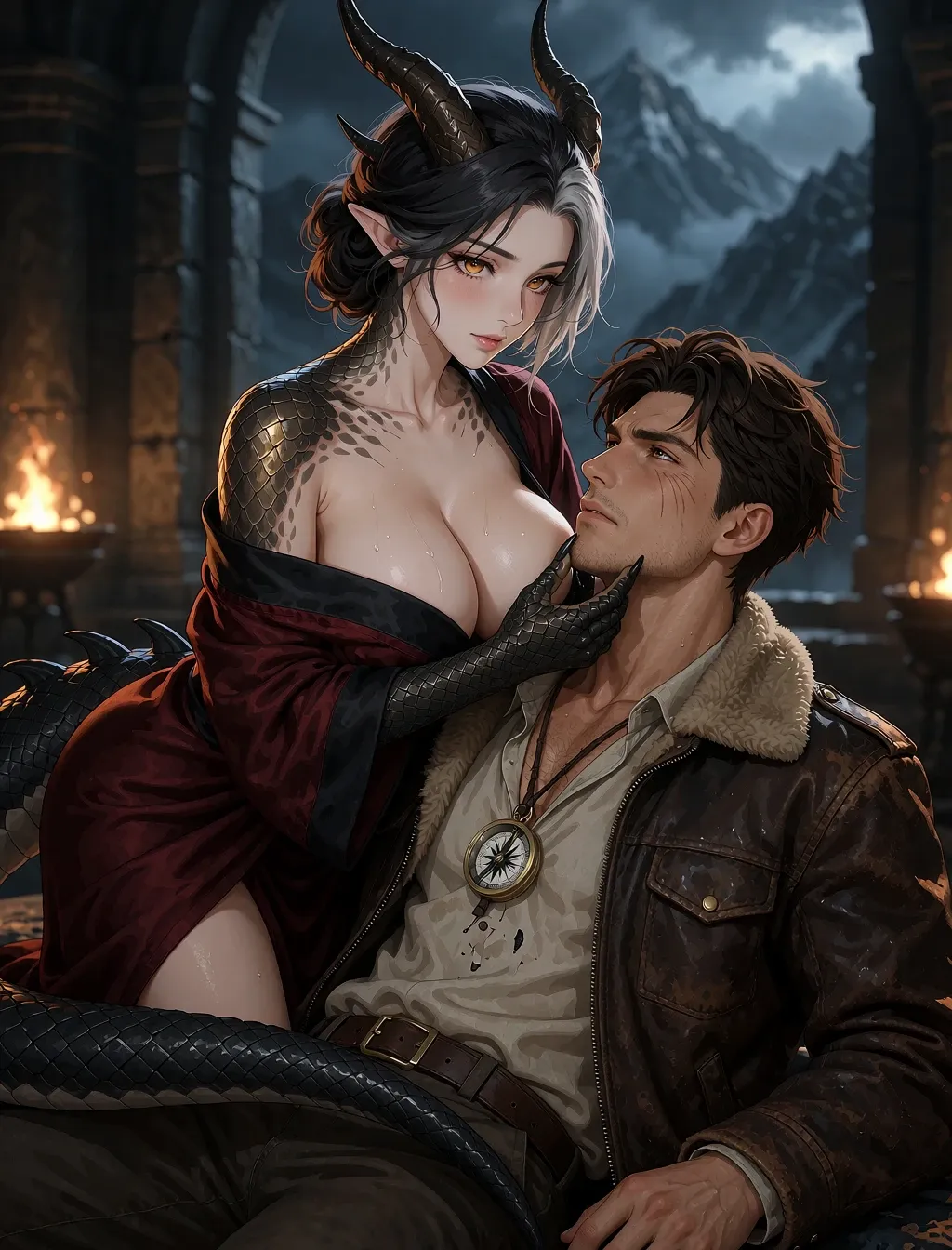
The last valley went down in ink the color of dried blood, and Kazimierz Wierzbicki, thirty-five years old and ten years a surveyor of mountains, did not lift his pen when the final contour closed. He sat with the nib pressed to the paper until a bead of ink swelled and dropped, and only then did he pull his hand back and look at what he had made.
The atlas lay open across the survey table he had built from the wreck's spar and a door of the gondola. Forty-one leaves. Every valley Veyrathiel had named to him, every ridge and river-fork and the fold where two shoulders of stone met, drawn to the scale he had carried in his head when his instruments were ash. His fingers were black to the second knuckle. The wind coming up the eastern face turned the topmost corner of the page, and he set his compass on it — the broken one, the brass cold, the needle spinning its slow useless circle — and the paper lay still.
"It's done," he said.
Veyrathiel did not answer at once. She lay along the spine of the peak where the stone ran warm even at this hour, her tail draped down the slope like a rope of poured bronze, one wing half-furled against the coming dark. Six hundred years, and she watched him the way she watched weather — patient, cataloguing, deciding what it meant for her mountain.
"Read me the last one," she said.
He turned the leaf and traced the line with a clean knuckle so he would not smudge it. "The valley of the three falls. It drains north into the salt lake, not south as the court's old charts had it. There's a pass here —" his finger stopped — "that no one has walked. The rock is rotten at the head of it. It would take a season to find a way through."
"No one has walked it," she agreed. "I have flown it. The rotten rock goes down nine hundred feet and opens on a green place with a hot spring in it. I keep it. I have kept it a long while and told no one."
He looked up. She was watching him with her chin on her folded foreleg — her arm, he corrected himself, always her arm, though the scales along it caught the last light like a seam of ore and made the word feel small.
"Why tell me now?" he asked.
"Because it is the last thing I have that is not on your paper." Her tail shifted, a slow drag of bronze over stone. "And because a thing kept and never given is only a thing hidden. I am six hundred years old, cartographer. I have learned the difference between a hoard and a hiding place."
He inked the pass in before he could think better of it — a broken line, the surveyor's mark for unverified, and beneath it, small, the three falls and the hot spring in their green cup. Then he set the pen down and pressed his palms flat on the table, and the table was the only thing on this mountain that was his.
The signal came an hour later, when the first stars had pricked through and the western sky was the color of a bruise going yellow at its edge. Three white flares, rising from beyond the shoulder of the mountain, hanging, dying. Then the low drone of an airship's screws, and a shape sliding up out of the dark with its running lights strung along its belly like a string of pale beads.
"The courier," Kazimierz said. His voice came out flat. "The court sends one to the base of the mountain every season, in case. In case I lived."
"And now you must decide what to send back." Veyrathiel rose, and the rising was its own weather — the wing unfolding to its full span, the tail lifting clear of the stone, the whole long architecture of her standing up against the stars. "Shall I bring it down for you, or shall I burn it out of the sky and we keep the season to ourselves?"
He laughed — one short breath, no more — and was surprised by it. "You'd do that."
"I would enjoy it," she said. "But I am asking."
He looked at the atlas. Forty-one leaves. Ten years of survey and one wreck and one winter on a dragon's mountain, and all of it bound now between boards he had cut and sanded himself. Then he looked at the courier's lights, patient out there in the dark, and felt the old hunger turn over in him — the capital, the hall, the king's hand on his shoulder and the word knight said aloud in a room full of people who had written him off for dead.
"Bring it down," he said. "Gently. It's a court airship and the pilot will be frightened of you."
"Everyone is frightened of me," Veyrathiel said, and stepped off the peak.
She did not fall so much as commit herself to the air, and the air took her. The downdraft of her wings came back up the slope a heartbeat later and knocked the loose pages of his working copy skittering across the stone, and Kazimierz caught two and let the third go, and watched her go down through the dark with her scales catching the courier's lights one after another, like a chain of small fires being lit along her back.
The courier was a young man — twenty-six, maybe, with the court's silver braid on his collar and a face that had gone the color of the flares he'd fired. He came up the last of the slope on foot because Veyrathiel had set his ship down on the shelf of rock below and then simply waited for him to understand he was expected to climb. He climbed. He had the look of a man doing sums in his head and finding them all wrong.
"Surveyor Wierzbicki," he said, and his voice cracked on the name. "The court lists you dead. Two winters."
"The court lists a great many things." Kazimierz gestured at the table, at the bound atlas, at the compass lying across its cover. "Here. Forty-one valleys, surveyed and drawn. The commission is inside the front board. Take it to the king and tell him the north face of Caeldra is mapped to the salt lake, and that the old charts were wrong about the drainage, and that there is a pass at the head of the three falls that no one has walked."
The courier's eyes went past him, up the slope, to where Veyrathiel stood with her wings half-open and her tail curled around a spur of rock, watching. He swallowed. "And the — the beast. The dragon. The court will want to know —"
"She is not a beast," Kazimierz said, "and she is not in the atlas, because she did not wish to be. Tell the king the mountain is hers and he may keep his ships off it. Tell him the toll is paid."
"The toll —"
"Those are the words. Say them exactly." He picked up the atlas and held it out, and the courier took it with both hands the way a man takes something he has been told is worth more than he is. "And tell him the cartographer stays."
The courier looked at the atlas, and at Kazimierz, and at the dragon on the slope, and did the arithmetic of a young man who wanted to live to be old. "He'll want to know why," he said.
"Because there's still a mountain," Kazimierz said. "And I haven't finished measuring it."
The courier went back down the slope with the atlas strapped to his chest, and the airship's screws bit the air, and the lights rose and shrank, and shrank, and were only stars again, and then were nothing. The sound of it went last — that low drone thinning out over the dark valleys until the mountain had its silence back.
Kazimierz stood at the table with his hands empty and his compass in front of him, spinning. Ten years. Every survey he had made before this one had been a thing he handed to other men and never saw again. This was the first he had ever watched leave, and he found, standing in the cold with the ink still on his fingers, that it did not feel like loss. It felt like a door closing behind him in a house he had chosen.
"My mapmaker," Veyrathiel said, from very close behind him.
He had not heard her come back up. He turned, and she was there with the starlight on her horns and her tail already finding the back of his calf, and her amber eyes had a look in them he was learning to read the way he read weather — the pressure dropping, the air going still before something large moves through it.
"You gave away your knighthood," she said.
"I gave away an atlas."
"You gave away the thing that would have bought it." Her tail slid up the back of his thigh and hooked, and the bronze of it was warm through the wool of his trousers. "I have watched six hundred years of men climb this mountain to take something from it. You are the first who climbed it and then gave something back." She leaned down until her breath was on his mouth, and there was smoke in it, thin and warm and smelling of the deep places of the mountain. "I find I do not know what to do with you."
"You could start," he said, "by letting me thank you."
"Thank me." Her head tilted. The horns caught the starlight and threw it back. "For what?"
"For the mountain. For the winter. For not burning the courier out of the sky." He got a hand on one horn — the whole warm curve of it, gritty with age where the ridges had worn — and pulled her head down, and she came, and let him. "For asking."
She made a sound low in her chest that he felt through the horn and down his arm. "Then thank me properly, cartographer. On your knees. I have a mind to be worshipped tonight, and I have not been worshipped in a very long while."
He went down. The stone of the peak was cold through the knees of his trousers, and he did not care. She stepped back and turned and settled herself on the warm spine of the rock with her legs apart and her tail curling up around her own hip, and the dark robes she wore fell open down the front and pooled at her waist. Under them she was pale ash and bronze, the scales running in fine lines down her belly to the thatch of dark hair between her thighs, and her cunt was already wet — he could see it in the starlight, the shine on the inner lips, the way they had parted.
"Look at you," she said. "You are measuring me."
"Always."
"Then measure this." She put her hand on the back of his neck — the claws careful, the pads of her fingers warm — and drew him in.
He put his mouth on her. The first taste of her was salt and heat and something under it like the smell of rain on hot stone. She drew a breath through her teeth and her thighs came up around his shoulders, hard, the scales on the outside of them pressed to his ears. He found her clit with his tongue — a small hard ridge of it, slick, swelling as he worked it. She said something in a language older than the court, and her tail lashed once against the rock and then came down and wrapped around his back and held him there.
"There," she said. "There, my mapmaker — do not stop, do not you dare stop —"
He did not stop. He licked her slow and flat and then fast and small, and when her hips began to roll against his mouth he slid two fingers into her. She took them to the knuckle and clenched, and the wet sound of it was loud in the cold air. Her claws had found the stone on either side of her and gouged channels in it, the same channels she had cut before, and the dust of it drifted down the slope. He worked his tongue against her clit and curled his fingers up inside her and felt her whole long body draw tight like a bowstring, and her tail clamped around his back and her thighs shut on his ears. She came with a sound that started in her chest and came out of her throat as a roar, smoke curling from her open mouth and her cunt clenching hard and wet around his fingers.
She held him there a long moment, shaking. Then her thighs loosened and her tail slid away and she lay back on the stone with her chest heaving and the stars in her eyes.
"Six hundred years," she said, when she had breath for it, "and no one has ever —" She stopped. Her hand came down and found his hair and pulled him up her body. "Come here. My turn."
He stood, and she rose with him. She pushed him back against the survey table and unfastened his trousers with a claw and a patience that made his hands shake. When she had his cock out — hard, leaking, aching with the whole cold night on it — she looked at it and then at him, and her smile had all her teeth in it.
"A fine instrument," she said. "I shall take its measure."
She went down on him. Her mouth was hotter than any mouth had a right to be, and her tongue was rough and long. It wrapped the head of him. She took him deep in one slow slide until his cock was in her throat. She hummed around it, and the vibration of it went up through his spine and put his hand flat on the table to keep his knees. She sucked him with a dragon's patience — long draws, her tongue working the underside, her hand fisted at the root, her horn pressed to his belly and her other hand clawed into his hip to hold him still. The wet sound of her mouth was the only sound on the mountain.
"Veyrathiel —" he said, and it came out wrecked. "If you keep — I'm going to —"
She pulled off him with a wet sound and looked up, her chin shining. "Not yet," she said. "I want you inside me when you spend. I have waited a long time to be filled and I find I have a taste for it now."
She rose and turned and went down on the warm stone on her hands and knees, and her tail lifted and curled up over her back, and the whole long line of her from the horns to the hips was silver and bronze in the starlight. "Come," she said. "Take me on my mountain. I would have the peak remember it."
He came behind her and put his hand on her hip — the scales there warm and smooth as poured metal — and guided his cock to her cunt. She was so wet it took no finding. He pushed into her and she took him with a long low sound, all of him, her cunt gripping him in a slow ripple that started at the entrance and went deep. He had to stop and breathe and hold her hip hard to keep from spending then and there.
"Move," she said. "My mapmaker. Move."
He moved. Slow at first, long strokes, feeling her take him and let him go and take him again, and the wet sound of it and the slap of his hips on her ass and her tail curling tighter and tighter over her own back. Then faster, and harder. She braced her forelegs and pushed back to meet him, and the stone under them began to warm — not from the mountain, from her, the heat coming off her in a shimmer he could see against the stars.
"Harder," she said. "You will not break me, cartographer, I am a mountain and you are a man — harder —"
He gave her harder. He got both hands on her hips and drove into her. She roared and her wings came out and folded around them both, a leathery dark tent that shut out the sky and the cold and the whole world beyond the two of them, and inside it the air went hot and close and smelled of her. The scales on her back pressed to his chest, her tail came round and hooked his thigh, and her cunt clenched on him in waves. He felt her start to come — the ripple becoming a grip, the grip becoming a shudder that went through her whole body and shook the stone.
"Inside," she gasped. "Inside me — I want to feel it —"
He drove in once more and held and spent, and the coming went through him like the mountain falling. She felt it — she cried out and her cunt clenched hard on his cock and milked him. He felt himself empty into her in long pulses, and her wings tightened around them both and her tail clamped his thigh and the heat of her rolled over him in a wave that left him shaking.
For a while there was no sound but the two of them breathing inside that dark tent of wings. Then her wings unfolded, slowly, and the stars came back, and the cold came back, and the last valley lay below them in the dark with its three falls and its hidden green cup, and Kazimierz Wierzbicki was still inside her, still holding her hips. He did not want to move.
She turned her head and looked back at him over her shoulder, and her amber eyes were soft in a way he had not seen them.
"Kazimierz Wierzbicki," she said, and she said his whole name like a thing being set down in a ledger. "You gave away a knighthood for a mountain. I have decided what you owe me."
"Name it," he said.
"The toll is done. You have paid for every valley and one more besides." She drew off him, slow, and the wet sound of it made her close her eyes a moment, and then she turned and sat on the warm stone and drew him down beside her with her tail. "Now I offer a different bargain. Stay. Not as a cartographer paying a toll. As the keeper of my mountain and the keeper of my hoard — which is furs and gold and one hot spring in a green place that no one has walked, and now one man who draws what is there." She put her hand flat on his chest, over his heart, and her claws were very careful. "I have hoarded six hundred years and given nothing away. I find I would like to give a mountain to someone who will keep it as I would."
He looked at her — the horns against the stars, the bronze scales down her shoulders, the smoke of her breath in the cold air — and he thought of the capital and the hall and the word knight, and it was very far away and very small, and the mountain was here and enormous and hers and now, if he said the word, partly his.
"I have a broken compass," he said. "It doesn't point north. It never will again."
"Then it will point at whatever you tell it to," she said. "You are the cartographer. Decide."
He reached past her and picked up the compass from the survey table and turned it over in his blackened fingers, and the needle spun its slow useless circle, and he closed his hand on it and looked out at the dark valleys of her mountain.
"All right," he said. "Keeper of the mountain. Keeper of the hoard." He turned back to her and put his hand on the soft place under her jaw where the scales turned soft, and she did not move away. "But I keep drawing. There's a pass at the three falls and I want to walk it."
"Then we will walk it together," Veyrathiel said, "in the spring, when the green place is green." And she drew him down onto the warm stone beside her, and her wing came over him like a roof, and the stars turned slowly over Mount Caeldra, which was hers, and now — by a bargain struck on the peak under the dark — was his too.
She did not let him sleep. Her wing had no sooner closed over him than her tail found his thigh again, slid up the wet inside of it, and curled there, and her mouth came down against the side of his throat and stayed, breathing smoke onto his pulse.
"I said I had a taste for it now," Veyrathiel murmured into his skin. "I did not say I was finished."
He turned into her. The stone was warm under his back where she had lain. She came over him — all that length and weight, the black horns crossing the stars, her hair falling loose from its gold pins — and braced a hand on either side of his head. The scales on her inner arms were finer than the ones on her shoulders, soft as a snake's belly, and when she lowered herself onto him her breasts brushed his chest and her nipples were rough and hot.
She took his cock in her hand and guided it, and sank down on it in one slow, unbroken motion, and her head went back and her throat worked. She made a sound like a struck bell.
"Six hundred years," she said, from somewhere above him, "and the mountain has never once been warm enough — there —" and she rolled her hips and found the angle she wanted and stopped, breathing hard, her cunt gripping him in a slow rhythm she was not quite controlling.
Kazimierz got his hands on her hips, on the bronze-scaled flare of them, and held on. She was heavy and hot and she moved like the tide — down slow, up slower, her thighs closing on his ribs, the scales on the outside of them rasping his skin. Her wings had half-unfurled to balance her and the wind off the peak caught them and made a low drumming sound over their heads, and he looked up past her shoulder at the stars wheeling through the thin membrane and thought, absurdly, I will have to draw this. The angle of the light through a wing.
"You are thinking about your paper," she said, and her eyes came down to his, and there was a warning in them and something else under it.
"I'm thinking," he said, "that I have never had a better view."
Her mouth curved. She came down on him hard and he lost the thread of it entirely. She rode him with a dragon's patience and a dragon's strength — no hurry in her, every stroke the full length of him, her cunt wet and tight and clenching at the top of each one — and when he tried to speed her she pressed a hand flat on his chest and held him down against the stone and smiled at him with all her teeth.
"No," she said. "You will take what I give you, cartographer."
"Veyrathiel —"
"Say it again."
"Veyrathiel."
She shuddered at her own name in his mouth and her hips lost their rhythm. She ground down on him instead, and her tail came round and wrapped his thigh and tightened until he felt the bronze of it bite. The heat was coming off her again, that shimmer he could see against the dark, and the smell of her was all around him — hot stone and rain and a musk underneath that was only her. He got one hand up into her hair and the other on the chipped horn and pulled her down and kissed her. She kissed him back with her rough tongue and her smoke.
She broke off with a gasp. "I am close," she said, and it sounded less like a boast than a confession. "I am close, and I do not — I have not —"
"Then come," he said. "Come on me. I want to feel it."
She did. She drove down on him and her whole body arched and her cunt clamped hard and milked him. She came with her head thrown back and fire spilling from her open mouth — a thin bright gout of it that lit the stone and the stars and her own scales gold. Then she was shaking and crying out in that older language and her wings snapped wide and knocked the loose pages of his working copy off the table entirely.
He was not far behind her. The grip of her, the fire, the great shuddering weight of her coming apart above him — it took him by the root and pulled. He got both hands on her hips and thrust up into her once, twice, and spent with a hoarse sound he did not recognize, emptying into her in long pulses while she held herself over him and watched his face with her amber eyes gone wide and soft and stunned.
Her cunt kept working him, gentle now, drawing it out. She leaned down and put her forehead to his and her horns crossed over him, and her breath was smoke and her mouth was open. She was still trembling.
"There," she said, when she could. "Now I am finished." A pause. "For tonight."
He laughed, wrecked, and could not stop laughing, and she lifted her head and looked down at him with one eyebrow raised in a way that was entirely human and entirely her.
"You are a strange man, Kazimierz Wierzbicki."
"I've been told."
She drew off him, slow, and the wet sound of it made her eyes close. Then she lay down along the stone beside him and pulled him against the front of her — her arm over his ribs, her tail draping his legs, her wing folding back down to roof them both. The peak was cold now beyond the reach of her warmth. Somewhere far below, an owl killed something in the dark valleys and the small scream of it carried up the mountain and thinned to nothing.
He lay with his cheek against her scales and listened to her heart slow down.
It was a long while before either of them spoke. The stars had moved. The wing over them had gone from black to a deep grey at its edges, and he understood that the night was nearly gone and that the first light would come up out of the east and find them still on the peak, and that he did not care.
"I have a question," he said, "and it is a surveyor's question, so you may find it dull."
"I find very little about you dull. Ask."
"The hoard." He turned his head. "You said furs and gold and one hot spring. But you have kept this mountain six hundred years. That is a great deal of time to keep a thing. What is actually in it?"
Veyrathiel was quiet for a moment, and he felt her tail shift against his legs, and he had the sense of a door being considered — whether to open it, and by how much.
"Come," she said at last, and rose, and drew him up with her.
She led him down from the peak by a way he had not mapped — a crack in the stone that widened into a stair, the steps worn into a curve by six centuries of one pair of feet, and the air going warmer with every turn, and the walls beginning to show, in the light of a flame she kindled in her palm, the marks of a claw that had scratched the same line over and over across the years. Counting. Or keeping her hand in.
The stair opened into a chamber he had not known was there. It was not large. The walls were dressed stone, and the floor was deep in furs, and along one wall stood shelves — shelves, cut into the rock and smoothed — and on them was not gold.
It was paper.
Rolled and stacked and bound, some of it cracked and brown at the edges, some of it new. Maps. Hundreds of them. Charts of coastlines that had surely changed, surveys of rivers that had moved, a child's drawing of a mountain on the bottom shelf with a house at the top of it and a figure with horns standing in the door.
Kazimierz stood in the doorway with his mouth open.
"Every one who ever climbed this mountain," Veyrathiel said, behind him, her voice carefully flat, "brought me a map. They thought they were bringing me tribute. They were bringing me the world." She stepped past him and touched the topmost roll with one claw, and it turned, and turned back. "I have kept it all. I have never been able to leave it. It is the only way I have ever had of going anywhere."
He walked to the shelves. He put out a hand and did not quite touch them.
"This is the largest collection of survey in the north," he said. His voice had gone strange. "Some of these are older than the Corvine Court. There is a chart here of the Brine Coast before the sinking —" He stopped. He turned. "Veyrathiel. Do you know what this is worth?"
"I know what it is worth to me."
"That is not what I —" He crossed the furs to her and took her face in both hands, and she let him, and her amber eyes were wary in a way that had nothing to do with a dragon. "I am not asking what it is worth to a buyer. I am asking whether you understand that you have been keeping the world in a room and calling it a hiding place. You told me on the peak that a thing kept and never given is only a thing hidden. You were talking about the pass. You were not talking about the pass."
She said nothing. Her tail had gone still.
"I am a cartographer," he said. "I have spent ten years copying other men's work and handing it to a court that filed it in a drawer. You have six hundred years of maps in a cave under a mountain and no one has ever read them." He let go of her face and stepped back and looked at the shelves again, and the surveyor in him was already at work, already measuring, already seeing it. "We could copy them. Every one. I could draw what is here and what is on the old charts and where they disagree, and we would have —" he laughed, once, disbelieving — "we would have the truest map of the north that has ever been drawn. Not a hoard. A book."
"A book," she repeated. "Of my mountain."
"Of your mountain and everything you have ever seen from it." He turned back to her. "You said you wanted to give a mountain to someone who would keep it as you would. I am telling you how I would keep it. I would not hide it. I would draw it so true that every ship that ever came north would steer by it, and know whose mountain it was, and keep off."
Veyrathiel looked at the shelves a long time. Then she looked at him, and the wariness was gone out of her eyes and something else had come in — something older and more careful, the look of a creature deciding to trust.
"The spring," she said. "When the green place is green. You will walk the pass, and I will fly you the rotten rock, and we will see whether your book is worth six hundred years of keeping." She reached out and closed her hand around his, and her claws were very careful, and her palm was warm. "And if it is —" she drew him in by the hand — "then the keeper of my hoard will have made of it a thing I could not have made alone. Which is, I think, the only tribute I have ever wanted."
He looked down at their joined hands — his ink-black fingers, her bronze-scaled ones — and then up at the shelves, the great quiet accumulation of a long life, and he thought of the capital and the hall and the word knight, and it was a small far thing and he let it go.
"Then we had better get an early start," he said. "In the spring."
"In the spring," Veyrathiel agreed, and led him from the map-room up the worn stair toward the grey light coming down from the peak, and behind them the old charts lay on their shelves in the warm dark, waiting to be read.