
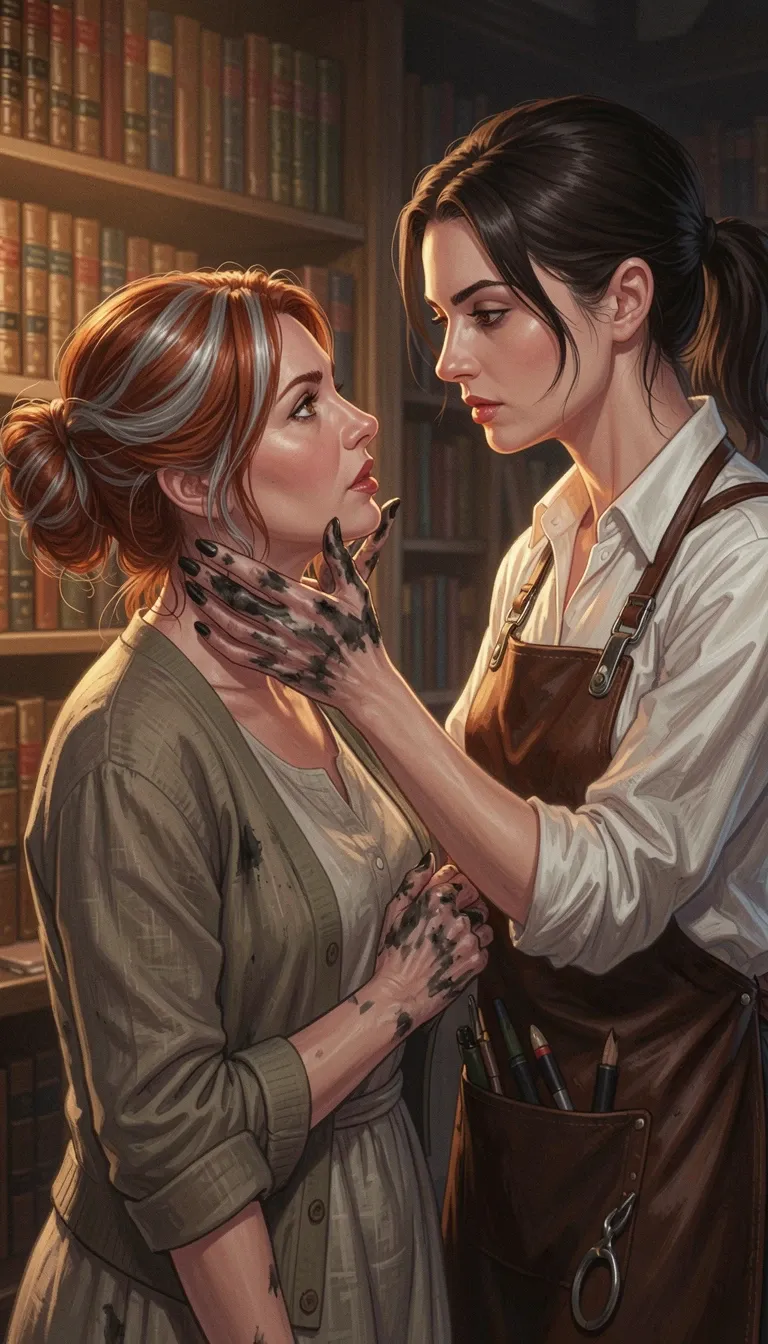
The bell over the bindery door had a flat, tinny note, like a coin dropped on stone, and Isla heard it before she heard anything else — before the cold came in around her ankles, before the smell. Leather. Wheat paste. Old paper gone soft at the edges, the way paper goes when it has been wet and dried and wet again. Somewhere under it, coffee, and something resinous she couldn't name.
She stood in the doorway with the book wrapped in a tea towel and her coat still buttoned to the throat, and she did not step in.
The workshop was one long room with the lights off at the far end. Only the bench was lit — a low brass lamp with a green glass shade, pulled down close over the work surface, so that everything beyond the circle of it went soft and brown and doubtful. Shelves climbed the walls. Spines in rows, some of them bound in nothing at all, just boards and thread and the pale ribs of the sewing. A press stood in the corner like something patient.
Vesna Petrović was at the bench with her back half-turned, a paring knife in her hand, shaving a sliver from the edge of a leather spine. She did not look up. "You'll let the cold in," she said. "Or you'll come in and shut the door. Either's fine, but standing in it is the worst of the three."
Isla came in and shut the door.
"I'm sorry. I'm early." She wasn't early. She was eleven minutes late and had walked the length of the Royal Mile twice in the wet to work up to the bell. "I phoned about a book. A first edition. It came out of the cellar during the flood in November and I've had it on the radiator, which I know now was the wrong thing."
"The radiator's always the wrong thing." Vesna set the knife down and turned, and wiped her palms on the front of her apron — a leather apron, cracked across the belly, over a white shirt with the sleeves rolled to the elbow. Her hair was pulled back low, dark brown going to black in the lamplight, and the line of her jaw came out sharp when she tilted her head. "Let's see it."
Isla set the bundle on the bench and unwrapped it with the care of a woman defusing something, and the book lay there between them — quarto, boards warped into a shallow bowl, the cloth of the spine lifted away in a curl. The pages had gone the colour of weak tea at the margins and darker at the foot, where the water had stood longest. A tide line ran across the title page like the ghost of a shoreline.
Vesna did not say anything for a while. She turned the lamp a fraction and leaned in, and her thumb came down on the corner of the first page and lifted it — slowly, the way you'd lift a sleeping cat's ear — and let it fall.
"It's not as bad as it looks," she said.
"It looks like a drowned thing."
"It looks like a drowned thing that was pulled out in time." She turned another page. Her thumbnail was short and square. There was a callus on the side of her middle finger, and a white scar across the back of her hand that went up under the cuff of her shirt. "Whoever set it on the radiator did the right thing by accident. The water came out of the paper instead of sitting in it and going to rot. If it had stayed damp through the winter you'd have had mould in the gutter and I'd be telling you a different story."
"So it can be saved."
"It can be saved." Vesna looked up, and her eyes were dark brown and steady and did not hurry away. "That's not the same as cheap, or quick."
"I didn't think it would be."
"Most people do." She turned back to the book and her voice went mild and level, the voice of a woman explaining a thing she had explained a hundred times and still enjoyed. "The boards have to come off. The spine's gone, so there's nothing holding it but the sewing, and the sewing's holding by a thread — literally, in two places. I'll take the text block apart, wash the sections, dry them flat between felts, then resew. New spine, new boards if you want them matched, or I can keep the old boards and reback them, which is cheaper and uglier and keeps more of the book's own history. That's a choice you'll have to make, not me."
"Which would you do?"
"Keep the boards." Vesna's mouth moved — not quite a smile. "But I'm sentimental about damage. It's a professional deformity."
Isla laughed. It came out of her before she'd decided to let it, a short surprised sound, and she put her hand over her mouth as though she'd been the one to swear.
"Sorry. I've been — it's been a long few months. I laugh at nothing now."
"Nothing's a good thing to laugh at." Vesna turned the page again. "There's a name in the front."
"Is there?"
"Faded. Pencil, I'd say. For A., on the occasion of—" she tilted the page to the light "—the twenty-fifth. The rest has gone."
Isla leaned in. She could smell Vesna now, over the leather and the paste — clean soap, and under it something warmer, the smell of a body that had been working. Their shoulders were a hand's width apart. Isla's eyes went, without her permission, to Vesna's hands again: the thumb flat on the page, the fingers spread to hold the block steady, the tendons moving under the skin as she turned it. She had watched those hands for four minutes and could have described them in the dark.
"Twenty-five years," Isla said. "Someone gave it to someone for twenty-five years of something."
"And then it went into a cellar and got flooded." Vesna let the page fall. "That's most things, in the end."
She reached for a notebook and a stub of pencil and wrote something down, and Isla watched the pencil move and did not hear a word of what she said next, which was about felt and weights and a fortnight, maybe three weeks. The lamp was close and warm on the side of Isla's face. The rest of the workshop was cold enough that she could see her own breath when she turned toward the dark end of the room, faint, the way breath goes in a place that has been cold all day and will be cold all night.
"You're cold," Vesna said.
"I'm fine."
"You're standing with your arms crossed and your shoulders up by your ears. You're cold." She set the pencil down. "There's a heater by the press. It's a bad heater but it's honest. Or—" and she turned her hand over on the bench, palm up, an offer with nothing in it "—give me your wrist a moment."
Isla looked at the hand. Then at Vesna's face, which was giving nothing away, which was only waiting, patient as the press in the corner.
"Why?"
"Because you've been staring at my hands since you came in, and I'd like to know what they feel like to you. And because your hands are shaking and I don't think it's the cold."
The words landed in the room and sat there. Isla's mouth had gone dry. She could feel her own pulse in her throat, in her wrists, absurdly, everywhere at once. She thought about the twenty years, and the flat in Marchmont with the boxes still half-unpacked, and the fact that she was forty-one years old and had never in her life been looked at like this by anyone, let alone by a woman with a scar on the back of her hand and a leather apron and a voice like a low fire.
She put her wrist in Vesna's palm.
Vesna's fingers closed around it, warm and dry and sure, and her thumb came to rest on the inside of the wrist, over the pulse, and stayed. She did not stroke. She did not do anything at all. She simply held it there, the pad of her thumb pressed flat to the thin skin, and looked at Isla's face while she did it.
"There," she said, after a while. "That's not the cold."
"No."
"Do you want me to let go?"
"No."
Vesna's thumb moved then — once, slowly, along the tendon — and Isla's whole arm went hot from the wrist up. She heard herself breathe in through her nose, too loud in the quiet room.
"I should tell you," Vesna said, and her voice had not changed at all, still low, still unhurried, "that I've been watching you watch my hands for four minutes and I've been thinking about what I'd like to do with them. And I should tell you that I'm not going to do any of it unless you say yes to me plainly. Not a nod. Not a maybe. I want the word."
Isla's heart was going like a bird in a box. She thought, with a clarity that surprised her, of her husband's hands — big, clean, always a little damp — and of twenty years of being touched the way you touch a thing you've already decided about. She thought: I am forty-one and I have never once been asked.
"Yes," she said. "Please."
"Please what?"
"Please kiss me."
Vesna let go of her wrist and stood, and the stool scraped back, and then she was there, close enough that Isla could see the small lines at the corners of her eyes and the one grey hair at her temple that the lamplight caught. She put her hand to the side of Isla's neck, thumb under the jaw, and tilted her face up, and looked at her for one more long moment as though checking the page before she set the type.
Then she kissed her.
It was not a gentle kiss. It was a kiss that had been decided on, and it opened Isla's mouth and went in, and Isla made a sound into it that she had not made in years — a small, startled, wanting sound — and her hands came up and gripped the front of Vesna's shirt because her knees had gone unreliable. Vesna's other hand found the small of her back and pulled her in, and the leather of the apron was cool against Isla's chest through her cardigan, and Vesna tasted of coffee and something sharp, and she kissed like a woman who had all night and meant to use it.
When she broke off, Isla was breathing hard and her glasses had fogged. Vesna took them off her, carefully, and set them on the bench beside the ruined book.
"All right?"
"All right." Isla's voice came out thin. "More than all right. I don't — I haven't done this. With a woman. Ever. I should say that now, before—"
"I know." Vesna's thumb moved along her jaw. "I could tell from the way you looked at my hands. Like a woman reading a language she'd only ever heard spoken." She stepped in and walked Isla backward, unhurried, one hand at her hip. "Then we'll go slowly. Or we won't. You'll tell me."
Isla's back met the edge of the workbench.
The wood was hard against her spine and the bench was at the height of her hips, and Vesna pressed into her, one thigh between hers, and Isla's breath went out of her in a rush at the pressure of it, the sudden blunt fact of another body against the place she had not let herself think about in months. Vesna's mouth found the side of her neck, and her teeth, and Isla's head fell back and her hands found the edge of the bench and held on.
"Tell me what you want," Vesna said against her throat.
"I don't know how to say it."
"You do. You've been saying it with your eyes since you came in." Her hand slid down Isla's side, over the cardigan, over the linen of her dress, and came to rest flat on her belly, low, the heel of her hand just above the waistband of Isla's jeans. "Say it, or I'll stop, and we'll go back to talking about felt and weights."
"Touch me." Isla's voice cracked in the middle of it. "God. Touch me properly."
"There she is."
Vesna's fingers found the button of her jeans and undid it, and the zip, and her hand slid inside the denim, flat over the cotton of Isla's knickers, and pressed. Isla's hips came off the bench. The cotton was already soaked through, and Vesna made a low sound in her throat at the feel of it.
"You're so wet," she said, and her voice had gone rough at the edges. "You've been standing there in the cold with your arms crossed and you're soaking wet for me."
"Yes."
"Say it again."
"I'm wet for you." The words came out of her like something breaking loose. "I've been — since you took the book. Since your thumb—"
"I know." Vesna's fingers pushed the cotton aside, and the first touch of her skin to Isla's skin made them both go still. "Oh. There you are."
She was wet and hot and swollen, and Vesna's fingers moved through it slowly, spreading the wet up and back, finding the clit and circling it once and then leaving it alone, and Isla made a sound that was half a protest and Vesna laughed, low, against her ear.
"Patience. You're going to come on my hand and I'm going to take my time getting you there."
Her fingers slid lower, and one pressed into her — just one, just the first inch — and Isla's whole body clenched around it and her hand flew out and knocked something on the bench and neither of them looked to see what. Vesna pushed in deeper, slow, and pulled out, and pushed in again, and the wet sound of it was loud in the quiet room under the lamp, and Isla's heels came up off the floor.
"More," she said. "Please. More."
"Greedy," Vesna said, pleased, and gave her two.
The stretch of it pulled a groan out of Isla that she felt in her throat. Vesna's fingers curled inside her, finding the place, and her thumb came down on her clit. She set a rhythm — slow and deep and then a quick flurry and then slow again, so that Isla never knew which was coming next and could not brace for any of it. The bench edge dug into her back. Her cardigan had come open. Vesna's mouth was at her ear, and she was talking, a low steady stream of it, and Isla heard herself answering.
"You feel that? That's my hand inside you. Say whose hand it is."
"Yours. Vesna—"
"Say it again."
"Vesna."
"Good girl."
The two words went through Isla like a wire pulled taut. Her hips were moving now without her, rocking into Vesna's hand, and Vesna let her, let her take what she needed, and her thumb pressed harder and her fingers went deeper and Isla's breath was coming in short ugly gasps that she could not have stopped for anything.
"I'm going to—"
"I know. Let me feel it." Vesna's mouth was at her jaw, her voice barely above a breath. "Come on my hand, Isla. I want to feel you do it."
It came up through her from the soles of her feet. Her cunt clenched hard around Vesna's fingers — once, twice, a third time — and she heard herself cry out, a sound she had never made in her life, and Vesna held her through it, fingers still moving, gentling, her other arm locked around Isla's back so she couldn't fall off the bench. The lamp swung slightly on its arm. The smell of leather and paste and her own body was everywhere.
Then it was over, and she was shaking, and Vesna's fingers had gone still inside her.
Neither of them said anything. Vesna's mouth was at her ear, warm, and her breath was not quite steady either, and her hand did not move. Outside, a bin lorry went down the Cowgate, and the sound came through the wall thin and far away, and the cold end of the workshop was still dark, and the book lay open on the bench beside Isla's hip, its drowned pages lifted a little at the corner where Vesna's thumb had left off.
"Well," Vesna said at last, into her ear.
Isla laughed — that same surprised sound, wrecked now, nothing left of her dignity — and put her forehead down on Vesna's shoulder, and Vesna's free hand came up and held the back of her head.
"Three weeks," Isla said, muffled against the leather. "You said three weeks for the book."
"Three weeks."
"That's a long time."
"It is." Vesna's fingers slid out of her, carefully, and Isla felt the loss of them like a small bereavement. "You could come back on Friday and look at the felt."
Isla lifted her head. The lamp was behind Vesna, and her face was in shadow, but her eyes were not, and they were steady on Isla's, and her hand was still at the back of Isla's neck.
"Friday," Isla said.