
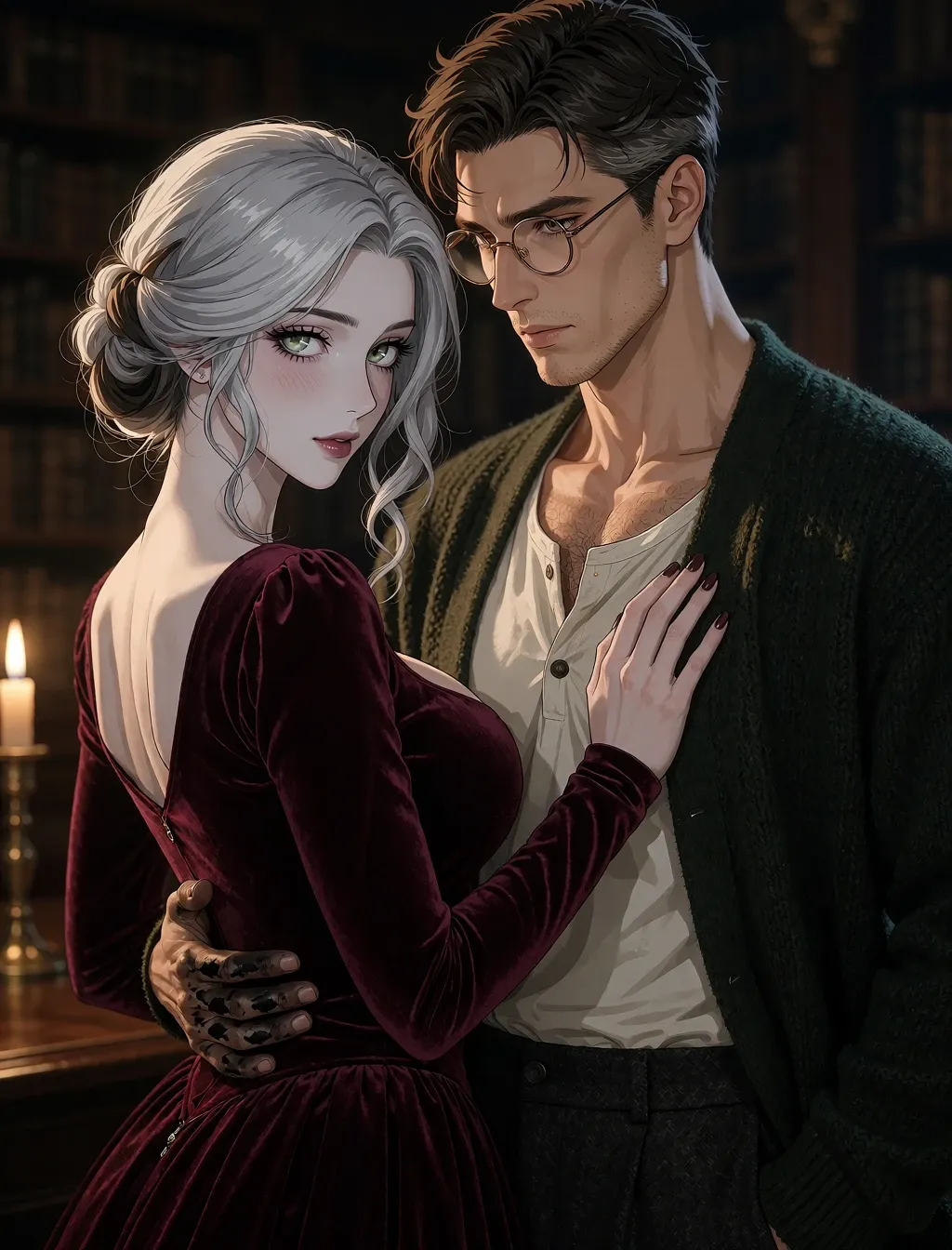
Snow came at the library windows in slow, fat flakes that stuck and slid and stuck again, and Anselm Brenner had stopped seeing them an hour ago. The lamp on the reading table threw a yellow circle wide enough for the diary, his hands, and the small brass pot of wheat paste going tacky at the rim. Beyond the circle the Drăgan library went up and up into dark, shelf after shelf of it, four hundred years of paper breathing in the cold.
He turned the page with the flat of his thumb, the way he'd been taught at the institute — never the fingertip, never the nail. The binding was original. The hand was a fine, slanting secretary script, and the ink had gone the color of dried blood, which, given the author, was probably not a figure of speech.
He had been reading for three nights. He was not supposed to be reading at all. The contract, signed in Vienna in a notary's office that smelled of wet wool and coal smoke, said cataloguing and conservation assessment, and it had a clause about the private collection, and the clause had the particular fussy thoroughness of a woman who had been dealing with lawyers since before lawyers were interesting. The diaries were not in the private collection. They were in a lacquered box with no lock, sitting on a shelf in the second gallery, and no lock, in Anselm's experience, was the most eloquent thing a lock could say.
He turned another page.
"He wept when I took him," the countess had written, in the winter of some year he had stopped trying to convert. "Not from pain. I had been careful with him. He wept because he had asked, and I had said yes, and he had not known until that moment how much of his life had been spent arranging the furniture of a house he was never allowed to enter."
Anselm set down his pen. He had not written anything for a long while. His tea had gone the temperature of the room, which was the temperature of a cellar, which was perhaps four degrees above freezing and dropping. He became aware, all at once, that he had been holding his breath, and that his heart was going in a way that had nothing to do with the cold, and that a woman was standing at the end of the shelf aisle with her arms folded and her head tilted, watching him.
He had not heard her come in. He never did.
"Countess."
"Anselm." Ilse Drăgan was forty-five in the way a glacier is a rock — that is, not at all, and exactly. Her gown was burgundy and would have been indecent on a younger woman and was instead simply true, the way old portraits are true. Silver threaded her dark hair where the chignon had loosened, and her pale green eyes went from his face to the open book to the open book again, and something in them settled, the way a cat settles when it has found the warmest chair in the house.
She crossed the floor. Her slippers made no sound on the boards. She came around the table and stood at his shoulder, close enough that he could smell her — cedar and cold and something underneath, warm, faintly metallic — and she looked down at the page under his hands.
"Ah," she said. "The 1780s. I was insufferable in the 1780s."
"You—" His voice came out dry. He cleared it. "You knew I had them."
"I knew where I left the box." She reached past him and turned the page herself, and her wrist passed within an inch of his chin, and he did not move his head, and he was aware of this as a decision. "The question was whether you would open it. Most men would have opened it on the first night."
"I opened it on the first night."
"Yes." Her mouth curved. "But you spent two nights not reading. That is the part I was watching."
The snow ticked at the glass. The lamp guttered, and she did not, and the long shadow she threw across the table had a still, patient edge to it that the lamp's light did not explain.
Anselm closed the diary. His fingers were ink-stained at the tips and he was suddenly, absurdly conscious of them, of the worn cuff of his cardigan, of the fact that he was thirty-nine years old and had spent his life repairing other people's books and had never once, in all that careful time, been the one who was opened.
"They are not about books," he said.
"No."
"They are about—" He stopped. He looked at the lacquered box, at the cracked spine, at his own thumb resting in the gutter of a page he had read three times. "They are about men who asked."
"Yes."
"And what happened to them."
She came around the table again, unhurried, and sat on the edge of it — not in the chair he would have brought her, but on the table itself, hip against the wood, one foot finding the floor, the velvet of her gown falling over her knee. The lamp lit her from below. It was the least flattering light in the castle and she wore it like a crown.
"What did you think they described, Anselm?"
He was quiet for a moment. The honest answer was: what he had been reading for three nights, with his heart in his throat, in a cold library, alone. The honest answer was that the countess wrote about mouths and hands and the specific weight of a body that had been permitted, and that he had read the same passage twice on the second night and once more before dawn, and that he had told himself it was for the cataloguing.
"I thought," he said, "that they described something I had no business knowing."
"And yet."
She held his eyes. Her gaze had the quality of a hand closing, slowly, on something it had been reaching for a long time. "You have been in my house eleven days," she said. "You have eaten at my table. You have mended the Cassiodorus and you have not once looked at my throat as though it were a door."
"I was trying to be a good guest."
"You were trying to be a good man. It is a different discipline and a worse one." She leaned down, and her voice dropped into something lower, older, amused. "The men in those diaries, Anselm — they were not good. They were honest. It is a far rarer thing and it costs the same at the till."
The snow hissed. He heard his own swallow.
"What do the pages describe?" he said. "Tell me. Not the—" He gestured, helplessly, at the book. "Not the words. You wrote them. Tell me what they were."
Ilse was silent for so long that he thought she would not answer, that he had overstepped, that she would stand and gather her gown and leave him to the cold and the lamp and the long climb to his room.
Then she stood. She stepped back from the table into the aisle between the shelves, where the lamplight ran out, and she took the hem of her gown in both hands.
"They were this," she said, and lifted it.
The velvet came up past her knees, past her thighs, and the pale, cool, unmistakable length of her cock stood out from the dark hair at her groin, hard, the head wet at the slit, curving up toward her stomach. She held the gown gathered at her waist and let him look. The lamp made a small wet gleam along the shaft. She was not breathing hard. She was not breathing at all, as far as he could tell, and she was watching his face with the patient attention of a woman who had waited four hundred years for a man to get to the point.
"They were this," she said again, "in a mouth that had asked for it."
Anselm's chair scraped back. He did not remember standing. The floorboards were cold through his socks and he did not care. He went down onto his knees in the aisle of the Drăgan library, on the boards worn smooth by four centuries of feet, with the snow at his back and the books going up into the dark on either side of him and the countess's cock hard in front of his face.
"Look at me," she said.
He looked up. Her eyes had gone from pale green to something with more iron in it.
"You understand what you are asking," she said. "Not with your mouth. With your knees. You understand that I will not be gentle to spare your dignity, and that if you want to stop you will have to say so plainly, because I do not read minds and I do not play at guessing."
"I understand."
"Say it properly."
"I want this." His voice cracked on it and he did not care. "I want it. I'm asking."
She let the gown fall. The velvet dropped over his head and shoulders like a tent, cut off the lamp, and in the dark under it there was her smell, cedar and cold and the thick warm iron of her, and then the head of her cock found his mouth and she was not gentle.
He took her deep. His hands came up and found her hips through the velvet. She let him hold her there, his fingers spread over the cool cloth, and the weight of her filled his mouth and pushed at the back of his throat. He made a sound around it that he had not intended to make. She tasted of salt and something sweeter, faintly like the smell of the library itself, old paper and dust and the cold breath off the windows.
"That's it," she said, from above him, muffled through the velvet. Her voice had gone low and pleased. "I have watched your hands for eleven days. Do you know what I thought, watching them? I thought, that is a man who has spent his whole life being careful with things he did not make. And I thought, what would he be like with something he was allowed to ruin."
He pulled off her, gasping, spit running down his chin. "I'm not—"
"You are not ruining anything." Her hand came down through the velvet and found the back of his head, not pushing yet, just resting there, the weight of it. "You are asking. It is the only thing I have ever wanted from a man and the only thing they are ever too proud to give. Take me again. Slower. I want to feel your tongue."
He took her again, slower, and this time he worked the underside of her with his tongue, felt the vein there, felt the pulse in it — slow, slow, slower than any pulse he had ever put his mouth to — and she made a sound above him, the first sound she had made, a soft click of pleasure at the back of her throat. Her fingers tightened in his hair. The velvet breathed with her, or he breathed with it, and the cold of the library was gone, replaced by the wet heat of his own mouth and the close dark and the slow, patient rocking of her hips into him.
"Deeper," she said. "You can. I will not break, and neither will you."
He pushed, and her cock slid into his throat, and his eyes watered. He held there. She held him there with the hand in his hair, counting, unhurried, while the snow ticked at the window and the lamp guttered and the books stood all around them in the dark, keeping their counsel.
"Good," she said at last, and let him up. "Very good. You have a gift for asking, Anselm. Most men ask once and consider the matter closed."
He wiped his mouth with the back of his wrist. "I've had a lot of practice at wanting things quietly."
"I know." She drew the gown up again, over his head, and the lamplight came back, and her face above him was not amused now, not teasing, but something older and more careful, the way she looked at a damaged binding she intended to save. "Get up. Not all the way. Onto the table. Sit."
He got up, stiff in the knees, and sat on the edge of the reading table with the diary open beside his hip and his feet not quite reaching the floor. She stepped between his knees. Her cock was still hard, wet from his mouth, and it brushed the inside of his thigh through his trousers. He shuddered and she noticed, of course she noticed, she noticed everything.
"Give me your arm," she said.
He gave her his left arm, the one with the ink stains, and she turned it over and looked at the inside of his wrist for a moment — the thin skin there, the blue veins, the small pale scar from a binding knife he'd been careless with at twenty-two. Then she lifted it to her mouth.
"This will not turn you," she said. "It is a mouthful, no more. But you will feel it in your knees for an hour and you will feel it in your dreams for a week, and you will know, every time you look at it, exactly what you asked for and who said yes."
"Do it," he said.
Her teeth found the inside of his wrist. They were sharp, and they were gentle, which was somehow worse — the care of it, the deliberateness, the way she closed her mouth on him the way a woman closes her mouth on a man's throat when she means to be remembered. The pain came a half-beat late, a bright thin line of it, and then the warmth, and the warmth went up his arm and into his chest and down into his groin all at once. He heard himself make a sound that was not quite a word.
Her other hand had already found his cock.
She had it out of his trousers before he had finished gasping, her fingers cool and certain. She stroked him root to head, once, slow, while her mouth stayed closed on his wrist and her eyes stayed on his face. The wet sound of it was very loud in the library. Her thumb came up over the head and smeared what was already there and went back down, and her teeth pressed a fraction deeper, and Anselm gripped the edge of the table with his free hand and held on.