
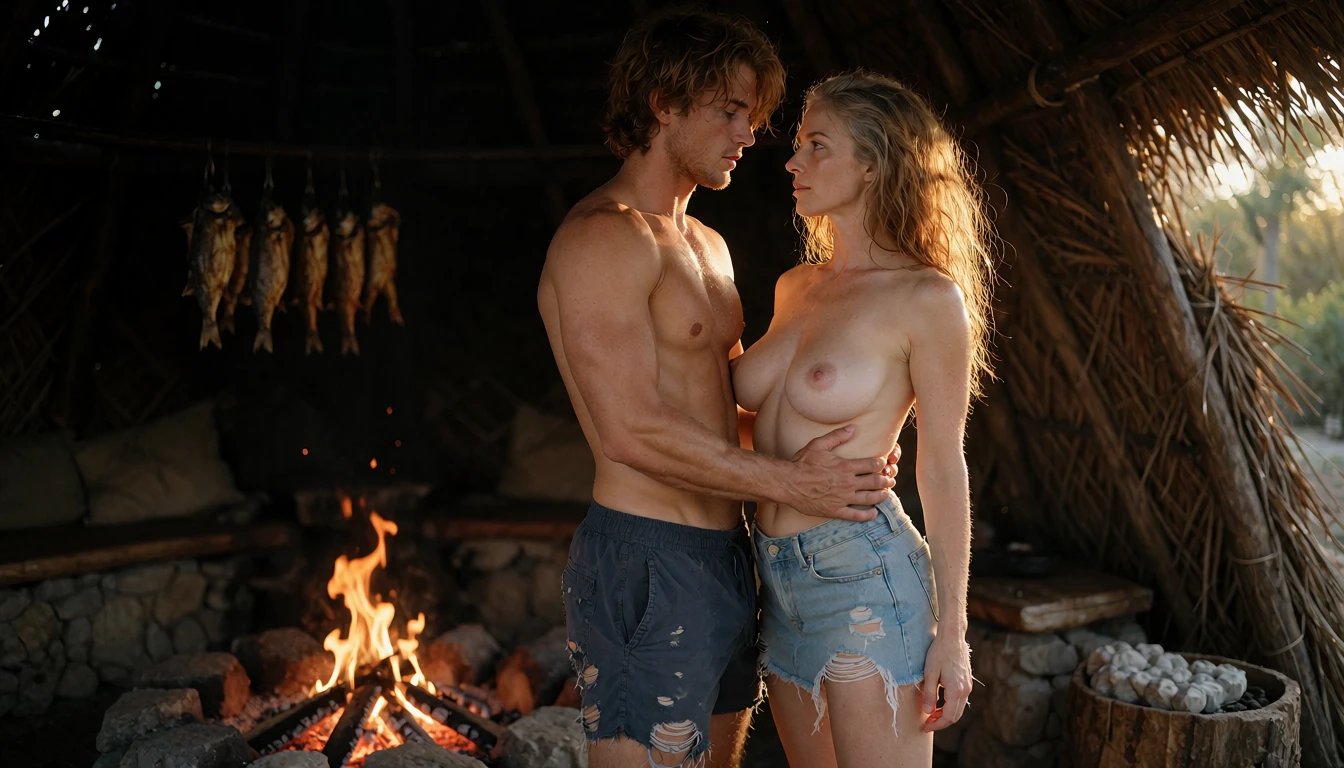

The fire had burned down to its bed of coals by the time Adam finished the last of the evening work, and the embers threw their orange up onto the underside of the palm thatch, onto the three of them where they sat, so that the night beyond the shelter's mouth was a wall of black with the sea somewhere out in it, breathing.
The second wall had gone up four days ago. He had woven it himself, split palm and vine, and it stood now where a week before there had been only the one wall and the wind coming through. The ridgepole carried a rack of fish — nine of them, smoked over green wood until their skins were the color of old leather and the fat had run out of them and hissed — and the smell of that smoke had soaked into everything they owned, which was not much.
Emily sat on the log bench with her knees drawn up and a heap of taro in her lap, sorting it — the good roots to one side, the soft ones to the other, the way they had learned to do it without talking about it. Her hair had been braided back wet and had come half undone, red strands hanging against her cheek, and her hands moved quick and sure in the firelight, turning each root, thumbing off the dirt.
Clara sat at the shelter's edge with the palm mat across her knees and a length of vine in her fingers, drawing it through a tear that had opened along one edge — in and out, in and out, the vine dark against the pale weave. She had not put anything on since the water. The tattered skirt lay folded by her hip. She had not reached for it, and the firelight moved on her shoulders and her breasts and the long flat of her stomach while she worked. She did not seem to notice it or to care.
Nobody said anything. That was the thing about it now — the silence had grown comfortable. A week ago the quiet between them had been a thing with teeth in it, every pause a place where somebody might say the wrong word. Now it was only the quiet of three people who had done a hard day's work together and were doing the last of it before sleep, and the fire snapped, and the vine went through the mat, and Emily set a root down with a small knock against the others, and none of it needed a word on top of it.
Adam crouched at the fire pit and used a green stick to draw the coals apart, spreading them so the heat would go out of them slow instead of all at once, and the orange brightened along the edges of the split and then sank. Salt was drying tight on his forearms. The cut on his thumb from the fish spine had closed to a thin red line. He was tired in the way that came from good work and not from fear, and he had begun — somewhere in the last few days, without marking when — to trust that the morning would come and that there would be water in the gourd and fish on the rack and the three of them still here.
"The soft ones," Emily said, not looking up. "Four of them. I'll put them in the water tonight, see if they'll take."
"They won't," Adam said.
"Then they won't, and we'll have eaten four soft roots for nothing." She set another one down. "I'd rather try."
Clara drew the vine through and pulled it snug, and the mat's edge puckered and lay flat. "She's got your stubbornness," she said, to neither of them in particular, and the firelight moved as she said it, and the words sat easy in the air.
Adam straightened. He put his hands on his lower back and leaned into them and felt the pull of it along his spine, the long day's ache loosening, and he looked at the two of them — his mother at the shelter's edge with the mat across her knees, his sister on the bench with the roots in her lap — and the firelight caught their faces from below and made them strange and gold, and something in his chest shifted and settled at the same time.
A week. A week since the water. A week since he had crawled up a beach with his lungs full of salt and found the two of them alive. In that week he had built a roof that mostly kept the rain out and a second wall that kept the wind off and a rack that held nine fish, and he had found the stream and the taro patch and the reef, and he had — the thought came to him plainly, without heat — he had taken his mother and his sister to bed, and they had taken him, and none of them had said a word about it that wasn't true.
He looked at them and thought: I know what their mouths taste like. I know the sound Emily makes when she is close. I know the way my mother's hand goes flat on my back when she wants me to stay. And none of that is a thing I have to be told. It is a thing I know now, the way I know the reef at low water.
The weight of it was not guilt. He had looked for guilt and had not found it, not in himself and not in them. The weight was something else — the weight of how much had changed and how fast, and how little of it had been decided. It had simply happened, the way the tide happened, and now it was the shape of their days.
Clara's hands had stopped.
He noticed it because they had not stopped all evening. The vine lay slack across her knuckles now and she was looking at him, and her eyes were steady in the firelight and her face gave him nothing he could name — not a smile, not a question, only the flat steady regard of a woman who had decided to look and was going to keep looking until she was done.
"What," he said.
"Nothing," she said. And then, because it was not nothing: "You were standing there looking at us like a man counting his stores."
"I was."
"And what did you count?"
He thought about it. The fire popped and a coal rolled and settled. "Two," he said. "And me. And nine fish and a rack of roots and a roof that mostly holds." He looked at the second wall, at the weave of it, at the way the firelight moved through the gaps. "A week ago I'd have counted one of those things and been grateful for it."
Clara's hands began to move again. The vine went through the mat and she drew it and the tear closed a little more. She did not look away from him while she did it. "A week ago," she said, "I was on that beach trying to remember whether I'd told you two I loved you before the water took the boat. That's what I was counting. Whether I'd said it."
"Had you?"
"I don't know." The vine pulled snug. "I've said it since. That'll have to do."
Emily had not put another root down. Her hands had gone still in her lap, one root half-sorted between her fingers, and she was looking from her mother to her brother and back again with her lips slightly parted, the way she looked when she was working out whether a thing was allowed to be said. The firelight found the freckles across her nose. She was eighteen and she had been a girl on a boat a week ago and she was something else now, and Adam could not have said what, only that it sat in her face and made her look older and younger at once.
"Say it," Adam said.
"Say what?"
"Whatever it is you're chewing on. You've got a face on."
Emily looked down at the root in her hand. She turned it over. Then she set it down on the good pile with the others, and she wiped her palms on her thighs, and she lifted her head and looked at him straight. "It's only — we don't talk about it," she said. "Any of it. We do it and then we do the next thing, and nobody says a word about what it is."
"What is it," Clara said. Not a challenge. She had gone back to her stitching, in and out, and her voice was mild as water.
"I don't know," Emily said. "That's the thing. I don't know what to call it, and I keep thinking I should, and then the day comes and there's fish to gut and roots to sort and I don't have to call it anything, and that's — " She stopped. Her jaw worked. "That's easy. And I don't think it's supposed to be easy."
The fire snapped. Out past the shelter's mouth the sea went on breathing, and the black was so complete that the sound of it seemed to come from everywhere at once, from under the ground and from the sky both.
Adam crouched back down at the fire pit. He did not sit. He put his forearms on his knees and looked into the coals, and the heat of them came up against his face, and he thought about what she had said and about the truth of it, which was that he had been counting his stores a moment ago and had not once thought to count what it cost them.
"It's not supposed to be easy," he said. "No. But I don't know that it's supposed to be hard, either. Not out here." He turned his head and looked at her. "There's no one to tell. That's the whole of it. There's no one on this island to look at us and say what we are. So we have to say it ourselves, or we don't say it, and either way the fish still need smoking."
"That's not an answer," Emily said.
"No," he said. "It's the truth, which is different."
Clara laughed — low, one breath of it, and it was the first laugh he had heard out of her since the water that was not a thing said to cover something else. "God," she said. "You sound like your father." She said it without flinching, which was new; a week ago his father's name had been a thing she stepped around. "He'd have said the same. Sit down, both of you. You're making the place look untidy."
Adam sat. He put his back against the shelter post and stretched his legs out toward the coals, and the heat came up along his shins, and Emily slid down off the bench and came and sat on the ground with her back against his knee, the way she had when she was small, and her hair was warm where it touched his thigh and smelled of smoke and salt.
Clara finished the last of the tear and bit the vine off with her teeth and laid the mat aside. Then she got up and came and sat on his other side, close, her shoulder against his, and she pulled her knees up and rested her forearms on them and looked into the fire with him, and for a while the three of them did nothing at all but sit and be warm.
The coals settled. A log broke along a crack and the two halves fell apart and the orange went up bright and then down. Somewhere out in the dark a bird called, twice, and stopped, and the sea went on breathing.
"I'll say it, then," Emily said, quietly, into the quiet. "Since nobody else will."
Adam felt Clara's shoulder go still against his. He did not turn his head. The coals pulsed. Emily's hair was warm against his knee and her voice had been steady and she had not lifted her face from the fire.