
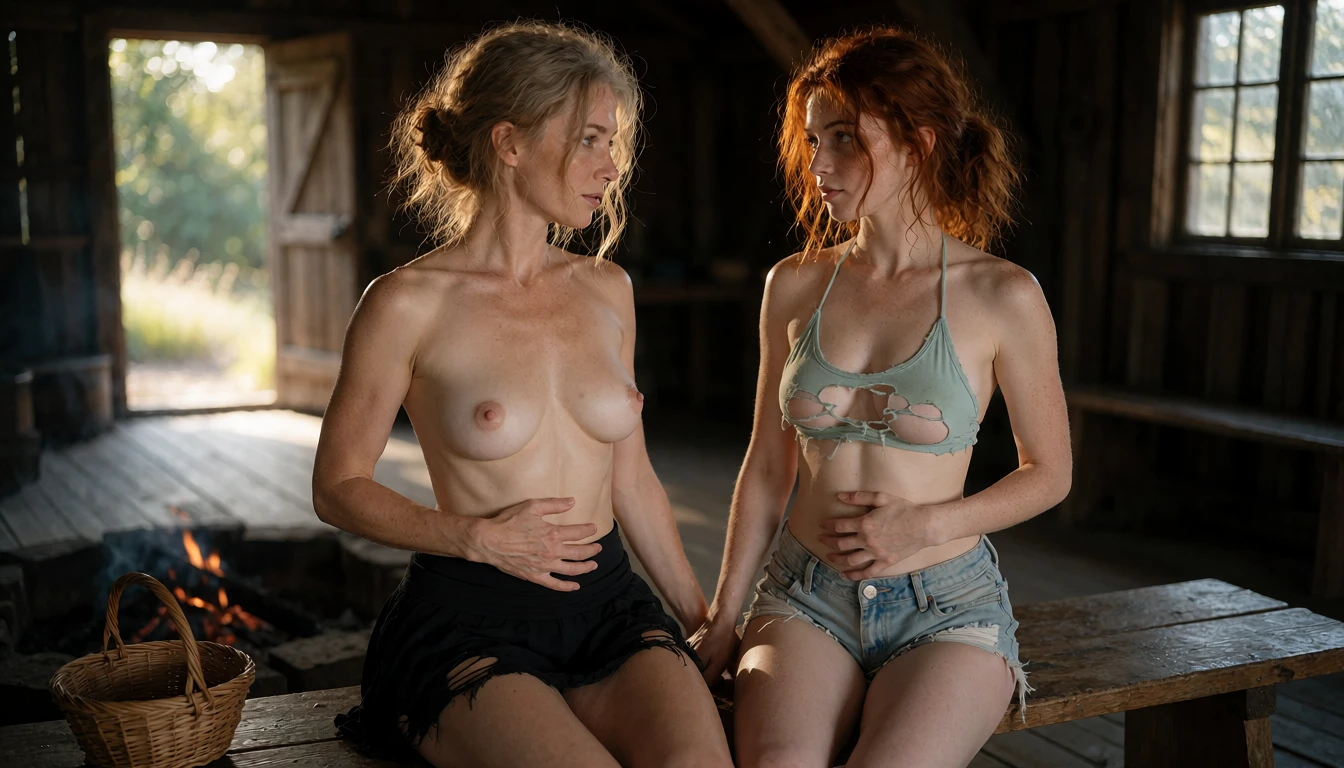

Clara woke before the light, the way she had learned to on the island — not to an alarm but to the shift in the air, the grey going blue at the edges of the doorway. She lay still on the sand beside the cold pit and listened to the sea beyond the treeline, and to Emily's breathing on the other side of Adam, and to Adam's own, slow and deep, the breath of a man who had done a day's work and would do another. Her hand had found her belly in the night and was still there. She did not move it. She had been doing that for weeks now, in the dark, where no one could see, and she had stopped pretending it was anything but what it was.
She sat up. The fire pit was grey and dead. Neither of them had lit it — Emily was already up, had been up, sitting on the bench with her knees drawn to her chest and her hair a red tangle down her back, staring at the pit as though it had asked her a question and she had not answered. Clara crossed the sand and sat down beside her without a word, and the bench took them both, the wood warm already from the sun that had not yet cleared the trees but had found the roof and was working its way down.
"You didn't light it," Clara said.
"No."
"Neither did I."
The bench was the one thing in the house Adam had made that was not for sleeping or eating or keeping the rain off. He had cut the planks from a fallen trunk and planed them with a stone and set them on two posts driven into the packed sand, and he had sat on it himself one evening with a look on his face like a man who had surprised himself. Clara had watched him build it and had not said anything, because there had been nothing to say that would not have sounded like praise, and praise had stopped being the thing between them somewhere around the second week.
Emily's hand was flat on her own belly. She had not put it there — or she had, and had forgotten she had, because it had been there so long now it was where her hand went. Clara looked at it and then looked away, at the cold pit, at the grey ash holding the shape of nothing.
"How long for you," Emily said. Not a question with a lift at the end. A thing said flat, because it had been carried too long to be lifted.
Clara did the count in her head the way she had done it every morning for a month, the way she had done it in the dark with her thumb moving on her own skin. "Six weeks. Maybe seven. I stopped keeping it proper." She heard her own voice and it was steady, and she was grateful for that, and a little ashamed of it too. "The hot spring was the first time I let myself think it. Before that I told myself it was the salt, the heat, the not eating."
Emily's jaw moved. "Mine was the burning." She said it to the pit, not to Clara. "The night we burned the clothes. I lay there after and I knew. I don't know how I knew. I just did."
"And you didn't say."
"Neither did you."
Clara let out a breath through her nose that was almost a laugh and had nothing funny in it. "No. Neither did I." She looked at her daughter — the freckles gone faint with the tan, the mouth that had been a girl's mouth a few months ago and was not anymore — and she felt the thing she had been holding off with both hands finally put itself down in front of her. "I was going to tell him. Every night I was going to tell him and then the night would go the way our nights go and I would think, tomorrow."
"Same." Emily turned her head then, and her eyes were dry, which was somehow worse than if they had not been. "I kept thinking I'd wait until I was sure. And then I was sure. And then I waited to be more sure."
Clara's hand came off her own belly and found Emily's and closed on it, and Emily's fingers turned and gripped back hard enough that Clara felt the bones of her own hand press together. They sat like that. The sun had reached the floor of the house now and lay in a long bright bar across the sand and up over the edge of the pit, and the grey ash in the pit caught the light and gave nothing back.
Somewhere off behind the house a hen made the low complaining sound hens make when they are put out about something, and then there was the sound of a latch, and then footsteps — Adam's footsteps, the particular weight of them, the heel coming down first because of the way he walked with his shoulders forward as though he were still carrying the boat. The door he had made creaked on its rope hinges. The light in the doorway went dark and then came back as he came through it.
He had the basket in his hand, the woven one, and the eggs in it were knocking softly against each other with his stride. He stopped just inside the door. He was naked and sun-dark and there was a smear of something on his forearm, and he looked from one of them to the other and then at the cold pit and then back, and Clara watched him read the room the way he read the sky when he was deciding whether to take the boat out.
"You didn't light the fire," he said.
"No," Clara said.
He set the basket down on the sand by the door. The eggs shifted and knocked and settled. He did not come further in. His hand stayed on the basket handle a moment after he had let go of it, as though he had forgotten to take it away.
Emily's voice came out steady. Clara felt her daughter's hand tighten on hers and then deliberately let go, and Emily sat up straight on the bench and put both her hands flat on her own thighs and looked at her brother across the cold pit. "Two months," she said. "Neither of us."
The words went out into the house and the house was very quiet after them. The bar of sun lay across the sand and did not move. Clara put her hand back on her own belly, flat, and left it there where he could see it, and then reached over and took Emily's hand again and held it on the bench between them, and the two of them looked at Adam — not with fear, Clara found, though she had expected fear and had braced for it. With something quieter than fear. The look of people who have done the counting and are waiting to hear the number read back to them.
Adam did not move from the door. His eyes went to Emily's belly and then to Clara's and then to the cold pit, and something crossed his face and was gone before Clara could name it — not the shock she had been ready for, and not the joy either. Something older than both. The look of a man who had known a thing in his body for weeks and had been waiting to be told it in words.
"Say it again," he said.
Emily's chin came up. "Two months. Both of us. I'm — " she stopped, and started again, and her voice did not shake. "I'm carrying your child, Adam. And so is Mom."
Clara watched him take it. He took it the way he took everything, standing still, his weight on both feet, his jaw working once and then going still. His hand came off the basket and hung at his side. The sun had reached the doorway behind him and made a bright edge along his shoulder and his arm, and the rest of him stood in the shadow of the roof he had built, and he looked at the two of them on the bench he had built, and he did not say anything at all.
The silence went on long enough that Clara felt it start to press. She had imagined this — she had imagined it in the dark more than once, imagined him angry, imagined him quiet, imagined him turning and walking out to the water and standing there with his back to them. She had not imagined this, the standing still, the looking, the way his eyes kept going back to Emily's flat belly as though he could see through the skin of it if he looked long enough.
"Adam," she said. "Say something."
He came in then. He crossed the sand and the cold pit and he did not stop at the bench, he went down on his knees in front of it, in front of the two of them, and his hands came up and one of them found Emily's knee and the other found Clara's, and he knelt there with his head down and his shoulders going once, hard, as though he had been holding a breath since the doorway and had only now let it out.
"I knew," he said, to the sand. "I've known since the spring. I didn't know I knew, but I did." He lifted his head. His eyes were bright and he did not wipe them and he did not look away from either of them. "I've been counting too. Every night. Lying there counting, and not saying it, because I didn't know how to say a thing like that and not have it be a thing I was asking for."
"You weren't asking," Clara said. Her voice had gone rough. "You never asked for any of it."
"No," he said. "But I wanted it. Every time. I want you to know that I wanted it." His hand tightened on her knee, and on Emily's. "Both of you. It wasn't duty. It was never duty."
Emily made a sound — not a sob, something smaller, something that had been held in the chest a long time and had come loose. She slid off the bench and down onto her knees in the sand facing him, and her hands came up and framed his face, and she looked at him with her eyes wet now, finally, and her mouth working. "I was so scared," she said. "Not of the baby. Of you looking at me different. Of you looking at me and seeing a thing you had to take care of instead of — " she stopped.
"Instead of what," he said.
"Instead of me."
He kissed her. It was not a hungry kiss; it was the other kind, the kind that had nowhere to go and did not need to go anywhere, his mouth on hers and his hand coming up into her tangled hair and holding her there, and Clara sat on the bench above them with her hand still on her own belly and watched her son kiss her daughter and felt the rope in her chest — the one that had been taking strain since the night they walked home naked through the dark — take one more turn and hold.
When he broke from Emily he turned his head and looked up at Clara, and his face was open in a way she had not seen it since before the wreck, since before he had become the man who built the shelter and read the sky. He looked young. He looked twenty-one years old and terrified and glad all at once.
"Mom," he said. And then, because he was Adam and could not leave a thing half-said, "I'm going to take care of you. Both of you. And the — " he stopped, and his hand came off Emily's knee and went to Clara's belly, flat and warm, and rested there. "And them."
Clara covered his hand with hers. It was the first time anyone had touched her belly since she had begun to suspect, and the touch of his calloused palm on the skin there undid something in her that she had not known was holding. Her eyes went hot and she did not fight it. She let it come.
"The island's answer," she said, and her voice broke on the last word and she laughed at herself for it. "That's what we said. That night. Let the island decide." She shook her head slowly, looking down at the two of them kneeling in the sand. "Well. It's decided."
Emily laughed too, wet and unsteady, and put her forehead against Adam's shoulder, and the three of them stayed like that in the bar of morning sun with the cold pit beside them and the basket of eggs by the door and the ash in the pit holding nothing at all.
Then Adam stood. He pulled Emily up with him and she came, and he reached down and took Clara's hand and drew her up off the bench, and for a moment the three of them stood in the middle of the house he had built with their hands joined, and Clara felt the shape of the days ahead settle onto her shoulders — the counting, the carrying, the water and the food and the roof, and the two lives growing in the dark under their own skin.
"First," Adam said, and his voice had gone back to the voice he used when there was work to do, low and steady and sure, "we eat. Then we light the fire. Then we talk about what comes next." He looked at the two of them. "All of it. No more waiting to be sure."
Emily nodded. Clara nodded. And Adam went to the basket and lifted it and carried it to the bench and set it down, and the eggs knocked softly together, and Clara watched him and thought that the island had answered, and that the answer was going to have to be lived with now, every day, in the house he had built with his own two hands.