
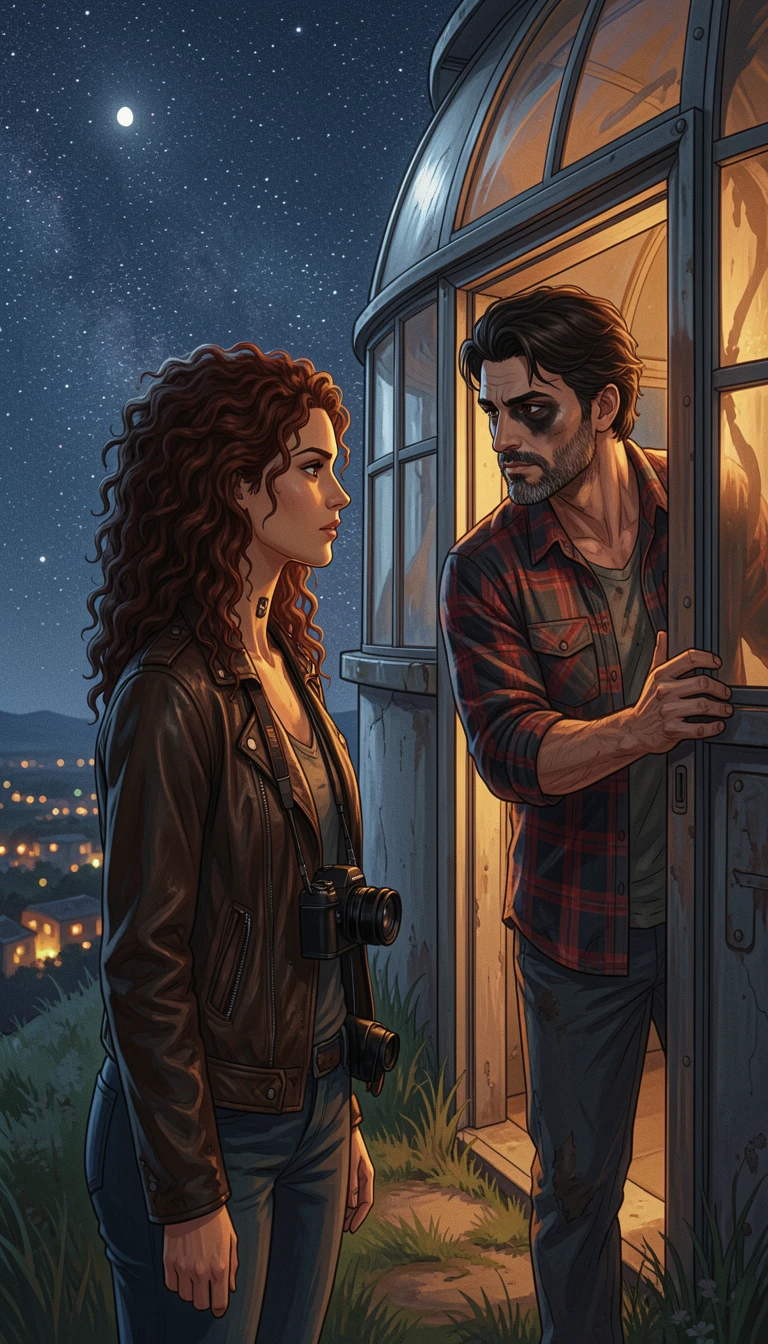
The vibration through his fingertips is the first thing he registers — not the click itself, but the way the telescope's brass carries it up through the focus barrel and into the bones of his hand. A shutter. Real. Her shutter. He watches her arms lower from the tripod, watches her step back to check the composition, her silhouette framed against the smear of the Milky Way like she's part of the constellation she's capturing.
His thumb finds the fine-focus again without permission, tweaking a quarter-turn, and her face swims into clarity. She's biting her lower lip — he's seen that before, memorized that, the way her teeth press into the soft flesh when she's concentrating. The moonlight catches the curve of her jaw, the wild tumble of chestnut curls she hasn't tucked behind her ears yet. He could name the exact shade of her skin in this light: old parchment, warm bronze, honey stirred into cream.
She moves to her left, adjusting the tripod by a few degrees, and he tracks her without thinking — his hands moving the telescope with the same instinctive precision he uses to find a distant nebula. The dome is cold against his back, the floorboards creaking under his weight as he shifts to follow her. She's wearing a leather jacket, the collar turned up against the night air, and when she bends to check her camera settings, the fabric pulls tight across her shoulders.
He realizes he's stopped breathing. The air in his lungs has gone still, waiting, and he forces a slow exhale that fogs against the eyepiece. He wipes it away with the heel of his palm, cursing himself, and when the image clears again she's looking up — straight at the observatory. Straight at him.
His hand freezes on the focus knob. She can't see him. The dome is dark, the telescope a silhouette against the star-scattered sky, and she's half a mile away across the valley. She can't see him. But she's looking anyway, her chin lifted, her dark eyes fixed on the dome's steel shutter like she knows exactly where he'd be standing. Like she's been waiting for him to notice she's looking back.
A long beat. Two. Then she raises one hand — a slow, deliberate wave — and turns back to her camera.
The vibration comes again. Another shutter, the faintest tremor through the metal, and he feels it in his chest this time, in the space between his ribs where his heart has started beating too fast. She's still there. Still working. Still framed in his lens like she belongs there, like the telescope was built for this purpose and not for tracking the dying light of stars that burned out before the first pyramid was raised.
He watches her pack up. The way she handles her equipment — efficient, unhurried, every movement precise — tells him she's done this a thousand times. She fits the lens cap like she's closing a book she'll open tomorrow. She slings the camera strap across her body, the leather creaking under the weight, and she pauses at the edge of the hill to look back one more time.
Her hand rises again. Not a wave this time — something smaller. A gesture he can't quite read through the lens, something between a question and a promise. Then she turns and walks down the hill, her silhouette dissolving into the treeline, and Marcus is left standing in the dark observatory with his heart in his throat and her image burned into the back of his eyelids like afterimage.
The telescope's metal is still warm from his hands. The vibration has faded. But he can still feel it — the rhythm of her shutter, the shape of her in the moonlight, the way she looked up and found him in the dark.
He presses his forehead against the cold brass eyepiece. The metal bites into his skin — sharp, grounding, real — and he lets it hold him there for a long moment, lets the chill seep into the space behind his eyes where her image is still burning. The brass smells of copper and old dust and his own breath, and somewhere beneath that, faint and impossible, something like the night air she walked through.
His hands stay on the focus knobs. He doesn't need to adjust anything. The telescope is still trained on the empty hill, on the patch of flattened grass where her tripod stood, on the dark line of trees that swallowed her silhouette. He could track her if he wanted to — the path down the hill is visible from here, a pale ribbon in the moonlight — but he doesn't. He stays fixed on the spot where she was, like the afterimage will fade faster if he looks away.
The silence in the dome is different now. Before, it was the ordinary quiet of a man alone with his instruments — the hum of the cooling fans, the creak of the steel shutter, the distant tick of the sidereal clock. Now it feels watchful. Like the dome itself knows something has changed. He straightens slowly, his forehead leaving a damp print on the brass, and he wipes it away with his sleeve before he can think about why that matters.
His reflection blurs in the brass. He catches a glimpse of himself — the dark hollows under his eyes, the stubble he forgot to shave again, the flannel collar turned up against a cold he stopped feeling hours ago — and he looks away. He doesn't want to see the man who watches women through telescopes. He wants to see the man she waved at, the one she looked up and found in the dark like she'd known he'd be there all along.
A moth spirals past the eyepiece, drunk on the faint glow of the control panel, and he watches it circle the brass with the same automatic attention he'd give a distant star. It lands on the focus knob, wings trembling, and he doesn't move to brush it off. The moth is the only other living thing in the dome. It feels like company.
He checks the sidereal clock without thinking — 3:47 AM. She's usually out here earlier. Tonight she stayed later, her shutter firing long past her usual hour, and he wonders if she knew he was watching before she looked up. If the wave was a greeting or a confirmation. If she'd felt his gaze the way he feels the weight of the telescope's empty stare now — like a presence, like a question, like someone standing too close in the dark.
He paces the dome's circumference. Seven strides to the wall, seven strides back. The floorboards groan under his boots in the same spots they always do, the rhythm worn into the wood by years of the same insomnia, the same orbit. He stops at the control panel and runs his thumb along the edge of the steel shutter switch. He could close it. He should close it. The night's observations are logged, the data captured, the sky charted with the same mechanical precision he's used for eighteen years.
His thumb stays on the switch. The shutter stays open.
He pulls out his phone — a cracked screen, a case stained with coffee — and opens the gallery. Empty. He doesn't take photos. He never has. But he scrolls through it anyway, thumb tracing the glass, looking at nothing, and he realizes he wants a picture of her. Not through the telescope. Not from half a mile away. A real one. The kind where she'd know he was taking it.
The thought sits in his chest like a second heartbeat.
He pockets the phone and looks through the eyepiece one more time. The hill is empty. The grass is still bent where her tripod stood. And at the edge of the frame, where the treeline meets the sky, something catches the light — small, pale, unmistakably deliberate. A piece of paper, folded into a triangle, wedged into the fork of a low branch. He didn't see her leave it. But she left it.
For him.
For him. The words don't escape his lips, but they live there, pressing against the back of his teeth like something physical. He pulls his phone from his pocket again — the cracked screen catches the control panel's faint glow, and his thumb finds the camera app without looking. He doesn't think about why. He just brings the phone to the eyepiece, angles it until the viewfinder lines up with the circle of light, and there it is — the paper triangle, pale and deliberate, wedged into the branch like a bird that decided to land and wait for him.
The image on his phone is dim. Pixelated. The phone's camera wasn't built for this — wasn't built to capture something half a mile away through a brass tube and a century of glass. But it's there. A proof. His thumb trembles as he taps the shutter. The screen flashes once, twice, three times — he doesn't stop pressing, doesn't stop capturing the same triangle from the same angle like repeating it will make it more real.
He lowers the phone and stares at the gallery. Three identical thumbnails. The same white triangle against the same dark treeline, each one slightly more blurred than the last because his hand won't stop shaking. He zooms into the first one — the image dissolves into pixels, the triangle becoming a suggestion, a rumor — but he can still see the fold. The deliberate crease. The way she pressed the edge flat with her thumb before she wedged it into the bark.
He scrolls past the blank space in his gallery — the empty expanse where he's never bothered to photograph anything — and stops on the latest capture. The paper triangle stares back at him, a question in three dimensions folded into two, and he realizes he's been holding his breath again. The air leaves him in a slow, unsteady rush, and he presses the phone to his chest like he's trying to keep the image from escaping through his ribs.
The moth is still on the focus knob. He watches it fold and unfold its wings, a small, rhythmic pulse in the corner of his vision, and he wonders if it saw her leave the note. If it watched her walk up to the tree, fold the paper with those precise fingers — he's memorized how precise they are, how steady she is with her equipment — and press it into the branch like she was setting a trap.
His thumb moves to the phone again. He opens the zoomed image one more time, squinting at the pixelated smear of white, and he tries to read it — tries to see through the digital noise to whatever she wrote. But the resolution won't give it up. The triangle keeps its secret, folded tight, waiting for hands that are half a mile away from the branch that holds it.
He could leave it there. He could close the shutter, log the night's observations, walk down the spiral stairs to the cot in the corner of the office where he sleeps more often than he should, and let the paper stay in its branch until morning. Until she comes back. She always comes back — he's charted her habits the way he charts star tracks, and she'll be here tomorrow night, setting up her tripod on the same patch of grass, biting her lip as she frames the same sky.
But tomorrow is eight hours away. And the paper is still there.
He pockets the phone and crosses the dome in four long strides, his boots finding the floorboards with the certainty of years spent in the same orbit. He pauses at the control panel, his hand hovering over the shutter switch — close it, he tells himself. Close it and go to bed. The paper will be there in the morning. It's been there this long. Eight more hours won't change anything.
His hand stays up. The shutter stays open.
He turns and heads for the spiral stairs, his palm cold against the iron railing, his heart beating a rhythm he doesn't recognize. The moth follows him as far as the doorway, then circles back to the warm glow of the panel — a small creature with its own orbit, its own reasons for staying. Marcus doesn't look back. He's already thinking about the tree. About the branch. About the folded paper waiting for him in the dark, holding a message he can't read from half a mile away but needs to hold in his hands.
The iron railing is cold enough to hurt. The spiral stairs groan under his weight, each step a confession written in creaking metal and dry timber, and he takes them too fast—his boots finding the edges of the treads, his hand sliding down the rail like he's counting the revolutions. The air changes as he descends: the cold clarity of the dome giving way to the still warmth of the stairwell, the smell of brass and machine oil softening into old wood and dust and the faint chemical bite of developing fluid from the darkroom he never uses.
His heart hasn't settled. It beats in his throat now, a tight, insistent pulse that makes him want to swallow and forget how. He reaches the bottom of the stairs and his palm leaves the railing with a sound like a seal breaking—skin separating from cold metal—and he stands in the narrow hallway that leads to the observatory's ground floor, one hand pressed flat against the wall as if the building itself is keeping him upright.
The hallway is dark. He knows it by memory—the loose floorboard three steps from the door, the light switch that sticks if you don't press it at the right angle, the coat hook that's been empty since the last research assistant left three years ago. He doesn't turn on the light. The darkness feels right, feels like the same darkness she walks through on her hill, and he wants to meet her there, in the place where the only light comes from what's been dead for millions of years.
His hand finds the door. The wood is familiar under his fingers—scratched by keys, warped by weather, painted over so many times the grain has become a rumor. He pushes it open and the night air hits him, cool and damp and smelling of damp grass and the distant sweetness of pine. The observatory's shadow stretches across the gravel yard, a long dark wedge pointing toward the treeline, and he steps into it like he's crossing a border.
The gravel crunches under his boots. Each step is loud in the stillness—too loud, he thinks, and he tries to walk softer, tries to make himself smaller in the dark. The moon has shifted since she left, casting longer shadows, and the grass at the edge of the gravel glows faintly silver where the light catches it. He can see the tree from here. The low branch. The pale triangle of paper still wedged in the fork like a flag planted on conquered ground.
He stops at the edge of the gravel. The tree is thirty feet away, separated by a stretch of damp grass that catches the moonlight in ripples, and he realizes he's been holding the photograph on his phone open in his mind—the pixelated triangle, the dark treeline, the proof that she left something for him. But seeing it with his own eyes is different. The paper is smaller than he expected. More deliberate. The fold catches the light at an angle that makes it look almost luminous, like a page torn from a book of stars.
He crosses the grass. His boots leave dark prints in the dew, each one a mark he'll have to explain if anyone ever asks why he was out here at four in the morning, walking toward a tree with his heart in his throat and his hands trembling at his sides. He doesn't have an answer. He doesn't need one. The tree is close now—close enough to see the bark, the rough texture of the trunk where it splits into branches, the way the paper is wedged into the fork like she pressed it there with her thumb and then stepped back to admire her work.
His hand reaches out. The distance between his fingers and the paper closes slowly—he watches it the way he watches a star drift across an eyepiece, the approach measured and inevitable, and when his thumb finally touches the folded edge, the paper is warm. Warm. From her hands. From the heat of her fingers pressing it into the bark before she turned and walked down the hill, leaving him the first real thing she's ever given him.
He lifts it carefully, like it's made of something fragile, and the paper unfolds in his hands—a single sheet, standard printer weight, creased into a tight triangle that resists opening. His fingers work the fold, pressing along the creases, and the paper spreads flat against his palm. The moonlight is just bright enough. He tilts it, catches the silver light, and the word is written in a hand he doesn't recognize—looping, unhurried, the ink slightly smudged at the edge where her thumb must have rested as she wrote it.
Tomorrow.
Just the word. No signature. No question mark. A statement. A promise. A deadline.
He reads it three times. The paper trembles in his hand, or his hand trembles around the paper—he can't tell which anymore. The word sits in his chest the way her image has been sitting all night, pressing against his ribs, demanding space. Tomorrow. She'll be back tomorrow. And she expects him to be here too.