
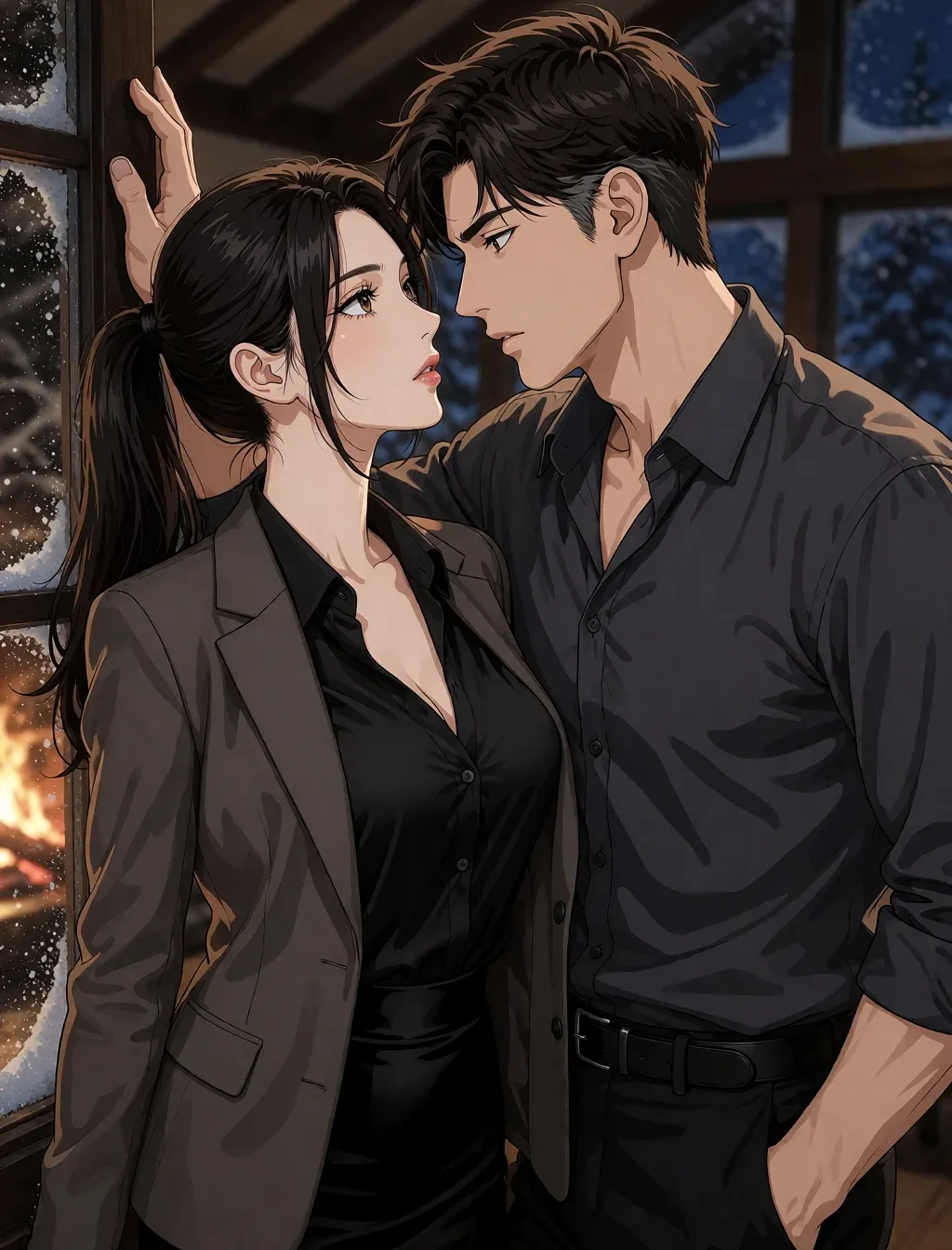
The cold had teeth tonight. Mio felt them in her knuckles, in the strip of wrist between her glove and her cuff, in the rims of her ears where her ponytail left them bare. Odori Park at eleven at night was a ghost of its daytime self — the snow-festival lots staked and roped, the other pavilions still skeletal, their timber ribs sticking up through drifts like the bones of something half-buried. The site lights were off. The only glow was the blue-white of the city bleeding over the trees, and the small hot eye of her flashlight.
"You've cross-threaded it."
Haruto Sakamoto (31) didn't look up from where he knelt in the snow. His parka was the color of a traffic cone, which she had told him twice was a safety hazard and once was a fashion crime, and he had worn it both times anyway. "I have not."
"The collar's sitting crooked. Look at it. That's a cross-thread."
"That's a collar that's sitting exactly where it's supposed to sit, and you're holding the light in your teeth so you can't see straight."
She took the flashlight out of her teeth. "It's not like I came out here at midnight for the pleasure of your company, Sakamoto-san. The client walks through at eight. If your cable run fails a load test—"
"—then it fails, and I fix it, and nobody's the wiser. Hand me the seven-sixteenth."
She handed him the seven-sixteenth. She did not think about the fact that she had known which one he meant without looking at the tray. Six years of sitting across from him had taught her the shape of his hands the way it had taught her the shape of a truss — by exposure, not by choice. His fingers were bare in the cold, stained graphite at the knuckle, and they turned the wrench with a slow, certain economy that she had once described to a colleague as "wasteful" and had not believed even as she said it.
The pavilion rose around them, a vault of stacked ice blocks lit only by her flashlight and the far-off sodium haze. The timber frame — her frame, her load path, her six months of section drawings and deflection calculations — held it all up, and the ice held the light, and the whole thing was waiting. She had built it to be looked at. She had not built it to be stood inside at midnight with a man in an orange parka swearing softly at a junction box.
"There." Haruto rocked back on his heels. "Test it."
"You test it. It's your rig."
"It's your pavilion." He stood, brushed snow off his knees, and came to stand beside her, close enough that his shoulder blocked the wind off her ear. "You want to be the one who sees it first, or you want to watch me see it first?"
She did not have an answer for that. She had a hundred sharp ones and none of them fit, because the truth was that she had been thinking about this moment for a week — the moment the ice would take the light and give it back — and she had never once pictured it with anyone else in the room.
"Don't get the wrong idea," she said. "This is purely structural. I'm verifying the reflectivity coefficients against the block density."
"Of course you are."
The breaker was a small gray box mounted to the frame's north post, and Haruto flipped the first bank with the flat of his thumb. Nothing. Then a low hum, the transformer waking up, and along the eastern wall a line of LED nodes came on one by one, pinpricks of white that the ice swallowed and spat back as a soft, diffuse glow. The wall breathed. Mio felt it in her chest before she understood it — the way the light moved through the frozen blocks, finding the seams, doubling at the corners, so that the pavilion was not lit but luminous, lit from inside like something alive.
"Second bank," Haruto said.
"Go."
He flipped it. The color came up.
It was not white. It was not the warm amber she had specified in the lighting schedule, the safe amber, the amber she had chosen because amber was professional and flattering to ice and made the client think of lanterns and festival and not of anything so specific as a preference. It was deeper than amber. It was the color of the inside of a peach held up to a window, of the last ten minutes of a good sunset, of a scarf she had owned at nineteen and lost on a train and never replaced because she had been too embarrassed to want a color that badly again.
She had never told him about the scarf.
The whole pavilion turned that color. The ice walls took it and threw it back doubled, and the timber frame went from gray to warm, and the snow at their feet blushed, and Mio stood in the middle of it with her mouth open and her flashlight hanging useless at her side. She could not find the sentence she had ready. She had a sentence. She always had a sentence. It had been in her mouth since the eastern wall came up, something about the lumen output being within tolerance and the color temperature being technically acceptable, and it died in her throat like a match in the wind.
"Huh," Haruto said.
She turned her head. He was not looking at the rig. He was not looking at the walls or the ceiling or the way the light pooled in the corners. He was looking at her face, and the glow was on it, and his expression was the one he wore when a client asked a stupid question — patient, a little amused, entirely unsurprised — except it wasn't, because under the patient there was something quieter, something that had been waiting.
"You knew," she said. Her voice came out wrong. Too low. "You knew which one."
"I know a lot of things, Kanzaki-san."
"The schedule said amber. Forty-three hundred Kelvin. I wrote it in the schedule."
"You wrote it in the schedule." He shrugged, slow, the way he did everything. "I read your section drawings twice. You think I didn't read the lighting schedule?"
"That's not an answer."
"It's the answer you're getting."
The timber frame creaked. The ice was warming, settling, the whole structure adjusting to the new heat of the lights, and the sound ran around the walls like something walking the perimeter. Mio's breath hung in front of her face, pale in the peach glow, and she was suddenly, acutely aware of how cold she was, and how the cold had stopped mattering, and how close he was standing — close enough that she could see the graphite on his thumb and the snow melting in his hair and the exact place where his grin had gone quiet.
*Say something sharp,* her inner voice hissed. *Say it's out of spec. Say the reflectivity's off. Say anything that gets you out of this pavilion and back in your car.*
"It's out of spec," she said.
"It's beautiful."
"That's not— those are two different—" She made a sound of pure frustration and turned away from him, and the turning put her shoulder against the timber post, and the post was cold through her parka, and she stayed there, because turning away from him meant turning into the light, and the light was too much, and the only place in the whole pavilion that wasn't the color of the scarf was the patch of snow at her feet.
Haruto didn't move. She could hear him not moving. It was a specific quality of silence, his — not the silence of a man who had run out of things to say, but the silence of a man who had said exactly enough and was now going to wait.
"It's not like I stayed late for you," she said, to the snow. "The load test had to be run tonight. The temperature's dropping. Ice contracts. If I'd waited until morning the tolerances would have shifted and I'd have had to—"
"Mio."
Her name. Not Kanzaki-san. Her name, spoken low and easy, and her whole body went hot from the collarbone down as if he'd put a hand flat on her sternum. She turned her head. He had moved — of course he had moved, he moved like weather — and he was right there, one hand braced on the post above her shoulder, the other still loose at his side, and his face in that light was the most unfair thing she had ever seen.
"Don't," she said.
"Don't what?"
"Don't do the thing where you—" She gestured, vaguely, at all of him. "The thing. With the face."
"I'm not doing a thing."
"You're doing it right now."
He kissed her.
It was not a gentle kiss, and it was not the kiss from the model room, the one that had started as an argument and ended as a broken truss. This one had been building for six days in the space between their desks, in the way he read her drawings and the way she stared at his forearms, and it landed on her mouth like something that had been aimed and finally released. His hand came off the post and found her jaw, cold fingers and warm palm, and she made a sound against his mouth that she would deny later and that he would remember.
"This is—" she started, when he let her breathe. "This is not— we agreed—"
"We agreed it never happened." His mouth was at her ear, at the hinge of her jaw, and his voice had gone rough in a way that made her knees unreliable. "So this won't have happened either. Problem solved."
"That's not how— that is *not* how logic—"
His hand slid down her side, over the bulk of her parka, and found the hem, and pushed under it, and the shock of his cold fingers against the warm skin of her waist made her gasp into his shoulder. The parka was too big and the layers underneath were too many and it took both of them, fumbling, laughing once — a real laugh, hers, startled out of her — to get her coat open and his open and the two of them pressed together in the peach light with the ice walls holding the color around them.
"Cold," she said, against his throat.
"I'll fix it."
He turned her — hands on her hips, firm, unhurried — and walked her back against the timber frame, and the post met her spine through her sweater. She arched off it and he was there, filling the space, one thigh pushing between her legs. His hand came up under her sweater, up her ribs, and his thumb found her nipple through her bra and she heard herself make a noise that had no business coming out of a structural engineer.
"Tell me to stop," he said. "If you want it to stop, tell me now."
"Shut up," she said. "Sakamoto-san, shut up and—"
"Haruto."
"What?"
"Say it." His fingers were at the waistband of her trousers now, working the button, and his mouth was at her ear again, and his voice was the least easy thing she had ever heard from him. "Say my name. Once. Then I'll shut up."
She turned her face into the cold timber and did not say it, and he didn't push. He just got her trousers open and his hand inside, and his fingers found her through her underwear. She stopped being able to think in sentences at all. He rubbed her through the cotton, slow circles, and she could feel how wet she was against her own underwear, how the fabric had gone slick. She heard his breath catch — the first time she had ever heard his breath catch — and that, more than anything, undid her.
"There you are," he murmured.
"Don't— don't say things like—"
His hand pushed under the cotton and his fingers were on her bare cunt. She made a sound that the ice walls threw back at her, and she bit her own wrist to stop the next one. He dragged two fingers through her, slow, spreading her, and then his fingertips found her clit and pressed, and her hips jerked off the post.
"That's it," he said. "That's it. Look at you."
"I hate you," she said, and it came out breathless and entirely without conviction, and he laughed against her neck.
"Sure you do." His fingers worked her in a rhythm that was not random, that was in fact the same slow, certain economy he brought to everything, and she was so wet that every stroke made a sound, and the sound was the loudest thing in the pavilion. "Tell me what you want."
"I want—" She couldn't. The words were there, somewhere, in the place where her sharp ones lived, and they had all been replaced by heat. "I want you to stop talking."
"Wrong answer."
"Haruto—" It slipped. It slipped out of her the way the scarf color had slipped into the pavilion — as if it had always been there, waiting for the walls to come up around it. His fingers stopped. She felt the stop all the way up her spine. "That was— I didn't— the cold affects the vocal cords, it's a documented—"
He turned her around.
She was facing the timber post now, both hands braced against it, her open parka hanging off her shoulders. She heard the sound of his zipper and the rustle of his own coat and then his hand was on her hip, holding her steady, and the head of his cock was sliding through her wetness from behind, dragging over her clit, and her whole body clenched around nothing.
"Say it again," he said.
"No."
"Say it again and I'll give you what you want."
"You're— this is coercion, this is professionally—"
He pushed into her.
Just the first inch, and then another. She was so wet that he slid deep on the second push, and the stretch of it made her eyes water and her hands claw at the frozen timber. He was thicker than she remembered. Or she had made herself forget. Either way her cunt took him in a long, hot, clenching slide. She heard herself moan, long and low, the sound rolling up the ice walls and coming back changed.
"Fuck," Haruto said, and it was not easy at all, it was ragged. "Mio. You're so—"
"Don't." Her forehead was against the post. "Don't say it. If you say it I'll—"
He pulled back and thrust and the rest of the sentence was lost. He set a rhythm, slow at first, deep and deliberate, and every thrust pushed her hips into the post and the post creaked and the ice around them creaked back. She was making sounds now that she could not have stopped if the client had walked in. His hand came around her hip and his fingers found her clit again, slick with her, and he worked her in time with his thrusts. She was so full and so close and so cold and so hot all at once that she had to put her own hand over her mouth.
"No," he said, and pulled her hand away. "I want to hear it. I've wanted to hear it for six years."
"That's— you're a menace—"
"Say my name."
"Haruto—" It came out on a thrust, on a gasp, and this time she didn't take it back. "Haruto, don't stop, don't you dare stop—"
"There she is."
He fucked her harder. The timber post was the only thing holding her up. His fingers on her clit were merciless now, quick and precise, and she could feel the orgasm coming up through her like the light had come up through the ice — from the inside, doubling at every seam. She tried to say something sharp and managed only his name again, and then she came.
Her cunt clenched around his cock in long, hard waves. She heard herself cry out — a real cry, high and cracked, *Haruto, Haruto* — and the pavilion threw her voice back at her from every wall, and her legs gave out. He caught her against the post and kept moving, driving through her orgasm. She was still clenching when he made a low, broken sound and pushed deep and came.
She felt it. The pulse of it, the heat of it, spilling inside her in slow, heavy throbs, and his hips jerking against her ass, and his hand flat on her stomach holding her to him. The light was all around them. The color was all around them. She stood in the middle of her own pavilion with her trousers around her knees and his cum running down her thigh and her heart going like a bird in a box.
For a long moment neither of them moved.
Then Mio said, into the timber post, in a voice she had to assemble from pieces: "The vocal cords. The cold. It's a documented phenomenon. The— the larynx constricts, and the—" She cleared her throat. "It slipped out. By accident. It was an accident."
Haruto's hand was still on her stomach. She could feel him smiling without turning around. She could feel it through his palm.
"Sure, Kanzaki-san," he said. "Accident."
"Don't get the wrong idea."
"Wouldn't dream of it."
She pushed off the post, on legs that did not entirely belong to her, and began the furious business of getting her clothes back together — the button, the zip, the parka, the ponytail that had come half down and would not go back up without a mirror. The peach light lay on her hands. The peach light lay on everything. She could not look at it and she could not stop looking at it, and she could not, for the life of her, remember why she had ever thought amber was the safe choice.