
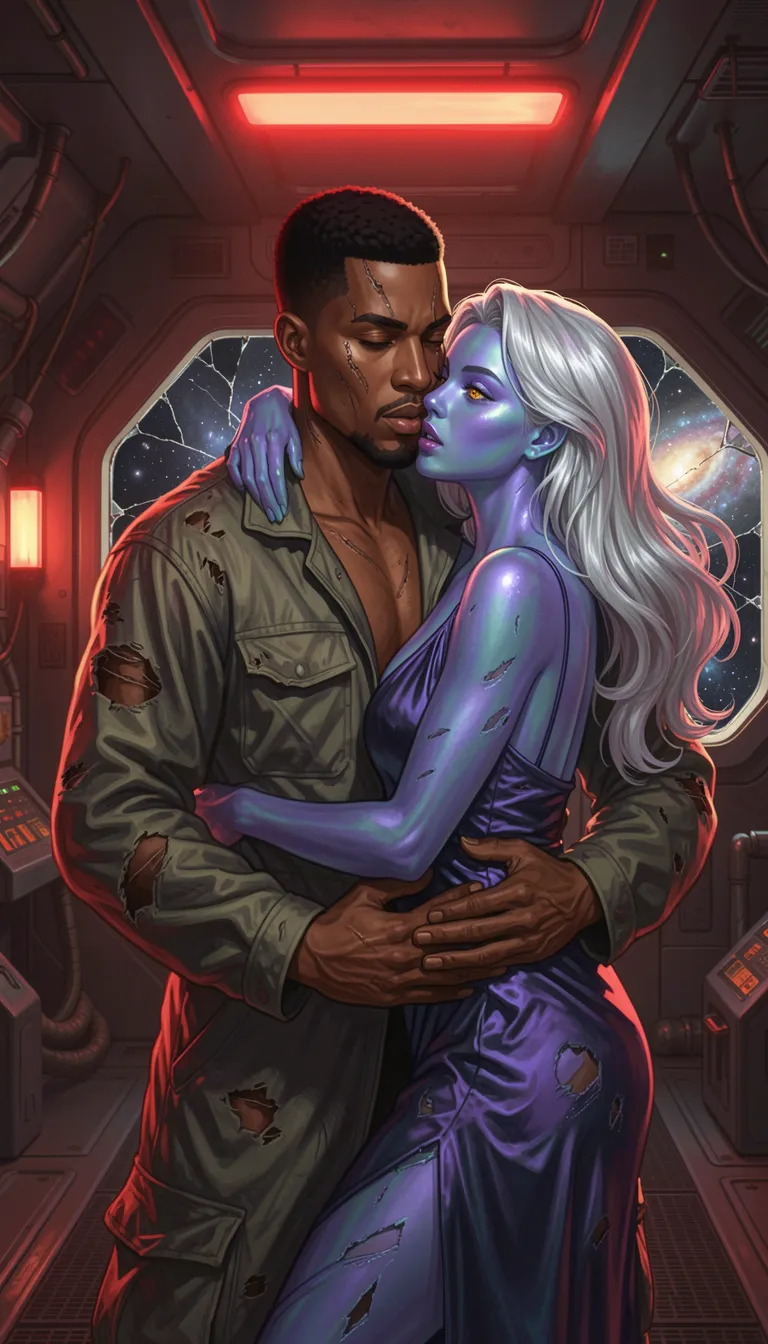
Jennifer Cole stood at the head of the long polished table in her New Jersey office with her hands flat on the wood, and she had not raised her voice once. The screen before Darius held her face at full resolution — the slight shine at her hairline from the overworked climate control behind her, the hazel of her eyes gone hard as bottle glass. The air-conditioning hummed against Darius's skin. Cold coffee and old carpet in his nose. Somewhere down the corridor a hatch cycled and clanged, and the sound carried through the hull like a knuckle on a door.
"A Commonwealth-protected Valkizon house on Monarchy soil," Lord Solis said from his own screen, and he said it the way a man might say a tumor. "On the border of the Kessik Reach. Within three jumps of my delegation's primary relay." His silver-blue skin caught the light of whatever room he sat in and threw it back in a ripple. "You are asking the Council of Kings to hand a foreign power a foothold in our own space and call it charity."
"I'm asking you to call it a colony," Jennifer said.
Sol's hand came down flat on the table in his own transmission feed. Not a slap — a settling, the way a man sets a weight he means to leave there. "A colony with Commonwealth guns on the wall and a Commonwealth captain holding the keys. Do not dress a garrison in a merchant's coat, Ambassador. I have been at this table a long time."
Darius sat two chairs down from his brother and kept his hands where everyone could see them. Malcolm had not moved since the argument began — arms crossed, jaw set, letting the diplomats wear themselves down against each other the way you let a cutting head work through plate before you applied the torch. The old man knew exactly what he was doing. Darius recognized the patience because he'd learned it from him, and because he'd spent three years unlearning it.
"Lord Solis," Jennifer said, and turned her head just enough that her own pickup caught her in profile. "What's your delegation's current assessment of the mana yield off the Kessik shelf?"
The Solari's cat-shaped eyes narrowed. "The shelf is depleted. Every survey in the last decade agrees. There is nothing there worth a survey ship, let alone a colony."
"That's what the last decade of surveys says." Jennifer lifted one hand from the table and touched a control, and a second image bloomed over the wood between them — a seam of crystal in dark rock, lit from within, blue-white and branching like frost on a window. "This came off the shelf eleven days ago. A test bore on a dead moon nobody bothered to name. The seam runs nine kilometers before it goes deep, and it doesn't go thin. It goes wider."
Silence. The air-conditioning hummed. On the screens, Sol's hand was still flat on his table, but the fingers had gone still.
"That's a lie," Sol said, without heat.
"It's a survey report, and you can read it yourself. It's already in your queue." Jennifer straightened. "Here is what I am offering, and I'll say it once, plainly, because we have four hours and I don't intend to spend them being polite. The Monarchy has the mana expertise. Your surveyors, your containment engineers, your guild licenses — the Commonwealth has never run a mana operation at this scale and we both know it. We have the capital and the protection. You have the knowledge." She set her palm down on the table before her pickup. "Joint colony. Monarchy expertise, Commonwealth security. Your council gets a seat at the table and a share of the spoils, and the Valkizon house gets a home that isn't a refugee berth on a ship that's running dark."
Lord Solis's eyes had not left the crystal. "A share," he said slowly. "Named how?"
"Forty percent to the Monarchy, sixty to the Commonwealth and the house, split three ways."
"Fifty-five."
"Forty-five, and the Monarchy holds the guild licensing and the first refusal on any mana weapons contract out of that shelf."
Darius watched the Solari's face on the screen and saw the exact moment the arithmetic closed behind his eyes. It was the same look a man got when a circuit finally took the load you'd been feeding it — the flicker of something settling into place. Lord Solis sat back. He did not smile. But he stopped arguing, and in a room like this, that was a signature.
Sol was slower. Sol was a Corsair, and Corsairs did not care about mana so much as they cared about who held the lane to it. "And the house?" he said. "Whose house? Veyra's? You'd put that woman's clan on a crystal shelf and hand her a charter?"
"Not Veyra's," Jennifer said. "Ova Rehn's."
Darius felt his own jaw tighten before he decided to let it. Ova — six weeks pregnant, holding a calm line to a clan head who'd filed trafficking charges against him, standing in his hold with forty women and children and her husband bleeding in a tube two decks away. Jennifer had just put a colony in her hands without asking her. That was the diplomat's arithmetic. That was also, he suspected, the only arithmetic that got everyone out alive.
"A Rehn," Sol said. "A vendor. A woman who runs a railroad out of a mining station's back corridors."
"A woman who has moved more Valkizon off that station in two years than House Veyra has moved in ten," Jennifer said. "A woman with a human husband and a family that already works. You want a house that holds, Captain. Not a house that claims."
Sol looked at the crystal on the shared display. He looked at Malcolm. Then his eyes came through the screen to Darius, and there was something in the look Darius couldn't read — not approval, not yet, but the door to it left ajar.
"And the captain of this colony," Sol said. "Who holds the keys to the guns?"
Malcolm answered before Jennifer could. "He does," he said, and tipped his head at Darius. "He's got a ship, he's got a crew, and he's got six Valkizon women who'd burn this table to the deck plates before they let anyone else hold it. You want to argue with that, argue with them."
Under the table, Darius's hand found Lyra's.
She had been so still he'd half forgotten she was there — a willowy length of shadow in the chair beside him, her galaxy hair gone dim under the conference lighting, one silver eye and one midnight-blue fixed on the screens with the patient attention of a woman watching a star die. Her fingers were cold. They closed around his without a sound, and he felt the faint hum of the bond rise in his chest and skull, the way it always did when she touched him — a note held low, waiting.
"They're not wrong," Lyra said, quietly, to no one in particular. "The shelf is a grave. It has been a grave for a thousand years. But graves make good foundations. The dead don't argue about property lines."
Sol stared at her through the screen. "Your father is a mage of the seventh circle, girl. Does he know you talk like a pirate?"
"He knows I talk like myself," Lyra said. "He finds it exhausting."
Ogner's laugh came through the speaker grille before Sol could answer — a rockfall of a sound from the Iron Verdict, holding station off the Hercules' flank. "I'll take the girl's grave and the crystal both," he said. "And I'll take the Rehn woman's name on the charter, and if Veyra Sol doesn't like it she can file another complaint and I'll file one back about her face."
"That's not a legal argument," Jennifer said.
"It's the only one that's gotten anything done in four hours."
The room leaned in. Darius watched it happen — the shift of weight around the table, the way Sol's shoulders came down a fraction on his feed, the way Lord Solis's silver-blue hand moved to rest on the survey report as if claiming it before anyone could take it back. The war council had been a room full of people who wanted different things. Now it was a room full of people who had found a way to want the same thing at a profit, and that, he had learned in three years of watching commanders and contractors and warlords, was the only kind of peace that ever held.
Ogner's voice came back through the grille, slow and deliberate, the way a man sets a second weight on a table he already owns. "One more thing, and then I'll stop talking. The Corsairs want a guild base on site. Not a Monarchy survey office, not a licensing bureau with a clerk and a stamp. A guild hall, our own docks, our own people on the ground, and a share of the mining operations to go with it." A pause, and Darius heard the grin in it. "I know what that does to your council, Solis. That's rather the point."
Lord Solis's silver-blue hand came off the survey report and flattened on his table. "Absolutely not," he said. "You would put a Corsair guild on a mana shelf and call it protection. The council will read it as a raid with paperwork. They will read it as a raid with paperwork and they will be right." He drew a breath. "And if the guild holds mining control, the official houses are cut out of the shelf entirely. You know this. You are asking me to hand my own council a knife and tell them it's a spoon."
"I'm asking you to give the Corsairs a reason to hold the lane that isn't a favor to you," Ogner said. "Favors get forgotten. Property gets defended."
The silence stretched. Darius watched Lord Solis's face on the screen, the cat-shaped eyes gone narrow, the jaw working — a man doing arithmetic he did not like and could not refuse. Then a new voice came onto the channel, dry and unhurried, from a room Darius could not see. "I'll back the guild base," Lyra's father said. "A Corsair hall on that shelf is a wall I don't have to pay for. Let it stand."
Lord Solis closed his eyes for a moment. When he opened them, the fight had gone out of his face and something harder had taken its place. "Fine," he said. "With Vane's backing it will go through the council, and I will be the one who has to sell it to them. This is going to be a major issue, and I will be hearing about it for a decade." He looked at Ogner's feed. "You wanted to piss off my council, war-captain. You have succeeded beyond your ambitions."
"Then we have the shape of it," Malcolm said, and reached for his mug. "Jennifer drafts the charter language, Solis takes the licensing question back to his council, Sol and Ogner hold the lane while we move the house. Four hours is four hours. I want —"
Ember's voice cut through the room like a blade through silk.
"Captain. Priority intercept, all channels, unencrypted." The construct's tone had lost its usual dry warmth. It was flat. It was the voice of a machine delivering a number it did not like. "A Keth strike group has hit the Monarchy base at Hallow Reach. Openly. No false flag, no proxy. Their banner is on the transmission."
The map on the wall went red.
Darius was on his feet before he decided to move. The overlay bloomed across the table's far wall — a star chart of the Eldora approaches, the base at Hallow Reach a bright hard knot at the center, and around it, spreading like ink through water, the Keth markers. Twelve ships. Then fourteen. Then the count kept climbing as Ember fed the intercept through the Hercules' own sensors and the station's relay and every dot that could see what was happening out there and agree.
Lyra's hand had not let go of his. He had not let go of hers. Under the table, in the sudden red light, that was the only thing in the room that was not moving.
"Hallow Reach is forty minutes from Eldora," Malcolm said. His voice had gone very calm, which was how Darius knew the old man was furious. "That's the gate. That's the only gate."
"It's not the gate," Sol said. "It's the door to the gate. And they're not hitting it to take it. They're hitting it to be seen hitting it." He turned from the map to Jennifer's screen. "Ambassador. Your joint colony just became the most valuable piece of rock in two sectors, and the Keth just announced to the whole galaxy that they know it. They're not here for the base. They're here to make sure nobody builds anything on that shelf before they do."
"How long?" Jennifer asked.
"Until they hold Hallow Reach?" Malcolm shook his head. "Six hours. Maybe eight. Then they own the approach and every ship that wants to reach Eldora buys a Keth pass or dies in the dark."
Darius looked at the map. He looked at the red spreading out from Hallow Reach like a wound opening, and he felt the old thing rise in his chest — the cold, clear thing that had kept him alive through the worst of the war and had nearly killed him after. The thing that counted exits and fields of fire and the number of people you could save if you were willing to spend the ones you couldn't.
He had spent his whole squad on that arithmetic once. He had spent Amara. He was not going to spend these six.
"Ember," he said. "Get me a count. Every ship we have, every gun we have, every body that can hold a rifle and every body that can hold a wrench. I want it on the table in ten minutes."
"Already compiling, Captain." A pause. "And Darius — the Keth transmission isn't a demand. There's no demand in it. It's a recording of them burning the base's outer ring, and then a single line of text."
"Read it."
Ember read it. "'The human who took the Valkizon will be brought to us. The rest may leave.'"
The room went silent in a way that had nothing to do with the air-conditioning. Darius felt Lyra's fingers tighten around his — hard, harder than she meant, the cold of them gone warm. Across the table Malcolm's face had gone to stone. On the screens, Sol's hand was flat on his table again, but it was a fist now, the knuckles pale.
"They know your name," Sol said. "They know what you are. That transmission went out on every channel in the sector. Every pirate, every mercenary, every bounty hunter from here to the Reach is going to read it and decide you're worth more alive than the base is worth defended."
"Then we give them a different arithmetic," Darius said.
He let go of Lyra's hand, and he put both of his on the table, and he leaned into the red light. "They want me. Fine. They can have me — at a place and a time I choose, with every gun we've got pointed at the door they walk through. But first we move the house. Ova's people, the children, the line — they go to Eldora under Malcolm's protection and they don't stop for anything. Then we go to Hallow Reach and we make the Keth regret putting my name in a transmission."
"That's a suicide run," Ogner said, and there was no mockery in it now. "You'd be flying into a Keth strike group with a patched freighter and a handful of cruisers."
"No," Darius said. "I'd be flying into a Keth strike group with a patched freighter, a handful of cruisers, and the only mana shelf in two sectors sitting right behind me. They're not hitting Hallow Reach because they're strong. They're hitting it because they're scared. Scared people make mistakes. I've spent three years fixing mistakes. It's time somebody made one for me."
Malcolm looked at him for a long moment. Then he picked up his mug, drank what was left in it, and set it down with a clack. "Jennifer," he said. "Draft the charter. Solis, get your council on the line. Sol, Ogner — you're with me. We've got four hours and about three of them are going to be spent arguing about who gets to shoot first."
The room broke apart into motion — chairs scraping, voices overlapping, the screens splitting into a dozen smaller screens as the captains pulled their own bridge crews in. Darius stood where he was for a moment, his hands still on the table, and felt the hum in his chest settle into something steadier. Lyra had not moved from her chair. She was looking at him with her mismatched eyes, and there was something in her face he had not seen before — not the riddling calm, not the otherworldly distance, but something raw underneath it, like a wire stripped bare.
"They put your name in the sky," she said.
"They did."
"That means they're afraid of you." She stood, and her galaxy hair drifted around her shoulders as if the air in the room had changed. "Good. Let them be afraid. I have been afraid of nothing for a very long time, Darius Cole, and I am tired of it. I would like to be afraid of something again. It would mean I had something left to lose."
He looked at her. The red light from the map caught one side of her translucent face and left the other in shadow, and for a moment she looked less like a woman and more like something you'd see at the edge of a sensor sweep — a shape you couldn't decide was a ship or a star.
"You've got six of us," she said, and her voice had gone quiet and certain. "You've got a ship. You've got a war. And you've got a resonator in the captain's quarters aboard this vessel that has been finished for two hours and is waiting for you to stop pretending you don't know what it's for."
Darius's hand found the edge of the table and held it. "Lyra."
"The council will argue for four hours. You will be needed for all four of them." She stepped close, close enough that the faint wild-berry scent of her rose between them, and the hum in his chest rose to meet it. "But before the arguing, before the red map and the Keth and the colony and the dead, there is one thing that is yours and mine and no one else's. I have waited a long time to be patient. I am done being patient."
She turned and walked out of the conference room, and the hatch closed behind her with a hiss, and Darius stood in the red light with his hand on the table and his heart going like a piston, and he knew — with the same cold clarity that had kept him alive through the war — that he was going to follow her.
Malcolm caught his eye across the room. The old man didn't say anything. He just tipped his head, once, toward the hatch — the same way he'd tipped it thirty years ago when Darius was a boy and there was something he needed to go do and his father understood without being told.
Darius went.
The borrowed captain's quarters aboard the Hercules were smaller than his own cabin on the Cobalt Dragon and colder, built for a Monarchy officer who liked his walls bare and his air thin. The hatch sealed behind him. The lights were low, and the resonator sat on the desk at the foot of the bunk — a lattice of silver and crystal the size of a fist, humming faintly, its surface moving with slow light like something breathing.
Lyra was standing at the far end of the room with her back to him, and she had already taken off her jacket. It lay on the floor. Her pale translucent skin caught the resonator's glow, and her galaxy hair drifted around her shoulders, and she was wearing a sheer gown the color of deep space, and underneath it, nothing.
She turned. Her mismatched eyes found his. "You took your time."
"I had a war council."
"You had a choice." She crossed the room slowly, and the sheer gown moved over her hips and her thighs and the long lines of her body, and Darius felt his dick thicken against his thigh, felt the heat of it climb his spine. "You could have stayed with the map and the red and the dead. You came here instead. Why?"
"Because you asked."
"No." She stopped a pace away. "Because you wanted to. Say it."
The bond hummed in his chest, and he felt her through it — the wild-berry scent rising off her skin, the quickness of her breath, the ache she had been holding back for weeks. "Because I wanted to," he said.
"Good." She reached up and set her palm flat against his chest, and the hum jumped between them like a struck wire. "Now take me into the bond. All the way. No stages, no patience, no counting. I want to feel what you are, Darius Cole, and I want you to feel what I am. I have been hiding for a very long time. I am done hiding."
He put his hand over hers, and closed his eyes, and reached.
The world fell away. And then it came back — different. A temple, not a room. Stone columns rose into a dark vaulted ceiling, and between the columns hung a sky full of stars, close enough to touch, and the floor was black glass that reflected them so that he stood in the middle of a galaxy that went down as far as it went up. Lyra stood at the center of it in the sheer gown, and the gown was the only thing she wore, and she was looking at him with her mismatched eyes and her chin lifted and her hands at her sides, and she was trembling.
"This is my mind," she said, and her voice echoed off the stone and the stars. "This is what I keep behind the riddles. Are you disappointed?"
Darius crossed the black glass floor to her. He did not answer with words. He took her by the waist and pulled her against him and kissed her, hard, and she made a sound into his mouth like a wire snapping — and then her hands were in his hair and her body was against his and the temple was full of the sound of her breathing and the hum of the bond rising through both of them like a tide.
He broke the kiss. "Nothing about you disappoints me," he said. "Nothing. Say you understand that."
"I understand it." Her voice had gone rough. "I don't believe it yet. Make me believe it."
He picked her up. She wrapped her legs around his waist and her arms around his neck, and the sheer gown bunched between them, and he carried her to the low stone altar at the center of the temple and laid her down on it. The stars moved overhead. The bond hummed. He looked down at her — the pale translucent skin, the galaxy hair spread across the stone, the mismatched eyes looking up at him with something that was not fear but was close to it — and he understood, finally, what she had been asking for all along. Not to be handled gently. To be met. To be taken by something as wild and untamed as the thing she kept behind her riddles, and to be left standing on the other side of it.
"You want wild," he said.
"I want you."
He took the sheer gown in both hands at the neckline and tore it down the middle. The sound of it split the temple — a long wet rip that ran off the columns and came back changed. Lyra's breath caught, and her hips came up off the stone before her mind had agreed to it, and the wild-berry scent of her rose so thick he could taste it at the back of his throat. Under the torn fabric her body was all one pale length, translucent enough that the starlight seemed to pass through her thighs and come out the other side.
"Again," she said. "Do it again."
He caught the two halves of the gown and pulled them apart down to the hem, and she arched into the tear like a woman offering her throat. The fabric came away in his fists. He dropped it. It fell to the black glass and lay there reflecting stars, and she was naked on the altar with her galaxy hair fanned out around her head and her mismatched eyes fixed on his face, and she was not trembling anymore.
He put his hands on her knees and opened her. She let him. Her thighs fell apart across the stone with no resistance at all, and the starlight caught the wet shining between them, and Darius looked at her until she made a small, raw sound and turned her face away.
"You said no hiding," he said.
"I said —" Her voice cracked. She turned her face back. "I said I was done hiding. I did not say it would be easy."
He lowered his mouth to the inside of her thigh and dragged his tongue up the length of it, slow, all the way to the crease of her hip, and she jerked under him and her hand came down on the back of his head and her fingers knotted in his hair. The bond jumped. He felt the echo of his own mouth on her skin come back at him through the circuit — the wet heat of his tongue, the scrape of his jaw — and his dick went hard enough to ache.
"Darius." His name came out of her in pieces. "Darius, that is — the bond is — I can feel you feeling me."
"Good." He said it into her skin. "Then you know what I want."
He put his mouth on her. She came off the altar. Her back bowed and her heels dug into the stone and the sound she made was not a word in any language he knew, and the temple shook with it — a fine dust of stone sifting down from the vault, the stars overhead shivering in their courses. He held her hips down with both hands and worked his tongue into her, and she was wet and hot and her taste was wild berries and salt, and every stroke of his tongue came back to him doubled through the bond until he could not tell which of them was being touched.
"Stop," she gasped. "Stop, I'll — I'll spend before you're inside me, and I want —"
He lifted his head. His jaw was slick. "Then say what you want."
"You." Her chest heaved. "Inside me. All of it. I want to feel you split me open, Darius Cole, I want to feel every inch of that —" she gestured at him, at the front of his trousers, and her pale throat worked as she swallowed, "— that thing you're carrying, and I want you to use me until I cannot remember my own name, and then I want you to say it back to me."
He stood. He got the belt open and the trousers down and his dick came out into the cold temple air heavy and thick and dark, and Lyra's eyes went wide and then narrow and then very, very bright.
"That is not going to fit," she said.
"It will fit." He stepped between her knees. "You were built for it. You told me so."
"I was being poetic."
"Then be quiet." He dragged the head of his dick through the wet of her, up and back, up and back, and her whole body followed the motion, her hips chasing him. "And find out."
He pushed in. Just the head, and she cried out and her nails raked down his forearm, and the bond slammed open between them like a door blown off its hinges — he felt the stretch of it in his own body, the impossible fullness, the burn, and under it a pleasure so sharp it was almost a wound. He stopped. He breathed. She was gripping him so tight he could feel her pulse around him, a hot drumbeat, and she was saying something over and over that might have been his name.
"More," she said. "More, don't you dare stop, I want —"
He drove the rest of the way in. She screamed. The columns rang with it. He was buried to the root in her and her hips were flush against his and her galaxy hair had lifted off the stone entirely, drifting in the air around her head like a slow storm, and the stars overhead had begun to move wrong — not the slow wheeling of the sky but a quickening, a churn.
"Lyra." He got a hand under her jaw and turned her face to his. "Look at me. Look at me."
Her mismatched eyes found his. The silver one was streaming light — actual light, spilling down her cheek like a tear made of it. "I'm here," she said. "I'm here, I'm — oh, you're so deep, you're in me all the way to the —"
He pulled out until only the head remained and drove back in, and she broke off into a sound that had no shape. He did it again. Again. The altar scraped across the black glass under the force of it, half an inch at a time, and the bond was a live wire running from his chest to hers and back, and he could feel the other five women somewhere at the far end of it, distant, stirring, feeling this without knowing what they were feeling.
"Harder," she said. "I said wild, Darius, I said —"
He gave her wild. He got both her wrists in one hand and pinned them above her head on the stone, and he put his other hand flat on her belly and held her down, and he fucked her the way the old thing in his chest had always wanted to — no counting, no patience, nothing held back. Her legs locked around his waist. Her heels dug into the small of his back. The altar screamed across the glass and the columns shed dust and the stars overhead spun faster and faster until they were not stars anymore but streaks of light, a whole galaxy whipping around the temple like water going down a drain.
"I'm going to —" Her voice climbed. "Darius, I'm going to, I can feel it coming up through the bond, I can feel you too, I can feel —"
"Then come," he said. "Now. With me."
She came. It went through her like a fracture — her spine bowing, her mouth open on a sound with no air behind it, her cunt clamping down on him in waves that he felt in his teeth. And then it went through him, the bond carrying her orgasm into his body whole, and he came with a shout that echoed off the vault, spilling into her in long hot pulses, and the light in her silver eye burst outward and filled the temple.
The stars stopped.
For one breath there was nothing but white — no stone, no glass, no Lyra, no him — and then the white drew back and the temple was still there, and the stars were still there, and they were arranged differently. He saw it from where he lay half across her, still inside her, both of them shaking. The constellations had moved. They made a shape he did not recognize, a long spiral with a bright knot at its center, and it was turning slowly, patiently, like something that had been waiting a very long time to be looked at.
Lyra laughed. It came out of her cracked and wet and astonished. "Oh," she said. "Oh, that's what it was for."
He lifted his head. "What was what for?"
She was looking past him, at the spiral, and her mismatched eyes were both full of light now, silver and blue, and her hand came up and her fingers closed on nothing and the nothing resisted them — the air itself went thick and bright between her fingers, and a thread of blue-white light drew out of it like a fiber pulled from a loom.
"Mana," she said. "I can see it. I can — Darius, I have never been able to see it, my father is a mage of the seventh circle and I could not light a candle, and now I can see the whole of it, it's in the stone, it's in the stars, it's in —" She looked down at where their bodies were still joined and her breath caught. "It's in you."
The bond rang. Not hummed — rang, all six notes of it at once, and he felt them all turn toward him down the wire: Nyla's sharp alarm, Mira's cool wonder, Zara's joy like a struck bell, Sera's warm steadying, Kaela's bright whoop of a feeling that had no words in it. Five women somewhere on the Hercules feeling a sixth come awake, and none of them knowing what it meant. And it came back to him through the wire in five different temperatures — Nyla's shock a hot electric prickle that made her drop her spanner and sent it skidding across the deck; Mira's a cold clean wash that lifted her a finger's width off her chair and left her gripping the desk; Zara's a warm flood that floated a rack of test cylinders up out of their cradle and spun them slow; Sera's a gentle heat that made her press both palms to her own chest and breathe; Kaela's a bright tingling that flung a datapad out of her hand and clattered it off the bulkhead. None of them knew what it meant. All of them felt it.
Darius eased out of her and she made a small hurt sound and caught his wrist. He turned his hand over and looked at his left forearm.
A new band had formed below the others. It was not a color he had a name for — it shifted as he watched, silver to blue to a deep violet-black and back, the way her hair moved, the way her skin caught the light. It was warm. It was alive. It sat against the crimson and the violet and the amber and the blue-violet — the four marks of the first stage, the four he had taken as far as the first stage went — as if it had always been there and the arm had only just been shown the truth of it. Sera's place on the wire was still quiet, still waiting, and he felt the absence of it like a held breath.
Lyra propped herself up on one elbow and looked at it, and then at him. Her hair had settled. The light in her eyes had banked down to an ember, but it had not gone out, and he understood that it never would now.
"Well," she said, and her voice was the old dry one again, the riddling one, though it had a new crack running through it. "That explains the family disappointment."
He laughed before he could stop himself — a real one, from the belly, the first in what felt like years — and she watched him do it with an expression he could not name, and outside the temple, in the cold borrowed cabin, the resonator on the desk had gone dark and quiet, its work done.
"Ember's going to want to know about this," he said.
"Ember can wait." Lyra sat up, and the starlight moved over her bare shoulders, and she reached out and laid her palm flat on his chest, over the hum. "The council has three hours left. And I have just discovered I can pull light out of the air with my hands." Her mismatched eyes came up to his. "I think, Captain, that we should find out how much of it I can pull before the Keth arrive."
The Cobalt Dragon's lounge smelled like hot metal and somebody's reheated noodles, and the curved wall monitor had been split three ways — Jennifer Cole's face in the center panel, her hair now pinned back off her forehead, the climate control in her New Jersey office still fighting a losing war; Lord Vane on the right in a chamber of black stone and candlelight, his Elcorian features sharp as cut glass; and on the left, a Corsair bridge with the Widow's Due's command chair and Sol's boots propped on a rail behind him.
Ova Rehn stood in front of all three of them with her arms crossed over her chest and her jaw set, and she had not sat down.
"You want me to be the face of a colony," she said. "A colony on a mana shelf. A colony with a charter and a council seat and a Corsair guild hall on the dock. And I am hearing about it for the first time from a woman on Earth I have never met, while my husband is in a tube two decks down and forty of my people are sleeping in a cargo hold."
"You're hearing about it now," Jennifer said.
"That is not the same as being asked."
Lord Vane's candlelit face tilted a fraction. "No. It is not." His voice carried the dry patience of a man who had spent a long life being the slowest and most dangerous thing in any room. "But you were not asked, Rehn, because you were not available to be asked. You were on a station running a railroad through the back corridors of a mining operation, moving women out from under a clan head who would have skinned you alive if she'd caught the pattern, and every hour you spent doing it was an hour nobody could put your name on a charter."
"I know what I was doing."
"You know what you were doing." Vane's pale eyes did not blink. "Did you believe nobody else did?"
The question landed in the lounge and sat there. Behind Ova, at the kitchen counter, one of the refugee women had stopped wiping down a pot and was pretending very hard to be somewhere else.
"The council has eyes in the Kessik Reach," Vane said. "The council has had eyes on Tarn's Rest since before you were born. Did you think a vendor with a human husband and a family that moved forty women a year through a station's maintenance tubes was invisible? Did you think the Monarchy did not know?"
Ova's arms came uncrossed. Her hands found the back of a chair and held it.
"We knew," Vane said. "We turned a blind eye because it was an internal Valkizon affair, and because the women you moved were not slaves and not criminals and not our problem, and because — this is the part you will not like — because we were watching to see whether you were worth anything." A pause. "You were. That is why the human-Valkizon couples came your way. The ones who needed a quiet berth and a woman who would not sell them. We sent them. Not the council, not the guilds — a handful of us, quietly, to a vendor on a mining station, because we had decided you could be trusted with them."
Ova's knuckles went pale on the chair back. "You used me."
"We used you the way a mason uses a good stone. You held." Vane leaned back in his chair, and the candlelight moved across the black of his collar. "But the shadow games are finished, Rehn. The Keth have put a human name in the sky and burned a Monarchy base to make sure everyone heard it. There is no more quiet. There is a charter, and a shelf, and three days of council argument, and a woman who has to stand in front of that council and be believed. That woman is you."
"Can you handle it?" Jennifer asked.
Ova turned her head and looked at the center panel for a long moment. "I ran a railroad under a clan head's nose for two years," she said. "I lied to Veyra Sol on an open line this morning with my children's names in her mouth. I can stand in front of a council."
"That's not what I asked."
The hatch behind them hissed open.
Toma Rehn came through it on his own two feet, and he was dressed — a clean grey work shirt, the sleeve rolled, the collar open at his throat. He was limping, the left leg coming down stiff and careful, the reconstruction tube's new skin still pink and shining where it showed above his boot. Sera Vale walked at his shoulder with one hand hovering near his elbow and not quite touching it, the way a medic walks beside a man who has told her twice to stop fussing.
"We can handle it," Toma said.
Jennifer's face on the monitor changed. The hardness went out of it — not all the way, but enough that Darius would have recognized it if he'd been in the room, the way a commander's face changed when a name came back from a casualty list. "Toma Osei," she said. "It has been a long time."
"Ambassador." Toma came around the end of the sunken conversation pit and stopped beside his wife, and he put his hand on the small of her back, and Ova leaned into it without seeming to decide to. "You look well. Still keeping the climate control at war with itself, I see."
"Still." Jennifer's mouth moved toward something that was almost a smile. "I'm glad you found a place, Toma. I wondered, after you left the service. I wondered for a long time."
Ova turned her head. "The service."
Toma looked down at her, and there was something in his face she had not seen in a while — not the quartermaster's calm, not the retired man's patience, but the older thing underneath them. "I was one of hers," he said. "Before you. Before the children. Before I decided I was done being a dangerous man." He nodded at the monitor. "I ran errands for the Ambassador in places where her name could not go. It's how I learned to move people quietly. It's how I learned the railroad before there was a railroad."
Ova was quiet for a moment. Then she said, "You never told me."
"You never asked me what I was before." He said it gently. "And I was not proud of all of it. I am proud of this."
Vane's voice came from the right panel, unhurried. "The ruling will take three solar days to pass. The council will argue the licensing, the guild hall, the share, the security clause — Solis will fight it and then he will sell it, because he has already seen the crystal and he is a practical man. But the charter does not pass on Solis's word or mine or the Ambassador's. It passes on the floor, with the house named and the house head standing in the chamber to answer for it." He looked at Ova. "You need to be on the planet when it happens. Not on a ship running dark. Not on a relay. On the floor, in the chamber, with your husband and your children behind you and your name on the document."
"Eldora," Ova said.
"Eldora."
The hatch hissed again, and Darius came through it with Lyra at his side.
He had not meant to walk into a council. He had meant to get Lyra to the med bay and find Sera and put the whole impossible thing in front of her before the three hours ran out and the arguing started again. But the lounge was on the way, and the hatch was open, and so he came through it with his hand still at the small of Lyra's back and the new band on his forearm warm under his sleeve, and the room turned to look.
Lord Vane came up out of his chair.
"Gods," he said, and his dry voice had cracked wide open. "Gods, look at her. Look at the light."
Lyra stopped. Her galaxy hair had not settled — it drifted around her shoulders in a slow current that had nothing to do with any air in the room — and the silver of her one eye was still throwing a faint shine, like a lamp behind frosted glass, and the translucent pale of her skin had gone luminous at the edges in a way that made the lounge's low lighting look shabby beside her.
"Father," she said.
"You ascended." Vane came around his own desk, and the candlelight in his chamber swung with him, and his face on the monitor was the face of a man who had stopped being a diplomat and become, for one unguarded moment, a father. "Mana level one. You — you could not light a candle. I tested you myself when you were six years old and you sat in the dark and cried and I told you it did not matter and I lied. And now —" He laughed, short and astonished. "How? What did it? Was it the bond? Was it the human?"
Lyra's mismatched eyes slid to Darius and back. "It was the bond," she said. "And it was the human."
"A level one ascension at your age, in a borrowed cabin, on a ship running from a Keth strike group." Vane shook his head slowly. "I have spent forty years studying the circles and I have never heard of it. Sera — Sera Vale, is she there? The Domini's daughter?"
Sera had come in behind Toma and was already moving forward, her honey-brown eyes fixed on Lyra with the flat, hungry attention of a physician who had just been handed a case she had been waiting years for. "I'm here."
"I want tests," Vane said. "Proper tests. Blood, resonance, the full spectrum — I will send you the protocols from the seventh circle, they are old and they are fussy and they work. I want to know what she can hold and what she can pull and whether it will burn her out. A level one who ascends at twenty-one either becomes something extraordinary or she becomes a candle that burns at both ends, and I will not have my daughter be the second one."
"I'll run them," Sera said. "But not in three hours. She needs to eat and she needs to sleep and she needs —" she glanced at Darius, and something in her expression went carefully blank, "— she needs to not be pushed again tonight."
The wall monitor chimed.
It was not the soft chime of an incoming call. It was the hard, flat triple-tone of a priority hail, and every screen in the lounge went to the same image at the same moment, and the image was Veyra Sol.
The clan head of House Veyra sat in a high-backed chair on the deck of her transport with the Kessik Reach burning cold and blue behind her viewport, and her face was the face of a woman who had been patient for a very long time and had just run out. Her iridescent skin had gone dark at the throat and temples, the way a Valkizon's did when the blood ran hot, and her eyes were fixed on the camera with the flat, final attention of a hunter who had found the trail.
"Ova Rehn," she said. "Darius Cole. I have filed my complaint and I have been patient and I have been lied to." Her gaze moved across the split screen, taking in Jennifer, taking in Vane, taking in the lounge behind them. "I am done being lied to. You will bring the six women and the refugees to my transport. You will do it within the hour. You will do it with your hands empty and your weapons cold, or I will bring House Veyra down on that ship and take them, and I will not be careful about who is standing in the way."
Her eyes moved again.
They stopped on Lyra.
Veyra Sol's face changed. The dark flush drained out of her throat and left it grey, and her mouth came open, and the sound that came out of her was not a word — it was a short, raw, wounded noise, the noise a woman made when she saw a thing she had been dreading for years and had begun, finally, to believe would never happen.
"No," she said. "No, no, no — you cannot have —" She came up out of her chair and her hand slapped down on the arm of it and her voice climbed into a shriek that cracked the speaker grille. "I am too late. I am too late. How did you do this? How did you do this so fast? A level one, a level one, in a human's bed, on a ship running from the Keth —" Her eyes swung to Darius, and the hatred in them was not the hatred of a woman who had been robbed. It was the hatred of a woman who had been beaten to a thing she had been racing for. "What are you?"
The hail cut.
The lounge was very quiet. Somewhere in the hold below, a child laughed at something, and the sound came up through the deck plates small and clear and entirely out of place.
Darius looked at the dead screen, and then at Lyra, and then at the new band on his forearm, and he felt the old cold thing in his chest settle into place like a bolt going home.
"Ember," he said. "Get me a count. And get me Malcolm. Veyra Sol just told us what she's afraid of, and I want to know why."
Lord Vane's face on the right panel had gone the color of old ash. The candlelight behind him threw his shadow huge across the black stone, and the shadow shook — not the candles, the man. His hands had come down flat on his desk and his knuckles were pale as bone, and his jaw worked twice before any sound came out of it.
"She knew," he said. "That is what that was. That sound she made." His voice came out low and it came out wrong, scraped raw. "Not a woman discovering a thing. A woman arriving at a thing she has been running toward for years and finding the door already open." He turned his head slowly, as if he could see through the wall of his chamber to the deck of Veyra's transport. "She has been testing for this. She has had the protocols — my protocols, the seventh circle's protocols — in her hands for a decade, and she has been feeding them to her own bloodline and calling it research. She was not coming for six women and a human. She was coming for a furnace she had already built the door to."
Darius stepped fully into the lounge. "Say it plain," he said. "What does she mean?"
"Run the tests." Vane's palm came down on the desk, once, hard enough that the candle flames jumped. "Now. Tonight. Not in three hours, not after the council — now, in that med bay, with the Domini girl's hands and my protocols and no one sleeping until we have a number. If I am right about what my daughter has become, then Veyra Sol has been racing us to a weapon and we have been politely arguing about property lines."
On the center panel, Lord Solis's cat-shaped eyes had gone still. He had been quiet since the hail cut, and now Darius watched the understanding move across the Solari's face the way weather moves across a valley — slow, then all at once. His silver-blue hand came up and covered his mouth.
"Clever," Solis said, and the word came out muffled through his fingers. Then he pulled the hand away and his voice cracked wide. "That clever, fiendish cow. She filed the trafficking complaint to buy time. She wanted the human brought to her transport so she could put him on a bench and cut the answer out of him before anyone else knew there was a question." His fist struck the table. "And we sat here and negotiated a charter."
"Will someone," Jennifer said, and her voice cut through the lounge like a blade through silk, "please explain to me what in God's name is happening on my channel."
Lyra had not moved from Darius's side, but her chin had come up and her mismatched eyes had gone to her father's panel. "They have a right to know," she said. "The humans. All of them in this room. They have earned it and they are about to be asked to die for it."
"No," Solis said. "Not on an open channel. Not before the council is seated. This is a Monarchy matter, Vane, and it stays in Monarchy hands until—"
"It is too late for hands," Vane said. "Look at her, Solis. Look at the light coming off her skin. If it is true — and I have spent forty years learning to read the circles and I am telling you it is true — then it cannot be stopped. Not by a council, not by a silence order, not by the two of us deciding what the humans are permitted to hear. It can only be understood, or it can be feared. I would rather my daughter explain it than Veyra Sol."
Lyra let out a breath. The galaxy hair drifting at her shoulders slowed, settled, as if she had been holding a current in it and had finally let it go.
"In the Monarchy," she said, "there are types. Four of them, and every soul born under the council's sky falls into one. The mundane — no mana in the blood, no psionic reach, nothing. They cannot use it and they are not born with it. But do not mistake that for worthless. The mundane are the builders and the bankers and the engineers and the soldiers. They run the whole machine. They are simply not among the blessed."
She held up one long pale finger.
"The psionic. The mind. The Valkizon are psionic — it is what we are, it is what we have been since before we had a word for it. We feel each other. We reach each other. That is the pride of the race and it is the whole of the pride of the race. Then the ascended — mana in the blood, the circles, the light. My father is ascended. Lord Solis is ascended. And the infused, who take the mana in later, through the body, and make it part of themselves by force."
She held up a second finger, and then a third, and Darius understood she was counting something out for him alone.
"One blessing each. That is the law of it. It is extremely rare for a soul to carry two — rare enough that when it happens the council opens a file and the guilds send a letter. And three?" Her mouth twisted. "Three is a story you tell children to frighten them into behaving. No one in living memory has carried all three."
"And the Valkizon," Darius said. "What happens when one of yours has mana?"
"Then she does not have the reach." Lyra's voice had gone quiet. "The two do not live in the same body. A Valkizon born with mana in her blood is born without the psionic gift — she is cast out of the pride of her race, quietly, kindly, and she is sent to a Monarchy school to be taught the circles instead. And a child born of a psionic and an ascended, or a psionic and an infused?" She looked at her father's panel. "The reach comes out weak. Or the child comes out different. Wrong-shaped. A candle that will not light."
Her hand came up and touched her own chest, over the hum.
"Like me."
The lounge was silent. Somewhere in the hold a hatch clanged and a child's voice rose and was hushed.
"I tested as mundane," Lyra said. "My father tested me himself when I was six and I sat in the dark and cried and he told me it did not matter and he lied to me. And then when I was eleven I decided he had lied badly and I would fix it myself, and I stole a sliver of raw mana out of his study and put it in my arm with a needle because I had read that the infused took it through the body and I thought — I was eleven — I thought if a needle worked for them it would work for me." She smiled, and it was not a good smile. "It nearly killed me. My father found me on the floor of his study with my heart going wrong in my chest, and he held me and he pulled the mana out of my blood with his own hands and it cost him — he was grey for a month. And then he grounded me for two years. Two years away from the study, away from the circles, away from every room in the house with a crystal in it. He kept me in the country where there was no mana in the ground and nothing to breathe in."
"It was the only thing I could think to do," Vane said. His voice had gone very quiet. "I could not cure her. I could keep her alive."
"You kept me alive," Lyra said. "And you kept me small." She turned back to Darius, and the light in her silver eye had come up again, banked but steady. "But tonight the bond did what eleven years of my father's careful distance could not. Something in you opened the door I was born without. And if a human can do that — if a human's touch can wake a mana gift in a Valkizon who was born to have none — then think, Darius. Think what a child born of a human and a Valkizon would be. Not one blessing. Both. The reach and the light in the same small body, and no reason for either to come out weak, because the human blood is not psionic and not ascended and does not compete with what the Valkizon brings. It fills the gap."
"Gods," Solis whispered.
"And the fact that he woke mine," Lyra said, "is the proof. Not a theory. Not a survey. A working example standing in front of you with a new band on his arm. That is what Veyra Sol has been trying to reach for ten years with her protocols and her bloodline and her quiet little tests. She wanted a human of her own to put on a bench. She wanted to find out what a pairing could make before anyone else could. And she is too late, and she knows it, and that is why she screamed."
Darius felt the cold thing in his chest turn over. "Then the Keth," he said. "They are not burning bases over a bounty. They are burning bases because they have done the same arithmetic."
"A race that can carry both blessings," Lyra said, "with the Valkizon birth rates to fill a generation with them. One clan of it would out-reach every house in the Monarchy inside fifty years. The Keth are afraid of exactly one thing in this galaxy, and it is not a patched freighter and a handful of cruisers. It is a nursery."
"And my children," Ova said. She had come forward out of the shadow of the conversation pit, and her arms were folded hard across her chest and her voice was flat and level and dangerous. "Toma's children. Nessa and Tobiah. They have shown nothing. No light. No reach beyond what a child has. If this is true, then my children should be —"
"They have never been tested," Lyra said. "They have never been exposed. They grew up on a mining station with no mana in the rock under their feet and no circle in any room they slept in. A gift that has never been asked for is a gift that has never answered. You cannot know what is in them until someone puts a crystal in front of them and a protocol in a physician's hand." She looked at Ova steadily. "And they are young. That is the mercy of it. Whatever they are, it is still small enough to grow straight."
"Level one," Vane said, and his voice had come back to itself, dry and exact. "She came out of that cabin at level one. Which means the bond did not merely wake the gift — it fed it. A first crossing. And if she and the human were to go further — if the bond were to be completed in the body, not only in the mind —" He stopped. His pale eyes came through the screen to Darius and did not move. "She could reach the fifth circle. I have spent my life at the seventh and I have known three souls who reached the fifth, and two of them are dead and the third is a hermit on a rock in the Reach who will not speak to me. My daughter could reach the fifth, and bear children who carry both blessings stronger than I am."
"Then it changes everything," Solis said. He had come up out of his chair and was already reaching for something off-screen. "Forget the three days. Forget the council's calendar and the licensing arguments and the polite fiction that we are negotiating a mining charter. I am leaving for the floor now. Tonight. I will wake the delegation myself and I will put this in front of them before Veyra Sol can put her version in front of them first." His hand stopped. He looked at Lyra through the screen, and there was something in his face that had not been there before — not the diplomat's arithmetic, something older and more careful. "Child. If this is true, you have just made yourself the most valuable woman in two sectors, and you have done it in a borrowed cabin on a ship running from a war. Do you understand what that means?"
"I understand it," Lyra said. "I have understood it since I was six years old and the test came back blank. I have simply never been valuable before."
"Run the tests," Vane said again, and this time it was not a demand, it was a command laid down like a stone. "Sera Vale. Blood, resonance, the full spectrum. My protocols are on their way to your console now. And Solis — go. Go now. I will follow you to the floor within the hour."
Malcolm's face came up on a fourth panel, and Darius saw that his brother had been listening to all of it with his arms crossed and his jaw set and his coffee gone cold in his hand. "Then we move," Malcolm said. "All of it. The house, the charter, the tests, the fleet. We do not wait for the council to be ready. We make them catch up."
"Captain," Ember said.
Her voice came from every speaker in the lounge at once, and it had gone flat and hard and cold as a bulkhead in vacuum.
"Five Valkizon hulls have just jumped in at the system's edge. House Veyra transponders, all five, running hot and closed. They are not holding station. They are on a direct vector for the Hercules and the Dragon, and their weapons are live."
The map on the wall went red again, and this time the red was moving.
"Time to intercept?" Darius said.
"Four minutes if we sit still. Less if they push their engines." A pause, and Ember's voice came back with something in it that was almost — not fear, Ember did not do fear — but the machine's equivalent, the flat precision of a system that had run the numbers and did not care for them. "Captain. The Hercules is damaged and the Dragon's coils are patched with thermal wrap. We cannot win a stand-up fight against five fresh hulls. But I have a course plotted to Eldora that uses the shelf's gravity well to slingshot us out of their firing line, and the Corsair cruisers are already moving to cover the lane."
"Then we take it," Darius said. He turned to the room. "Everyone. Now. Ova — get your people strapped in and get the children to the center of the hold where the hull is thickest. Sera — Lyra goes with you to the med bay, run whatever you can run while we are jumping, but she is strapped down before we go to lightspeed or she will break her neck on the first lurch. Malcolm —"
"Already moving," Malcolm said, and the panel went dark as he turned to shout orders at his own bridge.
"Vane. Solis. Go to your council. Tell them the truth or tell them a version of it, I don't care which, but get the charter passed and get it passed today." Darius's hand found the back of the chair and gripped it. "And somebody tell Sol and Ogner to put their cruisers between us and House Veyra, because if those five hulls get a clean shot at the Dragon's coils we are all going to be breathing vacuum in four minutes."
"The Corsairs are already forming the screen," Ember said. "Sol's Widow's Due is taking the lead. Ogner is on the flank. Voss is holding the rear." A pause. "They are asking for you on the channel, Captain. All three of them. At once."
Darius looked at Lyra. She was already moving toward the hatch with Sera's hand at her elbow, and she turned her head as she went and her mismatched eyes found his across the lounge, and she did not say anything at all. She did not have to. The new band on his forearm was warm, and the hum in his chest had gone from a note held low into something with a beat in it, a countdown, and he understood that whatever else happened in the next four minutes, the thing she had told him in the temple was already true.
He was going to follow her. He was going to follow all of them.
"Ember," he said, and he was already running for the hatch. "Take us out."
The Hercules and the Cobalt Dragon broke from the dead moon's shadow together, engines flaring, the three Corsair cruisers closing around them like a fist, and behind them the five House Veyra hulls came on with their weapons hot and their transponders screaming, and ahead of them, four jumps and a war away, the crystal shelf waited in the dark.
The deck plates of the Cobalt Dragon had never been built to hold a woman running while a war closed behind her. They rang under Ova's boots like struck iron, every stride a hammer-blow that came back up her shins, and the corridor lights had gone to amber — the ship's own voice telling everyone aboard that her captain had put her in a hard burn. The walls leaned. The floor pressed up against her soles like something trying to be sick.
"Hold the rail and move," she told the woman ahead of her, a pale Valkizon with a bundle against her chest and her hair loose and wet. "Rail, then hand, then foot. Don't look at the ceiling. The ceiling is lying to you."
The hold hatch stood open at the end of the corridor, and through it came the noise of forty frightened people trying to be quiet. Ova had heard that noise before — under Tarn's Rest, in the maintenance tubes, women with children pressed into the dark while boots went by overhead. It was a particular sound. It was the sound of people deciding, all at once, not to scream.
She got them through the hatch. Nessa was already there, her small hands clamped on the frame, her face gone the color of milk. Tobiah was on Sera Vale's hip with his arms locked around her neck and his heels drumming her ribs, and Sera had one hand flat on the bulkhead and her honey-brown eyes going around the hold, counting, counting.
"Forty-one," Sera said as Ova came through. "Forty-one souls and one of them is in a bad way — the elder with the grey braid, she's gone grey in the face too, I think her heart is —"
"You take the elder. I'll take the children." Ova reached for Tobiah, and he came off Sera's hip into her arms and buried his face in her throat. She felt his small heart going against her collarbone like a bird in a fist. "Toma."
"Here."
He came through the hatch last, the way he always came last, and he was limping hard now — the new pink skin above his boot had gone tight and shining and she could see the pain in the set of his mouth — but he had a coil of cargo strap over one shoulder and a mag-wrench in his other hand and his eyes were already up at the hold's ceiling, reading it.
"Center of the hold," he said. "Not the walls. Walls fold first on a hard burn. Center is the spine." He pointed with the wrench, up the long aisle between the cots and the partitions. "There. Where the deck plates cross. That's the strongest deck on this ship and it's where the hull is thickest. Get them there."
The hold had been a cargo bay once. The line had made it a home — cots in rows, partitions strung on wire, a wash station with a hand-pump, a cookpot on a heat plate that had gone cold. Now all of it was a hazard. A cot had already slid two meters across the deck and jammed against a stanchion. Somebody's cooking pot was rolling in a slow, drunken circle, and every time it hit a stanchion it rang.
"Listen to me," Ova called, and her voice went out across the hold and came back off the hull. She had learned to make that voice on the railroad — not loud, not shrill, a voice with a floor under it. "Everyone. Look at me. Not at the ceiling, not at the walls. At me."
Faces turned. Forty-one of them, women and children and two old men and a girl no older than Nessa with a bandage on her arm. Ova had moved most of them herself, one at a time, out of the back corridors of a mining station and into the dark. She knew their names. She knew which ones had been sold and which ones had run and which ones had simply been left behind when their clan moved on.
"We are going to the center of this hold and we are going to sit down on the deck in a circle and we are going to strap in," she said. "The captain is putting this ship through a slingshot around a moon and it is going to be rough. It will be loud. The hull will groan and the lights will flicker and it will feel like the ship is coming apart. It is not coming apart. It is fighting. And it is going to win."
"How do you know?" a woman called from the back, and her voice cracked on the last word.
"Because my husband is standing right there with a wrench and he is the most stubborn man I have ever met," Ova said. "Now move."
They moved. Toma went down the aisles with the strap, cutting lengths and tossing them, and the older children caught them and the women tied them and the deck began to tilt under all of them as the Dragon came around and put her nose to the slingshot. The lights stuttered. Somewhere aft, something heavy broke loose and struck a bulkhead and the whole hold flinched as one body.
"Center," Toma said, and his voice was calm, and he was limping from cot to cot and hauling the slow ones up. "Center, center, keep moving. You — auntie, take the boy's hand. Don't carry him, hold his hand, he can walk. Good. Good."
Ova got Nessa and Tobiah to the deck plates where the struts crossed and sat down with her back against a stanchion and a child on either side of her. Toma came last, as he always came last, and he lowered himself down beside her with a grunt he tried to hide and got his bad leg out in front of him, and then he reached over and put his arm around all three of them at once — his forearm across Nessa's shoulders, his hand cupping the back of Tobiah's head — and pulled them in against his chest.
The deck tilted harder. Someone screamed, short and sharp, and then cut it off.
"Toma," Ova said, low, under the noise. "Your leg."
"My leg is fine."
"Your leg is bleeding through the dressing."
"Then it is bleeding." He looked down at her, and his face was close, and there was sweat at his temple and something steady behind his eyes that had nothing to do with the ship. "Ova. When this is done I will let Sera fuss at me for an hour. Right now I am holding my children."
She let it go. The Dragon groaned — a long, low sound that came up through the deck plates and into the bones of everyone sitting on them — and the hold's lights went from amber to a deep red, and the red made all their faces look like something out of an old story.
Tobiah lifted his head from his father's chest. "Mama. Why is the ship angry?"
Ova looked at her son. Six years old, with his father's hazel eyes and his father's flat, serious brow, and a question in his mouth that was not really about the ship.
"The ship is not angry," she said. "The ship is running. There is a difference."
"Are the bad ships chasing us?"
"Yes."
"Are they going to catch us?"
The deck lurched. A strap came loose somewhere and cracked against a stanchion like a whip, and Nessa flinched and pressed her face into Ova's shoulder. Ova got her hand up and cupped the back of her daughter's head and held her there, and she looked at Toma over the top of it, and Toma looked back at her, and neither of them said the thing they were both thinking.
"No," Ova said. "They are not going to catch us. Do you want to know why?"
"Why?"
"Because I have been running from bigger things than them for two years, in the dark, with less than this." She shifted, got her back more squarely against the stanchion, and her voice came down into the register she used for stories — the low one, the one that made children lean in. "Do you want me to tell you about it?"
Nessa lifted her head. "The railroad."
"The railroad," Ova said.
"You've told us the railroad," Tobiah said, but he said it the way children say a thing they want to hear again.
"Not this part of it." Ova looked past them, at the hold, at the forty-one faces in the red light, and she raised her voice so it carried. "This part is for everyone. Listen. It will give you something to do besides count the noises."
The hold quieted. The pot had stopped rolling. Even the elder with the grey braid had her head up, Sera's fingers on her wrist.
"When I started the railroad," Ova said, "I had a stall in the market and a cart with a bad wheel and a husband who could lift a crate of ore with one arm and a mouth on him that would not quit." She felt Toma's chest move against her shoulder — not quite a laugh. "That was all I had. And I had a list. It was not a long list. Nine women, on a station of thousands. Nine women who had come to me over a year and asked me — some of them in whispers, some of them not even in whispers, just with their eyes — if I knew a way off."
"What did you tell them?" Nessa asked.
"I told them to come back at the change of the shift and to wear something grey." Ova's hand moved on her daughter's back, slow, steady. "The first one was a girl called Senn. She was younger than you, Nessa. She had a bond-mark on her arm and the man who had put it there had sold her contract to a mining crew and she had three days before they came for her. Three days. And I had a cart with a bad wheel."
"What did you do?"
"I put her in the cart under a tarp with a load of scrap over her and I pushed her through the service gate myself, in the middle of the day, with my own two hands, and the guard at the gate knew me and he waved me through because I was the vendor with the bad wheel and the good prices." Ova's mouth moved. "I have never been so frightened in my life. Not before. Not since. My hands were shaking so hard on the cart handle I thought the guard would see them. But he didn't. He was looking at my face, and my face was saying scrap metal, nothing here, move along. "
"And Senn?" Tobiah said.
"Senn is on this ship," Ova said. "She is over there by the wash station with her hair in a braid and a baby on her hip, and she is not a girl in a cart anymore. She is a woman with a family."
Heads turned. A woman at the wash station — young, dark-haired, a child asleep against her shoulder — lifted her hand, uncertain, and then a few of the others lifted theirs too, and the hold made a sound that was not fear.
"Nine women became nineteen," Ova said. "Nineteen became forty. I learned the maintenance tubes. I learned which hatches the guards never opened and which corridors had no eyes on them and which of the station's own people would look the other way for the price of a hot meal. I learned that a woman with a cart is invisible and a woman with a purpose is not, so I made myself a cart and I made myself a purpose and I pushed both of them through that station until the clan head's own people could not tell me from the walls."
The Dragon shuddered. The red light flickered and held. Out beyond the hull, something boomed — the slingshot's first pressure wave, the moon's gravity taking hold of the ship and swinging her — and the deck plates sang under all of them.
"Mama," Nessa said. "Were you ever caught?"
"Once." Ova felt Toma's arm tighten. "A man stopped me in the west corridor with a crate on my cart and a girl under the crate. He put his hand on the cart and he asked me what I was carrying. And do you know what I did?"
"What?"
"I told him the truth." Ova smiled, and it was not a nice smile. "I told him I was carrying a load of scrap and that if he wanted to see it he could lift the tarp himself, and that if he lifted the tarp he would be the man who lifted the tarp, and that when the clan head's people came asking who had been in the west corridor at that hour there would be two names on the list and one of them would be his." She shook her head slowly. "He took his hand off the cart. He never bothered me again. Not once."
"Because he was afraid of you," Tobiah said.
"Because he was afraid of being seen." Ova looked down at her son. "That is the whole trick of it, my love. The people who chase you are not braver than you are. They are just less careful. They are afraid of being caught doing the wrong thing in front of the wrong person. And a woman who has already decided she has nothing left to lose is the wrong person."
The deck lurched again, hard, and this time it did not stop — it kept going, the whole hold tilting up and up, cots sliding, the loose pot ringing off a stanchion and going silent, and someone in the circle began to pray in a language Ova did not know. Toma braced his bad leg against the deck and got his other arm around the stanchion and held all three of them against him, and Ova felt the strap cut into her hip and did not care.
"Hold on," she called out. "Hold on to each other and hold on to the deck and do not let go."
The tilt went past what the deck could bear and the hold's gravity plating whined — a high, thin sound like a kettle — and then the ship came around the far side of the moon and the tilt eased, and the red light went amber, and the deck settled under them like a horse coming down off a jump.
Ova let out a breath she had not known she was holding.
"There," she said. "You see? The ship was fighting. And it won."
Nessa lifted her head. Her eyes were wet and her chin was up. "Mama. Are we going to the crystal place? The one the captain talked about?"
"We are going to Eldora," Ova said. "And then we are going to a shelf of crystal in the dark, and we are going to build a house on it, and it is going to have a garden and a school and a kitchen big enough for everyone in this hold, and no one is ever going to put a bond-mark on a girl and sell her contract again." She said it plainly, because she had learned a long time ago that a promise made plainly was the only kind worth making. "That is what the railroad was for. It was never just to move women in the dark. It was to move them into the light. And we are almost there."
Tobiah sat up. "Will there be a window?"
Ova laughed — it came out of her cracked and surprised, and it made half the hold look up. "A window?"
"In the house. On the crystal place. Will there be a window so I can see the stars?"
"There will be so many windows," Ova said, "that you will be sick of stars."
Toma's hand came up and cupped the back of her neck, and she turned her head and found his face close and his eyes wet in the amber light, and he did not say anything at all. There was nothing to say. He had been a dangerous man once, before her, before the children, before he decided he was done — and she had known that, or thought she had, and had learned only an hour ago that he had been the Ambassador's man, that he had learned the railroad before there was a railroad, that the quiet quartermaster's calm had been built on top of something older and harder. She had not asked. She was not going to ask now. He was holding her children and his leg was bleeding through the dressing and he was here, and that was the whole of what she needed.
The deck plates hummed.
Ova felt it before she understood it — a change in the vibration under her thighs, under her palms, a deepening of the ship's voice. The engines were still fighting the slingshot, still roaring somewhere aft, but this was not the engines. This was lower. This was in the struts, in the deck, in the hull itself, a slow rising note that came up through the plates and into her bones like a finger drawn along the string of an instrument.
Around the hold, heads came up. The woman with the braid — Senn — turned her face toward the hull. The elder with the grey braid sat up straighter under Sera's hands. The pot on the deck began, very faintly, to ring.
"What is that?" Nessa whispered.
Ova did not answer. She put her hand flat on the deck plate and felt it come through her palm — not a shudder, not a tremor, something with a pitch to it, something singing, and it was not the engines and it was not the hull and it was not anything the ship's builders had put in her.
She turned her head and looked at Toma.
He had gone very still. His hand was flat on the deck too, his fingers spread, and his face in the amber light had the look of a man hearing a thing he had heard once before and never expected to hear again. He met her eyes, and he did not have to say it. She could see it in him — the same note, the same singing, coming up through the deck of a ship running from a war, and the two of them knowing, without a word between them, that whatever was waking in the struts of the Cobalt Dragon was not going to stay in the struts for long.
Ova got her hand off the deck and onto the stanchion and pulled herself up. The deck was still canted a few degrees off level from the slingshot and her boots wanted to slide, so she set them wide and took her weight on the balls of her feet, the way she had learned to stand on a cart with a bad wheel.
"Mama," Nessa said, and her small hand came up and caught at Ova's trouser leg. "Mama, don't."
"Sit down, love. Stay with your father."
"Don't go."
Ova crouched and got her hand around the back of her daughter's head and put her mouth close to Nessa's ear, close enough that the words were only for her. "I am going to go and put my hand on that wall and find out what is singing. That is all. I will be four steps away and you will be able to see my boots the whole time. Can you count to four?"
Nessa's chin trembled. "Yes."
"Then count." Ova kissed the top of her head and straightened.
Toma's hand came up and closed around her wrist. He did not pull her down. He held her there a moment, his thumb pressed hard into the inside of her wrist where the pulse ran, and his eyes went past her to the bulkhead and then came back.
"It is not the engines," he said, low, under the hold's noise.
"I know it is not the engines."
"Ova. On the Samson, when the reactor took a bad load, there was a note that came up through the deck before the alarms. Like a glass rim under a wet finger. I heard it once in eleven years and they put us in suits." His grip tightened. "If it is that, you do not go near the wall."
"It is not that." She said it flat, with the floor under it, because she had heard the note too and she knew what it was and it was not the reactor. "The reactor is aft. This is here. This is under my feet."
He let her go. He did not like letting her go, and he did it anyway, which was the whole of why she had married him.
The hold had gone quiet around her in a way that was worse than noise. Forty-one faces tracking her as she crossed the deck plates — the woman with the braid, the elder with her wrist still in Sera's fingers, the girl with the bandage sitting up now and watching with her mouth open. Ova stepped over a cargo strap. She put her boot around the loose pot, which had begun to ring again, a thin bright sound that came and went with the deeper note under it, and she nudged the pot into the lee of a stanchion where it could not roll.
Four steps. She counted them off for her daughter and for herself.
The bulkhead was the port side of the hold, a long run of deck plate and frame with a seam of weld down the middle where the original cargo bay had been cut and joined to the new section. Ova had looked at that weld a hundred times in the last week without seeing it. Now she saw it. The seam had a faint line of light in it, no wider than a hair, and the light was not the amber of the corridor lamps and it was not the red of the hard burn. It was the pale blue-white of a crystal seam in dark rock.
Her hand went flat against the metal before she had finished deciding to put it there.
The cold hit her first. Then the note.
It came up through her palm and into the heel of her hand and it did not stop at the wrist. It went up her forearm along the bone, a fine vibration that made the small hairs stand, and then it was in her elbow and her shoulder and then it was in her chest, low, under the breastbone, and her breath came out of her in a sound she had not meant to make. It was not pain. She had felt pain, and this was not that. It was the feeling of standing too close to a great bell while it was being struck, the moment after the striker falls and before the sound arrives, when the air itself has gone thick and the bones have already answered.
She pressed harder. The metal was warming under her hand.
"Ova." Toma's voice, from behind her. "What do you feel?"
"It is in my chest." Her own voice sounded strange to her, muffled, as if she were speaking through a hand. "It is not the wall. It is coming out of the wall and into me and it is —" She laughed, and the laugh was short and frightened and delighted all at once. "Toma, it is in my teeth."
The deck plates under her boots began to glow.
Not the whole deck. A patch of it, a hand's width from her left boot, the pale blue-white of the seam, and then another patch, and another, spreading out from where she stood in a slow ring like water finding the low places in a road. The light came up through the diamond tread and made the tread throw small hard shadows, and it lit the undersides of the cots and the tangle of cargo straps and the faces of forty-one people sitting on a deck in the dark.
"Get back," Toma said, and he was already on his feet, his bad leg dragging, his hand out. "Everyone get back from her, get to the far wall —"
"No." Ova turned her head. "No, do not run. If it were going to hurt me it would have hurt me already. Look at it. It is not fire. It is not a breach." She lifted her free hand and turned it over in the light, and the light lay on her palm and did not burn it. "It is the ship. The ship is —"
She stopped.
Because it was not the ship. That was the thing she had been circling and had not let herself say, and now that it was in her chest she could not un-know it. The Dragon was carrying the note the way a struck bell carries a sound — but a bell does not sing on its own. Something had struck it. Something had set the whole hull humming like a wet finger on a rim, and whatever that something was, it had found a way to come up through the deck plates and into a woman standing in the hold with her hand on a wall.
She thought of Lyra in the lounge with the light coming off her skin. She thought of the new band on the captain's arm. She thought of the note she had heard once before, in a maintenance tube under Tarn's Rest, when a woman with a mana-warmed hand had come down the ladder to help her carry a girl who could not walk.
"Sera," she called, and her voice carried the way it did in the market. "Sera Vale. Leave the elder with someone and come here. Bring your hands."
Sera came. She came at a run, her honey-brown eyes wide and her sunset hair coming loose from its tie, and she stopped a pace short of the glowing ring and went down on one knee and put her own palm flat on the deck beside Ova's boot.
Her breath went out of her in a rush. "Oh," she said. "Oh, that is — that is not a fault. That is not a fault at all."
"Tell me what it is."
"It is a resonance," Sera said, and her voice had gone quick and clinical, the physician's voice, and she was turning her head, reading the deck. "It is a standing wave in the hull plating, and it is not coming from the reactor or the coils, it is coming from the bond. It is coming from the bond and it is coming out through the ship because the ship is —" She looked up at Ova. "The captain is bonded to six Valkizon. The ship's own plates are carrying the resonance because the plates are what he touches. He walks these decks. He has been walking them for years. The metal remembers."
"And it is in me."
"It is in you." Sera's hand closed over Ova's wrist, over Toma's thumbprint still pressed into the skin, and she held it. "You are Valkizon and your husband is human and you have carried two children of a mixed pairing in your body, Ova. Whatever is waking in this hull tonight is waking in you too. You are not a bystander to it. You are part of the circuit."
The note deepened.
It was not louder — it was lower, the way a voice drops when it stops performing and starts telling the truth. The deck plates answered it. The glow at Ova's boots thickened and ran out along the seams of the deck in long threads, and the threads met the threads from the far side of the hold and joined, and the whole floor of the cargo bay was suddenly a map of light, a lattice of pale blue-white running between the cots and under the children and up the walls to the frames. The pot on the deck rang once, a clean note, and stopped.
Ova felt it move up her arm.
Not the vibration — the light. It was coming up out of the deck through the soles of her boots and up the backs of her calves and it was climbing her arm from the palm she had pressed to the wall, and where it went her skin went warm and then hot and then warm again, and she looked down at her own forearm and saw the faint blue-white threading under the skin, following the veins, and she made a sound that was not a word.
"Ova." Toma was behind her, close, his hand on her shoulder and his bad leg braced, and she could hear the fear in him and the thing he was doing to keep it out of his voice. "Ova, look at me."
She could not look at him. The note had her. It had come up into her chest and it was filling it, and her ribs were singing with it, and she understood, with a clarity that had nothing to do with thought, that the ship was not carrying the sound. The ship had never been carrying the sound. She was. The hull was a resonator and she was the string, and the whole of the Cobalt Dragon was humming because a woman was standing in her hold with her palm on a wall and her blood was answering.
The light reached her elbow. It reached her shoulder. It came up her throat and she felt it in her jaw, her tongue, the roof of her mouth. She opened her mouth to breathe and the breath that came out of her was warm and full of the taste of iron and honey.
"Sera," she said, and her voice was not her voice. "Sera, the children."
"They are clear." Sera had both hands on her now, one at her wrist and one at her waist, and she was shouting over her shoulder. "Toma — get them to the far bulkhead, all of them, get them behind the partitions, the partitions are grounded —"
"I am not leaving her."
"You are not leaving her, you are getting your children out of the light —"
The glow spread from Ova's palm up her arm in one long clean run, and the note in the hull found its pitch and held it, and the whole cargo bay went still and bright and quiet, and every soul in it heard the same thing at the same moment: the ship's hum resolving, the way a chord resolves, into a single clear tone.
Toma said her name.
He said it from behind her, and he said it the way a man says a word he has been holding in his mouth for a long time and is afraid to let go of, because once it is out it will be a question and he will have to hear the answer.
"Ova?"