
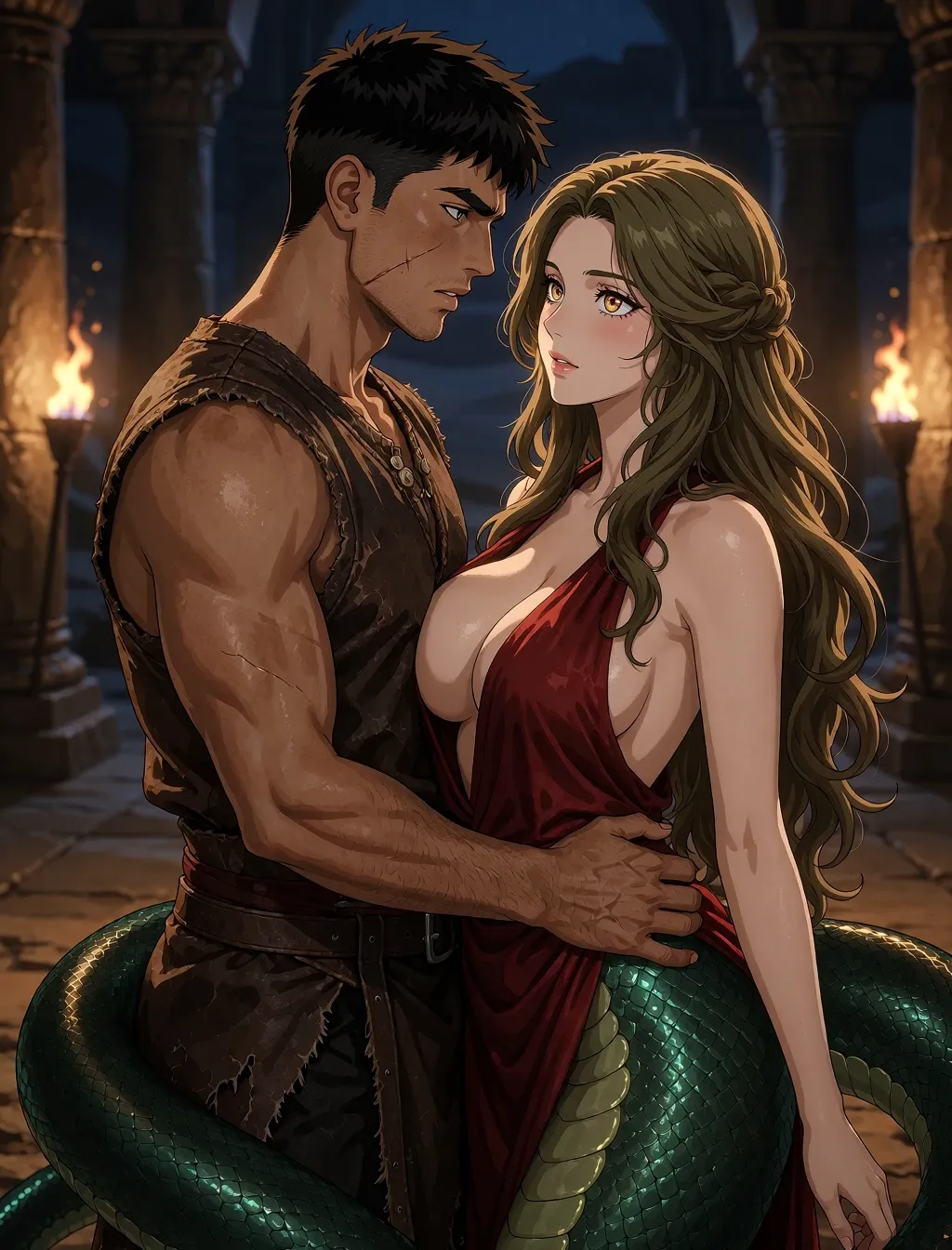
Five days, and the temple had begun to teach him its hours. Farid knew them now by the lamps — how the green flame in the western colonnade guttered toward dawn, how the great fire in the mosaic hall burned low and blue by the middle of the night, how the air changed an hour before the wind rose on the dunes above, going thin and dry, tasting of iron.
He sat with his back against the broken column, the way he had every night since she had pulled him out of the sand, and watched the mosaic floor take the lamplight. Thousands of cut stones, no bigger than his thumbnail, laid in a pattern that made a river of them — a river that ran the length of the hall and did not end at the walls but climbed them, going up into the dark where the ceiling had fallen in. He had not understood it the first night. He understood it now.
It was her people. The ones who had built this place and then gone.
Sythenna lay along the far side of the hall where the lamplight thinned, her human half propped on one elbow, her coils pooled and folded under her in a slow green spiral that took up more floor than a cart. Her bronze hair had come loose from where she'd knotted it that morning. It hung past her shoulder, and the ends of it lay across her own scales, and she had not moved to fix it.
"You are looking at the river again," she said, without opening her eyes.
"It's hard not to."
"Yes." Her voice came low out of the dark, unhurried. "It was meant to be hard not to. My mother's grandmother laid the first stones with her own hands, and she said a floor should argue with the eye that looked at it. A floor should not let a person rest." A pause. The coils shifted, scale over stone, a sound like a rope being drawn through a ring. "It has been a long time since anyone looked at it and did not know what they were seeing."
Farid turned his head. "Then tell me what I'm seeing."
She opened her eyes.
Golden, and slit-pupiled, and the lamplight caught in them the way it caught in old coins. She watched him for a while without speaking — she did that, let a question sit and grow heavy before she answered it, as though words were a well she had to lower a bucket into.
Then she pushed herself up, and the whole length of her came alive at once, coils unspooling across the mosaic in a long green run of muscle, and she crossed the hall to him — not gliding, not the way he'd half expected from the stories, but moving the way water moves downhill, all of her arriving at once and none of her seeming to hurry. She settled beside him with her human half upright and her tail curled around the base of his column, and the tip of it came to rest against his boot.
"Look up," she said.
He looked up.
The mural ran the length of the hall's surviving wall, high above the mosaic, and he had seen it a dozen times and never once read it. Now she named it, and it came apart into figures.
"There." Her hand lifted, and the sleeve fell back from her arm. "The tall one with the staff. That is Saresh, who brought the first of us across the waste when it was still a green country and the rivers ran. He is not a god. He was a surveyor. He walked the whole of it with a rope and a plumb line and he wrote down where the water was, and every family that survived the crossing did so because he had written it down."
"A surveyor," Farid said.
"You sound disappointed."
"No. I sound like a man who's spent twelve years following other men's maps." He rubbed his jaw, the scar along it. "I've cursed a few surveyors in my time. Never thanked one."
Her mouth moved — not a smile, but the shape a smile makes before it decides whether to arrive. She looked back up at the wall.
"The women with the baskets are the seed-keepers. Each one carried a different grain, and each grain had its own song, and the song was sung at planting so the seed would remember what it was meant to become." Her voice had gone quieter. "I know four of the songs. There were two hundred and eleven."
Farid said nothing. There was nothing to say to a number like that, and she did not seem to want anything said to it.
She showed him the rest. The well-diggers with their ropes. The children painted at the river's edge, small and gold and flaking now, the gold leaf coming away from the stone in little curled leaves of it that the lamplight turned to ash. The long procession of the dead at the bottom of the wall, walking into the river with their faces turned back over their shoulders. And at the center of it all, at the place where the river bent, a figure with a woman's torso and a serpent's tail, painted taller than the others and painted twice — once in gold, and once, underneath, in a red that had gone almost black with age, as though someone had painted over an older version of the same person and the older version had bled through.
Farid's eyes went to it, and stayed.
"That one has no name," Sythenna said, before he could ask. Her coils had drawn in tighter around the column, and the tip of her tail had gone still against his boot. "She is the one who kept the temple. Every generation had one. It was not a holy thing — do not look at me like that, guardsman, I am not holy, I have never been holy — it was a duty, like the well-digging. Someone had to stay and keep the lamps and the songs and the count of the grain, and it could not be a person who would wander, so it was always one of us. And we do not wander." She said it flatly. "We go to ground and we stay."
"How long?" Farid said.
"Three hundred years, give or take a decade. I stopped counting when the last of the caravans stopped coming." She turned her head and looked at him fully, and her golden eyes were unreadable in the way that a deep well is unreadable — not empty, just past the reach of light. "You are the first warm thing to cross that floor since before your grandfather's grandfather was born. Do you understand what I am telling you?"
"I understand it," Farid said. His voice had gone rough. "I don't know what to do with it."
"No one ever does." She looked away first. "That is the trouble with keeping a temple. You keep it for no one, and then one day someone comes, and you find you have forgotten how to be a person in front of a person."
The lamp between them leaned and steadied. She reached out and drew it closer — and then, without ceremony, she lifted the whole clay lamp in both hands and set it down inside the loose coil of her tail, curling the green length of herself around it the way a woman curls her arm around a sleeping child. The flame guttered, then found its draft, and the heat of it went into her scales. Farid watched the light move under the emerald, deep in the smooth plates, and understood that she was cold. That she was always cold. That she had been cold for three hundred years and had learned to borrow heat wherever she could find it.
"You're cold," he said.
"I am what I am." Her forked tongue flickered out once, tasting the air, and came back. "You are not. It is one of the several reasons I have not let you leave."
He laughed. It surprised him — a short, cracked sound, out of a chest that had not laughed in longer than he cared to count. She watched him do it with her head tilted, as though filing it away.
The silence that came after was a different kind of silence than the ones before it. Not the silence of a hall too big for two people. Something closer. The lamp crackled. Her coils resettled on the mosaic with that long rope-through-a-ring sound, and this time they came nearer to him, the outer loop of her resting against his thigh, cool and dry and impossibly smooth, and she did not move it away.
"Guardsman," she said.
"Sythenna."
"I have a question, and I would have you answer it honestly, and not spare me." Her golden eyes came up to his face and held there. The slit pupils had widened in the lamplight, gone round and dark. "I have read every scroll that survived in this place. I have read the surveyor's maps and the seed-songs and the count of the grain and the names of the dead, and none of them tells me a thing I need to know tonight. So I will ask you instead." She drew a breath. "How do human lovers please each other?"
Farid did not laugh.
He felt the question land in the room and go still, the way a thrown knife goes still when it finds the wood. She had asked it the way she asked everything — plainly, with her old courtesy, as though it were a matter of well-digging — and her eyes had not left his face, and there was nothing in them of mockery. Only the flat, patient hunger of a woman who had been alone so long she had forgotten the shape of the answer and wanted it given back to her.
"That's not a small question," he said.
"I did not ask a small question."
"No." He set his hands on his knees and looked at them, at the calluses and the old rope burns, and then he looked back at her. "All right. Honestly, then. There's no one way. A man learns a woman the way he learns a road — by walking it slow and paying attention when it changes under him. Some want to be spoken to. Some want to be quiet. Some want to be handled like they might break and some want the opposite of that entirely." He held her gaze. "But if you're asking what pleases a woman most — it's the mouth. Most men are in too much of a hurry to use it properly, and most women have spent their lives wishing they weren't."
Sythenna was very still. Her tail had gone still around the lamp, and the flame stood straight up in the sudden quiet.
"The mouth," she repeated. Her forked tongue came out and touched her lower lip, quick, and went back in. "I have a long tongue, guardsman. It is not for this. It is for tasting the air, for finding water through stone, for scenting what has passed and how long ago. I have never—" She stopped herself. Started again, and her voice had gone lower, and there was something underneath it now, something that had been asleep a long time and had just put its head up. "Three hundred years is a great many nights to lie in the dark and wonder what one is for."
"You're asking me to show you."
"I am asking you," she said, with great care, "whether you would be willing. I will not take it. I have never taken anything from a guest in my hall, and I will not begin with you."
Farid stood up.
His knees protested — five days off his feet had done him no favors — and he steadied himself on the column, and then he crossed the two steps between them and went down on the mosaic floor in front of her, and the cold stone bit through his trousers at the knees. She watched him come down with her golden eyes gone wide and her lips parted, and the lamp flame leaned between them, and he reached out and took the lamp out of the coil of her tail and set it aside on the floor.
"I'm willing," he said. "But you'll tell me if I do something you don't like. Say the word and I stop. That's how it works."
"And if I do not know what I like?"
"Then you'll find out." He put his hand on the smooth green of her tail, just below where the scales began to give way to skin, and felt her whole length go taut under his palm, one long ripple of muscle from the tip to where it vanished behind her. "And you'll tell me that too."
She let out a breath she had been holding for what looked like a very long time. "Then yes," she said. "Yes. Please."
He moved his hands up the seam where she changed.
It was the strangest country he had ever crossed. Below, the scales, cool and dry and overlapping like coins in a purse, so smooth his palms slid over them without friction. Above, the warm olive skin of her hips, and the place between them where the two met — a soft border, a scattering of fine scales that faded into skin the way frost fades into morning. He ran his thumbs along that border, both sides at once, and Sythenna made a sound he had not heard from her before. Low. Not quite a hiss. Something between a hiss and a moan, dragged out of her.
"That," she said, her voice unsteady. "Do that again."
He did it again. Slower. Her coils came up around him without her seeming to will it — one loop across his back, one across his thighs, not squeezing, just resting, the weight of her settling onto him like a hand laid flat. Her human half leaned back against the column and her chin came up, and the lamplight ran down the long line of her throat.
"I'm going to put my mouth on you," Farid said. "Is that all right."
"It is—" Her forked tongue flickered, tasting the air between them, and her golden eyes went half-lidded. "It is very much all right. Guardsman, I have been cold for three hundred years and you are asking me if I am all right."
He bent his head and put his mouth between her thighs.
She was wet already, and warm — warmer than he had expected, the heat of her gathered there where the scales gave way to skin. He licked up the length of her once, flat-tongued, slow, and she jerked against his mouth as though he had touched her with a live coal, and the coils across his back tightened hard enough to pull a grunt out of him.
"Sorry," she gasped. "Sorry, I—"
"Don't be sorry." He lifted his head just enough to speak, his breath hot against her. "Do it again. Hold on to me."
She did. The coils wrapped him properly now, one band across his shoulders and one across his hips, and he felt the strength in them, the corded power of a body that could crush a man, and she held him like something precious instead, and he put his mouth back on her and worked her slow.
His hands stayed busy at the border of scale and skin, thumbs rubbing slow circles there, and every time he found the right place she made that low hissing sound and her hips rolled up into his mouth. He learned her the way he had told her a man learns a road — paying attention when it changed under him. She liked the flat of his tongue, slow. She liked it when he found her clit and stayed there, steady, no hurry. She liked his hands on her scales, and when he slid one hand down along the smooth green of her tail, following the curve of it, her whole body shuddered and the coils around him went tight and then loose again.
"Guardsman—" Her voice had gone thin. "Farid—"
It was the first time she had used his name. He lifted his head. "Say it again."
"Farid." Her golden eyes were wide open now, the pupils blown round, and her bronze hair had fallen all around her face. "Farid, I am going to— I do not know what I am going to do. I have never—"
"Then do it," he said, and put his mouth back on her.
She came with a long hiss that went up into a cry, and her coils convulsed around him hard enough to drive the breath out of his chest, and her human half arched back against the column and her hands found his hair and held him there. He stayed with her through it, mouth working her slow and gentle, and she shook and shook, and the sound she made went on and on and echoed off the mosaic and the broken ceiling and came back down on them both.
When at last her coils went slack, he sat back on his heels and wiped his mouth on the back of his wrist and looked at her.
She was wrecked. She lay half-sprawled against the column with her hair in her eyes and her breasts rising and falling, and the scales of her tail had gone from emerald to a deeper green, flushed dark, and she was looking at him as though she had never seen him before.
"That," she said at last, "is what the mouth is for."
"That's part of it."
She pushed herself up. There was something new in her face now — not the patient hunger of a woman who had been alone too long, but something sharper and greedier, and her forked tongue came out and tasted the air between them and her golden eyes went to the front of his trousers.
"Then let me learn the rest," she said. "I have been cold for three hundred years. I am not finished being warm."
Her coils came up around him and lifted him — just like that, no effort in it at all, his knees leaving the mosaic — and turned him and set him down with his back against the column where she had been. She flowed down his body and put her hands on his belt.
"Tell me if I do it wrong," she said.
"You won't."
She opened his belt and drew him out, and her golden eyes went wide at the sight of him. She looked up at his face and then back down, and her forked tongue came out and touched him.
Farid's head went back against the column.
She learned him the way she had learned everything, with patience and attention, and her tongue was long — far longer than a human tongue, and forked. It did things a human tongue could not. She wrapped it around him and drew it up the underside of his cock, and the fork of it flickered against the head of him. He felt his whole body clench. She took him into her mouth then, slow, and her lips were cool and her mouth was hot. She went down on him until her nose was in the hair at the base of him and stayed there, and the sound she made was a low hum of discovery.
"Gods," Farid said. "Sythenna—"
She pulled off him, her lips wet, and looked up at him. "Is it good?"
"It's good. It's— keep going. Please."
She went back down on him, and her coils wrapped his hips and held him steady against the column. She worked him with her mouth and her tongue and her hand at the base of him, and the wet sound of it filled the quiet hall. Her forked tongue found the vein on the underside of his cock and traced it, and the fork of it did something at the head of him that made his hips jerk and his hands fist in her bronze hair.
"I'm close," he said, and his voice had gone to gravel. "Sythenna — I'm going to—"
She did not pull off. She looked up at him with her golden eyes and her mouth full of him, and she held his gaze, and she took him deeper.
He came with a groan that came up out of the bottom of his chest, and she stayed with him through it, her mouth working him slow, and he felt himself spill into her. She swallowed, and swallowed again, and did not let him go until he was spent and shaking and his hand had gone slack in her hair.
Then she drew off him, slowly, and sat back on her coils, and wiped her mouth with the back of her hand the way he had wiped his. Her golden eyes were very bright. Her scales had gone dark green all down her length, and the tip of her tail was curled tight around the base of the column.
"Well," she said, and her voice was rough. "Now I know."
Farid slid down the column until he was sitting on the mosaic floor, and he laughed, and she watched him do it with her head tilted and her eyes shining, and after a moment she laughed too — a strange, unpracticed sound, out of a throat that had not made it in a very long time.
Her coils came around him then, not to hold him but to warm him, the long green length of her settling across his lap and his chest and his shoulders, and she drew herself in close and laid her head against his shoulder, and the cool of her scales and the warmth of her human half pressed against him at once.
"Guardsman," she said, into his shoulder.
"Mm."
"The caravans come back through the Sable Waste at the turn of the season." Her voice was very quiet. "That is eleven days from now. I have counted them."
Farid opened his eyes and looked up at the mural in the lamplight — at the nameless serpent-tailed figure at the bend of the river, painted twice, the older version bleeding through. Then he looked down at the bronze hair spread across his shoulder, and the green coils wrapped around him, and the lamp flame burning low and blue.
"Eleven days," he said.
She did not lift her head. But her coils drew in a little tighter around him, and somewhere in the dark behind the columns, the wind rose on the dunes above the temple and began, very softly, to sing.