
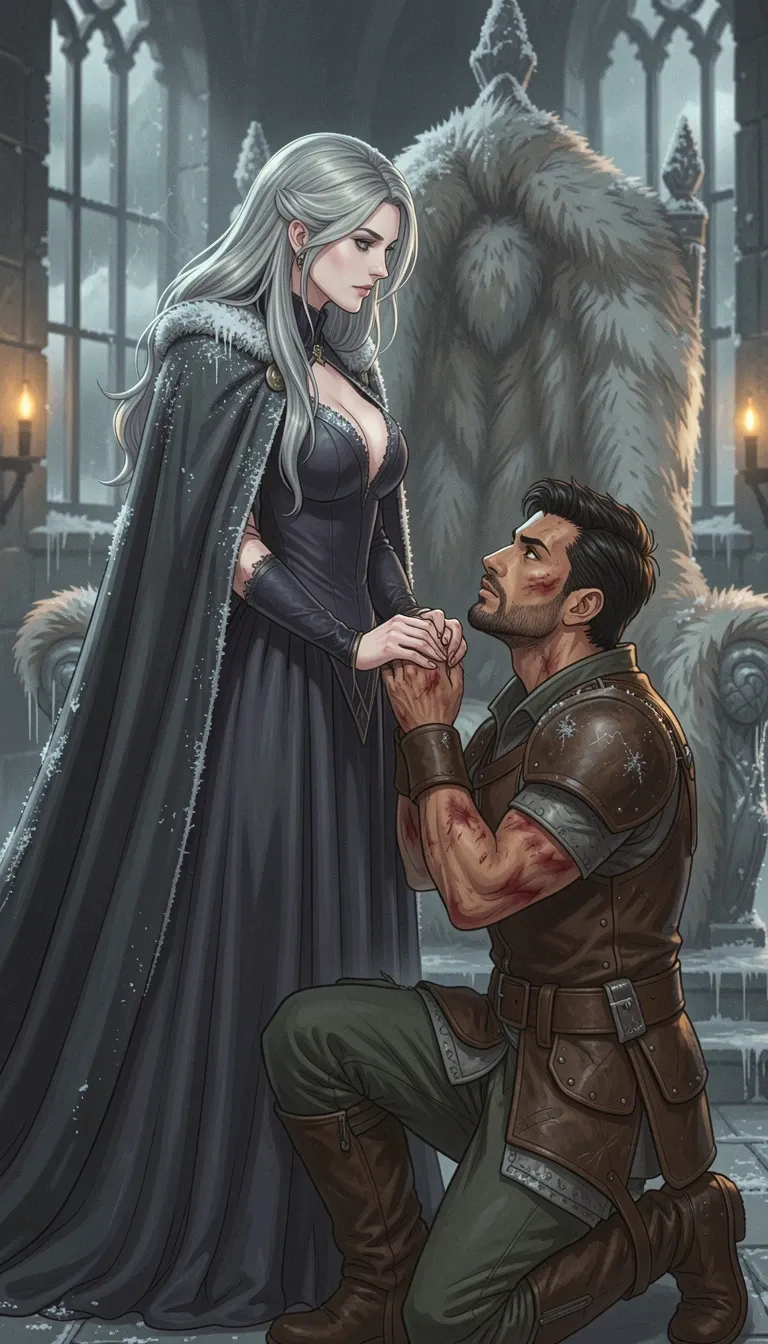
The raider sails came out of the dawn haze like a row of grey teeth, and Ysolde counted nine of them before the watchtower bell found its tongue. Nine hulls. Wide-bellied, low in the water, oars biting the swell in a rhythm that had been practiced. She had known they would come. The salt omens had been wrong all week, gulls flying inland, the tide running strange against the moon. She had known, and she had done nothing, because there was a part of her—the part that had spent a year being reasonable—that had wanted to believe the omens were only weather.
The wind cut through her robes and found the place where the seam had split. She had not mended it. The robe was old, salt-stiff at the hem, and the seam had opened at the shoulder the night before, when she had stood on this same wall and felt her own body remember what it was for. She had told herself she would have it sewn. She had not.
"How many?" Corin said at her shoulder. He had come up the stair behind her without a sound, which she had stopped being surprised by somewhere in the second month of knowing him. His sword was still sheathed, his hands loose at his sides, and he was watching the fleet the way a man watched weather he could not stop.
"Nine," she said.
"Nine." He let the word sit. "That's more than a raid. That's a claim."
She knew it. The Salt Reach had been eyeing Vaskar since her mother's reign, and the walls had held for forty years, and the Reach had spent those forty years learning the shape of the harbour and the speed of the garrison and the fact that the empress was one woman with one crown and a city full of merchants who would rather pay a toll than die. Nine ships was not a raid. Nine ships was a message, and the message was that the old walls had a price and the Reach intended to collect it.
She reached into the inner pocket of her robe and closed her fingers around the vial.
It was warm. It had been warm since she had brewed it three nights ago, warm the way a coal is warm when it has been banked and is waiting for air. The Draught of the Titan Queens. The old books had called it a myth, and then the old books had called it forbidden, and then the old books had stopped being honest about it altogether, and she had read between the lines of every one of them until she had found the recipe hidden in the marginalia of a treatise on tides.
"Sol," Corin said. He had turned to look at her. His amber eyes were steady, and there was a question in them that he was too disciplined to ask aloud.
"The garrison can hold the harbour mouth for an hour," she said. "Perhaps two. The Reach has brought enough men to take the wall in three."
"And the wall is the city."
"The wall is the city." She drew the vial out of her pocket and held it up between two fingers. The liquid inside was the colour of storm water, and it moved against the glass as though it had a current of its own.
Corin looked at it for a long moment. Then he looked at her. "You've done this before."
"Once."
"And it worked."
She thought of the throne room, the split throne, the eleven feet of her, the way the ceiling had seemed close enough to touch. She thought of Corin on his back in the warm salt water with his hands on her hips and wonder in his face. She thought of the slow settling afterward, the world pressing back in around her, and she did not know—she had never known—whether it had been the kneeling that had done it or the truth of the kneeling, the willingness, the fact that he had chosen it and not been made to. "It worked," she said. "I don't know if it will work twice."
"Then we'll find out." He said it the way he said everything, flat and certain, and she felt the banked heat in her chest stir at the sound of it.
She pulled the stopper. The smell came up out of the vial—salt and something bitter underneath, something like burnt wire and old blood—and she drank it down in one long pull, all of it, until the glass was empty and her throat was burning and her eyes were watering with the strength of it.
The vial rang on the stone when she let it fall. She watched it roll, and then she did not watch anything, because the heat had found her.
It started in her stomach, a coal dropped into dry tinder, and it spread through her in a way that was not pain and was not pleasure but something that had learned to wear both faces. Her skin flushed. Her breath came ragged. And then her bones began to move.
It was not a gentle thing. She felt the joints of her spine lengthen one after another, felt the long bones of her legs push down into the stone of the wall, felt her ribs spread and her shoulders widen and the seams of her robe give way with a sound like tearing paper. The parapet came level with her knee. Then her hip. Then her waist, and she was looking down at the harbour from a height she had never known, and the towers of Vaskar were shrinking beneath her, and the city was a thing she could hold in her two hands.
She kept going. Sixty feet, the old books had said, though they had said it in a language she had half-forgotten and had to reconstruct from memory. Sixty feet was the height of the Titan Queens. Sixty feet was enough.
The fleet was still coming. The oars had not slowed, but the rhythm had broken—she could see it from here, the way the rowers had faltered, the way the hulls had begun to drift a little off their line as men on the decks turned to look up at the wall and saw something on it that was not stone.
She reached out with one hand and put it on the harbour.
Not the water—the harbour, the whole shape of it, the arm of the sea wall and the mole and the anchorage, and she felt the tide move under her palm the way a horse moves under a hand on its neck. She did not have words for what she was doing. The Draught had given her the reach and the strength, but the knowledge was older, older than the books, older than the city. It came up out of her the way the heat had come, and she let it.
The water rose.
It came up in a swell that was not a wave and did not break, a slow lifting of the whole surface of the harbour, and the raider hulls rose with it, and their oars fouled in the churn, and she heard the sound of it—the clatter and the shouting and the crack of an oar-shaft snapping under the weight of the water—carried up to her on the wind. The first ship turned. Then the second. Then the whole line of them, one after another, the way a flock of birds turns, and they were pulling hard now, pulling for the open sea, and the swell was pushing them out ahead of it like a hand sweeping crumbs from a table.
She held the water until the last hull was a smudge on the grey horizon. Then she let it fall, and the harbour settled, and the gulls came back down out of the sky where they had been circling and screaming.
Her breath was ragged. Her skin was flushed and prickling with the cold wind, and the heat had not gone out of her. It had banked, the way it had banked after the throne room, but it had not gone. She stood sixty feet above Vaskar with her robes split at the shoulder and her hair in her eyes and her heart going like a hammer, and she was burning.
She looked down the wall and found Corin.
He had not moved. He stood on the sea wall where she had left him, a small figure in worn leather, and his sword was still sheathed and his hands were still open at his sides, and he was looking up at her. She could not read his face from this height. She could read the set of his shoulders, and the way he had not reached for his blade when the water rose, and the way he was standing his ground while a giantess looked down at him.
She came down off the wall.
It was not a graceful thing. She had to find handholds in the stone, and the stone was not made for hands her size, and she left cracks in the parapet where her fingers had been. The cliff path was a ribbon under her feet, and she came down it in long strides that carried her half a hundred yards at a time, and the wind off the cold sea pushed against her bare, enormous skin and she felt every inch of it.
Corin did not run. He stood where he was, and he watched her come, and when she was close enough that she could see the amber of his eyes and the stubble on his jaw and the small scar on his forearm, he still did not run.
She stopped. The cliff path was narrow, and she was too big for it, and her shadow fell over him and the whole of the path and the grass beyond it. She crouched, and even crouching she was taller than the tallest man in Vaskar.
"They're gone," she said. Her voice was strange at this size, deeper, and it made the air move.
"I saw." Corin's voice was steady. He looked up at her, and there was no fear in his face—there was something else, something that had been in his face in the throne room and had not left it since. "You're still big."
"I know."
"You came down anyway."
She looked at him. The heat was still banked in her, and it had found no battle to spend itself against, and it was sharpening now instead of fading, the way a fire sharpens when the wind turns. "I need you," she said, and the words came out before she had decided to say them, and she did not take them back.
Corin's jaw worked. He looked at her for a long moment, and then he did the thing she had not asked him to do and had not stopped hoping he would do. He went down on one knee on the cold stone of the cliff path, and then on both, and he put his hands on his thighs and bowed his head.
"Tell me what you want," he said.
The heat in her chest moved. She felt it move, a slow turning-over, and she reached down and closed her hand around him—not roughly, carefully, the way she would close her hand around a bird—and lifted him off the stone.
He was warm in her palm. He was small in her palm, small enough that she could feel the whole of him at once, the beat of his heart and the rise of his chest and the hardness of him pressing against her fingers through his breeches. He did not struggle. He looked up at her, and his face was open in a way she had never seen it, and she felt the heat in her sharpen again.
She sat down on the cliff edge with her back against the rock and her legs stretched out toward the sea, and she set him down between her thighs.
"You know what I want," she said. Her voice was low. "You knew it on the wall. You knew it before I drank."
"Yes."
"Say it."
He looked up at her. The wind pulled at his short dark hair, and his amber eyes were steady, and his voice when it came was rough and certain both. "I want to serve you. I want to kneel to you. I want to put my mouth on you and make you come."
She felt the heat turn over again, and she reached down and pulled her robe aside. She was wet already, wet enough that she could feel it on her thighs, and she was so big that the wetness was a thing she could see. She lifted him again—one hand, careful, and he let her—and she brought him to her cunt.
"Then serve me," she said. "Lick. Suck. Don't stop until I tell you."
He put his hands on her thighs to steady himself, and his mouth found her clit.
She felt it as a pressure first, the flat of his tongue against her, and then as heat, and then as something that made her breath catch in her throat and her hips tilt up off the rock. He was small and his mouth was small. He could not cover her, could not do more than find the one place that mattered and work at it, and he worked at it with a focus that made her hands clench on the stone on either side of her. His tongue was warm and wet. He used it the way a man used a tool he trusted, steady and patient. Then he closed his lips around her clit and sucked.
"There," she said. Her voice was ragged. "Right there. Don't—don't stop."
He did not stop. He sucked harder, and his hands on her thighs tightened. She felt the pull of it all the way up into her stomach and down into her legs. She was wet enough that she could feel it running, wet enough that his chin was slick with it. She reached down with one hand and pressed him closer, held him against her, and he made a sound against her cunt that she felt more than heard.
"Good," she said. "Gods, Corin. Good."
The heat built. It built the way it had built in the throne room, but slower now, deeper, and she let it build. She did not rush it. She held him there and let him work, and the wind off the sea was cold on her skin and the stone was hard under her back and the whole of Vaskar was below her on the cliff, and none of it mattered. There was only his mouth and the wet sound of it and the slow tightening in her belly.
"Faster," she said, and he went faster. "Harder. Use your tongue."
He used his tongue. He pressed it flat and then curled it and then sucked again. She felt the crest coming, felt it gather, and she did not hold it back. She let it take her. Her hips lifted and her back arched and her hands clenched on the stone hard enough to crack it. She came with a sound that was not a word, a long low sound that she felt in her chest and her throat and her cunt. She held him against her through all of it, and he kept his mouth on her until the last of it had passed.
She lay back against the rock. Her breath was ragged. The heat had not gone out of her—it had banked again, but it had not gone—and she looked down at Corin, at his slick face and his wet chin and the way he was still holding onto her thighs. She felt something turn over in her chest that was not the heat.
"Come here," she said, and she lifted him, and she set him down on her thigh, and she looked at him.
He was hard. She could see it, the strain of it through his breeches, and he was breathing hard, and his hands were shaking a little where they rested on her leg. He had not touched himself. He had not asked. He had waited.
"You waited," she said.
"You didn't tell me to."
She felt the heat stir again at that, at the flat certainty of it, and she reached down with one fingertip and traced the line of him through the leather. He shuddered. His hips moved, a small helpless jerk, and she felt the breath go out of him.
"Do you want me to touch you?" she said.
"Yes."
"Say it properly."
He looked up at her. His amber eyes were dark and his voice was rough. "Please. Touch me. I want your hand on my cock."
She unfastened his breeches. Her fingers were too big for the laces, and she had to work at them carefully. He lay back on her thigh and let her, and when she drew him out he was hard and hot in her hand and the whole of him fit inside her fist. She closed her fingers around him and stroked, slow, and he made a sound that was almost a sob.
"Like that?" she said.
"Yes. Gods. Yes."
She stroked him. One fingertip, then two, then her whole hand closed around him, and she watched his face while she did it—the way his eyes went half-closed, the way his mouth fell open, the way his hips moved in time with her hand. He was small and he was warm and he was hers, and the heat in her chest had sharpened again, and she did not try to bank it.
"Faster," he said, and then, "please," and she went faster.
"You're close," she said. It was not a question.
"Yes. Sol—"
"Come for me," she said. "Now. On my hand."
He came. She felt it—the jerk of him in her fist, the heat of it spilling over her fingers, the way his whole body tightened and then went loose on her thigh. He made a sound that was her name and something that was not a word. She held him through it, stroked him through it, until he went still and his breath came back to him.
The wind off the sea was cold. The gulls were circling. Below them, in the harbour, the water was settling, and the city was going about its morning, and no one on the wall could see what had happened on the cliff.
She looked down at her hand. His seed was on her fingers, cooling in the wind, and she looked at it for a long moment, and then she looked at him.
He was lying on her thigh with his eyes closed and his chest rising and falling, and his breeches were still open, and he looked—she did not have a word for how he looked. Spent. Open. Hers.
She did not feel smaller.
She felt the heat banked in her, still, and she felt the size of herself, the sixty feet of her, the way the world had not pressed back in around her the way it had in the throne room. The kneeling had not brought her down. The kneeling had not been enough, or it had not been the right kind, or the Draught had learned something in the drinking of it that the old books had not known.
She looked at Corin, and she felt the first cold thread of something that was not heat.
"Corin," she said. "I'm not coming down."