
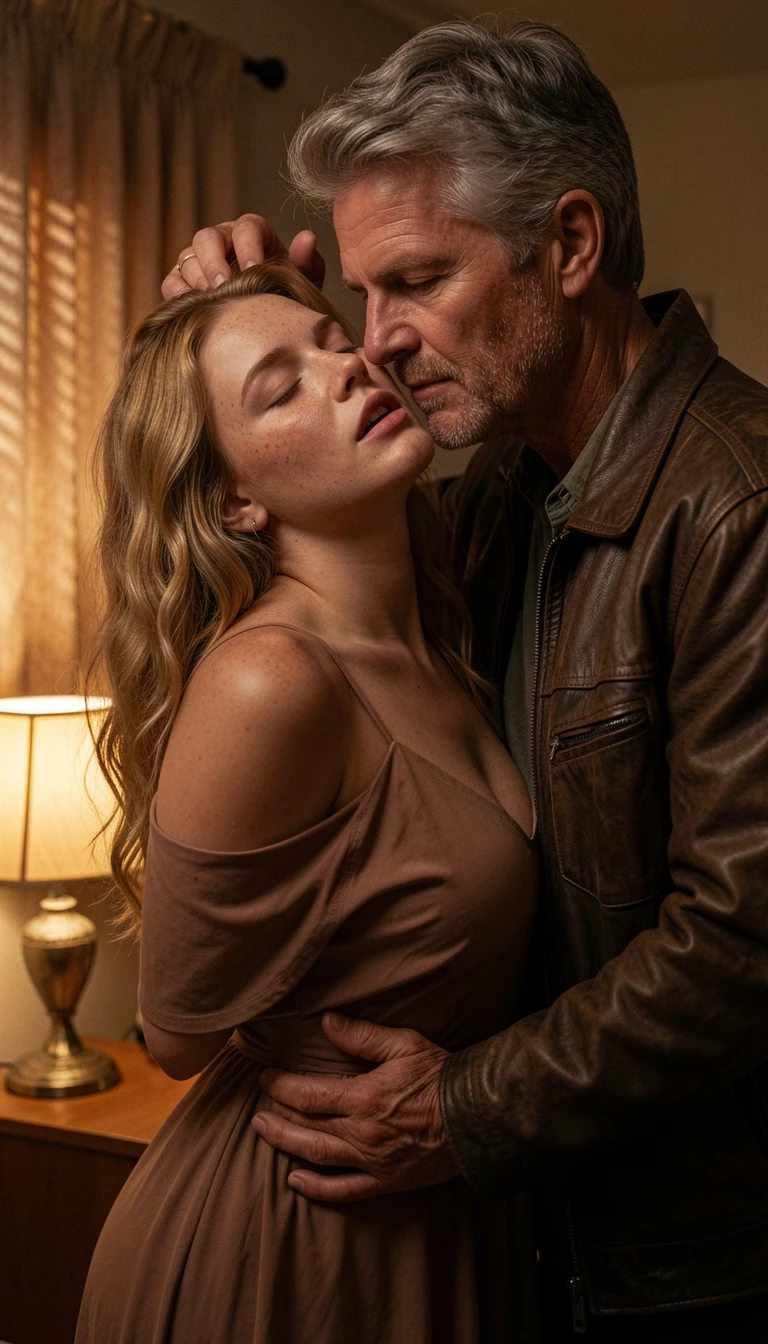
The air-conditioning rattled on, coughed, and fell silent. Chris sat on the edge of her bed, the mattress springs complaining under her weight, the hem of her sundress bunched around her thighs. She'd fallen asleep in it. Full-on passed out, face down, one shoe still on. The other lay sideways near the bathroom door, like it had crawled there to die.
The dress was wrinkled now. A crease ran diagonal across her ribs where she'd twisted in her sleep. She pressed her palm flat against it, felt the fabric warm from her body, and remembered how his hand had found the small of her back last night. How it had stayed there. How he'd guided her through the crowd like she was the only thing in the room he could see.
"You're an idiot," she said to the empty apartment.
The words hung in the stale air. The coffee maker on the counter stared back at her, unimpressed.
She ran her thumb over the inside of her elbow, where his fingers had curled when he leaned in close. "Look at that," he'd said, his mouth near her ear, his breath warm against the shell of it. "You can see Venus tonight. Right there, that bright one above the terrace." And she'd leaned into him without meaning to, the heat of his chest at her shoulder blade, the smell of whiskey and something clean—soap, maybe, or sun-warmed cotton.
She touched her own neck now. Where his breath had been.
The phone was on the nightstand. Face down. She'd put it there when she stumbled in, kicked off one shoe, and collapsed. The number he'd pressed into her palm was still burned into her memory, a sequence she'd repeated to herself in the cab like a prayer. She hadn't saved it to contacts. That would mean she was planning to use it.
She reached for the phone.
Her hand stopped halfway. She pulled it back.
"What are you doing," she whispered. Not a question. An accusation.
She stood up. The floor was cold against her bare foot. She limped across the room, picked up the stray shoe, tossed it toward the closet. It bounced off the door and landed where it had been. She didn't care.
The kitchen was three steps from the bed. That was the whole apartment—bed, kitchen, bathroom, door. A shoebox with a hot plate and a window that faced a brick wall. She'd chosen it because it was cheap and close to campus, and because she didn't plan to spend much time inside it. She'd been here eight months. The walls still felt temporary.
She filled the coffee maker with water. Measured grounds. Pressed start. The machine gurgled and sighed, and the smell of cheap coffee began to fill the space.
Through the window, the sky was doing that thing it did before dawn—purple at the edges, deep blue at the top, the brick wall across the alley still dark. She pressed her palm flat against the glass. Cold. She imagined his hand there instead, his palm against hers through the glass, like a kid playing a game. She shook her head.
"He's married." She said it out loud, tasting the word. Married. M-A-R-R-I-E-D. A word that should snap things into focus, should make her brain click back into the sensible place where she lived most of her life. "He has a wife. You met her. She wore pearls and shook your hand and said, 'Oh, you're the journalist.'"
Marilyn. That was her name. Blonde and slim and perfect, with a smile that didn't quite reach her eyes. She'd looked at Chris the way you look at a piece of furniture you might buy—appraising, polite, already moving on. "How lovely," she'd said, and then she'd turned to someone else, and Chris had been dismissed.
The coffee maker sputtered its last, and the smell of cheap grounds filled the tiny kitchen. Chris poured the black liquid into a chipped mug she'd bought at a thrift store—faded roses, a crack in the rim. She wrapped her hands around it, felt the warmth seep into her palms, and took a sip. Bitter. Too hot. She set it down and watched the surface ripple.
"You don't even know him," she said. Her voice sounded too loud in the empty room. "One conversation. One dance. A hand on your back that probably meant nothing." She pressed her lips together. "He's probably done that a hundred times. With a hundred women. It's what men like him do."
She turned from the counter and looked at the bed. The rumpled sheets. The dent in the pillow where her head had been. The dress. She ran a hand down the wrinkled fabric, felt the crease across her ribs, and remembered how his eyes had followed her when she walked away to get another drink. That wasn't nothing. That was a man watching something he wanted.
"Stop it." She said it sharper this time, like a command to a dog that wouldn't listen. She picked up the coffee and took a longer swallow, letting the burn settle her. The phone was still on the nightstand. Face down. Waiting.
She walked over to the window. The sky was lighter now, a pale peach bleeding into gray, the brick wall across the alley slowly taking shape. She pressed her forehead against the glass. Cold. She closed her eyes and felt his hand on her elbow, the gentle pressure steering her away from the edge of the terrace, the way he'd said her name—Chris—like he'd been saying it for years.
"Christina," she corrected herself. "He said Christina. The full thing."
She remembered how she'd laughed. "Nobody calls me that," she'd told him. And he'd smiled, that slow, crooked smile that made her feel like she was the only one in the room. "Good," he'd said. "Then it's ours."
Ours. The word sat in her chest, warm and dangerous. She shook her head, pushed off from the window, and went back to the nightstand. She picked up the phone. Her thumb found the edge, flipped it over. The screen was dark, her own reflection staring back—honey-blonde hair a mess, eyes tired, lipstick smudged and gone.
She unlocked it. The keypad glowed.
She typed the number from memory. Her fingers moved before her brain could stop them, each digit deliberate, the sequence she'd whispered in the cab now a real thing on the screen. A name field appeared. She typed: Robert. Then deleted it. Typed: Redford. Deleted again. Left it blank.
"What are you going to say?" she whispered. " 'Hey, I'm the girl from the party. I know you're married, but I wanted to hear your voice'?" She laughed, a short, hollow sound. "Pathetic."
The cursor blinked, waiting for her to press the green button. Her thumb hovered over it, the phone warm in her hand, the memory of his breath on her neck as vivid as if it were happening now. She could almost feel the weight of his hand on her waist, the way he'd pulled her closer to point at Venus, the press of his chest against her shoulder blades.
"You're an idiot," she said again, but her thumb didn't move. It stayed there, poised, a millimeter from the call button, the space between them electric and unbearable.
The phone buzzed in her hand.
She nearly dropped it. The screen lit up with an unknown number, a tiny photograph of a star—the same star he'd pointed at. Venus. Her breath stopped. Her thumb pressed the green button before she knew she'd done it.
"Hello?" Her voice cracked.
A beat of silence. Then that voice—low, rough, like he'd just woken up. "Christina."
Her knees went weak. She sat on the edge of the bed, the phone pressed so hard against her ear it hurt. "How did you get my number?"
"You gave it to me." A pause. "Last night. In the cab. You wrote it on a napkin."
She didn't remember that. She remembered the cab ride—the silence, the streetlights sliding across his face, the way his hand had rested on the seat between them, close enough to touch. She hadn't written anything. Had she? She squeezed her eyes shut. "I don't—"
"You don't remember." He wasn't accusing. He sounded amused, a smile threading through the words. "You were pretty drunk, Chris. I didn't want you to regret it in the morning. I let you sleep, and I kept the napkin."
She opened her eyes. The phone felt heavy in her hand. "Why are you calling?"
"Because you didn't," he said simply. "And I wanted to hear your voice."
She swallowed. The words pushed against the inside of her chest, demanding out. "Your wife."
Silence. Long enough that she checked the screen to make sure the call was still connected. When he spoke again, his voice was quieter. "Marilyn isn't the reason I'm calling, Chris."
"Then why are you?"
"Because I can't stop thinking about you."
The words fell into the space between them, and she let them sit there, let them settle around her like a blanket she wanted to pull over her head. The coffee was getting cold. The sky outside the window was pink now. She could hear the air-conditioning rattle and die, and then nothing but his breathing.
"You're married," she said again, because she needed to say it, needed to remind herself.
"I know." His voice was steady, not apologetic. "I've been married for eighteen years. I know what that means, Chris."
"Then why—"
"Because I can't stop thinking about you."
The words fell into the space between them, and she let them sit there, let them settle around her like a blanket she wanted to pull over her head. The coffee was getting cold. The sky outside the window was pink now. She could hear the air-conditioning rattle and die, and then nothing but his breathing.
"You're married," she said again, because she needed to say it, needed to remind herself.
"I know." His voice was steady, not apologetic. "I've been married for eighteen years. I know what that means, Chris."
"Then why—" She stopped. Pressed her palm against her forehead. "Why are you doing this?"
A long pause. She heard him exhale, a soft sound, almost a laugh but not quite. "Because I met you. And I've spent the last fifteen years being careful. Responsible. Doing everything the way I was supposed to." Another pause. "And then you walked past me at that party, and I forgot every reason I had to be careful."
She closed her eyes. The memory was sharp—the terrace, the way he'd appeared beside her at the railing, the cold glass of champagne in her hand, the weight of his attention like a hand on her spine. She'd felt seen. Really seen. Not the polite glance of a man checking her out, but a look that said he'd already decided something.
"I'm not looking for an affair," she said, but the words came out wrong—hollow, unconvincing, like a line she was reading off a script she didn't believe.
"I know." His voice softened. "I'm not looking for one either."
"Then what are you looking for?"
The silence stretched. She could hear the click of a lighter on his end, a sharp inhale. He was smoking. She remembered that from the terrace—the way he'd cupped his hand around the flame, the way the smoke had curled up past his eyes.
"I'm looking for the part of me that hasn't felt alive in a long time," he said finally. "And I found it in a girl on a balcony who didn't know who I was and didn't care."
She swallowed. "I knew who you were."
"You knew my name. You didn't know the rest."
"What's the rest?"
He was quiet for a moment. She heard him exhale smoke. "The rest is a man who wakes up next to someone he loves and still feels alone. Who has everything a person could want and still feels like he's starving." A pause. "And then he meets a woman who laughs like she means it, who looks at him like he's just a man, and he realizes what he's been missing."
Her throat tightened. She stared at the pale light bleeding through the window, at the dust motes floating in the beam, at her own bare legs on the edge of the bed. "I don't know what to say to that."
"You don't have to say anything." His voice was low, rough in a way that made her stomach tighten. "Just don't hang up. That's all I'm asking."
She didn't hang up. She pressed the phone closer to her ear, feeling the warmth of it against her skin, listening to him breathe on the other end of the line. The silence was heavy, but it wasn't uncomfortable. It was the silence of two people standing on the same edge, looking down at the same drop.
"What happens now?" she asked.
"Now?" She heard him take another drag, then the soft tap of ash. "Now I ask you to have breakfast with me."
She almost laughed. "It's six in the morning."
"I know." There was a smile in his voice. "There's a diner on Ventura that opens at five-thirty. Best pancakes in Los Angeles. I'll buy you a stack and watch you eat them."
"That sounds like a date."
"It sounds like breakfast," he said. "Two people. Coffee. Pancakes. Nothing complicated."
She bit her lip. Her thumb found the edge of the phone, traced the seam where the glass met the metal. "And if someone sees us?"
"No one will."
"You don't know that."
"I know that the only person in that diner at six in the morning is a man named Frank who's been working the grill for thirty years and doesn't care who walks through the door as long as they tip." He paused. "And I know that I'm asking you to take a risk. And I'm asking because I think you want to."
She closed her eyes. The apartment was quiet, the coffee cold in her hand, the sky outside turning gold through the grime on the window. She thought about the empty day ahead of her. The shift at the restaurant that didn't start until four. The hours of nothing, of pacing, of replaying last night until she drove herself crazy.
"What time?" she heard herself say.
The pause on his end was barely a breath. "I can pick you up in twenty minutes."
"No." The word came out too fast. "No, I'll—I'll meet you there. Text me the address."
"Chris."
"What?"
"You're scared." It wasn't a question.
"Of course I'm scared." She laughed, but it came out thin. "You're Robert Redford. You're married. I'm a waitress who lives in a studio apartment with a radiator that sounds like a dying animal. This is insane."
"I know." His voice was quiet. "But I'd still like to see you."
She pressed her lips together. The phone was warm against her ear, his voice settled somewhere deep in her chest, a low hum she couldn't shake. "Send me the address."
"I'll send it now." A pause. "Chris?"
"Yeah?"
"Thank you."
The line went dead. She stared at the screen, at the call timer still displayed, at the number she hadn't saved yet. Then a text appeared—a red pin on a map, a street name she recognized, the name of a diner she'd passed a dozen times and never entered.
She set the phone down on the nightstand. Looked at herself in the mirror across the room—hair tangled, eyes tired, the hem of the dress riding up her thigh. She looked like someone who'd made a decision she didn't know how to undo.
She stood up. The coffee was cold, so she dumped it in the sink and rinsed the mug. She walked to the closet and pulled out jeans, a white t-shirt, a denim jacket worn soft at the elbows. Clothes that belonged to her, not the girl from the party. She dressed quickly, without looking at herself again, and ran a brush through her hair until it lay flat. A swipe of mascara. Lip balm. Nothing that looked like effort.
The phone buzzed again. A second text: Frank makes his coffee strong. Just so you know.
She smiled before she could stop herself. Picked up the phone. Typed: I'll bring my own cream.
Three dots appeared. Then: I like you already.
She slipped the phone into her pocket, grabbed her keys, and paused at the door. Her hand rested on the knob. She could still turn back. Could still crawl into bed and pretend this never happened, pretend she never answered, pretend she didn't know what it felt like to have his voice in her ear at dawn.
She turned the knob.
The stairwell was dim, the steps worn concrete, the railing loose on one side. She took them two at a time, her sneakers echoing off the walls, and pushed open the door to the street. The air was cool, still holding the night's chill, and the sun was just cresting the roofline, spilling gold across the asphalt.
She walked. The diner was twelve blocks away, and she needed the air, needed to feel the ground under her feet, needed to prove to herself she could still turn back at any moment. She didn't turn back. She kept walking, past the bodega with its flickering sign, past the hydrant a dog was lifting a leg against, past a man hosing down the sidewalk in front of a laundromat.
She reached the diner at six-twelve. The sign said FRANK'S in red neon, the N flickering like it was about to give out. Through the window she could see a long counter, red vinyl stools, a man in a white apron flipping something on the grill. There was only one customer—a figure in a worn leather jacket, sitting at the far end of the counter, a coffee cup in front of him.
Her heart pounded against her ribs. She pushed open the door.
A bell jingled. The man in the apron looked up, nodded once, and went back to the grill. The figure at the counter turned.
Robert Redford looked at her with those blue eyes, crow's feet deepening as he smiled, and she felt the floor tilt under her feet. He stood up as she walked toward him, and she saw that he was wearing jeans and boots, the same leather jacket from last night, his hair still damp like he'd just showered.
"You came," he said. His voice was different in person—warmer, closer, the low hum she'd heard on the phone now filling the space between them.
"I don't know why," she said.