
“Upstairs,” Petra said. “In person. Alone. Before you leave.”
“You said that last night.”
“And you’ll hear it tomorrow.” Petra keyed the code into the archive door without shielding the panel. On the first night Noor had decided that was either trust or a test. The bolts withdrew in three slow steps, brass against brass, and cold air breathed out of the old vault, smelling of paper and pennies.
Noor stepped through. Petra didn’t.
“You could come in,” Noor said. “Keep me company. Count something.”
“I count exits.” Petra’s eyes moved once over the room: the green banker’s lamp, the long oak table, the cartons of ledgers stacked in the order Noor had left them. Then her eyes went up, briefly, to the glass gallery that ran along the far wall above the shelving, dark at this hour. “He doesn’t bend the rule. Not for anyone.”
“I’m not anyone. I’m the help.”
Petra almost smiled. It was the closest Noor had come in three nights. “Two a.m. check,” she said, and the door sealed behind her.
Noor folded her coat over a chair and uncapped the red pen from her collar.
The Varga Exchange had been a bank for sixty years before it became whatever it was now, and its archive still kept a bank’s habits. Every ledger was bound in oxblood cloth. Every page was numbered. Somebody had moved four point two million dollars through these columns in tidy, forgettable amounts. Nine thousand here, eleven there, a consultancy fee to a firm in Limassol that had no website, no staff and a very nice letterhead.
She had found the first thread on night one. On night two she had pulled it until it led to another thread. Tonight she meant to find the hand holding the end.
She worked the way she always had, before the firm, before the report with her name on it that three partners had very kindly asked her to reconsider. Columns down, then across. Dates against deposits. Red ink for anything that lied.
The pages filled with red.
The radiator under the shelving ticked and went quiet. She remembered his office on the first afternoon: rain on the arched windows, and Cassius Varga holding out one hand, palm up.
“Your phone,” he’d said.
She had looked at the hand. Long fingers, a white cuff turned once at the wrist, no rings. “Why?”
“Because this building has no cameras I don’t own, and I’d like to keep it that way.”
She had put the phone in his palm. He had slipped it into a drawer and locked it, and the smallness of the gesture had made her angry in a way she couldn’t account for.
“Fine,” she’d said. “Then my fee is double.”
He had raised the eyebrow with the scar through it. “Double.”
“You’re taking my phone. You’re taking my nights. I don’t work blind, Mr. Varga. I want every ledger. Not a curated selection. Every one, from the day this place stopped being a bank.”
He had studied her long enough that she counted the clock’s ticks. Eleven.
“Done,” he’d said, as if she’d offered him something instead of taking it. “Most people negotiate down when they’re afraid.”
“I’m not most people.”
“No,” he’d agreed. “I didn’t hire most people.”
Noor shook it off and turned a page.
Limassol paid Rotterdam. Rotterdam paid a shipping agent in Antwerp, who paid a charitable trust that had never given anything to charity. The trust paid a holding company. The holding company paid a single private account at a bank so small and so old that it still required wet signatures on its authorisation cards.
The Exchange kept copies. Of course it did.
She found the carton. She found the card.
At the bottom, in black ink, were two initials. C.V.
She knew that hand. She had been staring at it for three nights, on approvals and memos and margin notes. The C opened wide and generous and closed with a hook. The V was struck so hard the nib had scored the card. Nobody else in this building wrote a V like that.
She looked at the clock on the far wall. Two exactly.
Then she looked up.
The gallery was no longer dark. A single lamp burned behind the glass, and Cassius Varga stood in front of it, jacket off, hands in his pockets, watching her.
He did not step back. He did not pretend to be looking at anything else. He simply stood there, tall against the amber light, his face calm. He must have stood exactly so on the first night and the second, while she read his books and followed his money down every corridor he had built for her.
Her pulse went hard and quiet in her throat.
He’d known. He had watched her find it.
Noor held his gaze for as long as she could stand to, which was longer than she expected. Then she stood, carried the card to the old copier in the corner and laid it on the glass. The machine groaned awake. Green light swept under the lid. The page came out warm.
She clipped her pen back to her collar.
The door opened before she reached it. Petra, punctual to the minute, took one look at the page in her hand and stepped aside without a word.
“You knew too,” Noor said.
“I know the rule.”
The staircase to the gallery was iron and spiral, painted black a century ago and worn grey at the treads. Noor climbed it without hurrying. She felt every step. She could have walked out the front door instead. Petra would have let her. Nobody had told her she had to climb.
The study door stood open.
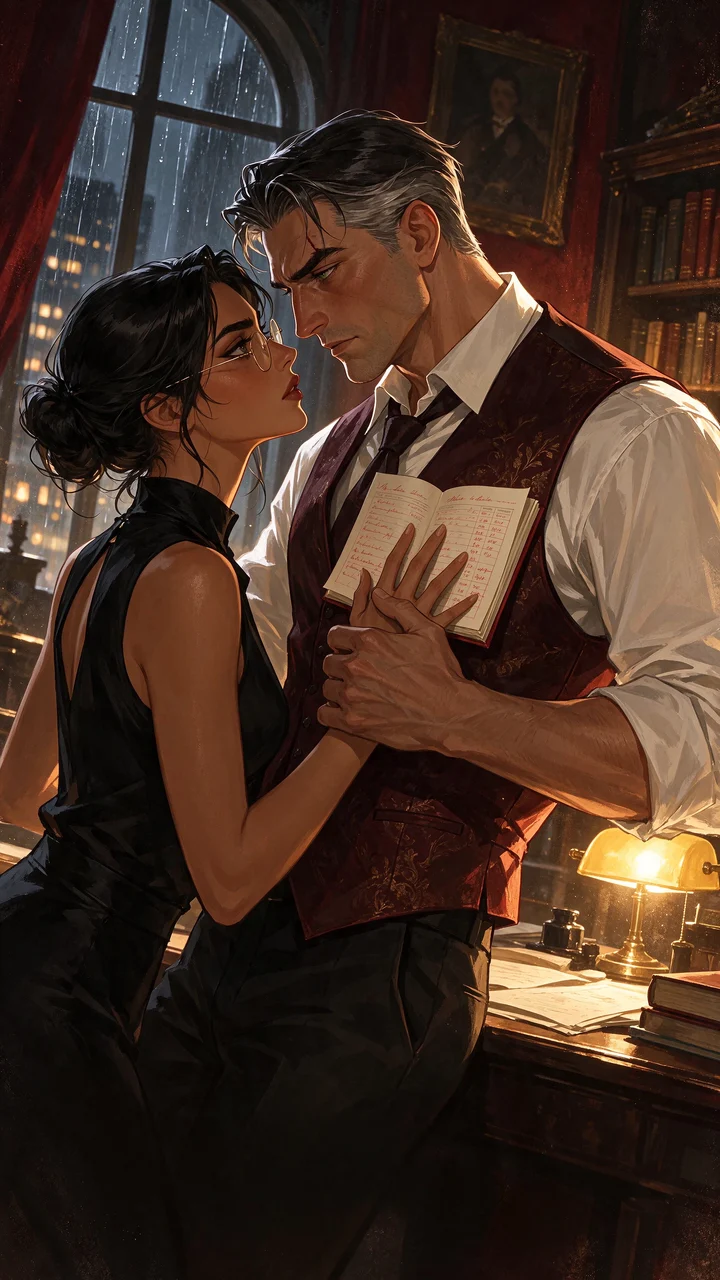
He had sat down, which surprised her. He was behind a walnut desk the size of a small boat, the lamp at his elbow, a glass of something amber untouched beside the blotter. His shirt was buttoned to the collar and the oxblood tie was still knotted. His sleeves were rolled once at each wrist. In this light the grey at his temples looked almost silver.
Noor walked to the desk and set the page in front of him, squared to the edge.
He didn’t look at it.
“Three nights,” she said. “You stood up there three nights.”
“Two and a half. I was late on Tuesday.”
“Why did you want me to find you?”
He leaned back. The chair made no sound. He looked at her the way she looked at a column that didn’t balance: patient, interested, in no hurry at all.
“Because you’re the only one who’d come upstairs and ask,” he said.
The rain had started again. She could hear it against the tall windows behind him.
“That’s not an answer.”
“It’s the only one you get for free.” He slid a long envelope across the desk toward her. Her name was on it, in that hand. “Your full fee. Doubled, as agreed.” He tapped the locked drawer with one finger. “Your phone is where I left it. You can take both and walk out of this building tonight, and you will never hear from me again.”
“Or.”
His mouth moved, not quite a smile. “Or you stay,” he said, “and you hear the rest. On my terms.”
The envelope sat between them. So did the page with his initials on it.
Noor looked at the money, then at the evidence, then at the man who had built a trap with his own name on it and waited for her inside.
“What terms?” she said.