
Seventeen pages, and her sister had read one.
Senna held the contract flat on her knees while the carriage climbed, because the glass road of Mount Ardrel was steep and the wheels kept trying to slide back toward Calvereth. Every turn of them rang. The road had been poured by dragonfire three centuries ago, black and smoke-green and smooth as the inside of a bottle, and it sang under iron rims the way a wet finger sings on a goblet. The escort captain had stuffed wool in his ears at the second switchback. Senna had not. She wanted to hear all of it.
She remembered the throne room in Calvereth, the smell of beeswax, the ice-blue brocade of Odarra’s sleeve as the queen reached for the quill.
“You’ve read it, of course,” Senna had said.
“The first page.” Odarra had smiled at the envoys, not at her. “Tribute, a princess of the blood, delivered by the turning of the year. The rest is lawyers’ lace.” She had signed with a flourish, sanded the ink, and kissed Senna’s cheek in front of the whole court. Her lips had been cool. “Be useful up there, little sister. It’s the first time anyone has asked you to be.”
Nobody had asked. Senna had volunteered. Then she had sat up four nights with a lamp, a penknife and a pot of oak-gall ink, and copied the contract out again in a hand so close to the chancery clerk’s that the clerk himself had initialed it. Sixteen pages were as he had drafted them. On the seventeenth, between a clause about the delivery of salt and a clause about grazing rights in the northern pastures, sat four lines of her own.
Her fingers were still grey at the tips. She had scrubbed them with pumice until they bled, and the stain had not come out.
The carriage lurched. A gust came down off the summit carrying grit and the smell of hot stone, and the captain rapped on the panel.
“Gate, Highness.”
. . .
The gate was not a gate. It was a split in the mountain wide enough for three wagons, its edges fused and rippled where the rock had once run like candle wax. Beyond it there was only dark, a low red breathing light, and heat that pressed against her face.
Senna stepped down. Her boots crunched on spilled glass. The twelve soldiers of her escort dismounted behind her and began, with grim faces, to form a column.
“No,” she said.
The captain lowered his helm. “Highness, the queen’s orders were to deliver you to the hall.”
“You have delivered me to the threshold. The contract says threshold. Go home, Captain Rell. Tell my sister I walked in on my own feet.”
He looked at the dark. He looked at her. She watched him decide that explaining her to Odarra would be easier than explaining himself to a dragon.
“Gods keep you,” he said, and turned his horse.
She waited until the ring of their hooves had faded down the road. Then she tucked the contract against her ribs, under her cloak, and walked in.
The passage sloped downward and opened all at once, and she stopped.
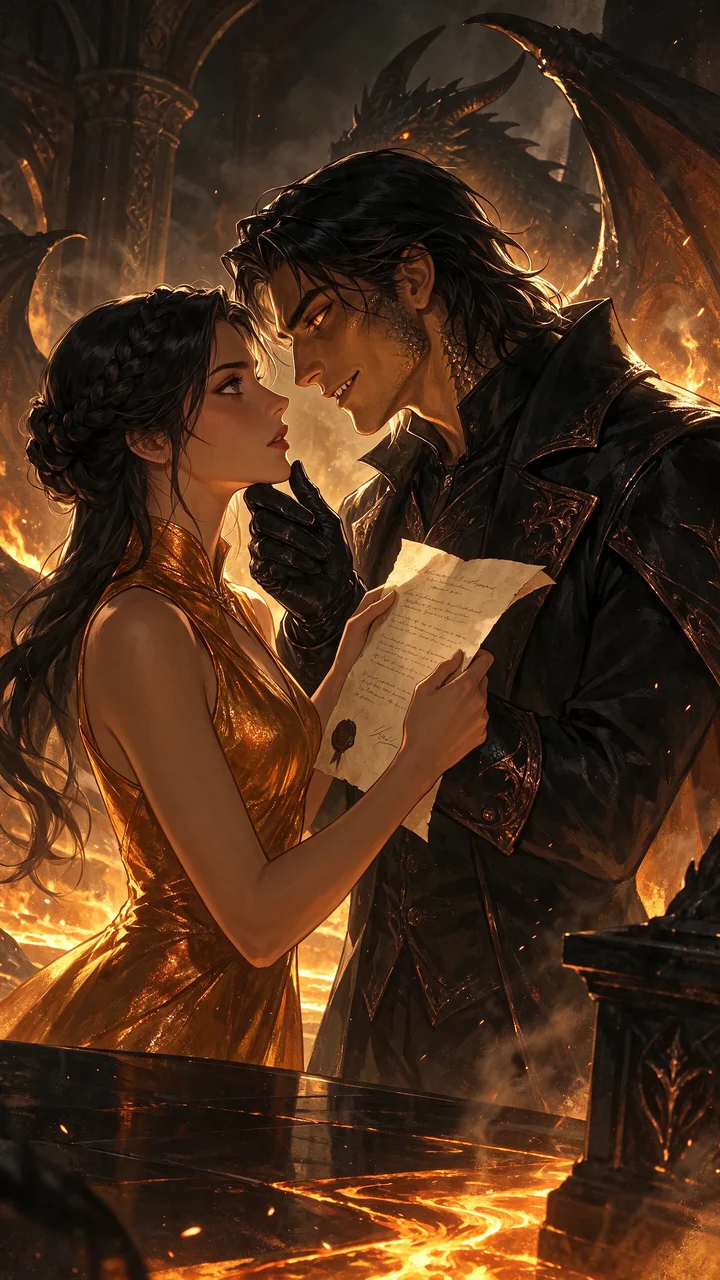
The hall was a cavern of black glass so vast that its ceiling vanished into shadow. The floor was crystal, clear as pond ice, and beneath it ran a river of fire. It moved slowly, folding over itself, gold at the heart and crimson at the edges, and it lit everything from below: her shadow thrown up onto the walls, the pillars shining like wet obsidian, her skirts turned the color of embers. The air smelled of smoke and cedar and hot metal, a forge on a feast day.
At the far end, on a throne of cooled lava, a man sat watching her.
She had not seen him arrive. She did not think he had arrived.
“Closer,” he said. His voice was quiet and carried anyway, as though the hall had been built to bring it to her. “I don’t bite tribute on the doorstep. It’s untidy.”
She walked the length of the river with her chin up. He did not rise. He was tall even seated, broad through the shoulders, in a long coat of obsidian silk buttoned to the throat and stitched with copper flames that seemed to move when the firelight moved. Black hair to his shoulders. Black gloves. His skin was bronze-gold, and along his jaw and down his throat ran a scatter of fine dark scales, small as a trout’s, catching the light.
His eyes were amber. The pupils were slits.
“Princess,” he said. “You’re alone.”
“I sent them home.”
“Brave.”
“Economical. They eat.”
The faint curve of his mouth deepened, and she saw his teeth. There were slightly too many of them. “You have something for me.”
She drew out the contract and held it toward him. He leaned forward, took it between two gloved fingers, and settled back to read.
He read every page. She stood on the crystal with fire flowing under her boots and listened to the soft turn of vellum. At the seventeenth page he stopped turning.
Then he read aloud.
“‘Each night the dragon may set the tribute one rule. Each night the tribute may refuse it, freely and without penalty, and the refusal shall end the contract and return her unharmed to Calvereth.’” He looked up. The smile came slowly, and it was delighted, and it was the most frightening thing she had seen all day. “Your sister signed this.”
“She signed it.”
“Did she read it?”
“She read the first page.”
He laughed, low, and the river beneath the floor brightened as if something down there had stirred. He rose.
He did not come straight to her. He stepped down from the throne and walked a slow circle around her, close enough that she felt the heat coming off him through her cloak, never close enough to touch. She did not turn to follow him. She kept her eyes on the empty throne and listened to the soft fall of his boots behind her shoulder, beside her ear, in front of her again.
“Three hundred years,” he said, “and every tribute who climbed that road came with a contract that bound her. Not one came with a door.”
“Now one has.”
“Why?” He stopped in front of her. “A princess arranges to be handed to a dragon, and then arranges to bargain with him. Why would she do that?”
She could have lied. She had prepared three lies on the road.
“Because the High Council of Calvereth has nine seats,” she said, “and a dragon’s word fills one of them. I want your voice on the Council. I want it speaking for me.”
His head tilted. “You want to use me.”
“I want to earn you. Using you is the other thing.”
That made him go still. Not the stillness of a man. The stillness of something on a ledge, deciding.
“Then here is the first rule,” he said softly. “Look at me when you say no.”
She did not understand it, and then she did. He meant every night. He meant that if she ever left, she would not be allowed to leave with her eyes on the floor, or on the door, or on her sister’s distant banners. She would have to do it to his face.
“Do you wish to leave, Princess?”
The river moved under her feet. She could smell cedar on him, and something hotter beneath it. His eyes held hers and did not blink, and she understood that he did not need to.
She looked at him. She did not look away. She did not say anything at all.
The silence went on long enough to become an answer.
He leaned down, so slowly that she had every chance to stop him and didn’t, until his mouth was beside her ear and the heat of him touched her cheek.
“Good,” he murmured. “I’ll be counting, Senna. Every night. To see how long you last.”