
"Okay," he says. And then he doesn't say anything else for a while.
I don't fill it. That's the thing I've learned about Eddie in eight days of phone calls and one morning of sitting across from him—he doesn't need the silence stuffed. He needs it held. So I hold it. My hand stays where it is on the tablecloth, his fingers wrapped around mine, and I watch him work up to it the way I watch a patient work up to telling me where it hurts.
He's got his glasses pushed up on his forehead now, and there's a tan line under the frames, a pale strip across his cheekbones that the sun hasn't reached all season. I've never seen that on anybody. It's such a specific thing, a pitcher's tan, and it makes him look like he belongs to something I don't understand.
"Arbitration," he says finally. "You know what that is?"
"Not really. I know it's a baseball thing."
"It's a hearing. You sit in a room with the team, and there's a panel, and the team tells the panel why you're worth less than what you're asking for." He says it flat, like reading a chart. "They bring numbers. Comparables. Guys who did what you did but worse. Guys who got hurt. They pull up your worst month and they put it on a screen and they say, this is what he is."
I feel my thumb move against his knuckle without deciding to. "They do that to you?"
"Every year." His mouth does something that isn't a smile. "Last winter I won. They offered four and a half. I asked for eight. The panel gave me nine."
"Nine million dollars."
"Nine million dollars." He says it like it's a diagnosis. "And I sat in that room and listened to a man I'd never met before explain to three strangers that I was a statistical outlier, that my second half was an aberration, that the league would figure me out." He adjusts his glasses down onto his nose, then pushes them back up. "I won. And I walked out of there feeling like I'd stolen something."
Tita Cora's rag has stopped. I don't turn around to check, but I can feel it—the counter behind us gone quiet, the way a room goes quiet when somebody's listening without meaning to. The baby in the far booth has settled. The TV keeps rolling.
"My dad retired last year," Eddie says. "Twenty-six years in the Navy. Chief. He spent most of it on ships, on bases, moving us every two years. Honolulu, then San Diego, then Pearl again, then here. I went to four elementary schools." He looks at our hands. "He did all of that so I could have a shot at something. He never said it. He never said anything. But I know what it cost him. I know what my mom gave up. And now he's working for Sea Lift Command, and he's on the water half the month, and he's still working, and I'm twenty-four years old with nine million dollars in my account and I—"
He stops.
"You what," I say.
"I don't know how to be a person who isn't paying something back."
The coffee in front of me is cold. I haven't touched it since he started talking, and I don't touch it now. I keep my hand where it is and I let him look at me, and I don't say the thing nurses say, the thing I say forty times a shift, the *I understand*. Because I don't. I understand the shape of it, the debt, the weight—I've got my own version, my student loans, my mom's face when I told her I wanted to be a nurse instead of a doctor—but I don't understand nine million dollars or a panel of strangers or a father on the water.
What I understand is that he's telling me anyway.
"The ankle," he says. "The ankle is the whole thing. Grade two sprain. Four to six weeks. I miss four starts, maybe five. And in a contract year, that's—" He lets go of my hand. Not away. He lets go so he can put both hands flat on the table, palms down, like he's bracing for something. "That's the number they slide across the table next winter. *He's injury-prone. He's never thrown two hundred innings. He's twenty-five and his landing leg is a question mark.*"
"You're twenty-four."
"I'll be twenty-five in November. That's how they'll say it." He looks up at me, and his eyes behind the glasses are dark brown and tired and younger than the rest of his face. "I've been throwing since I was five. I've got a callus on my right thumb you could file your nails on. I've never done anything else. I don't have a degree, I don't have a trade, I've got a curveball and a changeup and a body that's already started sending me bills."
"You went to State."
"Two years. Electrical engineering." He snorts. "I was gonna design circuits. I was gonna be an engineer like my dad wanted. And then I got drafted in the third round and my dad looked at me across the kitchen table and said, *Okay*, and that was it. That was the whole conversation. He said okay and went back to his coffee."
"Did he want you to go?"
"He wanted me to have a plan B." Eddie's jaw works. "He still wants me to have a plan B. Every time I call him he asks about school. Not about the games. About school."
I think about that. I think about a retired chief on a ship somewhere in the Pacific, calling his son and asking about circuits instead of curveballs, and I think about what that must feel like from both ends of the line. I think about my own dad, who's a contractor in El Cajon, who told me nursing was a good steady job and then never asked another question about it, which is its own kind of answer.
"That's why you live at home," I say. Not a question. I'm putting it together out loud because I want him to hear me putting it together.
"That's why I live at home." He pulls his hands back into his lap. "I've got the money. I could buy a house in La Jolla tomorrow. But until I sign a guaranteed deal, until I know I'm not gonna be non-tendered in March, I'm not—" He stops. Starts again. "I'm not gonna spend a dollar I might need to live on. I've got a BMW I bought like an idiot and a watch I bought like an idiot and everything else goes into index funds and CDs and my mom's retirement account. I'm not gonna be a guy who made nine million dollars and ended up broke at thirty-five."
"That's not a kid's answer."
"No." He looks at me sideways, and something in his face shifts, a crack, a hinge. "It's not."
Behind us, Tita Cora's rag starts up again. Slow. Deliberate. I hear her move down the counter, away from us, and I hear the little click of the burner under the coffee pot going off. She's giving us room. I don't know how she knows to, but she does, and I file that away—the way this family does things without saying them.
"Can I ask you something," I say.
"Yeah."
"Why'd you give me your number."
He's quiet for a second. The window light has moved across the table, and the red vinyl of the booth has gone from bright to deep, the color of a bruise that's healing. I watch him decide how to answer.
"Because you didn't know who I was," he says. "You put six stitches in my ankle and you asked me if I was allergic to anything and you told me to stop apologizing for being in pain, and you never once looked at me like I was—" He gestures at himself, at the glasses, at the whole package. "You looked at me like I was a guy with a bad ankle."
"You were a guy with a bad ankle."
"Yeah." He smiles, and it's the goofy one, the one from the phone, the one that doesn't match the tired eyes. "That's the whole thing. That's the whole reason. I've been famous since I was twenty-one years old, and nobody's looked at me like that in three years."
I feel that land somewhere in my chest, and I don't name it, and I don't look away.
"The front office called this morning," he says. "While I was getting dressed." He says it fast, like he's been holding it under everything else. "They wanted to know my timeline. They wanted to know if I could DH in two weeks. I told them I'd know more after the follow-up. And the guy on the phone—" He stops. Starts. "The guy on the phone said, *Well, Eddie, we'd love to see you back out there, but you know how it goes.* And I knew what he meant. I knew exactly what he meant."
"What did he mean."
"He meant, *don't get comfortable.*" Eddie's voice has gone low, and there's something raw in it, something I haven't heard on any of the phone calls, something that makes the hair on my arms stand up. "He meant, *we've got a kid in Double-A who throws a hundred and one, and you're a line item.*" He looks at me. "I've never told anyone that."
And then he stops, and he's just looking at me, and his eyes are wet, and he doesn't wipe them, and he doesn't look away, and I understand that he's waiting. He's waiting for me to do something with it. To take it, or hand it back, or say something that makes it okay.
I don't have anything that makes it okay.
What I have is my hand, and the table between us, and the fact that he's been holding his breath since he said *I've never told anyone that* and he hasn't let it out yet.
So I lean across the table.
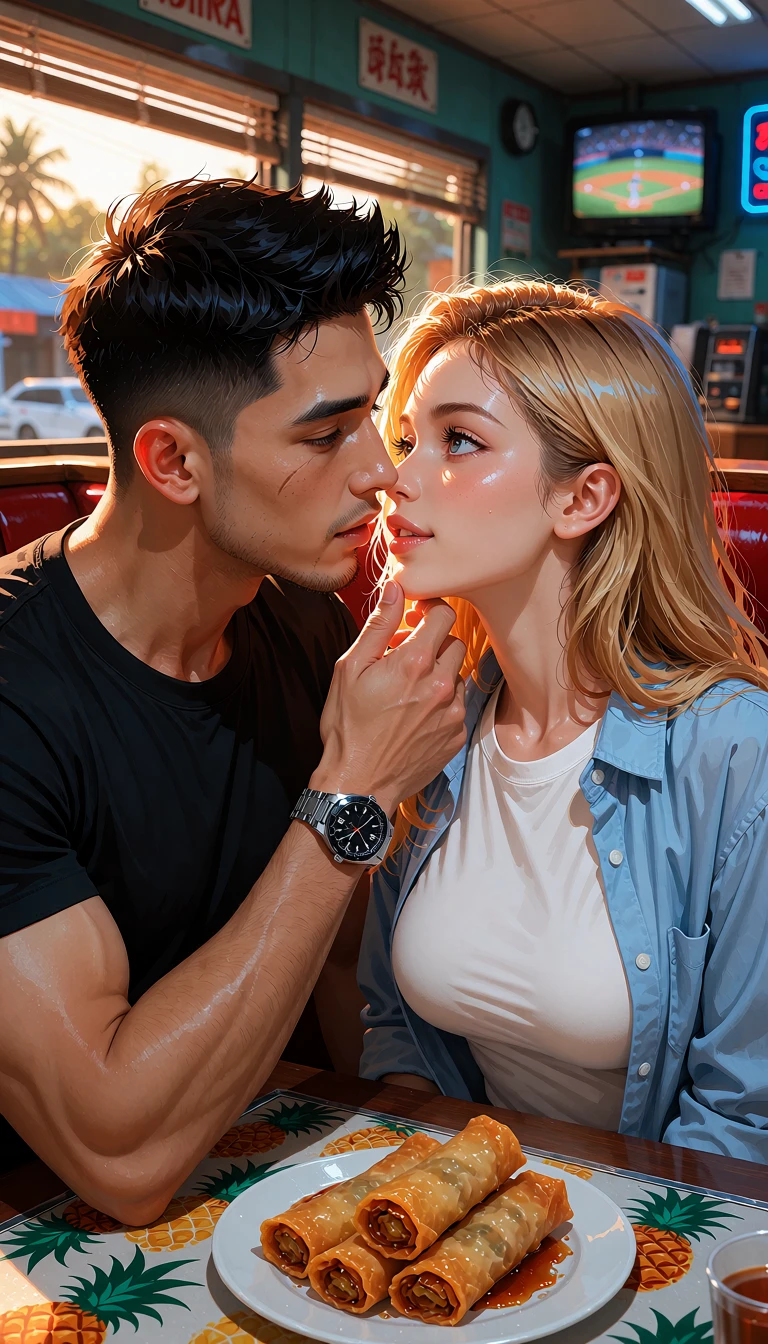
I don't think about it. If I think about it I'll stop, and stopping is the wrong thing, and I know it's the wrong thing the way I know a patient's blood pressure is dropping before the monitor tells me—something in my gut, something in my hands, something that doesn't need the chart. I lean across the plastic tablecloth and the cold coffee and the crumpled napkin, and I put my mouth on his.
It's soft. That's the first thing. His lips are soft and warm and he doesn't move for a half-second, and I feel the half-second like a held breath, and then he moves.
His hand comes up and finds my jaw, and his thumb—that callused thumb, the one with the pitcher's callus, the one that's been pressing into my palm for the last twenty minutes—presses into the hinge of my jaw, right where it meets my ear, and he holds me there. Not hard. Just enough. Just enough that I feel it in my teeth.
I hear Tita Cora's rag go still again.
I don't care.
His mouth opens against mine, and I feel the coffee on his tongue, and the mint from the gum he was chewing in the car, and something underneath that's just him, just Eddie, a taste I don't have a word for. I slide my hand up into his hair—the fade is soft on the sides, short, and the number two on top is long enough to grab, and I grab it—and he makes a sound into my mouth, low, surprised, like he didn't expect me to do that.
I didn't expect me to do that either.
The kiss goes deeper. His other hand finds my waist, above the table, and pulls me toward him, and the edge of the Formica digs into my ribs and I don't care, I lean into it, I lean into him, and my elbow knocks the cold coffee and I hear the cup slide but I don't hear it fall and I don't look. I've got both hands in his hair now and he's got one hand on my jaw and one on my waist and he's kissing me like the booth isn't in a diner on El Cajon Boulevard at two in the afternoon with his aunt twenty feet away.
Then he pulls back.
Just an inch. Just enough that our mouths are still almost touching, and I can feel his breath on my lips, fast, uneven, and I can see his eyes behind the glasses, and they're not wet anymore, they're something else, something dark and awake and a little bit scared.
"Paula," he says. Just my name. Just that.
I'm breathing hard. I can hear myself. I can feel my pulse in my throat and my hands are still in his hair and I'm not letting go, and somewhere behind me Tita Cora is standing at the counter with a rag in her hand and she hasn't moved, and the whole diner is holding still around us like the room knows something we don't.
"Yeah," I say. My voice comes out rough. "Yeah."
And I'm still leaning across the table, and he's still holding my jaw, and neither of us has moved an inch back toward our own side of the booth.