
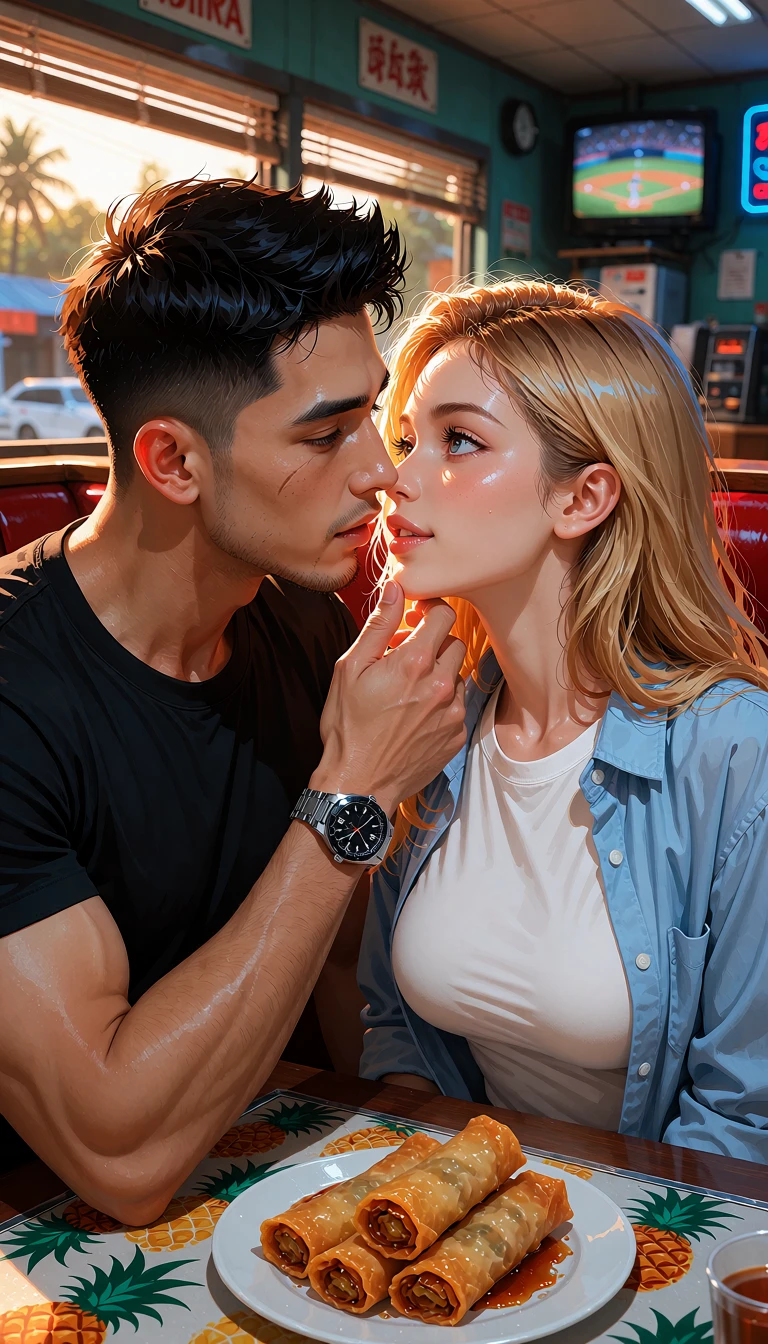
He parks the BMW on a side street off El Cajon Boulevard, in front of a storefront that doesn't look like much — a strip-mall slot between a laundromat and a phone-card place, a hand-painted sign above the door that says something in letters I can't read, a string of red and gold lights strung along the awning like it's Christmas in July.
"This is it?" I ask.
"This is it." He kills the engine and reaches for his crutches in the back seat. "Best lumpia in San Diego. Don't tell my mom I said that."
I get out first and come around to his side, and he waves me off before I can reach for the door, but I stand there anyway, because the concrete is uneven and he's on one leg and I'm a nurse, and I don't care if it hurts his pride. He gets himself out — one crutch, then the other, a small hop at the end that he tries to disguise as a step. I don't call it out. He adjusts his glasses with the back of his wrist, and we walk toward the door.
Inside, the air hits me first. Humid. Pork fat and fried garlic and something sweet underneath, like banana and brown sugar. Faded vinyl booths, red and cracked at the seams, the kind that squeak when you shift. Plastic tablecloths printed with a pattern of pineapples. A TV mounted in the corner above the counter, sound low, a Padres game on — the green of the field filling the little screen, a batter stepping out of the box.
And behind the counter, an old woman with gray hair pulled back in a clip looks up from a pot she's stirring, and her whole face opens.
"Eddie!" She comes around the counter fast for someone her age, wiping her hands on her apron. "You bring a girl!"
He laughs — that low, easy laugh I've heard on the phone a dozen times, but seeing it land on his face is different, the way his eyes go soft behind the glasses. "Tita Cora. This is Paula."
"Paula." She says it like she's tasting it, deciding if she likes the flavor. Then she takes my hand in both of hers, and her palms are warm and rough from work, and she looks up at me with dark eyes that miss nothing. "Pretty. Pretty girl. You eat? You hungry? Sit, sit."
She's already steering us toward a booth by the window, and Eddie's crutches clack on the linoleum, and I slide into the booth first, and he lowers himself across from me, propping the crutches against the wall, and the vinyl squeaks under both of us at once and we both hear it and neither of us says anything.
Tita Cora stands over us with a pad she doesn't need, because she hasn't written anything down since we walked in. She rattles off something in Tagalog, quick and rolling, and Eddie answers in the same language — his voice different in it, lower, rounder, the vowels landing somewhere new. I catch nothing. I catch the shape of it, the rhythm, the way he tilts his head when he asks her something back. A whole life I don't have access to, moving between them like weather.
She laughs at something he says and swats his shoulder with the back of her hand, and he grins up at her like a kid. Then she looks at me, and her eyebrows go up, and she says, in English, slow and deliberate, "You take care of him. He's a good boy. Too skinny. You feed him."
"I'll try," I say.
"Good." She nods once, satisfied, and disappears back behind the counter.
Eddie is watching me when I look back at him. He's got his forearms on the table and his glasses have slid down his nose and he hasn't fixed them, and there's something in his face I can't read — waiting, maybe. Like he wants to know what I think.
"You didn't order," I say.
"I did. You just didn't know it."
"What did you order?"
"Everything." He shrugs. "The good stuff. Trust me."
I lean back against the vinyl and let my eyes move around the room. Two old men at the counter, nursing coffees, eyes on the TV. A family in the far booth, a baby asleep in a car seat on the table. The Padres game flickers above them — a pitcher winding up, the ball a white blur, the crack of the bat tinny through the small speaker. I don't know who's winning. I don't know if it's Eddie's team. I don't know anything about this world he lives in, and here I am in a booth with him, and he's ordered for me in a language I don't speak, and it should feel like too much, and it doesn't.
The food comes fast. Tita Cora sets down plates in a fan across the table — a bowl of rice, a platter of something glistening in a dark sauce, a plate of long thin rolls, golden and crisp, stacked like firewood. The smell is overwhelming now, close up. Vinegar and soy and garlic and the sweet undertone I caught at the door.
"Lumpia," Eddie says, pointing at the rolls. "Start there."
I pick one up. It's hot — too hot — and I have to juggle it between my fingers, and he watches me do it with that grin starting at the corner of his mouth, and I take a bite.
The crunch is loud. The filling is pork and something green and a sweetness I wasn't expecting, and I close my eyes for a second without meaning to, and when I open them he's still watching me, and his grin has gone full — that goofy, unguarded thing I've only heard in his voice, never seen on his face, and seeing it now, aimed at me, does something to my chest I don't have a name for.
"Good?" he asks.
"Oh my God."
"My mom makes it better."
"I don't believe you."
"She does. She puts more garlic. And she doesn't use the frozen wrappers." He says it like a confession, like he's betraying Tita Cora by admitting it, and he picks up his fork and finally starts eating, and for a minute neither of us talks, and the only sounds are the TV and the baby breathing in the car seat and the click of our forks on the plates.
I watch him eat. He eats the way he does everything, I'm learning — efficient, focused, no wasted motion. He's got the fork in his left hand and he's scrolling his phone with his right, thumb moving, and I catch a glimpse of the screen before he flips it face-down on the table. A text thread. A name I don't get to read.
"Who's that?" I ask, before I can decide not to.
"Marc." He doesn't look up. "Checking on me. He does that."
"Your teammate."
"Yeah." He takes a bite. "He thinks I'm gonna do something stupid. Like try to pitch on this ankle."
"Are you?"
"No." A pause. "Not yet."
The TV crackles — a cheer from the small crowd on screen, the Padres dugout emptying, somebody crossing the plate. Tita Cora glances up at it and says something in Tagalog to the old men at the counter, and one of them answers without taking his eyes off the screen. Eddie doesn't look up at all. He keeps eating, and I realize he hasn't watched a single pitch since we sat down, and that a man who's spent his whole life on a baseball field is sitting in a diner with a game on the wall behind his head and his eyes are on me instead.
"You're not watching," I say.
"I know how it ends."
"You do?"
"It's a replay. From June." He shrugs. "I was there."
I don't know what to do with that — the casual way he says it, the fact that he was there, on the field, in the middle of it, and now he's here, in a strip-mall diner, eating lumpia with a nurse who doesn't know the difference between a slider and a curveball. The gap between those two lives is so wide I can't see across it. And he's just sitting there, chewing, like it's nothing.
He sets his fork down.
The clatter is small — metal on plastic, a single note — but something in the way he does it makes me stop chewing. He pushes the plate an inch away. He takes his glasses off, folds them, sets them on the tablecloth. Without them his face is younger, softer, his eyes darker and bigger than I expected, and he looks at me across the table like he's about to say something he's been holding for a while.
"Can I tell you something?" he asks.
"Yeah."
He's quiet for a second. The TV murmurs. The baby in the far booth makes a small sound and settles. Tita Cora is wiping the counter with a rag, not looking at us, but I get the feeling she's listening the way family listens — not with her ears, with her whole body.
"The reason I didn't want you meeting my mom yet," Eddie says, "is because she'll start planning the wedding."
I laugh — a short, surprised thing — and I'm about to make a joke, and then I see his face, and the joke dies in my throat.
"I'm serious," he says. "She's been asking about you all week. Every day. 'Who is she, when do I meet her, is she pretty.'" He does his mother's voice, a little, but it comes out flat. "If I bring you home, she's gonna start. And I can't — I can't do that right now. Because I'm not sure I'm gonna have a job next year."
The words sit on the table between us, next to the lumpia, raw and unpolished, and he doesn't dress them up. He doesn't smile. He just looks at me with his glasses off and his hands flat on the plastic tablecloth, and waits.
I put my fork down too. Slowly. I don't say anything, because I don't know what to say, and because the thing he just handed me is heavier than I expected, and I want to hold it right.
"What do you mean," I say finally, "you're not sure you're gonna have a job."
He exhales. Runs his thumb along the edge of the tablecloth, back and forth, a small nervous motion I've never seen him make — not on the phone, not in the ER, not once. "It's my contract year," he says. "Last year before free agency. I'm arbitration-eligible again. If I don't pitch — if I'm hurt, if I'm out, if they don't see what they need to see — they can let me go. Trade me. Non-tender me. Whatever. It's not a sure thing. It never is."
"But you're —" I stop. I don't actually know what he is. I don't know his numbers, his stats, his standing. I know he's a pitcher and he makes nine million dollars and he lives with his parents and he drives a BMW he probably shouldn't have bought. That's the whole file.
"I'm good," he says, and it's not bragging, it's just true, the way you'd say the sky is blue. "I'm really good. But good doesn't matter if you're on the DL for four starts in August. Good doesn't matter if the front office decides they'd rather spend the money somewhere else." He picks up his fork again, then puts it back down without using it. "I've been thinking about it every night. All week. Every time we talked. Every time you asked me how the ankle was."
I remember. Every call. How's the ankle. And he'd say better, or getting there, or Doc says two more weeks, and I'd move on to something else, and he'd let me, and I never once heard what was underneath it.
"You didn't say anything," I say.
"I know."
"Why not?"
He looks at me. The TV flickers behind him, the crowd on screen rising for something, and he doesn't turn around. "Because it's the long version," he says. "And I didn't know if you wanted to hear it yet."
I look at him across the plastic tablecloth and the half-eaten lumpia and the folded glasses and the Padres game nobody's watching, and I think about the eight days of phone calls, and the way I saved his number as just Eddie, and the way I tore it off the discharge chart and kept my hand in my pocket all shift like I was holding something that might get away. And I think about the fact that he's been carrying this alone, this whole time, and I didn't even know to look for it.
I reach across the table and put my hand over his. His knuckles are warm and there's a callus on his right thumb, the one he grips the ball with, rough under my palm. He goes very still.
"I want to hear it," I say.
He doesn't say anything for a second. Then his hand turns under mine, slow, and his fingers close around mine, and he holds on.
Behind us, Tita Cora wipes the same spot on the counter she's been wiping for the last two minutes. The baby in the far booth wakes up and starts to fuss, and its mother lifts it against her shoulder and pats its back. On the TV, the Padres game rolls on, sound low, a world away.
Eddie looks down at our hands on the tablecloth, and then up at me, and his eyes are dark and tired and younger than I've ever seen them, and he opens his mouth to say the long version.