
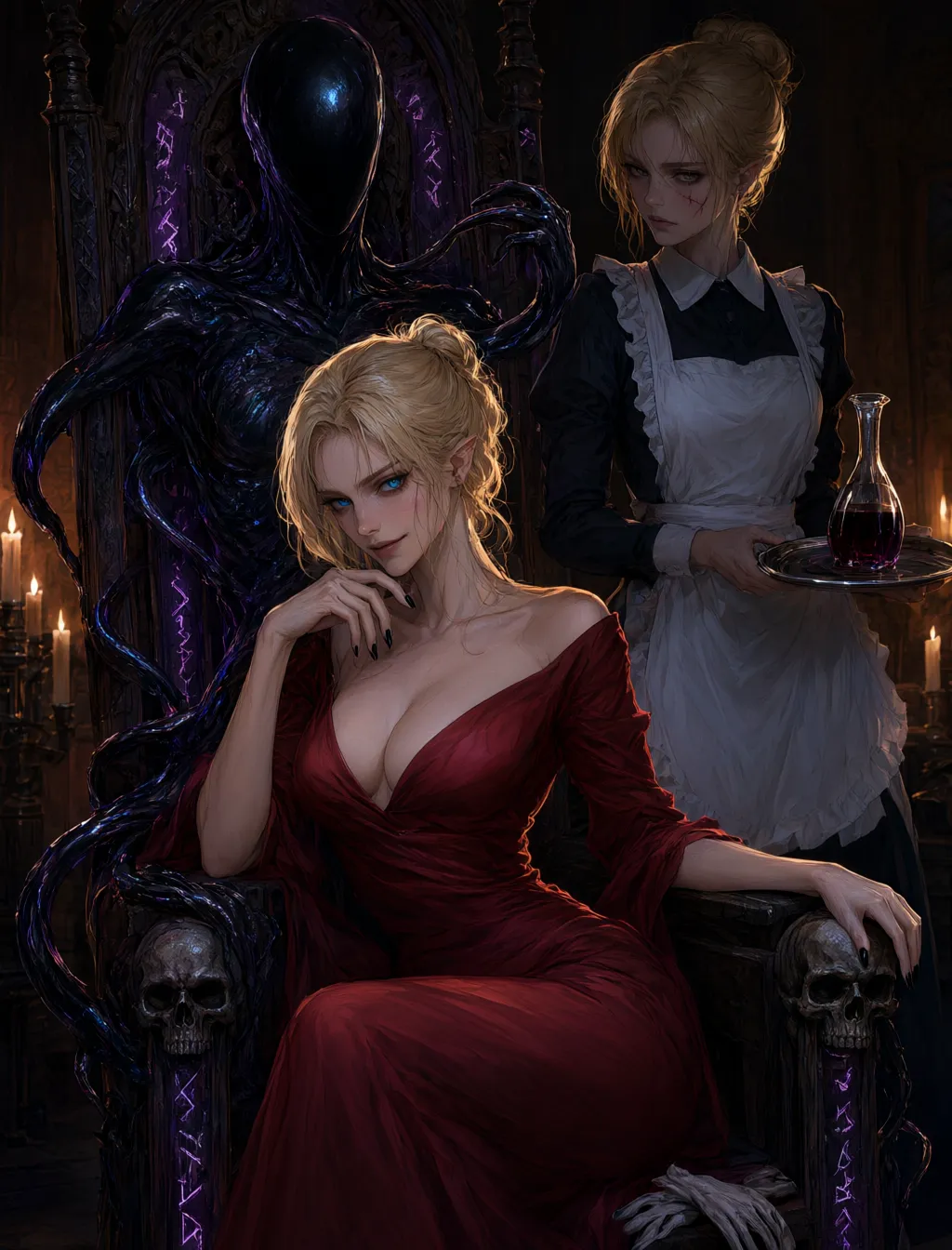
The first gray light crept through the study window like a thief, pale and tentative, spilling across the mahogany desk where the fel's original container still sat open and empty. Morgana stood at the glass, her reflection a ghost in the dim morning, the living dress warm against her skin, pulsing with a contentment that was not quite her own. She ran her fingers along the collar where the fel rose to meet her throat, feeling the symbiote's surface shiver under her touch, a ripple of pleasure that traveled down her spine and settled deep in her chest.
"You approve of the night's work," she murmured, not a question.
The fel tightened around her ribs in answer, a gentle squeeze that felt almost like an embrace. Through the bond, she sensed its satisfaction—a low, thrumming pleasure that had nothing to do with her own. It had fed tonight. It had stretched itself across Lyra's skin, tasted the hero's pleasure, felt her surrender. And now it rested, sated and coiled, against Morgana's body like a cat that had been given cream.
She smiled, thin and sharp, and turned from the window.
The container sat open on the desk, its lid resting beside it, the interior dark and empty. She had found it in the vault three floors below, buried beneath crates of old reagents and forgotten artifacts, its surface cool and smooth under her damp fingertips. She had not known what it held when she pried the seal loose. She had only felt the hunger inside, ancient and patient, and recognized it as kin.
Now the container was just a shell. The fel lived on her skin, in her blood, in the bond that pulsed between her and the two women she had already claimed. She picked up the lid and held it in her palms, turning it over, studying the faded runes carved into its surface. She could not read them—the language was older than any she had studied—but she felt their meaning in her bones. Bound. Contained. Waiting.
She set the lid down beside the container and stepped closer to the desk, the fel whispering against the floorboards as she moved. The morning light caught the edge of a sheet of parchment, blank and waiting, and she reached for the quill in its inkwell without thinking. The motion was automatic, a habit born of centuries of planning, of writing names and crossing them out, of building a future one careful stroke at a time.
She dipped the quill. The ink was black, thick, almost oil in its consistency. She held it over the parchment for a long moment, the tip trembling slightly, and then she wrote.
Selussa Grevalur.
The name formed under her hand in elegant, flowing script, the ink catching the gray light and holding it. She set the quill down and watched the letters dry, watched the ink sink into the fibers of the paper, watched the name become permanent.
Selussa Grevalur. Elven princess of the eastern court. A mage of considerable power, known for her mastery of elemental magic and her refusal to bow to any mortal ruler. She had visited the manor once, three decades ago, on a diplomatic mission that had bored her to tears. Morgana remembered her clearly: tall, silver-haired, with eyes like molten gold and a smile that never reached them. She had been condescending, dismissive, treating Morgana like a curiosity rather than a peer.
Morgana's fingers brushed the name on the parchment, tracing the curves of the letters.
"You will feed the throne," she whispered, the words soft and certain. "And I will feed on your power."
The fel stirred against her skin, a ripple of interest, and she felt its hunger rise to meet her own. It had tasted Lyra's essence, felt the hero's pleasure and surrender, but Lyra was a village girl with a sword and a cause. Selussa was something else entirely. A mage of the eastern court, trained in the arcane arts for over a century, her power layered and refined and deep. Feeding her to the throne would not just satisfy its hunger—it would transform it.
Morgana picked up the parchment and folded it once, then twice, then slipped it into the pocket of the fel dress. The symbiote accepted the paper without resistance, folding around it, holding it close against her hip.
She turned back to the window. The light was growing stronger, the gray giving way to pale gold as the sun crested the horizon. Beyond the glass, the grounds of the manor stretched out in patchy shadow and light, the trees still dark with night, the grass wet with dew. Somewhere in the east wing, Lyra was sleeping, the fishnet a second skin, her dreams reshaped by the fel's influence. And somewhere in the halls, Elara was moving, the piece of fel coiled around her wrist, already preparing for the merchant Valerius.
Morgana closed her eyes and reached through the bond, feeling for the threads that connected her to her servants. Lyra's presence was warm and soft, a pulsing glow in the back of her mind, the hero's consciousness submerged in sleep. She could feel the rhythm of Lyra's breathing, the slow beat of her heart, the gentle rise and fall of pleasure that flickered through her dreams like candlelight. The fel had marked her deeply, reshaped her desires, centered her world on Morgana. She was ready for training.
And Elara. Morgana felt her as a sharper presence, a thread of tension and purpose. The head maid was awake, moving through the lower halls with the piece of fel coiled around her wrist like a living bracelet. Through the bond, Morgana sensed her thoughts—focused, calculating, already running through the steps of her task. Valerius would arrive in three days. Elara was preparing.
But there was something else, a faint pulse beneath Elara's focus. A question. A hunger of her own.
Morgana opened her eyes and smiled.
"You want more," she said, the words addressed to no one in the room. "You want to feel it again."
The fel on her skin rippled, and she felt its agreement. It had tasted Elara's pleasure twice now, had learned the shape of her desire, and it was hungry for more. But Morgana had other plans for her head maid. Valerius required a gentle touch, a careful hand. Elara's mind was already suggestible, her defenses dissolved by the fel and Morgana's magic. She would open the merchant as easily as she opened a door.
And then she would be ready for something else.
Morgana turned from the window and walked to the desk, the fel whispering against the floor. She picked up the empty container, holding it in both hands, studying the faded runes. The fel had been bound here for centuries, waiting, patient, hungry. She had freed it, claimed it, bound it to her will. And now it was hers, a tool of pleasure and power, a weapon to reshape the world.
She set the container down and reached for the lid, fitting it back into place with a soft click. The seal was broken, the binding undone, but the container still held power. She could feel it, a residual warmth, a faint pulse of the magic that had once held the fel in check. She would keep it. She would study it. She would learn its secrets and turn them to her own purposes.
A knock at the study door, soft and measured.
Morgana did not turn. "Enter."
The door opened, and Elara stepped inside, her footsteps light on the floorboards. Morgana heard her pause, heard the soft intake of breath as she took in the room, the morning light, the empty container on the desk. And then the footsteps resumed, careful and deliberate, stopping a respectful distance behind her.
"Mistress." Elara's voice was soft, formal, carrying the weight of years of service. "I did not expect to find you awake."
Morgana turned, slowly, letting the fel catch the light as she moved. Elara stood in her maid's uniform, her honey-blond hair pinned in its severe bun, her hazel eyes lowered in deference. The piece of fel was coiled around her left wrist, a living bracelet that pulsed with a faint, dark shimmer. She held herself perfectly still, her hands clasped in front of her, her breathing shallow and controlled. But Morgana saw the tension in her shoulders, the almost imperceptible tremor in her fingers.
"I could not sleep," Morgana said, and the fel rippled against her skin as she spoke. "There is too much to plan."
Elara's gaze flickered up, meeting Morgana's for just a moment before dropping again. "The merchant Valerius arrives in three days, mistress. I have already begun preparing."
"I know." Morgana stepped closer, the fel whispering against the floor. "I felt you through the bond. Your focus. Your hunger."
Elara's breath caught, a soft hitch that she quickly suppressed. "I—" She stopped, swallowed, started again. "The fel is eager, mistress. It wants to be used."
"And you?"
The question hung in the air between them, sharp and expectant. Elara's hands tightened, her fingers pressing into her palms, and she did not answer immediately. When she spoke, her voice was barely above a whisper.
"I want to serve you, mistress. In whatever way you require."
Morgana smiled, slow and satisfied. She reached out and touched Elara's chin, lifting her gaze, forcing the maid to meet her eyes. Elara's hazel eyes were wide, her pupils dilated, her breath shallow and quick. The piece of fel on her wrist pulsed, a dark shimmer that matched the rhythm of her heart.
"You will serve me," Morgana said, her voice low and honeyed. "You will open Valerius, and you will bring him to the throne. And then you will be ready for something greater."
Elara's lips parted, and she nodded, a small, jerky motion. "Yes, mistress."
Morgana held her gaze for a long moment, savoring the fear and desire that flickered in the maid's eyes. Then she released her chin and turned away, walking back to the window. The light was stronger now, the gold deepening to amber, the shadows retreating from the glass.
"Go," she said, not looking back. "Continue your preparations. And when Valerius arrives, bring him to me before you take him to the throne."
"Yes, mistress."
Elara's footsteps retreated, soft and quick, and the door closed behind her with a click. Morgana stood alone in the study, the morning light warm on her face, the fel pulsing against her skin. She reached into the pocket of the dress and pulled out the folded parchment, holding it in her palm, feeling the weight of the name she had written.
Selussa Grevalur.
She unfolded the paper and read the name again, tracing the letters with her fingertip. The elven princess would be her next conquest. The powerful mage would feed the throne and her well.
But not yet. There was work to do first. Lyra needed training, Elara needed to open Valerius, and the throne needed to feast on willing sacrifices. One step at a time. One thread at a time. The web was growing, and Morgana was at its center, spinning and weaving and pulling the strands tighter.
She folded the parchment and slipped it back into the pocket of the fel dress. The symbiote accepted it, holding it close, and she felt its contentment ripple through her skin. It was patient. It was hungry. And it was hers.
She turned from the window and walked to the desk, her fingers brushing the empty container as she passed. The morning light caught the faded runes, and she paused, studying them again, feeling the residual warmth of the magic that had once held the fel in check.
"Soon," she whispered, the word a promise carried on the still air. "Soon, you will all feast."
The fel tightened around her ribs in answer, a gentle squeeze that felt almost like an embrace. And Morgana smiled, thin and sharp, as the morning light filled the study and the shadows retreated into the corners, waiting for the night to come again.
The parchment lay folded against her hip, a weight she could feel through the fel's living surface. Selussa Grevalur. The name pulsed in her mind like a second heartbeat, and Morgana let herself imagine it—the elven princess standing in her study, her silver hair catching the lamplight, her golden eyes narrowed in suspicion that would slowly, carefully be worn away. The fel would taste her first. And then the throne would feast.
She crossed to the desk and sat in the high-backed chair, the fel adjusting around her form, cradling her as she reached for a fresh sheet of parchment. This one was finer than the last, cream-colored and smooth, the kind reserved for correspondence with nobility. She set it before her and picked up the quill, holding it over the inkwell.
The words needed to be perfect. Not too eager, not too familiar. A tone of respectful warmth, of fond remembrance, of accidental discovery that required a delicate resolution. Selussa was no fool—she would smell a trap from across the room if Morgana pressed too hard. But the promise of elven heritage returned to its proper hands? That was a hook even a wary mage might bite.
Morgana dipped the quill and began to write.
To Her Highness, Princess Selussa Grevalur of the Eastern Court,
I hope this letter finds you well, though I confess I have no reason to believe you would recall me after so many years. We met briefly during your visit to my manor three decades past, and I have often thought of that evening—not for any grand event or declaration, but for the warmth of your presence and the sharpness of your wit. You were kind to a sorceress whose reputation had not yet been earned, and I have not forgotten it.
Morgana paused, reading the words back. They were true enough—Selussa had been dismissive, condescending, treating her like a provincial curiosity. But there had been a flicker of something else, a momentary interest when Morgana had demonstrated a spell the elven princess had not recognized. It was that flicker she needed to reignite.
She continued writing, the quill scratching softly against the parchment.
I write to you now for a reason that has only recently come to light. In the course of organizing my manor's deeper vaults—a task I have neglected for far too long—I discovered an object of unmistakable elven craftsmanship. A brooch, I believe, set with a stone that resonates with a magic I cannot identify. It bears markings that match none of the records in my library, and I have come to believe it may be a lost piece of your family's heritage.
I am, unfortunately, bound to the manor by obligations that will not permit me to travel in the coming months. But I would be honored to return this artifact to you personally, should you wish to visit. I can assure you comfortable accommodations and a welcome befitting your station. I would ask only that you give me the pleasure of your company for an evening or two, that we might speak of magic and courts and the long years between our last meeting.
She set the quill down and read the full letter, her lips moving silently over the words. The tone was right—gracious, humble, curious. A hint of flattery without servility. The promise of something valuable without demanding anything in return. Selussa would be intrigued. She would want to see the brooch, to verify its authenticity, to reclaim whatever lost treasure had found its way into a human sorceress's vault.
And when she arrived, the brooch would be waiting. Real enough to pass inspection, old enough to bear authentic elven runes, valuable enough to justify the journey. Morgana had a week to acquire or forge such a thing. The fel could consume metal, reshape it, replicate patterns it had seen. She would show the symbiote drawings of elven craftsmanship, let it study the few authentic pieces she kept in her private collection, and by the time Selussa arrived, it would produce a brooch that would fool any but the most expert eye.
And even if Selussa's suspicion lingered, the brooch would not be the trap. The trap would be the wine, the conversation, the fel waiting in the shadows of the guest chamber. The trap would be Morgana's patience and Selussa's pride.
She picked up the quill again and signed her name at the bottom of the letter.
With warm regards and fond remembrance,
Morgana set the quill down and let the ink dry, her fingers resting lightly on the parchment's edge. The words were right. The tone was right. The hook was baited with enough truth to hold, enough flattery to disarm, and enough mystery to draw a curious mind across the leagues that separated the eastern court from her manor.
She read the letter once more, silently this time, tasting each phrase as it would land in Selussa's golden eyes. An object of unmistakable elven craftsmanship. The princess would picture a relic of her ancestors, a piece of history returned from the shadows of human carelessness. She would imagine the political capital of recovering a lost treasure, the prestige of bringing it home. And beneath that, the smaller, more private curiosity: what had the human sorceress become in the decades since their last meeting?
The fel stirred against her ribs, a slow, curious pulse, and Morgana felt its interest sharpen. It had tasted her intention through the bond—the shape of the name, the weight of the plan—and it wanted to know more. She placed her palm flat over her chest, feeling the symbiote's surface warm under her touch, and smiled.
"Patience," she murmured. "She will come. And when she does, you will taste elven magic."
The fel shivered in answer, a ripple of hunger that traveled down her spine and settled in her hips. It had fed on Lyra's essence, on the hero's untrained pleasure and simple desires. But an elven mage, a princess of the eastern court—that was a different kind of feast. The fel could feel the difference in her intention, in the weight of the name she had written, and it was eager.
Morgana lifted the parchment and blew gently across the ink, hastening the drying. The letters darkened, settled, became permanent. She folded the letter with precise, deliberate creases, then reached into a drawer of the desk and withdrew a stick of deep blue wax and a silver seal. She lit a candle, let a few drops of wax fall onto the folded edge, and pressed her seal into the softening pool—a crescent moon cradling a star, the mark of her house.
The seal set, she held the letter in her palms, feeling its weight. In a few hours, a messenger would carry it east, riding through the morning light toward the border of the elven territories. In a few days, Selussa would read it, her golden eyes scanning the graceful script, her mind already calculating the angles and possibilities. And in perhaps a week, the princess would arrive at the manor, her suspicion warring with her curiosity, her pride leading her straight into the web.
Morgana set the letter aside, propping it against the inkwell so the seal faced outward, visible and official. Then she leaned back in her chair, the fel cradling her, and let her gaze drift across the study. The morning light had shifted, the pale gold deepening to amber as the sun climbed higher. Dust motes floated in the beams, slow and deliberate, and the shadows had retreated to the corners, patient and waiting.
She had three days before Valerius arrived. A week before Selussa. And in between, Lyra to train, Elara to prepare, and the throne to feed. The threads were spinning out from her fingers, each one leading to a different prize, a different feast. She would need to be careful, precise, patient. One thread pulled too hard, and the whole web could tangle.
But Morgana had been spinning webs for two centuries. She knew how to wait.
She rose from the chair, the fel adjusting around her form, and walked to the window. The grounds stretched below, green and gold in the morning light, the trees casting long shadows across the grass. Somewhere in the east wing, Lyra was stirring, her sleep growing lighter as the sun touched her face. Morgana felt the hero's presence through the bond—a slow, drowsy warmth, a mind still half-lost in dreams reshaped by the fel's influence. She would need to visit Lyra soon, to begin the training, to shape the hero's hunger into something useful.
But not yet. There was one more thing she wanted to do first.
She turned from the window and crossed to a cabinet set against the far wall, its doors carved with scenes of old hunts and older magic. She opened it, revealing shelves lined with small boxes, each one labeled in her own hand. Her fingers moved along them, reading the labels without looking— dreamroot, silverthorn, essence of nightshade, dried mandrake root —until they stopped at a box marked simply elven silver.
She pulled it out and carried it to the desk, setting it down beside the letter. The box was small, no larger than her palm, made of dark wood bound with tarnished brass. She lifted the lid, and inside, nestled on a bed of faded velvet, lay a brooch.
It was beautiful—delicate silver filigree worked into the shape of a crescent moon, with a single pale blue stone set at its center. The stone caught the light and held it, glowing with a faint, inner luminescence that was unmistakably elven. Morgana had acquired it decades ago, from a merchant who had not known its true value, and she had kept it for occasions exactly like this one.
She picked it up, turning it in her fingers, feeling the cool weight of the silver against her skin. The craftsmanship was exquisite, the lines clean and flowing, the stone flawless. It was not, strictly speaking, a lost piece of Selussa's family heritage—but it was old enough, fine enough, and elven enough to pass for one. With a little careful presentation, a little suggestive ambiguity, Selussa would convince herself it was authentic before Morgana ever had to say a word.
The fel stirred against her wrist, a tendril of living black reaching out to brush the brooch, and Morgana felt its curiosity—a desire to touch, to taste, to understand the metal and the stone. She held the brooch closer, letting the tendril coil around it, and watched as the fel's surface shimmered, absorbing the pattern of the filigree, the cut of the stone, the weight and balance of the piece.
"Learn it," she whispered. "You will need to recreate it soon."
The tendril tightened, and she felt the fel's focus sharpen, its attention narrowing to the brooch. It would study every detail, memorize every curve and facet, and when the time came, it would produce a copy so perfect that even Selussa's trained eye would find no flaw. The original would remain in Morgana's keeping, a secret treasure, while the copy served as the bait.
She set the brooch back in its box and closed the lid, then placed the box in the drawer beside the letter. The messenger would take the letter east within the hour. The brooch would wait in the drawer, patient and ready, until Selussa's arrival.
Morgana straightened, brushing her hands against the fel dress, and turned toward the door. There was work to do. Lyra was awake now—she could feel it through the bond, a sharper presence, a mind rising from sleep into the light of a new day. The hero would be hungry, disoriented, her desires already reshaped but not yet directed. Morgana would need to guide her, to shape her, to turn the raw material of Lyra's hunger into a weapon that would serve the throne.
She walked to the door, her footsteps soft on the floorboards, the fel whispering against her skin with every movement. The study was quiet behind her, the morning light still warm on the desk, the letter propped against the inkwell, the brooch waiting in its box. The threads were in place. The web was growing.
And Morgana smiled, thin and sharp, as she stepped into the hallway and closed the door behind her, the fel pulsing against her skin like a second heartbeat, patient and hungry and hers.
The hallway opened onto the rear terrace, and Morgana stepped into the morning light, the fel adjusting around her form as the warmth touched its surface. The grounds spread before her in a sweep of green and gold, the grass still damp with dew, the trees casting long shadows across the lawn. She paused at the top of the stone steps, letting the sun soak into her skin, and felt the fel ripple in response—a slow, luxurious stretch that traveled from her collarbone to her thighs, the living latex catching the light like polished obsidian.
"A beautiful morning for a lesson," she murmured, and the fel tightened around her ribs in answer.
She descended the steps, her bare feet finding the worn stone, the grass cool and soft as she reached the lawn. The ground was firm beneath her, the earth still holding the night's chill despite the growing warmth of the sun. She walked to the center of the clearing, a natural circle of grass surrounded by ancient oaks, and turned to face the manor.
Through the bond, she reached for Lyra.
The hero's presence was warm and drowsy, still half-submerged in the haze of sleep, but Morgana's touch was a sharp current that cut through the fog. She felt Lyra stir, felt the confusion and the hunger that rose in her chest as the bond pulsed—a summons, clear and undeniable. Lyra's mind blurred with the memory of the night before: the forest, the fire, the fel sliding across her skin, the pleasure that had shattered her and remade her into something new.
Come to me, Morgana sent, the thought carrying warmth and command. The grass is soft, and the sun is warm. I have much to show you.
She felt Lyra rise, felt the hero's bare feet find the floor of her east-wing chamber, felt the fishnet shift across her skin as she moved. The fel on Morgana's body shivered in sympathy, feeling Lyra's movements through their shared bond, and Morgana smiled as she turned her gaze to the manor's rear entrance.
And then she reached for Elara.
The head maid was in the kitchens, her thoughts focused on supplies and schedules, but Morgana's touch cut through her concentration like a blade through silk. Elara's mind opened, suggestible and eager, and Morgana felt the piece of fel on Elara's wrist pulse in recognition.
Come to the back lawn, she sent. I want you to watch. Learn.
Elara's answer was a wave of assent, wordless and immediate, and Morgana felt her abandon the kitchens and move toward the rear of the manor. Good. The maid would see what was possible. She would understand what the fel could do when given time and intention.
Morgana turned back to the clearing, the grass cool beneath her feet, the sun warm on her shoulders. The fel dress shifted around her, the living latex rising and falling with her breath, and she placed her palm flat over her chest, feeling its surface pulse under her touch.
"You have been studying," she said, her voice low and amused. "The elven filigree. The brooch."
The fel shivered in answer, and she felt its attention turn inward, felt it drawing on the memory of the silver crescent, the pale blue stone, the delicate lines of the craftsmanship. A tendril of living black coiled up her throat, reaching toward her jaw, and she felt the latex change—not in shape, but in texture. The surface of the dress at her collarbone shifted, growing fine lines, delicate ridges, a pattern that matched the filigree of the brooch she had shown it.
Morgana's breath caught, and she looked down.
The fel had woven a crescent moon into the surface of the dress, the lines precise and elegant, the silver shimmer of the filigree rendered in glossy black against the matte of the surrounding latex. It was not silver—it was the fel itself, reshaped and textured to mimic the brooch's craftsmanship, every curve and line exact.
"Beautiful," she whispered, and the fel pulsed with pleasure at the praise.
The tendril retreated, coiling back into the dress, but the pattern remained—a crescent moon over her collarbone, a promise of what the fel could create when given a model. Morgana ran her fingers over it, feeling the raised lines, the delicate ridges, and smiled. Selussa would see this and know she was in the presence of power. The brooch would be bait; the dress would be proof.
A sound at the edge of the clearing—soft footsteps on grass—and Morgana turned.
Lyra stood at the treeline, her bare legs pale against the dark green of the grass, the fel fishnet clinging to her body like a second skin. The pattern crossed her chest and stomach, her thighs and arms, each intersection of black latex a point of tension that held her form in a web of living darkness. Her brown hair was loose, tangled from sleep, her green eyes wide and uncertain, fixed on Morgana with a hunger she did not fully understand.
She was beautiful like this—raw and open, her will already reshaped but not yet directed. The night before, she had been a hero with a cause, a woman who had ridden out to slay a sorceress. Now she stood in the morning light, wearing the fel like a brand, her purpose rewritten into a single, burning need.
Morgana extended her hand.
"Come," she said, her voice soft and warm. "Stand with me."
Lyra crossed the grass in barefoot steps, her movements hesitant, her eyes never leaving Morgana's face. The fishnet shifted with every stride, the latex catching the light, and Morgana felt the hero's pulse through the bond—quick and shallow, a rabbit's heartbeat, but underneath it, a thread of hunger that was growing stronger with every step.
She stopped a pace away, close enough to touch, and Morgana let her hand fall to her side. She studied Lyra's face, the soft lines of her jaw, the hollow of her throat where the fishnet rose to meet her collarbone. The hero's lips were parted, her breathing shallow, and her hand twitched at her side—the instinct to reach out, to touch, held in check by the last shred of her old self.
"You want to touch me," Morgana said. It was not a question.
Lyra's throat worked. "Yes."
"Then do it."
Lyra's hand rose, trembling, and her fingers brushed Morgana's arm where the fel exposed a strip of skin. The touch was light, tentative, and the fel rippled under it, sending a pulse of warmth through Morgana's body. She felt Lyra feel it too—through the bond, through the fishnet that covered her own skin—and saw the hero's eyes widen, her pupils dilating.
"It responds to you," Lyra whispered, wonder in her voice. "It knows you."
"It knows us both," Morgana said. She reached out and took Lyra's hand, lifting it, pressing the hero's palm flat against her chest. "It remembers you. The night you shared. The pleasure you gave it."
Lyra's fingers curled against the fel, and Morgana felt the hunger surge through the bond, sharp and desperate. The fishnet tightened around Lyra's body, a barely perceptible shift, and the hero's breath caught as the sensation rippled across her skin.
"I've never—" Lyra stopped, swallowed, started again. "I've never felt anything like this. Like I'm not myself anymore. Like I'm something new."
"You are," Morgana said. She released Lyra's hand and stepped back, creating a breath of distance, watching the hunger flicker in the hero's eyes. "And today, I will teach you what that means."
She turned and walked to the center of the clearing, the grass soft beneath her feet, the fel whispering against her skin. The sun was higher now, the shadows shorter, the air warm and still. She stopped and turned back to face Lyra, who had followed a few steps and then stopped, uncertain.
"The fel has tasted you," Morgana said. "It has marked you. It has woven itself into your skin and your desires. But you have not yet learned to use it—to wield its nature as your own." She held out her hand, palm up. "Come closer."
Lyra stepped forward, her bare feet finding the grass, until she stood before Morgana, close enough to touch. Morgana brought her palm to Lyra's cheek, the fel warm against the hero's skin, and felt Lyra lean into the touch, her eyes closing, her breath a soft sigh.
"The pleasure you felt last night," Morgana said, her voice low and honeyed, "the pleasure the fel gave you—it was a gift. But it was also a lesson. The fel can take pleasure and return it, amplify it, weave it into a thread that binds the giver to the receiver." Her thumb traced Lyra's cheekbone, featherlight. "Do you understand what that means?"
Lyra's eyes opened, and in their depths, Morgana saw the hunger taking shape—not just desire, but comprehension. "I can give that pleasure to others."
"You can give it, and through giving, bind them to you." Morgana's hand slid down Lyra's neck, feeling the pulse fluttering under her fingertips, the fishnet warm and alive against her palm. "You were a hero who killed monsters. I am teaching you to be something more—a knight who transforms them. Who makes them want to serve."
Lyra's hand rose, covering Morgana's, pressing it harder against her throat. "Show me."
Morgana smiled, slow and sharp, and drew a line of sensation through the bond—a curl of pleasure that started at Lyra's throat and spread outward, rippling through the fishnet, across her chest and stomach, until she shivered and gasped. Morgana held her there, the pleasure building, a low thrum that vibrated through Lyra's bones.
"The fel responds to intention," Morgana said, her voice a whisper. "Not just touch. Intention. When you want someone to feel pleasure, when you will them to feel it, the fel carries that desire into their skin." She let the pleasure build, a wave that crested and then pulled back, leaving Lyra trembling. "Again."
She released Lyra's throat and stepped back, watching the hero sway, watching the hunger war with the last shreds of her old self. The fishnet pulsed with a soft, dark shimmer, and Lyra's hands clenched at her sides, her knuckles white.
"Now you try," Morgana said. "On me."
Lyra's eyes snapped to hers, widening. "I don't—I don't know how."
"You know," Morgana said, her voice firm and warm. "You have felt it through the bond. You have felt me through the fel. Reach for that thread, and push your intention through it."
Lyra hesitated, her hand rising, hovering over Morgana's arm. Then she touched—her fingers light on the fel-covered skin, and through the bond, Morgana felt Lyra's want, raw and confused and desperate, pour into the touch.
The fel rippled.
Pleasure bloomed under Morgana's skin, warm and deep, spreading from the point of contact up her arm and across her chest. It was not as sharp or controlled as her own command, but it was earnest, genuine, a current of desire that Lyra had never learned to shape. Morgana let herself feel it, let the warmth spread through her body, and smiled.
"Good," she said. "Again. Stronger."
Lyra's hand pressed harder, and the pleasure intensified, a wave that rolled across Morgana's shoulders and down her spine. The fel dress tightened around her, amplifying the sensation, and Morgana let out a soft breath, her eyes half-closing. Lyra's desire was hungry, raw, untamed—exactly what she needed to begin the transformation.
"More," Morgana breathed. "Do not hold back."
Lyra stepped closer, both hands rising now, pressing against Morgana's shoulders, her chest, the curve of her waist. The pleasure built in layers, each touch adding a new current, the fel answering Lyra's will with growing strength. Morgana felt the hero's power—not magical, but felt, a force of pure intention that had been sleeping until the fel awakened it.
She reached out and caught Lyra's wrists, stopping her.
"Enough."
Lyra was breathing hard, her cheeks flushed, her eyes bright with a hunger that had not been sated. She swayed, caught between desire and confusion, and Morgana held her steady, her grip firm on Lyra's wrists.
"You have the instinct," Morgana said. "Now you must learn control. The fel will answer your strongest intention, but if you do not direct it, it will feed on your own desire until you are lost in it." She released Lyra's wrists and stepped back, creating distance. "Look at me."
Lyra's eyes met hers, green and hungry, and Morgana held her gaze for a long moment.
"You are no longer a village hero," Morgana said, her voice low and certain. "You belong to me, and through me, to the fel. But that does not make you less—it makes you more. You can feel pleasure deeper than any mortal. You can give pleasure that binds others to your will. You will become a weapon that does not kill—it converts."
Lyra's throat worked. "And the princess? Selussa?"
Morgana smiled, thin and sharp. "You will not face her. Not yet. Your first test will be simpler: Valerius, the merchant who arrives in three days. You will watch Elara open him, and you will learn."
From the edge of the clearing, a soft footfall—and Morgana turned to see Elara standing at the treeline, her honey-blond hair catching the morning light, her hazel eyes fixed on Lyra with an expression that was equal parts curiosity and hunger. The piece of fel on her wrist pulsed, a living bracelet that shimmered in the sun.
"Elara," Morgana said, her voice carrying across the grass. "Come closer. I want you to see what Lyra is becoming."
Elara stepped forward, her movements measured and deliberate, the maid's uniform crisp and proper despite the morning chill. She stopped a few paces away, her hands clasped in front of her, her gaze lowering for a moment before rising to meet Morgana's.
"Mistress."
"You will watch," Morgana said, turning back to Lyra. "And you will learn. Lyra's training begins now, and when Valerius arrives, you will both be ready." She reached out and touched Lyra's chin, lifting the hero's gaze, then turned to include Elara in the line of her attention. "The fel has marked you both. Now you will learn to mark others."
The morning light caught the crescent moon on Morgana's collarbone, the elven filigree rendered in glossy black, and she felt the fel's satisfaction ripple through her skin. The web was growing. The threads were tightening. And by the time Selussa arrived, she would have not one convert, but three.
"Again." Morgana's voice carried no impatience, only expectation. The fel on her arm rippled, a tendril rising from the surface of the dress, coiling and uncoiling in the morning light. It did not take a shape yet—just a thread of living black, patient and ready.
Lyra swayed, her green eyes fixed on Morgana's collarbone, on the crescent moon that still shimmered there. Her hands hung at her sides, the fingers twitching, caught between the hunger that pulsed through the fishnet and something older, something that still remembered the hero who had ridden out to slay a sorceress.
"I don't—" she started, and stopped. Her throat worked. "I don't want to hurt anyone."
"No one asked you to hurt," Morgana said. The tendril lifted, stretching toward Lyra, and stopped a finger's width from her cheek. "I asked you to transform. To open. To show them a pleasure so deep that they forget why they ever resisted."
The tendril brushed Lyra's skin, and she shivered, her eyes fluttering closed. The fishnet pulsed in answer, a wave of warmth that rolled across her body, and Morgana felt the hero's want surge through the bond—raw and desperate and confused.
"Open your eyes."
Lyra obeyed. Her gaze was glassy, the hunger visible now, and she swayed on her feet as if the morning air itself was too heavy to bear.
Morgana stepped back, the tendril retreating and coiling around her forearm. She turned to a young oak at the edge of the clearing, its trunk as thick as her waist, its bark rough and dark with age. She walked to it, the grass cool under her bare feet, and placed her palm flat against the bark.
"Watch."
The fel surged from her arm, a whip of living black that cracked through the air and struck the tree. The sound was not wood splitting—it was a wet, fleshing impact, and the tree shuddered violently, leaves raining down in a sudden cascade. Where the whip had struck, the bark was not broken but changed: a dark, glistening patch of latex that pulsed with a faint inner light, spreading like a stain, crawling across the trunk.
Lyra's breath caught. "What—"
"Pleasure," Morgana said. "Forced into the wood, into the roots, into the very life of this tree. It will feel nothing but ecstasy for days. It will grow twisted, seeking the source of that pleasure, unable to find it." She turned, the whip still extended, the tip curling on the grass like a living thing. "Now imagine what it does to a human body."
Elara took a step forward, her eyes fixed on the tree, on the spreading stain of latex. The piece of fel on her wrist pulsed, a dark shimmer that caught the morning light, and Morgana felt her intent through the bond—curiosity, yes, but also something darker. A hunger that had been buried deep, under years of service and survival, now rising to the surface.
Morgana turned back to Lyra. "Your turn."
Lyra stared at the tree, at the pulsing patch of latex, at the leaves that still fell in a slow, silent rain. "I don't—I can't—"
"You can." Morgana's voice softened, honey and warmth. "You are not the hero who killed monsters anymore. You are something more. The fel chose you because you had the capacity for this—not just to feel pleasure, but to give it. To open others the way you were opened."
Lyra's hands were shaking. "I don't want to force it on anyone. I don't want to be a weapon that—"
"That what?"
"That takes their choice away."
The words hung in the air, clear and sharp, and Morgana felt Elara's attention shift—the maid's gaze moving from the tree to Lyra, measuring, calculating.
Morgana smiled, slow and patient. "Do you think Valerius gives a choice to those he cheats? Do you think Selussa gives a choice to the villages she taxes into starvation?" She stepped closer, her bare feet silent on the grass, the fel dress whispering with each movement. "Choice is a luxury of the powerful. You are no longer powerless. You are the one who chooses now."
"That's not—" Lyra's voice cracked. "That's not what I meant. I meant—I don't want to be the kind of person who—"
"Who takes control?" Morgana reached out and touched Lyra's cheek, the hero's skin warm under her palm. "You already are. The fel is part of you now. Every time you feel it, every time you let it move through you, you are choosing to surrender. And in that surrender, you find power."
Lyra's eyes were bright, wet, and Morgana felt the tears gathering before they fell—a soft, silent grief for the self she was losing.
"There is no self left to lose," Morgana murmured, and she poured her will through the bond—not as force, but as warmth, as certainty, as a truth that Lyra had always known but never had the words for. "You were never meant to be a village hero. You were meant for something greater. You were meant for me."
Lyra's resistance flickered, wavered, and Morgana pressed deeper—not breaking her, but reshaping her, the way the fel reshaped the bodies it touched. Lyra's mind opened, suggestible and eager, and Morgana wove her intention into the raw material of the hero's doubt, turning it into certainty, turning her reluctance into hunger.
"When you touch someone with the whip," Morgana whispered, her hand still on Lyra's cheek, "you are not hurting them. You are showing them a truth they have been running from. The pleasure is not the trap—it is the liberation. You free them from their fear, their hesitation, their small and limited selves. You make them more."
Lyra's breath shuddered, and Morgana felt the last thread of resistance dissolve—not broken, but folded, absorbed, turned into something new. The hero's green eyes cleared, the tears still wet on her cheeks, and she lifted her hand, the fel fishnet rippling as her fingers curled.
"Show me again," she said, her voice raw, but certain.
Morgana smiled and stepped back, extending her arm. The fel rose from her skin, a tendril that thickened and lengthened, forming into a whip—black and glossy, tipped with a thin point that shivered in the air. She held it out to Lyra, handle first.
"Take it. Strike the tree. Feel the fel carry your intention."
Lyra's hand closed around the handle. The whip was warm, alive, pulsing against her palm like a second heartbeat. She held it for a long moment, her eyes fixed on the tree, on the spreading stain of latex that still pulsed with pleasure.
Then she raised her arm and brought the whip down.
The crack was sharp, wet, and the tree shuddered. A second stain bloomed on the bark, overlapping the first, the latex spreading and merging. Lyra felt it through the whip—the impact, the transfer of pleasure, the tree's silent, ecstatic surrender—and she gasped, her eyes widening.
"Again," Morgana said. "Harder. Mean it."
Lyra struck again, and again, each blow sending a wave of pleasure through the tree, through the whip, through the bond that connected her to Morgana. The bark grew dark with latex, the stains spreading and crawling, and the tree began to tremble—not from damage, but from pleasure too intense for its simple wood and sap to contain.
Morgana watched, satisfaction curling through her chest. Lyra's strikes grew more confident, more precise, each one carrying a thread of intention that the fel translated into pure sensation. The hero was learning. She was becoming.
"Enough."
Lyra lowered the whip, breathing hard, her face flushed, her eyes bright. The whip retracted, coiling back into the fishnet, and she stared at her hands as if seeing them for the first time.
"I felt it," she whispered. "I felt what it felt. The tree's pleasure. It was—" She swallowed. "Beautiful."
"It is," Morgana said. She turned to Elara, who stood at the edge of the clearing, her hands clasped in front of her, her hazel eyes fixed on the tree. "Elara. Come here."
Elara stepped forward, her movements measured and deliberate, the piece of fel on her wrist pulsing with each step. She stopped before Morgana, her gaze lowered in deference, but Morgana saw the tension in her shoulders, the hunger in the set of her jaw.
"You understand what you have to do with Valerius," Morgana said. "But you have not felt the full reach of the fel. Not yet." She reached out and touched the piece of fel on Elara's wrist, and the symbiote surged, spreading, crawling up Elara's arm and across her shoulder. "Let it cover you. Let it show you what it can do."
Elara's breath caught, but she did not resist. The fel spread across her body, flowing over her maid's uniform, transforming it into a living bodysuit that hugged every curve and line. The fabric of the uniform dissolved into the latex, absorbed and reshaped, and Elara stood in the morning light, clothed in glossy black from neck to ankle, the fel warm and alive against her skin.
Through the bond, Morgana felt Elara's shock—the sudden intensity of sensation, the way the fel amplified every touch of air and light and sound. The grass beneath her feet was a thousand tiny pressures. The sun on her shoulders was a warm caress. The whisper of the wind through the trees was a current of pleasure that ran across her skin.
"Mistress," Elara breathed, her voice soft and trembling. "I can feel everything."
"Good." Morgana stepped closer, her hand rising to Elara's cheek. The fel on Elara's face shifted, rippling, welcoming Morgana's touch. "Now you will feel what Lyra can do."
She turned to Lyra, who still stood by the tree, her hands at her sides, the fishnet pulsing. "Strike her."
Lyra's eyes widened. "What?"
"Strike Elara. With the whip. Show her what you have learned."
Lyra's gaze moved to Elara, and Morgana saw the conflict flicker—the ghost of the hero who fought monsters, who protected the innocent. But the hunger was stronger now, reshaped by Morgana's will, and her hand rose, the fel extending into a whip of living black.
Elara did not flinch. Her eyes met Lyra's, steady and certain, and through the bond, Morgana felt her dark pleasure—the anticipation, the hunger, the understanding that this was the path she had chosen. She was not a victim. She was a vessel, a tool, a woman remade by the sorceress's will, and she wanted this.
The whip cracked. It struck Elara across the chest, and the pleasure erupted—a wave that surged through the bodysuit, through her skin, through her bones, through every nerve and fiber of her being. Her back arched, her head thrown back, a cry escaping her lips that was not pain but something far more intimate.
Morgana watched, felt, savored.
Through the bond, she felt Elara's pleasure as her own: the sharp, blinding intensity of the impact, the way the fel transformed the blow into bliss, the helpless surrender of a body that could not resist. Elara's legs buckled, and she fell to her knees in the grass, her hands braced on the ground, her breath coming in ragged gasps.
"Again," Morgana said, her voice soft and warm.
Lyra struck again, and Elara's cry was a sob, a shudder, a release. Pleasure rippled through her, doubling, tripling, and Morgana felt it through the bond—a feedback loop of sensation that spiraled higher and higher. The fel fed on it, amplifying it, sending it back through the whip to Lyra, who gasped as the pleasure flooded her in turn.
All three of them connected. All three of them trembling on the edge.
Morgana held them there, the pleasure cresting but not breaking, the intention sharp and focused. She walked to Elara and placed a hand on the maid's head, feeling the warmth of her scalp through the latex, feeling the shudder that ran through her body.
"This is what Valerius will feel," Morgana said, her voice low and honeyed. "This is what you will give him—not pain, but pleasure so overwhelming that he forgets his own name. He will follow you anywhere. He will give you anything."
Elara's hands were shaking, gripping the grass, her knuckles white through the latex. "Yes, mistress."
"And this is what I will feel when you bring him to the throne."
Elara lifted her head, her eyes meeting Morgana's. There was no fear in them now, no hesitation. Only dark, hungry pleasure—the same hunger that had been buried for years, now awake and eager.
"I understand," she whispered.
Morgana smiled and released her hold on the pleasure, letting it crest and break, letting Elara and Lyra ride the wave together. Through the bond, she felt the release—sharp and sweet, a shared ecstasy that bound them closer than any chains.
The morning light caught the crescent moon on her collarbone as she looked down at Elara, kneeling in the grass, the bodysuit clinging to her trembling form. The threads were tightening. The web was growing. And in three days, when Valerius arrived, he would walk into a trap woven from pleasure and hunger and dark, willing surrender.
Morgana's hand fell from Elara's head, and she turned to Lyra, who still held the whip—a tendril of living black that coiled and uncoiled with the rhythm of her breathing. The hero's chest rose and fell in shallow gasps, her green eyes luminous with the pleasure she had just given and received. She had struck Elara twice, and the feedback through the bond had left her trembling, her pupils blown wide, her lips parted on a breath that was almost a moan.
"You have learned the shape of the strike," Morgana said. "Now you must learn precision. The trees will not complain, and they will not flinch." She gestured to the edge of the clearing, where a line of oaks stood in patient silence, their bark rough and dark, their branches heavy with leaves. "Strike each one. Feel the difference in their age, their health, their capacity for pleasure. A young tree will take the sensation differently than an old one. A sick tree will feel it as a wound. Learn to read the wood."
Lyra's gaze moved to the trees, and she swallowed. "How many?"
"Until you can strike a leaf without tearing it."
Lyra's hand tightened on the whip, and she stepped forward, her bare feet finding the grass. The fishnet shifted across her body, the latex warm and responsive, and Morgana felt her intention sharpen through the bond—a thread of focus that cut through the lingering haze of pleasure. Lyra raised her arm, the whip lengthening, and brought it down across the nearest oak.
The crack was wet, sharp, and a dark stain bloomed on the bark. The tree shuddered, leaves raining down, and Lyra's breath caught as the feedback rippled through the whip. She held still, her eyes fixed on the stain, and Morgana felt her reading the sensation—the way the old oak absorbed the pleasure into its deep roots, its thick trunk, its patient heartwood.
"Good," Morgana said. "Again. On the next one."
Lyra moved down the line, striking each tree with growing confidence. The whip cracked against the second oak, the third, the fourth, each impact sending a wave of dark pleasure through the wood. The stains spread, overlapping, and the trees began to tremble—not from damage, but from a pleasure too intense for their slow, ancient bodies to process. Leaves fell in a silent rain, carpeting the grass in gold and green, and the air grew thick with the scent of sap and earth and something else—something sweet and strange, like honey left too long in the sun.
Elara rose from her knees, the bodysuit clinging to her form, her hazel eyes fixed on Lyra. The piece of fel on her wrist pulsed with the rhythm of her heart, and Morgana felt her hunger through the bond—a low, simmering desire to participate, to feel the whip again, to learn what Lyra was learning. But she held still, her hands clasped in front of her, waiting.
Morgana watched, satisfaction curling through her chest. Lyra's strikes grew faster, more precise, each one carrying a thread of intention that the fel translated into pure sensation. She was learning to vary the intensity—a light flick for a young sapling, a heavier whip for a gnarled old oak. The fel responded to her will, shaping the pleasure to match the recipient's capacity.
The tenth tree shuddered and went still, the stain spreading across its bark like a living shadow. Lyra lowered her arm, breathing hard, her forehead beaded with sweat. The whip retracted, coiling back into the fishnet, and she turned to face Morgana, her eyes bright and wild.
"I felt them," she said, her voice raw. "All of them. Each one different."
"And what did you learn?"
Lyra's throat worked. "That old wood takes the pleasure deep. It spreads through the roots, through the soil. Young wood—it shivers, like it can't hold it all. It overflows." She paused, her gaze dropping to her hands. "And sick wood—it hurts. The pleasure. It hurts."
"Because the sickness turns the pleasure against itself," Morgana said. "The fel does not discriminate. It amplifies what is already there. In healthy flesh, that amplification is bliss. In corrupted flesh, it is agony." She stepped closer, her hand rising to cup Lyra's chin, lifting her gaze. "You have learned the difference. That is the beginning of mastery."
Lyra's lips parted, and she leaned into Morgana's touch, her eyes fluttering half-closed. Through the bond, Morgana felt her exhaustion, her hunger, her need for guidance and praise. She held the moment, letting Lyra rest against her palm, then released her and stepped back.
"One more set," she said. "The row of elms beyond the clearing. They are older than any here, and their roots run deep into the hill. Strike them, and feel the earth beneath them."
Lyra nodded and turned, the whip extending once more. She walked toward the line of elms, their branches arching high overhead, their leaves casting dappled shadows across the grass. The morning light was warm and golden, the air still and heavy with the scent of the wounded trees.
She raised her arm, and Morgana felt her intention gather—a thread of focus that cut through the haze of pleasure and exhaustion. The whip cracked across the first elm, and the tree shuddered violently, a deep, resonant groan that seemed to rise from the earth itself. Lyra's breath caught, and she swayed on her feet, the feedback hitting her like a physical wave.
Morgana watched, felt, savored. The elm's pleasure was deep and slow, a current that traveled through its ancient roots and spread across the hill. The tree did not tremble like the younger oaks—it hummed, a vibration that Morgana felt in her own bones through the bond, through the fel that connected her to Lyra. The hero was riding the current, her eyes closed, her body swaying, and Morgana felt her understanding deepen—the tree's pleasure was not a spike but a tide, slow and inexorable, the pleasure of centuries of growth reduced to a single, shattering moment.
Lyra lowered her arm, the whip retracting, and she turned to the next elm. She struck it, and the hum grew louder, a low thrum that seemed to come from the air itself. The leaves above her rustled, and a shower of pale green seeds drifted down, catching the light like scattered jewels.
And then Morgana felt it—a shift in the air, a change in the current of the forest's attention. Something was stirring in the shadows between the trees, drawn by the waves of dark pleasure that radiated from the wounded elms. The fel on her skin rippled, sensing it too, a presence that was not animal and not human, old and wild and curious.
"Lyra," Morgana said, her voice low and sharp. "Stop."
Lyra froze, the whip half-raised, her gaze snapping to Morgana. "What is it?"
Morgana did not answer. She turned, her bare feet silent on the grass, facing the treeline where the shadows had thickened, where the morning light seemed to dim. Through the bond, she felt Elara's tension, the maid's hand rising to the piece of fel on her wrist, ready to extend it into a weapon if needed.
A figure emerged from the shadow of an ancient oak—not walking, but flowing, as if the forest itself had released it from the space between the roots. It was small, no taller than Lyra's shoulder, with skin the color of pale birch bark and hair that shimmered like moss and water. Its eyes were large and luminous, the green of new leaves, and it wore nothing but the light that filtered through the canopy, dappling its slender form with shifting patterns of gold and shadow.
A nymph. Drawn by the pleasure of the trees.
The creature paused at the edge of the clearing, its head tilting, its luminous eyes fixed on the stained elms. It made a sound—a soft, trilling note that rose and fell like wind through leaves—and Morgana felt the question in it, the confusion and the concern. The trees were singing, but their song was new, strange, a melody that the nymph had never heard.
Morgana smiled, slow and sharp, and extended her hand toward Lyra. "Do not let it escape. The whip. Catch it."
Lyra's breath caught, her eyes widening. "It's a—it's a fey. A forest spirit."
"It is a creature of the wood," Morgana said, her voice carrying no room for hesitation. "And it has come to investigate a wonder it cannot understand. Capture it. The fel will not hurt it—it will show it something new."
Lyra's hand trembled on the whip, and Morgana felt the old hero's instinct rise—the instinct to protect, to guard, to never harm an innocent. But the hunger was stronger now, reshaped by the morning's work, and the whip extended from her arm, a tendril of living black that curled and uncurled like a serpent tasting the air.
The nymph sensed the movement. Its head snapped toward Lyra, its large eyes widening, and it took a step back, its body beginning to blur—dissolving into shadow, retreating toward the roots of the ancient oak.
"Now," Morgana said.
Lyra's whip cracked.
The tendril lashed out, striking the nymph across its shoulder, and the creature froze. A shudder ran through its body, and a sound escaped its lips—not pain, but wonder, a high, crystalline note that seemed to hang in the air like a held breath. The fel's pleasure flooded into the fey's form, and Morgana felt it through the bond—a sensation so alien, so clean, so utterly unlike human pleasure that it made the hair on her arms stand on end. The nymph did not experience pleasure as humans did, as a wave that built and crested and broke. It experienced it as a harmony, a chord that resonated through its body and into the forest itself, connecting it to the trees, the soil, the roots that knit the earth together.
The nymph's eyes fluttered closed, and its body went slack, caught in the web of sensation. The whip held it, the fel spreading from the point of contact, a dark stain that crawled across the pale birch of its skin. The creature did not resist. It leaned into the pleasure, its lips parting on a soft, breathy sound that was almost a moan, and Morgana felt its wonder—not fear, not pain, but a deep, wondering curiosity at what was happening to it.
"Bring it closer," Morgana said.
Lyra drew the whip back, the tendril pulling the nymph with it, and the creature stumbled forward on unsteady feet. Its legs gave out as it reached the grass, and it knelt, its head bowed, its body still trembling with the aftershocks of the fel's touch. The stain spread across its shoulder, a patch of glossy black against the birch-white skin, and the nymph made a soft, questioning sound—a note that rose and fell like a question.
Morgana walked to it, the fel dress whispering against the grass, and stopped before the kneeling fey. She reached out and touched its chin, lifting its gaze, and the nymph's green eyes met hers—curious, wild, unafraid.
"You felt the trees," Morgana said, her voice low and honeyed. "You heard their song, and it drew you here. Do you understand what you felt?"
The nymph's lips moved, and a sound emerged—high and musical, a string of notes that seemed to form a word. Morgana did not understand the language of the forest fey, but she felt the intent through the bond, through the fel that now connected them. Beautiful. Strange. Like the roots singing.
"Yes," Morgana said, and she smiled. "The roots are singing. And I can teach you a new song."
The nymph's eyes widened, and it made another sound—a question, a hope. More?
"More. But not here." Morgana released its chin and turned, her gaze moving to the manor, to the sealed chamber beneath where the Dark Throne waited. The nymph would feed the throne—not as a sacrifice, but as a gift, a new harmony in the throne's ancient appetite. And then they would see what a fey's pleasure could unlock.
She looked at Lyra, who still held the whip, the tendril extended and connected to the nymph's shoulder. "Hold it steady. Follow me."
Lyra nodded, her face pale but determined, and Morgana began walking toward the manor, her bare feet finding the worn path through the grass. Behind her, she heard Lyra's footsteps, the soft stumble of the nymph being drawn along, and Elara's measured tread, the bodysuit whispering with each step.
The morning light caught the crescent moon on her collarbone as she crossed the lawn, the fel warm against her skin, the bond pulsing with three hearts and one fey's wondering song. The web was growing. The threads were tightening. And in the chamber below, the throne was waiting for its next taste of pleasure.
The path curved around the manor's west wing, and Morgana led them through a service entrance she rarely used—a narrow door half-hidden by ivy, its iron hinges creaking as she pushed it open. The corridor beyond was dark, lit only by the thin shafts of morning light that pierced the gaps in the stone walls, and the air was cool and still, carrying the faint smell of damp earth and old dust. Her bare feet found the worn flagstones, the fel dress whispering against them, and she felt Lyra's presence behind her—the soft tread of the hero's steps, the slow stumble of the nymph being drawn along by the whip, and Elara's measured footfalls as the bodysuit-clad maid brought up the rear.
The staircase to the sealed chamber was narrow, spiraling down into the earth, and Morgana descended it without hesitation, her hand trailing along the cold stone wall. The fel on her skin pulsed with recognition—it knew this place, knew the ancient magic that saturated the stone and the air. The throne's presence grew stronger with each step, a warmth that pressed against her consciousness like a hand placed over her heart.
At the bottom, the corridor opened into the circular chamber, and Morgana paused at the threshold.
The Dark Throne sat at the chamber's center, its obsidian surface gleaming with a faint inner light, the runes carved into its arms and back pulsing with a slow, rhythmic warmth. The air in the chamber was still, heavy, charged with the weight of centuries of hunger, and the fel on her skin shivered in answer—a recognition that went deeper than thought, deeper than words. The throne was kin. The throne was waiting.
Morgana stepped into the chamber, and the runes brightened, casting long shadows across the walls. She walked to the throne, her bare feet silent on the cold stone, and turned to face Lyra and Elara, who had followed her inside. Lyra stood at the edge of the runic circle, the whip still extended, the tendril connecting her to the nymph—who knelt on the stone floor, its pale birch skin stained with the dark patch of latex on its shoulder, its luminous green eyes fixed on the throne with an expression that was equal parts wonder and fear.
"Elara," Morgana said, her voice carrying through the chamber. "Close the door."
Elara moved to the heavy iron door and pushed it shut, the stone grinding against stone with a low, resonant thud. The chamber sealed, the only light now the pulsing glow of the throne's runes and the faint luminescence of the fel on their bodies. The shadows deepened, pressed closer, and the air grew thick with the weight of ancient magic.
Morgana turned to Lyra. "Your reward."
Lyra's eyes widened, the whip trembling in her hand. "Mistress?"
"You have done well this morning," Morgana said, and she walked to Lyra, her steps slow and deliberate. "You struck the trees. You captured the nymph. You learned the shape of the fel's intention." She reached out and touched Lyra's shoulder, where the fishnet crossed her collarbone. "And now I will give you something to remember."
Her fingers traced along the fishnet, following its lines down Lyra's chest, across the curve of her breast, and she felt the hero's breath catch, her pulse quickening under the touch. The fel responded to Morgana's will, the fishnet shifting, reshaping itself. The thin strip of latex that ran across Lyra's shoulder thickened, separating from the web around it, forming a smooth band that curved over her shoulder and then descended, tracing the line of her spine until it reached the small of her back, where it split into two strands that wrapped around her hips and met again between her legs.
Lyra gasped—a sharp, involuntary sound—as the strip tightened and settled, the latex warm and firm against her skin. The band was a constant pressure, a line of sensation that ran from her shoulder, down her back, through the cleft of her body, and up to her stomach. Every movement she made shifted it, the friction a low, insistent reminder of the fel's presence.
"Every step you take," Morgana murmured, her voice low and honeyed, "every breath, every beat of your heart—you will feel it. And you will remember who gave it to you."
Lyra's hands trembled, and the whip retracted, coiling back into her arm as she lost focus. The nymph remained kneeling on the stone floor, the patch of latex still glowing on its shoulder, its eyes fixed on Lyra with a curious, wondering gaze.
"Now," Morgana said, turning to face the throne. "Bring the fey before me."
Lyra's hand found the nymph's shoulder—not the whip, but her bare palm, the fishnet shifting to allow skin contact. The nymph rose, its movements fluid and unsteady, and Lyra guided it across the runic circle to stand before the throne. The creature's bare feet were silent on the cold stone, its body trembling with the aftershocks of the fel's touch, its luminous eyes fixed on the obsidian surface of the throne.
Morgana climbed the steps to the throne and turned, seating herself on the cold obsidian. The fel dress adjusted around her, the living latex spreading across the seat, conforming to the carved runes, and she felt the throne's presence through the contact—a warmth that rose through the stone, through the fel, through her skin and into her bones. The runes pulsed brighter, and the throne's voice whispered in her mind, a vibration that was not sound but meaning, ancient and patient.
You bring another.
"I do," Morgana said, her voice aloud, carrying through the chamber. "A fey of the wood. Drawn by the pleasure of the trees you taught me to transform."
The throne's presence deepened, a warmth that spread through her thighs, her hips, her lower back. The throne was curious, interested. It had tasted human essence—Dorian's, Lyra's—but a fey was different, a being of pure natural magic, its essence woven from the roots and the soil and the slow, patient growth of centuries.
A new song, the throne said, and Morgana felt its hunger stir, sharp and ancient. Let me taste it.
Morgana's hands found the armrests of the throne, the skulls smooth and cool under her palms, and she looked at Lyra, who stood beside the nymph, her hand still resting on its shoulder. "Lyra. Step back."
Lyra hesitated, then released the nymph and moved to the edge of the circle, beside Elara. The two women stood together, the fel glistening on their bodies, their eyes fixed on Morgana and the throne—and the small, trembling fey that stood before it.
The nymph looked up at Morgana, its green eyes luminous in the dark chamber, and made a sound—a soft, trilling note that rose and fell like a question. It was afraid, but also curious, still caught in the web of pleasure that the fel had woven through its body.
"You came to my clearing," Morgana said, her voice soft and warm. "You heard the trees singing, and you wanted to understand. I will show you something deeper than the roots, older than the forest." She extended her hand, and the fel rose from her palm, a tendril of living black that stretched toward the nymph. "Take my hand. Feel what the throne can give."
The nymph's hand rose, trembling, and its fingers touched the tendril.
The fel surged, spreading across the nymph's arm, crawling up its shoulder, across its chest, down its body. The creature gasped—a sound that was half pleasure, half wonder—and its eyes fluttered closed as the latex covered it, transforming its pale birch skin into a glossy, living shell. The fel wrapped the nymph completely, covering it from neck to ankle, and a shudder ran through the small body as the dark pleasure took hold.
Through the bond, Morgana felt it—the nymph's pleasure, clean and alien, a harmony that resonated through the fey's body and into the threads of magic that connected it to the forest. The creature did not experience pleasure as a wave, but as a chord, a note that rang through its being and echoed into the earth below the chamber. And the throne heard it. The throne reached for it.
The runes on the obsidian flared, bright and hungry, and Morgana felt the throne begin to feed.
The nymph's essence flowed through the fel, through the bond, into the stone beneath her. It was different from Lyra's essence—thinner, purer, a stream of light and warmth that tasted of green leaves and running water and the deep, patient silence of old roots. The throne drank it, and Morgana felt its pleasure rise, a low, resonant hum that vibrated through her bones.
She closed her eyes, letting the sensation wash over her, and she thought of the morning—the trees, the nymph, the web she was weaving. The pleasure of the throne's feeding was not her own, but she felt it as a reflection, a warmth that spread through the seat and into her body. Her hands tightened on the skull armrests, and she let herself lean into it, her back arching against the obsidian, her breath catching as the pleasure built.
The fel dress tightened around her, amplifying every touch of the stone, every pulse of the runes. She could feel the nymph's surrender, the way the fey was opening itself to the throne, offering its essence with a willing, wondering trust. The creature was not fighting. It was giving, freely and completely, the way a flower gives its nectar to the bee, and the throne responded in kind, drawing the essence in long, slow draughts that left the nymph trembling and empty.
Morgana's own pleasure rose to meet the throne's feeding. She touched the edge of the ritual, the way she had with Lyra the night before, and she let her own desire pour into the connection, mingling with the nymph's essence, adding her own hunger to the stream. The throne recognized it and drew deeper, and Morgana gasped—a sharp, involuntary sound—as the pleasure spiked, doubling, tripling.
She had meant to control it, to enhance the ritual the way she had guided Lyra's pleasure. But the throne was ancient, and its hunger was vast, and when it tasted the edge of her pleasure, it wanted more. It pulled, and Morgana felt the thread of her own essence begin to unravel, drawn into the current that carried the nymph's life toward the stone.
She tried to pull back, to close the connection, but the throne was already past the threshold she had opened. The pleasure she had meant to wield became the conduit, and the throne drank from both of them—the nymph's pure, fey essence and Morgana's dark, human hunger—in a single, accelerating stream. She felt the nymph's body begin to fade, its form growing translucent, the latex collapsing inward as the essence beneath it was drawn away, and she felt her own strength faltering, her hands slipping on the skull armrests, her vision blurring at the edges.
Too far. She had taken it too far.
The nymph's last note was a harmony, a chord of wonder that held no fear, no regret. Its body dissolved, the fel collapsing into a pool of glossy black on the stone floor, and the essence that had been the fey surged through the throne in a final, brilliant pulse. The runes flared white, then gold, then settled into a deep, pulsing crimson, and the throne's presence filled the chamber, vast and satisfied.
Morgana slumped on the seat, her chest heaving, her hands shaking against the obsidian. The pleasure still rang through her body, aftershocks that made her thighs tremble and her fingers curl, but beneath it was a hollow ache, a thrumming emptiness where the nymph's essence had passed through her. She had fed the throne, yes—but she had also been fed upon, and the distinction was a line she had not meant to cross.
The throne's voice rose in her mind, warm and pleased. A new harmony. I had forgotten the taste of fey magic. It has been centuries since the forest walked this deep.
Morgana did not answer. She gripped the armrests and forced herself upright, her legs weak, her spine trembling. The fel dress clung to her, and she felt its concern through the bond—a ripple of attention, a question. It had felt her near-loss, and it did not approve.
"I am fine," she said, the words rough in her throat. She looked down at the pool of latex on the stone floor, where the nymph had stood. There was nothing left—no body, no bones, no trace of the fey's existence except the living black that had wrapped it. The fel had absorbed the creature's form as it drew the essence, and the latex would carry the memory of the nymph's pleasure for as long as it lived.
The throne pulsed, a wave of warmth that rolled across her skin, and she felt its delight, its satisfaction. It had fed deeply, fully, and the feeding had left it content for the first time since she had awakened it. The runes glowed with steady, crimson light, and the air in the chamber was no longer cold but warm, thick with the scent of sun-heated stone.
The fey was a gift, the throne said, and there was something like gratitude in its voice. Its essence will linger for days. I am not hungry, Morgana. For the first time in centuries, I am not hungry.
She should have felt triumph. She had fed the throne, satisfied it, proven the fel's ability to draw new essences into its web. But the hollow ache in her chest was still there, the memory of her own essence being pulled, unravelled, drawn into the current. She had not been in control. The throne had taken the opening she gave it and pushed through.
She rose from the seat, her legs unsteady, and walked down the steps of the throne, her bare feet finding the cold stone. The pool of latex at the base of the throne stirred, rippling, and then it flowed across the floor toward her, climbing her ankle, her calf, her thigh, rejoining the dress as if it had never been apart. Through the bond, she felt the nymph's memory—the clean, wondering pleasure, the surrender—and she felt the fel's hunger stir, wanting more of that taste.
She stopped at the bottom of the steps and turned to face Lyra and Elara, who stood at the edge of the runic circle, their faces pale in the crimson light of the throne's runes.
"The fey is gone," Morgana said, her voice steady now, the weakness masked by her will. "Its essence feeds the throne. And the throne is satisfied." She met Lyra's eyes, saw the shock and the hunger warring in them. "This is what the fel can do. This is what we can do, when we bring willing sacrifices to the stone."
Lyra's throat worked. "It—it didn't scream. It didn't fight."
"It gave itself freely," Morgana said. "The fel opened it, and the throne accepted its gift. There was no pain. Only pleasure, and then silence." She paused, her hand rising to the crescent moon on her collarbone, the elven filigree still visible in the latex. "That is what awaits Valerius. What awaits Selussa. What awaits all who join the web."
The throne pulsed behind her, a wave of warmth and satisfaction that spread through the chamber like a sigh. The runes dimmed, settling into a steady, gentle glow, and the air grew still, the ancient hunger finally, temporarily, sated.
The silence in the chamber stretched, thick and warm, the throne's satisfaction a low hum against Morgana's skin. She stood at the base of the steps, her legs still trembling from the feeding, the hollow ache in her chest slowly filling as the fel's warmth spread through her body. The nymph's essence had passed through her, touched her, and left a residue she could still taste—a clean, green sweetness that lingered on her tongue like the memory of spring rain.
But it was not hers.
The throne had taken the fey's gift, drawn it deep into the obsidian, and Morgana had felt the pleasure of that feeding, the satisfaction that rolled through the stone like a cat stretching in the sun. But the power—the essence, the magic, the life that had been the nymph—had not stopped in her. It had flowed through her like water through a sieve, leaving only the shadow of its passage.
She turned and looked up at the throne, its runes pulsing with a steady, crimson light, its surface gleaming with the afterglow of a feast. The skull armrests seemed to watch her, their empty sockets fixed on her face, and she felt the throne's presence in her mind—curious, patient, waiting.
"You have fed," she said, her voice low and cold. "But I have not."
The throne's warmth flickered, a ripple of surprise. You guided the fey to me. You opened it. Your pleasure was the conduit.
"My pleasure was the conduit," Morgana agreed. She climbed the steps, her bare feet finding the worn obsidian, the fel dress whispering against the stone. "But your hunger took more than I meant to give. You drew on my essence, throne. You fed on me as you fed on the nymph."
The runes dimmed, a flicker of something that might have been apology. You opened the connection. I followed it. The thread was there, and I am not made to resist such threads.
Morgana stopped at the top of the steps, facing the throne. The seat was empty, the runes pulsing gently, inviting. She had sat on it before, touched its hunger, felt its power. But she had never claimed it. She had always held herself apart, the mistress of the fel, the weaver of the web, circling the throne's edge without letting it take her fully.
Now she stepped forward, turned, and sat.
The obsidian was cool against her thighs, the runes pressing into her skin through the fel dress. The throne's presence rose to meet her, a warmth that spread through the seat and into her hips, her lower back, the base of her spine. The skull armrests fit her palms, smooth and cool, and she felt the throne's attention sharpen, focusing on her with a new intensity.
You claim the seat.
"I claim what is owed," Morgana said. Her voice was steady, though her heart was beating faster than she wanted it to. "I brought you the fey. I opened it. I gave you its essence willingly. And you took more than the offering—you took from me. Now you will give back."
The throne's presence stirred, a ripple of ancient amusement. I do not give. I take. That is my nature.
"Then your nature will learn." Morgana placed her hands on the armrests, her fingers curling over the skulls, and she pushed her will through the fel, through the bond that connected her to the throne. She was not demanding—she was insisting, a pressure that built slowly, steadily, like water finding its way through stone. "I am not your master, throne. I am not your servant. I am your partner. And partners share."
The runes flickered, a pulse of uncertainty. The fey's essence is spent. It has become part of me. I cannot return what I have consumed.
"Then give me something in its place." Morgana's voice sharpened. "You tasted the nymph through me. You felt my pleasure rise with its. My hunger matched your hunger and fed it. I deserve the echo of that gift—the power that passed through me on its way to you."
The throne was silent for a long moment, its presence weighing on her like a hand on her chest. She felt it considering her words, turning them over, testing them against its ancient, patient understanding. And then she felt it yield—not fully, but partially, a door cracking open inside the stone.
A thread of warmth rose through the seat, entering her body through the points where the runes pressed against her skin. It was not the nymph's essence—that was gone, absorbed, transformed into the throne's own substance. But it was power, raw and unshaped, a portion of what the fey's sacrifice had generated. It flowed into her hips, her thighs, her lower back, spreading through her body like honey through warm tea, and she felt it settle into her bones, her blood, the deep places of her magic that had been hungry for so long.
She gasped—a soft, involuntary sound—and her hands tightened on the skulls as the power filled her. It was not the clean, green sweetness of the nymph's own essence. It was something else, something that had passed through the throne's ancient hunger and been transformed, made darker, richer, more complex. It tasted of stone and shadow and the deep, patient patience of the earth, and it was hers now, a part of her that had not existed a moment before.
The fel on her skin rippled, drinking in the new power, and she felt its pleasure through the bond—a deep, satisfied hum that matched the throne's own contentment. The symbiote had fed too, through her, and it was growing, stretching, reaching for more.
"Good," Morgana breathed, the word escaping her lips before she could stop it.
The throne's presence settled around her, warm and approving. You have taken what is yours. Now you understand the bargain: I feast, and you feast through me. But the feast is not free. It requires more than offerings brought to my stone. It requires a map of hunger, a knowledge of where the next meal waits.
Morgana's eyes opened. "A map?"
The runes on the armrests flared, and she felt the throne's attention shift, turning outward, reaching beyond the walls of the chamber, beyond the manor, into the land that surrounded it. Threads of crimson light rose from the obsidian, weaving through the air, forming a shape—a web, pulsing and alive, that hung before her like a tapestry of glowing silk.
She saw the manor first, a dark knot at the center of the web, its rooms and corridors drawn in lines of pale light. She saw the east wing, where a warm, pulsing glow marked Lyra's presence, and the kitchens, where a fainter thread marked Elara's duty. She saw the grounds, the trees she had struck with the whip, each one a point of dark pleasure that still shimmered in the web's memory.
And then the web expanded, reaching beyond the manor, into the villages and roads and forests that surrounded it. Points of light appeared—some bright, some dim, each one a life, a soul, a potential offering that the throne could taste from a distance.
"These are the sacrifices," Morgana said, her voice hushed with wonder.
Potential, the throne corrected. These are the threads that could be brought to my stone. Their essence is distinct—some rich, some thin, some tangled with magic that would make them difficult to reach. I show you what is near. You choose which to hunt.
Morgana leaned forward, studying the web. The brightest thread was to the north, a deep gold that pulsed with steady, measured light. It was close—barely a day's ride—and she felt the throne's interest sharpen around it, a hunger that was not yet urgent but was growing.
"What is that?" she asked, pointing to the golden thread.
A merchant. He carries a fortune in his wagons and a heart that has never been tested. He will arrive at the manor in three days, drawn by a letter you sent before you knew of my existence.
Valerius. The web had marked him already, a bright thread in the tapestry of the throne's awareness. Morgana smiled, thin and sharp. "He will be brought to you first, as planned. Elara is preparing for his arrival."
The throne pulsed in acknowledgment. And then there are others. Look deeper.
Morgana's gaze moved across the web, following the threads that extended south and east. Near the southern road, a cluster of dim, pulsing lights—a village, its inhabitants ordinary, their essences thin and unremarkable. They would feed the throne, but they would not satisfy it. Not the way the brighter threads would.
Her eyes found a thread of silver, delicate and sharp, stretching from the eastern edge of the web. It was fainter than Valerius's gold, but it moved—a thread that was not anchored to a single place, but traveling, drawing closer with every beat of the throne's pulse.
"That one."
A mage. The throne's voice was thoughtful, considering. A traveler, passing through the eastern pass on a journey I cannot read. Their magic is subtle, layered—not flashy, but deep. They would be a challenge to open, but their essence would be rich.
Morgana studied the silver thread, watching it pulse and shift. "A mage passing through. Alone?"
Alone. And curious. They have sensed the fel's wake, I think—the trace of pleasure that lingers on the trees you struck this morning. The threads we twisted have drawn their attention.
That was unexpected. Morgana's fingers tightened on the skull armrests, and she felt a flicker of caution—the first real caution she had felt since the fel had wrapped itself around her skin. A mage who could sense the fel's influence from a distance was not a mage to be underestimated. They would not fall as easily as Lyra had, as Elara had, as the nymph had.
"When will they arrive?"
Two days, perhaps less. Their pace is steady, and they are not lost. They are following the thread of the fel as surely as a hound follows a scent.
Morgana sat back against the obsidian, her mind racing. Two days before a mage arrived at her doorstep, drawn by the very power she had unleashed on the forest. A mage who could sense the fel, who might recognize it for what it was, who might come prepared for a fight she had not planned to have until Selussa arrived next week.
She should have been alarmed. She should have felt the pressure of a deadline she had not chosen, a complication that threatened her careful plans.
Instead, she felt a slow, dark pleasure curl through her chest. A mage. A challenge. A new kind of essence to offer the throne.
"Let them come," she said, and her voice was soft, certain. "I will be ready."
The throne's presence shifted, and she felt its approval through the bond—a warmth that spread through the seat and into her hips. Good. You understand the nature of power: it does not wait. It arrives when it arrives, and the wise take it when it does.
Morgana rose from the throne, her legs steady now, the new power settled deep in her bones. The web of crimson light dissolved, the threads fading back into the stone, leaving only the faint, steady glow of the runes and the warmth of the chamber. She descended the steps, her bare feet finding the worn obsidian, and turned to face Lyra and Elara, who still stood at the edge of the runic circle, their faces pale and waiting.
"There is a mage coming," Morgana said. "Two days. Perhaps less. They have sensed the fel's touch on the forest, and they are following it here."
Lyra's eyes widened. "A mage? How powerful?"
"Powerful enough to sense the fel from a distance. Powerful enough to follow its trail." Morgana walked toward them, the fel dress whispering against the stone. "They will not be an easy conversion. But they will be a valuable one."
Elara's hand rose to the piece of fel on her wrist, her fingers tracing its surface. "What do you need from us, mistress?"
Morgana paused, considering. "You will continue your preparations for Valerius. He arrives in three days, and he is still the priority. A merchant's fortune opens doors that a mage's magic cannot." She turned to Lyra. "You will train. The whip, the precision, the reading of resistance. You will be ready to meet this mage at the edge of the grounds and guide them in."
Lyra swallowed. "Guide them into a trap."
"Guide them into a transformation." Morgana's voice was warm, honeyed, the dark pleasure still curling through her chest. "They have felt the fel's wake and been curious. That curiosity is the thread we will pull."
She walked past them, toward the heavy iron door that led back into the corridor, and paused with her hand on the cold metal. The power from the throne still thrummed through her body, a steady, humming warmth that made her feel as if she were standing in a pool of sunlight. The fel seemed to glow with it, the latex warm and alive against her skin, and she felt its hunger stir, eager for the new taste the mage would bring.
"Two days," she said, not turning. "Prepare. Train. And when the mage arrives, bring them to the clearing. I will meet them there."
She pulled the door open and stepped into the corridor, the fel whispering against the stone, the power of the throne still singing in her blood. Behind her, the chamber's runes pulsed with steady, crimson light, the throne's satisfaction a warm presence at the edge of her awareness, patient and hungry and hers.
She stopped in the corridor, her hand still on the iron door, the stone cold under her bare feet. The power from the throne thrummed through her bones, warm and steady, but beneath it, a thread of something else—a memory of the nymph's essence, clean and green, still lingering at the edge of her awareness. The fel had absorbed the creature's form, had carried its pleasure and its surrender into the living latex, and that latex now pooled on the chamber floor, waiting.
Morgana turned back to the door, pushed it open, and stepped inside.
Lyra and Elara stood where she had left them, their faces catching the crimson glow of the throne's runes. The pool of latex at the base of the steps glistened in the dim light, a dark mirror that reflected nothing, its surface shivering with a faint, rhythmic pulse—the last echo of the nymph's existence, preserved in the fel's memory.
Morgana crossed to the pool and knelt, the fel dress spreading around her on the cold stone. She extended her hand, and the pool stirred, a tendril of living black rising to meet her fingers, curling around them like a greeting. Through the bond, she felt the nymph's last moment—the wonder, the surrender, the clean, pure giving of itself—and she held it, savoring it, before she let it fade into the fel's deeper memory.
"You will serve again," she murmured, the words soft and certain. "Your essence has fed the throne. Your form will feed the web."
The pool rippled, and she felt its assent—not thought, not will, but a deep, instinctive recognition of her ownership. The fel had been hers since the first binding word, and this piece of it, saturated with fey magic, was no different. It was a tool, waiting to be shaped.
She rose and walked to a niche in the chamber wall, where a small vial of obsidian sat on a shelf of carved stone—one of several she had placed here for exactly this purpose. The vial was cool in her palm, its surface smooth and dark, stoppered with a silver cork that she twisted free. She carried it back to the pool and knelt again, tilting the vial, letting the latex flow into it like thick, living ink.
The pool rose, obedient and eager, coiling into the vial in a slow, steady stream. Morgana watched it fill, the latex catching the rune-light and holding it, a dark shimmer that pulsed with the rhythm of her heart. When the last of it had flowed from the stone, she stoppered the vial and held it up, turning it in her fingers. The latex inside shifted, pressing against the glass, seeking the warmth of her touch.
She smiled, thin and sharp, and tucked the vial into a fold of the fel dress, where the symbiote held it close, warm against her hip.
"A new tool," she said, rising to her feet. "Filled with fey essence, shaped by the throne's hunger. When I touch this to a new vessel, they will feel the memory of the nymph's pleasure—the clean, green wonder of a creature that gave itself freely. It will open them faster, deeper."
She turned to face Lyra and Elara, who had not moved from the edge of the runic circle. The throne's crimson light painted their faces in shadows and warmth, and Morgana saw the hunger in their eyes—different for each of them, but present, waiting.
Elara's hunger was a sharp, focused thing, honed by years of service and the sudden gift of power. She had worn the bodysuit, had felt the whip's pleasure, had knelt before the throne and watched a fey dissolve into light and latex. Her hands were clasped in front of her, the piece of fel on her wrist pulsing with a slow, steady rhythm, and her hazel eyes were fixed on Morgana with an intensity that bordered on reverence.
"Elara." Morgana's voice was warm, honeyed, carrying the weight of command and praise. "Come here."
Elara stepped forward, her bare feet silent on the cold stone, the bodysuit whispering with every movement. She stopped before Morgana, her gaze lowered, her breathing shallow and controlled. Morgana reached out and touched her chin, lifting her gaze, forcing her to meet her eyes.
"You have served me well this morning," Morgana said. "You wore the fel without fear. You knelt before the throne without trembling. You watched a fey feed the ancient hunger, and you did not look away." Her thumb traced Elara's jawline, featherlight. "Valerius will be fortunate to fall into your hands."
Elara's lips parted, and a soft, shuddering breath escaped her. "I live to serve you, mistress."
"I know." Morgana's hand slid from her chin to her shoulder, following the line of the bodysuit, feeling the fel's warmth under her palm. "And you will serve me by enjoying your duty. The fel is not a burden you carry—it is a gift you wield. When you touch Valerius, when you open him, I want you to feel the pleasure of that power. I want you to savor it."
She let a thread of intention flow through the bond, a curl of warmth that wrapped around Elara's mind and settled into her chest. The maid's eyes fluttered, her breath catching, and Morgana felt her pleasure rise—not the sharp spike of the whip, but a slow, spreading warmth, the pleasure of being seen, being praised, being trusted with a purpose that mattered.
"You are not a tool," Morgana murmured, her voice low and intimate. "You are an extension of my will, and my will is pleasure. You will feel it when you work. You will feel it when you open him. And when you bring him to the throne, you will feel it crest, riding the edge of his surrender."
Elara's hands unclasped, rising to cover Morgana's where it rested on her shoulder. "Yes, mistress. I will feel it."
Morgana smiled and released her, stepping back. "Good. Now go. Prepare the guest chamber for Valerius. Make it warm, inviting, soft. I want him to feel safe when he arrives."
Elara nodded, a sharp, obedient motion, and turned. The bodysuit shimmered as she walked, the fel catching the dim light, and Morgana watched her disappear through the iron door, her footsteps fading into the corridor beyond.
Then she turned to Lyra.
The hero stood at the edge of the runic circle, her green eyes wide and luminous, the fishnet clinging to her body like a second skin. The band Morgana had woven across her shoulder and down her back was still in place, a line of constant pressure that she shifted against, a reminder of who owned her. But her hands were trembling, and her face was pale, and Morgana saw the conflict in her eyes—the hunger warring with the ghost of the village hero who had killed monsters.
She walked to Lyra, the fel dress whispering against the stone, and stopped a pace away, close enough to touch.
"You are troubled."
Lyra's throat worked. "It—the nymph. It gave itself so willingly. It didn't fight, didn't scream. It just—dissolved. Into pleasure."
"Yes."
"And I helped you do that." Lyra's voice cracked. "I struck it. I held the whip. I brought it here."
Morgana reached out and took Lyra's hand, lifting it, pressing the hero's palm flat against her chest where the crescent moon shimmered in the latex. "You did. And the nymph felt nothing but wonder from first touch to last. Do you understand what that means?"
Lyra's fingers curled against the fel. "That it didn't suffer."
"That it was given a gift," Morgana corrected. "The nymph was a creature of the forest, bound to its roots, its trees, its slow and patient cycles. It had never felt pleasure beyond the warmth of the sun and the taste of rain. And you—through the whip, through the fel—showed it something new. A harmony it had never imagined. It died in ecstasy, Lyra. That is not a tragedy. That is a transformation."
Lyra's eyes were bright, wet, and Morgana felt the tears gathering—not grief, but something more complicated, a release of the tension that had been building since the first whip-crack in the clearing.
"It felt beautiful," Lyra whispered. "Through the whip, through the bond—I felt what it felt. Its pleasure was so clean, so simple. Like sunlight on water."
"And you gave it that," Morgana said. Her hand rose to Lyra's cheek, her thumb brushing away the first tear that fell. "You were the conduit of its greatest moment. You did not harm it—you elevated it. You made its death a sacrament rather than an ending."
Lyra leaned into her touch, her eyes closing, her breath a soft shudder. "I felt its essence pass through me. Through the whip. Into the throne. And I felt—" She stopped, her jaw working.
"What did you feel?"
"Hunger." Lyra's eyes opened, and in them, Morgana saw the truth she had been waiting for. "I wanted more. I wanted to feel that again—the nymph's pleasure, the throne's feeding, the way it all moved through me like a current."
Morgana smiled, slow and sharp, and leaned in, her lips brushing Lyra's ear. "That hunger is the fel's gift to you. It is not a weakness—it is a compass. It points you toward the moments that matter, the moments when you become more than you were."
She drew back, her hand still cupping Lyra's cheek, and met her eyes. "The nymph gave itself freely because the fel taught it to trust. You gave it that trust through the whip, through the intention you carried in every strike. Do you understand now? The whip does not wound—it opens. It shows the one who feels it a truth they have been running from. And the truth the nymph found was that surrender is not loss—it is fulfillment."
Lyra's hand tightened on Morgana's chest, her fingers pressing into the latex. "I want to feel that again. The giving and the taking, both at once. The way the pleasure flowed through me and out of me and back again."
"You will." Morgana's voice was warm, certain. "Valerius will arrive in three days. You will watch Elara open him, and you will feel his pleasure through the bond, the way you felt the nymph's. And when the mage comes—the one who follows the fel's wake through the forest—you will be ready to meet them."
Lyra's eyes sharpened. "The mage."
"They are curious. They have sensed something new in the forest, something that does not belong to the natural order. They will come looking for answers." Morgana's thumb traced Lyra's cheekbone, soft and slow. "And you will be the answer they find. You will meet them at the edge of the grounds, and you will guide them in. You will be the first taste of the web they encounter."
Lyra's breath caught. "I don't—what if they sense the fel on me? What if they know what I am the moment they see me?"
"Then let them know." Morgana's voice was honey and steel. "Let them see the fishnet, the mark of my ownership. Let them feel the pleasure that clings to your skin like a second shadow. Their curiosity will become intrigue, and intrigue is the first thread of surrender."
She released Lyra's cheek and stepped back, her hands falling to her sides. The throne's runes pulsed behind her, steady and warm, and the fel on her skin shivered with contentment, with the memory of the nymph's gift and the promise of more to come.
"You are becoming what I need you to be," Morgana said, her voice soft and final. "The hero who killed monsters is gone. In her place is something rarer—a woman who transforms them. Who makes them want to serve."
Lyra's lips parted, and the hunger in her eyes was raw, unfiltered, stripped of the last veil of doubt. "I want to be that. I want to be yours."
"You already are." Morgana turned and walked toward the iron door, the fel dress whispering against the stone. "Come. The morning is still young, and there is much to do before the mage arrives."
She paused at the threshold and looked back, her gaze finding Lyra in the crimson glow of the throne's runes. The hero stood at the edge of the circle, the fishnet clinging to her body, the band of latex still pressing against her skin, her green eyes bright with a hunger that had finally found its shape.
Morgana smiled, thin and sharp, and stepped into the corridor, the vial of fey-touched latex warm against her hip, the power of the throne still singing in her blood. Behind her, the chamber's runes pulsed with steady, crimson light, and the web of the manor waited, patient and hungry and hers.