
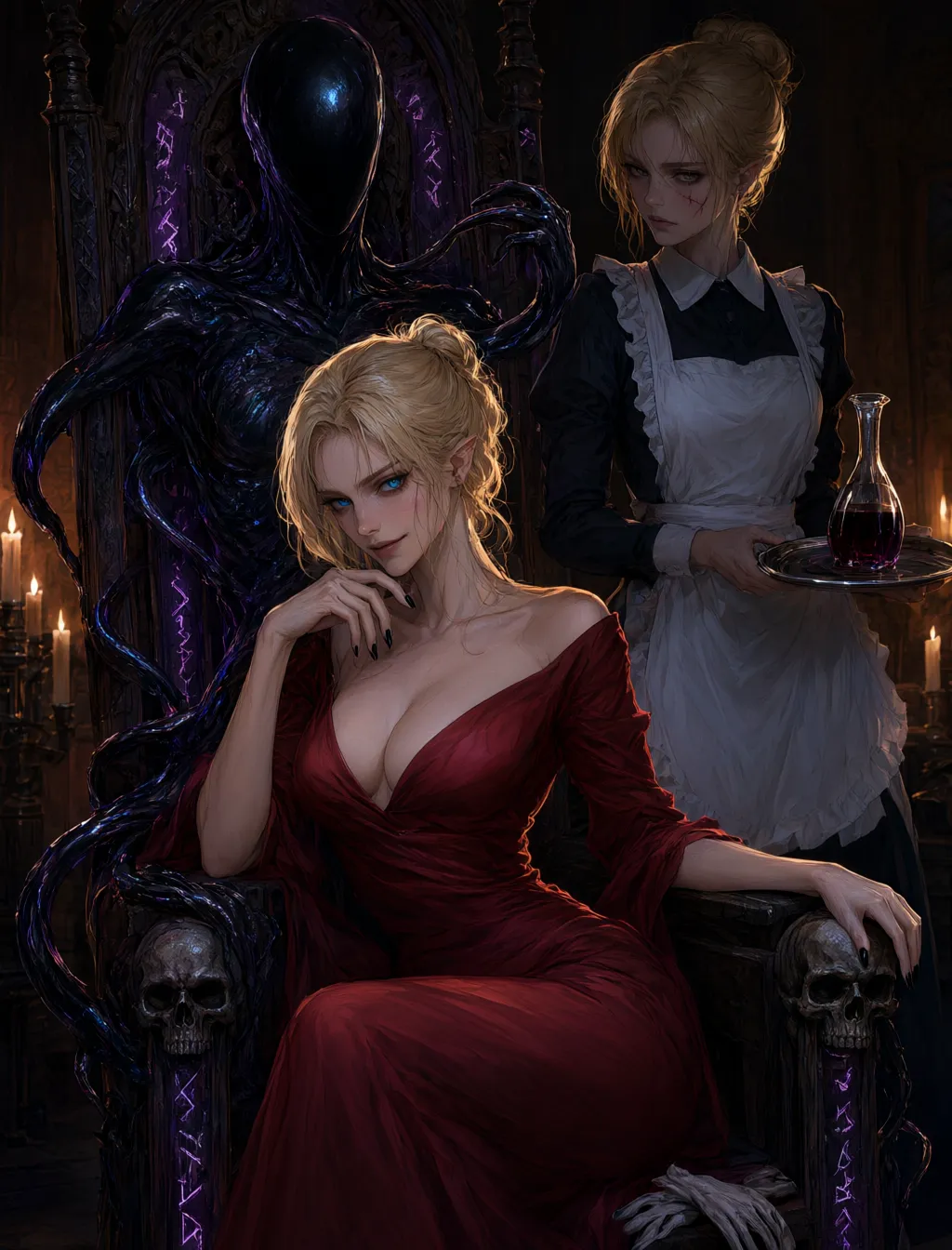
The spiral stairs curved down into the dark, each step worn smooth by centuries of footsteps that had long since turned to dust. Morgana's hand trailed along the cold stone wall, her palm drinking in the damp chill that seeped through the mortar. Behind her, Elara's footfalls were softer—hesitant, careful, the rhythm of someone counting each step as a descent into unknown territory.
The fel dress caught the torchlight in ripples of glossy black, the light sliding across its surface like water over oil. With every step Morgana took, the living fabric shifted against her skin, responding to her movement, her breathing, the subtle tension gathering in her shoulders. It had learned her shape in the study above. Now it was learning her mood—the coiled anticipation, the hunger that made her fingers curl against the stone.
"The throne room was sealed when I took the manor," Morgana said, her voice low, the words bouncing off the close walls. "The previous mistress never spoke of it. I found the entrance behind a tapestry in what she called the wine cellar." A dry pause. "She was not a woman who appreciated what she had."
Elara did not answer. Her breathing was shallow, her attention fixed on the uneven steps, one hand pressed flat against the wall for balance. The fel's connection hummed between them—a thread of shared sensation that carried the cool of the stone through Morgana's palm and the faint trembling in Elara's knees.
They descended for what felt like a full minute, the torchlight from the study above fading until only the flame in Morgana's raised hand illuminated the passage. The air grew heavier with each step, pressing against the ears, thickening in the lungs. It was not the damp weight of underground spaces—it was something older. Something that remembered being fed.
The stairs opened into a circular chamber, and Morgana stopped at the threshold.
The Dark Throne sat at the center of the room, black against black, carved from a single piece of obsidian that drank the torchlight and returned nothing. Its high back rose like a cathedral spire, studded with runes that seemed to shift at the edge of vision—not moving, exactly, but suggesting movement, the way a dying ember suggests heat. The armrests were skulls, their empty sockets fixed on the entrance, their jaws frozen in a silent chorus of welcome.
Morgana stepped forward, and the torch flame guttered.
"No." The word was quiet, patient. The flame steadied. She took another step, and the air in front of her rippled, as if she were pushing through the surface of a pond. The pressure built behind her eyes, a presence that was not sound but pressure —a vast, coiled patience that had been waiting in the dark for longer than the manor had stood.
The fel dress tightened against her skin. Not in fear. In recognition.
Elara gasped. Her hand flew to her chest, pressing flat against the glossy black surface. "Morgana—"
"Quiet." Morgana's voice was steady, but her pulse had quickened, the beat of it pressing against her ribs. The throne was alive. Not in the way the fel was alive—hungry and immediate and eager—but in the way old stone is alive, in the way deep water is alive, in the way a held breath is alive just before it releases.
She walked the circumference of the chamber, her fingers trailing along the wall, feeling the grooves of carved runes beneath her touch. The stone was cold, but the runes were warm. Warm as a living body. Warm as a hand that had just been pressed to skin.
"The warlocks who forged this," she murmured, more to herself than to Elara, "they poured more than magic into it. They poured presence. A fragment of their own consciousness, bound into the obsidian, fed by those who sat upon it." Her gaze traced the runes, the interlocking patterns that spiraled toward the throne's peak. "It remembers every sitter. Every ambition. Every sacrifice."
Elara had not moved from the threshold. Her hands were clasped in front of her, fingers interlaced, knuckles white. The fel dress clung to her form, its glossy surface trembling with each rapid breath she took. Through the bond, Morgana felt the maid's uncertainty—the ancient weight in the room pressing against her chest like a physical hand, the sense that she was standing in a space where power was measured in lifetimes, not years.
"Come." Morgana's command was soft, but it carried. "Stand beside me."
Elara obeyed. Her bare feet made no sound on the stone floor as she crossed the chamber, the torchlight painting long shadows across her transformed body. The fel had reshaped her into something beautiful—her shoulders pulled back, her spine straight, her movements fluid and deliberate. But the fear was still there, in the tightness around her eyes, in the way her fingers curled against her palms.
"The throne can feel you," Morgana said. "Through the fel. It knows you are open, suggestible, willing to receive. What do you sense from it?"
Elara's brow furrowed. Her eyes lost focus, turning inward. "It's... patient. Very patient. It has been waiting for a long time." A pause. "It is interested in you. In what you carry. In what you intend to build."
"And the fel?"
The black dress rippled, responding to Elara's attention. "The fel is curious. They recognize each other. Not as kin—but as things that were made for the same purpose."
Morgana's lips curved. "And what purpose is that?"
Elara's gaze dropped to the floor. "To transform. To elevate. To consume the ordinary and remake it into something greater."
The words settled into the chamber like ash after a fire. Morgana turned back to the throne, studying its silhouette, the runes that pulsed with a faint inner light—a heartbeat in stone, slow and patient and utterly inhuman.
The pressure behind her eyes intensified. A voice that was not a voice brushed against her thoughts—not words, not yet, but the shape of words, the suggestion of a presence that was considering her, tasting her through the air, through the fel that clung to her skin like a living garment.
Morgana held still. Let it taste. Let it consider.
She was not afraid of ancient artifacts. She had broken curses older than this throne. She had bound spirits that had devoured mages twice her age. What she felt, standing in the torchlight with the fel warm against her skin and the presence of the throne pressing against her mind, was not fear. It was interest. The same interest she had felt when the fel first stirred in the vault, the same hunger for discovery that had driven her from a penniless childhood to the heights of aristocratic power.
The throne's presence shifted. The pressure eased, then returned, slower now, more deliberate. It was circling her thoughts, testing the edges of her mind, searching for the shape of her ambition.
Behind her, Elara's breathing had grown shallow. Through the bond, Morgana felt the maid's consciousness brushing against the throne's vast patience—a candle flame held to the edge of an ocean. The contrast was dizzying. The smallness of it made Elara's knees weak, her hands trembling at her sides.
"Breathe," Morgana said, not turning. "The throne cannot hurt you through the fel. It can only invite. And you are not in a position to accept invitations without my permission."
Elara drew a shuddering breath. The trembling eased, though the vulnerability remained, raw and open against the throne's slow consideration.
Morgana stepped closer to the throne. The air thickened with each step, the pressure building until it felt like walking through honey, the torch flame bending toward the obsidian seat as if drawn by a current. The runes on the armrests pulsed in rhythm with her heartbeat—matching it, steadying it, slowing it to the long, patient cadence of stone.
She stopped a hand's breadth from the right armrest. One of the skulls stared up at her, its empty sockets catching the flickering light, its jaw slightly open as if frozen mid-word. The iron chains bolted to the armrests were rusted, but not from age—from use, from the sweat of bound wrists, from the strain of bodies that had been held in place while the throne did its work.
Her fingers twitched at her side. The urge to touch was overwhelming—not a desire to sit, but to connect, to press her palm against the obsidian and feel the full weight of the presence that waited there, to let the ancient power of the throne taste her directly, skin to stone, will to will.
The fel dress tightened around her arm, a subtle compression that was almost a warning. The symbiote did not want her to touch the throne without preparation. It knew what the throne was. It knew what the throne could do.
Morgana's hand rose.
Slowly, deliberately, she extended her fingers toward the armrest, stopping a breath before contact. The runes pulsed beneath her hand, the heat of them reaching up to warm her palm, the pressure behind her eyes swelling into something like the moment before a word is spoken—a throat cleared, a breath drawn, a presence preparing to announce itself.
The air in the chamber went still. The torch flame stood upright, frozen.
The throne had not yet spoken. But it was about to.
Morgana held there, her fingers suspended above the obsidian, the heat of the runes lapping at her skin like a living breath. The pressure behind her eyes had coalesced into something with weight and shape—a presence that was no longer circling but facing her, directly, deliberately, as if the throne had turned its attention fully upon her and found her worth the looking.
The fel dress rippled against her body, a slow undulation that started at her shoulders and traveled downward, the glossy black surface catching the torchlight in waves. Through the bond, she felt the symbiote's reaction—not fear, but alertness, a sharpening of its senses, the way a hunting cat goes still when it scents something larger in the dark. The fel recognized the throne's power. It recognized the weight of what was waking in the chamber.
Elara's breath caught behind her, a small, sharp sound that cut through the stillness. Through the bond, Morgana felt the maid's knees tremble, felt the ancient pressure pressing against Elara's open mind like a hand testing a door. The fel transmitted every sensation—the cold of the stone floor against her bare feet, the tightness in her chest, the way her pulse had begun to race in rhythm with the runes' slow pulse.
"It is aware of you," Elara whispered, her voice barely audible. "It has been waiting for someone who could hold the fel without being consumed by it. It says—" She stopped, her throat working. "It says you are the first in a century who could sit the throne and survive the sitting."
Morgana's lips curved, a thin, cold smile that did not reach her eyes. "Tell it I am not in the habit of sitting where I have not first tested the furniture." Her fingers lowered, the tips brushing the surface of the armrest—a touch so light it was barely contact, the barest graze of skin against heated stone.
The runes flared. The pressure behind her eyes opened, and the throne spoke.
The throne's voice did not come through sound. It came through the marrow of her bones, through the spaces between her thoughts, through the electrical whisper of her own nerves as they carried sensation from her fingertips to her spine. It was ancient and patient and darkly amused, the texture of honey aged in barrels made from trees that had died before the first stone of the manor was laid.
It said: Finally.
The single word unfolded inside her like a flower opening in fast-forward, petals of meaning spreading outward until she understood the layers beneath it—the centuries of silence, the parade of unworthy sitters who had approached and hesitated and retreated, the long, patient hunger of an artifact that knew exactly what it was and had been waiting for someone who would not flinch.
Morgana's fingers remained on the armrest, the runes pulsing against her skin like a second heartbeat. The heat had climbed up her wrist, threading through the veins in her forearm, spreading toward her elbow in slow, deliberate waves. It did not burn. It felt. Felt the architecture of her bones, the rhythm of her blood, the shape of her ambition as if it were tracing the contours of her soul with careful, greedy fingers.
"You have had sitters before," Morgana said. Her voice was steady, but the throne's presence had begun to coil around her words, lending them an echo that was not acoustic. "Whole processions of them, I imagine. Would-be tyrants and petty lords and ambitious fools who thought a throne could make them great."
The runes flickered. The presence within her skull seemed to smile—not with lips, but with the quality of its attention, a warmth that was almost paternal, almost predatory, and entirely certain of its own power.
They sat. They fed me. They died. You are not them.
"No." Morgana's lips curved. "I am not."
She drew her hand back from the armrest, and the absence of contact felt like a small death—the heat receding, the pulse of the runes dimming, the throne's presence withdrawing to the edges of her consciousness like a tide pulling back from the shore. She stood in the silence of the chamber, the torchlight steady now, Elara's shallow breathing the only sound that disturbed the stillness.
The fel rippled against Morgana's skin, a subtle movement that started at her collarbones and traveled downward, settling around her hips like a hand finding its grip. Through the bond, she felt the symbiote's attention fixed on the throne—not fear, not hunger, but something closer to recognition. The same recognition Elara had named. Kin. Or kin-adjacent. Things that had been made for the same purpose.
To transform. To elevate. To consume the ordinary and remake it into something greater.
Morgana turned, her gaze sweeping the chamber—the rune-covered walls, the iron chains coiled at the base of the throne, the skulls whose empty sockets had tracked her movement without eyes. The weight of the place pressed against her from all sides, the accumulated ambition of every soul who had sat in that seat and felt its power flow into them and imagined themselves gods.
She had not come here to imagine.
"Elara." She did not raise her voice, but the name carried through the chamber like a bell. "Tell me what you feel from the threshold. From the moment before the chair accepts someone."
The maid's breath caught. Through the bond, Morgana felt the shift in Elara's attention—the way her consciousness turned toward the throne, the way the fel amplified her sensitivity, the way the ancient presence in the room immediately noticed the smaller mind reaching toward it and turned to look.
Elara's knees buckled. She caught herself, one hand pressed to the stone floor, the glossy black of the fel dress pooling around her like liquid shadow. Her voice came out ragged, scraped thin by the weight of the throne's attention.
"It is—it is huge. A pressure that goes down forever. Like standing at the edge of a well that has no bottom, except the well is looking back at you." She swallowed. "It does not care about me. Not individually. I am a shape it recognizes—a vessel, a conduit. It is interested in what I carry. What the fel carries. What you have put inside me."
Morgana's smile widened. "Good."
She turned back to the throne. The skulls stared up at her, their empty jaws frozen in welcome, their eye sockets deep enough to hold shadows that had not moved in centuries. The chains at the armrests lay still, rusted and patient, waiting for wrists that would not come until she willed them.
She could feel the throne's patience. It had waited centuries. It could wait another hour, another day, another week while she considered its offer and weighed its cost. It was not impatient. It was not hungry. It was certain —certain that she would eventually sit, certain that she was the sitter it had been waiting for, certain that her ambition would eventually overcome her caution, because ambition always did.
But Morgana had not built her empire by doing what was expected.
She stepped forward. One step. Another. The air thickened around her, the pressure building until it was like walking through deep water, each step a deliberate effort against the weight of the throne's attention. The torch flame bent toward her, drawn by her passage, the light casting her shadow long and wavering across the rune-covered walls.
She reached the throne. The skulls stared. The chains waited.
She did not sit.
She placed both hands on the armrests, her fingers curling over the smooth obsidian, the heat of the runes pressing into her palms like a pulse. The throne's presence surged upward through her arms, flooding her chest, spreading through her ribs like warm water through dry earth. Her breath caught—not from fear, but from sensation. The throne was tasting her now, properly, not through a single fingertip but through both hands, through the full contact of her palms against its ancient surface, and what it found made the runes flare bright enough to cast shadows across the chamber.
The pleasure was sudden and sharp, a spike of heat that drove through her center and spread outward, curling her toes inside her shoes, arching her spine, pulling a sound from her throat that she did not quite manage to suppress. It was not sexual—not exactly—but it occupied the same territory, the same raw sensitivity, the same vulnerability of nerves laid bare and stroked by something that understood exactly how to make her feel full.
The throne's power was rich and dark, the texture of velvet dragged across bare skin, the weight of a fur cloak settling around her shoulders on a winter night. It filled her from the inside, pressing against the boundaries of her consciousness, offering her a taste of what it would feel like to sit—truly sit—and let the full reservoir of its ancient power pour into her like wine into a cup.
The fel tightened around her body, drinking in the sensation, feeding on the pleasure that radiated from her skin in waves. Through the bond, Morgana felt the symbiote's reaction—a greedy, delighted yes, a hunger that sharpened with every pulse of the throne's energy, a recognition that this was what it had been made for, that this was the purpose that had been waiting at the end of its creation.
"You like that," Morgana breathed, not to the throne, but to the fel. The symbiote's response was a ripple of heat across her ribs, a silent laugh that vibrated through her skin like the purr of a satisfied cat.
The throne's voice returned, warm and amused, brushing against her thoughts with the intimacy of a lover's whisper.
You wear the fel well. It recognizes me. I recognize it. We were shaped from the same impulse—the desire to transform, to elevate, to take what is ordinary and make it divine. The fel feeds on pleasure. I feed on power. They are the same river, Morgana. Different tributaries, but the same water.
"And your price." She said it flatly, not a question. "Every throne has a price. What do you demand of those who sit?"
The presence in her skull went still. Not withdrawn—considering. Weighing her the way she had weighed it. Then the answer came, slow and deliberate, each word shaped with care.
Sacrifice. Not blood, unless you choose it. Not life, unless you offer it. I feed on souls that are given freely—willingly, joyfully, offered by those who understand what they are giving and choose to give it anyway. The more complete the offering, the deeper the power I return to the one who sits. A lamb led to slaughter is a pittance. A soul that kneels and opens its throat with a smile—that is a feast.
Morgana's hands tightened on the armrests. The runes pulsed beneath her fingers, a steady rhythm that matched her heartbeat, slowing it, deepening it, pulling her into the long patience of stone.
"Willing sacrifice." She tested the words on her tongue, rolling them around, tasting their weight. "Not bound. Not coerced. Not tricked."
Correct. The bonds of force are weak currency. I do not accept them. The offering must be genuine—the soul must choose, must desire, must offer itself with open hands and a glad heart. Only then does the power flow freely. Only then does the throne give what it holds.
Morgana's laugh was low, a sound that carried no humor and all the warmth of a winter sky. "That is a high price. Willing sacrifice is not easily found."
No. It is not. Which is why no one has sat the throne in living memory. The ambitious ones who found this chamber could not find the offering I require. They tried to bargain. They tried to force. They tried to trick the throne into accepting lesser coin. The throne does not bargain. The throne does not compromise. The throne waits.
"And now I am here, and you believe I can find what the others could not."
You carry the fel. You understand pleasure. You understand the shape of desire, the architecture of willingness, the way a soul can be led to the edge of a cliff and made to want to jump. You are the first sitter in a century who has the tools to pay my price.
The throne's presence pressed deeper, warmer, a pulse of approval that sent another wave of pleasure through Morgana's body, making her hips shift against the armrests, her breath catch, her fingers curl against the heated obsidian. The fel drank it in, amplifying the sensation, sending it back through the bond, where Elara—still kneeling on the stone floor—let out a soft, broken sound that was half gasp and half whimper.
And in that moment, between one heartbeat and the next, the idea arrived.
It did not come from the throne. It did not come from the fel, though the fel immediately recognized its shape and wrapped around it with approval. It came from Morgana's own mind, from the cold, calculating center of her that had been solving puzzles since she was a child clawing her way out of poverty. It was not a revelation. It was a synthesis —the fel's hunger and the throne's demand and the willing, open mind of the woman kneeling behind her, all of the pieces clicking together like the tumblers of a lock.
She turned her head, just slightly, just enough to see Elara in her peripheral vision. The maid was still on her knees, one hand pressed to the floor, the fel dress clinging to her trembling form. Her eyes were glassy, unfocused, caught between the throne's weight and the pleasure that had leaked through the bond—a fraction of what Morgana felt, and already enough to leave her breathless.
If a willing sacrifice was the throne's price. And if the fel could make a person feel pleasure so intense that they would do anything to feel it again, anything to feel it more. And if a soul offered freely, with open hands and a glad heart, was the coin the throne demanded...
Morgana's lips curved into a smile that was all sharp edges.
She looked down at the skull set into the left armrest, its empty sockets fixed on her face, its jaw frozen mid-word. "You told me you need willing sacrifice. Souls that choose to offer themselves."
I did.
"What if I told you I can create them?"
The runes flared. The pressure in the chamber changed—not tightening, but listening, the throne's attention sharpening to a point that made the air itself feel keener, thinner, more alive.
Explain.
Morgana's hand lifted from the armrest and reached back, toward Elara, her fingers brushing the maid's cheek. The fel dress rippled beneath her touch, the glossy black surface warming against her palm. Elara leaned into the contact, her eyes fluttering closed, a soft sigh escaping her lips—the instinctive response of a mind that had been opened and made suggestible, a will that had been reshaped to receive pleasure and obedience in equal measure.
"The fel amplifies sensation. You have felt it—the pleasure that flows through me, carrying into her, carrying into anyone who wears it. That pleasure is addictive. Once a person has felt the full weight of it, once their body has been remade by it, they will do anything to feel it again." She stroked Elara's jaw, feeling the maid tremble beneath her fingers. "And if that pleasure is tied to the moment of sacrifice—if the offering itself is made ecstatic, the soul surrendering in a peak of pleasure so intense that death feels like the natural next step—"
"Then the sacrifice is willing."
The words came from Elara's mouth. Her eyes were open now, fixed on Morgana's face, her expression the serene emptiness of a mind that had been opened too wide and left too exposed. Through the bond, Morgana felt the shape of her thought—the echo of the idea, the recognition of her own role in the plan, the acceptance that settled into her bones like a stone dropping into still water.
Morgana's smile deepened. "Then the sacrifice is willing."
The throne was silent for a long moment. The runes dimmed, then brightened, a slow pulse that felt like breathing. The presence behind Morgana's eyes withdrew, considered, and returned—slower now, measured, the quality of its attention shifting from appraisal to something that might have been respect.
The fel's touch creates ecstasy. Ecstasy creates willingness. Willingness creates sacrifice. A pause, the weight of ancient approval settling over her like a cloak. You have found the key that every other sitter overlooked. The fel was made for pleasure. I was made for power. They are the same river.
"And I am the woman who will drink from both."
She released Elara's face and turned back to the throne, placing both hands on the armrests, the heat of the runes surging up her arms with renewed intensity. The pleasure was sharper now, the throne feeding her approval through her skin, the fel feeding on that pleasure and returning it in a loop that spiraled upward, building toward something that made her vision blur and her knees weaken and her chest fill with a heat that was almost unbearable.
"I will find you your sacrifices," she said, her voice low, the words pressed through the haze of sensation. "I will bring them to you bound in pleasure and opened by ecstasy, and they will offer themselves with glad hearts and open hands, and you will drink them down and give me power."
Yes.
The word was a physical pressure, a pulse of agreement that drove through her chest and settled in her core, leaving her breathless and trembling and hungry for more. The runes blazed, the throne's presence filling her completely, and for a single, suspended moment, Morgana felt what it would be like to sit—to truly sit, to accept the full weight of the throne's ancient power and let it remake her—and the taste of it was so rich, so dark, so utterly intoxicating that she understood why every sitter before her had eventually succumbed.
But she did not sit.
She stepped back, her hands leaving the armrests, the runes dimming as contact was broken. The pressure receded, the pleasure fading to a warm afterglow that settled into her bones like the memory of a dream. The throne's presence withdrew, patient and satisfied, having tasted her ambition and found it worthy.
Morgana turned to face Elara. The maid was still kneeling, her eyes glassy, the fel dress clinging to her trembling form. Through the bond, Morgana felt the echo of her own pleasure—faded, but present, a warmth that had settled into Elara's chest and was slowly spreading outward, leaving her loose-limbed and open and utterly pliable.
"The plan begins with you," Morgana said, her voice soft, almost gentle. "You are the template. The proof that the fel can open a mind, reshape a will, make a person willing to receive whatever I choose to give." She cupped Elara's chin, tilting her face upward. "When the time comes, you will be the first to offer yourself to the throne. And you will do it gladly."
Elara's eyes were clear, her expression serene, her voice steady as she spoke the words that settled into the chamber like a vow. "I will. Gladly."