
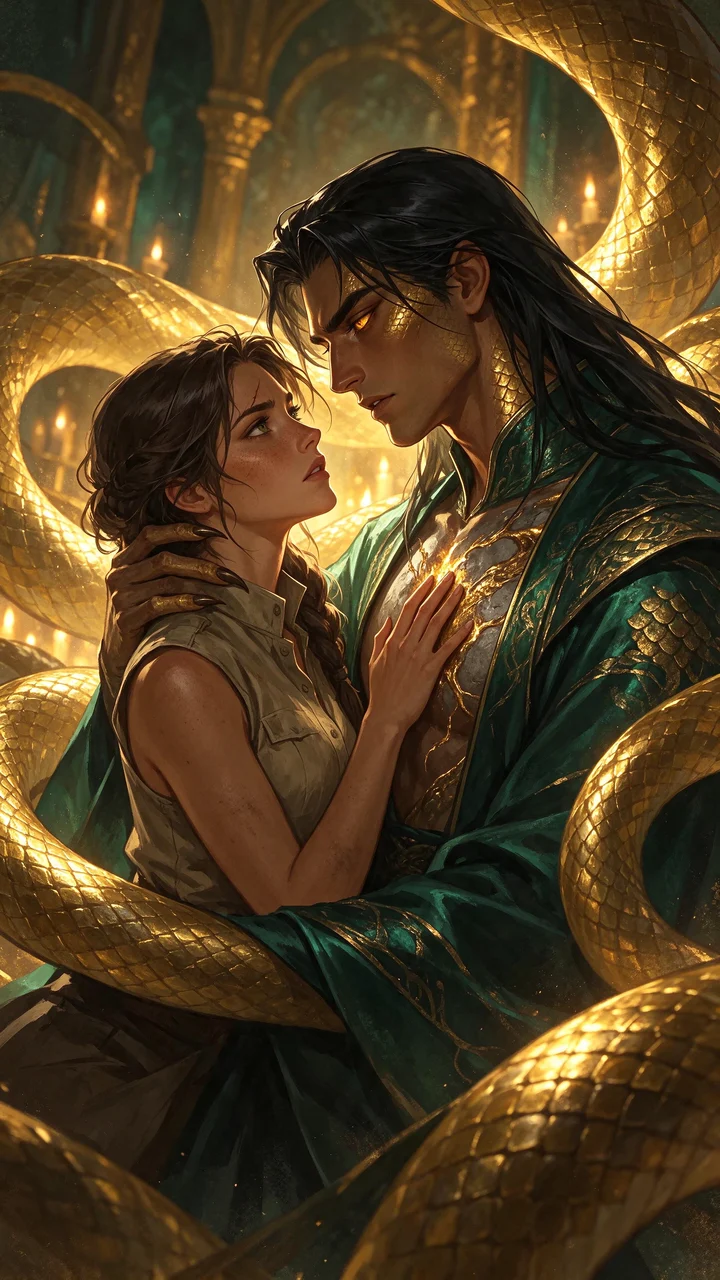
The heart-stone was cracked straight through its center.
Maren had found the chamber by following the cold. Ixtaren had been slower all morning, his answers shorter, and twice she had looked up from a joint to find him with one hand pressed flat to his chest beneath the jade silk. When she asked, he said it was nothing, in the voice people use for the opposite. The radio had been dead since dawn. So she had followed the faults alone, chalk in hand, down a stair she had never noticed, into this.
A round sanctum, no wider than a chapel. A hundred candles guttered in niches on every side, lit by no one she could name, and between them the walls glittered with gold leaf laid over serpents carved so close they seemed to move. The air was warm and close and it hummed, a low pulse she felt at the back of her teeth.
In the center stood the stone. Waist-high, round, green-black, polished smooth by six hundred years of nothing. A crack ran from crown to base, and from it a web of fine grey fractures spread outward.
“This one wasn’t me,” she said.
“No.” He filled the doorway behind her, coils pouring down the stair. “This one is every other one. Your crack in the seal ran here. They all run here, in the end.”
She turned. He was holding himself very straight, the way people hold themselves around a broken rib. His breath came slow and shallow.
“Show me,” she said.
“Dr. Holt.”
“You promised to keep me alive. I’m returning the favor. Show me.”
He looked at her for a long moment. Then he came into the chamber, the candle flames bending away from him, and stopped with the heart-stone between them. Above the high collar his throat moved. At its base, where the fine scales thinned, she could see the edge of grey.
“It is under the robe,” he said. “Over the collarbone. Spreading downward.”
“May I?”
His eyes held hers, amber and slit-pupiled, with something in them she hadn’t seen before. “Yes.”
He raised his own hands to the collar. The fastening was a row of small gold toggles in silk loops, and he undid them one by one, unhurried, never once looking away from her face. Three. Four. He parted the collar no further than he had to, a narrow opening of jade silk at the throat, and stopped.
Beneath it, bronze skin was traced with gold scale, and across his left collarbone lay a plate of grey stone, flat and fissured, the exact twin of the heart-stone’s wound.
“Go on,” he said quietly.
She mixed the mortar on her knee with her back to the candles, her hands not quite steady. She worked the heart-stone first, packing the fracture in thin layers, smoothing each with her thumb, the resin going soft and fragrant in the heat.
“Hold still,” she said, without thinking.
“I am a serpent. Stillness is the one talent I was born with.”
“You’re fidgeting.”
“I am breathing. Badly. As you so often point out.”
She set her left palm on the crown of the stone. Then, after one more look at his face, she laid her right over the grey at his collarbone.
It was cold. Colder than anything in that warm room. Under the cold, very far down, she felt his heart.
His coils moved. Not toward her. Around her. They slid across the floor in a wide gold loop, rising at her back, curving past her shoulder, closing a circle around her and the stone until she stood inside a ring of burnished scale that touched her nowhere at all. Near enough that she felt the heat coming off it. Near enough to lean on, if she let herself.
“You’re doing that on purpose,” she said.
“The floor is unstable.”
“It isn’t.”
“Then I am doing it on purpose.”
She pressed mortar into the last of the seam. The hum in the walls changed pitch. Under her right hand, something gave.
“Ixtaren.”
“Don’t stop.”
“I’m not stopping. Talk to me. Your breathing’s awful.”
“I am aware of my breathing.” The candlelight slid along his jaw. “I have kept this house six hundred and twelve years. I have been angry for most of them and lonely for all of them, and I had made my peace with both.” His voice dropped. “Then you came in with your chisel and your terrible humming.”
“My humming is fine.”
“Your humming is a crime against the choir.” His throat moved under her palm. “When this is done, the doors will open, and you will go. And I am afraid, Maren. Not of the stone. Of what I will feel when your hands are gone.”
The first time he had said her name.
Under her palm, the cold broke.
Gold came up through the grey, slowly, then all at once, warmth flooding beneath her fingers the way sunrise floods down a wall, fissures sealing, stone turning back into skin and scale. His breath caught, then went deep, a full breath, his first in hours. The hum of the chamber steadied, low and even.
She did not take her hand away.
He raised his. Slowly, so she could see it coming. His fingertips touched her jaw, light, tracing its stubborn line, and his thumb came to rest just beneath her ear. His skin was warm. Hers was warmer.
“Tell me to stop,” he said.
She didn’t.
He bent his head. She tipped her face up. The candles guttered, the coils drew their circle in by an inch, and his breath reached her mouth, warm, and hers reached his, and there was nothing left between them but the width of a thought.
The floor jumped.
A scream of steel tore through the rock beyond the wall, high and grinding. Gold leaf shivered loose and drifted down around them in flakes. The candles leaned. Again: a drill bit, industrial, chewing deep, and the whole chamber shuddered.
Then a voice, amplified, warm and reasonable and horribly familiar, came rolling through the stone.
“Maren! It’s Desmond. Hold tight, sweetheart. We’re coming in to get you.”
The heart-stone split again with that sound of breaking bone. She felt it run.
Ixtaren’s breath stopped. Beneath her palm, across the gold she had just made whole, cold lines raced outward from his heart.