
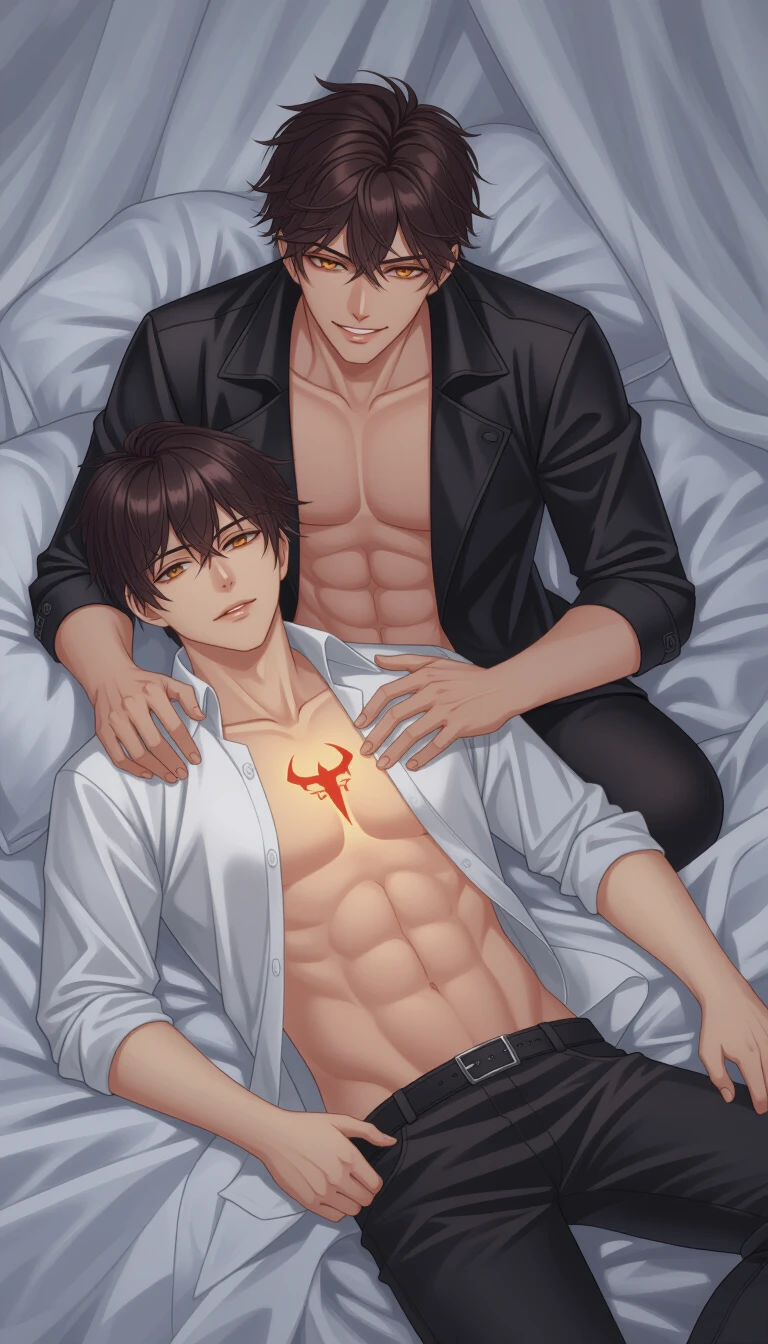
Tokyo in autumn meant the light came through the windows at a certain angle—gold and amber, softened by the last warm days before winter bit down. The Nijisanji cafeteria was half-empty at this hour, a lull between the lunch rush and the afternoon meetings, and the table near the windows held four voices and the clatter of chopsticks against takeout containers.
"No, no, no—listen." Sho leaned forward, a grain of rice clinging to his lower lip. "If you're playing Viper on Icebox, the one-way smokes have to go here—" He drew a line through the air with his chopsticks, nearly hitting Lauren's drink.
Lauren batted his hand away without looking up from his phone. "You're describing a setup that requires ult economy we won't have until round five."
"And you're describing a personality disorder where you can't just let a man dream."
Rou laughed, low and warm, and the sound made the table feel smaller, safer. He had a way of doing that—smoothing the edges of any argument without trying, just by being there, his broad shoulders relaxed and his smile easy.
Kanato watched them bicker with the fond tolerance of a man who had seen this exact exchange a hundred times. He lifted his iced coffee, took a sip, and let his gaze drift sideways—to the empty seat beside him.
The chair was still warm.
Akira had left maybe ten minutes ago, excusing himself with that small, almost apologetic bow he did when he didn't want to interrupt but had to go. I should head down early. Want to check the recording room before the staff arrives. And Kanato had nodded, squeezed his wrist under the table where no one could see, and said break a leg, Nagi just to watch the tips of Akira's ears go pink.
He missed him already.
That was the truth of it, the embarrassing, tender truth Kanato carried in his chest like a bruise he kept pressing. Three years of dancing around each other, and now—now that he had permission to want—every minute apart felt like a small wound.
"He's early," Lauren said, and it took Kanato a second to realize Lauren was talking to him. "The recording's not for another hour."
"Yeah." Kanato set his coffee down. "Let him."
Lauren's eyebrow lifted a fraction—the silent question he'd perfected over years of friendship.
Kanato looked at the empty chair, then back at his friends. At Sho, who had finally given up on the Viper argument and was now trying to steal a piece of chicken from Rou's container. At Rou, who let him, because Rou was kind like that. At Lauren, who watched everything with those sharp eyes that missed nothing.
"He's been excited about this," Kanato said. "The radio program. It's—" He paused, searching for the right words. "It's not like the music stuff."
"The music stuff?" Sho asked around a mouthful of stolen chicken.
"You know." Kanato gestured vaguely. "The singing. The dancing. The choreography. Akira works hard at it—god, he works hard—but it doesn't come naturally to him the way it does for the rest of us."
Rou nodded slowly. "He's always the last one to pick up the routine."
"Yeah. And I can see it get to him sometimes. The frustration. The feeling that he's lagging behind." Kanato's voice softened without his permission. "But this—the radio thing. The talking. That's his arena."
Lauren set his phone down, face-up, screen dark. "He's good at it."
"He's great at it." Kanato leaned back in his chair, and the memory surfaced warm and unbidden: Akira on his first solo stream, three hours of unscripted rambling about nothing and everything, the way his voice had filled the silence like it belonged there. "You know what made him want to be a vtuber?"
"The money?" Sho offered.
Kanato laughed, short and genuine. "No. Well—maybe a little. But no." He looked at the window, at the autumn light, at the city stretching out beyond the glass. "He used to listen to Rikichi's radio program. The variety show one. Late-night, when the world was quiet and he was alone."
The table had gone still. Even Sho had stopped chewing.
"He told me once that he'd sit in his apartment—back when he was still at SPIA, before everything—and he'd listen to Rikichi talk, and he'd think: I want that. I want to just… talk. To fill the silence with something good. To make people feel less alone in the dark."
Kanato's throat tightened. He cleared it. "He already has his own podcast. Weekly. You've seen the numbers—they're solid. But that's not the dream."
"What is?" Rou asked, quiet.
"Having his own FM radio channel. Broadcasting across Japan. His voice, his show, his hour of the night where anyone tuning in feels like they're sitting across from a friend."
The silence that followed was not empty. It was full—full of the weight of knowing someone that deeply, of being trusted with a dream so tender it could break if handled wrong.
Lauren picked up his phone. Checked something. Set it down. "He never mentioned it."
"He wouldn't." Kanato smiled, and it ached. "He's too busy being embarrassed about wanting things."
Sho made a sound, somewhere between a laugh and a sigh. "That's—god, that's so him."
"Yeah." Kanato's eyes drifted back to the empty chair. "So let him be early. Let him stand in that recording room and breathe it in. He's earned this."
The fluorescent lights of the cafeteria hummed overhead. Somewhere in the building, an elevator chimed. And across the table, three men who had become family looked at Kanato and saw what he didn't say: I'm terrified for him. I'm proud of him. I love him so much it's destroying me.
---
The recording room was cold.
Not the kind of cold that came from bad insulation—the kind that came from empty spaces waiting to be filled. Akira stood in the center of it, hands in the pockets of his jacket, and let his eyes trace the contours of the room: the soundproofing panels on the walls, the microphones on their stands, the mixing board dark and dormant, waiting for fingers to bring it to life.
He was early. Forty minutes early. Kanato was right about that.
But Kanato was also right about the other thing—the thing Akira had never said out loud, not to anyone who hadn't already known: this mattered. Not in the way the music mattered, which was a duty, a craft, a thing he had to fight for every inch of. This mattered the way breathing mattered. Natural. Necessary. The part of him that had always been there, waiting for a microphone to find it.
He exhaled. Slow. Let his shoulders drop.
The door opened behind him.
"Shikinagi-san?"
He turned, and there they were—the MC first, a man in his forties with a weathered face and a voice that had greeted him through speakers a hundred times before. Behind him, the production staff: a sound engineer, a writer, two assistants Akira didn't recognize. They all carried that particular energy of people who had been doing this long enough to move through a room like they owned it.
"That's me." Akira smiled, easy, professional. "Thank you for having me."
"The pleasure's ours." The MC stepped forward, hand extended. "I've been following your podcast. The structure is solid, but your timing—that's the thing you can't teach. You know when to let a pause breathe."
The compliment landed somewhere warm in Akira's chest. "That means a lot. From you especially. I've been listening to your program since—" He stopped, almost embarrassed. "Since before I debuted."
The MC's smile widened. "Then let's make this a good one."
They settled into the pre-recording rhythm: sound checks, level adjustments, the choreography of bodies moving around equipment. One of the assistants—a young woman with a clipboard—approached Akira with a tray of drinks.
"Can I get you something? We have coffee, tea, some juice—"
Akira's training fired before his conscious mind caught up. Never accept drinks from unknown sources. Never let them see you hesitate. The reflex was older than Voltaction, older than the contract, older than Kanato's hands on his skin. It was scar tissue.
"Thank you," he said, and his voice was smooth, practiced. "I'll stick with mineral water, if you have it. Want to keep my throat in top condition for the talk."
The assistant nodded, made a note, and disappeared. Akira watched her go, cataloging the exits, the angles, the weight of the people in the room. Three years out of SPIA, and the habit hadn't faded. Probably never would.
The mineral water arrived in a sealed bottle. He opened it himself, poured it into a cup he'd watched the assistant take from a fresh stack. Safe.
The MC wandered over, holding a box of snacks. "You mind if I have some of these? I get hungry during recordings—bad habit."
"Go ahead."
The MC opened the box. High-end confectionery, the kind that came in elegant wrapping with a brand name Akira recognized from advertisements. The man popped one into his mouth, crunched, sighed contentedly. "Want one? They're good. And I promise—" A wink. "—they're not a bribe. Just good manners."
Akira's first instinct was no. His second instinct was that's rude. His third instinct—the one that had gotten him through a hundred social situations he didn't want to be in—found a compromise.
The package was sealed. He'd watched the MC break the seal himself. The brand was famous, exclusive, the kind of thing that would be nearly impossible to tamper with from production to table.
Safe.
"Just one," Akira said, and reached for the box.
The confection was light, flaky, dusted with sugar. It dissolved on his tongue with a sweetness that was almost floral. He chewed, swallowed, smiled. "That is good."
"Told you." The MC closed the box, set it aside. "Alright—let's run through the segment order before we start recording."
Ten minutes.
That was how long it took for the first wrong note to sound.
Akira was mid-sentence, discussing the structure of his podcast, when he felt it: a warmth spreading from his stomach outward, slow at first, like a hand pressing gently from the inside. He paused. Blinked. The words he'd been about to say scattered like startled birds.
"Shikinagi-san?" The writer, looking up from her notes. "Everything alright?"
"Fine." His voice came out thinner than he wanted. "Just—give me a second."
The warmth was moving. Spreading. Down his thighs, up his chest, into his fingertips. His heart had begun to hammer, a fast, irregular rhythm that felt wrong in his ribs. And beneath it, something else—a heat that was not fever, not illness, but hunger.
Incubus hunger.
His hand found the edge of the table. Gripped it. The wood was real, solid, grounding. He focused on the texture of it, the grain against his palm, and tried to breathe.
No. Not here. Not now.
"You look pale." The MC's voice had changed. Softer. Closer. He had moved without Akira noticing, was standing just beside him now, a hand hovering near Akira's shoulder. "Maybe you should sit down."
That hand landed.
And Akira felt it—the pressure, the warmth, the way the man's fingers curled slightly against the fabric of his jacket—and his entire body went rigid with the wrongness of it.
"I'm fine," he said, and it came out as a command, the voice he'd used in SPIA when he needed people to believe him. "Just need a minute."
"Of course." The MC didn't move his hand. "But the recording can wait. You're our guest—we want you comfortable."
The production staff had gone quiet. Too quiet. Akira's training screamed at him: something is wrong, the exits, catalogue the exits—
He tried to stand.
His legs did not obey.
The sedative had kicked in properly now, turning his limbs to lead, his thoughts to syrup. The world tilted. The MC's hand found his shoulder again, steadying him, and the grip was too firm, too possessive for a concerned host.
"Easy," the man said. "Easy. Let's get you lying down."
"Don't—" Akira's tongue was thick. "Don't touch me."
"You're not well. We're just trying to help." But the voice had changed. The warmth had drained out of it, leaving something cold beneath. "Can someone get the door?"
Two of the assistants moved toward the emergency exit at the back of the room. The sound engineer was already there, key in hand, unlocking it.
Akira's body moved before his mind caught up. Adrenaline—clean, sharp, cutting through the chemical fog—drove him to his feet. His arm swung out, caught the MC across the chest, sent him stumbling back. The chair clattered. The writer screamed.
"Don't touch me."
He made it three steps toward the main door before they grabbed him.
Hands on his arms. His waist. His throat. He twisted, used the momentum to throw one of them off—a man with a beard and a tattoo on his wrist—watched him hit the wall with a crack. Another came at him from behind. Akira dropped his weight, hooked a leg, sent him crashing into the table.
Two down. His body was burning with effort, the sedative dragging at every movement, the aphrodisiac fizzing in his blood like poison trying to be pleasure. He could feel the incubus mark beneath his stomach pulsing, hot, desperate for contact it should not want.
Get out. Get out get out get—
Something hit his back.
He didn't see it coming—didn't hear the swing, didn't register the weight until it connected with his spine, just below the shoulder blades. The impact drove the air from his lungs, drove him forward, drove him to his knees. His vision went white, then gray, then dark at the edges.
The bag swung again. This time, he felt nothing.
---
The stairwell door clicked shut behind them, and the world became concrete and echo and the chemical smell of old exhaust fumes. They moved fast—the sound engineer and one of the assistants, each gripping an arm, dragging Akira's unconscious body between them. His head lolled. His feet scraped against the ground, heels dragging, leaving no mark that anyone would notice in the dark of the parking basement.
"—hurry, someone will come looking—"
"The van's at the far end. If we get him in before anyone checks the guest book—"
"His manager. His manager's going to show up for the recording."
"Then we have thirty minutes. Move."
The van was an unmarked white model, the kind a thousand businesses used across Tokyo. Anonymous. Untraceable. The back doors swung open, and Akira was thrown inside like cargo. His head hit the metal floor with a sound that would have made anyone flinch.
No one flinched.
The sound engineer climbed in after him, rope in hand. He worked fast, efficient, looping the cord around Akira's wrists and pulling them above his head, securing them to the handgrip bolted to the ceiling. Another length for his ankles, pulled tight, leaving red marks on the skin even through unconsciousness.
"The collar's in the front seat. We'll put it on him when he wakes—makes him easier to handle."
"What about the door?"
"Leave it cracked. He's not going anywhere."
A pause. The sound engineer looked down at Akira's face—slack, pale, a thin line of blood from where he'd bitten his lip during the struggle. Something flickered in his expression that might have been guilt, might have been nothing.
He slammed the doors shut.
The van sat in the dark, engine off, air conditioner silent. The minutes ticked by. The temperature rose. And on the metal floor of the cargo hold, bound and alone, Akira began to sweat.
---
The headshot sound was satisfying in a way that had nothing to do with violence and everything to do with precision. Kanato's crosshair was already moving to the next target before the first body hit the ground—muscle memory, hours of practice, the rhythm of a game he had mastered.
"Nice." Kuzuha's voice through the headset, clipped and focused. "They're stacking B. I'm rotating."
"Copy." Kanato's fingers danced across the keyboard. "Sho, you've got A. I'm holding mid."
In the corner of his monitor, the live chat scrolled past in a blur of emojis and exclamation points. Tournament—not official, but important. Practice for the real thing next week, the one where sponsors would be watching, where nerves would be high and every mistake would be catalogued by people who didn't care about the human being behind the screen.
Kanato's phone sat face-up on the desk beside his keyboard, screen dark, notifications silenced. He had put it on Do Not Disturb before the match started, because he knew himself: if he saw a message come in, he would check it. And if he checked it, he would lose focus. And if he lost focus, he would let his team down.
He had people counting on him. He always did.
The round stretched on. Four minutes of slow, methodical clearing, of utility trade-offs and angle holds. Lauren died first—a stray peek into A-site that got punished by a waiting Operator. He sighed, pulled his headset off one ear, and leaned back to watch the rest of the round play out on Kanato's screen.
"You've got a call," Lauren said.
Kanato didn't look away from the monitor. "I'm in a round."
"It's—" Lauren paused. "It's the second time it's rung."
"I'll check it after."
Another kill. Two enemies down. Kanato's heart rate was steady, his breathing even. He was in the flow state, the place where the game became extension of will, where thinking was too slow and only instinct mattered.
Lauren shifted beside him. Leaned closer. "Kanato. It's Akira's manager."
The words didn't register at first. They arrived as sounds, as syllables, and then they rearranged themselves into meaning—Akira, manager, call—and Kanato's hands stopped moving.
His character stood still in the middle of a corridor. An enemy appeared from the right. Shot him dead.
The round was lost.
Kanato didn't care.
He yanked his headset off, the motion sharp enough to hurt, and grabbed his phone. Two missed calls from Akira's manager. The most recent one was twenty seconds ago.
Akira's manager never called him. Not once, in three years.
He hit redial, and the phone was at his ear before the first ring finished.
"Kanato-san." The manager's voice was tight, controlled, the kind of control that was fraying at the edges. "Is Akira with you?"
The question landed like a punch to the diaphragm.
"No." Kanato was already standing, already reaching for his jacket. "He left for the recording early. Why?"
Silence. A breath. The sound of the manager's composure cracking.
"I'm at the recording room. He's not here. The radio staff isn't here. The room is empty, Kanato-san. Equipment on, chairs knocked over—like there was a struggle."
The room tilted. Just slightly. Just enough for Kanato to feel the floor shift beneath him.
"I've called him four times. Straight to voicemail." The manager's voice was rising now, the control slipping. "I called Hibari-san—he doesn't know where Akira is either. The front desk says the radio staff checked in, but nobody saw them leave. The back exit—the emergency door—it was unlocked. The security guard didn't notice, but I noticed, because I've been doing this for fifteen years and I know when something is wrong."
Kanato's hand found the edge of his desk. Held it. The wood was real. The pressure grounded him.
"I'm on my way to the security room," the manager said. "They have CCTV on the back exits. I'm going to find out if they left the building. And if they didn't—" A pause. "I have the police on standby."
"I'll meet you at the security room." Kanato's voice came out flat, hollow, the voice he used when emergencies happened and feelings had to wait. "Don't call anyone yet. I'm coming."
He hung up.
The gaming room was silent. Kuzuha, Sho, Rou, Lauren—they were all watching him, headsets off, expressions shifting from confusion to concern as they read what was on his face.
"Akira's missing," Kanato said. It was the first time he had said it aloud, and the words felt wrong in his mouth, sharp and jagged like broken glass. "The radio staff—something happened. I'm going to the security room."
He was already moving, already at the door, when Sho's voice stopped him.
"We're coming with you."
Kanato turned. Looked at them. Four faces, four men who had been strangers once and were now something closer to brothers. They didn't know Akira the way he did—didn't know the sound he made when he was happy, the way his tail curled when he was embarrassed, the small, vulnerable noises he made in his sleep—but they were here. They were here.
"Let's go," Kanato said. The word was all he had left.
---
The security room was small and windowless, walled with monitors that showed the building in grainy black-and-white. The security guard—a young man with a badge and a nervous expression—was already pulling up footage when Kanato arrived with his team at his back.
"The recording room feed from the last hour," the manager said. He was standing by the main console, arms crossed, jaw tight. "I told him to start from when Akira arrived."
Kanato nodded. He didn't trust his voice.
The monitor flickered, and there he was—Akira, walking into the recording room, shoulders set, a small smile on his face. The camera angle was wide, catching the whole space: the mixing board, the microphones, the door opening behind him to admit the radio staff.
Kanato watched his lover move through the pre-recording ritual. The handshake. The smile. The polite refusal of the offered drinks, the way Akira opened the sealed water bottle himself—a habit Kanato had noticed before but never asked about, because some survival reflexes deserved privacy.
"He's careful," Sho murmured from behind him.
"He's been careful his whole life," Kanato said, and the words tasted like ash.
On the screen, the MC opened a box of snacks. Offered it to Akira. Akira hesitated—Kanato saw it, that fractional pause, that weighing of risk—and then reached for one.
"No," Kanato breathed. "Akira, no—"
But the Akira on the screen couldn't hear him. The Akira on the screen ate the confection, smiled, and went back to conversation. Ten minutes passed on the timestamp. Fifteen.
Then Akira's hand found the table.
Kanato saw it happen—saw the way his lover's body changed, the slight sway, the way his eyes lost focus for a moment. Saw him try to stand and fail. Saw the MC's hand land on his shoulder, and the way Akira flinched like he'd been burned.
"Don't touch him," Kanato whispered. The words were a prayer. They were a threat. They were useless either way.
The sound was off, but they didn't need it. The story was clear in the movement: Akira pushing back, knocking the MC away, trying to reach the door. The two staff members grabbing him. Akira throwing them off with a grace that spoke of years of training—Kanato felt a stab of pride even through the terror, because that was his Akira, fighting when he should have been frozen, moving when he should have given up.
And then the bag.
The blow to the back.
Akira crumpling.
Kanato's vision went red at the edges. He felt Lauren's hand on his arm, Sho's voice saying something he couldn't parse, the manager's sharp intake of breath. The room was too small. The air was too thin. He needed to move, needed to find, needed to—
"—they took him out the back." The security guard's voice cut through the static. "I've got them on the stairwell camera. Three people, dragging him. They exit to the basement parking at 14:23."
"Show me." Kanato's voice was not his own. It came from somewhere deeper, older, the part of him that had been raised in the mafia and had never fully left. "Show me where they took him."
The guard switched feeds. A white van, anonymous, backing into a parking spot near the emergency exit. The back doors opened. Akira's body was thrown inside like a sack of grain.
Kanato's hand found the edge of the console. Squeezed until the plastic creaked.
"I have the license plate," the manager said, already reaching for his phone. "I'm calling the police."
"Don't."
The word stopped everyone in the room. Kanato turned, and the mask he wore was not the easy smile, not the lazy confidence, not the teasing affection they knew. It was something older. Something colder. The face of a man who had grown up in a world where the police were a liability, not a solution.
"I can get a search team there faster than any precinct in Tokyo." He was already pulling out his phone, scrolling through a contact list that didn't exist on any public registry. "Give me the license plate. I'll have people at that van's location before you finish dialing."
Lauren stepped forward. "Kanato—"
"Trust me." Kanato's eyes met his. They were hard. Certain. The eyes of a man who had made impossible things happen before. "I know what I'm doing."
---
The parking lot was gray concrete and fluorescent buzz, the air heavy with the smell of exhaust and damp. Kanato's footsteps echoed as he crossed toward the corner where two figures waited beside a familiar black car.
Hibari stood with his arms crossed, his usual energy banked and coiled, a tension in his shoulders that made him look bigger than he was. Seraph leaned against the driver's side door, arms loose, expression unreadable—but his eyes tracked Kanato's approach with the focus of a man who had already catalogued every exit and weapon in sight.
They knew. The manager must have called them. Or maybe they had felt it—the same wrongness that had been crawling under Kanato's skin since he saw Akira fall.
"You found him?" Hibari's voice was rough. His hands were shaking. He was not trying to hide it.
"Akira and Seraph have location sharing on their phones," Kanato said. He spoke fast, efficient, the words coming out before they could catch in his throat. "From SPIA. In case either of them got taken."
Seraph pulled out his phone. Tapped the screen. A map opened, a dot pulsing in the industrial district—a cluster of buildings near the river, where the addresses got vague and the streets stopped having names.
"The radio program's office," Seraph said. It was the first thing he had spoken, and the sound of it was wrong—too flat, too controlled, the kind of calm that preceded something catastrophic. "That's their main location. Basement parking."
Hibari's keys were already in his hand. "My car. Now."
The drive took seventeen minutes. Kanato counted every second.
---
The radio program's office was a three-story building set back from the road, its facade unremarkable, its basement entrance half-hidden behind a rusted security gate. Two cars pulled into the lot—Hibari's, with Kanato in the passenger seat and Seraph in the back, and Lauren's, carrying Sho, Rou, and Kuzuha close behind.
The basement was darker than the upper levels. The fluorescent lights flickered, casting shadows that moved when nothing was there to move them. And in the far corner, tucked against the wall like something that wanted to be forgotten—
The white van.
Kanato's heart stopped. Restarted. Beat so hard he felt it in his teeth.
He was out of the car before it had fully stopped, his shoes hitting concrete, his legs carrying him forward before his brain had caught up to what he was going to do when he got there. Behind him, he heard Hibari's door open, heard Seraph's footsteps, heard Lauren's voice saying something that was probably important and probably useless.
The van's doors were closed. Locked. The air around it was still, too still, like the vehicle was holding its breath.
"Akira." Kanato's voice cracked on the syllable. He hit the door with his palm. "Akira—"
Hibari reached him in three strides. He grabbed the handle, pulled. The lock held. A sound came out of Hibari's throat—not quite a growl, not quite a sob—and he stepped back, braced himself, and drove his shoulder into the door.
Metal screamed. The frame bent. Once. Twice.
The third time, the door wrenched open.
The smell hit them first: sweat and heat and something metallic, the smell of a body pushed past its limits in a sealed space. And then the sight of him.
Akira was hanging from the handgrip—that was the first thing Kanato's brain registered. His arms stretched above his head, wrists bound, the rope digging into his skin so hard it had left dark red furrows. His head was bowed, his chin against his chest, his body limp in a way that made Kanato's stomach drop through the floor.
Sweat soaked his white shirt through, turning the fabric translucent, clinging to the lines of his body. The shirt was half-unbuttoned—not fallen open, but deliberately undone, the last button still holding at his sternum. His belt and trousers were done up in a way that was clearly not his own work—crooked, rushed, the buckle off-center.
And his neck—
Kanato saw the bruises first. The marks on his throat, the kiss-shaped welts that had been pressed into his skin with enough force to leave color. His lips were bloody, bitten through, the same way Kanato had seen him bite down during nightmares, trying to stay silent while something hurt him.
Hibari made a sound that was not human.
He was at Akira's side before anyone could move, his hands finding the rope at Akira's wrists, working at the knots with trembling fingers. The rope was tight—too tight—and when it came loose, the marks it left behind were dark and angry.
Akira's body slumped forward. Hibari caught him, gathered him, cradled him against his chest like something precious and broken.
"I've got you," Hibari said, and his voice was wrecked, torn open, bleeding. "I've got you, I've got you, I've got you—"
Kanato's legs gave out. He didn't fall—his hand found the side of the van, held him upright—but something in him collapsed, some support he hadn't known he was leaning on. The sight of Akira, pale and sweating and marked, was a wound he didn't know how to survive.
"Akira—" Kuzuha's voice came from behind them, soft, horrified. He was standing at the edge of the scene, a bottle of water in one hand and a towel in the other, like he had known they would need them. "Is he—"
"He's alive." Seraph's voice cut through the chaos, clinical and steady, but his hands were shaking as he knelt beside Hibari, pressing two fingers to Akira's throat. "Pulse is fast but steady. He's dehydrated. He needs water and medical attention."
Kanato heard the words. They went into his brain and stayed there, factual, processed. But beneath them, running parallel, was another set of words, raw and repeating: I should have been there. I should have gone with him. I should have protected him.
---
The alarm went off when the van door was forced open—a thin, keening sound that sliced through the basement's silence. And from the building's back entrance, footsteps.
Kanato turned.
The radio staff were spilling out of the emergency exit, three of them, the MC at the front. The man's face was flushed, his shirt untucked, his eyes wild with panic. He took in the scene—the open van, the strangers, Akira cradled in Hibari's arms—and his expression shifted from panic to calculation.
"You," Kanato said. The word was quiet. It carried more weight than a scream.
The MC held up his hands. "Listen. Listen. Whatever you think happened—"
Kanato moved.
He was not a fighter by training—he had grown up in the mafia, yes, but as an heir, not an enforcer. He knew how to command, how to strategize, how to make people disappear without getting his hands dirty. But the thing that took over his body now was not strategy. It was three years of wanting. One hour of terror. And the sight of Akira's wrists, raw and bleeding.
His fist connected with the MC's jaw. The man's head snapped back. He stumbled, caught himself, and Kanato hit him again—harder—feeling something crack beneath his knuckles.
"Kanato." Lauren's voice, somewhere distant. "Kanato—"
Someone grabbed his arm. He shook them off. The MC was on the ground now, covering his face, and Kanato wanted to keep going, wanted to make him feel even a fraction of what Akira had felt, wanted to—
Something stopped him.
Not a hand. Not a voice. A sound—wet, choked, broken—coming from behind him. Coming from the van.
He turned.
Seraph had not held back.
Of all of them, Seraph was the one who had been trained to kill. SPIA's assassination division, years of conditioning, a body built for violence and a mind that had learned to turn it off like a switch. But the switch was not off now. The switch was nowhere to be found.
He had one of the staff members pinned against the wall, his forearm across the man's throat, his face inches away. The staff member's feet were dangling—Seraph had lifted him off the ground. The man was choking, clawing at Seraph's arm, and Seraph was watching him, his pale eyes empty, his expression so calm it was more terrifying than rage.
Rou reached him first. Rou, who moved through the world like a gentle current, who had never raised his voice in anger as long as Kanato had known him. He wrapped his arms around Seraph from behind, pulled, spoke in a low voice that Kanato couldn't hear.
Seraph didn't move. Didn't react. But after a long, terrible moment, his arm loosened. The staff member dropped, gasping, clutching his throat.
Rou kept his hold on Seraph. Didn't let go. Just stood there, solid and steady, breathing slow and even until Seraph's shoulders began to come down from their fight-or-flight height.
---
Akira woke to warmth.
It was the first thing his body registered, before his eyes opened, before his brain caught up to the fact that he could wake, that he was still alive. Warmth, and pressure, and a voice saying his name in a rhythm he knew.
"—nagi-chan. Nagi-chan, can you hear me?"
Nagi-chan.
No one called him that. No one except—
Akira's eyes opened.
Hibari's face hovered above him, close enough that Akira could see the tear tracks on his cheeks, the red rims of his eyes, the way his smile trembled at the edges when he saw Akira was conscious.
"There you are." Hibari's voice cracked. "There you are, there you are, there you—"
Akira's body moved on instinct. His hand shot out—caught Hibari's wrist—and for a second, something dark and unfocused flickered in his eyes. A defensive reflex, the ghost of the fight he had been in the middle of when the world went black.
Hibari didn't pull away. Didn't flinch. He let Akira grip his wrist, let him hold on, and kept his voice low and gentle.
"It's me. It's Hibari. You're safe."
Akira blinked. The fog in his brain was thick, heavy, pressing down on every thought before it could form. He was in a car—no, a van—no, he was outside, the air was moving, cool against his sweat-soaked skin. He was in someone's arms. Hibari's arms.
"Hi—" His voice came out as a rasp, a scrape, barely a whisper. "Hibari—"
"I'm here." Hibari's hand found the back of his head, cradling him. "I'm here, Nagi-chan. Kanato's here. Seraph's here. We've got you."
Nagi-chan.
The name hit him like a warm wave, breaking through the static. It was Seraph's name for him. Seraph's private name, the one he had used in the dark, in the safe spaces, in the years when they were the only thing each other had.
That meant he was safe.
That meant this was real.
The tension in his body broke. His hand fell from Hibari's wrist, limp, and he let himself be held. The trembling started then—fine and violent, shaking through his bones like he was coming apart from the inside.
"Water," he managed. "Please—"
Someone pressed a bottle into Hibari's hand. Lauren, standing at the edge of the group, the towel draped over his arm, his face pale with shock he was trying to hide. Hibari took the bottle, unscrewed the cap, and brought it to Akira's lips.
"Slow," Hibari murmured. "Slow, Nagi-chan. You'll make yourself sick."
Akira tried to obey. He really did. But the water was cold and clean and the first thing that had touched his throat that wasn't chemical or fear, and he drank like a man dying of thirst, which he was, in a way. The water spilled down his chin, soaked into the collar of his ruined shirt. Hibari's thumb caught it, gentle, wiping it away.
When the bottle was empty, Akira's hand was still shaking too hard to hold it. He let it drop. Let his head fall against Hibari's shoulder. And then he said the only word that mattered:
"Hibari."
It was not a question. It was a plea.
"I'm here."
"Hibari." Again. Harder. His fingers found the fabric of Hibari's t-shirt, bunched it in his fist, clung. "Hibari, Hibari, Hibari—"
The name was all he had. The words he wanted—they drugged me, they touched me, I was so scared, I thought I was going to die, I thought I would never see you again—were too big, too sharp, too close to the surface. They got stuck in his throat, and all that came out was the name of the man holding him, repeated like a prayer, a chant, a tether to a world he had almost left.
Hibari held him. Tight. One arm around his back, the other cradling his head. "I heard you," he whispered into Akira's hair. "I heard you, Nagi-chan. I'm here. I'm not going anywhere."
Akira's voice was fraying. Each repetition of Hibari's name came out hoarser than the last, the sound of a man using the last of his strength to hold on. And as his voice faded, the tears came—silent at first, then shaking his shoulders, soaked into Hibari's shirt.
Hibari's face crumpled. His eyes were wet, his jaw tight, his breath coming in short, controlled bursts. He was trying to be strong. Trying to be the pillar Akira needed. But the people around them—Kanato's friends, who had seen them laugh and bicker and make terrible jokes in the middle of gaming sessions—could see the cracks.
"Kanato," Lauren said quietly. "We should get him somewhere safe. The police are on their way to handle—" He gestured vaguely at the staff, who were now pinned under Sho and Rou's weight, subdued and silent. "—that."
Kanato nodded. He hadn't spoken since the moment he saw Akira wake. His voice was gone, buried somewhere beneath the rage and relief and guilt that were tangled in his chest. He walked to where Hibari was kneeling, crouched down, and touched Akira's hand—the one still gripping Hibari's shirt.
Akira flinched. Then stopped. Then turned his head, just enough to see Kanato's face.
Kanato's eyes were red-rimmed. His jaw was set so hard it looked like it might break. But when he spoke, his voice was soft—the softest it had ever been.
"Let's go home."
Akira stared at him for a long moment. Then, slowly, almost imperceptibly, he nodded.
---
The back seat of Hibari's car was warm. Akira was in the middle, his head on Hibari's lap, his legs stretched across the seat toward Kanato, who sat in the passenger seat with his hand reaching back to rest on Akira's knee. Seraph drove, his knuckles white on the steering wheel, his eyes fixed on the road.
Behind them, Lauren's car followed, carrying the others.
The sun was setting. The sky through the windshield was a deep, bruised orange, the color of a healing wound. No one spoke. No one needed to.
Kanato's phone buzzed. He glanced at it—the manager, confirming that the police had taken the radio staff into custody, that the hospital had been notified, that Voltaction's schedule had been cleared for the next three days.
He didn't respond. He put the phone face-down on the dashboard and kept his hand on Akira's knee, feeling the slight rise and fall of his breathing, the proof that he was alive.
Somewhere on the side of the road, a bird took flight. The car crossed a bridge. The river below caught the last light and turned it into gold.
And Akira slept.