
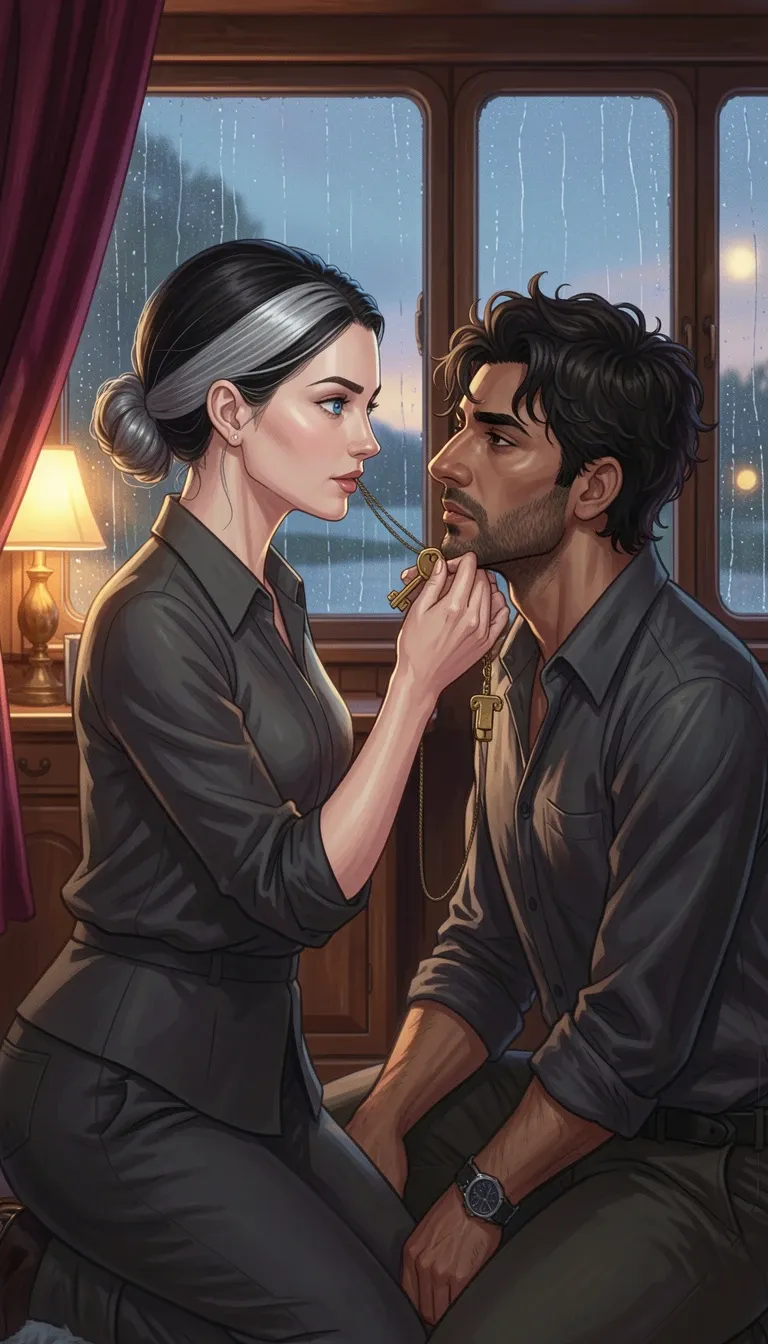
King's Day had turned the whole canal into a moving thing, orange bunting strung between the mooring posts, a flotilla of boats sliding past below with their decks packed shoulder to shoulder, brass horns and a sound system arguing across the water about which song the night belonged to. Rosalind had opened the hatch to the roof deck at half past ten and let him climb up first. She had brought a bottle and two glasses and, tucked under her arm, the brass box.
He was thirty-five years old and he had never been on a roof in his life the way she meant it — not the flat tarred roof of a building, but the deck of a houseboat, sloped and narrow, a low rail around it, the city spread out in orange and warm white, strangers passing below close enough to hear laughing. She laid a wool blanket out flat. She set the box down on it. She sat with her back against the low wooden housing of the wheelhouse and patted the blanket beside her.
"Sit. You're allowed to look at the boats. Everyone looks at the boats."
He sat. His legs were still not entirely reliable around her, and the blanket was thin, and the night air came off the water with a bite in it that had nothing to do with the season and everything to do with the fact that it was the first of May and the Dutch had decided, collectively, that cold was a matter of opinion. He pulled the blanket up over his knees. She poured them each a glass.
"Sixty days," she said, and lifted hers. "To the number."
He touched his glass to hers. The wine was cold and a little sharp and he drank half of it too fast, because his mouth had gone dry the instant she said the number, and the number was the reason they were up here, and the reason they were up here was not yet clear to him. She had said bring the box up and nothing else. She had not said what the box was for.
Below them a boat went by with a live band crammed onto its foredeck, a trumpet player in an orange wig leaning out over the water to play at the bank, and the sound of it came up and over them and made the deck hum under his hip. He watched it pass. He was aware of her beside him in the way he was always aware of her — the whole side of him turned toward her like a plant, the skin of his arm not quite touching the sleeve of her coat and knowing exactly how far away it was.
"You've been quiet all evening," she said.
"I've been thinking about the clause."
"I know you have. You've been thinking about it for two months." She turned her glass by the stem, watching the canal rather than him. "You read it again that first night. I watched you. You read it four times and then you put the contract down and you made yourself a cup of tea and you didn't say anything to me about it for two months."
"I didn't know what to say."
"No," she agreed. "It's not a clause that invites conversation. It's a clause that invites patience." She set her glass down on the deck between her feet. "It says the keyholder may, at the end of a contract, offer a new one. It says the terms of the new contract are hers to write. It doesn't say what happens if the client wants to sign. That's the part that isn't in the boilerplate. That's the part you've been reading and re-reading, and it isn't there, and it's not going to be there, because I've never written it."
The trumpet boat had gone round the bend. Another came, a long low barge strung with paper lanterns, and the people on it were singing something old and Dutch that he didn't know the words to, and their voices came up thin and happy and completely indifferent to the fact that his chest had stopped doing its job.
"You've never offered one," he said.
"Eighty-one clients. Twenty years. Not one." She reached for the box. It was brass and it had been brass for a long time, the corners worn round where her hands had held it, and she set it in the middle of the blanket between them and put her palm flat on its lid. "I'm going to tell you why, and then I'm going to ask you a question, and you're going to take your time with the answer. Do you understand?"
"Yes."
"The clause exists because of a man in 2009 who asked me to write him one, and I said no, and he was right to ask and I was wrong to say no, and I've known it for sixteen years. He wanted what you want. He wanted the line held by someone who wasn't himself. And I told him no, because I was afraid of what it would mean if I wrote the terms and he signed them and then one day he wanted out and I had to be the one to let him out. That's the whole of it. I was afraid of being the one who opens the box."
He looked at her hands on the box. The silver in her hair caught the lantern light from the passing barge and went out again as it moved on. She was not looking at him. She was looking at the water, and her jaw was set in a way he had learned to read over sixty days — the way she set it when she was saying something true and would rather have said something else.
"You're not afraid now," he said.
"No." She turned her head. "I'm not. I've been sitting with it for a week, and I find I'm not afraid of it at all, and that frightens me a little in a different way, so I'd like to do something about it before I lose my nerve and go back to being sensible." She lifted her hand off the box. "But not first. First I want you under me. It's the last night of the contract and I've had sixty days of your mouth and your hands and your reports and I have not once had you the way I want you, and I'm not going to write a single word on a piece of paper until I have."
He set his glass down. His hand was not steady and he did not try to make it so.
"On the deck," she said. "Under the blanket. There are people on the water and they will not see us and I don't care if they do. If that's a problem, say it now, and we'll go below and do it in the office like sensible people and I'll be disappointed."
"It's not a problem."
"Good." She pulled the blanket up over her lap and spread it wide. "Then take your clothes off and get on your hands and knees, and put your head down, and don't look up until I tell you."
He undressed in the cold with the canal noise all around him and his skin going tight and his cock straining against the cage the way it had strained every night for sixty days, and the cold was a relief because it gave him something to feel that wasn't the waiting. He folded his clothes because she liked them folded and set them under the rail and knelt on the blanket with his head down and his forearms on the wool and the deck hard under his knees. The blanket came up over his back and settled, and then her hand came down on the back of his neck and stayed there, warm and certain, and the whole city went quiet around the edges.
"There," she said. "Now you're not a client on a roof. You're just a man on his knees in the cold with his arse in the air, and nobody down there knows it, and I do." Her hand moved down his spine, slow, the flat of it, and he felt every vertebra she passed. "Reach back and spread yourself for me. Both hands. Show me."
He did. The cold air found him and he shivered. She made a low sound of approval and her thumb pressed where he was open, no warning, and he made a sound into the wool that he was glad the boats couldn't hear. She took her time. She took so much time that he stopped being able to tell how much time it was — her thumb, then two fingers, then the cool slick of something from the box and her fingers working it into him slow and thorough while she talked to him in that measured voice about how well he took it, how he'd learned to take it, how on the tenth day he'd shaken on the deck and on the sixtieth he opened for her without being asked twice.
"Breathe out," she said. He did, and the harness pressed against him and then the head of it pushed in and his breath went out of him in a long broken rush and did not come back. She held there. "Again. Out." He let go. She slid deeper and the stretch of it burned and opened and burned. He gripped his own arse with both hands and pressed his forehead into the blanket and made a noise that was not a word.
"That's it. All the way. Don't rush it." Her hand found the small of his back. "You're doing beautifully. You always do, when you stop trying to be clever about it."
She fucked him slow. That was the thing about her — she had never once in sixty days done anything faster than she meant to. The harness moved in him at a pace that let him feel every inch of the withdrawal and every inch of the return, and the wool was rough under his cheek and the deck was hard under his knees and the cold was on his shoulders where the blanket had slipped, and below them a boat went by with a sound system playing something with a heavy slow beat that matched her and did not match her. He could not tell anymore which was which.
"Rosalind—"
"I know." She drove in harder, once, and he heard himself cry out and did not care. "I know exactly. You've been locked for sixty days and you're going to come with nothing touching your cock and you're going to do it because I'm inside you and because I told you to, and then I'm going to open that box."
His hips were shaking. The cage was a hard line against the blanket and every thrust pressed him into it and the pressure was wrong and right and building somewhere behind his balls and at the base of his spine and he heard himself saying please, please, and she said now, and he came with his face in the wool and her hand fisted in his hair and his whole body clenching around the thing inside him, and it went on and on and she did not stop, she rode him through it until he was sobbing and then she stopped, gently, and pulled out slow and he felt the empty ache of it and lay there shaking.
"Turn over," she said. "Careful. Your knees."
He turned. The blanket came over him and she was above him with the lantern light behind her head and her coat off and her hair coming loose from its bun, and she reached for the box and opened it. The key was in there with the little brass tag he had written his name on sixty days ago, and she took it out and held it up between two fingers so he could see it, and then she knelt down over him and put the key in the lock of the cage and turned it.
The click was very small. The cage came away in her hand and his cock came free. It was so hard it ached, flushed dark and slick at the tip and twitching in the cold air. He made a sound that was almost a sob of relief and she looked down at it with the frank interest she gave to everything and said, "There you are. I've been wondering."
"Please—"
"I'm going to ride you," she said. "And you're going to lie there and take it and not come until I say. Do you understand?"
"Yes. Yes."
She straddled him and reached down and took him in her hand and guided him. She was wet — she had been wet since before she put the harness on, he could feel it on his thigh where she'd knelt, and she took him in one long slow slide that made her breath go out of her in a way he had never heard from her before, a real sound, unmeasured. She sat down on him to the root and stayed there and her eyes closed and her hands came down flat on his chest.
"Oh," she said. Just that. Then she opened her eyes and looked down at him and something in her face had come loose. "You feel — that's very good. That's very good indeed."
She rode him. Not slow, not this time. She rode him like a woman who had been holding herself in check for sixty days and had decided to stop, her hips rolling and her cunt tight and wet around him, and every time she came down he felt the clench of her and had to grip the blanket to keep from spending, and the canal was full of orange light and singing and the deck moved gently under them with the water. She put her hand around his throat — not squeezing, just there, just the weight of it — and said, "Look at me. Don't you dare look away."
He looked at her. Her face was flushed and her mouth open and the silver in her hair had come entirely loose and she was beautiful in a way that had nothing to do with the way she looked in the office, and he felt himself go right to the edge and said, "I can't—"
"Not yet. Hold it."
"Rosalind—"
"Hold it," she said, and drove down harder, and he held it, teeth clenched, hips lifting. She watched his face while she did it and her rhythm started to break and her breath came short and her fingers tightened on his throat. She said, "Now. Now, come with me—"
She came first, or he did, or there was no first — her cunt clamping down on him and her back arching and a sound coming out of her that was nothing like her measured voice. He came inside her with his hands on her hips and his own voice breaking on her name. It went on, pulse after pulse, her rocking down on him through it until they were both shaking. She folded forward onto his chest with her forehead against his collarbone and her hair in his face and did not move.
The canal went on being King's Day around them. A boat passed with a cheer going up from it about something. The blanket had slid half off and the night air was cold on his shoulder and her weight was warm and heavy and entirely on him, and her breath was warm against his throat. He lay there with his cock still inside her and his hand in her hair and did not say anything at all, because there was nothing to say that wouldn't have been smaller than the moment.
After a while she lifted her head. She looked at him — close, from six inches, the way she looked at a lock she was deciding how to open — and then she pushed herself up off him and sat back on her heels, and reached for the brass box where it lay open on the blanket, and drew it over between them. The cage was inside it. The key was in the lock. She set the box down in the middle of the deck between her knees and his, open, the empty cage catching the lantern light, and she looked at it and then at him and said nothing at all.
She reached into the box and took out the key. Then she took the cage out too, set it aside on the wool, and shut the lid, and the brass made its small dull sound, and she laid the key flat on top of it.
"That's not a question," she said. "That's just the box. The box doesn't ask anything."
He got his elbows under him. His knees had gone to water and the blanket was cold where the night had got into it, and his cock lay against his belly still wet from her, not softening, not finished. "It looks like a question."
"It's a habit. I put the box in the middle of things. Twenty years." She turned her glass upright where it had spilled, a little dark pool in the wool, and pushed it away with the side of her hand. "Now. You said you couldn't hold it. You held it. And then you came inside me with your hands on my hips and you said my name and I felt every pulse of it, and I don't say that to be kind, I say it because I'm going to ask you for something else and I want you to know what you've already given me."
He waited. Above them the bunting moved, and the canal threw the orange light back up at the underside of the mooring lines, and she was still straddling nothing now, sitting back on her heels with her coat off and her dress open at the throat, and she looked like a woman in the middle of her own house doing sums.
"I want to watch you," she said. "Not the cage. I've watched the cage for sixty days, I know the cage. I want to see you touch yourself and I want to see you do it slowly and I want to hear what you say when nobody's telling you what to say."
"Rosalind—"
"You can say no. That's the whole of it, that's the offer, and it doesn't cost you anything to take it or leave it." She picked up the key and turned it over once and put it down again. "But I've had your mouth and your hands and your reports and your knees, and I have not once had you unguarded, and I find I want it. So. Touch yourself. Slowly. And don't come until I tell you."
His hand found his cock and it was so hot in the cold air it startled him, and his own grip after sixty days of nothing was a stranger's grip, too hard. He had to stop and start again. She watched. She didn't look away and she didn't help. She didn't narrate, and that was worse than anything she could have said, the flat blue attention of her, the way she tipped her head when his thumb came over the head and his breath went out of him.
"Slower," she said.
He slowed. His fist moved up the shaft and the wet sound of it was loud on the deck. He heard it and his face went hot. Down. His balls drew up tight. He stopped at the root and squeezed and his hips came off the blanket.
"There. You see? You've been taught to hurry and you don't have to." She leaned in and put her hand over his, over his fist, and made him loosen it. "Like that. Let it cost you something."
He worked himself with her hand on his for a while, her thumb on his knuckles, and then she took her hand away and he did it alone, and the pleasure came up through him in a slow dirty climb that had nowhere to go. His thighs shook. He said her name. He said it again. He said, "I can't do this, I can't, it's too much," and she said, "You can. You've been doing it for sixty days. This is the easy one."
She swung her leg over and straddled him again, and this time she was facing away, her back to him, the long pale line of her spine and the wing of her shoulder blades and her hair down her back. She reached behind and took his cock from his hand and set it against her cunt and sank down on it.
He shouted. He couldn't help it. She was slick and hot and tight and she took him all the way in one long push and then sat still, and he could see the whole of her from behind, the way her shoulders dropped, the way her hand came up to brace on his knee. "There," she said, from somewhere he couldn't see. "Now you can move. Gently. You do the work this time."
He did. He got his feet flat and his hands on her hips. He fucked up into her in a slow rhythm, and she let him. She made a low sound each time he bottomed out, and the canal went on being King's Day below them, a boat going by with someone singing badly and someone else laughing at it. He could not have cared less about any of it. He watched his cock slide out of her wet and go back in, watched her arse meet his hips, and the sight of it was almost as good as the feeling. He had to close his eyes.
"No. Look." Her voice was thick. "Look at where you are."
He looked. She was so wet it ran down to his balls, and the lantern light caught the shine of it. She reached down between her own legs with two fingers and worked her clit in fast circles while he fucked her, and her rhythm went ragged and her head dropped forward.
"That's it," he heard himself say, and it came out of him in a voice he didn't know he had. "That's it, keep—"
She came like that, on his cock, with her fingers on herself, her whole body going rigid and then shuddering. She made a sound that had no words in it at all, and her cunt clamped down on him so hard he saw white. He held on. He held on with his teeth and his hands and the last of his sense. It was the hardest thing he had ever done.
She slumped forward and caught herself on her hands, and then she lifted up off him and turned, unsteady, and came down over him face to face, and put her hand flat on his chest. "Now," she said. "Now. Come for me. Let me see it."
She took him in her hand and stroked him, fast and sure, and he came with a broken sound and it went up over his own belly and her fingers and her wrist, pulse after pulse, and she kept stroking until he grabbed her wrist and she stopped and held him and watched his face while the last of it shook through him.
"Good," she said. "God. Good."
She wiped her hand on the wool and lay down beside him on the blanket, and neither of them said anything for a while, and the cold came back in around them both.
It was she who got up first. She pulled her dress straight and found her coat and put it on, and then she stood and looked down at him and said, "Come inside. You'll freeze out here and I'm not carrying you down the ladder."
He dressed with his hands still not entirely his, and gathered the blanket, and followed her down through the hatch into the warm lamplight of the office with the canal smell and the old wood and the desk. She poured them both a fresh glass and sat down in her chair and did not tell him to kneel, and he stood there a moment, uncertain, and then sat down on the rug at her feet with his back against the chair leg, because it was where he wanted to be and she had not said otherwise.
Her hand came down and rested on the top of his head.
"I'm going to write it," she said. "The new contract. I've been drafting it in my head for a week and I'm going to write it out on paper tomorrow and you're going to read it slowly, all of it, every clause, and take it home and think about it for a week before you sign anything. That's not a formality. That's the whole point of the thing. Do you understand me?"
"Yes."
"And I'm going to tell you what's in it, because I don't want you walking into it blind like a man who signs what he doesn't read." She took a drink. "It's not sixty days. Sixty days is a trial and we're past the trial. This one runs until one of us ends it, and the ending has to be said out loud, by the person who wants it, and then there's a month after that where I keep the key and I don't touch you and you decide if you meant it. And there's a clause in it I've never written before, and you're going to want to read that one twice."
"What clause?"
"The one about the house," she said. "I live alone on this boat and I've lived alone on it for eleven years and I've been thinking, lately, that I might not want to. That's all I'm going to say tonight. You'll read it in the morning."
He turned his head and looked up at her, and she looked back down at him with her sharp blue eyes and her loosened hair and her glass, and did not smile and did not look away.
"Rosalind," he said. "I want to sign it."
"I know you do." She set her glass down. "That's why you're going to wait a week."
The clock on the shelf ticked. Somewhere out on the canal a boat went by with one last cheer in it, and then the water was quiet, and she kept her hand on his head.
He did not get up. The clock ticked on, and her hand stayed where it was, and the lamplight lay flat on the desk and the brass box and the two glasses, one of them empty now, and outside the water knocked softly against the hull as if it had somewhere to be.
"Say it back to me," she said.
"A week. I read it, all of it, and I take it home, and I don't sign it for a week."
"And?"
"And the clause about the house I read twice."
"Good." Her fingers moved, once, through his hair, and stopped. "Now get up off my rug and go home, because you have work in the morning and so do I, and I've no intention of being the reason a man's code goes out into the world with a bug in it."
He got up. His knees complained. She walked him to the hatch and stood with her arms crossed while he found his shoes, and when he turned at the top of the steps she was already looking at the desk, at the box, her mind plainly somewhere past tomorrow's ink.
"Rosalind."
"Mm."
"Thank you. For tonight. Not the—" He stopped, recalibrated. "For telling me. About the clause. You didn't have to tell me anything."
"No," she said. "I didn't." And she went back to her chair.
The Prinsengracht was a wreck of orange by the time he reached the street. Bunting down in the gutters, a paper crown trodden flat in the cobbles, a boy asleep against a lamppost with a flag in his fist, and the whole city smelling of beer and canal water and fried dough gone cold. He walked with his hands in his pockets and the key to nothing in his flat and the cage warm against him from the walking, and he did not once think about the code.
He read it the next morning at half past six, standing up, with the kettle going, having slept four hours. It was six pages, handwritten, in her small upright hand, and the clause about the house was on the fifth page and it was four sentences long, and he read it twice, and then he read it a third time standing very still with the kettle shrieking behind him until he remembered the kettle.
He did not sign it that week. She had told him not to, and he found, to his own surprise, that he did not want to. He wanted to read it again on Tuesday. He wanted to lie awake on Wednesday with the fourth sentence of the fifth page and know that he could still say no and that saying no would cost him something and that he was going to say yes anyway, on Sunday, in his own hand, in front of her.
He reported every morning at seven. His real numbers. He gave her the walking and the sleep and the truth about the beer on King's Day, and she wrote it all down in the ledger without comment, and the cage stayed on, and on the Friday she let him kneel on the rug in the office while she worked at the desk above him, and did not touch him, and did not have to.
On the Sunday she sat at the desk with the new contract between them and her pen laid across it, and he sat in the chair opposite, dressed, and read the last page once more, and signed.
She blotted it. She did not smile. She put the pen down and looked at him across the desk with the sharp blue of her and said, "Then it's done, and it runs until one of us says otherwise, out loud, and there's a month of nothing after that, and you'll hate the month. Everybody hates the month."
"I know."
"And the house." She turned her glass a quarter turn. "You'll want to think about it properly. It's not a thing you decide in a Sunday afternoon. You'll come for dinner next week and see how it sits with you, the boat, the evenings, the way I keep things, and if it doesn't sit, you say so and we go on exactly as we are and neither of us is wounded by it. Do you understand me?"
"I understand you."
"Then say the other thing."
He looked at her. The canal light was on the ceiling, moving, and the clock was ticking, and somewhere down the length of the boat a rope creaked against a cleat. "I want to live here," he said. "With you. On the boat. If you'll have me."
"Good," she said, and picked up her pen, and drew a small neat line under the last clause, and reached into the box for the key.