
The door wouldn’t open.
Ilse shoved again, shoulder to the steel, and it gave a few centimeters and stopped against something heavy and warm. Heat came through the gap, a furnace breath in the cold passage.
“Dray.”
Nothing. Then a low sound, more vibration than voice.
She squeezed out sideways. He was slumped where she had left him, but wrong now. His head had fallen against the doorframe and his skin had gone grey under the olive, slick with sweat. When she put the back of her hand to his forehead she flinched. He burned.
The blood on his henley had dried brown at the edges. Under the cloth along his side, fine grey lines branched outward from the wound beneath his skin, the way frost creeps across a window.
“Silver,” he said without opening his eyes. “It travels.”
“How far?”
“Far enough.”
“That’s not an answer.”
“It’s an honest one.” His eyes opened, pale and too bright. “Galley. First-aid locker. Iodine, tweezers. If you’re going to do it, do it before I stop being polite.”
. . .
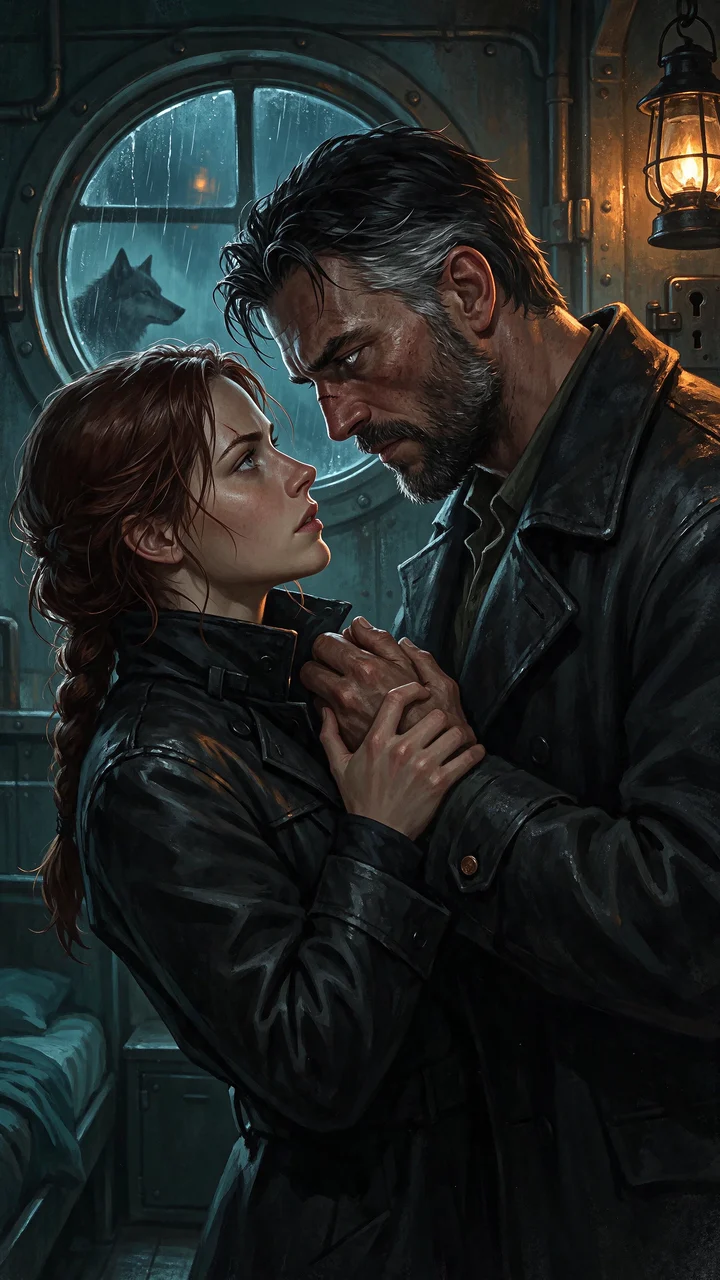
She got him into the captain’s cabin by letting him lean on her, which felt like steering a wardrobe down a corridor. She hung the storm lantern from the hook over the chart table. It swung with the ship’s slow roll, so the light slid back and forth across the cold sweating walls, his face, her hands.
The galley gave up a kettle, a dented first-aid tin, a bottle of iodine with a cracked cap, and a jar of instant coffee she made so strong it was nearly solid. She put a mug in his hand. He held it and didn’t drink.
“Shirt,” she said.
He reached for the hem and stopped with his jaw clenched. She took the kitchen scissors and cut the henley up the side instead, hip to ribs, and peeled the wet cloth back only as far as the wound.
Up close it was worse. Something bright winked deep in the blackened edge.
“There’s still metal in there.”
“I know.”
“You’ve been sitting on a piece of silver for twelve hours.”
“I was busy.”
She soaked a gauze pad in iodine and pressed it to the gash. The muscle under her palm locked hard as iron. He made no sound. He didn’t move. His hand closed slowly around the edge of the chart table until the wood creaked, and that was all.
She worked the tweezers in. He breathed through his nose. Her fingertips rested against his ribs, and she could feel his heart under them, heavy and fast and far too hot. She could feel him holding himself still for her, every part of him, the way you hold still when a bird lands on your hand.
The sliver came free. She dropped it into the saucer and the spilled coffee hissed.
“Got it.”
“I felt that.” Something close to a laugh. “Thank you.”
She taped the dressing down, her fingers clumsier than they had any right to be. When she sat back on her heels he was watching her. Not her hands. Her.
“What?”
“You’re in charge here,” he said. “Whatever happens on this ship, you decide. I follow.”
“Wolves don’t follow.”
“This one will.” His voice was very quiet. “Set your terms, Inspector.”
She stood, because kneeling between his boots had suddenly become impossible, and folded her arms.
“No lies.”
“Done.”
“Not a careful truth. Not something you leave out. No lies.”
“Done.”
“You don’t turn into anything without telling me first.”
“Wolf,” he said. “You can say it.”
“Without telling me first.”
“Done.”
“And you don’t touch me.” The lantern swung. “Not unless I ask.”
He took longer over that one. Long enough for her to hear the rain on the porthole, the far-off circling howl, her own pulse in her ears.
“Done.”
“That was fast.”
“They’re good rules.” He finally drank, and grimaced. “I’d have written the same ones.”
. . .
He heard the radio call before she reached it.
The fever made everything loud: the rain, the drip of the galley tap, the scrape of her boots on the deck plates. The wolf in him had paced for twelve hours, sick and furious with the silver, and it settled the moment her voice came through the bulkhead. It always had. For two years he had watched her from a car across the quay, from the salvage office window, from the dark under the cranes, and the animal had never made a sound she could hear. It had only ever leaned toward her.
“Say that again,” she said in the galley.
Tamsin’s voice, tinny and much too calm. “The clearance code on the Marisol is four-four-seven-one-V. I pulled it twice. I pulled it from the backup. It’s Vos, Ilse. It’s Gerrit.”
He heard her heart stumble. One missed stroke, then a hard double knock, the rhythm of someone who has just been hit and refuses to fall.
“He taught me to read a manifest,” she said.
“I know.”
“He signed my commendation.”
“I know, babe. I’m sorry.”
He set the mug down carefully so he wouldn’t crush it. Then he waited for her, and he decided that from now on she would not have to learn one thing about him from someone else.
. . .
Ilse came back into the cabin, shut the door, and leaned against it.
“You heard.”
“Yes.”
“Of course you did.” Her laugh came out short and ugly. “Was that in your file on me? That my boss would sell me out?”
“I suspected Vos. I didn’t know.” He held her gaze. “No lies. You asked.”
“Then answer this one.” She pushed away from the door. “How long have you been watching my docks?”
He didn’t look away. “Two years.”
“Why?”
“Because they tried to buy everyone in that building, and everyone took it. The night clerks. The pilots. Your supervisor.” He shifted, winced, kept going. “They tried you three times. Three envelopes, and you sent every one back. You were the only door on this harbor they couldn’t open, Ilse. So I watched the door.”
She stared at him. The lantern swung across his face. Light, dark, light.
“You could have come to me.”
“And said what? I’m a wolf and a criminal and I’d like to help?” He tilted his head. “You’d have had me in a cell by lunch.”
“Breakfast.”
“Breakfast,” he agreed. His eyes warmed, and she hated how much she liked it.
She sat down on the chart table because her legs had decided it for her. Outside, the howl went round the ship again.
“The cargo deck is wrong,” she said at last. “I paced it last night. Galley bulkhead to the stern frame is sixty-two meters on the inside. The register puts the hull at sixty-eight. That’s six meters of ship nobody drew on the plans.”
He went still. “Aft of frame forty.”
“You knew?”
“I guessed. I didn’t have your eye.” Something rough and proud crossed his face. “You found it in one night.”
“I found it because I don’t sleep.”
“You slept,” he said softly. “I listened.”
The heat that went through her had nothing to do with the coffee. He sat there grey and wounded with her tape across his ribs and his hand resting open on his knee, palm up, a forearm’s length from hers. Not reaching. He had promised not to reach.
She looked at that hand far longer than she should have.
The third rule. She had made it so fast. She had been so sure.