
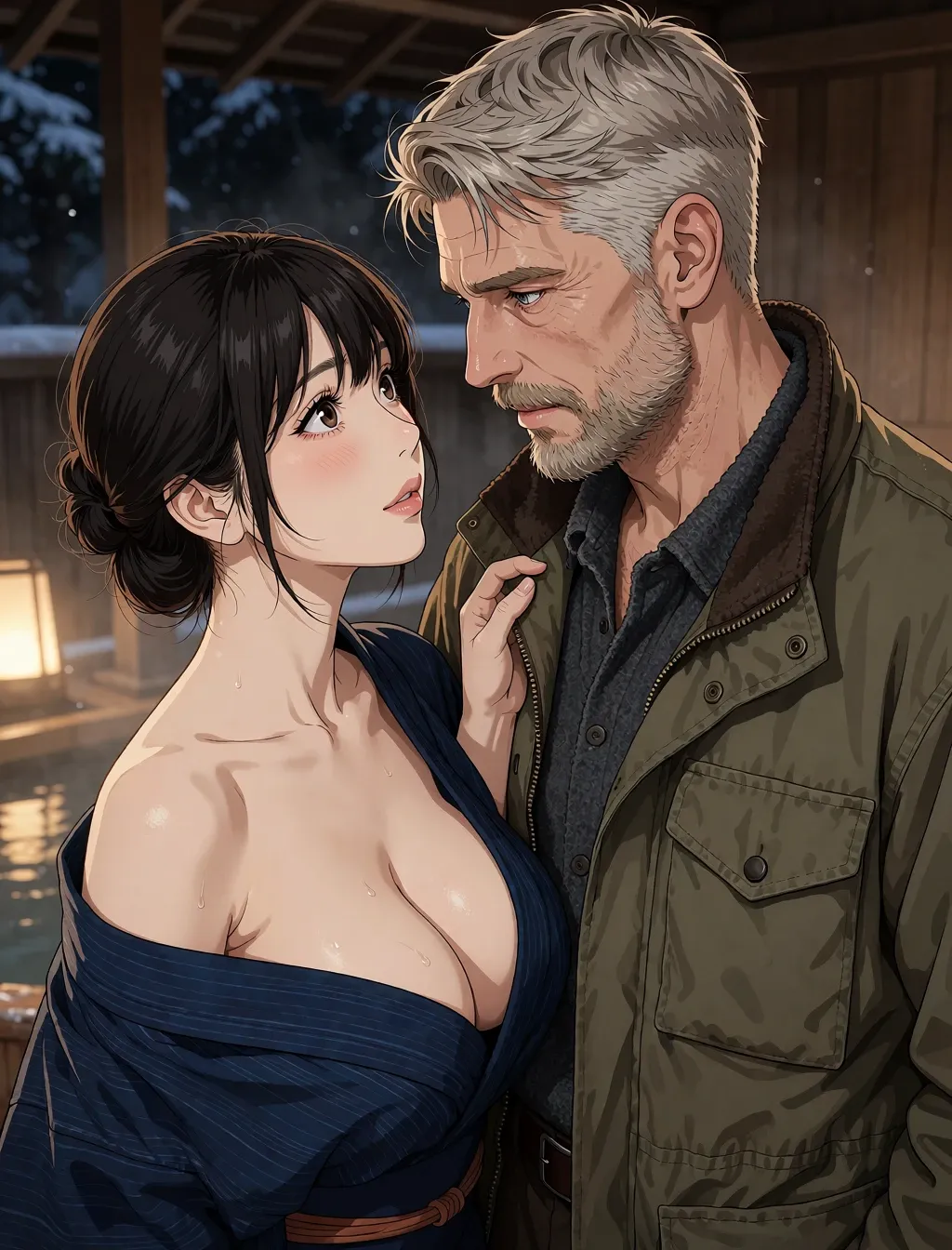
The snow had been falling for two days, and Torbjörn Wahlgren had stopped trying to photograph it.
He had learned that on the first afternoon, when he set up his tripod on the engawa and watched the flakes come down like a curtain being drawn, thick and slow and utterly indifferent to his shutter speed. Thirty years in the field. Norway, Iceland, the high plateaus of Mongolia. And still the snow here did something he could not catch — fell heavier than snow had any right to fall, gathered on the cedar beams in soft white fists, hushed the whole valley until the only sound left in the world was the wind working at the shutters and the low complaint of the inn's old bones.
The last guests had left that morning. A family from Sapporo who had spent three days in the outdoor bath and their phones, and who had stood in the genkan pulling on their boots and apologizing to Fumiko-san for the trouble of the roads while she waved them off with both hands and a smile that said the trouble was hers and she was glad of it. Then the snowplow had come grinding up the pass at noon, cleared one lane, and gone back down, and the lane had filled again by two.
Now it was night, and the inn was empty except for the two of them.
Torbjörn sat on the tatami with his back against a pillar, his yukata pulled as far down over his knees as it would go, which was not far enough. The sleeves stopped a good hand's width above his wrists. The hem rode up when he shifted. He was a tall man in a country built for shorter ones, and no amount of polite silence from his hostess could disguise the fact that he was wearing a garment designed for someone a head shorter and considerably less broad. *I look like a heron in a towel,* he thought. *A heron with a beard.*
Across the sunken hearth, Fumiko Tachibana knelt with her weight settled back on her heels, and the fire between them turned the underside of her jaw to copper. She was forty-four — he had learned that on the first night, in the roundabout way she had of answering questions without seeming to — and she wore her indigo yukata the way other people wore their own skin, the collar set straight, the sleeves folded back from her forearms in a neat cuff. Her hands rested on her thighs. He had noticed them the first evening and had not stopped noticing them since: broad through the palm, the knuckles a little swollen, the skin of the fingertips gone smooth and pale from years of hot water and cedar and lye. A woodcutter's hands, or a farmer's. Not the hands he had expected on a woman who poured sake with such precision.
She lifted the flask from where it sat warming at the hearth's edge, and poured for him first. The sake came out in a thin, steady thread, and stopped clean.
"The road will not open tomorrow," she said. "Perhaps the day after. Perhaps not."
"I'm not sorry."
She set the flask down and looked at him, and the corner of her mouth moved — not quite a smile. "No," she said. "I did not think you were."
He drank. The sake was warm and a little sweet, and it went down the way warm things go down when the room beyond the hearth has gone cold enough that his breath had fogged when he crossed it. The inn's low ceiling pressed down over them both. Somewhere past the shutters, the outdoor bath sat silent and buried, its steam gone, its stones under half a meter of snow. He had photographed it that morning before the light failed — the empty tub, the snow heaped on the bamboo fence, the whole world white and the water black — and the picture had been good and had meant nothing.
"You have not asked me why I am here," he said.
"You are making a book."
"Everyone makes a book. I have made nine." He turned the cup in his fingers. "I am here because a man in Tokyo told me this valley has the best light in Hokkaido in February, and because I am forty-seven years old and I have spent thirty of those years looking at beautiful things through a piece of glass and I thought it might be time to look at one without it."
He heard it after it was out of his mouth — how it sounded, sitting alone with a widow in an empty inn. He opened his mouth to blunt it, to say something about the light, the snow, the composition, and Fumiko poured him more sake before he could.
"Then you should look," she said.
Her voice was soft, and it was not soft the way people were soft with foreigners who had said too much. It was soft the way the fire was soft — banked, and warm, and entirely deliberate. He looked at her. She looked back. The wind put its shoulder to the shutters and the coals settled with a small dry sound, and neither of them said anything for long enough that the silence stopped being silence and became a thing with a shape, sitting between them on the tatami.
*Say something,* he thought. *Say anything.*
"Wahlgren-san," she said. "You are cold."
"I'm Swedish. This is a mild spring evening."
That got a laugh out of her — low, and short, and surprised out of her before she could stop it. She put her fingertips to her mouth as if to catch it. "A mild spring evening. In a blizzard."
"In Sweden we call this 'Tuesday.'"
She laughed again, longer this time, and the laugh did something to her face that the firelight had not been doing — took ten years off it, put color in it, made the faint lines at the corners of her eyes into proof that she had been laughing like this for a long time before the inn and the snow and the ten years alone. *Ten years,* he thought. *She has been pouring sake for strangers for ten years and there has been no one to make her laugh at the end of the night.*
He reached for the flask to pour for her — the way she had poured for him, the way he had watched her do it a hundred times in three days — and got the angle wrong, and the sake came out too fast and overfilled her cup and ran down the side onto the tatami.
"Ah —" He set the flask down too hard. "Forgive me. I —"
"It is only sake." She was already blotting it with her sleeve, unbothered, and then she looked up at him and the laughter was still in her face. "You pour like a man who has never poured for anyone."
"I have never poured for anyone."
It came out flatter than he meant it. Truer than he meant it. He watched her hands go still on the tatami, the wet sleeve, the cup, and he watched her decide not to make a joke of it.
"Then I will teach you," she said. "It is not difficult. You hold the flask here —" she reached across and set her fingers over his on the flask, her hand warm and dry and unexpectedly heavy — "and you turn the wrist. So. Not the arm. The wrist."
He did not hear the rest of it. Her fingers were on his, and she was leaning in to show him, and the collar of her yukata had fallen a little open at the throat, and there was a small pale scar on the back of her hand at the base of the thumb that he had not seen before and could not stop seeing now. *Steam,* he thought, absurdly. *A burn from steam, years ago.*
"Wahlgren-san."
"Yes."
"You are not watching the flask."
"No."
She did not pull her hand away. The fire ticked. He was aware of his own pulse in his throat, which was ridiculous — he was forty-seven years old and he had not had a pulse in his throat since he was nineteen — and he was aware of the exact distance between her face and his, which was not far, which was in fact close enough that he could see the firelight move in her eyes when she blinked.
"Fumiko," he said.
The name came out of him without permission. He had been saying *Tachibana-san* for three days, and *Wahlgren-san* had been coming back at him like a door closing, and he had not realized until this moment how much he had wanted to hear himself say her name — not the surname, not the innkeeper's name, not the name on the wooden sign above the door, but *Fumiko*, three soft syllables he had been turning over in his mouth in the dark of his room for two nights.
She went still. Her hand was still on his on the flask, and her breath had stopped somewhere in her chest, and then the flush came up her throat and over her cheeks and all the way to the tips of her ears. She looked away — toward the fire, toward the shutters, anywhere — and her hand tightened on his.
"You said it correctly," she said, to the fire.
"I've been practicing."
"For three days?"
"Since the first night."
She turned back to him. The flush was still there, high in her cheeks, and she did not look like a woman of forty-four who had run an inn alone for ten years and had heard every kind of thing a man could say at the end of a night. She looked like a woman who had been alone a long time and had just been handed something she had stopped expecting to be handed.
"Wahlgren-san —" she began, and stopped herself, and he watched her decide. Her thumb moved once across his knuckles, slow, deliberate, as if testing whether the hand was real. Then she let go of the flask and reached up and put her palm flat against his jaw, into his beard, and kissed him.
She kissed him first.
He had a moment to think *oh* — and then nothing at all, because her mouth was warm and tasted of sake and she kissed the way she poured, steady and exact and without a single wasted motion, and his hands came up to her waist through the yukata and found her solid and warm and real, and she made a small sound into his mouth that he felt in his chest. The firelight moved over them. Her fingers slid back into his hair and closed, and the kiss deepened, and he forgot the flask, the hearth, the blizzard, the entire white indifferent valley beyond the shutters.
When she pulled back, her forehead stayed against his, and her breath was uneven against his mouth.
"The room is cold," she said.
"I hadn't noticed."
"My quarters are warm." She said it quietly, plainly, the way she said everything, and her eyes were steady on his. "If you would like."
"Fumiko."
"Yes."
She rose and held out her hand, and he took it, and she led him past the hearth and down the corridor where the cold of the inn met them and his breath fogged again, past the sliding door with the worn wooden track, and into her room.
It was small and it was warm, and it was hers in a way the rest of the inn was not — a futon already laid out on the tatami, a low chest against the wall, a single lamp, a hairpin on a small dish. She slid the door shut behind them, and the storm went quiet, and the two of them stood in the lamplight and looked at each other.
He reached for her and she came to him this time with her hands already at the collar of his yukata, and she undid it with the same economy she did everything, and pushed it back off his shoulders and down. He was aware of his own body in a way he had not been in years — the cold air on his skin, the grey hair on his chest, the long pale length of him that the too-short yukata had been hiding. She looked at him. Her hands came flat onto his chest and moved down, unhurried, learning him.
"You are very tall," she said.
"It's been said."
She smiled — that quick surprised smile — and then she lowered herself to the futon and drew him down with her, and her hands found the tie of her own yukata and pulled it loose.
He got the collar open and pushed the indigo fabric back off her shoulders. She was warm underneath it and full-figured and soft in a way that made his hands ache, the skin of her belly and her thighs pale in the lamplight, her breasts settling when she lay back. She watched him look at her with her dark eyes and did not cover herself. Her hand found his hip and drew him over her. He kissed her throat, and her collarbone, and the small hollow between her breasts. She arched up into his mouth with a soft sound. Her hand slid down his belly and found his cock — hard already, and heavy. She took it in her strong work-worn hand and held it, and stroked it once, slowly. He made a sound against her skin that he did not recognize as his own.
"Wait," she said.
He stopped. "Yes."
She pushed at his chest, gently, and he rolled onto his back. She came up over him and settled between his legs and looked at him — the flush back in her cheeks, her hair coming loose from its bun. Then she bent her head and took him into her mouth.
The heat of it went through him like the fire through cold iron. She was slow. She took him in an inch at a time, her lips stretched around him, her tongue flat and warm along the underside. She stopped when he was deep and held there, breathing through her nose. He felt the back of her throat and his whole body tightened. Her hand wrapped the base of him and worked it in time with her mouth, and her other hand came up to rest flat on his belly, holding him down against the futon. He put his hand in her hair — careful, careful — and she made a low sound of approval around him that he felt all the way to his spine.
"Fumiko —"
She pulled off, slowly, her lips dragging, and looked up at him with her chin wet. "Yes."
"You —" His voice had gone somewhere. He tried again. "You don't have to —"
"I know." She smiled, and it was a different smile than the innkeeper's. Then she lowered her head again and took him back into her mouth, deeper this time, and he stopped trying to say anything at all.
She worked him slowly for a long time — long enough that the lamplight seemed to thicken, long enough that he forgot where the cold of the inn had gone and there was only her mouth and her hand and the wet sound of it and the small pleased hum she made in her throat. His hips wanted to move and her hand on his belly held him still. His fingers tightened in her hair. "I'm close," he said, hoarse. "Fumiko. I'm —" and she pulled off and looked at him, her lips swollen, and said, "Not yet," and he laughed — a broken, helpless sound — and she smiled and climbed up his body and kissed him.
She straddled him. Her thighs came down on either side of his hips, warm and strong. She reached between them and took his cock in her hand and held it steady and sank down onto it.
He felt her open around him — the heat of her, the wetness, the tight slow give as she took him in — and she stopped halfway and breathed, her hands flat on his chest, her eyes closed, her brow furrowed. "All right?" he said. "Yes," she said, her voice thin. "Yes." And she sank the rest of the way down and settled with a small broken sound and stayed there, full of him, her chest rising and falling.
Then she began to move.
Slow at first, a long rolling of her hips that took him deep and drew back and took him deep again, her hands braced on his chest, her head tipped back so the line of her throat showed in the lamplight. He put his hands on her hips and felt her move under them — the strong muscle of her thighs, the soft give of her waist, the way her breath came faster. She found her rhythm and kept it, and the wet sound of it filled the small room. He watched her face and her breasts move and the flush climb her throat. He thought, *I have photographed a thousand beautiful things and I have never seen anything like this.*
"Torbjörn," she said — not the surname, not the honorific, his name, and it went through him like the first crack of light on a frozen lake. "Torbjörn."
He sat up under her, his hands on her back, and she wrapped her arms around his neck and rode him faster, her forehead against his, both of them breathing each other's air. She was close — he could feel it in the way her thighs tightened and her rhythm broke and her breath came in short hitching pulls. "Don't stop," she said. "Don't stop."
He put his hand between them and found her clit with his thumb and pressed. She made a high broken sound against his mouth and her cunt clenched hard around him, once, twice, and then she came — her whole body bowing into his, her fingers digging into his shoulders, a long shuddering moan that she did not bother to muffle. He held her through it, moving under her in a slow deep rhythm. She gasped and shook and rode it out against his hand and his cock and his chest, and then her head dropped onto his shoulder. She breathed.
He was close. He had been close since her mouth and now the clench of her around him was pulling him over. "Fumiko —" he said, "I'm going to —"
"Yes." Her voice against his throat. "Inside. Yes."
He thrust up into her once, twice, and came — spilling into her with a low groan, his hands hard on her hips, his whole body tightening and letting go. She held him through it and pressed her mouth to the side of his neck and stayed there while he shook.
For a while there was only the storm and their breathing.
She lifted her head and looked at him, her hair fallen down out of its bun, her cheeks flushed, her lips swollen, and she looked younger than she had all week and more tired and entirely unguarded, and she did not say anything at all. He put his hand on the side of her face and she leaned into it, and closed her eyes.
Outside, the wind put its shoulder to the shutters and the snow went on falling on the buried bath and the closed road and the whole white indifferent valley, and neither of them said a word about the morning.