
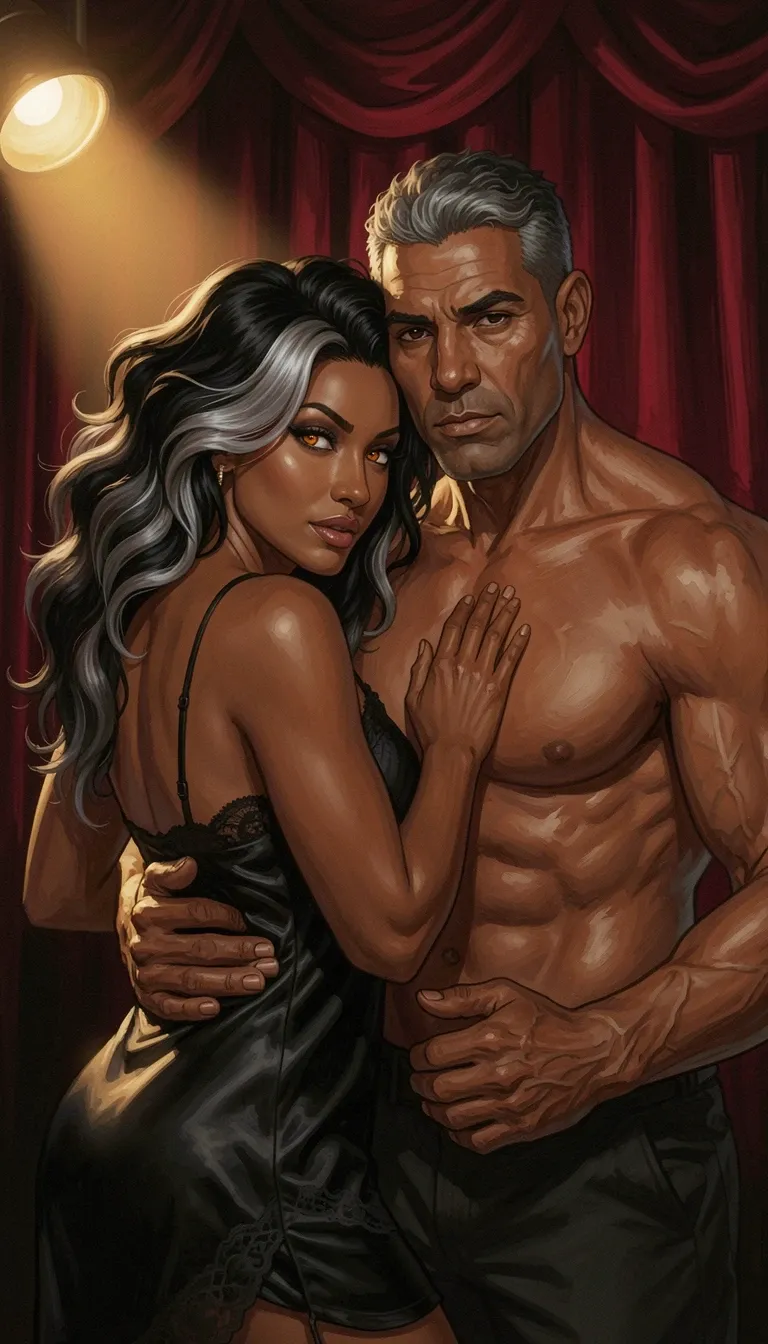
The last note of "Do You Know What It Means" died somewhere over the bar, and the room held it a second too long before the applause broke. Celestine Broussard stood at the microphone with her hand still wrapped around the stand, letting the sound roll over her. Twenty-three years of stages and her hands still shook a little at the end of a good set. She never told anybody that.
The house lights came up slow. Evie was already at the back, dimming the panels the way she did, letting people find their coats without the night ending all at once. Forty-four years old and Celestine could feel every one of them in her ankles tonight. She stepped down from the riser and the floorboards gave under her heel, and she smelled him before she saw him — river water, cypress, old leather. It cut through the smoke and the spilled bourbon and the sweet rot of the Quarter outside the door.
She looked. She couldn't help it.
He was at the corner table with a stocky man in flannel who was laughing at his own joke, and he was not laughing. He was watching her. Early fifties, sun-weathered, salt-and-pepper hair cropped close, a face that had been handsome once and had gotten better use out of it since. His hands were on the table, flat, and they were the hands of a man who worked — knuckles wide, a scar across one thumb. He did not look away when she caught him. That was the thing that got her. Every man in the room looked away. He just held her eyes and let her see him do it.
Evie appeared at her elbow, paint on two fingers, curls escaping the knot at her neck. "Auntie. You want me to walk you back?"
"I'm fine, baby."
"Mm." Evie's gaze slid to the corner table and stayed there a beat too long. "The one in the leather jacket bought three bourbons and didn't drink but one. Kept asking when the last set was."
"You're a menace."
"I'm a manager. It's the same job." Evie squeezed her arm and was gone, sweeping a napkin off a table on her way, and the room emptied out around Celestine in that slow tide of chairs and coats and one man who didn't move.
The dressing room was a closet with a mirror in it. Bare bulbs in a frame around the glass, half of them burnt out, the way they'd been since she took the residency. A chair with a cracked vinyl seat. A folding screen she'd never once used. The door had a lock that stuck, and she had learned to leave it unlocked because the lock was worse than no lock at all.
She sat down and pulled the pins from her hair. It came down heavy and warm against her shoulders, and she watched herself do it in the mirror, the stage makeup too much under the bare bulbs — the red lip, the kohl gone soft at the corners, the silver at her temples showing through the black. The heat was under her skin tonight. It had been building for days, a low fever in her blood she kept telling herself was the weather, was the season, was anything but what it was. She was forty-four. She had made her peace with that years ago. She had made it and made it and made it, and now her body was going back on the deal.
A knock. Two knuckles, unhurried.
"It's open," she said, before she thought about it.
He filled the doorway. That was the first thing — the size of him, broad shoulders in the worn leather, the frame too wide for the room, so that the whole dressing room seemed to lean toward him. He took his hat off. He had a hat, and he took it off, and he held it against his chest like a man at a funeral.
"Augustin Thibodeaux," he said. "I don't mean to trouble you."
"You're not troubling me." She turned on the chair to face him, one arm over the back. "You're the one who didn't drink his bourbon."
Something moved at the corner of his mouth. "Beau drank it. Beau drinks everything."
"The loud one."
"My brother-in-law. He dragged me out. Said I been in the parish too long, said I was gonna turn into the moss." He turned the hat a quarter turn in his hands. "He was right. I ain't been in a room with live music in — a while."
"How long is a while?"
He considered it. He was a man who considered things. "Seven years, maybe."
Celestine let that sit. Seven years. She knew what lived in a number like that — she had her own, tucked away, and she did not take them out for company. "And you came out for the music," she said.
"I came out 'cause Beau wouldn't leave me be." His eyes came up from the hat. Dark brown, and steady, and honest as a hand on a shoulder. "I stayed 'cause of you."
The room got smaller. Or she did. She felt the vinyl creak under her as her weight shifted, and she heard it — that little sound the chair made — and it was suddenly the loudest thing in the world. "That's a bold thing to say to a woman you just met."
"I know it." He didn't back up. "I'm fifty-two years old, cher. I ain't got the time left to be coy about a thing I know."
She stood. She didn't plan to; her body decided it. Standing, she was close enough to him to feel the heat coming off the leather, and under the river water and the cypress there was something else, something that made the fine hairs on her arms lift, and she did not let herself name it. "You should go," she said. Her voice came out lower than she meant it to. A singer's voice, wrecked from the set, nothing like the stage. "I'm not — tonight's not a good night for me to be talked to pretty."
"I ain't talking pretty." He set the hat down on the edge of the vanity, careful, like it was something that could break. "I'm telling you I heard you sing and I felt it here." He touched his sternum with two fingers. "And I been standing at the back of that room for an hour trying to figure out how a man says that without sounding like a fool."
"And did you figure it out?"
"No, ma'am."
She laughed. It surprised her, coming out of her, rusty — she laughed so rarely it felt like a muscle she'd forgotten she had. And his face changed when she did it, opened up, the way a closed door opens onto a lit room.
"Sit down," she said, and pointed at the chair. "You're making the room feel small, standing there."
He sat. The chair took him with a complaint of old vinyl. And then it was just the two of them, close, in the bad light, and the fever under her skin turned up a notch, and she knew — she knew, the way the nose knows before the mind will say it — and she pushed the knowing down and away and stood over him with her arms crossed, because standing was easier than sitting.
"Where'd you hear me before tonight?" she asked. "You said you stayed because of me. That means you knew my name before Beau dragged you out."
He was quiet a moment. "I heard a record. Years back. Beau's wife had it — my Rosalie. She played it Sundays." His thumb moved along the cracked vinyl of the chair arm, back and forth. "You were singing 'Basin Street.' I remember thinking the woman on that record sounded like she'd been somewhere."
"I have been somewhere."
"I know it." His eyes came up. "I can hear it."
She uncrossed her arms. She didn't know what to do with her hands, so she reached past him for the bourbon glass on the vanity — her own, the one she'd poured before the set and forgotten — and drank the warm flat inch of it, and set it down, and her hand was not steady when she did.
He saw. Of course he saw. He was a man who saw things.
"You're running a fever," he said, quiet. Not a question.
"It's the weather."
"It ain't the weather." He said it gently, and his hand came up and stopped in the air between them, an offering he would not press on her. "Cher. I know what I'm smelling. I ain't gonna say it out loud in your dressing room like some kind of animal, but I know it, and I want you to know I know it."
The floor tilted. Celestine put her hand on the back of the chair to keep from swaying, and her fingers brushed his shoulder, and the touch went through her like a struck string — she felt it in her teeth, in her knees, in the low heavy place under her belly. She pulled her hand back as if the leather had gone hot.
"You need to go," she said again, and this time it was a plea and they both heard it.
He stood up out of the chair. He was so close now, and he did not touch her, and that restraint — the way he kept his callused hands at his sides when every part of him must have been roaring — undid something in her chest.
"I'll go," he said. "But I'm gonna ask you one thing first, and then I'll go and you won't have to see me again unless you want to." He waited until she looked at him. "Do you want me to stay?"
The bulbs buzzed. Out on Frenchmen Street somebody laughed, and a trumpet tried a phrase and gave it up. She could smell the smoke in her own hair and the fever coming off her skin and him, him, him.
"Stay," she said.
He went down on his knees.
Not the way a man goes down to beg — the way a man goes down to pray. His hands found her hips and turned her, and she let herself be turned, and the back of the chair met the back of her thighs and she sat down into it hard, and the vinyl complained, and he was between her knees with his face lifted to hers.
"Tell me to stop and I stop," he said. "You hear me?"
"I hear you."
His hands came up under the hem of her dress. The callus of them dragged over her thighs, and the drag was the whole world — rough and warm and certain, and her thighs fell open for him before she told them to. He pushed the dress up over her hips and looked at her. Just looked, the way he'd looked at her across the room, and the heat of that look pooled in her cunt until she felt it slick and swollen against her own underwear.
"You're so wet you're soaking through," he said, low, wondering. His thumb pressed the cotton flat against her and dragged up, slow, and she heard herself make a sound she hadn't made in years. "That's for me?"
"Don't tease me."
"I ain't teasing." He hooked his fingers in the cotton and pulled it down her legs, over her knees, off one ankle, and it hung there forgotten. "I'm gonna eat this pussy till you forget your own name, cher. That's what I'm gonna do."
And he put his mouth on her.
She grabbed the arms of the chair. The first stroke of his tongue was flat and broad and sure, dragging up through her from the bottom, and her whole body bowed in the chair, her heel skidding on the floor. He did it again, slower, and again, and on the third pass he found her clit and closed his lips around it and sucked, and Celestine's vision went white at the edges. She heard her own voice come out of her — a long low broken note, a singer's note, nothing like the stage.
"Oh — God — " Her fingers found his hair and held on. Salt-and-pepper, coarse under her nails. She held his head there and rolled her hips into his mouth. He let her, he let her use him, groaning against her cunt like it was his pleasure being taken and not hers being given.
He worked her. Tongue and lips and the flat of his jaw, a rhythm that built and slowed and built again, and when she thought she couldn't take another second of it he pushed two fingers into her and curled them. She came apart with a sound that bounced off the mirror and filled the little room. Her cunt clenched down on his fingers, hard, over and over. He stayed with her through it, lapping her through the whole long shudder until she was too tender to bear it and pushed at his head.
He came up with his mouth wet and his eyes black in the bulb light. "There she is," he said, hoarse. "There's the woman from the record."
She hauled him up by the front of his shirt. She was shaking, her legs useless, and she did not care. She got his belt open with hands that wouldn't stop and shoved his jeans down over his hips and took hold of his cock. It was thick and hot and leaking in her fist, and Augustin Thibodeaux made a sound like a man taking a wound.
"Turn around," he said. "Cher. Turn around."
She turned. Her hands found the edge of the vanity and the mirror threw her own face back at her, wrecked and flushed and wild, and behind her in the glass he rose up and fitted himself against her, the head of his cock sliding through the slick he'd made of her, once, twice, and then — he pushed in.
She watched herself in the mirror take him. Her mouth fell open. The stretch of it, the slow terrible fullness of him going in an inch at a time, and her cunt gripping him, drawing him deeper, wet enough that it was easy. He did not stop until he was all the way inside her and his hips were pressed flat to her ass.
"Fuck," he breathed, against her shoulder. "Fuck, you feel — " He didn't finish. He pulled back and thrust and the vanity knocked against the wall and her glass of bourbon tipped and rolled and neither of them cared.
He fucked her slow at first, deep and steady, watching her in the mirror the way she was watching herself, and the bulbs threw their doubled light over both of them, over his hand spread on her hip, over her own breasts swaying with every thrust. Then his hand slid up her back and gathered her hair and pulled, gently, and her back arched and the angle changed. She cried out.
"There," she gasped. "There, there — "
"I got you." His voice was thick, Cajun and gravel. "I got you, cher, I ain't gonna stop."
He drove into her and the sound of it filled the room, skin and wet and the creak of the chair behind them. She felt the build start again, low and heavy. She pushed back into him and met him thrust for thrust. "Don't you dare pull out," she said. "Do you hear me? Don't you dare — "
"I ain't gonna." His hips stuttered. "God, I'm close — where — "
"Inside me." She turned her face and found his eyes in the glass. "Inside me, Augustin."
He said her name then — Celestine, the whole of it, low and broken — and drove in one last time and held. She felt him come. Felt the hot flood of it inside her, the pulse of his cock, the way her cunt clenched down and milked him and her own body answered and broke again, a second wave rolling through her, and her knees gave. He caught her, both arms around her. They sagged together against the vanity with the mirror fogged and the bulbs buzzing and her heart going like a drum.
For a long moment neither of them moved. His breath was hot on her neck. His hand was still tangled in her hair. She could feel him softening inside her, and the wet of what he'd left there beginning to slip down her thigh.
"Well," Celestine said, when she could speak. Her voice was shot to hell. "That's not how I expected my Tuesday to go."
He laughed against her shoulder — a low rumble, rare and earned — and did not let her go.