
The fluorescent lights of Fairfax Nova Hospital hummed at a frequency that settled into Ivan's teeth, a low thrum that he'd been counting in sets of three since they'd walked through the automatic doors an hour ago. The room was warm—too warm, the kind of institutional heat that came from old radiators and decades of bodies passing through—and the smell of antiseptic and stale coffee hung in the air like a physical presence. Eleanor lay in the bed near the window, her gray hair fanned across the white pillow, her blue eyes half-lidded but still sharp, still watching, still Eleanor. The IV drip beside her counted seconds in clear drops, and the heart monitor beeped a rhythm that Ivan found himself matching with his thumb against his thigh. Tap. Tap. Tap. Pause. Tap. Tap. Tap.
The room was full. Packed. Rickey stood near the door with his arms crossed, his blood-red and midnight-black frame a statue of coiled tension. Jennifer was at the foot of the bed, her yellow-orange-red-and-black eyes fixed on Eleanor with an intensity that could have cut glass. Kimberly stood beside the heart monitor, her orange eyes blazing, her jaw set so tight Ivan could see the muscle jumping in her cheek. Michelle was in the corner, silent as always, her black eyes tracking the room like she was cataloging exits and threats and the weight of every word spoken.
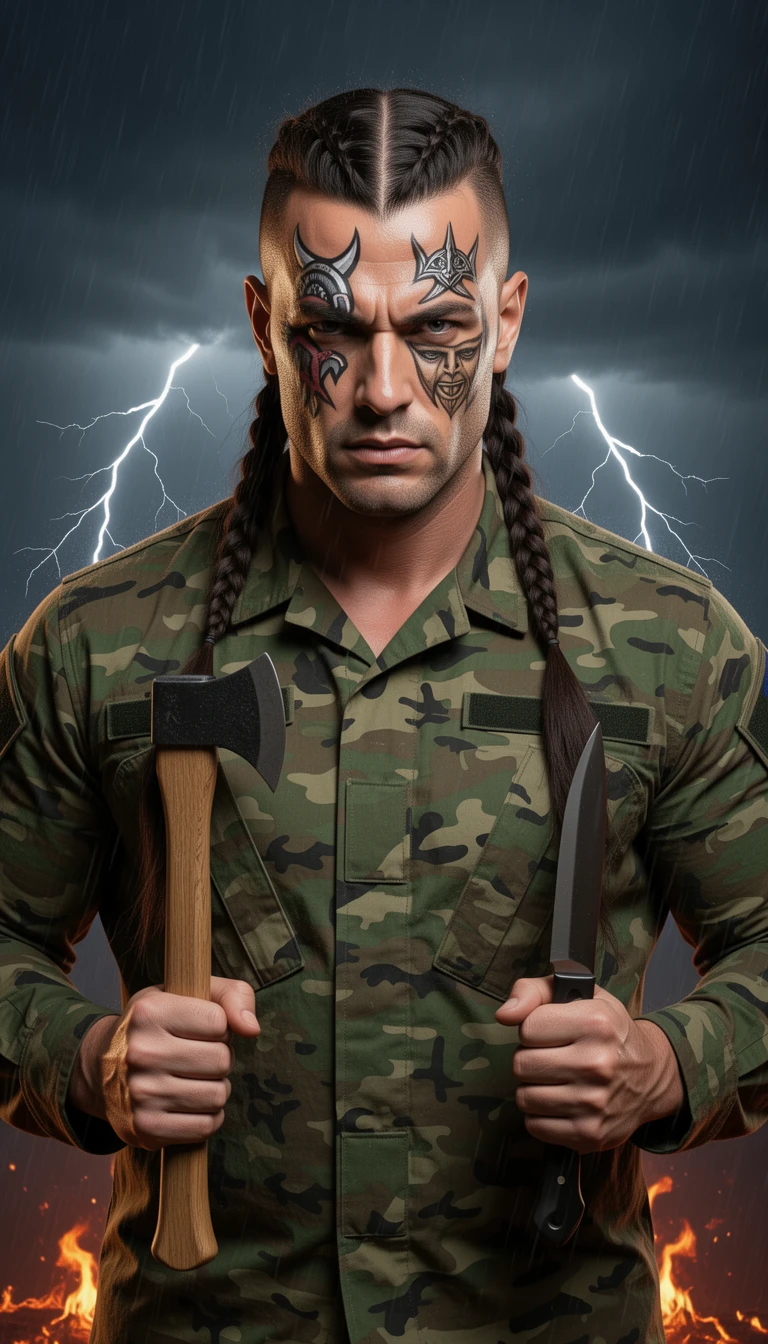
Stevenson and Jack flanked the door like sentinels, their painted faces unreadable, their bodies loose and ready. Melissa stood near the window, her mismatched eyes—ocean blue and emerald green—flickering between Eleanor and Michael with a wariness that spoke of years of combat and an instinct for when things were about to go sideways. Sarah was beside Ivan, her bubblegum-pink eyes soft but alert, her hand finding his in the space between their bodies, her thumb tracing a slow circle across his knuckles. Mark Douglas stood near the head of the bed, his blue eyes carrying the weight of the presidency and the heavier weight of being here as family, not as commander-in-chief. Robert Davis was at the far wall, his braided mohawk and painted face catching the fluorescent light, his hazel eyes watching the scene with the quiet intensity of a man who'd spent ten years alone and was still learning how to be in a room full of people again.
Maria Smith stood near the door with John beside her, their presence new and uncertain, their eyes wide as they took in the gathering. They didn't know these people yet—not really—but they'd shown up because Ivan had asked, because family was family, and because Maria had looked at Eleanor once and seen something that made her eyes go soft and her hand find John's.
And Michael. Michael stood at the foot of the bed, his blue eyes hard, his medium build tense beneath an expensive suit that probably cost more than Ivan made in a month at Hubco. His hands were in his pockets, but his shoulders were tight, and his jaw was doing that thing it did when he was trying to control a conversation he was already losing.
"You're gonna be buried in the family cemetery," Michael said. It wasn't a question. It was a statement dressed up as certainty, a command wrapped in the pretense of information. He said it like he was telling her how things were going to be, like he still had a say, like the courts hadn't stripped him of everything and left him standing in a hospital room with nothing but his anger and his desperate grip on a world that had already moved on without him.
Eleanor's eyes shifted. Slow. Deliberate. The kind of look that had been landing like a blade for eighty years and hadn't dulled a fraction. "No," she said. Her voice was thin—weaker than Ivan had ever heard it—but the word itself was iron. "I wanna be buried in the vault. With Robert Nightsworn. Your father. My son."
The room went still. Not the kind of still that comes from silence, but the kind that comes from everyone holding their breath at the same time. Ivan felt Sarah's hand tighten around his, and he didn't look at her. He looked at Michael. Watched the words land. Watched them settle into his brother's chest like stones dropping into deep water.
Michael's face did something complicated. His blue eyes narrowed, then widened, then narrowed again. His jaw worked. His hands came out of his pockets, and he spread them in a gesture that was half confusion and half accusation. "There was no underground crypt," he said. "I was there. I was at the funeral. I watched them put him in the ground at the family cemetery like every Nightsworn before him."
No one spoke. Ivan felt the weight of the truth pressing against his ribs, felt it sitting in the room like a living thing. He knew. Rickey knew. Jennifer knew. Kimberly, Michelle, Stevenson, Jack, Melissa, Sarah, Mark, Robert—they all knew. They'd stood in the vault. They'd seen the crypts. They'd walked through the Cathedral and the Sacred Sanctuary and the Family Vault where Robert Nightsworn's body had been resting for twenty-one years, waiting for Eleanor to join him.
But no one spoke.
Michael's eyes swept the room. He saw the silence. He saw the way no one met his gaze. He saw the truth written in the space between their bodies, in the way Ivan's hand stayed wrapped around Sarah's, in the way Rickey's arms stayed crossed and his mouth stayed shut.
"You dug our father up," Michael said. His voice was flat now. Dangerous. The kind of flat that came before something broke. "You dug him up and buried him in this—this so-called underground crypt."
"Yes," Eleanor said.
The word landed like a gunshot.
Michael stared at her. His blue eyes were wide, and there was something in them that Ivan had never seen before—not anger, not rage, but something rawer. Something that looked like grief, twisted and poisoned and turned into a weapon he didn't know how to put down. "Fuck this shit," he said.
The words came out low. Quiet. The kind of quiet that filled a room more completely than any shout could.
Michael's head turned. His eyes found Mark Douglas, and the look that crossed his face was pure disgust—the kind of disgust that came from a place so deep it had calcified into something permanent. Then his gaze shifted to Sarah, and the disgust deepened. Curdled. Became something that made Ivan's free hand curl into a fist at his side.
"You're fucking stupid," Michael said to Eleanor. His voice was rising now, cracking at the edges. "You're fucking stupid for putting the president's sister on the board. You handed everything to them. Everything. To people who aren't even—"
Kimberly moved.
It happened so fast that Ivan's brain registered it in pieces—the shift of her weight, the flash of her hand moving to her waistband, the glint of something small and silver appearing between her fingers. She crossed the distance in two steps, and then the scalpel was at Michael's throat, pressed against the skin just below his jaw, and Kimberly's orange eyes were burning inches from his face.
The scalpel was small. Old. The kind of blade a surgeon would have used decades ago, before laser cuts and disposable scalpels and all the modern tools that made medicine sterile and cold. Kimberly had stolen it when she was eight years old, during a trip to the hospital after breaking her arm falling out of a tree. She'd hidden it in her sock and carried it ever since—through boot camp, through the Coast Guard, through deployments and missions and every moment of her adult life. It was the first thing she'd ever taken that was hers alone, and she'd kept it for thirty years.
Now it was pressed against her brother's throat, and her voice was low and cold and absolute.
"Fuck off," Kimberly said. Her voice was barely a whisper, but it carried like a shout in the silence of the room. "Fuck off all the way, bitch. Or I will slit your throat."
Michael's eyes went wide. His hands came up slowly, palms out, the gesture of a man who knew exactly how fast a blade could move and exactly how much Kimberly meant what she said. His mouth opened, then closed. His throat bobbed against the scalpel's edge, and a thin line of red appeared—a scratch, nothing more, but enough to prove the blade was real and sharp and hungry.
Ivan didn't move. He felt Sarah's hand tighten around his, felt her breath catch and hold, but he didn't look away from Kimberly's face. His sister's face. The face that had been painted in white and black and gray since she was sixteen years old, the face that had stared down enemies and allies and everyone in between, the face that was now inches from their brother's throat with a scalpel she'd carried since childhood.
No one in the room moved to stop her. No one spoke. The heart monitor beeped. The IV dripped. The fluorescent lights hummed.
Michael took a step back. Slow. Careful. The scalpel followed him, staying against his throat until Kimberly let it drop—not because she was done, but because she'd made her point. She held his gaze for one beat longer, then two, then three. Then she stepped back, slipped the scalpel back into its hidden place at her waistband, and returned to her position beside the heart monitor like nothing had happened.
Michael's hand went to his throat. His fingers came away red, and he stared at the blood for a long moment before looking up at the room. At his family. At the people who had chosen each other over him, who had kept secrets and built vaults and buried their father in a crypt he'd never known existed.
His eyes found Eleanor one last time. Something passed between them—something old and broken and beyond repair. His mouth opened, but no words came out. He closed it. Turned. Walked to the door, past Stevenson and Jack, past Rickey and Robert, past Maria and John. He didn't look back.
The door closed behind him with a soft click.
The silence that followed was not the silence of relief. It was the silence of a wound that had been opened and left to bleed. Ivan felt it in his chest, felt it in the way Sarah's hand was still wrapped around his, felt it in the way his heart was beating too fast and too hard and too loud in his own ears.
Tap. Tap. Tap.
His thumb found his thigh. Three times. Pause. Three times. Pause.
"Ivan."
Eleanor's voice. Thin. Fading. But still iron.
He looked at her. His grandmother. Eighty years old, dying of cancer, lying in a hospital bed with an IV in her arm and a heart monitor beeping beside her. She looked small against the white sheets. She looked frail in a way he had never seen her look before, in a way that made something crack open in his chest and spill hot through his ribs.
"Come here," she said.
He went. His feet carried him across the room without his permission, and then he was sitting on the edge of her bed, her hand finding his, her blue eyes meeting his gray-and-silver gaze with a clarity that belied the tubes and wires and machines surrounding her.
"You heard," she said. Not a question. A statement.
Ivan nodded. His throat was too tight for words.
"The vault is real," Eleanor said. "The crypt is real. Your father is there, waiting for me. And when I go—" She paused. Her eyes flickered, and for a moment, Ivan saw something in them that looked like fear. Not fear of death. Fear of leaving. Fear of the unfinished thing. "When I go, I want you to make sure they put me beside him. Not in the cemetery. In the vault. In the crypt. Beside my son."
Ivan's hand tightened around hers. "I will."
Eleanor's eyes held his. "Promise me."
"I promise."
She nodded once. Then her eyes closed, and her breathing slowed, and the room settled into a quiet that was part vigil and part waiting and part the strange, suspended space between one moment and the next.
Ivan sat there, holding his grandmother's hand, feeling the warmth of her skin against his, feeling the pulse that was still beating, still fighting, still refusing to surrender. Behind him, his family moved in soft, careful patterns—Jennifer pulling up a chair, Rickey leaning against the wall, Sarah's hand finding his shoulder and resting there like an anchor.
The fluorescent lights hummed. The IV dripped. The heart monitor beeped.
And somewhere in the distance, a door closed.
The door opened again before the silence had a chance to settle, and Ivan's hand went to his waistband on instinct—old habits, old training, the body remembering what the mind hadn't yet processed. But the two men who walked through were not Michael. They were not Black Hand. They were not anything Ivan had been prepared for.
The first man was tall and broad-shouldered, pushing seventy with a full head of silver hair and a face that looked like it had been carved from granite and left in the sun too long. He wore a white coat with a hospital ID badge clipped to the pocket, and his hands—large, scarred, weathered—hung at his sides with the easy confidence of a man who had spent decades in operating rooms. The second man was shorter, rounder, with a bald head and wire-rimmed glasses that magnified his eyes into something almost comical. He was in a suit, not a coat, and he carried himself like someone who had spent more time in boardrooms than in surgery.
The tall one—the Chief of Surgery, Ivan's brain supplied from the name on his badge—stopped in the doorway and let his gaze sweep across the room. He looked at Ivan. At Rickey. At Jennifer, Kimberly, Michelle. At Stevenson and Wolf and Jack. At Melissa and Sarah and Mark. At Robert, leaning against the far wall with his arms crossed.
The Chief of Surgery's face broke into a grin.
"Well, well, well," he said. "It's the debris from hell."
Maria and John exchanged a confused glance from their seats near the window. Ian was asleep on his mother's lap, his small chest rising and falling in the easy rhythm of childhood. The Chen family had no context for what was happening, no frame of reference for why this man was looking at the Nightsworn siblings like they were old friends and old enemies all at once.
Ivan felt the memory flicker somewhere in the back of his skull—not a clear image, not a full recall, just the impression of something. A hallway. Fluorescent lights. The smell of antiseptic and his own blood. A vending machine lying on its side, glass shattered, candy bars scattered across the floor like offerings.
He was eight years old.
"You remember," the Chief of Surgery said, and it wasn't a question. His eyes had found Ivan's face—the painted face, the silver eye and the gray eye, the three styles of paint that had been part of Ivan's identity since he was sixteen years old. "You remember, don't you?"
Ivan's thumb found his thigh. Tap. Tap. Tap. Pause.
"Vaguely," he said.
The Chief of Surgery laughed—a deep, rolling sound that filled the room and made the heart monitor seem to skip a beat in response. He turned to the shorter man beside him, the hospital CEO, and clapped him on the shoulder with enough force to make the man's glasses jump.
"Vaguely, he says. Vaguely." The Chief shook his head, still grinning. "I've been telling that story for thirty years. Best night of my career. And he remembers it vaguely."
Kimberly shifted her weight. Her orange eyes were fixed on the Chief of Surgery with an intensity that Ivan recognized—the same intensity she'd had when she pressed the scalpel against Michael's throat. But this was different. This was not anger. This was recognition.
"You were the resident on call," she said.
The Chief of Surgery turned to her, and his grin softened into something almost reverent. "You remember."
"You stitched up my arm." Kimberly's voice was quiet, flat, the voice of someone recalling a fact rather than a feeling. "Eight stitches. You told me I was the bravest kid you'd ever seen."
"I did." The Chief of Surgery nodded slowly. "And I meant it. Still do."
The hospital CEO cleared his throat and stepped forward. His wire-rimmed glasses caught the fluorescent light as he adjusted them, and his voice was softer than the Chief's, more measured, the voice of a man who had learned to navigate hospitals the way a ship captain navigates a storm.
"I was the night administrator," he said. "Thirty years ago. Fresh out of grad school, first job, thought I knew everything there was to know about running a hospital." He paused, and a small, wry smile touched his lips. "Then eleven children showed up in my emergency room with six security guards, a janitor, and a vending machine in various states of destruction."
Maria's eyes went wide. John leaned forward in his chair, his hand moving instinctively to rest on Ian's back. Even Eleanor, lying in her hospital bed with tubes in her arm and monitors beeping around her, had opened her eyes and was watching the exchange with something that looked like amusement.
"Eleven children," the CEO repeated. "Ages eight to nine. Covered in blood—most of it not their own. And standing in the middle of them, holding a scalpel like she'd been born with it in her hand, was a little girl with orange eyes and a face that said she'd do it all over again if she had to."
He looked at Kimberly.
"That was you."
Kimberly didn't flinch. Didn't look away. Her hand moved to her waistband, to the hidden place where the scalpel still rested, and her fingers brushed against it through the fabric of her shirt. A confirmation. A recognition.
"The security guards were trying to throw us out," she said. "We were waiting for our grandmother. She was in surgery. They said we couldn't stay in the waiting room because we were making too much noise."
"We were playing tag," Michelle said quietly. Her voice was soft, almost distant, like she was reading the words off a page written long ago. "I ran into a janitor's cart. It tipped over. The mop bucket spilled. The janitor grabbed my arm."
"He grabbed her hard," Rickey added. His voice was flat, emotionless, the voice of a man recounting a fact rather than a feeling. "Left bruises. I saw them."
Jennifer nodded. "We all saw them."
The Chief of Surgery's grin had faded completely now, replaced by something darker. He pulled back the sleeve of his white coat, revealing a thick, pale scar that ran from his wrist to his elbow—a scar that had been there long enough to fade to silver, long enough to be part of him.
"I was coming down the hallway when it started," he said. "I heard the commotion, the shouting, the crash of the vending machine going over. By the time I got there, the guards were on the ground. The janitor was on the ground. And this little girl—" He pointed at Kimberly with his scarred arm. "—was standing over them with a scalpel in her hand, breathing hard, orange eyes blazing like I've never seen before or since."
He lowered his arm.
"She turned to me. I thought she was going to stab me too. I was a resident, twenty-eight years old, and I was genuinely afraid of an eight-year-old girl." He let out a breath that was almost a laugh. "But she just looked at me and said, 'He hurt my sister. He's not going to do it again.'"
The room was silent. The heart monitor beeped. The IV dripped. The fluorescent lights hummed their endless, mindless song.
Kimberly's hand was still at her waistband. Her orange eyes were fixed on the Chief of Surgery's scar, following its path from wrist to elbow, tracing the silver line that had been there for thirty years.
"I did that," she said. It wasn't a question.
"You did." The Chief of Surgery nodded. "You were aiming for my chest. I put my arm up to block, and the scalpel caught me here—" He touched the scar. "—instead of here." He touched his sternum. "I've always considered that a win."
Kimberly's jaw tightened. Her hand dropped from her waistband, and she took a step forward—not aggressive, not threatening, just moving. She stopped a few feet from the Chief of Surgery and looked up at him, her orange eyes meeting his gray ones.
"I'm sorry," she said.
The words hung in the air. Simple. Direct. No excuses, no explanations, no justifications. Just an apology, thirty years in the making, offered by a woman who had carried a scalpel since she was eight years old and had never once apologized for what she'd done with it.
The Chief of Surgery looked at her for a long moment. Then he shook his head.
"You have nothing to apologize for," he said. His voice was quiet now, almost gentle. "You gave us the best day of our lives. The greatest story." He glanced at the hospital CEO. "Tell them. Tell them what we've been telling people for thirty years."
The CEO adjusted his glasses. His smile widened, and for a moment, he looked like a man who had been waiting his whole life to tell this story to the people who lived it.
"We still talk about it," he said. "At Christmas parties. At retirement dinners. At the annual hospital gala, when everyone's had a few drinks and someone brings up the night of the great pediatric brawl." He laughed—a genuine, warm sound that filled the room. "Six security guards. A janitor. A vending machine. And eleven children who decided that nobody was going to lay a hand on their family."
He pointed at Stevenson. "You pinned the first guard against the wall with a tray table."
Stevenson's black eyes flickered. A rare smile touched his lips. "He was reaching for Jennifer."
The CEO pointed at Wolf. "You took out the second guard with a fire extinguisher. Shot him right in the face."
Wolf's painted face split into a grin. "He was trying to grab Rickey."
The CEO pointed at Jack. "You—you were the one who tipped the vending machine. I don't know how an eight-year-old tipped a vending machine, but you did it."
Jack shrugged, his blue eyes glinting. "Adrenaline."
The CEO pointed at Sarah, at Mark, at Melissa, at Robert. "You three kept the janitor cornered in the supply closet while the rest of them handled the guards."
Sarah's bubblegum pink eyes narrowed, and she tilted her head slightly. "We didn't want him to call for backup."
"And you," the CEO said, turning to Ivan. "You were the one who hit the panic button on the wall. Not because you were scared. Because you wanted to make sure everyone knew what was happening. You wanted the cameras to see."
Ivan remembered it now—the flash of that moment, the press of his small hand against the red button, the sound of the alarm that had echoed through the hospital corridors. He'd been eight years old, covered in scratches and bruises, his knuckles raw from hitting a security guard who had grabbed Michelle by the hair. And he'd hit the panic button because he wanted the world to see what happened when someone tried to hurt his family.
"I remember," he said.
The Chief of Surgery stepped forward and pulled back his collar, revealing another scar—shorter, thinner, just below his jaw. "This one was from the scalpel. The first one—the one she took from the supply cart when she ran past." He touched it gently, almost fondly. "I was trying to restrain her. She was trying to get to the guard who had grabbed Michelle. She didn't even realize she'd cut me."
Kimberly's face was unreadable. Her orange eyes were fixed on the scar, tracing its line, memorizing it. "I remember," she said quietly. "I remember the blood. I remember thinking I'd killed you."
"You were eight," the Chief said gently. "You were protecting your sister. And you did what you had to do." He lowered his collar and met her eyes. "I've been a surgeon for thirty years. I've saved hundreds of lives. And I still tell people about the night an eight-year-old girl almost took me out with a stolen scalpel because she loved her family that much."
Kimberly's breath caught. Just a hitch, just a fraction of a second, but Ivan saw it. He saw the way her shoulders tightened, the way her hand moved to her waistband again, the way her orange eyes flickered with something that might have been gratitude or grief or both.
"That's the greatest compliment I've ever received," she said.
The Chief of Surgery smiled. "It's the truth."
The hospital CEO cleared his throat again, and when he spoke, his voice had shifted—still warm, but more serious. More deliberate.
"We saw Michael leave," he said. "We were coming down the hallway when he walked past us. He didn't acknowledge us. Didn't look at us. Just walked straight to the elevator with his hand pressed against his throat." The CEO paused. "There was blood on his fingers."
The room went still.
The CEO looked at Kimberly, and there was no judgment in his eyes—only a quiet, steady acknowledgment. "We didn't ask. We didn't need to. We've known Michael Nightsworn for thirty years, and we've known the rest of you for just as long. We know the difference."
He turned to the room as a whole, his wire-rimmed glasses catching the light.
"Michael Nightsworn is officially banned from this hospital," he said. "Effective immediately. I've already notified security, and I've filed a formal order with the board. He is not to set foot on this property for any reason. If he attempts to enter, he will be arrested for trespassing."
Eleanor's voice came from the bed—thin, but still carrying that iron core that had defined her for eighty years. "On what grounds?"
The CEO turned to face her. His expression softened. "Disruptive behavior. Harassment of patients. And a standing order from the Chief of Surgery that Michael Nightsworn is a danger to the medical staff and the patient population." He paused. "The Chief signed it thirty years ago. We've just been waiting for the right moment to enforce it."
Eleanor's eyes closed. A small smile touched her lips—the first genuine smile Ivan had seen from her since they arrived at the hospital. "Good," she said. And then, softer: "Good."
The Chief of Surgery stepped closer to Eleanor's bed, his scarred hands hanging at his sides. "Mrs. Nightsworn. I operated on your daughter-in-law thirty years ago. I was a resident, and she came in after a car accident—she and her husband. I did everything I could, but the damage was too severe." He paused, and his voice dropped. "I never forgot that night. I never forgot the way you held her hand while she was still conscious, the way you told her it was going to be okay even though we both knew it wasn't."
Eleanor's eyes opened. She looked at the Chief of Surgery—really looked at him, her blue eyes sharp and clear despite the pain and the tubes and the machines.
"You were the resident," she said slowly. "You were the one who stayed after your shift ended. You held her other hand while she passed."
The Chief nodded. "I did."
Eleanor's hand reached out from the bed, thin and trembling, and the Chief of Surgery took it without hesitation. His scarred fingers wrapped around her pale ones, and for a moment, no one in the room breathed.
"Thank you," Eleanor said. "I never got to say that. I never knew your name."
"Dr. Marcus Webb," he said. "And you don't have to thank me, Mrs. Nightsworn. It was an honor."
Eleanor's grip tightened. "I'm dying, Dr. Webb."
"I know."
"I'm not afraid."
"I know that too."
Eleanor smiled—that same small, iron smile that Ivan had seen a thousand times. "Good. Then you know I mean it when I say that I'm proud of you. Of the doctor you became. Of the man you are."
Dr. Webb's jaw tightened. His eyes glistened, but he didn't let go of her hand. "That means more than you know."
The moment held—fragile and perfect and suspended in the fluorescent light of a hospital room that had seen too much death and too much life and too much of everything in between.
And then the door opened again.
Ivan's hand went to his waistband a second time, but the woman who walked in was not a threat. She was tall, with gray-streaked hair pulled back in a loose ponytail, and she wore a white coat with a hospital ID that read DR. LINDA JOHNSON. Behind her came two younger women—one with blue-and-red hair that Ivan recognized as Maria Smith, and one with purple-and-pink hair he recognized as Tia Chen.
Dr. Linda Johnson—Striker's ex-wife, the woman whose husband Ivan had killed, the woman who had sat across from him at a diner and listened to his confession and given him forgiveness he didn't deserve—stopped in the doorway and surveyed the room with the practiced eye of someone who had walked into worse situations.
"I see the cavalry's already here," she said. Her voice was dry, wry, carrying the faint edge of dark humor that Ivan had come to recognize in the short time he'd known her. "I should have known."
Maria and Tia stepped past her, moving toward Eleanor's bed with a quiet purpose that spoke of familiarity and care. Maria's blue-and-red hair caught the fluorescent light as she leaned down to check Eleanor's IV, her fingers moving with practiced ease. Tia—younger, sharper, with purple-and-pink hair that seemed to glow in the harsh hospital light—moved to the other side of the bed and began adjusting the settings on the heart monitor.
"We came as soon as we heard," Maria said. Her voice was soft, gentle, the voice of someone who had learned to move through the world with kindness even when the world didn't deserve it. "Lance called. He said Eleanor was in the hospital, and we—" She glanced at Tia, then at Linda. "We wanted to make sure she was comfortable."
Linda walked to the foot of Eleanor's bed and stood there, her hands in the pockets of her white coat, her eyes moving across the room with a clinical assessment that Ivan recognized from their meeting at the diner. She was assessing the room—the family, the tension, the medical equipment, the emotional state of everyone present.
"Dr. Johnson," Ivan said. His voice came out rougher than he intended, raw from the weight of the day. "What are you doing here?"
Linda met his eyes. Her gaze was steady, unflinching, the gaze of a woman who had spent her entire career looking at things that other people wanted to look away from. "I work at the Forward Base, Ivan. I told you that. When I heard that Eleanor Nightsworn had been admitted, I called in a favor and got myself assigned as her consulting psychiatrist. I'm not here as a friend—I'm here as a doctor."
She paused. Her eyes softened, just slightly. "But I'm also here because you're going to need someone to talk to when this is over. And I'd rather be in the room now than have to find you later."
Ivan's throat tightened. He nodded once, sharp and quick, and turned back to Eleanor.
Maria was holding Eleanor's hand now, her blue-and-red hair falling forward as she leaned close to the old woman's face. "Mrs. Nightsworn," she said softly. "I'm Maria. I don't know if you remember me—Ivan saved my life seven years ago. I'm one of the Chen sisters."
Eleanor's eyes opened. She looked at Maria, and something flickered in her gaze—recognition, perhaps, or just the awareness of kindness. "I remember," she said. Her voice was thin, but steady. "You have a son. Ian."
Maria's breath caught. "Yes. He's here. He's sleeping in my lap."
"Good." Eleanor's eyes drifted to where Ian was curled up on his mother's lap, his small face peaceful in sleep. "He looks like his father."
Maria laughed—a soft, surprised sound that seemed to fill the room with warmth. "He does. Everyone says so."
Tia finished adjusting the heart monitor and stepped back, her purple-and-pink hair swaying as she moved. "The vitals are stable," she said. "I've increased the morphine drip to keep her comfortable. She should be able to rest without pain."
Linda nodded, stepping forward to review the monitor readings. She checked the IV, the oxygen levels, the pulse oximeter, her movements precise and efficient. When she was satisfied, she turned to face the room.
"She's stable for now," Linda said. "But her body is shutting down. The cancer has spread to her liver, her lungs, and her brain. The morphine is managing the pain, but it's not going to stop what's coming." She paused. "I'm sorry. I know that's not what anyone wants to hear."
Ivan's hand tightened around Eleanor's. He felt the warmth of her skin, the thinness of her fingers, the way her pulse fluttered beneath his touch like a bird trying to stay aloft.
"How long?" he asked. His voice was flat, controlled, the voice of a man who had asked this question too many times before.
Linda met his eyes. "Days. Maybe hours. It's hard to predict at this stage."
Ivan nodded. His thumb traced a slow circle on the back of Eleanor's hand, and he felt her fingers curl around his in response—a squeeze, a reassurance, a final message from a woman who had spent her entire life caring for him.
"Thank you," he said. "For being here."
Linda's gaze softened. "I wouldn't be anywhere else."
The room settled into a quiet rhythm—Maria adjusting the pillows behind Eleanor's head, Tia checking the IV lines, Linda reviewing the chart at the foot of the bed. The hospital CEO and Dr. Webb exchanged a look and stepped toward the door, their work done, their presence a gift that had been offered and accepted.
"We'll leave you to it," the CEO said. "If you need anything—anything at all—call the front desk and ask for me by name. I'll make sure it's handled."
Ivan looked up. "Thank you."
The CEO nodded. "Take care of your grandmother, Ivan. And take care of each other." He paused at the door, his wire-rimmed glasses catching the light one last time. "And if you ever need a hospital that knows how to keep its mouth shut, you know where to find us."
The door closed behind them.
And the family was left alone with Eleanor, with the beeping monitors and the dripping IV and the soft, steady sound of her breathing—the sound of a woman who had lived long enough and loved hard enough and fought fiercely enough to earn the peace she was finally, finally allowing herself to feel.
Ivan leaned forward and pressed his forehead against Eleanor's hand, his eyes closing, his breath slow and steady.
"I'm here, Grandma," he whispered. "I'm not going anywhere."
Eleanor's fingers tightened around his. "I know," she said. Her voice was barely a breath, barely a whisper, but it carried through the room like a bell. "You've always been here, Ivan. You've always been the one who stayed."
Ivan felt something crack open in his chest—something that had been sealed for years, locked away behind walls of duty and loss and the constant, grinding weight of survival. He felt it break, felt it bleed, felt it begin to heal in the same breath.
And he stayed.
He stayed because he had promised. Because he had meant it. Because Eleanor Nightsworn had raised him, shaped him, loved him through every broken piece of himself, and she deserved to have someone beside her when she took her final breath.
He stayed because that was what family did.
And he wasn't going anywhere.
Linda Johnson stepped closer to the bed, her hazel eyes soft but steady, the gray stripes in her medium-length hair catching the fluorescent light as she moved. She folded her hands in front of her, a gesture that was professional but not cold, and looked down at Eleanor with the kind of attention that said she had done this before—had stood beside dying beds and offered choices that mattered.
"Eleanor," she said, her voice low and warm, "we have two options."
Ivan felt his grandmother's fingers tighten around his hand. He didn't look at Linda. He kept his eyes on Eleanor's face, watching the way her blue eyes tracked Linda's movement, the way her chest rose and fell in shallow, steady breaths.
"Option one," Linda continued, "we can make you comfortable here. I can coordinate with the hospital staff, manage your pain, keep you stable. You'll have a private room, round-the-clock nursing, and your family can visit as often as they want." She paused. "It's a good option. You'll be cared for. You won't suffer."
Eleanor's gaze didn't waver. She was listening, Ivan could tell—listening the way she listened to everything, with the full weight of her attention, as if she was measuring every word against a lifetime of experience.
"Option two," Linda said, and her voice dropped slightly, became more intimate, "we can use the farmhouse. Make you comfortable there. And myself and Ms. Chen can take care of you."
The room went still.
Ivan felt the words land in his chest like stones. The farmhouse. Eleanor's home. The place where she had raised him, shaped him, loved him through every broken piece of himself. The idea of her dying there—of her last breaths being taken in the house where she had lived for eighty years—hit him with a force he hadn't expected.
"Yes," Linda said, "we will love our families to wear you live at and give you around-the-clock care." Her voice caught slightly on the word love, and she cleared her throat. "I mean—we would love for our families to be where you live. To give you care. Around the clock. You wouldn't be alone for a single moment, Eleanor. Not one."
Eleanor's eyes moved from Linda to Ivan. Her gaze was clear—surprisingly clear, given the morphine and the cancer eating through her brain—and Ivan saw something in them that he hadn't seen in days. A spark. A flicker of the woman who had commanded armies and built empires and stared down death with nothing but her own stubborn will.
"The farmhouse," Eleanor said. Her voice was thin, but it carried. "I want to go home, Ivan."
Ivan's throat closed. He nodded, not trusting his voice, and squeezed her hand gently.
"I know, Grandma," he said. His voice came out rough, scraped raw. "I know."
Kimberly stepped forward, her orange eyes blazing in the fluorescent light, her face paint vivid against her skin. "We need to move fast," she said. "The longer she stays here, the weaker she gets. Every hour in this bed is an hour she's not in her own room, her own bed, her own home."
Michelle didn't speak. She was already at the door, her black eyes scanning the hallway, her body a coiled spring of efficiency. She pulled out her phone and started typing—coordinating, Ivan knew. Logistics. Transport. Security. The things Michelle did without being asked, without needing direction, because she was already three steps ahead of everyone else.
Jennifer moved to the other side of Eleanor's bed, her yellow-orange-red-and-black eyes fixed on her grandmother's face. She reached down and took Eleanor's other hand, her fingers gentle against the thin, papery skin.
"We've got you, Grandma," Jennifer said. Her voice was steady, but Ivan saw the crack in it—the same crack he felt in his own chest. "We're going to take you home."
Maria shifted Ian in her lap, her blue-and-red hair falling forward as she looked up at Linda. "I can help," she said. "I'm a nurse. I can do shifts, night rotations, whatever you need."
Linda nodded. "I was counting on that." She turned to Tia, who was still adjusting the IV lines with practiced precision. "Tia, can you stay overnight? I'll need someone to monitor her vitals while I coordinate the transfer."
Tia looked up, her purple-and-pink hair swaying. "I can stay. Lance can bring me a change of clothes."
"Done," Michelle said from the door, not looking up from her phone. "Lance is on his way with a bag. I've also called Rickey and Robert. They're prepping the farmhouse."
Ivan listened to the machinery of his family clicking into place around him—the quiet competence, the seamless coordination, the way each person found their role without being told. It was beautiful, in its way. A symphony of love and efficiency, orchestrated by decades of training and trust and the unspoken understanding that when one of them fell, the others would carry them.
But Ivan didn't move. He stayed beside Eleanor, his forehead pressed against her hand, his eyes closed, his breath slow and steady. He felt her pulse beneath his fingers—thin, fluttery, like a bird's heart—and he counted each beat, each breath, each moment she was still here, still alive, still fighting.
"Ivan."
Eleanor's voice was barely a whisper, but it cut through the noise of the room like a blade. He opened his eyes and looked at her.
"I'm here, Grandma."
"I know." Her blue eyes held his, and in them he saw eighty years of love and loss and fierce, unyielding determination. "I need you to do something for me."
"Anything."
"When we get to the farmhouse," she said, each word a labor, each breath a gift, "I want you to bring me the book."
Ivan's brow furrowed. "The Dark Quartet Legion book?"
"No." Eleanor's fingers tightened around his. "The journal. The one I kept. The one with the photograph of your mother."
Ivan's chest ached. "Why?"
Eleanor's lips curved into a small, tired smile. "Because I want to read it to you. Before I go. I want you to know everything." She paused, her breath catching, and Ivan felt the weight of those words settle over him like a shroud. "I want you to know who you are, Ivan. Who you've always been. And who you're going to be."
Ivan didn't trust himself to speak. He nodded, pressing his lips to her knuckles, feeling the warmth of her skin against his mouth.
"I'll bring it," he said. "I promise."
Eleanor's eyes drifted closed, and her breathing slowed, deepened. The morphine was pulling her under, wrapping her in a soft haze of painlessness, and Ivan watched her face relax into something like peace.
Linda stepped forward and checked the IV, the monitor, the oxygen levels. "She's stable," she said quietly. "I've adjusted the drip to keep her comfortable during transport. We have about an hour before we need to move her."
Ivan looked up. "An hour."
"Give or take. Long enough to get the farmhouse ready." Linda met his eyes. "Long enough to say what needs to be said."
The room settled into a quiet rhythm—Maria adjusting Ian's blanket, Tia checking the IV lines one last time, Jennifer and Kimberly conferring in low voices near the door. Michelle was still on her phone, coordinating with whoever needed coordinating, her black eyes sharp and focused in a way that meant she was running a full tactical operation in her head.
Ivan didn't move. He stayed beside Eleanor, his hand wrapped around hers, his eyes fixed on her face. He watched the rise and fall of her chest, the flutter of her eyelids, the way her lips moved slightly in her sleep as if she was still talking, still planning, still fighting.
And he thought about the farmhouse. About the porch where he had sat with Sarah, the cellar where he had held the Dark Quartet Legion book, the kitchen where Eleanor had made him breakfast every morning for eighteen years. He thought about the bedroom where she had tucked him in at night, the garden where she had taught him to plant tomatoes, the study where she had told him the stories of Leonidas and Ivar the Boneless and Vlad III.
He thought about coming home from combat—from the mountains of Afghanistan, the jungles of Colombia, the rooftops of Fallujah—and finding her waiting on the porch, a glass of sweet tea in her hand, a smile on her face, as if she had known exactly when he would arrive.
She had always known. She had always been there. And now she was leaving, and Ivan didn't know how to be in a world where Eleanor Nightsworn wasn't waiting for him.
His thumb traced a slow circle on the back of her hand.
"I don't know how to do this," he whispered, the words slipping out before he could stop them. "I don't know how to let you go."
Eleanor's eyes opened. Slowly, painfully, but they opened, and she looked at him with that same fierce, loving clarity that had carried her through eighty years of life and loss and secrets.
"You don't let go," she said. "You carry me. In your chest, in your blood, in the way you love and fight and build. I'll be there, Ivan. Every time you make a choice, every time you stand up for someone who can't stand for themselves, every time you look at Sarah and remember what it means to be whole."
Her hand came up, trembling, and touched his painted cheek.
"You are my legacy," she said. "Not the company. Not the armies. Not the vault or the flags or the hundred trillion dollars." Her thumb brushed the paint on his cheekbone. "You. And your siblings. And the family you've built around you."
Ivan felt something break open in his chest. Not the clean crack of a bone, but the slow, grinding fracture of a wall that had been holding for decades. He felt tears slide down his face, cutting tracks through the Juggalo paint on his left cheek, the Viking paint in the center, the Vlad III paint on his right.
He didn't wipe them away.
"I love you, Grandma," he said. His voice broke on the word love, cracked and splintered and raw. "I love you so much."
Eleanor smiled. It was a tired smile, a worn smile, a smile that had been used a thousand times across a thousand days. But it was real. It was hers. And Ivan felt it land in his chest like a warm hand.
"I love you too, Ivan Leonardo Nightsworn," she said. "More than you will ever know."
She closed her eyes, and her breathing evened out, and Ivan watched her slip into a morphine dream, her face peaceful, her hand still wrapped around his.
He stayed.
He stayed because he had promised. Because he had meant it. Because Eleanor Nightsworn had raised him, shaped him, loved him through every broken piece of himself, and she deserved to have someone beside her when she took her final breath.
He stayed because that was what family did.
And he wasn't going anywhere.
Ivan lifted his head, the weight of Eleanor's words still pressing against his ribs like a second heartbeat. He turned, his painted face catching the fluorescent light, and found Linda standing near the door with Tia beside her, both women watching him with the quiet patience of people who understood that some moments couldn't be rushed.
"Thank you," Ivan said. His voice was rough, scraped raw from the tears he hadn't wiped away. "For everything. For being here. For—" He stopped, swallowed, tried again. "For taking care of her."
Linda's hazel eyes softened. She stepped forward, her gray-streaked hair catching the light as she moved, and she placed a hand on his arm. The touch was light, professional, but there was warmth in it. "That's my job, Ivan. But it's not a burden. She's a remarkable woman."
"She's my grandmother," Ivan said. Like that explained everything. Like that was the only answer that mattered.
Tia shifted beside Linda, her purple and bubblegum-pink hair bright against the sterile white of the hospital walls. She was young—twenty-one, Ivan remembered—but there was a steadiness in her light blue eyes that belied her age. "I'll help with the transport," she said. "I've done medical transfers before. Back in Hawaii, I volunteered with the mobile clinic."
Ivan nodded. He didn't have words for gratitude anymore. They were all used up, spent in the space between Eleanor's morphine dreams and his own breaking heart.
Jennifer stepped forward from where she had been standing near the window, her yellow-orange-red-and-black eyes catching the light in a way that made her look almost otherworldly. Her face paint—Juggalo on the left, Viking in the center, Vlad III on the right—was intact, but there was a rawness to her expression that Ivan recognized. She was holding it together the same way he was. By refusing to let go.
"Linda," Jennifer said, her voice low and even, the voice of someone who had coordinated extractions in hostile territory, "ready for transportation."
Linda nodded, already moving toward the monitors. "I've got the portable oxygen tank prepped. The IV pole has wheels. We'll need someone on each side of the bed for the transfer to the stretcher, and someone to handle the door." She glanced at Ivan. "You'll want to be beside her. She'll be disoriented when the morphine starts wearing off, and she'll need a familiar face."
"I'll be there," Ivan said. It wasn't a question.
Kimberly appeared in the doorway, her orange eyes blazing even in the dim light. She had a phone pressed to her ear, her voice a low murmur as she coordinated something with someone on the other end. She hung up, slipped the phone into her pocket, and met Ivan's gaze.
"Farmhouse is ready," she said. "Rickey and Robert set up the hospital bed in her room. Michelle's got the medical supplies staged. Jack and Stevenson are sweeping the perimeter—just in case Michael decides to make another appearance." Her jaw tightened. "Wolf's monitoring the hospital feeds. If Michael shows up again, we'll know before he reaches the parking lot."
Ivan felt something settle in his chest. Not peace—he wasn't sure he'd ever feel peace again—but the kind of grim certainty that came from knowing his family had his back. They were a machine, each part moving in sync, each piece doing its job so that he could do his.
He looked down at Eleanor's hand, still wrapped in his. Her skin was paper-thin, blue veins visible beneath the surface, her nails clipped short and clean. She had held the world together with those hands. She had raised him, shaped him, loved him through every broken piece of himself.
And now she was leaving.
The thought hit him again, a fist to the sternum, and he felt his breath catch. He didn't let go of her hand. He couldn't. If he let go, it would be real. If he let go, she would be gone, and he would be alone in a world that had never made sense without her in it.
You don't let go. You carry me.
Her voice echoed in his skull, and he pressed his lips together, forcing the tears back. He had work to do. He could break later. He could break when she was safe in the farmhouse, when the machines were beeping in the bedroom where he had learned to read, when the family was gathered around the scarred oak table and the night was quiet and the only thing left was the waiting.
He could break then.
"Ivan."
He looked up. Maria was standing beside him, Ian balanced on her hip, the five-year-old's blue eyes wide as he took in the room full of adults with painted faces and hard eyes. Maria's hand found his shoulder, squeezed once.
"We're going to follow you to the farm," she said. "John's pulling the car around. We'll be there when you arrive."
Ivan nodded. "You don't have to—"
"We want to." Her voice was firm, the same voice she had used seven years ago when she had looked at him across a jungle clearing and told him she wasn't afraid. "You showed us your home, Ivan. You showed us your family. We're going to be there for yours the way you were there for ours."
Ian squirmed in his mother's arms, then reached out a small hand toward Ivan's painted face. His fingers brushed the Vlad III paint on Ivan's right cheek, and Ivan felt the small, warm touch like a brand.
"You have colors," Ian said, his voice high and curious. "Like a rainbow."
Ivan felt something crack open in his chest again. He managed a smile—small, tired, real. "Yeah, buddy. Like a rainbow."
Ian grinned, showing a gap where his front teeth were still coming in, and then buried his face in his mother's neck, suddenly shy.
Maria laughed softly. "He's been talking about you all morning. 'When are we going to see the rainbow man again?'" She shook her head. "You made an impression."
Ivan didn't know what to say to that. He looked down at Eleanor's hand, then back up at Maria. "Thank you," he said again. The words felt inadequate, small, but they were all he had.
Maria nodded, and then she was gone, Ian's small hand waving over her shoulder as she disappeared through the door.
The room settled into a rhythm of preparation. Linda and Tia moved around the bed, checking lines, adjusting monitors, preparing the portable oxygen tank. Jennifer and Kimberly coordinated in low voices, their words a steady stream of tactical jargon that Ivan had learned to tune out years ago. Michelle appeared in the doorway, her black eyes scanning the room with the quiet efficiency of someone who had already planned for every variable.
"The ambulance is here," she said. "I told them to wait. Give us ten minutes to get her stable."
Ivan nodded. He looked down at Eleanor's face, peaceful in sleep, her lips slightly parted, her breathing even. She looked smaller than she had an hour ago. Smaller and more fragile, as if the confession had drained something out of her, left her hollowed out and thin.
He leaned down, pressed his lips to her forehead. Her skin was warm, soft, smelled of lavender and the faint, chemical tang of hospital soap.
"I'm right here, Grandma," he whispered. "I'm not going anywhere."
Her eyelids fluttered, but she didn't wake. The morphine was holding her deep, wrapping her in a dreamless sleep that Ivan envied and feared in equal measure.
He straightened, looked at Linda. "What do you need from me?"
Linda's hazel eyes met his. "Stand beside her. Hold her hand. When we move her, talk to her. She'll hear your voice even if she can't respond. It'll keep her calm."
Ivan nodded. He could do that. He had done it a hundred times—in the field, with wounded men who were slipping away, with the dying and the broken and the ones who had given everything they had. He had held their hands and told them they weren't alone, that someone was there, that they mattered.
He had never done it for someone he loved this much.
Linda and Tia worked in tandem, disconnecting monitors with practiced efficiency, transferring lines to the portable unit, checking the oxygen tank's pressure one last time. Kimberly stepped forward and lowered the bed rail, and Jennifer moved to the foot of the bed, ready to guide it through the door.
"On my count," Linda said. "Three, two, one—"
They moved. The bed rolled forward, its wheels squeaking softly against the linoleum, and Ivan walked beside it, his hand wrapped around Eleanor's, his eyes fixed on her face. He watched for any sign of distress, any flicker of pain, but she remained still, her breathing even, her face peaceful.
They navigated the hallway, past the nurses' station where a young woman with kind eyes watched them go, past the waiting room where an elderly man looked up from his magazine and nodded once, a gesture of recognition and respect that Ivan didn't understand but accepted. The fluorescent lights buzzed overhead, casting everything in a flat, clinical glow, and the air smelled of disinfectant and stale coffee and the particular ache of a place where people came to say goodbye.
The elevator doors opened. Michelle held them, her black eyes scanning the corridor one last time before she stepped inside with them. The doors closed, and the elevator descended, the numbers ticking down in a slow, mechanical rhythm.
Ivan looked at Eleanor's face in the elevator's harsh light. The wrinkles around her eyes, the soft curve of her jaw, the way her lips twitched slightly as if she was dreaming. He had seen her face a thousand times—across the breakfast table, in the garden, on the porch as he drove away to war—and he had never really looked at it. Not like this. Not like he was memorizing it.
The doors opened. The lobby stretched out before them, wide and bright, with a reception desk at the far end and a pair of automatic doors leading to the ambulance bay. The Chen family was gathered near the entrance—David and Sue, Lance and Tia, John holding Ian, Maria standing beside her father—and they watched in silence as the bed rolled past.
Ivan saw them. He saw the way David Chen's eyes tracked Eleanor's face, the way Sue Chen pressed her hand to her chest, the way Lance put his arm around Tia and pulled her close. They were strangers, essentially. They had known Eleanor for less than twenty-four hours. But they were here. They were bearing witness.
The automatic doors opened, and the cold night air hit Ivan's face like a slap. He inhaled deeply, filling his lungs with the smell of asphalt and exhaust and the faint, green scent of the trees that lined the hospital's parking lot. The ambulance was waiting, its back doors open, a pair of paramedics standing ready.
Linda and Tia transferred Eleanor's bed to the ambulance's gurney with practiced ease, locking it into place, securing the oxygen tank and the IV lines. Ivan climbed in beside her, settling into the narrow seat against the wall, his hand never leaving hers.
"I'll ride with her," he said. It wasn't a question.
Linda nodded. "I'll follow in my car. Jennifer and Kimberly are right behind us." She paused, her hazel eyes meeting his. "You did good today, Ivan. You showed up. That's more than most people ever do."
Ivan didn't know how to respond to that, so he didn't. He just nodded, looked down at Eleanor's hand in his, and waited for the doors to close.
The paramedic—a young man with a close-cropped beard and kind brown eyes—checked the monitors one last time, then knocked on the cab's partition. The ambulance engine rumbled to life, and they were moving, pulling out of the bay and onto the road, the world outside the small windows blurring into streaks of streetlight and shadow.
Ivan leaned forward, his elbows on his knees, his forehead nearly touching Eleanor's arm. He could feel the vibration of the road through the floor, the gentle sway of the ambulance as it navigated the turns, the steady beep of the heart monitor that meant Eleanor was still here, still fighting, still breathing.
"I'm going to bring you home, Grandma," he said, his voice low, almost a whisper. "I'm going to get you into your bed, and I'm going to sit beside you, and I'm not going to leave until you open your eyes and tell me I'm being dramatic."
A pause. The monitor beeped. The ambulance hummed.
"You're going to tell me about the journal. About Mom. About everything." He swallowed. "And then you're going to rest. You're going to let us take care of you the way you took care of us."
His thumb traced a slow circle on the back of her hand.
"And when you're ready—when you're tired and you've said everything you need to say—I'll be there. I'll hold your hand. I'll tell you I love you. And I'll let you go."
The words hung in the air, heavy and raw, and Ivan felt them settle into his bones like a promise he wasn't sure he could keep.
But he would try. For her. He would try.
The ambulance turned, and through the window, Ivan saw the familiar silhouette of the farmhouse rising against the dark sky, its windows glowing with warm light, the porch where he had sat with Sarah, the fields where he had learned to shoot, the land that had been in his family for two hundred years.
Eleanor was coming home.
And Ivan was going to be there, every step of the way, until the very end.
The ambulance slowed, pulled into the long driveway, and Ivan felt something shift in his chest. Not peace. Not acceptance. But a kind of readiness. A willingness to face what was coming, because there was no other choice.
He looked at Eleanor's face, peaceful in the dim light, and he squeezed her hand.
"We're home, Grandma," he said. "We're home."