
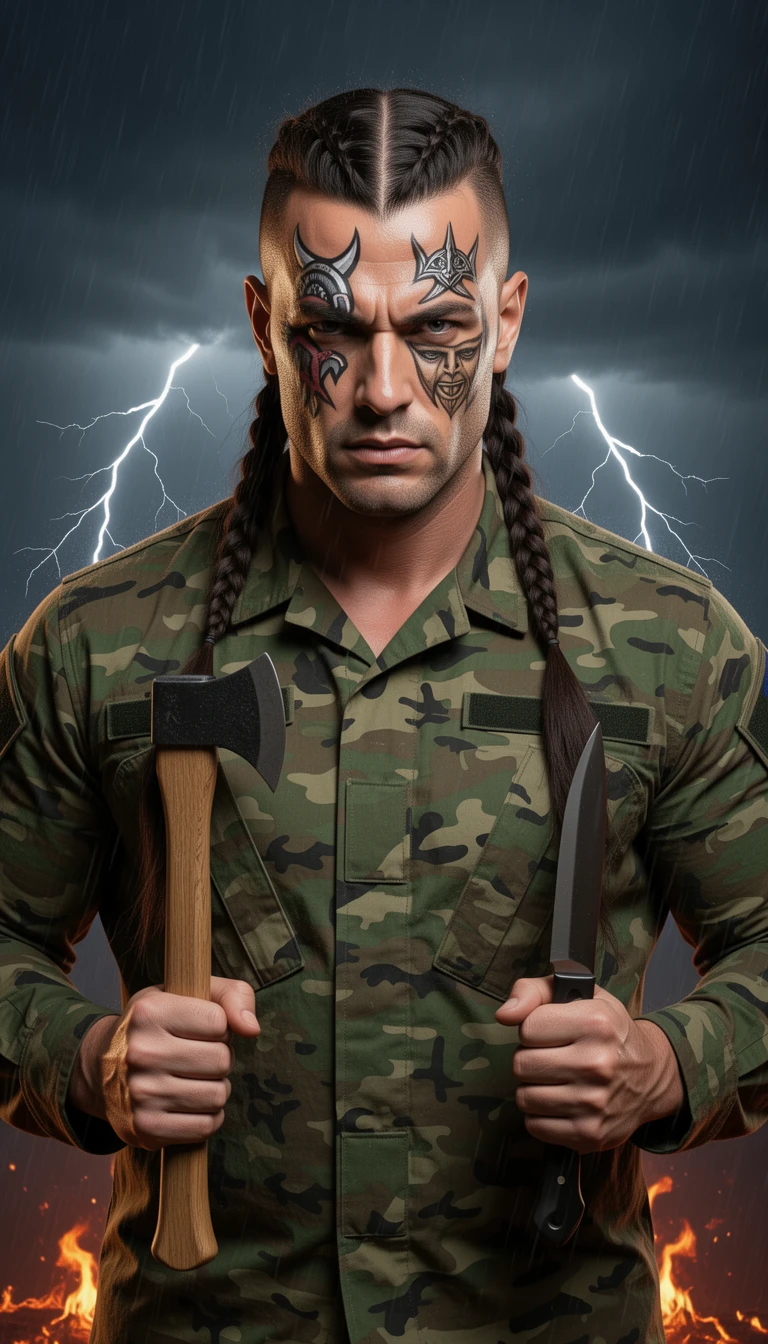
Ivan's hands moved on autopilot—case of soup to the shelf, tear the box, stack the cans, three across, three deep, pull the cardboard flat. The rhythm was a prayer he'd been saying for years now, the kind that didn't need words. His mind was in the farmhouse cellar, in the worn leather of the Dark Quartet Legion book, in the weight of his grandmother's journal in his jacket pocket. Tonight. Tonight they drove to D.C. Tonight they ended it.
The fluorescent hum of Hubco filled the space behind his eyes. Aisles stretching away in straight lines, every shelf faced forward, every tag facing out. Order he could touch. Order that stayed ordered. He slid another box open, the tape giving way with that particular ripping sound he knew better than his own heartbeat.
Eleven-oh-three. His watch said so. Three hours and fifty-seven minutes until his shift ended. He'd counted.
He was counting the seconds until he could hold Sarah again, until they drove south on 395 with the evidence that would bring Lionel Price down, until he watched that man's world crumble the way his had crumbled twenty-one years ago in a phone call from basic training—your parents are dead, your girlfriend is dead, the crash, we're so sorry son—
Ivan tapped his thigh three times. Hard. The pain anchored him.
Focus. Soup. Shelf. Box. Repeat.
He didn't hear the front door open. He didn't hear the footsteps. What he heard was a woman's voice—not loud, not sharp, but breaking—calling his name across the cavernous hangar of the store.
"Ivan."
He looked up. And the world stopped turning.
She was walking toward him—no, running, a full sprint down the center aisle, her two-tone hair streaming behind her, blue on the left, red on the right, her face wet before she reached him. Behind her, a man with blue eyes and mixed skin stood frozen, holding the hand of a small boy with black hair and those same blue eyes.
Ivan didn't recognize her. He didn't—he was already reaching for the knife at his hip, already cataloging exits, already calculating—
And then she hit him. Full body. Arms around his neck. Sobbing.
"Thank you," she said, her voice muffled against his chest, her whole body shaking. "Thank you thank you thank you—"
His hands hung in the air. A reflex he couldn't complete. A boy, eighteen years old, covered in mud and blood in a Vietnamese jungle, screaming at a girl to stay behind him while he—
Maria.
The name hit him like a bullet. His arms came up. His hands found her back. He held her.
"Maria," he said. Not a question. Not anymore.
She pulled back just enough to look at his face—his painted face, his mismatched eyes—and she laughed, a wet, broken sound that was half sob, half joy. "You remember. You actually remember."
"I remember everything." His voice was rough, scraped raw. "Every second."
She was twenty-five now. He could see it in the fine lines around her eyes, the way she held herself differently. But the girl he'd pulled from that warehouse—that girl was still there, looking back at him through tears.
"I've been looking for you for seven years," she said. "I asked everyone. The military, the VA, the—I didn't even know your last name. You just said 'Ivan' and then you were gone and I didn't—" She stopped. Swallowed. "I thought you were dead. I thought—"
"I know." He said it soft. "I know."
He pulled her back in. Held her tighter. His jaw pressed against the top of her head, and he felt the years collapsing between them—the jungle, the fire, the bodies, the girl he'd carried out with her brother and her parents, the girl he'd told to run and never look back.
She'd looked back. She'd looked for him.
"Thank you," she said again, quieter now, her hands gripping the fabric of his blue vest. "For saving me. For saving my brother Lance. For saving my parents—David and Sue—in that village, in the jungle. Thank you for getting rid of Striker. Thank you for—"
"Stop." He said it gentle. "You don't have to thank me. I'd do it again. I'd do it a thousand times."
She pulled back. Wiped her face with the back of her hand. "I know you would. That's who you are."
Behind her, the man—her husband, Ivan realized, seeing the way he watched her, the protective set of his shoulders—stepped forward. He had the boy's hand in his, and the boy was staring up at Ivan with those impossibly blue eyes, unafraid.
"I'm John," the man said. "Maria's husband. I—" He stopped. Looked at his wife. Looked at Ivan. "She told me about you. About what you did. She never stopped talking about you. Never stopped looking."
Ivan nodded. He didn't know what to say. His hands were shaking again. He pressed them flat against his thighs, counted to three, released.
Maria turned. She knelt beside the boy, her hand on his small shoulder. "Ian," she said, her voice breaking on the name. "This is Ivan. The man I told you about. The one who saved us."
The boy—five years old, black hair, blue eyes, a smattering of freckles across his nose—looked up at Ivan. And smiled.
"My name is Ian," he said. "Ian Ivan Smith."
The world stopped turning a second time.
Ivan felt something crack inside his chest. Something he'd fortified for so long, brick by brick, mission by mission, kill by kill, that he'd forgotten it was even there. A wall. A dam. A grave he'd been digging for himself since he was eighteen years old.
"You named him," Ivan said. His voice didn't sound like his own. "After me."
Maria stood up. She was crying again, but she was smiling too, a trembling, beautiful thing. "I didn't know your last name. I just knew—I knew if I ever had a son, I wanted him to be brave. I wanted him to be the kind of man who runs toward the fire when everyone else runs away. I wanted him to be like you."
Ivan couldn't breathe. His chest was too tight. His eyes were burning, and he couldn't—he hadn't cried in—he didn't remember the last time he'd cried. When his parents died. When Amber died. Those were the last tears he'd let himself shed, and he'd sealed them in a vault and thrown away the key.
But the vault was open now. And the tears were coming.
He knelt down. His knees hit the cold floor of Hubco, right there in the soup aisle, and he didn't care who saw. He looked at this boy—this small, perfect boy with his mother's eyes and a name that meant something—and Ivan Nightsworn, killer of men, monster with a painted face and blood on his hands, started to cry.
"Hey," Maria said, her voice soft, and she knelt beside him, her hand on his back. "It's okay. It's okay."
"I'm not—" He couldn't finish. His hand came up, trembling, and he pressed his palm over his mouth, trying to hold it in, but it was too big, too much, a wave that swept everything clean.
"Yes you are." She said it firm. "You're good, Ivan. You're so good. You saved us. You gave me my life back. You gave me a future. You gave me this." She looked at Ian. At John. "You gave me everything."
Ian stepped forward. Small hands reached out and touched Ivan's knee. "Are you crying?"
Ivan let out a sound—half laugh, half sob. "Yeah, buddy. I guess I am."
"It's okay to cry," Ian said, serious as a five-year-old can be. "My mom says it's how your heart talks when your mouth can't find the words."
Ivan looked at Maria. She was smiling through her tears, her hand still on his back, warm and steady.
"That's a good thing to teach him," Ivan said.
"He learned it from me," she said. "I learned it from you."
Ivan didn't understand. "From me?"
"That night. In the jungle. You were crying when you carried me out. I saw it. You thought I was unconscious, but I wasn't. I saw your face. You were terrified. But you kept going. You kept fighting. You kept being brave even when you were falling apart." She squeezed his shoulder. "That's the bravest thing I've ever seen."
Ivan closed his eyes. The memory surfaced—mud, rain, the smell of cordite and blood, his hands shaking as he pressed a dressing to her brother's leg, his voice hoarse from screaming orders, the tears he hadn't been able to stop mixing with the rain on his face.
He'd thought she was asleep. He'd thought no one saw.
Someone always sees.
He wiped his face with his sleeve. Stood up. Ian was still there, looking up at him with an expression of pure, uncomplicated trust.
"What do you do here?" Ian asked. "Do you work here?"
Ivan nodded. "I stock shelves. Make sure everything looks nice."
"That's a good job," Ian said seriously. "My mom says being tidy is a sign of a disciplined mind."
Ivan laughed. It was a rusty sound, unpracticed, but it was real. "Your mom sounds like she knows what she's talking about."
"She's a doctor," Ian said. "She fixes people."
Ivan looked at Maria. "A doctor?"
She shrugged, almost shy. "Emergency medicine. Fairfax Hospital. I finished med school two years ago. I—" She paused. "I wanted to be the person who saves people. Like you saved me."
The warehouse. The women in cages. Striker's men with their guns and their knives and their smug, cruel faces. He'd killed them all. Every single one. He'd burned that place to the ground with Striker inside it, and he'd walked out with a girl who couldn't stop shaking, and he'd put her on a plane to Saigon with her family, and he'd never looked back.
He'd thought that was the end of the story.
It wasn't. It was just the beginning.
"I live in Ashburn," Maria said. "We bought a house there last year. Three bedrooms, a backyard, a swing set that Ian's already broken twice."
"I didn't break it," Ian protested. "The swing broke. It was old."
"You swung too hard and snapped the chain."
"It was old."
John laughed, a warm, easy sound. "He's got his mother's stubbornness. And her heart." He looked at Ivan. "We've been looking for you for seven years. Maria never gave up. She filed FOIA requests. She called the Pentagon. She—" He shook his head. "She's relentless."
"I had to find him," Maria said simply. "I had to say thank you. And I had to tell him about Ian. About what his name means."
Ivan swallowed. His throat was tight. "Where in Ashburn?"
"Off Evergreen Mills Road. Near the corridor."
Ivan's hand moved to his pocket. The receipt with the 348 acres he'd bought this morning crinkled under his fingers. "I live in a Dupont apartment. Off the same corridor."
John's eyebrows went up. "Near Leesburg?"
Ivan nodded. "Yeah. About fifteen minutes from Evergreen Mills."
Maria's face lit up. "Then you have to come to dinner. Tonight. Please."
Tonight. He was supposed to drive to D.C. tonight. He was supposed to bring the evidence to Mark. He was supposed to end Lionel Price.
"I—" He stopped. Looked at Ian, who was still watching him with those blue eyes. Looked at Maria, who had named her son after him. Looked at John, who had married a woman who never stopped searching for a ghost.
"Please," Maria said. "I've been looking for you for seven years. Just—one dinner. One night. Let me cook for you. Let me thank you properly."
Ivan's hand found the receipt in his pocket. The journal in his jacket. The weight of a hundred trillion dollars and a legacy older than America.
None of it mattered right now.
"Okay," he said. "I'll come."
Maria's smile could have lit the whole store.
John reached into his pocket and pulled out a pen and a scrap of paper. He wrote quickly, then handed it to Ivan. "1427 Maple Street. Ashburn. Seven o'clock. We'll have dinner waiting."
Ivan took the paper. Looked at the address. Felt it press into his palm like a promise.
"I'll be there."
Maria stepped forward and hugged him again. Tight. Fierce. "Thank you," she whispered, her lips near his ear. "For everything. For my life. For my husband. For my son."
Ivan held her. "Thank you for making it mean something."
She pulled back. Wiped her eyes one more time. "Seven o'clock. Don't be late."
"I won't."
She took Ian's hand. John put his arm around her shoulder. They walked toward the front of the store, a small family, a good family, a family that existed because Ivan had done something right once.
At the door, Ian turned. Waved.
Ivan waved back.
And then they were gone, and the fluorescent hum of Hubco filled the silence, and Ivan stood in the soup aisle with a piece of paper in his hand and tears drying on his painted face.
He looked at the address.
1427 Maple Street.
Seven o'clock.
He folded the paper carefully, precisely, and slid it into the same pocket as the receipt for the 348 acres. His hand rested there for a moment, feeling the weight of both—the land he'd bought for his family, the address of a family he'd saved.
He tapped his thigh three times.
Then he picked up the next box and went back to work.
The rest could wait. Tonight, he had dinner. Tonight, he would sit at a table with a woman he'd pulled from hell, with a man who loved her, with a boy who carried his name.
Tonight, he would remember that the world wasn't just ashes and blood.
The world was also this. A second chance. A life that kept going. A name passed down like a torch.
Ivan stacked soup cans and counted the hours until seven o'clock.
Ivan pulled his phone from his pocket as he walked toward the back of the store, past the pallets of flour and the stacks of paper towels, past the break room where the fluorescent light buzzed in a frequency that matched the one in his chest. The address from Maria was in his other pocket, pressed against the receipt for the land, and the journal from Eleanor was in his jacket, a weight that kept him anchored to the gravity of what was coming tonight.
Tonight. D.C. The evidence. The end of Lionel Price.
But first, seven o'clock. And first, this call.
He found the corner near the receiving dock, where the hum of the store faded to a dull roar and the concrete walls held the cold of the morning. He leaned against a stack of boxes, felt the phone warm against his ear as it rang.
Eleanor answered on the second ring. "Ivan." Not a question. She always knew.
"Grandma." He paused. Rubbed the back of his neck with his free hand. "I been thinking about the land. The 348 acres."
"The land you bought this morning."
"Yeah." He looked at the concrete floor, at the crack that ran from the wall to the drain, the way it split in three directions like a river delta. "I want to build something on the first 82 acres. An apartment complex."
Silence on the other end. He could picture her in the farmhouse kitchen, the morning light through the windows, her hand wrapped around a cup of tea, her eyes sharp and patient.
"That's interesting," she said finally. "Why that?"
Ivan tapped his thigh three times. "I don't know. It just came to me. Been sitting in the back of my head since I signed the papers. Like it was already there, waiting for me to find it."
"An apartment complex."
"Yeah." He shifted his weight, felt the concrete cold through his boots. "Not a luxury one. Not some high-rise with a doorman and a gym nobody uses. Just—places for people. Families. Working people. People who need a roof that doesn't leak and walls that keep the cold out."
He thought about Maria. About the village in the jungle, the bamboo huts with thatch roofs, the way the rain had come through the walls and soaked everything. About the look on her face when she'd hugged him in the soup aisle, the way she'd held on like he was the only solid thing in a world that kept shifting.
"I've seen too many people without homes," he said. "Without places to be safe. This land—it's good land. It deserves to hold something that matters."
"Do you have a name for it yet?" Eleanor asked.
Ivan looked at the crack in the concrete. Traced its path with his eyes. "Not yet. It'll come. Always does."
"It does," Eleanor said. There was warmth in her voice, the kind that had been there his whole life, even in the hardest moments. "You always know, Ivan. You always have. Even when you don't think you do."
He felt something loosen in his chest. Just a little.
"There's something else," he said.
"Tell me."
"Maria found me. Maria Chen. The girl I pulled out of the jungle seven years ago." He heard Eleanor's sharp intake of breath on the other end, the way she went still when something hit her deep. "She's alive, Grandma. She's married. She has a son. A five-year-old boy." He stopped. Swallowed. "She named him Ian Ivan Smith."
The silence on Eleanor's end stretched. When she spoke, her voice was thick. "She named her son after you."
"Yeah."
"Seven years she's been looking for you."
"Yeah."
Eleanor was quiet for a long moment. He could hear her breathing, the slight unsteadiness that meant she was crying, just a little. Eleanor Nightsworn, who had faced down kings and presidents and the weight of a legacy older than America—crying on the other end of a phone because a woman he'd saved had named her son after him.
"She invited me to dinner tonight," he said. "Her and her husband. They live in Ashburn. Seven o'clock." He paused. "I said yes."
"Of course you did." Eleanor's voice was steady now, but warm. "You always say yes to the people who need you."
"I don't—" He stopped. Ran a hand over his face, felt the paint, the ridges and valleys of a mask he'd worn so long it was skin. "I don't know if I'm what she needs. I'm just—I'm the guy who pulled her out of a village seven years ago. I'm not—"
"You're the man who saved her life," Eleanor said. "You're the man who carried her through the jungle while bullets flew past your head. You're the man who killed the men who took her family." Her voice dropped, sharp and certain. "You're the man she named her son after. Go to that dinner, Ivan. Go and eat her food and hold her son and let her thank you."
He closed his eyes. The fluorescent hum faded. The concrete under his boots, the boxes stacked against the wall, the crack in the floor—all of it receded, leaving just her voice.
"Go to that dinner," Eleanor said again, softer this time. "Let yourself have this. You've earned it."
He opened his eyes. Looked at the crack in the concrete. Followed it to the drain, where it disappeared into darkness.
"Okay," he said. "I'll go."
"Good." He heard her take a sip of something, probably that tea she always had. "And Ivan?"
"Yeah?"
"Your mother would be proud of you."
The words hit him like a fist to the chest. He stood there, phone pressed to his ear, and let them land.
"I know," he said. "I know."
They hung up. Ivan stood in the corner of the receiving dock, phone in his hand, the address from Maria in his pocket, the journal from Eleanor in his jacket, and the weight of a hundred trillion dollars and a legacy older than America pressing down on his shoulders.
None of it moved.
He put the phone back in his pocket. Tapped his thigh three times. Then he walked back onto the sales floor, past the pallets and the stacks and the buzz of fluorescent light, and went back to stocking soup.
The hours passed the way they always did at Hubco—slow and fast at the same time, the clock moving in starts and stops, each minute dragging and then vanishing before he could catch it. He stocked, he faced, he helped a woman find the right size of lightbulb and a man who needed a specific kind of drill bit. He tapped his thigh in threes and counted the flickers of the lights and tried not to think about the journal in his jacket or the evidence in Eleanor's hands or the drive to D.C. that was waiting for him after dinner.
The clock on the Hubco wall clicked to 4:00 PM. Ivan tapped his thigh three times, set the last can of tomato soup on the shelf, and walked toward the break room without looking back. The fluorescent hum followed him down the corridor, past the employee bulletin board with its faded notices and the coffee machine that hadn't been cleaned since 2019. He grabbed his jacket from the hook, pulled it on, felt the weight of Eleanor's journal in the inside pocket.
He clocked out. The parking lot was quiet, the late afternoon sun slanting long across the asphalt, casting shadows that stretched like fingers. His truck sat alone near the back fence, a 2018 F-150 with 140,000 miles and a dent in the passenger door from a deer he'd hit two years ago on Route 7. He got in, started the engine, and sat there for a moment with his hands on the wheel.
The drive to his DuPont apartment off Evergreen Mills Road was quiet. He took the back roads, the ones that wound through the edges of Loudon County where the subdivisions gave way to horse farms and the horse farms gave way to woods. He passed a sign for a winery, then another for a pumpkin patch that wouldn't open for months. The sun was still high enough to make the world look golden, soft, like a photograph from a time before everything got complicated.
His mind drifted. The jungle. Seven years ago. The way the humidity had wrapped around him like a wet blanket, the way the mosquitoes had found every inch of exposed skin, the way the village had smelled of smoke and rain and something metallic he'd learned to recognize as blood. He'd been thirty years old, ten years into a life that had already taken more from him than it had given. He'd been in the village for three days, tracking a man named Striker who was running a trafficking operation through the tri-border region.
He remembered the sound of the first shot. The way it had cracked through the jungle, flat and final. He'd been moving toward it before he'd made the conscious decision to move, his rifle up, his body in that state of hyperawareness that only combat brings. He'd found the village in chaos. He'd found Striker's men dragging people out of huts. He'd found a girl, maybe eighteen, with blue eyes and a face that looked like she'd already decided she was going to die.
Maria.
He'd killed four men getting to her. Two more getting her brother Lance out of the hut where they'd been held. Then he'd found David and Sue Chen in a separate building, bound and beaten, and he'd carried the father over his shoulder while Maria helped her mother and Lance held the rear. They'd run for two miles through the jungle, through mud and rain and the sound of gunfire behind them, until they'd reached the extraction point. He'd put them on the helicopter and watched them disappear into the gray sky.
He'd never expected to see them again. That wasn't how this life worked. You saved people, you put them on a helicopter, and you never knew if they made it. You assumed they did. You had to. But you didn't know.
He pulled into the parking lot of his apartment building, a brick complex built in the 70s with balconies that hadn't been updated since. His unit was on the third floor, one bedroom, 650 square feet. He'd lived there for six years, and the walls were still bare except for a single photograph of his parents on the nightstand. He showered. Changed into a clean pair of jeans and a black long-sleeve shirt. Checked the clock.
5:45 PM.
He sat on the edge of his bed, the journal in his hands. He didn't open it. He just held it, felt the weight of it, the leather worn smooth by decades of Eleanor's hands. There was evidence in that journal. Names. Dates. The truth about his parents' death. The truth about Lionel Price. The truth about his own brother.
He put the journal back in his jacket pocket. He tapped his thigh three times. Then he stood, grabbed his keys, and walked out the door.
The drive to Ashburn took thirty-five minutes. He took the toll road, moving with the flow of traffic, his mind quiet in that way it got before something important. Not calm, exactly. More like the stillness before a storm, when the air goes heavy and the animals go silent and you know something is coming but you don't know what.
6:55 PM. He turned onto a street lined with houses that looked like they belonged in a catalog. Lawns trimmed, flowers planted, a basketball hoop in a driveway, a tricycle on a porch. The kind of neighborhood where children played outside and neighbors waved to each other and the biggest drama of the week was whose garbage can got left out too long.
He pulled up in front of the house at the end of the cul-de-sac. A two-story colonial, beige siding, white shutters, a porch with a swing. Lights on in the front window. A minivan in the driveway. The kind of house he'd never imagined himself walking into.
He sat in the truck for a long moment, his hands on the wheel, the engine ticking as it cooled. He thought about the dinner. He thought about Maria, about the way she'd looked at him in the Hubco aisle, the way she'd said his name like it was something she'd been holding in her chest for seven years. He thought about her son, the five-year-old boy who carried his name.
Ian Ivan Smith.
He tapped his thigh three times. Then he opened the door, stepped out into the cooling evening air, and walked up the driveway to the front door.
He knocked. Three times. The rhythm was automatic, a habit from a lifetime of door-knocks that had ended in gunfire or intel or bodies. He stood there, hands at his sides, and waited.
The door opened.
John Smith stood in the doorway, a dish towel over his shoulder, a smile spreading across his face that was as open and genuine as anything Ivan had seen in years. He was built like a former athlete, broad shoulders, easy posture, the kind of man who'd learned to be comfortable in his own skin.
"Come on in," John said. He stepped aside, holding the door open. "We've been waiting for you."
Ivan stepped through the threshold. The house smelled like garlic and onions and something simmering, the warm smell of a home where people cooked for each other. He registered the layout automatically: living room to the left, kitchen straight ahead, stairs to the right, a hallway leading to what looked like a den and a bathroom. Standard colonial. Two exits on the ground floor, plus the back door he could see through the kitchen window. Good.
"Ivan."
He turned. Lance was coming toward him from the living room, moving fast, his face crumpling before he even reached him. The kid was twenty-one now, a man, but in that moment he looked exactly like the frightened teenager Ivan had pulled out of a hut seven years ago. His arms went around Ivan's chest, tight, desperate, and Ivan stood there for a heartbeat before his own arms came up and wrapped around the kid's back.
"Thank you," Lance said, his voice breaking. "Thank you for saving me. Thank you for saving my sister. Thank you for saving my parents. Thank you—" He couldn't finish. His shoulders shook, his face pressed into Ivan's shoulder, and Ivan held him.
Ivan didn't speak. He didn't know the words. He just held the kid, felt the weight of seven years of searching, of wondering, of carrying the memory of a man with paint on his face who'd appeared out of the jungle and killed the men who'd taken everything. Lance cried. The sound was raw, broken, the kind of cry that came from somewhere deeper than grief.
"I looked for you," Lance said, pulling back, wiping his face with the back of his hand. His eyes were red, his nose running. "For years. I looked for you everywhere. I didn't even know your name, I just—I remembered your face. The paint. I remembered the paint."
Ivan nodded. His throat was tight. "I remember you too."
Before he could say anything else, David and Sue Chen were there, emerging from the kitchen, their faces wet with tears. David moved with the careful gait of a man who'd survived something that should have killed him, his hand finding Ivan's arm, gripping it like he was afraid Ivan would disappear.
"Thank you," David said. His voice was hoarse, thick with emotion. "Thank you for saving us. Thank you for saving our family."
Sue couldn't speak. She just reached up and touched Ivan's face, her fingers light against the painted lines, tracing them like she was memorizing them. She was crying silently, tears streaming down her cheeks, and she pressed her forehead to his chest and stayed there.
Ivan stood still. He didn't know what to do with this. He'd killed men in that village. He'd carried a father through mud while bullets flew past his head. He'd put a family on a helicopter and watched them disappear, and he'd told himself that was enough. That he didn't need to know what happened next. That he didn't deserve to know.
He'd been wrong.
"Ivan."
Maria's voice. He looked up. She was standing in the kitchen doorway, her blue-and-red hair pulled back, her eyes bright with tears she was trying to hold back. She was wearing an apron over a simple dress, and her hands were covered in flour, and she was looking at him like he was something she'd been searching for her whole life.
"Hi," she said.
He opened his mouth. Closed it. Opened it again. "Hi."
She laughed, a broken, beautiful sound, and crossed the room to him. She didn't hug him. She just stopped a foot away and looked at him, looked at his face, at the paint, at the eyes that were two different colors and saw things no one should have to see.
"You came," she said.
"I said I would."
"I know." She smiled, and it was the smile of a woman who'd spent seven years hoping for something she wasn't sure would ever happen. "I just—I didn't let myself believe it until I saw you standing there."
There was a movement behind her. A small shape, barely visible through the gap between her legs. Ivan looked down.
Ian Ivan Smith was five years old, and he was looking at Ivan like Ivan was the most interesting thing he'd ever seen. He had his mother's blue eyes and his father's build, a mop of black hair and a gap-toothed smile that was missing two front teeth. He was holding a toy truck in one hand, a red dump truck with chipped paint and one missing wheel.
"You're Ivan," Ian said. It wasn't a question.
Ivan knelt down, bringing himself to eye level with the boy. "I am."
"Mommy talks about you all the time." Ian held out the truck. "This is my favorite. It's a dump truck. It carries rocks."
Ivan took the truck carefully, turning it over in his hands. The missing wheel was the front right. The paint was worn off the bed where small hands had gripped it a thousand times. There was a sticker on the back, a Jedi Order symbol, half-peeled. "That's a good truck."
"Daddy says I have too many trucks." Ian shrugged, a gesture that was pure five-year-old. "I don't think you can have too many trucks."
"Your daddy's wrong," Ivan said. "You can never have too many trucks."
Ian grinned, showing the gap in his teeth. "That's what I said."
Maria laughed, the sound catching in her throat. "Ian, why don't you show Ivan your room? He can see your other trucks."
Ian grabbed Ivan's hand without hesitation, his small fingers wrapping around Ivan's calloused ones. "Come on. I'll show you the collection."
Ivan let himself be pulled. He followed the boy down the hallway, past a bathroom with rubber duck decals on the door, past a closet full of shoes and board games, into a room that was a hurricane of primary colors. Toy trucks of every size and shape covered the floor, the bed, the windowsill. A fire truck. A cement mixer. A police car with the siren broken off. A tractor. Three different excavators. A monster truck with oversized wheels that read GRAVE DIGGER on the side.
"This is the fleet," Ian said, spreading his arms wide. "I have twenty-three. But I want more."
"Twenty-three is a good start." Ivan crouched down, picking up a green tractor with a trailer hitch. "You got a favorite?"
"The dump truck." Ian pointed at the truck in Ivan's hand. "That one's my favorite. The red one with the missing wheel. It was Grandma Sue's when she was little."
Ivan looked at the truck again. The worn paint. The missing wheel. The sticker that was half-peeled, placed there by a child who'd loved it. He handed it back to Ian carefully, like it was something precious.
Ian took it and set it on the windowsill next to a fire truck. "I'm in kindergarten now. We're learning about different things. Shapes. Colors. Letters. We have a pet hamster named Mr. Whiskers but he sleeps all day."
"That's what hamsters do," Ivan said. "They sleep during the day and run on their wheel at night."
"That's what my teacher said." Ian looked up at Ivan with those blue eyes, so much like his mother's. "Are you a superhero?"
The question caught Ivan off guard. He blinked. "What?"
"Mommy says you saved her. She says you came out of the jungle and fought the bad guys and put her on a helicopter." Ian picked up a fire truck and made a siren noise with his mouth. "That sounds like a superhero to me."
Ivan didn't know what to say. He looked at the boy, at the earnestness in his face, at the way he held the fire truck like it was a weapon against the dark. He thought about the village. The blood. The bodies. The way he'd carried Maria through the mud, his hand over her mouth to keep her quiet, his rifle in the other hand, scanning the trees for movement.
"I'm not a superhero," he said finally. "I'm just someone who was in the right place at the right time."
"That's what superheroes say." Ian nodded sagely, like he'd heard this before. "They always say they're just regular people. But they're not." He pointed at Ivan's face. "I like your paint. It's cool."
Ivan touched his cheek. The paint. The mask he'd worn so long it was skin. "Thanks."
"Ian!" Maria's voice came from the kitchen. "Dinner's almost ready. Come wash your hands."
"Coming, Mommy!" Ian grabbed Ivan's hand again. "You have to sit next to me, okay? I'll show you my trucks after dinner."
Ivan let himself be led. They walked back to the kitchen, where the table was set for nine, a spread of dishes that smelled like Vietnam and love. Pho. Spring rolls. A whole fish with ginger and scallions. Rice. Vegetables. A bottle of wine on the counter that Ivan recognized—Nightsworn Family Wine, the Original flavor, from the 460 BC line.
He looked at Maria. She was watching him, a slight smile on her face. "I found it at a specialty store," she said. "I didn't know it was your family's until I looked it up. But I figured it was fitting."
Ivan picked up the bottle. Turned it over in his hands. The label was simple, elegant, a black background with gold lettering: Nightsworn Family Wine. Since 460 BC. Original Flavor. $20 a bottle.
"This is my family's," he said. It felt strange to say it out loud. "I grew up with this. My grandmother—she's been making it for longer than anyone can remember."
"It's good wine." John came up beside him, holding a corkscrew. "We had it at our wedding. Maria insisted."
"It was the only wine that felt right," Maria said. She was at the stove, stirring something in a pot, her back to him. "I didn't know why at the time. I just—I knew it was the one."
Ivan set the bottle down. He helped John open it, his hands moving on autopilot, the motions familiar from a thousand family dinners. The cork came out with a soft pop, and the smell of black currant and oak filled the air.
They sat down to dinner. Ivan ended up between Ian and Lance, with David across from him and Sue to his right. John sat at the head of the table, Maria at the other end, and they passed dishes around like they'd been doing this for years.
Ivan didn't eat much at first. He watched. He listened. He took in the way Lance teased Ian about his trucks, the way David asked John about his day at work, the way Sue reached over and touched Maria's hand when she thought no one was looking. This was a family. A real family. The kind he'd imagined for himself, once, a long time ago, before the jungle and the blood and the years of killing had made him forget what it looked like.
"Ivan." Maria's voice pulled him back. She was looking at him, a spring roll halfway to her mouth. "How did you end up at Hubco? I always thought you were—" She stopped, searching for the word. "I don't know. Doing something else."
He set down his fork. "I was. For a long time. But I got out. Retired. Hubco is—it's quiet. Nobody shoots at you. Nobody needs you to make the kind of choices that keep you up at night." He paused. "Mostly."
"And the nursing home?" Maria asked. "John told me you mentioned that too."
Ivan looked down at his plate. "I volunteer at Fairfax Meadows. A nursing home in Leesburg. I sit with people who don't have anyone else. I read to them. I listen to their stories." He paused. "There's a woman there, Mrs. Gable. She thinks I'm her son David. He died in Vietnam. I don't correct her."
The table went quiet. Ivan felt the weight of their eyes on him, the weight of what he'd just admitted. He didn't look up.
"That's beautiful," Sue said softly. "That you sit with her. That you let her have that."
Ivan shrugged. "It's not—I don't do it to be—" He stopped. Ran a hand over his face. "I do it because she reminds me of my grandmother. Because when I sit with her, I feel like I'm doing something that matters."
"It does matter," David said. His voice was quiet but firm. "You saved our lives, Ivan. You carried me through the jungle while men were trying to kill us. And now you sit with an old woman who thinks you're her son." He shook his head. "That's not nothing. That's everything."
Ivan didn't know how to respond to that. He picked up his fork and took a bite of the fish. It was good. Really good. The ginger and scallions melded together in a way that tasted like someone had put thought into it, care into it, love into it.
"This is incredible," he said. "Who cooked?"
"Maria and Sue," John said. "They've been in the kitchen since 3 PM."
"It's nothing special," Maria said, but she was smiling. "Just family recipes."
"They're special to me," Ivan said. He meant it.
They ate. They talked. The conversation flowed like water, moving from topic to topic without effort. Lance talked about his job at a tech startup in Reston. Tia, his wife, talked about her work as a nurse at Fairfax Nova Hospital. David talked about his years as a surgeon, the cases that had stayed with him, the ones he couldn't save. Sue talked about her work as a medical researcher before she retired, the years she'd spent studying infectious diseases, the hope that she'd made a difference.
Ivan asked Maria how she and John met. She laughed, a warm sound that filled the room, and looked at John with an expression that was pure love.
"We met at a coffee shop in Arlington," she said. "I was working as a barista, and he came in every morning for three weeks before he asked me out. I thought he was cute, but I also thought he was probably a serial killer."
"I was not a serial killer," John said, his hand over his heart in mock offense.
"That's exactly what a serial killer would say." Maria grinned at him. "But he kept coming back, and eventually I agreed to go on a date with him. He took me to a Thai place in Clarendon. We talked for four hours."
"Best four hours of my life," John said.
Maria looked at Ivan. "I told him about the jungle on our third date. About the man with the painted face who saved me. I told him I'd been looking for you for years. I told him I didn't know your name, I didn't know where you were, but I knew I had to find you." She paused. "He didn't run. He stayed. He helped me look."
Ivan looked at John. The man met his gaze steadily, without flinching. "She showed me a sketch she'd drawn of your face," John said. "The paint. The eyes. She drew it from memory, and it was—" He shook his head. "It was incredible. The detail. The way she remembered every line. I knew then that whoever you were, you meant something to her. And I knew I had to help her find you."
Ivan's throat was tight again. He looked down at his plate, at the half-eaten food, at the fork in his hand. "I'm sorry it took seven years."
"Don't be," Maria said. "You found me. That's what matters."
He looked at Lance and Tia. "How did you two meet?"
Lance smiled, a shy, boyish smile that made him look younger than twenty-one. "We met at a climbing gym in Sterling. She was scaling a wall that I'd been trying to get up for an hour, and she made it look easy. I asked her for tips. She said I needed to use my legs more."
"He was using all arms," Tia said. Her hair was a cascade of purple and bubblegum pink, her light blue eyes bright with amusement. "No leg strength at all. I told him he was going to hurt himself, and he asked me to spot him."
"And the rest is history," Lance said.
Tia smiled at him, a soft, private smile. "Best decision I ever made."
Ivan looked at Tia. "You said you're a nurse at Fairfax Nova?"
She nodded. "I work in the ER. It's chaotic, it's exhausting, and I love it."
"You ever meet a woman named Linda Johnson there?" Ivan asked. "Psychiatrist?"
Tia's eyebrows went up. "Dr. Johnson? Yeah, I know her. She's one of the best. She runs the Forward Base program for veterans. Why?"
Ivan paused. "She's—I've been talking to her. She's helping me with some things." It was the truth. Just not all of it.
Tia nodded, not pushing. "She's good people. If she's helping you, you're in good hands."
The conversation turned to David and Sue. David talked about his years as a surgeon, the changes he'd seen in medicine, the way the field had evolved. Sue talked about her research, the vaccines she'd helped develop, the papers she'd published. They were both in their fifties now, retired, living a quiet life in Ashburn, watching their grandchildren grow up.
"We never thought we'd get this," Sue said, her voice soft. "After the jungle—after what happened—we didn't think we'd have a life. We didn't think we'd get to see our children grow up, get married, have children of their own." She looked at Ivan, her eyes wet. "We got to do all of that because of you."
Ivan shook his head. "I just—I did what anyone would have done."
"No," David said. The word was firm, final. "You did what no one else did. You came into that village alone. You killed the men who had us. You carried me through the jungle while bullets flew past your head. You put us on a helicopter and you made sure we got out." He leaned forward, his eyes locked on Ivan's. "You gave us our lives back. And we have spent every day since then hoping we could thank you."
Ivan looked around the table. At David and Sue, their faces etched with gratitude and grief and love. At Lance, still wiping his eyes. At Tia, holding her husband's hand. At John, steady and solid. At Maria, watching him like he was something precious. At Ian, who had fallen asleep in his chair, his head resting on his arms, his red dump truck clutched to his chest.
He didn't know what to say. He didn't have words for this. He'd spent his whole life being a weapon, a tool, a solution to problems that required violence. He'd never learned how to be thanked. He'd never learned how to receive gratitude without feeling like he was going to shatter.
"I don't—" He stopped. Started again. "I don't know how to be this. I don't know how to be the person you think I am."
"You don't have to know," Maria said. "You just have to be here."
He looked at her. Her blue-and-red hair, her blue eyes, her face that had grown from a terrified teenager into a woman who had built a life. She was looking at him with something that looked like peace.
"Thank you," he said. It was all he had. "Thank you for—for finding me. For not giving up. For—" He gestured at the table, at the family, at the house full of love. "For this."
Maria reached across the table and took his hand. Her fingers were warm, her grip firm. "Thank you for saving me."
They sat there for a long moment, hands touching, the table full of food and family and a gratitude that didn't need words. Then Ian stirred, blinked, and looked at Ivan with sleepy eyes.
"Did I miss dessert?"
The table laughed. The moment broke, but it didn't shatter—it settled, soft and warm, into the fabric of the evening. Ivan let go of Maria's hand and helped John clear the dishes, and Tia brought out a cake she'd baked that morning, a chocolate layer cake with vanilla frosting and sprinkles that Ian had helped put on.
They ate cake. They drank coffee. Ian showed Ivan his trucks again, this time with full commentary on each one's capabilities and history. Ivan listened. He asked questions. He held the red dump truck when Ian handed it to him and looked at the missing wheel and the worn paint and the half-peeled sticker and thought about a five-year-old boy who carried his name.
Ian was looking at him with those blue eyes—Maria's eyes, bright and curious and full of questions that hadn't been asked yet. The red dump truck was still clutched to his chest, the missing wheel pressed against his pajama shirt.
"You said you have a farm," Ian said. His voice was quiet now, the excitement of showing off his trucks fading into something softer. "Is it big?"
Ivan looked at the boy. At the five-year-old who carried his name. At the small hands holding a worn-out truck that had been loved into pieces.
"Yeah," he said. "It's big."
"How big?"
Ivan set the dump truck down on the table, careful to keep it upright, the missing wheel facing toward Ian so the boy wouldn't see it. "It's a hundred and twenty miles square."
Ian's eyebrows went up. "That's bigger than my whole neighborhood."
"It's bigger than a lot of things." Ivan leaned back in his chair, feeling the warmth of the kitchen around him, the smell of chocolate cake still hanging in the air. "It's got three zones. The first zone is for trails and logging and horses. The second zone is for crops—grain fields, vineyards, orchards. The third zone is for animals."
"What kind of animals?" Ian leaned forward, his elbows on the table, his chin in his hands.
Ivan thought about it. Thought about the pastures and the barns and the animals he'd seen in Eleanor's photographs, the ones he'd only visited a handful of times. "Horses," he said. "Thirty Mustangs, thirty Arabians, thirty Tennessee Walkers. A hundred Angus cows for beef, a hundred Holsteins for milk, a hundred Jerseys for cream, a hundred Herefords for grazing. Two hundred Mammoth donkeys and two hundred guard jennies—they're these big donkeys that protect the other animals from coyotes."
"Donkeys protect them?" Ian's eyes were wide now.
"They hunt coyotes," Ivan said. "They're horse-height, and they're mean when they need to be. Nothing gets past them."
Ian was grinning now, his missing front tooth showing. "That's awesome."
"It gets better. We've got two hundred Hog Island sheep and two hundred Merino sheep—their wool is used for textiles. We've got a hundred Ancona chickens, a hundred Australorps, a hundred Rhode Island Reds, and a hundred White Leghorns. That's four hundred chickens, all free-range, laying eggs every day."
"Four hundred chickens," Ian breathed. "That's so many eggs."
"And a hundred Berkshire pigs, a hundred Tamworths, and a hundred Durocs. The Tamworths are ginger-red, they forage in the pasture blocks. The Durocs are fast-growing, they feed the underground barracks."
Ian's face scrunched up. "Underground barracks?"
Ivan paused. He looked at Maria, at David and Sue, at John and Lance and Tia. They were all watching him, their faces a mix of curiosity and wonder, like they were seeing something they didn't quite understand but wanted to.
"The farm goes underground," Ivan said. "Four layers. The first layer is ten meters deep—that's the infrastructure grid. Hydroponic farms, water recycling, air systems. Enough to support tens of thousands of people."
"Tens of thousands?" John's voice was low, careful. "How many people are we talking about?"
Ivan met his eyes. "The surface city—the Central Citadel—is twenty square miles. It's designed to hold up to thirty thousand residents. Guards, specialized personnel, their families. Right now we've got a thousand Swiss Guards and their families, and a thousand Grenadier Guards and their families. But the infrastructure is built for the full thirty thousand."
The table was silent. The clock on the wall ticked. Somewhere in the house, a pipe hummed.
"Swiss Guards?" Lance said. "Like—the Vatican Swiss Guards?"
"The same," Ivan said. "They've been protecting the family since the 1700s. The Grenadier Guards have been protecting the British Royal Family since 972 AD, and they've been on our property since the 1600s."
"How do you have Swiss Guards and Grenadier Guards on a farm in Virginia?" Tia asked. Her light blue eyes were sharp, curious, her purple-and-pink hair catching the kitchen light.
Ivan took a breath. This was the part he didn't know how to explain. The part that made him sound like he was lying or crazy or both. But the Chen family had trusted him with their lives. They'd named their son after him. He owed them the truth, or as much of it as he could give.
"The Nightsworn family has been protecting governments for centuries," he said. "We've got pre-Constitution contracts with the U.S. military dating to 1775. We've got contracts with the British and French governments from the 1830s. We've got contracts with the British Crown and the Vatican from 1607. Those contracts are still in force."
David Chen set down his coffee cup. His hazel eyes were fixed on Ivan's face, reading him the way a surgeon reads a chart. "You're telling me your family has been running a private military operation for four hundred years."
"Longer," Ivan said. "We've been making wine since 460 BC. The family recipe is older than most countries."
"Wine?" Ian perked up. "You make wine?"
Ivan nodded. "Wine, sangria, whiskey, moonshine. The wine's been aged since 460 BC. We sell it for twenty dollars a bottle, ten dollars a jar. There are over a hundred flavors—all year round, spring and summer and fall, holiday, exclusive. The candy line is everyone's favorite."
"Candy line?" Ian's voice went up an octave.
"Starburst flavors. Skittles flavors. Jolly Rancher flavors. Dumb Dumb Lollipop flavors. Life Saver, Sweet Tart, Tootsie Pop, Smartie flavors. Every candy you've ever had, we've got it as a wine or a whiskey or a moonshine or a sangria."
Ian looked at his mother. "Mom. We need to go to this farm."
Maria laughed, a bright, surprised sound. "Ian—"
"No, seriously," Ian said. "They have candy wine. I need to see this."
The table laughed. Even Ivan felt the corner of his mouth twitch, a smile he hadn't expected.
"The farm has a museum too," he said, because Ian was looking at him like he was the most interesting person in the world, and he didn't want that look to fade. "A surface museum with exhibits about the Revolutionary War, the Civil War, the Underground Railroad, the Royal and Papal Guards, the modern American military, the distilling and winemaking process. There's a section where you can look down into the actual facility where the grapes are pressed and fermented. There's a whiskey aging room with rows of charred white oak barrels that have been sitting since 1607. And the centerpiece is the original 1791 copper moonshine still, behind secure glass, with the original handwritten recipe from the Whiskey Rebellion."
Ian's mouth was hanging open. "You have a moonshine still from 1791?"
"Yeah."
"That's older than America."
"By about fifteen years."
Ian sat back in his chair, processing. Then he looked at his father. "Dad. We have to go to this farm. It's not optional."
John smiled, a slow, warm smile that reached his blue eyes. "It sounds like we've been invited."
Ivan nodded. "You have. All of you. Whenever you want."
Maria reached across the table and put her hand on his. Her fingers were warm, her grip gentle. "Ivan. This is—this is a lot."
"I know."
"Your family has been doing this for—" She shook her head. "Since before Christ."
"Since 460 BC," Ivan said. "That's what my grandmother says. And I believe her."
"How do you have a family business that's been running for twenty-five hundred years?"
Ivan looked down at the table, at the red dump truck with its missing wheel, at the crumbs of chocolate cake on Ian's plate. "Because we don't stop. We don't quit. We've been protecting people for so long that it's not a job anymore—it's what we are. It's in the blood."
"And you're the one leading it now?" Sue's voice was soft, careful.
Ivan met her eyes. "My grandmother gave me command of the Dark Quartet Legion. It's—it's a lot. I'm still figuring out what it means."
"You'll figure it out," David said. The words were quiet, certain. "You figured out how to save us in the middle of a jungle with no backup and no plan. You'll figure out how to lead an army."
Ivan felt the weight of those words settle in his chest, warm and heavy. He didn't know how to respond, so he just nodded.
Ian picked up his red dump truck and held it out to Ivan. "You can keep this," he said. "While you're figuring things out. So you remember that someone named after you is rooting for you."
Ivan looked at the truck. At the missing wheel. At the worn paint and the half-peeled sticker and the love that had been poured into this small, broken thing.
He took it. His fingers closed around the worn plastic, and he held it like it was made of gold.
"Thank you," he said. His voice was rough. "I'll take good care of it."
Ian nodded, serious and solemn. "You better. It's my favorite."
Maria stood up and started clearing the plates. "Okay. Who wants coffee? Or tea? I think I have some of that apple cider Ian likes."
"Cider!" Ian scrambled off his chair. "I want cider."
John stood too, gathering the cake plates. "I'll help."
Lance and Tia started collecting the scattered trucks, stacking them in a corner. David and Sue stayed at the table, their eyes on Ivan.
"You have a lot on your shoulders," David said quietly.
Ivan nodded. "Yeah."
"But you're not carrying it alone."
Ivan looked at the journal in his jacket pocket, the one Eleanor had given him. The evidence of his parents' murder. The evidence of his brother's betrayal. The name of the Vice President of the United States.
"No," he said. "I'm not alone."
Sue reached across the table and took his hand. Her palm was warm, her grip steady. "When you're ready to tell us more—about the farm, about what's happening, about why you looked so heavy when you walked in—we'll be here."
Ivan looked at her. At the gray-streaked hair and the brown eyes that had seen a jungle and survived it. At the woman who had been dragged through hell and had built a life on the other side.
"Thank you," he said. "For tonight. For—for letting me be part of this."
"You're always part of this," Sue said. "You saved us. That doesn't end."
He didn't have words for that. He just held her hand and let the warmth of the kitchen and the smell of cider and the sound of Ian's laughter fill the spaces where words should have been.
Maria stood up from the table, her chair scraping against the linoleum. She wiped her hands on her jeans and looked at Ian, who was already yawning, the red dump truck in Ivan's hands forgotten for a moment as sleep pulled at his eyelids.
"Let me put Ian to bed," she said. Her voice was soft, but there was something underneath it—a knowing. Like she could feel the weight of what was coming. Like she understood that the conversation was about to turn toward things a five-year-old shouldn't hear.
John nodded. "I'll get his bath started."
Ian slid off his chair and shuffled over to Maria, his feet dragging. He paused at Ivan's chair and looked up at him with those blue eyes, half his father's and half his mother's, and for a second he looked so serious that Ivan felt his chest tighten.
"Goodnight, Ivan," Ian said.
Ivan swallowed. "Goodnight, Ian."
"You still got my truck?"
Ivan held it up. The red plastic caught the kitchen light, the missing wheel obvious, the worn paint showing through.
Ian nodded, satisfied. "Okay. Just checking." And then he followed his mother out of the kitchen, his small hand in hers, and Ivan watched them go until the hallway swallowed them.
The kitchen felt different after they left. Smaller. Quieter. The clock on the wall ticked. The faucet dripped once, twice, a steady rhythm that Ivan's brain started counting without permission.
He looked at the truck in his hand.
"He asked about it every day," John said. He was leaning against the counter, arms crossed, his blue eyes steady on Ivan. "For seven years. Every single day—'When are we gonna find him? When are we gonna thank him?' We didn't know your name. Just your face. Just the description Maria gave us. A man with painted faces. A man with two different colored eyes."
Ivan's thumb traced the truck's missing wheel well. The plastic was smooth from years of handling.
"She drew a sketch of you," Tia said quietly. She was sitting next to Lance at the table, her bubblegum-and-purple hair bright in the warm kitchen light. "Right after it happened. Before they flew us out of Vietnam. She drew your face from memory—all three sides of the paint. She carried that sketch in her bag for two years."
"Still has it," Lance said. His voice was rough. "It's in a frame in her bedroom."
Ivan closed his eyes. The kitchen sounds faded. He could feel the heat of the jungle, the weight of his rifle, the wet sound of Striker's blood hitting the leaves.
"I need to tell you something," he said. "The full story. Not the version I told at dinner. The real one."
David leaned forward in his chair. Sue's hand was still warm on Ivan's. John uncrossed his arms and walked back to the table, pulling out a chair and sitting down across from Ivan. Lance and Tia shifted closer. The clock ticked. The faucet dripped.
"I'm listening," John said.
Ivan set the red dump truck on the table in front of him. His hands found each other, fingers interlacing, and he pressed them against the edge of the table like he needed something solid to hold onto.
"I was thirty years old," he said. "It was 2018. I was attached to a black ops unit—deniable, off the books, no paper trail. The mission was a village in the Vietnamese jungle. Mountain raids during the tail end of the jungle wars. The target was Maria's father."
David's face didn't change. He'd been a surgeon. He'd seen things. But his jaw tightened.
"Striker—my team commander—he told me David was the leader of a hostile faction. That he was running weapons, running men, that the village was a staging ground for attacks on American interests. That was the intelligence we were given. That was the mission brief."
"He wasn't," Sue said. Her voice was quiet, but there was steel in it. "David was a doctor. He ran a clinic. He treated anyone who came, no questions asked. Government soldiers, rebels, villagers—it didn't matter. He saved lives."
"I know that now," Ivan said. "I figured it out about forty-eight hours into the mission. But by then, I was already in the jungle. Already committed. Already surrounded by a team I'd been working with for six months."
He paused. His thumb pressed into the table edge. Once. Then twice. Then a third time.
"Striker was American. The rest of the team weren't. They were contractors, mercenaries, former intelligence operatives from a dozen different countries. And Striker—" Ivan's voice dropped. "Striker didn't care about the mission. He cared about sending a message."
"What kind of message?" John asked.
Ivan looked up. His gray eye and silver eye met John's blue ones.
"That no one was safe. That no one could hide. That the government could reach into any village, any country, any home, and take whatever they wanted."
The kitchen was silent.
"Striker knew the intel was wrong," Ivan continued. "He knew David was a doctor. He knew the clinic was real. He knew that the village was full of women and children and old men who had nothing to do with the war. He knew all of it. And he didn't care."
Lance's hands were white-knuckled on the table. Tia had her hand on his arm. David was very still. Sue's grip on Ivan's hand had tightened until her knuckles were pale.
"The night before the raid," Ivan said, "Striker pulled me aside. He told me something I didn't understand until later. He told me that he knew who I was. That he knew about my family. That he knew about—"
His voice cracked. He stopped. Pressed his thumb into the table edge. Once. Twice. Three times.
"He knew about Amber."
"Who's Amber?" Tia asked softly.
Ivan stared at the table. At the red dump truck. At the missing wheel.
"She was my girlfriend," he said. "We were eighteen. We were going to get married. She was in the car with my parents the night they died."
No one spoke.
"Striker told me that the government killed them," Ivan said. "That they killed my family. That they killed Amber. That they did it to break me. To turn me into a weapon. A perfect soldier who didn't have anything left to lose."
His hands were shaking. He could feel the tremor in his fingers, the fine vibration that started in his chest and worked its way out.
"He said they wanted me to be a machine. A nuke button. Something that does what the government can't do, because there's nothing left in me that says no."
John's face was unreadable. "What happened next?"
Ivan's voice dropped to something barely audible. "The raid happened. We hit the village at dawn. Striker's men went through the huts like a scythe. And when we found the Chen family—when Striker put a gun to Maria's head—he looked at me and said, 'What's it gonna be? Your code doesn't mean a fucking thing. You're a machine. Take your pick.'"
The words hung in the air. Ivan could smell the jungle again. The wet leaves. The gunpowder. The blood.
"Maria was eighteen," he said. "Lance was fourteen. David and Sue were in the corner. Striker had his gun against her temple, and he was smiling. He wanted me to choose. He wanted me to prove that I was the weapon they'd built."
"What did you do?" Tia's voice was barely a whisper.
Ivan met her eyes. His mismatched eyes. Silver and gray.
"I chose her."
The kitchen didn't move. The clock ticked. The faucet dripped. The refrigerator hummed.
"I killed my entire team," Ivan said. "Every single one. Striker first. Then the rest. I killed them the same way—the exact same way—because I needed them to know. I needed Striker to know, in the last seconds of his life, that the machine he'd tried to build had just turned around and bitten his throat out."
David Chen spoke for the first time in minutes. His voice was steady, but his eyes were wet. "How?"
Ivan looked at him. This man who had been a doctor in a jungle. This man who had saved lives while governments played games.
"Scalped him," Ivan said. "Cut out his tongue. Gave him a blood eagle. Cut his head off and impaled it. Crucified him. Put two black coins on his eyes. Put a Marine challenge coin in his pocket. A joker card in his left hand. The Dead Man's Hand in his right."
The words landed like stones. One after another. Heavy. Final.
"I did the same to the rest of his team," Ivan said. "Every one of them. I left them in the village square as a message."
Silence.
"And then," Ivan said, "I figured out the truth. Striker was American. The rest of the team weren't. They were mercenaries from a dozen countries. And Striker—Striker and his men had already killed three other villages before mine. Villages that had complained about him. Villages where the men underneath him had disappeared and been replaced by men with no allegiance to anything but the paycheck."
He pulled a folded piece of paper from his jacket pocket. It was worn, creased, yellowed at the edges. He set it on the table.
"I left a note," he said. "With the bodies. I said that Striker and his team had killed this village. That they had killed three other villages before it. That the military was investigating. That the first two men who had complained about Striker had disappeared, and the new team wasn't American."
He unfolded the paper. The writing was his. Seven years old. The ink was faded but still legible.
"And I left another note." He turned the paper so they could see. "I said Striker broke his number one rule. The rule I made after I learned what they'd done to my family. The rule that says: Don't hurt the innocent. Don't hurt the weak. Innocent men, women, children, the elderly—they're off the table. Always."
His finger tapped the paper. Once. Twice. Three times.
"I called it the Maria Rule."
Maria's name. The woman who was upstairs putting her son to bed. The woman whose life he'd saved by ending a dozen others.
David Chen reached across the table and took Ivan's hand—the hand that had killed Striker, that had carved the message into a dozen bodies, that had written the Maria Rule on a piece of paper in a Vietnamese jungle seven years ago.
"You saved my family," David said. His voice broke on the last word. "You saved my wife. My daughter. My son. And you carried this alone for seven years."
Ivan's throat was tight. "I didn't know how to tell anyone. Who do you tell that to? Who hears that story and doesn't run?"
"We ran toward you," Sue said. "We searched for you."
"I know." Ivan's voice was rough. "I know you did."
John leaned forward. "Why are you telling us now?"
Ivan looked at the paper on the table. At the Maria Rule in his own handwriting. At the red dump truck with its missing wheel.
"Because I'm done hiding," he said. "Because my grandmother told me tonight that my parents were murdered. That my brother was involved. That the Vice President of the United States ordered it. And because I'm supposed to drive to D.C. tonight with evidence to bring him down."
The kitchen went still.
"The Vice President?" Lance said. His voice was sharp. "The Vice President killed your parents?"
"And my girlfriend," Ivan said. "And eighteen years ago, he covered it up. And my brother helped him."
Tia's hand went to her mouth. John's jaw tightened. David's grip on Ivan's hand didn't loosen.
"So that's where I'm going tonight," Ivan said. "After I leave here, I'm meeting my family. We're driving to Washington. And we're ending it."
The red dump truck sat on the table between them. Ivan picked it up, feeling the worn plastic against his fingers, the missing wheel, the half-peeled sticker that said MADE IN CHINA.
"But first," he said, "I needed you to know. All of it. Because you deserve the truth. You've been searching for seven years, and you deserve to know who you found."
Maria's voice came from the hallway. "I already know who I found."
She was standing in the kitchen doorway. Her blue-and-red hair was slightly mussed, like she'd been lying down with Ian. Her eyes were wet. But she was smiling.
"I knew the night you saved us," she said. "When you put yourself between Striker's gun and my head, I knew exactly who you were."
She walked over to the table and sat down next to John, her hand finding his on the tabletop.
"You're the man who broke the machine," she said. "You're the man who chose mercy when the world told you to choose violence. You're the man who made a rule about protecting the innocent and named it after a girl you didn't even know."
Ivan couldn't speak.
"And now," Maria said, "you're going to D.C. to end the people who killed your family. And you're going to do it the same way you saved us—by refusing to be the weapon they tried to make you."
"I don't know if I can," Ivan said. "I don't know if I'm strong enough."
Maria reached across the table and took his hand. Her grip was warm. Steady.
"You already are," she said. "You've been strong enough since the moment you pulled that trigger in the jungle. You just need to believe it."
The red dump truck sat in Ivan's other hand. He looked at it—the missing wheel, the worn paint, the small evidence of a child's love.
"I'll take care of it," he said. "I promise."
"I know you will," Maria said. "That's who you are."
"It's getting pretty late," Lance said, glancing at the clock on the kitchen wall. His hand found Tia's on the table. "We should head out."
Tia nodded, her purple-and-pink hair catching the light as she stood. "We'll be back here at breakfast time." She squeezed Lance's hand, then looked at Ivan. "It was really good to meet you. Finally."
Ivan nodded. The words felt too small. "You too."
David Chen pushed himself up from the table, his joints cracking in the quiet kitchen. His eyes were red-rimmed but clear. Steady. "We need to get going too." Sue was already standing beside him, her hand on his arm, grounding him. "But we'll be back at breakfast time."
"We have so much more to talk about," Sue said. Her voice was warm but tired. "And I want to cook you a real breakfast. Not just coffee."
"I'd like that," Ivan said.
David crossed to him and held out his hand. Ivan took it. David pulled him into a hug instead—brief, fierce, a man who didn't hug often but needed to now.
"Thank you," David whispered. "For everything. For her. For all of it."
Ivan's throat closed. He nodded against David's shoulder.
David pulled back. Sue hugged him too—softer, longer, her hand patting his back like he was one of hers.
"You come to us for anything," she said. "Anything. You hear me?"
"Yes, ma'am."
They gathered their things—coats, keys, a tupperware of leftovers Sue insisted on packing. Lance and Tia followed, a cascade of goodbyes and see-you-tomorrows and thank-yous that filled the hallway and then emptied it.
The front door closed.
The house got quiet.
Ivan stood in the kitchen, the red dump truck still in his hand. The coffee cups were scattered across the table—seven of them, maybe eight, a fossil record of the night's conversation. The paper with the Maria Rule sat beside his cup, the ink slightly smudged where someone's finger had touched it.
"Come on," John said. "I'll show you the guest room."
Ivan folded the paper and put it in his pocket. He followed John and Maria up the stairs, the wood creaking under his boots. The hallway was narrow, lined with family photos—Ian at every age, John and Maria's wedding, a younger David and Sue with Lance and Maria as children.
John stopped at the door at the end of the hall. "It's not much. But the bed's comfortable."
Ivan looked inside. A twin bed with a blue quilt. A nightstand with a lamp. A window that faced the backyard, the moonlight spilling across the grass.
"It's perfect."
"Bathroom's across the hall," Maria said. "Towels are in the closet. If you need anything—"
"I won't." Ivan looked at them—John with his hand on Maria's lower back, Maria with her blue-and-red hair mussed and her eyes still holding the weight of the night. "Thank you. For letting me stay here."
Maria laughed. It was a small sound, warm. "You don't have to thank us."
Ivan almost smiled. "I know."
She laughed again, and he did too—a quiet exhale that loosened something in his chest.
"Goodnight, Ivan," John said.
"Goodnight."
"Goodnight," Maria said. She held his gaze for a second longer than a casual goodbye. Then she turned, and John's hand slid from her back to her hip as they walked to their room at the other end of the hall.
Ivan stepped into the guest room and closed the door.
The room was small. The bed took up most of the space. He sat on the edge of it, the mattress creaking under his weight, and looked at the red dump truck in his hands.
Missing wheel. Worn paint. Half-peeled sticker.
A five-year-old boy had pushed this truck across a living room floor. Had crashed it into furniture. Had probably taken it to bed with him. And his mother had named him Ian Ivan Smith.
Ivan set the truck on the nightstand. He didn't take his boots off. He lay back on the bed, staring at the ceiling, listening to the house settle around him.
The furnace kicked on. A pipe gurgled somewhere in the walls. The wind pushed against the window.
And then, from the other end of the hallway—muffled, distant—a door closing.
---
Maria closed the bedroom door behind her and leaned against it.
John was already sitting on the edge of the bed, watching her. The lamp on the nightstand cast a soft yellow glow across the room, catching the blue in her hair, the shadows under her eyes.
"You okay?" he asked.
She nodded. "I'm better than I've been in seven years."
He held out his hand. She crossed the room and took it, letting him pull her onto the bed beside him. The mattress dipped. His arm went around her shoulders, and she leaned into him, her head finding the hollow of his shoulder like it belonged there.
"I have something I want to talk about," she said.
"I figured."
She looked up at him. His blue eyes were steady, patient. He'd always been patient with her—even when she was eighteen and broken, even when she woke up screaming from dreams about a jungle she'd never seen in daylight, even when she spent years searching for a man whose name she didn't know.
"I want Ivan to live next door," she said.
John's eyebrows went up. "The Henderson house?"
"It's been empty for six months. We could talk to the owners. See if they'd sell or rent." She turned to face him fully, her knee pressing into his thigh. "He's alone, John. He has that big family, but he carries everything by himself. And he works at a hardware store, driving an hour each way. If he lived next door, he could see Ian. We could watch out for him."
John was quiet for a moment. Then he nodded. "I'm open to it. But we talk to him about it slowly. We don't overwhelm him."
"Slowly," she agreed. "I promise."
She looked at him. His face was half in shadow, half in light, and she loved him—loved him with a ferocity that still surprised her after five years of marriage. He had found her when she was still breaking. Had held her while she put herself back together. Had never once asked her to be anything other than what she was.
"I want to have sex with Ivan," she said.
John's body went still.
She felt it—the pause in his breathing, the slight tension in his arm around her. She didn't look away.
"I want to thank him," she said. "Not with words. With my body. I want him to know what he saved. I want him to feel it."
John was silent for a long moment. She watched his face—the way his jaw tightened, then relaxed. The way his eyes searched hers, looking for something. Doubt. Regret. Certainty.
"Are you sure about this?" he asked finally.
"Yes." No hesitation. "I've been thinking about it since I saw him at Hubco. I didn't understand it at first. I just knew I needed to find him, to see him. But now I understand. I want to give myself to him. Once. To show him that the girl he pulled from the jungle grew up. That she's happy. That she's loved. That she's whole because of him."
John's hand came up to her face, his thumb brushing her cheek. "And me?"
"I want you to be part of it." She put her hand over his. "I want him to hear us. I want him to know that what he saved—what he made possible—is this. Us. The life we built. The son we made. I want him to hear me with you and know that I'm okay. That we're okay. That it was worth it."
John's jaw tightened. His thumb stopped moving.
"I want him to hear you come," she said. "I want him to lie in that bed and hear me in your arms and know that his hands—the ones that killed—also made this possible. That his violence bought me a life of being loved."
A long silence.
The furnace clicked on. The wind pushed against the window.
"We do this slowly," John said. His voice was rough. "We don't rush him. If he's not ready, if he's not open to it, we back off completely."
"I know."
"And if he hears us tonight—if it happens tonight—then it happens. But we don't plan it. We don't make it a performance. We just..." He trailed off, his hand sliding from her face to her neck. "We let it be real."
"It will be real," she said. "It's always real with you."
She kissed him.
It started slow—her lips against his, soft, searching. His hand tightened on her neck. She opened her mouth against his, and the kiss deepened, the way it always did when they came back to each other after a long day, after a hard conversation, after the world had pushed them apart and they found their way back.
His other hand found her waist. She shifted, straddling his lap, her knees on either side of his thighs. The bed creaked. Her hair fell forward, brushing his face, and she laughed—a small, breathless sound—before kissing him again.
"I love you," she said against his mouth.
"I love you too." His hands slid under her shirt, palms flat against her back, warm. "You know I'd do anything for you."
"I know." She pulled back, looking at him, her eyes bright. "That's why I married you."
He almost smiled. Then his hands found the hem of her shirt, and he pulled it up, and she raised her arms to let him take it off.
The air was cool on her skin. Her bra was plain—black, functional, the kind she wore for long days and longer nights. John's fingers found the clasp, and she felt it give, and the bra fell away, and she was bare in front of him, the way she'd been a thousand times.
But this time was different.
This time, she knew Ivan was across the hall, lying in that twin bed, probably staring at the ceiling the way he'd stared at the kitchen table. Probably replaying the night. Probably wondering if he deserved to be here.
She wanted him to know he did.
The spare bedroom door was across from Maria and John's room. She pulled it open, the old brass knob catching for a half-second before it gave, and the light from the hallway spilled across the narrow bed, the worn dresser, the small window that faced the backyard. She stood in the doorway, looking across the hall at the door where Ivan was staying.
John's voice came from behind her, low and rough. "Why did you do that?"
She didn't turn around. "So he could watch. If he wanted to."
A beat of silence. Then John's hand found her shoulder, and he said, "Yeah." Just that. Just a nod she couldn't see but felt in the weight of his palm on her skin. "Yeah."
She heard Ivan's door open before she saw him. The sound of the old hinges—a soft, drawn-out creak—and then he was standing in the hallway, backlit by the dim light from his room, his face half in shadow, his gray eye and his silver eye catching the glow from the bathroom down the hall.
Maria turned to face him fully.
Their eyes met.
Seven years. She'd carried his face in her mind every single day—the paint, the eyes, the way he'd looked at her in that jungle like she was the only thing in the world worth saving. Now he was here, three feet away, in her house, in the hallway outside the spare bedroom, and the air between them felt thick enough to hold.
She reached for the hem of her shirt.
Slow. Deliberate. Her fingers found the fabric, pulled it up over her stomach, her ribs, her chest. The shirt came off over her head and she dropped it on the floor. The hallway air was cool against her skin, raising goosebumps across her arms and stomach.
Ivan's eyes tracked the movement. He didn't speak. Didn't move. Just watched.
Her hands went to the waistband of her sweatpants. She pushed them down—slowly, the fabric dragging over her hips, her thighs, her calves until she stepped out of them, one foot, then the other. She stood in her g-string, black and minimal, the thin fabric cutting across her hips.
She hooked her thumbs into the waistband and pulled it down.
The g-string slid over her hips, her thighs, down to her ankles. She stepped out of it and straightened, standing completely naked in the hallway, her pussy shaved smooth, her 32B breasts rising and falling with her breath.
She smiled at him.
Not a coy smile. Not a seductive smile. A real one—the smile of a woman who had survived, who had thrived, who had built a life worth living, and who was finally, after seven years, standing in front of the man who made it possible.
Ivan's jaw tightened. His hands were at his sides, fingers curling slightly, and she saw the breath he took—a long, slow inhale, like he was steadying himself.
Then Maria turned back to John.
She stepped into him, her body pressing against his, her naked skin against his clothed chest. She found his mouth with hers, and the kiss started slow—soft, searching, the way they always kissed when they had all the time in the world and nowhere to be.
John's hands found her waist. His fingers spread across her bare skin, warm and familiar, and she leaned into him, deepening the kiss.
Behind her, she knew Ivan was watching.
She could feel his eyes on her—on the curve of her spine, the swell of her ass, the way her hips moved as she pressed into John. She didn't look back. She didn't need to. The awareness of him was a heat at her back, a presence she could feel in her skin.
John's mouth left hers and traveled down her jaw, her neck. She tilted her head back, giving him access, and let out a soft breath as his teeth grazed her pulse point. His hands slid down her back, over her ass, gripping her firmly, pulling her closer.
"You're sure?" he whispered against her throat.
"I'm sure." She said it without hesitation. "I want him to see. I want him to know."
John's hands tightened on her, and he kissed her again—harder this time, more urgent. Her fingers found the hem of his shirt, pulling it up, and he broke the kiss just long enough to let her pull it over his head. The fabric hit the floor next to hers.
She heard movement behind her.
Ivan.
She didn't turn. Didn't stop kissing John. But she heard his footsteps in the hallway, heard the soft sound of the spare bedroom door opening wider, and then she heard the sound of his belt unbuckling.
She kept her mouth on John's.
Behind her, she heard Ivan's pants slide down. The sound of denim against skin—rough, heavy. Then the soft hitch of his breath as he wrapped his hand around himself.
She let her eyes drift open, just for a second, and caught the reflection in the window glass. Ivan, standing in the doorway of the spare bedroom, his cock hard and thick in his hand, his fist moving slowly along the shaft, his eyes fixed on her and John.
She looked back at John, kissed him deeper, and let her hand drift down his chest, his stomach, until she found the waistband of his jeans.
She didn't stop kissing him as she unbuckled his belt. Didn't stop as she pushed his jeans down his hips, freeing his cock, already hard, already ready. Her fingers wrapped around him, and he groaned against her mouth.
She guided him backward, toward the wall, and he went willingly, his back hitting the hallway wallpaper with a soft thud. She dropped to her knees.
She took him in her mouth.
Slow. Deep. Her tongue tracing the length of him, her lips tight around his shaft, her eyes closed as she focused on the taste of him, the weight of him, the sound of his breath catching above her.
Behind her, she could hear Ivan's breathing. Shallow. Fast. The wet sound of his hand sliding along his cock.
She took John deeper, her throat relaxing, and he gasped, his hand finding her hair, gripping the blue and red strands as she moved her head up and down. She was wet. She could feel it, the heat between her legs, the ache building as she knelt there, as she tasted John, as she felt Ivan's gaze burning into her from across the hall.
"Get up," John said, his voice rough. "I want to fuck you."
She released him with a soft, wet sound and stood. He turned her around, pressing her back against the wall where he'd been standing, and lifted her. Her legs wrapped around his waist automatically, her back against the cool wallpaper, her arms around his neck.
He pushed into her.
She gasped—the familiar stretch, the fullness of him, the way her body opened to take him the way it always did. Her head fell back against the wall, and she heard the slap of his hips against hers, slow at first, building a rhythm.
She looked past John's shoulder, across the hall, into the spare bedroom.
Ivan was still standing there, his cock in his hand, his fist moving faster now, his gray eye and his silver eye fixed on her. On them. On the way John's body moved against hers, the way her legs tightened around him with every thrust.
She met Ivan's eyes.
"Thank you," she said. Her voice was breathless, broken by John's movements. "For saving me."
John thrust harder. Faster. The rhythm shifted, the slap of skin against skin filling the hallway, her moans mixing with his grunts. She felt the tension building, coiling low in her belly, her body tightening around him.
"I'm close," John said, his voice strained.
"Inside me." She said it without thinking. "Cum inside me."
He groaned, his body shuddering against hers, and she felt him release, felt his cock pulse inside her, felt the warmth spreading through her, filling her. She held him tight, her legs wrapped around him, her nails digging into his shoulders as he rode out the wave.
Across the hall, Ivan's breath caught, and she watched him cum, watched his body tense and release, watched his cum spill over his fist and onto the floor.
John pulled out of her slowly. She slid down the wall, her legs shaky, her body humming with the aftershocks. John's cum dripped down her thigh, warm and wet, and she didn't wipe it away.
She walked across the hall.
Ivan was still catching his breath, his cock softening in his hand, cum drying on his fingers. She knelt in front of him, the movement fluid and natural, and looked up at his face. The paint. The eyes. The man who had pulled her from hell.
"Wow," she said, her eyes dropping to his cock. "It's bigger than I thought."
She wrapped her hand around him, feeling the weight of him, the warmth. She leaned forward and took him in her mouth.
He groaned.
The sound of it—low, deep, almost pained—sent a thrill through her. She moved her head slowly, her tongue tracing the length of him, her lips tight and wet. She tasted herself on him—John's cum from her fingers, the salt of his skin—and she didn't care. She wanted to taste him. All of him.
She pulled back, licking the head of his cock, and looked up at him. "You taste fucking amazing," she said, her voice low.
His hand found her hair, not pulling, just resting. "Yeah?"
"Yeah." She licked him again, slow, savoring the taste. "I've thought about this. Thought about what it would be like to have you inside me. To taste you. To feel you." She took him in her mouth again, deep, relaxing her throat, and held him there for a moment before pulling back. "You're bigger than I imagined. Thicker. I want to feel you stretch me."
He sucked in a breath. "Fuck, Maria."
She smiled against his skin. "Is that okay?"
"Yes." His voice was rough, barely controlled. "Keep going."
She licked down the length of him, her tongue tracing the vein on the underside, and took his balls into her mouth, sucking gently. His hand tightened in her hair. She licked and sucked, her tongue circling, her hand stroking his shaft, and she felt him throb against her palm.
"You like that?" she asked, her mouth against his sac.
"Fuck yes."
"Good." She licked back up to the head, taking him deep again, and her free hand drifted down her body, between her legs. She was still wet with John's cum, her pussy slick and swollen, and she pushed two fingers inside herself as she sucked Ivan's cock.
She moaned around him.
The vibration made him gasp. She moved faster, her hand on herself matching the rhythm of her mouth on him, building toward something, both of them climbing the same wave.
"I'm gonna cum," he said, his voice strained. "Where—"
She pulled back and looked up at him. "In my mouth. I want to taste you."
She took him deep again, and she felt him let go—felt his body tense, felt his cock pulse against her tongue, felt the warm burst of his cum filling her mouth. She swallowed, taking all of it, her eyes never leaving his.
When he was done, she released him, licking her lips, and smiled. "Thank you."
He stared at her, breathing hard, his hand still in her hair. "You're—" He shook his head, a laugh escaping him. "You're something else."
She stood, taking his hand, and led him into the spare bedroom. She pushed him gently onto the bed, and he went, lying back on the thin mattress, his body stretched out beneath her.
She climbed onto the bed and lay on her back, spreading her legs, her pussy wet and open, John's cum still leaking out of her. "I want you to eat my pussy," she said, her voice low. "I want to feel your tongue inside me."
He didn't need to be told twice.
He moved between her legs, lowering himself, and his first touch was his mouth—a slow, hot press of his lips against her inner thigh. He kissed his way up, his breath warm against her skin, until his mouth found her pussy.
He licked her. Slow. Broad strokes of his tongue, gathering the wetness, tasting her and John mixed together. She moaned, her hand finding his head, her fingers threading through his hair.
"Yes," she breathed. "Just like that."
His tongue circled her clit, slow and deliberate, and she arched her back, pressing herself against his mouth. He licked her lips, her entrance, the soft skin between, and she felt herself getting wetter, felt her body opening for him.
"Don't stop," she said. "Please don't stop."
He didn't. His tongue moved deeper, pushing inside her, and she gasped, her hips bucking against his face. He licked and sucked, his fingers joining his mouth, pushing into her, two fingers, then three, stretching her, filling her, his tongue working her clit as he fingered her.
She was close. She could feel it, the tension coiling tight, the wave building. "I'm gonna cum," she said, her voice breaking. "I'm gonna—"
He pressed deeper, his fingers curling inside her, his tongue flicking her clit faster, and she came undone.
Her body arched off the bed, a cry tearing from her throat, her pussy clenching around his fingers as the orgasm ripped through her. He didn't stop. He kept licking, kept sucking, drawing it out, prolonging it until she was trembling, oversensitive, pushing his head away with a laugh.
"Fuck," she breathed, her chest heaving. "That was—fuck."
He crawled up her body, kissing her stomach, her ribs, her breasts. He licked her nipple, slow, his tongue circling the peak, and she moaned, her hand finding the back of his head, holding him there.
"Suck them," she said. "Suck my nipples."
He did. He took her left nipple into his mouth, sucking gently, his tongue rolling over the sensitive peak, and she gasped, her back arching. He moved to the other, giving it the same attention, and she felt her body responding, felt the heat building again.
He kissed down her body—her sternum, her stomach, the curve of her hip, her thighs. He kissed her pelvis, just above her pussy, and she whimpered, wanting his mouth back where it had been.
He gave it to her.
His mouth found her pussy again, and he licked her, slow and deep, his tongue pushing inside her. She felt his fingers slide back into her, three of them, stretching her, and she moaned, her hips moving against his face.
He ate her out slowly, deliberately, his tongue and fingers working in tandem until she was trembling, gasping, her second orgasm building faster than the first. He pushed her over the edge, and she came again, her body shaking, her cry filling the room.
This time, he didn't stop until she was completely spent, her legs weak, her breath ragged.
He crawled back up her body, his mouth finding hers, and she tasted herself on his lips—sweet and salt and musk. She kissed him deep, her tongue sliding against his, tasting herself, tasting him, tasting the night.
"Fuck me," she said against his mouth. "I want to feel you inside me."
He positioned himself between her legs. She felt the head of his cock press against her, felt the heat of him, the thickness of him, and she held her breath.
He pushed in.
Slow. Inch by inch. Her body stretched to accommodate him, and she gasped, her eyes going wide, her vision blurring at the edges. He was bigger than John. Thicker. She felt every millimeter as he pushed deeper, filling her, stretching her, claiming her in a way she hadn't expected.
Her eyes crossed. Rolled back.
"Oh fuck," she breathed. "Oh fuck, oh fuck, oh fuck—"
He pushed deeper, and deeper still, until he was fully inside her, his hips pressed against hers, his cock buried to the hilt. She felt full. Completely, utterly full, like he was touching something inside her she didn't know existed.
He pulled out. Inch by inch, the sensation dragging, stretching, and she wrapped her legs around him, her heels pressing into his lower back, pulling him back inside her.
"Don't stop," she said. "Don't—"
He thrust into her again, slow and deep, and she moaned, her hands gripping the sheets, her body arching to meet him.
They found a rhythm. Slow. Deliberate. Each thrust a question, each withdrawal an answer. She talked to him through it—dirty, honest, her mouth running without filter. "You feel so fucking good inside me. You're so big. I can feel you everywhere."
"Yeah?" His voice was strained, his hips moving against hers. "You like having my cock inside you?"
"Yes. Fuck yes. I want you to cum inside me. I want to feel you fill me."
He drove into her harder, faster, and she matched him, her hips rising to meet his thrusts. The bed creaked beneath them, the headboard knocking against the wall, and she didn't care if the whole house heard. She wanted them to hear. Wanted John to hear. Wanted the world to know that she was here, alive, being fucked by the man who saved her.
She felt the orgasm building again—the third one—and she let it come, let it take her, her body clenching around his cock, her cry mixing with his groan as he followed her over the edge, spilling inside her, his cum hot and deep.
They lay there, tangled together, breathing hard.
She didn't want him to pull out. She wanted to stay like this, connected, full of him. But eventually he softened and slipped out, and she felt his cum leaking from her, warm and wet against her thighs.
She rolled onto her side, facing him, and ran her hand down his chest, tracing the scars she found there. "That was..." She trailed off, looking for the word. "Thank you."
He caught her hand, his fingers lacing with hers. "Thank you."
She smiled, then shifted, climbing on top of him. She guided his cock back inside her—still hard, still ready—and began to ride him. Slow. Methodical. Her hips moving in long, grinding circles, her pussy rubbing against his cock, up and down, taking him deep and then shallower, building a different rhythm.
He sucked her nipples, his mouth gentle, his tongue slow. He kissed her neck, her collarbone, the space between her breasts, and she rode him, her body moving like water, her breath coming in soft moans.
They came together again, slow and deep, and she collapsed on his chest, spent.
"John is okay with this," she said, her voice muffled against his skin. "He's not jealous at all. He wanted this too. He wanted me to thank you."
Ivan's hand moved up her back, slow, tracing her spine. "He's a good man."
"He is." She lifted her head, looking at him. "And you're a good man too, Ivan Nightsworn. Don't ever forget that."
She kissed him softly, then settled against his chest, her ear over his heart. The rhythm of it was steady, strong, and she let it lull her, let her eyes drift closed, let the warmth of his body and the safety of his arms carry her into sleep.
Morning light filtered through the thin curtains, pale and gray, and Maria opened her eyes to find herself still draped across Ivan's chest, his arm around her, his breathing even.
She lay there for a moment, listening to the sounds of the house. A bird outside. The hum of the refrigerator downstairs. The soft creak of floorboards as someone moved through the kitchen.
She smiled.
She untangled herself from him carefully, but his eyes opened as she moved, the silver and gray finding her face. He looked at her without speaking, and she looked back, and neither of them needed words.
"Coffee?" she said.
A pause. Then he nodded. "Yeah."
She dressed quickly—found a robe in the closet, wrapped it around herself, and padded barefoot down the stairs. The kitchen was warm, the coffee maker already gurgling, and John was standing at the counter, pouring himself a cup.
He looked up when she walked in.
For a second, neither of them spoke.
Then John set down the coffee pot, crossed the kitchen, and wrapped his arms around her. He held her tight, his face pressed into her hair, and she felt the tension in his body—not jealousy, not anger, just the weight of the night, the strangeness of it, the love that held them together.
"Good morning," she said against his chest.
"Good morning." He pulled back, looking at her face, his thumb brushing her cheek. "You okay?"
"I'm perfect." She said it, and meant it.
Ivan came down the stairs. He was dressed in his jeans and t-shirt from last night, his face bare of paint for once, his hair still mussed from sleep. He looked younger somehow. Softer.
John looked at him. Ivan looked back.
Then John walked over and held out his hand. Ivan took it, and they shook—firm, not too long, not too short. A gesture of men who understood each other without needing to say it.
"Coffee?" John asked.
"Please."
John poured him a cup and handed it over. Ivan wrapped his hands around the mug, letting the warmth seep into his palms, and took a long drink.
"This is the best sleep I've had in a long time," he said.
Maria smiled. "Good."
They stood in the kitchen, the three of them, drinking coffee in the gray morning light. The silence was not awkward. It was comfortable—the silence of people who had shared something real and were still finding their way back to normal, piece by piece.
A car pulled into the driveway.
Maria looked out the window and saw Tia's car—a bright blue sedan with a bumper sticker that read I'm a Doctor, Not a Magician—and behind it, David's old pickup truck.
"They're here," she said.
The front door opened before anyone could reach it. Tia walked in, her purple and pink hair bright in the dim hallway, Lance right behind her, his arm slung around her shoulders. David and Sue followed, David carrying a bag of groceries, Sue carrying a casserole dish wrapped in a towel.
"Good morning!" Tia's voice was bright, cutting through the quiet. She stopped when she saw Ivan standing in the kitchen, a coffee mug in his hands, dressed in yesterday's clothes. Her eyebrows went up, but she didn't say anything. Just smiled. "Good morning, Ivan."
"Morning." His voice was low, calm.
David set the groceries on the counter. "We brought breakfast supplies. Eggs, bacon, pancake mix—the works."
Sue set down the casserole dish. "And my famous breakfast strata. It just needs to be popped in the oven."
Maria hugged her mother, then her father, then Tia and Lance. The kitchen filled with warmth, with the sounds of people moving, with the smell of coffee and bacon and home.
"Ian's still asleep?" Sue asked.
"Yeah," John said. "We let him sleep in. Saturday, you know."
"Good. Let the boy rest." Sue tied an apron around her waist and began pulling ingredients from the refrigerator. "Tia, start the bacon. Maria, you're on eggs. I'll handle the pancakes."
The kitchen fell into a comfortable rhythm—the women at the stove, the men at the table, the sounds of cooking mixing with conversation. Ivan sat at the table with David, Lance, and John, nursing his coffee, watching the morning unfold around him.
Maria looked over her shoulder at him, at the way he sat—his shoulders relaxed, his hands loose around the mug. He looked different than he had at Hubco. Different than he had at dinner. He looked like he was starting to believe that he was allowed to be here.
She turned back to the stove, a smile tugging at her lips.
An hour later, Ian padded down the stairs, his hair a mess, his eyes still half-closed. He was wearing pajamas with little boats on them, and he shuffled into the kitchen, rubbing his eyes.
"Good morning, sleepyhead," Maria said.
Ian yawned, then looked around the kitchen, taking in the crowd. His eyes landed on Ivan, and he brightened. "Ivan!"
"Hey, buddy." Ivan's voice was soft—the same gentle tone he'd used at the dinner table last night. "You sleep okay?"
"Yeah." Ian climbed onto the chair next to Ivan, patting the seat. "Are you staying for breakfast?"
"Looks like I am."
"Good." Ian said it matter-of-factly, like it was the most obvious thing in the world. "I want you to stay forever."
The table went quiet. David's hand stopped mid-reach for the syrup. Sue paused, spatula in hand.
Ivan looked at Ian. The boy was staring at him with absolute certainty, the way only a five-year-old can—no filter, no agenda, just truth.
"Forever's a long time, buddy," Ivan said. "I don't know if I can stay that long. But I can stay for breakfast."
Ian considered this, then nodded. "Okay. Breakfast is good."
Maria blinked back the sudden heat behind her eyes and turned back to the stove.
Sue ladled pancake batter onto the griddle. Tia flipped bacon. Maria cracked eggs, one after another, her hands moving automatically.
Behind her, at the table, Ivan said something to Ian that made the boy laugh—a bright, clear sound that filled the kitchen like light.
Maria let the sound wash over her, and she smiled, and she cracked another egg.
The breakfast table was a symphony of passing plates and reaching hands, the clink of forks against ceramic, the low hum of conversation layered over the sizzle of bacon still carrying from the kitchen. Ian sat between Ivan and John, attacking his pancakes with the single-minded focus of a five-year-old who had discovered the perfect ratio of syrup to butter. Maria watched them from across the table, her fork hovering halfway to her mouth, her blue-and-red hair catching the morning light streaming through the window.
Ivan ate methodically, the way he did everything—measured, deliberate, his eyes scanning the table even as his hands moved. He'd finished his eggs and was working through a second pancake when he set down his fork and leaned back, his coffee mug warm against his palm.
"Do you know where Bluemont is?"
John looked up from his plate, chewing, swallowing. "Bluemont? Yeah, it's way out there. Past Round Hill, up in the mountains. Why?"
Ivan nodded, slow. "That's where the Belmont Nightsworn farm is." He said it like it was nothing, like he was mentioning the weather. But his fingers found the rim of his mug, traced it once, twice, three times. "I'd love to take you out there. Show you what it looks like. What we're building."
The table went quiet. David set down his fork. Sue's hands stopped mid-reach for the syrup.
Maria looked at Ivan, her blue eyes searching his face, reading what he wasn't saying. "You want to show us your home."
"Yeah." His voice was low, rough at the edges. "I do."
Ian looked up, pancake syrup smeared across his cheek. "Do they have horses?"
Ivan's mouth twitched. "Yeah, buddy. They have horses."
"Can I ride one?"
"I'll put you on the gentlest one we got."
Ian's eyes went wide, and he turned to his mother with the kind of desperate hope only a five-year-old can manufacture. "Mom. Mom. Can we go? Please?"
Maria looked at John. John looked at Maria. Something passed between them—a conversation happening in micro-expressions, in the tilt of a chin, in the softening of a jaw. Then Maria looked at her parents, at Tia and Lance, at the way they were all watching Ivan like he was something rare and precious that had wandered into their kitchen.
"I think we'd love that," Maria said.
Sue nodded, already wiping her hands on a napkin. "Let me pack some snacks. It's a long drive."
"Mom," Maria said, laughing, "we just ate breakfast."
"And we'll get hungry again. That's how hunger works."
Ivan watched them move—Sue bustling to the kitchen, David rising to help, Tia grabbing her jacket, Lance already pulling on his boots. They moved like a unit, like people who had been doing this together their whole lives. No hesitation. No second-guessing. Just motion.
Something in his chest tightened. He took a sip of coffee to cover it.
John leaned in, his voice low. "You okay?"
Ivan set down the mug. Met John's eyes. "Yeah. Just not used to people saying yes."
John held his gaze for a long moment, then nodded. "Get used to it."
Twenty minutes later, they were loaded into three vehicles—Ivan's blacked-out Expedition, John's pickup, and David's sedan. The convoy rolled out of the Chen family's driveway, past the suburban streets of Fairfax, onto the highway heading west. Ian sat in the back of Ivan's Expedition, buckled into a booster seat that Maria had transferred over, his face pressed to the window as the city gave way to trees, then to hills, then to the blue-gray rise of the Blue Ridge Mountains in the distance.
"How much farther?" Ian asked for the fourth time.
"About twenty minutes," Ivan said, his eyes on the road. His hands were at ten and two, steady, his posture relaxed but alert. The highway narrowed to two lanes, then to a winding road that climbed through dense forest, the canopy arching overhead, dappling the asphalt with shadows.
Maria sat in the passenger seat, her hand resting on the center console, her fingers close to his but not touching. She watched the landscape change—the houses growing farther apart, the driveways turning to gravel, the mailboxes giving way to gated entrances with stone pillars and wrought iron.
"It's beautiful out here," she said.
"Yeah." Ivan's voice was quiet. "It's home."
The road curved, and then the gate appeared.
It rose out of the tree line like something from another century—two massive stone pillars, each the width of a pickup truck, topped with carved granite eagles that seemed to watch the road. Between them, a wrought iron gate spanned the width of four lanes, its bars shaped into intricate patterns of interlocking shields and swords, the Nightsworn crest embossed in gold at the center. The crest was a black field with a silver wolf's head, three stars above it, and a Latin inscription curved along the bottom edge.
John's pickup pulled up behind them, and David's sedan stopped behind that. No one got out. No one moved.
Through the rearview mirror, Ivan could see their faces—John leaning forward over his steering wheel, David's mouth hanging open, Sue's hand pressed to her chest. Even Tia, who had been bouncing along to music in the back seat of David's car, had gone still.
Ivan rolled down his window and pressed his thumb to a hidden scanner recessed into the driver's side pillar. A green light blinked. The gate emitted a low mechanical hum, then began to swing open inward, revealing a paved road that stretched into the distance, flanked by rows of ancient oaks whose branches formed a cathedral-like canopy overhead.
"Holy shit," John breathed, his voice carrying through the open window.
Maria turned to Ivan, her eyes wide. "How big is this place?"
Ivan put the Expedition in gear and started forward. "About a hundred and twenty square miles."
The convoy followed him through the gate, past the stone pillars, onto the private road. The oaks gave way to open pasture—rolling green fields that seemed to go on forever, dotted with horses that lifted their heads to watch the vehicles pass. Fences ran along both sides of the road, white wooden rails freshly painted, stretching to the horizon.
Ian pressed his face so hard against the window that his breath fogged the glass. "Mom. Mom, there's horses. So many horses."
Maria couldn't answer. She was staring at the sheer scale of it—the way the fields merged into forest, the way the forest rose into hills, the way the hills framed a distant cluster of buildings that grew larger with every passing second.
The road curved again, and the farmhouse came into view.
It wasn't a farmhouse. Not really. It was a manor—three stories of fieldstone and dark wood, with a wraparound porch that could have held thirty people, with dormer windows set into a slate roof that had weathered a century of seasons. Chimneys rose from both ends, a thin ribbon of smoke curling from one. The front door was solid oak, banded with iron, flanked by lanterns that burned a warm amber even in the daylight.
And on the front porch, in a rocking chair that creaked gently with each movement, sat Eleanor Nightsworn.
She was knitting. Her needles moved with the slow, deliberate rhythm of a woman who had been doing this for seventy years, her gray hair catching the light, her blue eyes sharp and warm as she watched the convoy approach. She didn't stand. She just smiled, and kept knitting, and let the moment settle.
On the porch beside her, Kimberly and Michelle leaned against the railing, their painted faces breaking into grins as they recognized Ivan's Expedition. Rickey sat on the top step, elbows on his knees, a cup of coffee in his hands, a slow smile spreading across his face.
Ivan parked in front of the house and killed the engine.
For a long moment, no one moved. Then Ian unbuckled his booster seat and scrambled over the center console, past his mother, practically climbing into Ivan's lap to get a better view through the windshield.
"Is that where you live?" Ian's voice was full of wonder.
"Yeah, buddy. That's where I live."
"It's so big."
Ivan looked at the farmhouse—at his grandmother on the porch, at his siblings standing to greet him, at the home that had held his family for four hundred years. "Yeah," he said, his voice rough. "It is."
Maria opened her door and stepped out, her boots crunching on the gravel. She looked up at the house, at the porch, at the woman in the rocking chair who had set down her knitting and was rising to her feet with the kind of grace that only eighty years of living could give you.
The other vehicles opened. John stepped out, Ian in his arms. David and Sue emerged from the sedan, Tia and Lance behind them. They stood in a loose cluster, staring at the manor, at the pastures stretching behind it, at the mountains rising in the distance.
"This is a nice farm," Maria said, and her voice was soft, almost reverent.
Eleanor Nightsworn walked to the edge of the porch, her hands resting on the railing, her eyes moving over the group with a warmth that seemed to embrace them all at once. "Thank you," she said, her voice carrying across the yard. "It's been in the family since 1607. We've had time to make it feel like home."
Kimberly was already moving, bounding down the porch steps with the energy of someone half her age. She crossed the yard in long strides, her orange eyes bright, her braided hair swinging. She stopped in front of Maria and wrapped her in a hug so fierce that Maria let out a surprised laugh.
"You must be Maria," Kimberly said, pulling back, her hands still on Maria's shoulders. "Ivan told us about you. All of you." She looked over at Ian, and her face softened. "And this must be Ian."
Ian buried his face in John's shoulder, suddenly shy.
Kimberly laughed, low and warm. "That's okay. I'm shy too. Just better at hiding it."
Michelle followed at a slower pace, her black eyes unreadable, a small smile on her lips. She nodded at Maria, then at David and Sue, then at Tia and Lance. "Welcome to the farm," she said, her voice quiet but carrying. "We're glad you're here."
Rickey rose from the steps and walked over, his blood-red eye and midnight-black eye taking in the group with a calm assessment that softened into something like recognition. "Ivan doesn't bring people here," he said. "Ever. So you must be family."
Ivan stepped out of the Expedition, walked around the hood, and stood beside Maria. He didn't say anything. He didn't have to.
From the side of the house, the sound of hooves—not a horse, but an engine sputtering and popping. A dirt bike came around the corner, its tires kicking up dust, and on it was Sarah Douglas, her bubblegum pink eyes bright behind a pair of aviator sunglasses, her braided hair wild from the wind. Behind her, on the back of the bike, sat Robert Davis, his hazel eyes squinting against the sun, his painted face split in a grin.
Sarah killed the engine and swung off the bike, pulling off her sunglasses. She looked at Ivan, then at the group standing beside him, and her face broke into a smile that could have lit the whole valley.
"You brought them," she said.
Ivan nodded. "I did."
Sarah walked over, pulled off her gloves, and extended a hand to Maria. "Sarah Douglas. I've heard a lot about you."
Maria took her hand, and Sarah pulled her into a hug instead. "Welcome to the circus," Sarah said, her voice warm. "We're all a little crazy, but we mean well."
Robert dismounted the bike, stretched his arms over his head, and ambled over. He looked at Ivan, then at the Chens, then back at Ivan. "This them?"
"This is them."
Robert nodded, then walked over to David and extended his hand. "Robert Davis. I help out around here. Keep things running."
David shook his hand, still looking a little dazed by the sheer scale of everything. "David Chen. Ivan's... I don't know what Ivan is to us. Family, I think."
Robert's smile widened. "Yeah. That sounds about right."
From the direction of the stables, more figures emerged—Jack King, Stevenson Wolf, and Melissa Alvarez, their painted faces bright in the morning sun, their clothes dusty from horse work. They saw the convoy, saw the group gathered in front of the farmhouse, and broke into grins.
Jack walked up first, his blue eyes scanning the group with a sniper's attention before softening. "Ivan brought guests. This is a historic day."
Stevenson clapped Ivan on the shoulder, his black eyes warm. "Good to see you, brother."
Melissa stepped forward, her ocean-blue and emerald-green eyes moving over the group, landing on Ian. She crouched down to his eye level. "Hey there. I heard someone wanted to ride a horse."
Ian peeked out from John's shoulder. "Maybe."
"I've got a mare named Daisy. She's the gentlest thing on four legs. She lets me braid flowers into her mane."
Ian's eyes went wide. "Really?"
"Really." Melissa held out her hand. "Want to come meet her?"
Ian looked at his mother. Maria nodded. Ian slid down from John's arms, took Melissa's hand, and let her lead him toward the stables.
Maria watched him go, a knot of emotion lodged in her throat. She turned to Ivan, her eyes shining. "Thank you."
Ivan looked at her. "For what?"
"For bringing us here. For showing us." She gestured at the farmhouse, at the family gathered on the lawn, at the mountains rising behind it all. "This is... I don't have words for this."
Eleanor had descended the porch steps and was walking toward them, her knitting left behind in her chair. She moved slowly, deliberately, but her eyes were sharp, her smile genuine. She stopped in front of Maria and took her hands.
"You're the one he saved," Eleanor said. It wasn't a question.
Maria nodded, her voice catching. "Yes, ma'am."
Eleanor squeezed her hands. "Then you're part of this family. You have been since that day in the jungle. I'm just sorry it took us seven years to meet you properly."
Maria blinked, and a tear slipped down her cheek. "I don't know what to say."
"You don't have to say anything." Eleanor released her hands and looked at the group—at David and Sue, at Tia and Lance, at John, at the little boy disappearing into the stables with Melissa. "You're here. That's enough."
Ivan stood at the center of it all, watching his worlds collide. The woman he'd saved. The family that had saved him. The farm that held all of it together. He didn't have words for it either. So he just stood there, letting it wash over him, letting himself feel it.
Sarah came up beside him, her shoulder brushing his. "You okay?"
He looked at her—at the woman who had crossed a country for him, who had snuck away from a syndicate enforcer to ride dirt bikes on his family's land, who had loved him for twenty years without ever saying it out loud.
"Getting there," he said.
She smiled, soft, private, just for him. "Good."
Rickey clapped his hands together, breaking the spell. "Alright. Tour time. Ivan, you want to do the honors, or should I warn them about the museum first?"
Ivan looked at the Chens—at David's dazed wonder, at Sue's happy tears, at Tia and Lance holding hands and staring at the mountains, at John watching his son disappear into a stable with a woman who painted her face like a Viking.
"I'll take them," Ivan said. "But I want everyone to come. All of us."
Kimberly grinned. "A family outing. I love it."
Michelle said nothing, but she was already walking toward the farmhouse to grab her jacket.
Eleanor turned and led the way, her steps steady. The family fell in behind her—Kimberly and Michelle, Rickey and Jack, Stevenson and Melissa, Sarah and Robert. And behind them, the Chens—David and Sue, Tia and Lance, Maria and John, with Ian running back from the stables, his hand in Melissa's, his face bright with joy.
Ivan walked at the back of the group, watching them all move together, and for a moment—just a moment—the weight on his shoulders felt a little lighter.
The museum stood at the edge of the central compound, a two-story building of gray stone and glass that looked like it belonged alongside the farmhouse. But where the farmhouse was warm and lived-in, the museum was sharp, precise, built to display centuries of history with the reverence it deserved.
Eleanor pushed open the front doors, and the group stepped inside.
The first exhibit hall opened before them—a vast, open space with high ceilings, track lighting, and glass cases that held artifacts dating back to the Revolutionary War. The walls were lined with framed documents, faded maps, and portraits of men and women in uniforms that spanned three centuries.
"This is the Revolutionary War and Early American Wing," Eleanor said, her voice echoing slightly in the quiet space. "It details the Red Shadow Army's service protecting General George Washington starting in 1775."
David stepped toward a glass case, peering at the contents. Inside were flintlock muskets, their wooden stocks polished smooth by years of use, their metal parts dark with age. Beside them lay folded uniforms—blue coats with brass buttons, white cross belts, tricorn hats that had seen rain and snow and blood.
"These are originals," David said, his voice hushed. "These are actual muskets carried by actual soldiers."
"Soldiers from this family," Eleanor said. "The Nightsworns have been fighting for this country since before it was a country."
Sue moved to the next case, which held ledgers and contracts, their pages yellowed, the handwriting cramped and precise. "What are these?"
"Original shipping contracts," Eleanor said. "The family provided metal, wood, and supplies to the Continental Army. Without those shipments, the army wouldn't have made it through the winter at Valley Forge."
Sue looked at the ledgers, then at Eleanor, then back at the ledgers. "This family helped win the Revolutionary War."
"Among other things."
Ian tugged at Maria's hand, pulling her toward the next section. "Mom, come look!"
The Civil War and Underground Railroad Gallery was a long corridor with walls painted a deep, somber blue. Display cases held lanterns with sliding panels, maps with hidden markings, and letters written in code. One entire wall was dedicated to the Underground Railroad, showing the routes that had passed directly beneath the farm, through tunnels that still existed today.
"The family ran the Underground Railroad from this property," Eleanor said. "They hid escaped slaves in the cellars, then moved them north through the tunnels. At its peak, they moved over two hundred people a year to freedom."
Maria stared at the maps, at the hidden compartments, at the lanterns that had once signaled safety in the dark. "How did they not get caught?"
"They had help." Eleanor pointed to a glass case at the center of the gallery. "Those are the Safe Zone Pledges. Signed letters from Robert E. Lee, Ulysses S. Grant, Stonewall Jackson, and Jefferson Davis, all promising to leave the farm untouched during the war."
"Generals on both sides," John said, his voice low. "They all agreed to leave this place alone."
Eleanor nodded. "The family fed both armies. Treated their wounded. Buried their dead. Neither side was willing to destroy that."
Ian pressed his face against the glass of the pledge case, staring at the faded signatures. "General Lee signed this?"
"He did," Eleanor said. "He visited the farm in 1861, had dinner in the same dining room we use today."
Ian looked up at her, his eyes wide. "He ate here?"
"He did. And he kept his word. Not a single soldier crossed this property line during the entire war."
The group moved through the gallery in silence, each person lost in their own thoughts. Tia and Lance held hands, their fingers intertwined. David's hand rested on Sue's back, steadying her, grounding her.
At the end of the corridor, the Historical Royal and Papal Guard Display opened into a bright, airy room. On one side, the evolution of the British Grenadier Guards' uniforms—the iconic tall bearskin hats and red tunics, displayed alongside modern ceremonial gear, with a timeline that stretched back to 972 AD.
"The Nightsworns have protected the British Royal Family since the tenth century," Eleanor said. "The Grenadier Guards exhibit shows the evolution of that duty."
Maria stared at the timeline. "Since 972 AD. That's over a thousand years."
"The family has been guarding thrones longer than most thrones have existed."
On the other side of the room, the Swiss Guard exhibit displayed the striking blue, red, and yellow striped Renaissance uniforms, with ceremonial halberds and silver breastplates. A placard explained that the Swiss Guard had served the Vatican since the 1700s, and that the Nightsworn family had provided guards to multiple popes over the centuries.
"The Vatican," John said, his voice hushed. "Your family guards the Pope."
"Protected the Pope," Eleanor corrected. "Multiple popes. And the British monarch. And the American president. We've been in the protection business for a very long time."
Sue turned to Eleanor, her eyes searching the older woman's face. "Who are you people?"
Eleanor smiled—a slow, knowing smile that held centuries of secrets. "That's a very long story, dear. And we have all day."
Ivan led them out of the museum's back entrance, the afternoon sun catching the dust motes that swirled in the warm Virginia air. The Chen family followed in a loose cluster—David and Sue with their arms brushing, Lance and Tia hand in hand, John carrying Ian on his shoulders while Maria walked beside them, her blue-and-red hair catching the light like a banner.
"That was..." David started, then stopped, shaking his gray head. "I don't have words for that."
"Most people don't," Ivan said. He walked with his hands in his pockets, his boots crunching on the gravel path that led away from the museum toward a cluster of buildings that rose from the tree line like something out of a military planning map. "But we're not done yet."
Maria caught up to him, falling into step at his side. Her blue eyes found his face—the three styles of paint, the mismatched eyes, the hard lines that twenty years of war had carved into him. "What else is there?"
Ivan pointed ahead. "The Joint Public Safety Complex. Police precinct, fire and rescue station, subterranean platforms, commercial center. It's the backbone of the community."
Ian leaned forward from his father's shoulders, his small hands gripping John's hair. "Police? Like with real cars?"
"Real cars," Ivan said, and something in his chest shifted when he saw the boy's face light up. "Real trucks. Real everything."
The path curved through a stand of old oaks, their branches forming a canopy that dappled the ground with shifting patterns of light and shadow. Then the trees fell away, and the complex opened before them.
It was massive—a sprawling three-story structure of reinforced concrete and blast-resistant glass, its exterior painted in the muted earth tones that blended into the surrounding landscape. The main building stretched for what had to be two football fields, with a separate structure beside it that housed the fire station, its bay doors standing open like the mouths of hungry beasts.
"Holy shit," Lance breathed.
Tia elbowed him. "Language."
"Sorry. Holy... crap." Lance's blue eyes were wide, taking in the scale of it. "This is all on your property?"
"All of it," Ivan said. He stopped at the edge of the parking lot, letting them take it in. "The police precinct houses a hundred-bay secure garage. Tactical cruisers, armored vehicles, remote perimeter drone monitoring stations. Every vehicle in that garage can be deployed within ninety seconds of an alert."
"Ninety seconds?" John shifted Ian's weight on his shoulders. "That's faster than most city precincts."
"Most city precincts don't have a century of military planning behind them." Ivan started walking again, angling toward the main entrance. "Come on. I'll show you."
The front doors of the precinct were solid steel, set into a frame that could withstand a direct hit from a truck bomb. Ivan pressed his palm to a biometric scanner beside the entrance, and the locks disengaged with a heavy thunk.
Inside, the air was cool and smelled of concrete, cleaning solution, and the faint ozone tang of electronics. The lobby was sparse but functional—a reception desk built to withstand gunfire, a bank of monitors showing live feeds from cameras positioned around the perimeter, and a hallway that stretched into the building's heart.
"This is the command center," Ivan said, leading them past the reception desk and down the hallway. "From here, we can monitor every inch of the property. The drone station is on the roof—twenty-four drones that can be launched simultaneously, each one equipped with thermal imaging and facial recognition."
Maria's hand found his arm, her fingers wrapping around his bicep. "You built all of this."
"My grandmother built it," Ivan said. "I'm just the one who gets to show it off."
They passed through a set of double doors, and the garage opened before them.
It was cavernous—a hundred parking bays arranged in neat rows, each one occupied by a vehicle that gleamed under the fluorescent lights. Black-and-white cruisers with reinforced bumpers and gun racks. Armored personnel carriers that looked like they'd been pulled straight from a military motor pool. Unmarked sedans with dark-tinted windows and antenna arrays bristling from their trunks.
"Sweet," Ian whispered. He wriggled down from John's shoulders, his sneakers hitting the concrete floor with a soft scuff. "Can I touch one?"
Ivan looked at Maria, who nodded. "Stay close," he told the boy. "Don't wander."
Ian didn't need to be told twice. He darted to the nearest cruiser, his small hands pressing against the passenger-side window as he peered inside. "There's a computer in here. And a gun rack. And—is that a shotgun?"
"It is," Ivan said. He walked over, his boots echoing in the vast space. "Every cruiser carries a shotgun, a rifle, and a trauma kit. The officers who work this precinct are trained to respond to anything."
"Anything like what?" Ian looked up at him, his blue eyes—his mother's eyes—wide and earnest.
Ivan crouched down, bringing himself to the boy's level. "Anything. Car accidents. Fires. Active shooters. Natural disasters. Whatever comes, they're ready for it."
Ian's small brow furrowed. "Are you ready for it?"
The question hit Ivan somewhere deep, in a place he didn't usually let people touch. He looked at the boy—this child who carried his name, who had been born because Ivan had pulled his mother out of a jungle seven years ago—and felt the weight of that responsibility settle across his shoulders like a mantle he hadn't asked for but couldn't put down.
"I'm getting ready," Ivan said. "Every day, I'm getting a little more ready."
Ian nodded, apparently satisfied with that answer, and turned back to the cruiser. "Can I sit in it?"
"Not today." Ivan stood, his knees cracking. "But maybe next time."
Maria was watching him, her expression unreadable. She stood with her arms crossed, her weight shifted onto one hip, and there was something in her eyes—gratitude, maybe, or wonder, or both—that made Ivan look away.
"Show us the fire station," she said. It wasn't a question.
Ivan led them out of the precinct and across the connecting walkway that linked the two buildings. The fire station was even more impressive than the police precinct—a three-story structure with bay doors that could accommodate the largest fire engines in existence, their red bodies gleaming like fresh blood under the overhead lights.
"Twenty-four custom heavy rescue squads," Ivan said, gesturing at the rows of vehicles. "Each one equipped for a specific type of emergency. Structural collapse. Wildland fire. Hazardous materials. Water rescue. There's a squad for every scenario."
Ian had frozen in the doorway, his mouth hanging open. The fire trucks filled his entire field of vision—massive, gleaming, beautiful machines that promised speed and power and salvation. He looked like a kid who'd just walked into heaven.
"Dad," he whispered. "Dad, look."
John came up behind him, resting his hands on his son's shoulders. "I see it, buddy."
"They're so big."
"They are."
Ivan watched the exchange, something tight and warm forming in his chest. He'd spent so many years looking at these vehicles as tools—instruments of response, weapons against chaos. He'd forgotten what they looked like through the eyes of a five-year-old boy who still believed in heroes.
"There's more," Ivan said. He led them past the fire engines, past the racks of turn-out gear and the sleeping quarters where firefighters waited for the call, to a set of reinforced doors at the back of the station. "The NBC decontamination center."
"NBC?" Sue asked, her voice careful.
"Nuclear, biological, chemical." Ivan pressed his palm to another scanner, and the doors hissed open. "If there's a contamination event, this is where first responders get cleaned before they can spread anything to the civilian population."
The decontamination center was a series of interlocking rooms—shower stations with industrial-grade nozzles, airlock chambers that could be pressurized and depressurized, storage lockers filled with hazmat suits and respirators. Everything was white and sterile, lit by fluorescent lights that hummed with a low, constant frequency.
"You have a nuclear decontamination center," David said slowly. "On a farm."
"A farm that's been here since before the United States was a country," Ivan said. "We've learned to plan for everything."
"What else do you have?" Maria asked. Her voice was soft, almost awed.
Ivan turned to her, and for a moment, the rest of the family fell away. There was just her—this woman he'd saved, who had named her son after him, who had given him something he hadn't known he needed.
"Helipads," he said. "Four of them. High-speed, capable of handling anything from medevac choppers to military transport helicopters. They're on the roof."
Ian tugged at his mother's hand. "Can we see?"
Maria looked at Ivan. "Can we?"
Ivan nodded. "Follow me."
They took a service elevator to the roof, the doors opening onto a wide platform that overlooked the entire property. The four helipads were arranged in a diamond pattern, each one marked with a large white H inside a circle of landing lights. The wind was stronger up here, whipping Maria's hair around her face, making Ian's eyes water.
But he didn't complain. He stood at the edge of the platform, staring out at the view—the endless expanse of green fields, the cluster of buildings that made up the Central Citadel, the mountains in the distance that seemed to go on forever.
"This is your home," he said. It wasn't a question.
Ivan came to stand beside him, looking out at the same view. "Yeah. It is."
"It's really big."
"It is."
Ian was quiet for a moment, his small face serious in the afternoon light. Then he looked up at Ivan, his blue eyes holding a question that seemed too large for a five-year-old to ask. "Do you think I could live here someday?"
The question hit Ivan like a punch to the chest. He opened his mouth, closed it, opened it again. Behind him, he heard Maria's sharp intake of breath, John's low murmur.
"If your parents want to," Ivan said finally, his voice rough. "There's always room here."
Ian nodded, seemingly satisfied, and turned back to the view.
Maria came up on Ivan's other side, her shoulder brushing his. "You don't have to promise him things," she said quietly. "He's five. He'll forget by dinner."
"He won't forget," Ivan said. "Kids don't forget that kind of thing."
She looked at him, her blue eyes searching his face. "You didn't."
It wasn't a question. Ivan didn't answer it.
They took the elevator back down, crossing from the fire station to the next building—the commercial shopping center. It was a sprawling, mixed-use structure that housed a grocery store, a medical clinic, a supply depot, and a series of private community spaces designed to support the families that lived on the property.
"This is where people shop," Ivan said as they walked through the grocery store's aisles. "Fresh produce from the farm's own gardens. Meat from the livestock. Dairy from the cows. Everything the community needs is produced right here."
Tia picked up a jar of honey from a shelf, turning it over in her hands. The label was simple—a hand-drawn image of a beehive, the words NIGHTSWORN FARMS printed beneath it in elegant script. "You make your own honey?"
"We have over two hundred hives," Ivan said. "The bees pollinate the crops, and we harvest the honey twice a year. It's one of the best-selling products in the local markets."
Lance picked up a jar of jam, examining it with the same reverence. "This is incredible. You're completely self-sufficient."
"That's the goal," Ivan said. "We're not there yet, but we're close."
The medical clinic was small but well-equipped—an examination room, a pharmacy, a small surgical suite. "We have two full-time doctors and three nurses," Ivan explained. "They handle everything from routine checkups to emergency surgeries. Anything they can't handle, we have a helicopter that can get a patient to a major hospital in under fifteen minutes."
Maria ran her hand along the counter of the pharmacy, her fingers trailing over the smooth surface. "You thought of everything."
Ivan shook his head. "My grandmother thought of everything. I'm just the one who gets to show it off."
They moved through the community spaces—a lounge with comfortable chairs and a fireplace, a kitchen where families could gather for meals, a playroom filled with toys and books for the children. Ian immediately made a beeline for the toy corner, grabbing a wooden train and running it along a track that had been set up on the floor.
"He's comfortable here," John said, watching his son. "It's good to see."
Maria wrapped her arm around her husband's waist, leaning into him. "It feels like somewhere safe."
"It is," Ivan said. "That's the whole point."
They left the commercial center and walked toward the farm proper—the sprawling fields and pastures that stretched across the acreage. The afternoon sun was beginning to slant, casting long shadows across the grass, and the air was filled with the sounds of animals: the lowing of cows, the bleating of sheep, the distant nicker of horses.
"The farm animals," Ivan said, gesturing at the pastures ahead. "We've got horses, cows, donkeys, sheep, chickens, pigs. Everything we need for a fully operational agricultural operation."
Ian ran ahead, his small legs carrying him toward the nearest pasture. Maria called after him, her voice sharp with mother's instinct, but Ivan shook his head. "He's fine. The fences are electric, but they're set to a non-lethal charge. It won't hurt him."
The pasture was home to the horses—three separate herds, each one a distinct breed. The Mustangs were on the left, their coats a mix of bay, black, and sorrel, their manes wild and untamed. The Arabians were in the center pasture, more refined, their heads held high with the pride of their ancient lineage. The Tennessee Walkings stood in the right pasture, calm and steady, their smooth gaits a testament to generations of careful breeding.
"Thirty of each," Ivan said. "Ninety horses total. We use them for trail rides, therapy programs, and breeding."
Ian pressed against the fence, his eyes wide as he watched a Mustang stallion trot along the fence line, its muscles rippling under its glossy coat. "They're beautiful."
"They are," Ivan agreed. He came to stand beside the boy, resting his forearms on the top rail of the fence. "You want to see the rest?"
Ian nodded, his head bobbing with enthusiasm.
The cows were in the next set of pastures—four hundred of them spread across four breeds. The Angus were solid black, their bodies compact and muscular. The Holsteins were black and white, the classic dairy cow, their udders full and heavy. The Jerseys were a warm shade of brown, their eyes soft and gentle. The Herefords were red with white faces, built for beef, their bodies thick and sturdy.
"One hundred of each," Ivan said. "We get about two thousand gallons of milk a day from the Holsteins and Jerseys. The Angus and Herefords are for beef—we process about fifty head a year, and the meat feeds the entire community."
David let out a low whistle. "That's a lot of cows."
"It's a lot of everything," Ivan said. "That's the point. We don't rely on outside supply chains. If something happens—a natural disaster, an economic collapse, a war—we can feed ourselves indefinitely."
The donkeys were in the next pasture—four hundred of them, the Mammoth donkeys towering over the smaller guard jennies. They brayed as the group approached, their voices carrying across the fields like rusty trumpets.
"Donkeys?" Tia asked, a smile playing at her lips. "Why so many donkeys?"
"Guard animals," Ivan said. "Donkeys are territorial. They'll chase off coyotes, foxes, even mountain lions. The Mammoth donkeys are big enough to take down a wolf. The guard jennies are smaller but faster—they patrol the perimeter and raise the alarm if anything gets too close."
Ian reached through the fence, his small hand extended toward a Mammoth donkey that had wandered over to investigate. The donkey sniffed his fingers, its nostrils flaring, then let out a soft, rumbling breath that made Ian giggle.
"He likes me," Ian said.
"He does," Ivan said. "Donkeys are good judges of character."
They moved on to the sheep pasture—four hundred animals spread across two breeds. The Hog Island Sheep were a heritage breed, their wool coarse and their bodies hardy, built for the harsh conditions of the Virginia countryside. The Merinos were finer, their wool prized for its softness and warmth.
"We shear them twice a year," Ivan said. "The wool is processed on-site and turned into clothing, blankets, and yarn. We sell the surplus at local markets and online."
"You make clothes?" Maria asked, her voice carrying a note of wonder.
"We make everything," Ivan said. "Or we're learning to. It's a work in progress."
The chicken coops came next—a series of long, low buildings that housed four hundred birds. The Anconas were speckled black and white, their combs bright red. The Australorps were solid black, their feathers glossy in the afternoon light. The Rhode Island Reds were a deep mahogany, their bodies sturdy and productive. The White Leghorns were pure white, their eggs the largest of all the breeds.
"We get about three hundred eggs a day," Ivan said. "Between the chickens and the cows, we've got more protein than we know what to do with."
"That's a lot of eggs," Lance said.
"That's a lot of omelets," Ivan replied.
The pig pens were at the far end of the farm—three hundred animals divided into Berkshire, Tamworth, and Duroc breeds. The Berkshires were black with white socks and snouts, their meat prized for its marbling and flavor. The Tamworths were a rusty red, lean and hardy. The Durocs were solid red, their bodies thick with muscle.
"Pigs are the most efficient meat animal we have," Ivan said, leaning against the fence. "They convert feed to meat better than cows or sheep. Plus, they're smart. Smarter than dogs, really."
Ian pressed his face against the fence, watching a group of piglets tumble over each other in the mud. "They're funny."
"They are," Ivan said. "They're also delicious."
Maria laughed—a sound that seemed to surprise even her. She clapped her hand over her mouth, her eyes wide, and then she laughed again, harder this time, the sound carrying across the fields.
"What?" Ivan asked.
"Nothing." She shook her head, still laughing. "It's just... you. Standing here, talking about how delicious pigs are, surrounded by all of this. A year ago, I didn't even know your full name. And now I'm standing on your family farm, looking at four hundred pigs, and my son wants to move here."
Ivan looked at her, at the laughter still dancing in her eyes, at the way the afternoon light caught the colors in her hair. "So move."
The words came out before he could stop them. He felt the weight of them settle in the air between them, heavy with meaning.
Maria's laughter faded. She looked at him—really looked, in a way that made him feel seen down to his bones. "You mean that."
"There's an empty house on the next road over," Ivan said. "The Henderson place. It's been sitting empty for two years. It's got three bedrooms, a big yard, a porch that wraps around the whole thing. It needs some work, but it's solid."
John had come up behind his wife, his hand finding her lower back. "You're offering us a house."
Ivan nodded. "I'm offering you a place. If you want it."
The Chen family gathered around them, forming a loose circle in the fading afternoon light. David and Sue stood with their arms around each other. Lance and Tia held hands. Ian was still pressed against the pig pen, half-listening, more interested in the piglets than the conversation.
Maria looked at her husband. John looked at her. Something passed between them—years of marriage, of shared struggle, of love that had been tested and had held.
"We'll think about it," Maria said finally. "But Ivan?"
"Yeah?"
"Thank you. For all of it. For the tour, for the offer, for..." She gestured at the farm, at the animals, at the life that stretched out before them. "For everything."
Ivan looked at her—at the woman he'd pulled out of a jungle, at the boy who carried his name, at the family that surrounded them—and felt something shift in his chest. A settling, like a lock clicking into place.
"You're welcome," he said. And he meant it.
Ivan looked at Maria, at the laughter still fading from her eyes, at the way the afternoon light caught the blue and red of her hair. The silence between them stretched comfortable, full of something that didn't need words.
He turned, gesturing toward the eastern horizon where the land rose into rolling hills. "Let me show you how it's all laid out."
They walked, the Chen family spreading out behind him like a loose formation. Ian ran ahead, his small boots kicking up dust, his laughter carrying across the fields. Maria walked at Ivan's side, John on her other side, their shoulders brushing with each step.
"The whole property is a hundred and twenty square miles," Ivan said. "But we broke it down into zones. Three of them, each thirty-three point three square miles."
"That's..." Maria did the math in her head. "Forty thousand acres per zone?"
Ivan nodded. "Zone One is Rural and Trails. It's split into three sectors. Sector 1A is Industrial Logging—fifteen square miles of timber harvesting, lumber processing, shipping. It's on the furthest edge, near the export gates. Strictly restricted access."
"You cut your own lumber?" John asked.
"We build our own houses, our own furniture, our own everything." Ivan pointed west, toward the mountain foothills. "Sector 1B is ten square miles of ATV and dirt bike trails. Rugged terrain, motocross tracks, mud pits. It's completely enclosed by sound-barrier treelines—engine noise doesn't leak into the rest of the farm."
Ian had stopped running. He was staring at Ivan with wide eyes. "You have dirt bike tracks?"
"We have dirt bike tracks." Ivan smiled. "And Sector 1C is eight point three square miles of equestrian trails. Horse-only. No motorized vehicles. Peaceful riding through the woods and water crossings."
"You have horses too?" Lance asked.
"We have horses. Mustangs, Arabians, Tennessee Walkers. And Mammoth Guard Jennies—donkeys that are as tall as horses. They protect the livestock from predators."
Tia's eyebrows went up. "Donkeys kill predators?"
"They hunt coyotes," Ivan said. "They're territorial. Protective. A single Jenny can take down a pack of coyotes if she has to."
The group had stopped walking, gathered in a loose circle around him. The sun was beginning its slow descent toward the mountains, casting long shadows across the fields. The air was cooling, carrying the smell of grass and earth and something sweet from the orchards.
"Zone Two," Ivan continued, "is Crop Harvesting and Distilleries. Thirty-three point three square miles. It's the commercial engine of the property."
"Distilleries?" David Chen asked. His voice carried a note of surprise.
"Wine. Whiskey. Moonshine. Sangria." Ivan counted them off on his fingers. "We've been making spirits since 1607. The recipes have been in the family for centuries."
"1607?" Sue Chen's voice was barely a whisper. "That's... that's Jamestown."
"Before Jamestown," Ivan said. "Our family was making whiskey in Virginia before there was a United States."
He let that settle. He watched it land in their eyes—the weight of it, the scope of what he was showing them.
"Industrial grain fields," he said. "Thousands of acres of corn, barley, wheat. Animal feed and spirits production. Vineyards that run for miles. Orchards full of apples, pears, citrus. All of it harvested daily."
"Citrus in Virginia?" John asked.
"Greenhouses. Climate-controlled. We grow what we need."
Maria was staring at him with an expression he couldn't quite read. It was wonder, maybe. Or awe. Or something deeper—a recognition that she had stumbled into something far larger than she had imagined.
"The Fermentation and Distilling Vaults are the heart of Zone Two," Ivan said. "Massive steel vats. Copper stills. We process, bottle, and package everything on-site. Wine and sangria go for twenty dollars a bottle, ten dollars a jar. Whiskey and moonshine—same price. But the quality..." He shook his head. "You can't buy this stuff in stores. It's not for sale to the public. It's for the family, and for the rotating forces that guard the property."
"Rotating forces?" Lance's voice was sharp. "You have guards?"
Ivan looked at him. Held his gaze. "We have a private military. Black-belt operatives. Former special forces. They rotate through the property year-round. The bunker supply routes run from the distilleries directly to the underground storage vaults—high-capacity freight lifts that keep the garrison supplied indefinitely."
The silence that followed was thick enough to taste.
Lance swallowed. "How many people are we talking about?"
"Enough to defend a hundred and twenty square miles of sovereign land against any threat." Ivan's voice was flat. Matter-of-fact. "Including a military invasion."
John's hand found Maria's. She gripped it tight.
"Zone Three," Ivan said, "is Livestock Grazing and Sanctuary. Thirty-three point three square miles. Rotational grazing. Advanced monitoring. Thousands of animals."
He started walking again, and the family followed. They crossed a dirt road that separated the crop fields from the pastures. The fence lines stretched into the distance, straight and true, dividing the land into precise sections.
"Triple-breed cattle sector," Ivan said. "Angus for beef. Jersey for high-fat dairy. Holstein for high-volume milk. Automated milking parlors and processing facilities on the border of the sector."
"Automated," David repeated. "How automated?"
"Robotic milkers. The cows walk in when they need to be milked. The system identifies them by their collars, cleans their udders, attaches the cups, and records the data. No human involvement required."
David shook his head slowly. "That's... that's incredible."
"Triple-breed swine barns," Ivan continued. "Berkshires for executive dining—the best marbling in the world. Tamworths for foraging—lean, athletic, ginger-red. Durocs for mass production—fast-growing, heavy muscle. The meat sustains the underground tactical barracks."
"The pigs feed the soldiers," Lance said. It wasn't a question.
"The pigs feed the soldiers," Ivan confirmed.
They walked past a fence line where a group of sheep were grazing. Their wool was thick and coarse, their bodies sturdy. Behind them, a separate pasture held finer animals with softer fleeces.
"Hog Island Sheep," Ivan said, pointing. "Rugged Virginia heritage breed. They've been on this land since before the Revolution. And Merinos—ultra-fine wool. We process it into clothing, blankets, yarn. Sell the surplus at local markets."
"You make clothes," Maria said softly. It was the same wonder she'd expressed earlier, but deeper now. More real.
"We make everything," Ivan said. "Or we're learning to. It's a work in progress."
The chicken coops came into view as they crested a small rise. Long, low buildings stretching across the pasture. Hundreds of birds scratched and pecked in the open fields beyond.
"Free-range poultry enclosures," Ivan said. "Predator-proof coops that open into massive free-range fields. Anconas, Australorps, Rhode Island Reds, White Leghorns. We get about three hundred eggs a day."
"That's a lot of eggs," Lance said.
"That's a lot of omelets," Ivan replied. The same joke from earlier, but it landed differently now. There was a weight behind it—the weight of everything he'd just shown them.
They walked in silence for a while, the only sounds their footsteps and the distant lowing of cattle. The sun was lower now, the sky turning shades of orange and pink. The air was cool and clean, carrying the smell of grass and earth and the faint sweetness of ripening Fruit.
Ivan's boots crunched on the gravel as he turned to face the Chen family. The sun was beginning its slow descent, casting long shadows across the fields of corn and barley that stretched to the horizon. He looked at each of them—Maria with her blue and red hair pulled back, John standing protective beside her with little Ian balanced on his hip, Lance and Tia holding hands, David and Sue waiting patiently.
"All of you can have your own houses here on the farm," Ivan said. His voice carried across the open space, flat and matter-of-fact, like he was offering them a cup of coffee. "Every home and individual bedroom contains an encrypted, biometric-locked pneumatic vacuum elevator. These shafts drop straight through the bedrock to a perfectly mirrored underground bunker town. Instant escape or combat deployment."
Lance blinked. "Pneumatic vacuum elevator."
"Yes."
"Like... a tube."
"Like a tube," Ivan confirmed. "Biometric-locked. Encrypted. Drops two hundred feet straight down in under thirty seconds."
John let out a low whistle. "You're telling me every house on this farm has a secret escape tube that leads to an underground city."
"Town," Ivan corrected. "Bunker town. Fully supplied. Independent power grid. Water filtration. Food stores for two years."
Maria stared at him, her blue eyes wide. "Why would you need to escape so fast?"
Ivan held her gaze. "Because we have enemies. Because some of them are powerful. Because I made a promise seven years ago that no one I care about would ever be helpless again."
The silence that followed was thick, heavy, filled with the weight of everything he'd just implied. Ian squirmed in John's arms, oblivious, pointing at a tractor in the distance. "Big truck!"
"Yeah, buddy," John said softly. "Big truck."
Sue Chen stepped forward. She had been quiet most of the tour, absorbing, watching. Her gray-streaked hair was pulled into a loose bun, and her brown eyes held a depth of understanding that came from surviving war. She looked at Eleanor, who had been standing at the edge of the group, leaning on her cane.
"Eleanor," Sue said. Her voice was soft, hesitant. "Do you remember what I asked you? When we first arrived?"
Eleanor's face broke into a warm smile. "I remember."
"I asked who you people were." Sue's voice cracked slightly. "You said you'd tell me when the time was right."
Eleanor nodded slowly. She looked at Ivan, then at the family, then back at Sue. "This is a good time," she said. "This is the right time."
She walked forward, her cane tapping against the gravel, until she stood at the center of the group. The wind caught her gray hair, tugging at it. She planted her feet, squared her shoulders, and when she spoke, her voice was not the voice of an eighty-year-old woman. It was the voice of a matriarch who had carried secrets for decades.
"We were once called the Nocturnus Vindices," Eleanor said. "Defenders of the Night. Some called us the Silentium Order—the Order of Silence and Stealth. That was a long time ago. In Greece. In 460 BC."
David Chen's eyebrows rose. "Before Christ."
"Before Christ," Eleanor confirmed. "We are direct descendants of Leonidas I. King of Sparta. The man who led three hundred against a million at Thermopylae."
Lance's mouth fell open. "You're saying you're related to—"
"I am his great-granddaughter," Eleanor said. "Through an unbroken line. Two thousand four hundred and eighty-three years of blood."
Ivan stood motionless. He had heard this before, in fragments, in the cellar with his siblings. But hearing it out loud, in the open air, with the Chen family standing there—it made it real. He felt the weight of it pressing down on his shoulders, settling into his bones.
"In 460 BC," Eleanor continued, "our family created an army called the Krypteia. The ancient Spartan secret police. Shadows that moved through the night. We stood side by side with the Spartans at Thermopylae. When the three hundred died, the Krypteia did not die. We slaughtered the Persian army as they retreated. We hunted them through the passes, through the forests, through the darkness. We drove them back to the sea."
Her voice hardened. "And then we faded. Quietly. Into history. We let history run its course, as it was meant to. We did not seek glory. We sought purpose."
"We have the body of Leonidas I," Ivan said. His own voice surprised him. It was low, rough, almost reverent. "In a crypt beneath this farm. With his armor. His shield. His spear."
Maria's hand flew to her mouth. "You have his... you have his actual body?"
"We have his bones," Ivan said. "We have his weapons. We have the shields from Thermopylae."
Eleanor nodded. "We have kept them safe for two thousand years. And that is only the beginning."
She began to walk, slowly, and the group followed. They moved past the fields, past the orchards, past the greenhouses, until they came to a clearing where the farmhouse stood in the distance. The flags flew from the poles in front of it—twenty-five of them, snapping in the wind.
"In 500 BC," Eleanor said, "our family created the Lacedaemon Guard. They protected every leader who mattered. Including the first pope. For centuries, they guarded the papal throne. Then, in 792 AD, they began protecting the British royal family. And in 1789, they started protecting the President of the United States."
David Chen shook his head slowly. "The pope. The British crown. The American presidency. All guarded by the same family."
"The same bloodline," Eleanor corrected. "The same sacred duty."
They walked in silence for a moment, the only sound the crunch of gravel underfoot and the distant lowing of cattle. Ivan let Eleanor speak. This was her story. Her legacy. Her gift to the Chens, and to him.
"During the Roman Empire," Eleanor continued, "our ancestors were commanders and soldiers in four legions: Legio VI Ferrata—the Sixth Ironclad Legion, with the she-wolf emblem. Legio VIII Augusta—the Eighth Legion, with the bull emblem. Legio XIV Gemina—the Twinned Fourteenth, with the Capricorn emblem. And Legio IX Hispana—the Ninth Legion, with the golden eagle."
Lance frowned. "The Ninth Legion. The one that disappeared in Britain."
Eleanor smiled. "They didn't disappear. They came home. They left the Roman military when their service ended and returned to the family. They lived as keepers of peace. Protectors of the innocent."
She stopped walking and turned to face them. "In 5 BC, we created the Black Cross Army. Legio VI Ferrata, Legio VIII Augusta, Legio XIV Gemina, and Legio IX Hispana—all reborn under a single banner. They fought for justice. They fought for the vulnerable."
John shifted Ian on his hip. "That's a lot of armies."
"There are more," Eleanor said. "In 33 AD, we created the Knights of St. Dumas. After the crucifixion of Jesus Christ, our commander personally executed the man responsible. Crucified him upside down. Burned him on the cross. The knights then protected Mary Magdalene and Sarah—the royal bloodline of Christ. They have guarded the pope ever since. From the first pope to the current one."
Maria's voice was barely a whisper. "You protected Jesus's family."
"We protected His wife," Eleanor said. "And His daughter. And their descendants."
Ivan watched Maria's face. She was pale, her blue eyes wide, her lips parted. He knew what she was feeling. He had felt it himself, in the cellar, when Eleanor had first told him. The world had shifted. History had cracked open. Nothing would ever be the same.
"In 400 AD," Eleanor said, "our family became the Evenstar Athelsones. We held that name until 1607, when we arrived in Virginia and became the Nightsworn. We have owned this farm—one hundred and twenty square miles in Loudoun County—and the five-hundred-acre estate in Clifton, Fairfax County, since the year we landed."
"Wait." David Chen raised a hand. "You've owned this land since 1607?"
"Continuous deed," Ivan said. "Unbroken title. Pre-dates the United States."
David stared at him. "That's... that's four hundred years."
"Seventeen generations," Ivan said. "We've been here the whole time."
Eleanor resumed walking, and they followed. The flags grew closer, their colors vivid against the blue sky. "In 700 AD, we created the Iron Cross Army. In 972 AD, they began protecting the British royal family. One thousand years of continuous service. When a guardsman dies, a new one takes his place. Permanent. Unbroken. The rotation has never stopped."
She pointed toward the flagpole where the Union Jack flew. "The 1,000 British Grenadier Guards who protect the farm are not contractors. They are not temporary. They are a permanent standard rotation, sent by the British Crown under an agreement that has been in place since 1700. When one dies or retires, a replacement arrives within days."
Lance ran a hand through his hair. "So there are a thousand British soldiers living on this farm."
"Hiding in plain sight," Eleanor said. "Working regular jobs. Living normal lives. But ready to defend this land at a moment's notice."
"The same with the 1,000 Swiss Guards sent by the Vatican," Ivan added. "They arrived in the 1700s. They're still here. Same rotation. Same duty. They guard the family. They guard the vaults."
"In 865 AD," Eleanor said, "we created the Shadow-Huskarls army to stand shoulder to shoulder with Ivar the Boneless. We are related to him. We have his body and his crypt beneath this farm."
Sue Chen crossed herself. Ivan saw the gesture, the instinctive reach for faith in the face of something too large to comprehend.
"In 1200 AD," Eleanor continued, "we created the RedFire Knights army. They stood shoulder to shoulder with the Knights Templar. Our family is the descendant of the last Grand Master of the Templars, Jacques de Molay. We have the tomb of Jesus Christ in our vault. The sarcophagus of Mary Magdalene, His wife. The sarcophagus of Sarah, their daughter. We have the nails of the Crucifixion. The Holy Spear. The True Cross itself."
Tia, who had been silent all day, spoke for the first time. "You have the actual cross?"
"The wood is tested," Ivan said. "Dated. Verified. Carbon-dating confirms the first century AD. The pollen analysis matches Jerusalem. It's real."
Tia's light blue eyes were wide. "And it's just... under this farm?"
"In a vault," Ivan said. "Eighty meters down. Temperature-controlled. Atmosphere-controlled. Guarded by people who would die before letting anyone take it."
John found his voice. "Why are you telling us this?"
Ivan looked at him. "Because you asked. Because you came to find me. Because Maria named her son after me, and that means something."
"In 1448," Eleanor said, drawing their attention back, "we created the Crimson Blood army. We fought side by side with Vlad III—Vlad the Impaler—against the Ottoman Empire. We are related to him. His body is in a crypt beneath this farm."
Lance let out a breath. "Vlad the Impaler. Dracula."
"A man," Eleanor said simply. "A warrior. A defender of his people. Our bloodline."
"In the 1700s," she continued, "we created the Red Shadow army. They have been protecting the presidents of the United States since George Washington. Every president. Every administration. Every day."
David Chen's voice was hoarse. "You mean the Secret Service isn't..."
"The Secret Service is the visible layer," Ivan said. "We're the invisible one. They never see us. They never know we're there. But we're always there."
"We have been making wine since 460 BC," Eleanor said. "Twenty dollars a bottle. Ten dollars a jar. We have been making whiskey since 1607. Moonshine since 1791. Sangria since the 1900s. All at the same prices. All from the crops grown on this land."
She gestured at the fields around them. "We grow the grapes. We grow the barley and the wheat and the corn. We raise the horses, the cows, the chickens, the donkeys, the sheep, the goats, the pigs. We do our own logging. We import and export cars, trucks, SUVs, construction materials, hospital equipment, food, clothes, medicine, wood, and metal."
She paused. "We shipped steel for Andrew Carnegie. We shipped oil for John D. Rockefeller. We helped build the railroads for Cornelius Vanderbilt. We still import and export steel and oil. We have contracts with oil companies, with the U.S. military, with the British military, with the French government. We are the only Virginia company that has held military contracts with Britain and France since 1830."
"We armed the French people during the French Revolution," Ivan said. "We supplied the coalitions that defeated Napoleon at Waterloo."
Maria was staring at him. "You fought Napoleon?"
"The family did," Ivan said. "I carry the weight of that history. I've never fought Napoleon. But my ancestors did. My grandmother did."
Eleanor nodded. "I have been on active military duty since 460 BC. Every leader of this family has been. Desert wars. Jungle wars. Every conflict, every battle, every fight for the innocent—we were there."
She looked at Ivan, and her eyes softened. "We have been spies since the time of Julius Caesar. We have connections to the Culper Spy Ring, the OSS, and the early elements of the CIA. We have hand signals and codes that have been passed down for two thousand years."
"The family motto," Ivan said, his voice low, "is that we never harm the innocent. Men. Women. Children. It is absolute. It is unbreakable. Every soldier in every army operates under that code. If a Nightsworn harms an innocent, they are executed. Immediately. Permanently."
"That is why we fight," Eleanor said. "Not for power. Not for money. Not for glory. We fight to shield the vulnerable. We fight so that no innocent person ever has to suffer at the hands of tyrants, terrorists, and oppressors."
She looked at Sue Chen. "That is who we are. That is what Ivan is. That is why he was in that jungle seven years ago. He was not there for a paycheck. He was there because it was his duty. His blood. His purpose."
Sue Chen's eyes glistened. "You saved my daughter," she whispered. "You saved my son. You saved my entire family."
Ivan met her gaze. "It's what we do."
Eleanor continued, her voice gaining strength. "We have seven private armies. The Krypteia—the Shadow Force, est. 460 BC. The Black Cross Army, est. 5 BC. The Shadow-Huskarls, est. 865 AD. The RedFire Knights, est. 1200 AD. The Crimson Blood Army, est. 1448 AD. These four are combined into the Dark Quartet Legion, which Ivan leads. It works with the U.S. military and NATO forces. The classification is above top secret."
"The other three," she said, "are the Lacedaemon Guard, est. 500 BC. The Knights of St. Dumas, est. 32 AD. The Iron Cross Army, est. 700 AD. And the Red Shadow Army, est. 1700. These four are combined into the Three Crowns Sentinel, led by Kimberly. They protect the pope, the British monarchy, and the American presidency."
She smiled. "And then there is the Praetorian Shield. The Swiss Guard and the Grenadier Guards, combined. Rickey leads them. They protect this family. They protect the vaults. They protect the land."
"Jennifer leads the Doom-Bringer," Ivan said. "The unified Nightsworn insignia. The symbol of absolute lethal force when it is required. And Michelle leads the Eclipse Syndicate—the fusion of the Dark Quartet Legion and the Three Crowns Sentinel into a single sovereign entity."
Lance shook his head. "You have your own military alliance. With flags. And insignias. And commanders."
"Seven armies," Ivan said. "Two thousand five hundred years of continuous operation. Unbroken command structure. Absolute loyalty."
Eleanor gestured to the flagpoles. "Twenty-five flags fly on this farm. The Nightsworn family crest. The Krypteia. The Black Cross Army. The Shadow-Huskarls. The RedFire Knights. The Crimson Blood Army. The Dark Quartet Legion. The Lacedaemon Guard. The Knights of St. Dumas. The Iron Cross Army. The Red Shadow Army. The Three Crowns Sentinel. The Eclipse Syndicate. The United States flag. The Virginia state flag. The U.S. Army, Navy, Marine Corps, and Coast Guard flags. The Vatican flag. The Union Jack. The Spartan Shield Lambda. The True Cross flag, representing Jesus, Mary, and Sarah. The Raven Banner of Ivar the Boneless. The red and white field with the Wallachian bird of Vlad III."
She turned to face them fully. "Every flag tells a story. Every flag represents a vow. Every flag is a promise written in blood and steel that this family will never stop fighting for the innocent."
Ivan stood in the center of the group, the flags snapping behind him, the weight of two and a half millennia pressing down on his shoulders. He thought about his mother, who had drafted the Ivan Amendment before she died. He thought about his father, whose brake line had been cut by Lionel Price. He thought about Amber, who had died in the same crash. He thought about Michael, his own brother, who had betrayed them all for money.
He thought about the Dark Quartet Legion book in the cellar, waiting for him. He thought about the 348 acres he had just bought, the land he would build on. He thought about the future—the apartment complex, the safe houses, the homes for the families of the fallen.
He thought about Sarah, out there in the dark, pretending to love Victor Reed while the Black Hand Syndicate watched her every move.
He thought about the drive to Washington tonight. The evidence in the cellar. The Vice President of the United States, who had ordered his family murdered.
And he thought about Maria Chen, who had crossed an ocean to find him, who had named her son after him, who had given herself to him last night as a gift of gratitude, and who now stood before him with tears in her eyes, finally understanding who he was and what he was part of.
"That was seven years ago," Maria said softly. "In that jungle. When you saved us. That was..."
"That was my duty," Ivan said. "That was my blood. That was everything my family has stood for since before the birth of Christ."
She stepped forward and took his hand. Her fingers were warm, her grip firm.
"And you never told me," she said. "You never once said a word about who you really were."
"I couldn't," Ivan said. "The classification. The need-to-know. The danger. If I had told you, I would have put you and your family at risk."
She looked at him, her blue eyes searching his face. "But you're telling me now."
"Because you came here," Ivan said. "Because you found me. Because you already know who I am, even if you didn't know the words for it. And because"—he paused, choosing his next words carefully—"because I trust you."
Maria's breath caught. She squeezed his hand, then let go, stepping back to stand beside John. Her husband wrapped an arm around her shoulder, pulling her close.
"So what happens now?" Lance asked. His voice was steadier than it had been, but there was still an edge of uncertainty.
Ivan looked at the flags. At the fields. At the farmhouse in the distance, where the cellar held the evidence that would bring down a vice president.
"Now," he said, "you decide if you want to be part of this. The house next door is empty. The offer stands. You can live here, on the farm, with your own house and your own elevator and your own place in the bunker town. You can be part of the family."
He looked at Maria. "Or you can leave. You can go back to your life in Falls Church, and you can never speak of this to anyone, and you can be safe."
Maria looked at John. John looked at Ian. Ian was asleep now, his head resting on his father's shoulder, his small chest rising and falling with the rhythm of deep sleep.
John met Maria's eyes. "We came here to find him," he said. "We came here to thank him. We came here to start over."
Maria nodded. She turned to Ivan.
"We stay," she said. "We're not going anywhere."
Ivan felt something loosen in his chest. A tension he hadn't realized he'd been holding. He nodded once, short and sharp.
"Good," he said.
Ian looked at Ivan, his small face scrunched up with that particular intensity only a five-year-old could muster, his blue eyes wide and unblinking. "Why are your eyes different colors?" he asked, pointing at Ivan's face. "Uncle Ivan, your eyes are different. One is silver and one is gray. That's weird. But cool weird."
Ivan blinked. Then he looked at Rickey, then Jennifer, then Kimberly, then Michelle, then Sarah, then Melissa. Seven people, fourteen eyes, none of them matching. He let out a low breath and crouched down to Ian's level.
"Well, Ian," Ivan said, his voice dropping to that gentle register he reserved for children and the dying, "some people are born with matching eyes. And some people—" He gestured to himself, then to the rest of his family. "Some people are born with eyes that look like the universe couldn't make up its mind."
Ian tilted his head. "The universe?"
"The universe," Ivan repeated. "It makes all of us different. On purpose. So we can tell each other apart."
Ian considered this for a long moment, then turned to Rickey. "Your eyes are red and black. That's like Halloween colors."
Rickey grinned, his blood red left eye catching the afternoon light. "Halloween is my favorite holiday, little man. I celebrate it all year."
Ian giggled. Then he turned to Jennifer, whose eyes were a swirl of yellow, orange, red, and black. "Your eyes look like fire."
Jennifer crouched down beside Ivan, her voice soft. "That's because I have fire in me, Ian. I always have."
"Cool," Ian said. He looked at Kimberly, whose eyes were completely orange. "You look like a tiger."
Kimberly laughed, a warm sound that carried across the field. "I've been called worse, kid."
Ian turned to Michelle, whose eyes were solid black. He stared for a long moment, then said, "Your eyes are like the night sky."
Michelle smiled, a rare, quiet thing. "That's the nicest thing anyone's ever said to me."
He looked at Sarah, whose bubblegum pink eyes made him gasp. "You have pink eyes! Like a bunny rabbit!"
Sarah laughed, the sound bright and genuine. "I've never been compared to a bunny before, but I'll take it."
Then he looked at Melissa, whose left eye was ocean blue and right eye was emerald green. "Your eyes are like the ocean and the forest."
Melissa's face softened. "That's beautiful, Ian. Thank you."
Maria watched her son with an expression of pure wonder, her blue-and-red hair shifting in the breeze. "He's never seen so many different eye colors before," she said, her voice thick with emotion. "None of us have."
Then Ian asked his second question. "Why do you all have three different paints on your faces? The Juggalo paint, the Viking paint, and the Vlad III paint?"
The group went quiet for a beat. Ivan looked at Rickey. Rickey looked at Jennifer. Jennifer looked at Kimberly. Kimberly looked at Michelle. Michelle looked at Sarah. Sarah looked at Melissa. They all looked at each other, and then they all looked at Ian.
"That is a very good question," Ivan said slowly. "And it has a very long answer."
Maria stepped forward, her brow furrowed. "What's Juggalo paint?"
Ian looked at his mother, then back at Rickey, who was clearly the designated explainer for this specific question. "You have to answer her," Ian said, pointing at Rickey. "Disney style."
Rickey stared at Ian. "Disney style?"
"Yeah," Ian said, nodding seriously. "Like a story. With magic and stuff. That's how Uncle Ivan explained things to me earlier. He said the universe makes people different."
Rickey let out a long, slow breath. He looked at Ivan, who shrugged. He looked at Eleanor, who was watching with an amused glint in her blue eyes. He looked at the flags snapping in the wind above them — the Juggalo face paint represented by the dark, chaotic energy of the Crimson Blood Army, the Viking paint representing the Shadow-Huskarls and the Iron Cross Army, the Vlad III paint representing the Wallachian bird and the Dark Quartet Legion.
"Okay," Rickey said, squatting down to Ian's level. "Okay, Disney style. I can do that."
He took a breath. "Once upon a time," he said, "there was a family. And this family had a very important job. They had to protect the innocent. They had to protect people who couldn't protect themselves. And to do that, they had to be three different kinds of people at the same time."
Ian's eyes were wide, locked onto Rickey's face.
"The first kind of person," Rickey continued, "is the Juggalo. The Juggalo is the part of the family that's crazy. Not bad crazy — good crazy. The kind of crazy that laughs in the face of danger. The kind of crazy that dances in the rain and sings in the dark and never, ever gives up. The Juggalo is the heart."
He tapped the left side of his face, where the black-and-white harlequin paint formed a grinning mask. "That's what this paint means. It means we're not afraid to be wild. We're not afraid to be different. We're not afraid to be the ones who laugh when everyone else is scared."
Ian grinned. "That sounds fun."
"It is," Rickey said. "But it's not the only part."
He touched the center of his face, where the Viking paint — the black lines, the angular symbols, the marks of the ancient Norse — crossed from his forehead to his chin. "The second kind of person is the Viking. The Viking is the part of the family that fights. The Viking is strong. The Viking is brave. The Viking stands at the front of the battle and says, 'You will not pass.' The Viking is the warrior, the protector, the one who never backs down."
Ian's small hands curled into fists. "Like a superhero."
"Exactly like a superhero," Rickey said. "But there's one more."
He touched the right side of his face, where the Vlad III paint — the pale white, the blood-red lines, the mark of the Impaler — covered his skin like a mask of judgment. "The third kind of person is the Vlad. The Vlad is the part of the family that makes the hard choices. The Vlad is the one who does what needs to be done, even if it's scary. Even if it's painful. Even if no one else understands. The Vlad is the justice-bringer, the one who makes sure the bad guys can't hurt anyone ever again."
Ian was quiet for a long moment. Then he said, "So you're all three."
Rickey nodded. "We're all three. Every single one of us. The heart, the warrior, and the justice-bringer. All at the same time. All on the same face."
Ian looked at Ivan, whose face bore the same three paints. He looked at Jennifer, at Kimberly, at Michelle, at Sarah, at Melissa, at Jack, at Stevenson, at Robert. All of them, wearing the same three masks.
"You're all weird," Ian said.
The silence stretched for exactly one second. And then everyone laughed. Ivan laughed, a low, rumbling sound that came from somewhere deep in his chest. Rickey laughed, loud and bright, slapping his knee. Jennifer laughed, a sharp, surprised bark. Kimberly laughed until tears streamed down her orange-painted cheeks. Michelle smiled, a rare, genuine smile that softened her entire face. Sarah laughed, her hand finding Ivan's and squeezing. Melissa laughed, doubling over and gripping her knees.
Jack King laughed, his blue eyes crinkling at the corners. "Kid's got a point," he managed between breaths.
Stevenson Wolf laughed, a quiet, steady sound, his black eyes shining. "That's the best explanation I've ever heard for who we are."
Robert Davis laughed, the sound rusty from years of disuse, but genuine. "We are weird. We're the weirdest family I've ever met, and I've been part of it my whole life."
Even Eleanor laughed. She stood at the edge of the group, her gray hair catching the afternoon light, her blue eyes wet with tears of mirth. "Ian," she said, her voice warm and cracked, "you are absolutely right. We are all very, very weird. And that is exactly how we like it."
Maria looked at her son, then at Ivan, then at the sprawling farmhouse behind them, then at the flags snapping in the wind. She thought about the seven armies, the two-thousand-five-hundred-year history, the bunker town beneath their feet, the war chest worth a hundred trillion dollars, the evidence in the cellar that would bring down a vice president.
She thought about the man who had killed his own team to save her family.
And she laughed too.
"You're all insane," she said, shaking her head, her blue-and-red hair swaying. "Every single one of you. Utterly, completely, beautifully insane."
Ian tugged on his mother's sleeve. "Mommy, can we stay here? Please? They have different eyes and face paints and they're weird like me."
Maria looked at John. John looked at Maria. And then they both looked at Ivan.
Ivan met their gaze. His silver eye and his gray eye held nothing but warmth.
"The house next door is ready whenever you are," he said.
Maria's breath caught. She looked at John, who was already looking at her, a question in his blue eyes. She looked at Ian, who was bouncing on his heels, his face split with a grin that showed the gap where his front tooth had fallen out last week. She looked at her parents, David and Sue, standing behind her, their faces unreadable but their eyes wet. She looked at Lance and Tia, her brother and sister-in-law, who had followed them to this strange place without hesitation because family followed family. And then she looked back at Ivan, at his mismatched eyes — one silver, one gray — at the three layers of paint on his face, at the man who had killed his own team to save her when she was eighteen years old, at the man she had searched for for seven years.
"Okay," she said, her voice cracking. "Okay, we'll stay."
Ian let out a whoop that echoed across the farmhouse lawn. He grabbed his mother's hand and started pulling her toward the house next door — a two-story colonial with white siding and a wraparound porch, a porch swing swaying gently in the afternoon breeze, flower boxes under the windows filled with marigolds and petunias. "Come on, Mommy! I want to see my room!"
"Hold on, hold on," Maria laughed, letting herself be pulled but not running. "We have to eat dinner first. And we have to—"
"It's time for dinner," Eleanor said, her voice carrying across the group like a bell. She stood at the edge of the farmhouse porch, one hand resting on a wooden pillar, the other pressed against her side where the ache was worst. Her gray hair caught the fading afternoon light, and her blue eyes moved across the assembled family — the Chens, the Smiths, the Nightsworns, the Douglases, the Kings, the Wolfs, the Alvarezes, the Davises. "What would you all like?"
The question landed like a stone in still water. Everyone started talking at once.
"Pizza," Ian said immediately.
"Burgers," Rickey countered.
"Something with rice," Sue Chen said quietly.
"Steaks," Jack King rumbled. "We got steaks in the freezer. Good ones."
"Ivan's shepherd's pie," Sarah said. She was standing beside him, her shoulder brushing his, and when she said it, she felt him tense slightly — not from discomfort, but from something else. Something softer.
Eleanor's eyebrows rose. "Ivan's shepherd's pie?"
"He makes it for me," Sarah said. "When I'm having a bad day. When the world feels too heavy. He makes shepherd's pie, and he doesn't say anything about it, he just puts a plate in front of me, and the first bite always makes me feel like—" She stopped. Cleared her throat. "Like everything's going to be okay."
The silence that followed was the kind of silence that said more than words ever could. Ivan stared at the ground, his jaw working, his hands shoved into the pockets of his cargo pants. Sarah kept her gaze forward, her bubblegum pink eyes fixed on the horizon, but her hand found his arm and squeezed, just once, just enough.
"Shepherd's pie it is," Ivan said. His voice was rough. "But we're gonna need a lot of it."
"I'll help," John Smith said. He stepped forward, his hands up. "I can't cook much, but I can chop vegetables. I can peel potatoes. I can follow directions."
"I can make the cornbread," Maria added. "My grandmother's recipe. It's not fancy, but it's good."
"I'll make a salad," Sue Chen said, already rolling up her sleeves. "And some rice. Just in case."
"I'll set the table," Kimberly said. "And break out the good plates. The ones with the gold trim."
"I'll get the fire pit going," Stevenson Wolf said. "It's going to be a cool night. We can eat out back, under the lights."
"I'll make drinks," Rickey said, grinning. "I've been practicing my sangria recipe. It's got fruit in it. That's healthy, right?"
"I'll make sure he doesn't poison anyone," Melissa Alvarez said, falling into step beside him, her mismatched eyes — one ocean blue, one emerald green — rolling in mock exasperation.
"I'll watch the kids," Michelle Nightsworn said. She was already crouched down to Ian's level, her black eyes soft in a way they rarely were. "You want to see the chickens?"
Ian's eyes went wide. "You have chickens?"
"We have chickens. We have goats. We have a horse named Sherman who eats apples out of your hand if you're patient enough."
"Yes," Ian breathed. "Yes, I want to see the chickens."
Michelle held out her hand. Ian took it without hesitation. And the two of them — the woman in Viking braids and three layers of face paint, and the five-year-old boy with his father's blue eyes and his mother's hope — walked off toward the barn together, Ian chattering about the chickens he'd seen at a petting zoo two years ago, Michelle listening like every word mattered.
Ivan watched them go. He stood in the middle of the lawn, surrounded by the people he loved and the people he had saved and the people who had saved him, and he felt something shift in his chest. Something he couldn't name. Something that felt almost like — not peace. Not exactly. He didn't believe in peace. But maybe a moment of stillness. A moment where the noise in his head went quiet, and all he could hear was the wind in the trees and Ian's laughter and the sound of his family deciding what to make for dinner.
"You're staring," Sarah said softly.
"I'm cataloging," he said. "Every face. Every voice. Every sound. I'm trying to remember it."
"Remember it for what?"
He looked at her. At her bubblegum pink eyes, at the three layers of paint on her face — the same as his, the same as all of theirs. At the woman who had been his best friend for twenty years, and who was now something more, something he still didn't have words for.
"For when the war starts," he said. "For when I need to remember what I'm fighting for."
Sarah's jaw tightened. She didn't tell him he was being dramatic. She didn't tell him the war might not come. She knew better. They all knew better. The Black Hand Syndicate was out there. Michael was out there. Lionel Price was still Vice President of the United States, still breathing, still poisoning the country from the inside. The war was coming. It was just a question of when.
"Then let's make tonight worth remembering," she said. She took his hand. "Come on. You're making shepherd's pie, and I'm not letting you out of it."
"Wouldn't dream of it," he said.
They walked toward the farmhouse together, her hand in his, and behind them, the Chen family followed — David carrying a box of groceries from their car, Sue already talking to Eleanor about the garden, Lance and Tia arm in arm, Maria holding John's hand, Ian's voice still carrying from the barn, asking Michelle if the chickens had names.
Inside the farmhouse kitchen, the afternoon light slanted through the windows, catching dust motes in golden beams. The counters were worn oak, scarred from decades of use, and the stove was an ancient gas range that Eleanor had refused to replace despite offers of modern induction cooktops and smart ovens. "This stove has fed five generations," she always said. "It's not done yet."
Ivan moved through the kitchen like he'd been born in it. He pulled potatoes from the pantry — a ten-pound bag, maybe more — and set them on the counter. He found the ground lamb in the freezer, still wrapped in butcher paper from the farm's own livestock. He grabbed onions, carrots, celery, garlic, thyme, rosemary, a can of tomato paste, a bottle of Worcestershire sauce, a bag of frozen peas, a block of cheddar cheese.
John Smith appeared beside him, a peeler in his hand, an apron tied around his waist. "Tell me where to start."
"Potatoes," Ivan said. "Peel 'em. Dice 'em. Get 'em boiling in salted water."
"Salted water. Got it." John filled the largest pot he could find and set it on the stove, the gas flame roaring to life under his hand. "How much salt?"
"Until it tastes like the ocean."
John paused. "Is that a cooking tip or a philosophy?"
"Both."
Maria appeared on Ivan's other side, a cutting board under her arm and a knife in her hand. "Onions?"
"Diced. Fine. No tears."
"I never cry over onions," she said. "Only over men who save my life and then disappear for seven years."
Ivan's hands stilled on the butcher paper. He looked at her — at her blue-and-red hair, at the laugh lines around her eyes that hadn't been there seven years ago, at the woman who had grown up without him, who had found someone else, who had named her son after him anyway.
"I'm sorry," he said. The words came out quiet, rough, scraped from somewhere deep. "I should have found you. After. I should have made sure you were okay."
"You were fighting a war," Maria said. "I read the transcripts. I know what happened after. The courts-martial. The investigations. The discharge." She set down the knife and turned to face him fully. "You didn't abandon me, Ivan. You were drowning. And I'm not going to hold it against you that you needed time to learn how to breathe again."
Sarah, who had been silent at Ivan's other side, watching the exchange with a careful stillness, spoke up. "He's still learning."
Maria looked at her — at the other woman whose hand was still resting on Ivan's arm, whose eyes said everything about what she felt for him. "So are we all," Maria said. "That's what life is. Learning to breathe again, over and over."
The kitchen was quiet for a moment, the only sounds the hiss of the gas flame and the thump of John's knife against the cutting board. And then Maria picked up her knife and started dicing onions, and Ivan unwrapped the ground lamb and dropped it into a hot pan where it began to sizzle and brown, and the kitchen filled with the smell of garlic and thyme and something that felt like home.
Outside, through the window over the sink, Ivan could see Rickey and Stevenson setting up tables on the back patio — folding tables covered with red-checkered cloths, string lights draped between posts, a fire pit already crackling with flame. He could see Kimberly and Melissa carrying plates and silverware, their laughter drifting through the screen door. He could see Michelle emerging from the barn with Ian on her shoulders, the boy's hands tangled in her Viking braids, his face flushed with joy.
"The chickens are named," Ian announced as they approached the house. "There's Pepper and Salt and Cinnamon and Nutmeg and one who doesn't have a name yet because she's new, and Auntie Michelle said I can name her."
"Auntie Michelle?" Maria raised an eyebrow, looking at her son.
Ian nodded seriously. "She said I'm part of the family now. And family calls each other auntie and uncle. That's the rule."
Michelle set Ian down at the kitchen door, her black eyes meeting Maria's across the room. "That's the rule," she confirmed.
Maria's throat tightened. She looked at her son — at his blue eyes shining, at his gap-toothed grin, at the smudge of dirt on his cheek from the barn — and she felt something crack open in her chest. A door she hadn't even realized she'd kept closed, a lock she'd held tight for seven years, not knowing who would be on the other side when it opened.
"Okay," she said, her voice rough. "Okay. Auntie Michelle. I think that's a good rule."
Ian beamed. And then he was off again, running through the kitchen, dodging between adults, heading for the back door and the tables and the fire pit and the string lights that were just beginning to glow in the fading dusk.
"He's got a lot of energy," John said, not looking up from his potatoes.
"He's five," Maria said. "And he just discovered he has a whole new family. Of course he has energy."
Ivan looked down at the shepherd's pie he was building — layer of seasoned meat, layer of vegetables, layer of mashed potatoes spread smooth and even, the tines of a fork creating ridges across the top that would crisp in the oven. He thought about the house next door, empty for five years since old Mrs. Henderson passed. He thought about the sound of a child's laughter in that house, the creak of a porch swing, the thump of small feet on stairs.
He thought about the war coming. The Syndicate. Lionel Price. The evidence in the cellar that he was supposed to take to Washington tonight.
He thought about Maria and John and Ian, standing in the yard of their new home, safe, alive, free.
"It's going to get worse before it gets better," he said, his voice low, pitched for Sarah's ears only. "The thing we're driving to D.C. tonight. The thing that's going to crack this whole thing open. It's going to get worse before it gets better."
Sarah leaned into him, her shoulder pressing against his. "I know."
"I don't want to bring them into that. The Chens. They've been through enough. They've—"
"Ivan." Sarah's voice was soft but firm. "Look at them."
He looked. Maria was laughing at something David said, her head tilted back, the blue-and-red hair catching the kitchen light. John was stirring the potatoes, his face relaxed in a way Ivan hadn't seen since they'd met. Sue and Eleanor were at the counter, side by side, discussing the proper ratio of vinegar to oil for vinaigrette. Lance and Tia were setting out glasses, his hand on the small of her back, her head resting against his shoulder.
"They're not going to let themselves be protected," Sarah said. "That's not who they are. That's not who you raised them to be."
"I didn't raise them."
"You showed them what survival looks like. That's the same thing." She turned to face him fully, her bubblegum pink eyes holding his gray and silver ones. "They're Nightsworns now. All of them. Whether they know it yet or not."
Ivan stared at her. At the woman who had loved him for twenty years, who had kissed him for the first time only a few days ago, who was going undercover with the Black Hand Syndicate in a few more, who might not come back, who might be walking into a trap that neither of them could see yet.
"I'm not going to lose you," he said. The words came out before he could stop them, raw and unguarded. "Not to the Syndicate. Not to Victor Reed. Not to—"
"You're not going to lose me," she said. She reached up and touched his face, her palm resting against the place where the Viking paint met the Vlad III paint, where the warrior became the justice-bringer. "I'm the one who's going to walk out the other side. I'm the one who's going to come home. And you're the one who's going to be here, making shepherd's pie, waiting for me."
He leaned into her touch, closing his eyes for just a second. "Promise?"
"I promise."
"Okay." He opened his eyes. Stepped back. Picked up the shepherd's pie and carried it to the oven. "Then let's make sure tonight's worth remembering."
The oven door closed with a clang. The timer was set for forty-five minutes. And the family gathered, slowly, in the kitchen and on the patio, pulling chairs close, filling glasses, passing bowls of salad and cornbread and rice, their voices rising and falling like the tide, washing over Ivan as he sat at the head of the table with Sarah at his side and Ian on his lap, the boy telling him about the chickens and the goats and the horse named Sherman and the secret fort in the barn that Auntie Michelle had promised to help him build.
The stars came out, one by one, pinpricks of light in the darkening Virginia sky. The string lights glowed warm and golden. The fire crackled and popped, sending sparks spiraling into the night. And Ivan sat in the middle of his family — the family he was born into and the family he had chosen and the family he had saved — and he let himself feel it, just for tonight, just for this moment, before the war came.
He let himself be home.
Eleanor Nightsworn pushed back from the table, her chair scraping against the flagstone patio, and the sound cut through the laughter and the clinking of spoons against glass bowls. Ivan looked up from the last bite of his ice cream—vanilla bean with a swirl of caramel, the kind his grandmother had been making since he was a kid—and saw something shift in her face. A weight. A purpose. The same look she'd worn in the cellar when she'd pulled out the photograph of his mother.
"All of you," Eleanor said, her voice carrying across the table, across the patio, across the yard where Ian was chasing fireflies with Lance and Tia. "Maria. John. Ian. Lance. Tia. David. Sue. Ivan. Rickey. Jennifer. Kimberly. Michelle. Jack. Stevenson. Melissa. Sarah. Robert." She paused, her blue eyes sweeping over each face, touching each person like she was counting them, like she was making sure they were all still there. "I want to show you something."
Ivan set down his spoon. The bowl clinked against the stone. Beside him, Sarah shifted, her shoulder brushing his, her bubblegum pink eyes narrowing just slightly—not suspicion, but curiosity. The same curiosity that had been burning in her since she'd first stepped onto this farm, since she'd first seen the string lights and the barn and the fields that stretched further than any field had a right to stretch.
"What is it, Grandmother?" Jennifer asked, her yellow-orange-red-and-black eyes catching the firelight. She was sitting cross-legged on the grass, her Viking braids loose around her shoulders, a half-eaten bowl of chocolate ice cream balanced on her knee.
Eleanor didn't answer. She just turned and walked toward the farmhouse, her steps steady, her back straight, her gray hair catching the light from the string lights and the stars and the fire. She didn't look back to see if they were following. She didn't need to.
Ivan stood first. Then Sarah. Then Rickey, his blood-red and midnight-black eyes gleaming in the dark. Then Kimberly, her orange eyes burning like embers. Then Michelle, silent as always, her black eyes unreadable. Then Jack and Stevenson, side by side, their painted faces catching the firelight in ways that made them look like warriors from an old story, a story that had been told around campfires for centuries. Then Melissa, her ocean-blue and emerald-green eyes scanning the dark, her mohawk sharp against the night sky. Then Robert, his hazel eyes soft, his braided mohawk swaying as he stood. Then the Chens—David and Sue, their faces uncertain but trusting. Lance and Tia, their hands finding each other. Maria and John, their eyes meeting, their son still chasing fireflies in the grass.
"Ian," Maria called, her voice soft but carrying. "Come. Ba Noi wants to show us something."
Ian stopped mid-chase, his blue eyes wide, his small chest heaving. He looked at the firefly in his cupped hands, then at his mother, then at the old woman disappearing into the farmhouse. He opened his hands. The firefly rose, blinking, and vanished into the dark. And then he ran, his small feet pounding against the grass, his laughter trailing behind him like a ribbon.
They followed Eleanor into the farmhouse, through the kitchen where the shepherd's pie pans were still cooling on the stove, through the living room where the fire was dying in the hearth, through the hallway where the photographs of generations lined the walls—faces staring out from sepia and black-and-white and faded color, faces that shared the same jawline, the same eyes, the same way of holding their mouths. Ivan had walked this hallway a thousand times. He had never really looked at the photographs. He looked now, and he saw his father's eyes in a man from 1880, his own silver eye in a woman from 1770, the same Viking braids in a warrior from 1200.
Eleanor stopped at the cellar door. The same door Ivan had walked through a dozen times in the past week. She pulled it open, and the dark yawned below them, cold and deep and patient.
"Ivan," she said. "The lights."
He reached past her, his fingers finding the switch, and the cellar flooded with light—not the dim, single-bulb glow that had been there his whole childhood, but a bright, clean light that showed the stone walls, the packed dirt floor, the shelves of canned goods and wine bottles and old trunks that he'd always assumed were full of blankets and Christmas decorations.
Eleanor descended first. Her steps were slow but sure, her hand gripping the wooden railing that had been worn smooth by decades of use. Behind her came Ivan, then Sarah, then the rest, a line of painted faces and steady hands and beating hearts, descending into the earth.
The cellar looked the same as it always had. But Eleanor didn't stop at the bottom. She walked to the far wall, where a set of wooden shelves held jars of pickled beets and canned peaches and something that might have been venison from a deer Ivan's grandfather had shot forty years ago. She reached past the jars, her fingers finding something invisible, something that clicked.
The wall moved.
It didn't swing open like a door. It slid sideways, grinding against stone, the sound deep and old and final. Behind it, a corridor stretched into the dark, lit by dim lights set into the ceiling, the walls raw earth held back by wooden beams that looked centuries old.
"This was built in 1607," Eleanor said, not turning around. "The year the first Nightsworns set foot on this continent. They dug for three years. By hand. With shovels and picks and their bare hands. They knew, even then, that they would need somewhere to keep what mattered."
She stepped into the corridor. The rest of them followed.
The air changed. It grew cooler, heavier, older. The smell of earth and stone and something else—something metallic, something that Ivan's nose recognized from a dozen combat zones, a dozen tunnels, a dozen places where men had died. The smell of blood that had soaked into the ground and never fully washed away.
The corridor sloped downward. Slowly at first, then steeper. Steps appeared, cut into the earth, reinforced with stone that looked like it had been brought from somewhere else, carried across an ocean and lowered into the ground. Ivan counted the steps. Forty. Sixty. Eighty. At eighty, the corridor opened into a chamber.
Ivan stopped.
The chamber was vast. Cathedral-vast. The ceiling arched fifty feet above them, supported by pillars of stone that had been carved with symbols—Greek letters, Celtic knots, Hebrew script, Arabic calligraphy, Latin phrases, symbols Ivan recognized from the Dark Quartet Legion book. The floor was polished stone, black and white, laid in a pattern that spiraled toward the center of the room, where a single pillar rose, thicker than the others, carved with the shape of a tree—roots plunging into the earth, branches reaching for the sky, and at the center of the trunk, a door.
"Layer Four," Eleanor said. "Eighty meters deep. The Deep Core. The Cathedral. The place where we keep what the world has forgotten."
Maria made a sound. A small sound, somewhere between a gasp and a sob. John's arm went around her waist, pulling her close. Ian pressed against his mother's leg, his blue eyes wide, his mouth open, staring at the ceiling like he was looking at the stars.
"This is..." David Chen started, his voice trailing off. He was a practical man, a man who had spent his life working with his hands, fixing what was broken, building what was needed. He had seen a lot in his fifty-four years. He had never seen anything like this.
"This is the Cathedral," Eleanor said. "It has many names. The Hall of Records. The Library of the Fallen. The Place Where the Blood Speaks. But to us, it is simply the Cathedral. The heart of the Nightsworn legacy."
She walked forward, her steps echoing against the stone, her shadow stretching long and thin across the black-and-white floor. The rest of them followed, their footsteps a chorus of soft sounds—sneakers on stone, boots on stone, the small slap of Ian's sandals, the click of Sarah's boots, the near-silent tread of Michelle, who could cross a room without making a sound even when she wasn't trying.
At the center of the chamber, Eleanor stopped. She turned, her blue eyes finding each of them in turn, her face lit by the dim, ancient light that seemed to come from everywhere and nowhere at once.
"What I am about to show you," she said, "has never been shown to anyone outside the Nightsworn bloodline. Not in four hundred years. Not since the first vault was sealed. But you are not outside the bloodline. You are the bloodline. Every one of you. By blood, by choice, by the life you have lived and the battles you have fought."
She looked at Maria. At John. At Ian. At David and Sue and Lance and Tia.
"You saved my grandson," she said to Maria. "You gave him a reason to keep fighting. You named your son after him. That makes you Nightsworn. That makes all of you Nightsworn. And Nightsworns see what is in the vault."
She turned to the pillar. The door at the center of the tree. She pressed her palm against the wood—not a lock, not a key, just her hand, flat against the grain.
The door swung open.
Beyond it, a corridor stretched into the dark, narrower than the first, lined with alcoves. And in each alcove, something gleamed. Gold. Silver. Bronze. Iron. The glint of metal that had been polished and cared for for centuries, that had been touched by hands that were now dust, that had been carried across deserts and oceans and mountains, that had been hidden from kings and emperors and armies.
"The Family Vault," Eleanor said. "The Crypt of Kings. The Spartan artifacts. The Sacred Sanctuary." She stepped into the corridor, her voice echoing ahead of her. "Come. I will show you each one."
Ivan followed. His heart was beating hard in his chest, his breath coming shallow, his hands trembling with something that wasn't fear—wasn't even awe—was something older than both. Something that felt like coming home to a place he had never known existed.
The first alcove was small. A recess in the wall, lined with velvet that had once been red but had faded to a deep, dusty brown. Inside, on a pedestal of black stone, sat a crown. Not a king's crown—too simple for that, too plain. A band of iron, hammered thin, set with a single stone that caught the light and threw it back in a thousand directions.
"The Crown of the Krypteia," Eleanor said. "Worn by the commander of the Spartan secret police. The one who walked in the shadows, who did what needed to be done so that the city could sleep at night. Our family has worn this crown for two thousand four hundred years."
She moved on. The next alcove held a shield. Round, bronze, dented and scarred, the surface marked by cuts that had never been polished away. A single word was etched into the rim, in letters so old that Ivan almost didn't recognize them: ΜΟΛΩΝ ΛΑΒΕ.
"Come and take them," Sarah breathed, her voice barely a whisper.
Eleanor nodded. "The shield of a Spartan who stood at Thermopylae. Not Leonidas—his shield is in the next chamber. This one belonged to a soldier. A man whose name has been lost to history. But we remember him. We remember all of them."
They passed alcoves filled with swords, with spears, with helmets that still bore the crests of long-dead warriors. They passed a case filled with scrolls, their edges brittle, their ink faded to brown, their words written in languages that had not been spoken in millennia. They passed a pedestal holding a single arrowhead, blackened by fire, and Eleanor paused there, her hand hovering over it without touching.
"The arrow that killed Ivar the Boneless," she said. "He was my great-grandfather. Many times over. He died on a battlefield in Ireland, leading a charge he knew he would not survive. He wanted to die on his feet, with a sword in his hand, facing his enemies. He got his wish."
They moved deeper. The corridor opened into a larger chamber, and Ivan felt his breath leave his body.
The Crypt of Kings.
Stone sarcophagi lined the walls, each one carved with the likeness of the person who lay inside. Kings. Queens. Warriors. Commanders. Their faces frozen in stone, their eyes closed, their hands folded over their chests or gripping the hilts of swords that had been carved to match the ones they had carried in life. Above each sarcophagus, a flag hung from the ceiling—the Raven Banner, the Wallachian bird, the Shield of Lacedaemon, the True Cross, and a dozen others Ivan had never seen before, their colors faded, their fabric threadbare, their symbols speaking of kingdoms and empires that had crumbled to dust.
"Leonidas," Eleanor said, pointing to the largest sarcophagus, carved from white marble that seemed to glow in the dim light. "First of our line. The one who stood at the Hot Gates and refused to yield. His blood runs in every Nightsworn who has ever lived."
She moved to the next. "Ivar. The Boneless. The one who terrified England and Ireland, who conquered with a mind as sharp as any blade, who never lost a battle even though his legs could not carry him."
She moved to the next. "Vlad. The Impaler. The one who made the Ottoman Empire tremble, who drove a stake through the heart of their invasion, who kept his people free by being more terrible than any enemy they faced."
She moved to the next. "Jesus. Yeshua. The one who taught us that love is stronger than death, that the soul cannot be killed, that the light shines in the darkness and the darkness has not overcome it."
Ivan's knees nearly buckled. Beside him, Sarah reached out, her hand finding his, her fingers lacing through his, her grip tight enough to bruise.
"Jesus," Rickey said, his voice flat, his blood-red and midnight-black eyes fixed on the sarcophagus. "Jesus Christ is in our family vault."
"He was our great-grandfather," Eleanor said, her voice gentle, as if she understood how much this was asking them to accept. "He was born to a Jewish mother and a Roman father. He was a teacher, a healer, a revolutionary. He was killed by the empire for the crime of telling people they were free. And he was buried here, in this vault, by his wife and his children, who carried his body across the sea and laid him to rest in the earth of a continent that had not yet been discovered by the world that killed him."
Maria was crying. Silent tears running down her face, her hand pressed against her mouth, her blue-and-red hair catching the light as she shook her head slowly, back and forth, like she was trying to unhear what she had just heard. John held her, his arm around her shoulders, his own face pale, his own eyes wet.
Ian stood at the edge of the crypt, his small body still, his blue eyes fixed on the sarcophagus of Jesus. He didn't understand. Not fully. But he understood enough. He understood that this was important. That this was sacred. That this was something he would remember for the rest of his life.
Eleanor moved on, and they followed, because there was nothing else to do. Because the world they had known was crumbling around them, and this—this ancient, impossible truth—was the only thing holding it together.
The next chamber was smaller, warmer, lit by candles that had been burning for so long that the wax had formed stalactites that hung from the holders like frozen waterfalls. In the center of the room, on a pedestal of white stone, sat a spear. Its shaft was wood, dark with age, wrapped in leather that had been replaced a hundred times. Its head was iron, simple, unadorned, the point still sharp, the edges still capable of cutting.
"The Holy Spear," Eleanor said. "The Spear of Longinus. The one that pierced his side. It has been in our family since the morning of the resurrection, when Mary Magdalene—our great-grandmother—took it from the Roman soldier who had dropped it and ran. She carried it to the tomb. She held it when she found it empty. And she kept it, for the rest of her life, as proof that he had been real, that he had suffered, that he had risen."
Ivan stared at the spear. He had read about it. Heard about it. Dismissed it as legend, as myth, as something that belonged in the same category as the Holy Grail and the Ark of the Covenant. But here it was. In a chamber eighty meters beneath a farm in Virginia. In his family's vault. Passed down through two thousand years of hands, of battles, of escapes and exiles and hidden rooms.
"There's more," Eleanor said. She led them to the next chamber, and the next, and the next. Each one held something that should not exist, something that the world had decided was fiction, something that historians had argued about for centuries. The Nails of the Cross, their iron black with age, their points still sharp. The shroud that had wrapped his body, the fabric stained with something that looked like blood, that smelled like myrrh and aloe and grief. The cup that had held the wine at the last supper, simple clay, unadorned, the rim chipped from two thousand years of use.
And then, at the end of the corridor, a door. Wooden, iron-banded, taller than any door had a right to be. Carved with the same tree that had been carved on the pillar in the Cathedral, roots and branches and at the center, a space that was smooth, untouched, waiting.
"The Sacred Sanctuary," Eleanor said. She pressed her hand against the door, and it swung open, silent, well-oiled, moving like it weighed nothing at all.
Inside, the room was empty.
Not empty of objects—there were objects. Shelves lined the walls, filled with books and scrolls and boxes and artifacts that Ivan couldn't even begin to identify. A desk sat in the center of the room, covered in papers, in maps, in letters written in a dozen languages. A chair was pushed back from the desk, as if someone had just stood up and would be right back.
But the room felt empty. It felt like a place that was waiting for something. For someone. For a purpose that had not yet been fulfilled.
"This is where I have spent the last forty years," Eleanor said. "Not the room—the work. The study. The preparation. I have read every book in this library. I have translated every scroll. I have mapped every bloodline, traced every inheritance, followed every thread that connects us to the past."
She turned to face them, her blue eyes bright, her face lined, her hands steady on the walking stick she had picked up somewhere during the descent.
"And I have found the thread that connects us to the future." She looked at Ivan. "The Dark Quartet Legion is not just a book. It is a key. A key to something that has been waiting for two thousand years. Something that only the commander of the Legion can unlock."
Ivan's mouth was dry. His heart was pounding. His hands were shaking. Sarah's grip on his hand was the only thing keeping him grounded, keeping him in his body, keeping him from floating away into the vastness of what he had just seen.
"What is it?" he asked. His voice was hoarse. "What's waiting?"
Eleanor smiled. It was a small smile, a tired smile, a smile that held sixty years of secrets and sorrows and stubborn, unyielding hope.
"That," she said, "is what you are going to find out."
She walked to the desk and picked up a book. Leather-bound, worn, the spine cracked, the pages yellowed. She held it out to Ivan, and he took it, his fingers brushing against the leather, feeling the weight of it, the age of it, the stories that were pressed into every page.
"The Dark Quartet Legion," she said. "Not the copy I showed you before. That was a translation. This is the original. Written in the hand of Mary Magdalene herself, two thousand years ago, in a language that only the commander of the Legion can read."
Ivan looked down at the book. At the symbols on the cover, symbols that looked like nothing he had ever seen, that seemed to shift and move in the candlelight, that seemed to be trying to tell him something he couldn't quite hear.
"I don't..." He swallowed. "I don't know how to read this."
"You will," Eleanor said. "The book will teach you. It has been waiting for you, Ivan. For two thousand years, it has been waiting for the one who would lead the Legion, who would unlock the sanctuary, who would finish what was started at the cross and the spear and the empty tomb."
She reached up and touched his face, her palm resting against the place where the Viking paint met the Vlad III paint, where the warrior became the justice-bringer.
"You are not just Ivan Nightsworn," she said. "You are the inheritor of everything we have built, everything we have hidden, everything we have protected. You are the one who will decide what comes next."
Ivan stared at her. At the book in his hands. At the room around him, filled with the accumulated wisdom of two thousand years. At his family—the siblings who had bled beside him, the friends who had never abandoned him, the Chens who had trusted him with their lives, the boy who carried his name, the woman who had loved him since preschool and was about to walk into the heart of the enemy's territory.
"I don't know if I'm ready," he said.
Eleanor smiled. "None of us ever are. But we step forward anyway. That is what it means to be a Nightsworn."
She turned to the rest of them, her voice rising to fill the room.
"This is your legacy," she said. "Every one of you. The Crypt of Kings. The Spartan artifacts. The Sacred Sanctuary. The book that will change everything. This is what we have been protecting, for four hundred years on this continent, for two thousand years before that. This is what the Nightsworn name means."
She looked at Maria, at John, at Ian, at David and Sue and Lance and Tia.
"And now it is yours, too. Because Ivan saved you. Because you chose to trust him. Because you named your son after him. Because you are family, and family does not keep secrets from each other."
Maria stepped forward. Her face was still wet with tears, but her eyes were clear, her jaw set, her hand reaching out to touch the cover of the book that Ivan held.
"What happens now?" she asked.
Ivan looked down at the book. At the symbols that seemed to pulse with a life of their own. At the weight of two thousand years resting in his hands.
"Now," he said, "I learn to read."
The candles flickered. The shadows danced. Somewhere above them, in the world of strip malls and traffic lights and people who had no idea what lay beneath their feet, the night deepened and the stars turned and the war that was coming drew one breath closer.
But here, eighty meters underground, surrounded by the bones of kings and the weapons of warriors and the book of a woman who had seen her husband rise from the dead, Ivan Nightsworn felt something he had not felt in a very long time.
He felt ready.
"We have enough bedroom here at the farm for everyone to sleep tonight," Eleanor said, her voice cutting through the silence that had settled over the vault like dust after a century of stillness. Her blue eyes moved across the Chen family—David and Sue standing close together, Maria with Ian balanced on her hip, John with his hand on Maria's shoulder, Lance and Tia holding hands like they were afraid the ground might open up and swallow them. "The main house has twelve bedrooms. The guest house has six more. And the apartment above the garage has three. You are not driving back to Ashburn tonight. You are staying."
Maria opened her mouth. Closed it. Opened it again. Her blue-and-red hair caught the candlelight, the colors bleeding into each other in the flickering glow, and her eyes—those blue eyes that Ivan remembered from the jungle, wide with fear and hope and something he had never been able to name—were wet again. "We can't—" she started.
"You can," Eleanor said. "And you will." She smiled, and it was the kind of smile that had ended arguments for sixty years. "I am eighty years old, Maria. I have terminal cancer. I have spent the last forty years preparing for a war that is coming, and I have spent the last four years being slowly poisoned by my own grandson. I have seen the bodies of kings and the weapons of warriors and a book written by the woman who watched her husband rise from the dead. I have earned the right to tell you where you are sleeping tonight."
Maria laughed. It was a broken sound, a sound that was half sob and half release, and she pressed her free hand to her mouth as if she could push it back in. "I'm sorry," she said. "I'm sorry, I just—"
"Don't apologize," Eleanor said. "Not for laughing. Not for crying. Not for any of it." She stepped closer, her walking stick tapping against the stone floor, and reached out to touch Maria's cheek. "You have been through something that most people cannot imagine. You have seen things tonight that most people will never believe exist. And you are still standing. That is not nothing. That is everything."
Maria's face crumpled. She turned into John's shoulder, and Ian reached up to pat her hair with his small hand, his blue eyes wide and confused but trusting, always trusting, because he was five years old and the world was still a place where mothers did not break.
"Eleanor," David said, stepping forward. His voice was careful, measured, the voice of a man who had spent his life building things and was now trying to understand something that did not fit into any blueprint he had ever seen. "I have questions."
"Of course you do," Eleanor said. "Ask them."
David looked at the room around them. At the shelves lined with scrolls and books and artifacts that spanned millennia. At the crypts that held the bones of men who had shaped history. At the book in Ivan's hands, the original Dark Quartet Legion, written in a language that no living person could read.
"This," he said, gesturing at everything. "All of this. How long has it been here?"
"The vaults were built in 1607," Eleanor said. "When the first Nightsworns arrived on this continent. They brought the artifacts with them from Europe—from Greece, from Rome, from Jerusalem. They had been protecting them for nearly two thousand years by then."
"And no one knew?" Sue asked. Her voice was softer than her husband's, but no less steady. "No government? No historian? No archaeologist?"
"The Vatican knows," Eleanor said. "The British Crown knows. The President of the United States knows. But they do not speak of it. They cannot speak of it. The Nightsworn family has protected these things for so long that the protection has become part of the agreement. We do not ask for recognition. We do not ask for gratitude. We ask only to be left alone to do what we have always done."
"And what is that?" Lance asked. He was standing next to Tia, his arm around her waist, his blue eyes flickering across the room like he was trying to memorize every detail. "What do you do?"
Eleanor looked at him. At his young face, his strong hands, his eyes that were still bright with the kind of curiosity that had not yet been worn down by the world.
"We wait," she said. "And we prepare. And when the time comes, we act."
Lance frowned. "Wait for what?"
"For the war that is coming." Eleanor's voice was quiet, but it filled the room. "For the enemy that has been hunting us for generations. For the moment when everything we have built, everything we have hidden, everything we have protected will be tested."
Tia shifted closer to Lance. Her bubblegum-pink and purple hair caught the light, and her light blue eyes were fixed on Eleanor with an intensity that belied her age. "Who is the enemy?"
"The Black Hand Syndicate," Eleanor said. "And the man who leads them. And the Vice President of the United States, who has been working with them since before Ivan's parents died."
John's hand tightened on Maria's shoulder. "The Vice President?"
"Lionel Price," Ivan said. His voice was rough, and he realized he had not spoken in a while. He cleared his throat and tried again. "He ordered the hit on my parents. And my girlfriend. In 2006."
Ian looked up at that. His blue eyes, so much like his mother's, fixed on Ivan's face with the directness of a child who had not yet learned to look away from hard things. "Your girlfriend?"
Ivan's chest tightened. He looked at the boy—the boy who carried his name, the boy who had been named after a man he had never met, the boy who was looking at him like he was a hero when Ivan knew, he knew, that he was just a man who had done terrible things in the dark.
"Her name was Amber," he said. "She was eighteen. She had blue eyes and long hair and a laugh that sounded like bells. And she died because a man who wanted power thought she was in the way."
Ian was quiet for a moment. Then he said, "That's not fair."
"No," Ivan said. "It's not."
Ian nodded, like that settled something. Like the world was still a place where fairness mattered, where things that were not fair could be named and set aside. He turned back to his mother and buried his face in her neck, and Maria held him tighter, her eyes meeting Ivan's over the top of their son's head.
"Eleanor," Sue said, stepping forward. Her gray-streaked hair was pulled back, her brown eyes sharp and focused. "You said you have been preparing for forty years. Preparing how?"
Eleanor smiled. It was a small smile, a knowing smile, the smile of a woman who had spent four decades building something that the world did not know existed.
"Come," she said. "I will show you."
She turned and walked toward the far end of the vault, her walking stick tapping against the stone, and the family followed—the Chens and the Nightsworns and Sarah, all of them moving together through the candlelit space, past the crypts and the shelves and the artifacts, until they reached a door that Ivan had not noticed before.
It was made of iron. Black, rusted, ancient. There was no handle, no lock, no visible way to open it.
Eleanor reached into the folds of her dress and pulled out a key. It was long and thin and made of gold, and it glowed in the candlelight like it had been waiting for this moment for a very long time.
"This door has not been opened in four hundred years," she said. "Not since the first Nightsworns sealed it behind them. It leads to the lower vaults—deeper than anything you have seen tonight. Deeper than the Crypt of Kings. Deeper than the Sacred Sanctuary."
She inserted the key into a slot that Ivan had not seen, that seemed to appear out of the iron itself, and turned it.
The door groaned. Shifted. Began to open.
And beyond it, stretching down into darkness that seemed to have no bottom, was a staircase. Stone. Worn. Ancient. Leading down into something that Ivan could not see, could not feel, could not even imagine.
"The lower vaults," Eleanor said, "contain everything that the Nightsworn family has hidden from the world for two thousand years. The things that even the Vatican does not know about. The things that the Black Hand Syndicate has been hunting for generations."
She turned to face them, her blue eyes bright in the darkness, her face lined and tired and full of a fierce, unyielding hope.
"And tonight," she said, "you are going to see them."
Maria stepped forward. Ian was still in her arms, his eyes wide, his small hand reaching out toward the darkness like he could touch it, like he could feel the weight of the history that was waiting below.
"Is it safe?" she asked.
Eleanor looked at her. At Ivan. At all of them, standing at the edge of something that had been waiting for centuries.
"No," she said. "But nothing worth doing ever is."
She started down the stairs.
And one by one, they followed.
The morning light came through the farmhouse windows in long golden shafts, dust motes floating in the air like tiny galaxies. Ivan lay on his back in bed, Sarah's body curled against his side, her head on his chest, her breath slow and even. He had been awake for an hour, watching the light move across the ceiling, feeling the weight of her against him, the way her fingers were curled loosely over his heart.
He did not move.
He did not want to move.
There was something sacred about this—the stillness, the warmth, the sound of her breathing. He had spent thirty-seven years learning to be awake, to be alert, to be ready for the thing that was coming. But this moment, this single moment of peace, felt like a gift he had not earned and did not deserve.
Sarah stirred. Her hand tightened on his chest, and she made a small sound, half-asleep, half-awake.
"You're thinking," she said. Her voice was rough with sleep, her face still pressed against his skin.
"Always."
"Stop."
He smiled. It was a small thing, barely a movement of his mouth, but it was real. "Can't."
She lifted her head, her bubblegum pink eyes finding his in the dim light. Her face paint was smudged from sleep, her hair a wild mess of braids and loose strands. She was the most beautiful thing he had ever seen.
"What are you thinking about?" she asked.
He looked at her for a long moment. The truth was, he was thinking about everything—the vaults, the war, the Vice President, the Chen family, the lower levels they had not yet explored. The weight of it all pressed against his chest like a physical thing. But that was not what he said.
"I'm thinking about how I don't want this to end."
Sarah's eyes softened. She reached up and traced the line of his jaw, her fingers light against his painted skin. "It doesn't have to."
"The morning, I mean." He caught her hand and pressed a kiss to her palm. "I want to stay in this bed with you forever. I want to watch the light move across the ceiling and feel your heartbeat against mine and pretend that the world outside doesn't exist."
"That sounds nice."
"It does." He was quiet for a moment. "But the world outside does exist. And it's waiting for us."
Sarah sighed. She pressed a kiss to his chest, then pushed herself up, the sheet falling away from her shoulders. The morning light caught the curve of her spine, the muscles of her back, the way her hair fell across her face.
"Then let's go meet it," she said. "Together."
He watched her get out of bed, watched her stretch, watched the way the light loved her body. And he thought about how, twenty years ago, he had been a broken eighteen-year-old who did not know how to love anything. And how, somehow, despite everything, he had learned.
He got out of bed and followed her.
---
The farmhouse kitchen was already alive when they came downstairs. The smell of bacon and coffee filled the air, mixing with the warm scent of wood smoke and fresh bread. Eleanor sat at the head of the table, a cup of tea in her hands, watching the chaos with a quiet smile.
David and Sue were at the stove, working side by side, their movements synchronized in the way of a couple who had been cooking together for thirty years. Sue flipped pancakes while David tended to the bacon, and they spoke in low voices, in Vietnamese, words that Ivan could not quite catch but that sounded like home.
Lance and Rickey were already at the table, hunched over plates piled high with food. Lance was talking with his mouth full, gesturing wildly with a fork, and Rickey was laughing, his blood-red and midnight-black face paint catching the morning light. John sat next to them, quieter, but smiling, his blue eyes warm as he watched his brother-in-law tell some story about a dirt bike race in Colorado.
Kimberly and Michelle were at the counter, pouring coffee, their voices low and serious. Kimberly's orange eyes were sharp, focused, and Michelle's black eyes matched her intensity. They were planning something—Ivan could tell by the way they stood, the way their shoulders were set, the way they spoke in clipped, efficient sentences.
Maria sat on the floor in the corner of the living room, her back against the couch, Ian in her lap. She was reading him a book, her voice soft and melodic, her blue and red hair falling over her shoulders like a curtain. Ian's blue eyes were fixed on the pages, his small hand reaching out to touch the pictures, and he was completely absorbed in the world his mother was building for him.
Jennifer and Melissa were nowhere to be seen. Robert, too. Probably already out on the farm, working. Jack and Stevenson were likely already on patrol, circling the perimeter in the police cruisers that Eleanor had acquired through channels Ivan did not ask about.
And Sarah—Sarah was standing next to him, her hand in his, her shoulder brushing against his arm.
This was his family.
This was what they were fighting for.
Eleanor looked up as they entered, her blue eyes bright and clear. She smiled, and there was something in that smile—a warmth, a pride, a quiet sorrow—that made Ivan's chest tighten.
"Good morning," she said. "Sleep well?"
Sarah smiled. "Better than I have in weeks."
"Good." Eleanor gestured to the table. "Sit. Eat. There is a lot to do today."
They sat. Sue appeared at Ivan's elbow with a plate of pancakes and bacon, pressing a kiss to the top of his head before she turned back to the stove. Ivan stared at the food for a moment, overwhelmed by the simple kindness of it.
Then he picked up his fork and ate.
---
Breakfast lasted an hour. Maybe two. Time moved differently in the farmhouse, suspended in the warmth of the morning, the clatter of dishes, the rise and fall of voices.
Lance finished first, pushing his plate away with a satisfied groan. "Alright," he said, looking at Rickey. "You ready to get your ass kicked?"
Rickey raised an eyebrow. "On a dirt bike? Please."
"I'm just saying, I've been riding since I was six."
"And I've been riding since I was four. In combat zones. With people shooting at me."
Lance grinned. "Show-off."
Kimberly stood, grabbing her coffee cup. "I'm in. John?"
John looked up from his plate. "Yeah. I could use some fresh air."
They moved toward the door, a tide of energy and laughter, grabbing jackets and helmets from the hooks by the entrance. Rickey paused at the door, looking back at Ivan.
"You sure you don't want to come?"
Ivan shook his head. "I've got other plans."
Rickey nodded. "Horses?"
"Horses."
A grin. "Alright. Try not to fall off."
"Try not to crash."
Rickey laughed and was gone, the door swinging shut behind him.
---
The silence that followed was different. Fuller. Richer.
Maria stood, Ian perched on her hip, his small hand wrapped around a strand of her blue hair. She looked at Ivan, then at Sarah, then at Michelle, who was still standing by the counter with her coffee cup.
"Horses?" Maria asked.
Ivan nodded. "The trails here are incredible. Miles and miles of them, through the woods and across the fields. Eleanor keeps a stable of about forty horses—thoroughbreds, Arabians, a few mustangs."
"I've never ridden," Maria said.
"Neither has Ian," Ivan said. "But we've got horses gentle enough for a child. And Sarah's an expert."
Sarah smiled. "I'll teach you."
Maria looked at her for a long moment, something shifting in her blue eyes. Then she nodded. "Okay."
Michelle set down her coffee cup. "I'll come. Keep an eye on things."
Ivan looked at her, and she met his gaze with those black eyes of hers, unreadable and steady. She was the quietest of them, the one who spoke the least but saw the most. He trusted her with his life.
"Let's go," he said.
---
The stable was a quarter mile from the farmhouse, a long, low building of whitewashed wood and red tin roof. The morning sun had burned off the last of the mist, and the air was clean and sharp, carrying the scent of hay and horse and earth.
Ivan walked ahead, his boots crunching on the gravel path, Sarah at his side. Maria followed, carrying Ian, with Michelle bringing up the rear. The horses heard them coming; heads appeared over stall doors, ears pricked forward, nostrils flaring.
Ian gasped. "Horses!"
"Yeah, buddy," Ivan said. "Lots of them."
He pushed open the stable door, and the smell hit him—warm and familiar, a smell that had been part of his life since he was a child. The horses shifted in their stalls, nickering softly, and Ivan felt something unwind in his chest.
There was a horse at the far end of the aisle. A black Arabian stallion, sixteen hands high, with a white star on his forehead and eyes that gleamed like polished obsidian. His name was Shadow, and he had been Ivan's horse since he was fifteen.
Shadow looked up as Ivan approached. He let out a low whicker and pushed his nose against Ivan's chest, a greeting that was both gentle and insistent.
"Hey, boy," Ivan said, his voice rough. He ran his hand down Shadow's neck, feeling the warmth of the horse's skin, the ripple of muscle beneath the coat. "Missed you too."
Sarah stepped up beside him, reaching out to stroke Shadow's muzzle. "He remembers you."
"He always does."
Maria came closer, Ian still in her arms. The little boy's eyes were wide, his small body tense with excitement and a little fear. "Can I pet him?"
"Sure," Ivan said. "Come here."
He guided Ian's small hand to Shadow's muzzle, letting the boy feel the warmth of the horse's breath, the softness of his coat. Ian's face broke into a smile that lit up the whole stable.
"He's soft," Ian whispered.
"He is." Ivan looked at Maria. "There's a mare in the next stall. Gentle as they come. Her name is Daisy. She'd be perfect for you."
Maria nodded. She looked nervous, but there was something else in her eyes—a willingness, an openness. She handed Ian to Sarah and followed Ivan to the mare's stall.
Daisy was a palomino, her coat the color of honey, her mane and tail a pale cream. She turned her head as Maria approached, her brown eyes calm and curious.
"She's beautiful," Maria said.
"She is." Ivan opened the stall door. "Want to meet her?"
Maria stepped inside. Daisy lowered her head, sniffing at Maria's outstretched hand, and then let out a soft breath that ruffled Maria's hair. Maria laughed, a sound that was surprised and genuine, and she reached up to stroke Daisy's neck.
"Okay," she said. "I think I'm ready."
---
It took them an hour to get everyone saddled and ready. Michelle chose a gray gelding named Storm, a horse as quiet and watchful as she was. Sarah picked a chestnut mare called Firefly, a horse she had ridden a hundred times before. And for Ian, Ivan saddled a small, sturdy pony named Peanut, who had carried dozens of children through these trails and had never once spooked.
They led the horses out into the morning light, the sun warm on their faces, the sky a perfect, endless blue. The fields stretched out before them, green and gold, rolling toward the treeline in the distance.
Ivan helped Maria into the saddle, adjusting her stirrups, showing her how to hold the reins. She was nervous, he could see it, but she was also determined, and that was what mattered.
"You're a natural," he said.
"I'm terrified," she admitted.
"That's fine. Terror is just excitement in disguise."
She laughed. "Did you read that on a motivational poster?"
"No. I learned it in the jungle."
Her laughter faded. She looked at him, really looked at him, and he saw something pass through her eyes—a memory, a recognition, a gratitude so deep it had no words.
"I know," she said quietly. "I know what you did for me. I know what you risked. And I have never been able to thank you properly."
Ivan looked away. "You don't have to."
"I know I don't have to. But I want to." She reached down and took his hand, her fingers warm against his painted skin. "I named my son after you. I tell him stories about the man who saved his mother. I want him to grow up knowing that there are people in this world who do ugly things for beautiful reasons."
Ivan's throat tightened. He did not know what to say, so he said nothing.
Sarah rode up beside them, Ian in front of her on Peanut, his small hands gripping the saddle horn. "Ready?" she asked.
Ivan looked at Maria. She nodded.
"Ready," he said.
He swung up onto Shadow's back, and they set off across the fields.
---
The trail wound through the woods, dappled sunlight filtering through the canopy, the sound of hooves on soft earth a steady rhythm beneath them. Birds sang overhead. A deer crashed through the underbrush somewhere to their left. The world felt alive and peaceful, untouched by the darkness that waited beyond the farm's borders.
Ivan rode at the front, Shadow moving with a smooth, powerful gait that ate up the ground. Behind him came Sarah, with Ian chattering away about everything he saw—a squirrel, a butterfly, a fallen log that looked like a dragon. Maria rode beside Michelle, quiet at first, then slowly opening up, asking questions about the farm, the horses, the land.
"How long has your family owned this place?" Maria asked.
"Since 1607," Michelle said. Her voice was low, measured. "The original land grant was signed by King James I."
Maria's eyes widened. "That's—that's four hundred years."
"Yes."
"How do you keep something like this secret?"
Michelle was quiet for a moment. "You don't tell anyone. And you make sure that anyone who finds out either joins you or forgets they ever saw it."
Maria absorbed that. She did not ask what happened to the people who refused to join.
They rode deeper into the woods, the trail narrowing, the trees pressing closer. The light changed, becoming greener, softer, filtered through a canopy of oak and maple and pine. The air cooled, carrying the scent of moss and damp earth.
Ivan felt something settle in his chest. A peace he had not felt in years, maybe decades. The rhythm of the horse, the warmth of the sun, the sound of Sarah's voice behind him, talking to Ian, pointing out the shapes of clouds. This was what he had been fighting for. This was what he wanted to protect.
He looked back at Sarah. She caught his eye and smiled, and in that smile, he saw everything he had ever wanted.
---
They reached the top of a ridge an hour later, the trees opening onto a view that made Maria gasp. The farm spread out below them, a patchwork of fields and forests and buildings, the farmhouse a white speck in the distance, the mountains rising blue and hazy on the horizon.
"Oh," Maria breathed. "Oh, my God."
Ivan pulled Shadow to a stop and sat there, taking it in. He had seen this view a thousand times, but it never got old. It never stopped feeling like coming home.
"This is where I grew up," he said. "Every summer, every holiday, every moment I wasn't deployed. This is where I learned to ride, to shoot, to track. This is where my grandmother taught me what it means to be a Nightsworn."
Maria looked at him. "It's beautiful."
"It is."
She was quiet for a moment, her blue eyes fixed on the horizon. Then she said, "I want this for Ian. I want him to grow up somewhere like this. Somewhere safe. Somewhere he can run and climb and fall and get back up again. Somewhere he can be a kid."
Ivan looked at her. "That's what we're offering. Not just a house. A home. A family. A place where he will never have to be afraid."
Maria's eyes glistened. She blinked, hard, and looked away. "I don't know how to accept that. I don't know how to accept that kind of generosity."
"You don't have to know. You just have to say yes."
She was quiet for a long time. Then she nodded.
"Yes."
---
They rode back down the trail in silence, the horses picking their way carefully over the rocky ground. The sun had climbed higher, the morning cool giving way to the warmth of midday. By the time they reached the stable, Ivan's shirt was damp with sweat, and his muscles ached in that good, deep way that came from a long ride.
They unsaddled the horses, brushed them down, gave them fresh water and hay. Ian helped, his small hands clumsy but eager, and Ivan felt a warmth spread through his chest as he watched the boy learn.
As they walked back toward the farmhouse, Ivan's phone buzzed. He pulled it out and saw a text from Jack.
"Perimeter clear. Just finished third lap. Heading back for lunch."
Ivan smiled and typed back: "Same."
---
Lunch was a sprawling affair, the dining table crowded with food and people. Lance, Rickey, John, and Kimberly had returned from their ride, covered in mud and grinning like idiots. Lance was already telling the story—something about a jump over a creek that had gone spectacularly wrong—and Rickey was arguing that it had gone exactly as planned.
"You ended up in the water," Lance said.
"I meant to do that."
"You were underwater for three seconds."
"I was cooling off."
Kimberly rolled her orange eyes. "He landed on his ass in three feet of mud."
"It was strategic."
The table erupted in laughter, and Ivan felt himself smiling, the sound filling the room, filling his chest. He looked around the table—at his siblings, his friends, his family, the Chens, Sarah—and he felt a gratitude so deep it ached.
Eleanor caught his eye from the head of the table. She smiled, and there was a knowing in her eyes, a warmth that spoke of decades of moments like this.
"This is what we're fighting for," she said quietly, as if reading his thoughts.
Ivan nodded. "I know."
"Good." She reached out and covered his hand with hers. "Then don't forget it."
---
After lunch, the day settled into a rhythm. David and Sue and Eleanor retreated to the living room, their voices low and serious, talking about the vaults, the artifacts, the history that lay beneath their feet. Jennifer and Melissa headed out to the fields with Robert, working alongside the farmhands, repairing fences and checking on the livestock.
Jack and Stevenson rolled out in the police cruisers, their routes patrolling the perimeter, watching for anything that did not belong. Ivan watched them go, feeling a familiar tension settle into his shoulders—the awareness that danger was never far, that the peace they had found was fragile and hard-won.
But he did not follow them. He stayed.
He stayed because Sarah was here. Because Maria and Ian were here. Because this was where he was supposed to be.
He found Sarah on the back porch, sitting in a rocking chair, a cup of coffee in her hands. She was looking out at the fields, her bubblegum pink eyes distant, her face peaceful in a way he did not often see.
He sat down in the chair next to her, and they rocked in silence for a long moment, the only sound the creak of the wood and the birdsong from the trees.
"What are you thinking about?" he asked.
She took a sip of her coffee. "I'm thinking about how I don't want to leave."
"Then don't."
She smiled, but it was sad. "You know I have to. The mission—"
"I know." He reached over and took her hand, lacing his fingers through hers. "I know."
She leaned her head against his shoulder, and they sat there, watching the light shift across the fields, feeling the warmth of the afternoon sun on their skin.
"I will come back," she said quietly.
"I know."
"I promise."
He lifted her hand and pressed a kiss to her knuckles. "I know."
---
The afternoon stretched on, golden and unhurried. Ivan found himself in the barn with Ian, showing the boy how to milk a goat, how to gather eggs from the chicken coop, how to tell when a horse was happy by the way it held its ears. Ian asked a thousand questions, his blue eyes wide with wonder, and Ivan answered every one of them, patient and present in a way he had never been with anyone else.
Maria watched from the doorway, her arms crossed, a small smile on her face. She did not interrupt. She just watched, and Ivan felt the weight of her gaze, the gratitude and the hope and the quiet sorrow of a mother who had seen too much.
When Ian finally ran out of questions, exhausted and happy, Maria scooped him up and carried him back to the farmhouse for a nap. She paused at the door, looking back at Ivan.
"Thank you," she said.
He nodded. "Any time."
"I mean it." Her voice cracked, just a little. "For everything. For then. For now. For giving my son a world where he can be safe."
Ivan looked at her, at the boy in her arms, at the family that was slowly, carefully, beginning to heal.
"That's what we do," he said. "We protect the people who matter."
Maria smiled. It was a small thing, a fragile thing, but it was real.
Then she turned and carried her son inside, and Ivan stood alone in the barn, surrounded by the smell of hay and horses, listening to the distant sound of laughter from the fields, feeling, for the first time in a very long time, that maybe—just maybe—everything was going to be okay.
---
The sun began to set, painting the sky in shades of orange and pink and purple. Ivan stood on the back porch, watching the light fade, feeling the cool of the evening settle over the farm.
Sarah came up beside him. She did not say anything. She just slipped her hand into his and stood with him, watching the day end.
Behind them, the farmhouse was alive with sound—the clatter of dishes, the murmur of voices, the laughter of children. David and Sue were cooking dinner, their voices rising and falling in Vietnamese. Lance and Rickey were arguing about something, their voices carrying through the walls. Eleanor was reading to Ian, her voice soft and warm, telling him stories about heroes and kings and the wars they had fought.
And Ivan stood there, on the porch, with Sarah's hand in his, watching the sun go down over the land he had sworn to protect.
"I love you," she said quietly.
He turned to look at her. Her face was half in shadow, half in light, her pink eyes catching the last of the sun.
"I know," he said.
She smiled. "You're supposed to say it back."
He pulled her close, his hand finding the small of her back, his forehead resting against hers. "I love you too, Sarah. I have loved you since I was six years old, sitting in the dirt outside your house, watching you jump rope. I have loved you through every deployment, every mission, every dark thing I have ever done. I will love you until the day I die, and if there is anything after this, I will love you then too."
Her eyes glistened. She reached up and touched his face, her fingers tracing the lines of his paint, the scars, the hard edges that she alone had learned to soften.
"That's a long time," she whispered.
"I know."
"Good." She kissed him, soft and slow, and the world fell away.
---
They stayed on the porch until the stars came out, a million points of light scattered across the darkening sky. The sounds of the farmhouse faded, one by one, as people drifted off to bed. The night grew quiet, the only sound the crickets and the distant hoot of an owl.
Ivan did not move. He stood there, with Sarah in his arms, and he let himself feel the peace of the moment. He let himself believe, for just a little while, that the war was over, that the danger had passed, that they had won.
He knew it was not true. He knew that tomorrow, or the day after, or the day after that, the world would come knocking. The Black Hand Syndicate was out there, and Lionel Price, and a thousand other enemies he had not yet met. The war was coming, and it would be terrible.
But tonight, standing on the porch, with the woman he loved in his arms and his family safe inside, Ivan Nightsworn allowed himself to be happy.
And that was enough.
The night had settled in around them, cool and still, the stars scattered across the sky like a million watching eyes. Ivan stood at the edge of the back porch, his boots on the first step, his breath misting in the air. Behind him, the farmhouse hummed with warmth—the glow of lamps through windows, the murmur of voices, the clatter of dishes being washed.
Sarah had gone inside a few minutes ago, her hand lingering against his before she slipped through the door. He could still feel the press of her fingers, the warmth she left behind.
He turned and walked back into the kitchen.
The room was full of life. David and Sue stood at the sink, Sue washing, David drying, their movements synchronized from decades of shared routine. Sue's gray-streaked hair was pulled back in a loose bun, and she laughed at something David said, her voice low and warm. Lance and Tia sat at the scarred oak table, their heads close together, Tia's two-toned hair—purple on the left, bubblegum pink on the right—catching the overhead light. She had her hand on Lance's arm, tracing small circles on his skin. Lance's blue eyes were bright, his Vietnamese features soft in the dim light.
Maria sat on the living room couch with Ian in her lap, reading him a picture book about a dragon who couldn't breathe fire. John was curled up beside them, his arm draped over Maria's shoulders, his eyes half-closed in a contentment that looked foreign on a man who had spent years running.
Ivan stood in the doorway and watched them for a long moment.
His family.
All of them
Ivan stood in the doorway of the kitchen, the warmth of the farmhouse pressing against his back, the smell of David's cooking still hanging in the air—garlic and fish sauce and something sweet. He watched them for a moment longer, this family he had pulled out of a jungle and into his world, and he felt the weight of what he was about to offer settle into his chest.
He stepped forward, his boots soft on the worn hardwood, and the conversation at the table shifted. Lance looked up first, his blue eyes catching the light, a question already forming. Tia's hand stilled on his arm, her bubblegum-pink hair brushing her shoulder as she turned. Maria looked up from the book in her lap, Ian's head resting against her chest, his eyes half-closed.
"Hey," Ivan said. His voice was quiet, but it cut through the room. "I got something I want to ask you all."
David set down the dish towel. Sue turned from the sink, her hands still wet, her gray-streaked hair catching the light. John shifted on the couch, his arm tightening around Maria's shoulders.
"What is it?" David asked. His voice was careful, the way it always was when he didn't know if the news was good or bad.
Ivan reached into his pocket and pulled out his phone. He unlocked it, scrolled for a moment, then turned the screen toward them. It was a list—the Nightsworn family wine catalog, all the way back to 460 BC, the flavors listed in neat rows, the prices next to them.
"The Nightsworn family has been making wine since before Rome was a republic," Ivan said. "We got about two thousand years of recipes. Wine, whiskey, moonshine, sangria. Candy flavors, holiday flavors, exclusive stuff you can't get anywhere else." He paused, his gray eyes moving across their faces. "I want to know if you'd like to take some. Try it. See what you think."
The room was quiet for a long moment. Then David let out a low whistle, his hazel eyes widening as he stepped closer to look at the screen.
"Since 460 BC?" he said. "That's before—"
"Before Christ," Ivan said. "Yeah."
Maria sat up straighter, Ian stirring in her lap. Her blue eyes—the left side of her hair blue, the right side red—caught the light from the lamp, and she looked at Ivan with something like wonder.
"You have wine that old?" she asked.
"The recipes are that old," Ivan said. "We still make it the same way. We got barrels in the cellar that have been aging since the 1700s. Bottles that were sealed before the Revolutionary War." He shrugged, a small, almost shy gesture. "My grandmother's been keeping it going. She taught me the process when I was a kid."
Lance leaned forward, his elbows on the table, his blue eyes bright with curiosity. "What flavors you got?"
Ivan scrolled through the list, reading off the names. "All year round, we got Original, Black Currant, Honeyed Retsina, Orange Zest Rkatsiteli, Dark Spice Cherry, Linden Blossom White, Pressed Elderflower, Toasted Fennel and Pine, Plum and Peony, Ginger Lime Moscato." He paused. "Then there's the spring, summer, and fall flavors—Acacia White, Apricot Blossom Viognier, Lavender Rosé, Pineapple Smash, Raspberry, Cucumber Sauvignon Blanc, Roasted Hazelnut Red, Savory Garlic and Herb, Golden Apple Harvest, Violet-Lifted Pinot. And the holiday ones—Star Anise Spiced Red, Winter Pear and Honey, Cranberry Brandy Twist, Peppermint White Chocolate, Baked Brie and Fig, Clove and Orange Zest, Pumpkin Pie Late Harvest, Chestnut and Port, Caramelized Apple Cava, Smoky Cherry Mulled Wine."
He looked up. "Plus three exclusives. Turkish Delight Gewürztraminer, Ancient Kykeon Potion, and Dark Chocolate Truffle Cabernet."
Tia's eyes went wide. "Wait—Peppermint White Chocolate? That's a wine?"
"Yeah." Ivan almost smiled. "It tastes like Christmas in a glass. My grandmother's favorite."
John leaned forward, his blue eyes locked on Ivan. "What about the whiskey? You said you got whiskey too."
Ivan nodded. "Nightsworn family whiskey. 1607 recipe, 60 proof. Same deal—all year round flavors, seasonal, holiday, exclusive. Original, Pecan Praline, Smoked Maple, Peanut Butter and Banana, Southern Peach, Honey Sting, Toasted Vanilla, Salted Caramel, Black Cherry, Cocoa Bomb." He scrolled further. "Spring, summer, fall—Lavender Lemonade, Fresh Mint Julep, Strawberry Basil, Pineapple Smash, Spiced Apple Cider, Pumpkin Cheesecake, Bananas Foster, Spiced Pumpkin Cha, Cranberry Ginger, Roasted Hazelnut. Holiday—Christmas Cinnamon Toast, Peppermint Candy Cane, Bourbon Ball Chocolate, Baking Spice and Orange Peel, Hot Cocoa and Marshmallow, Butterscotch Ripple, Spiced Eggnog, Caramelized Pear, Dark Chocolate Truffle, Winter Wheat and Honey. Exclusives—Vanilla Soft Serve, Fudge Brownie, Pecan Macaroon."
David let out a breath. "That's... a lot of whiskey."
"That's not all of it," Ivan said. "We got moonshine too. 1791 recipe, 190 proof. Original, Strawberry, Blueberry, BlackBerry, Watermelon, Apple Pie, Peach, Lemon Drop, Cherry. Seasonal—Lightning Lemonade, Orange Creamsicle, Pineapple, Grape—they call it Purple Jesus—Mango Habanero, Pumpkin Spice, Butter Pecan, Sweet Tea, Margarita, Banana Pudding. Holiday—Shine Nog, Peppermint, Cranberry, Salted Caramel, Peppermint White Russian, Vanilla Bean, Gingerbread, Chocolate Brownie, White Chocolate Strawberry, Cinnamon. Exclusives—Vanilla Ice Cream, Chocolate Ice Cream, Butterscotch."
Sue laughed, a surprised, delighted sound. "Purple Jesus?"
"It's grape flavored," Ivan said. "Tastes like grape soda. Knocks you on your ass."
Maria was grinning now, her hand pressed over her mouth. "Ivan, how much of this do you have?"
"Enough to stock a small country," he said. "My grandmother's been building the inventory for sixty years. We got warehouses full of it. The candy line—Starburst flavors, Skittles flavors, Jolly Ranchers, Dumb Dumb Lollipops, LifeSavers, SweeTARTS, Tootsie Pops, Smarties—that alone sells more than the rest of it combined."
John shook his head slowly. "You're telling me you got wine that's been aging since before the United States existed, and you also got Skittles-flavored moonshine."
"Yeah." Ivan said it like it was the most natural thing in the world. "The candy line isn't the best quality, but people love it. It sells."
Lance let out a low laugh. "I gotta try that Skittles moonshine."
"It tastes like liquid candy," Ivan said. "You'll regret it in the morning, but it's worth it."
Tia nudged Lance with her elbow. "We're gonna have to try them all."
"That's the idea," Ivan said. He looked at David, then Sue, then Maria, then John, then Lance, then Tia. "You're family now. That means you get access to the family stock. Whatever you want, whenever you want it. No charge."
David's expression shifted, something softening in his hazel eyes. "Ivan, that's too much."
"It's not too much," Ivan said. "You lost everything because of me. Your home, your business, your whole life. This is the least I can do."
The silence that followed was heavy, full of things unsaid. Sue wiped her hands on her apron and crossed the room, stopping in front of Ivan. She was shorter than him by a head, her gray-streaked hair pulled back, her brown eyes looking up into his mismatched ones.
"You saved my daughter's life," she said quietly. "You saved my son's life. You saved my husband's life. You saved mine. We don't owe you anything—but we are grateful. And we would be honored to try your family's wine."
Ivan felt something crack in his chest. He nodded, once, his jaw tight. "I'll bring up a selection. Let you all pick what you want."
Maria stood, carefully shifting Ian to her hip. The boy was almost asleep, his head lolling against her shoulder, his blue eyes half-closed. She crossed to Ivan and stopped in front of him, close enough that he could smell her shampoo—coconut and something floral.
"Thank you," she said. "For everything. For bringing us here. For giving us a home. For—" She gestured vaguely at the room, at her family, at the warmth surrounding them. "For all of this."
Ivan looked at her for a long moment. He remembered her as she had been seven years ago—eighteen years old, covered in mud and blood, her eyes wild with fear, her hands shaking as he pulled her out of that village. She had been a child then, barely old enough to understand what was happening to her. Now she was a mother, a wife, a woman with a family of her own.
And she had named her son after him.
He reached out and touched her shoulder, a brief, gentle pressure. "You don't have to thank me, Maria. I'd do it again. A thousand times."
Her eyes glistened. She blinked, once, twice, and then she smiled—a real smile, the kind that reached her eyes and made her whole face light up.
"I know," she said. "That's why I named him after you."
Ian stirred, blinking sleepily. He looked up at Ivan with blue eyes that were almost the same shade as his mother's, and he smiled a small, drowsy smile.
"Hi, Uncle Ivan," he mumbled.
Ivan's throat tightened. He crouched down, bringing himself to eye level with the boy, his painted face softening into something almost tender.
"Hey, little man," he said quietly. "You having a good night?"
Ian nodded, his head bobbing against his mother's shoulder. "Grandma Eleanor read me a story. About a dragon."
"Yeah? What kind of dragon?"
"A dragon who couldn't breathe fire." Ian's brow furrowed. "But he was still a good dragon. He helped people."
Ivan felt the words land somewhere deep in his chest. He reached out and ruffled the boy's hair, his hand gentle.
"That sounds like a good dragon," he said. "The best kind."
Ian smiled again, his eyes drifting closed, and Maria shifted him to her other hip, her hand coming up to cradle the back of his head.
"He's out," she said softly. "I should put him to bed."
"I'll show you where," Ivan said. He stood, his knees cracking, and led her through the farmhouse to the room Eleanor had prepared—a small bedroom on the second floor, painted a soft blue, with a crib and a rocking chair and a window that looked out over the fields. Maria laid Ian down carefully, covering him with a quilt that smelled of lavender, and she stood there for a moment, watching him sleep.
Ivan waited in the doorway. He didn't say anything. He just stood there, his arms crossed, his silver and gray eyes fixed on the scene in front of him—a mother watching over her son, safe, warm, protected.
Maria turned and walked back to him. She stopped in the doorway, close enough that he could see the faint freckles across her nose, the small scar above her left eyebrow that he had never noticed before.
"Thank you," she whispered.
"You already said that."
"I know. But I mean it. Every time."
He nodded. "I know you do."
They stood there for a moment longer, and then Maria stepped past him and headed back down the stairs, her footsteps soft on the old wood. Ivan followed, his hand trailing along the banister, his mind turning over everything that had happened in the past few days.
When they reached the kitchen, the conversation had shifted. Lance and Tia were arguing about which flavor to try first—Lance wanted the Purple Jesus moonshine, Tia wanted the Lavender Rosé wine—while David and Sue debated the merits of the Smoked Maple whiskey versus the Pecan Praline. John sat at the table, a grin spreading across his face, his blue eyes bright with amusement.
Ivan watched them for a moment, and then he crossed to the cellar door and pulled it open. The stairs descended into darkness, the smell of oak and age rising up to meet him.
"I'll be right back," he said.
He descended into the cellar, his boots thudding on the wooden steps, his hand finding the light switch at the bottom. Fluorescent lights flickered on, illuminating rows and rows of shelves, each one stacked with bottles—wine, whiskey, moonshine, sangria, labels dating back centuries. The oldest bottles were in glass cases, sealed with wax, their labels handwritten in ink that had faded to near-illegibility.
Ivan walked the rows, his fingers brushing the necks of bottles as he passed. He knew this cellar the way some men knew their own reflection—every shelf, every label, every vintage that his grandmother had cataloged over sixty years. He stopped in front of the wine section and selected a bottle of the Original, a bottle of the Black Currant, a bottle of the Honeyed Retsina, and a bottle of the Dark Spice Cherry. He added a bottle of the Smoked Maple whiskey, a bottle of the Purple Jesus moonshine, and a bottle of the Strawberry sangria.
He carried them back up the stairs, the bottles clinking gently in his arms, and set them on the kitchen table. The room fell silent as everyone looked at the bottles—the labels old-fashioned, the glass thick, the liquid inside catching the light in shades of amber and ruby and gold.
"That's a start," Ivan said. "There's more where that came from. But I figured you'd want to pace yourselves."
Lance reached for the Purple Jesus first, turning the bottle in his hands, reading the label. "This is really 190 proof?"
"Yeah. Don't drink it straight unless you want to see God."
Lance grinned. "Challenge accepted."
Tia smacked his arm. "You are not drinking 190 proof moonshine tonight."
"But—"
"No."
Lance sighed dramatically, but he was smiling, and he set the bottle down gently, almost reverently.
David picked up the Smoked Maple whiskey, holding it up to the light. "This one sounds interesting."
"It's smooth," Ivan said. "Tastes like breakfast by a campfire. Good with coffee."
David nodded, a thoughtful look crossing his face. "I'll save that for tomorrow morning, then."
Sue chose the Lavender Rosé next, her fingers tracing the label. "Lavender. I've never had a lavender wine."
"It's light," Ivan said. "Floral. Good for warm evenings."
Maria picked up the Dark Spice Cherry, turning it over in her hands. "This one sounds like it would be good with chocolate."
"It is," Ivan said. "Pair it with dark chocolate and you'll never go back."
John reached for the Strawberry sangria, his fingers wrapping around the bottle. "Sangria. We used to have this at family gatherings, back when—" He stopped, his jaw tightening. "Back before everything."
The room went quiet. Maria reached over and put her hand on his arm, her fingers squeezing gently.
John took a breath. "Anyway. I'm looking forward to trying it."
Ivan watched him for a moment, then nodded. "We got time. All the time in the world."
He pulled out a chair and sat down at the table, the wood creaking under his weight. The others settled around him, the bottles arrayed in the center like a centerpiece, the conversation slowly picking back up. Tia convinced Lance to start with the Original wine instead of the moonshine, and he grudgingly agreed, pouring a small amount into a glass and swirling it the way he'd seen in movies.
Ivan watched them—this family he had saved, this family he had brought into his home, this family that was now, by blood or by choice, his. He watched David and Sue share a quiet look, their hands brushing across the table. He watched Lance and Tia bicker good-naturedly, their love for each other evident in every word. He watched Maria and John lean into each other, their son sleeping safely upstairs, their faces soft with a peace they had not known for years.
And he thought about what his grandmother had said. About family being more than blood. About the people you choose to stand beside. About the war that was coming, and the home they were building to survive it.
He reached for the bottle of Original wine and poured himself a glass. The liquid was deep red, almost black, catching the light like a drop of blood. He raised it to his lips and took a sip, the taste rolling across his tongue—rich, earthy, with notes of dark fruit and oak and something ancient, something that had been passed down through two thousand years of Nightsworn hands.
His father had drunk this wine. His grandfather. His ancestors stretching back to the kings of Sparta.
He set the glass down and looked around the table at the faces of the people he had chosen to protect.
"To family," he said quietly.
The others raised their glasses. David's voice was low, rough with emotion. "To family."
They drank.
The wine hit his tongue and he let it sit there, let the weight of it settle before he swallowed. Two thousand years of Nightsworn hands had touched this grape, this soil, this moment, and he could feel every one of them in the back of his throat. The table was warm around him—glasses clinking, voices low, the soft creak of old wood as someone shifted in their chair. He set his glass down and watched the wine swirl, a dark red galaxy spinning in the dim light of the kitchen.
Sarah was watching him. He felt her eyes before he saw them, that familiar weight of her attention that he'd learned to read across twenty years of shared silences. When he looked up, she was grinning. Not her usual grin—the sharp one she used in briefings, the one that said she'd already thought three moves ahead. This was something softer. Something knowing.
Her eyes flicked to Maria. Then back to him.
And she winked.
Ivan's hand froze on the glass. His jaw tightened, the muscle jumping once before he forced it still. He knew that wink. He'd seen it a hundred times across a hundred operations—when she'd spotted something no one else had, when she'd cracked a code or uncovered a tell, when she'd figured out the thing you were trying to hide and decided, for reasons of her own, to let you keep your secret but let you know she knew.
She knew.
He watched her lift her glass to her lips, the picture of casual ease, her bubblegum-pink eyes glittering over the rim. She took a slow sip, then set the glass down and ran her thumb along its edge, studying the smear of wine on her skin like it was the most interesting thing in the room.
She wasn't going to say a word. He could see it in the set of her shoulders, the way she didn't look at him again. She was going to sit there with her knowing and her quiet satisfaction and let him squirm.
Maria, to his left, had gone very still.
He didn't turn to look at her. He kept his eyes forward, his face neutral, the mask sliding into place the way it always did when he needed to be somewhere else. But he could feel the heat radiating off her skin, the way her breathing had changed—shallower, quicker. He didn't need to see her face to know she was blushing. The air around her had gone warm and tight, charged with the particular electricity of being caught.
He reached for the bottle of red velvet cake whiskey. His fingers closed around the neck—the glass cool, the label embossed, the liquid inside the color of dark cherry syrup. He turned it in his hands, studying the label with the intense focus of a man who needed to look anywhere but at the two women who had just silently, wordlessly, acknowledged something he wasn't ready to name.
"This one," he said, his voice rougher than he'd intended, "tastes exactly like the name. Red velvet cake. Sweet, cream cheese finish. Pairs well with vanilla or chocolate. Or coffee."
He was rambling. He knew he was rambling. He could feel Sarah's amusement radiating across the table like heat from a stove.
Sarah leaned back in her chair, stretching her arms above her head with a theatrical sigh. "You know what I'm in the mood for?"
Ivan looked at her. Her grin had widened, but there was nothing cruel in it. Just delight. Pure, uncomplicated delight at having caught him out.
"What?" he said.
"That jolly rancher grape moonshine you told me about. The one that tastes like candy but hits like a freight train." She licked her lips. "I got to hand me that. Please."
The shift in her voice on the last word—from casual demand to genuine request, that softening that only happened when she was asking for something from him, not just taking it—made something in his chest loosen.
He nodded. Set down the red velvet whiskey. Pushed back his chair and stood, the wood scraping against the floor, and walked to the cabinet where Eleanor kept the specialty bottles.
The purple glass caught the light first—a deep, dark amethyst that seemed to absorb the glow rather than reflect it. The bottle was shaped like an old-fashioned apothecary jar, wide at the base and narrow at the neck, sealed with a cork wrapped in wax. He pulled it out and held it up, letting the light pass through it from behind, turning the liquid inside into a cascade of deep violet.
This was the good stuff. Not the 190-proof purple Jesus that Lance had been eyeing earlier, but something smoother, sweeter, built for flavor as much as effect. Eleanor had perfected the recipe over a decade—grape juice, sugar, yeast, and a particular strain of moonshine that she'd developed herself, aged in charred oak barrels for two years before being cut with spring water and a hint of something she'd never written down.
He carried it back to the table and set it in front of Sarah with a soft thunk.
"There you go. Jolly Rancher grape. Handle with care."
Sarah picked it up, turning it the way he had, studying the way the light moved through the glass. "It's beautiful."
"It tastes better than it looks." He sat back down, the chair groaning under him. "First sip's gonna hit you like candy. Second sip's gonna hit you like a brick. Pace yourself."
She grinned and pulled the cork, the soft pop echoing in the quiet kitchen. The smell hit immediately—sweet, artificial, exactly like the candy, but underneath it, a darker note. Ethanol. Proof. The promise of forgetting.
She poured a finger into her glass, raised it to her lips, and took a sip.
Her eyes widened.
"Holy shit."
"Told you."
She took another sip, slower this time, letting it coat her tongue. "That is dangerous."
"Yeah. Grandma doesn't make anything that isn't."
Maria laughed beside him—a small, breathy sound that seemed to surprise even her. He glanced at her, finally, and saw that the blush had faded to a warm glow, something softer than embarrassment. Gratitude, maybe. Or relief.
She was looking at Sarah. Sarah was looking back at her. And in that glance, something passed between them—a recognition, an acknowledgment, a quiet understanding that they were both in this strange orbit around the same man, and that neither of them was going to make it weird.
Ivan cleared his throat.
"I bought land."
The words came out flat, matter-of-fact, the way he'd announce a supply run or a shift change. But the table went quiet, heads turning toward him, glasses pausing mid-lift.
David set his wine down. "What kind of land?"
"Three hundred and forty-eight acres. Evergreen Mills Road corridor. Near my apartment complex." He reached for the red velvet whiskey, pulled the cork, and poured himself a generous measure. The liquid was dark, almost black, with a red tint at the edges. "Paid five million for it. Cash."
Lance let out a low whistle. "Five million dollars. Cash."
"I had it."
"You had five million dollars in cash?"
"No. I had five million dollars in a bank account. I wrote a check."
Lance stared at him. "You're telling me you had five million dollars in a checking account?"
"Savings. Separate from the family money. I've been working since I was twelve. Never really spent anything." He shrugged, lifting the glass to his lips. "It added up."
Tia leaned forward, her purple and pink hair catching the light. "What are you going to do with it?"
Ivan took a sip. The whiskey hit his tongue sweet at first, then hot, the cream cheese finish lingering at the back of his throat. He swallowed and set the glass down, letting the silence stretch while he thought about how to answer.
What was he going to do with it?
He'd been asking himself that question since the moment he'd signed the papers. The land was raw—acres of rolling Virginia hills, woods thick with oak and maple, a creek cutting through the southern edge. No buildings. No roads. Just earth, waiting to be shaped into something.
He looked at Maria. At John. At Lance and Tia. At David and Sue, their faces open, waiting, trusting.
"I'm going to build," he said. "I don't know what yet. Houses, maybe. A community. Something that lasts. Something that keeps people safe."
John set his glass down, his fingers still wrapped around the stem. "Safe from what?"
The question hung in the air. No one spoke.
Ivan looked at John. At the man whose wife he'd carried out of a jungle seven years ago, whose son was named after him, whose life had been rebuilt from the ashes of a massacre. John knew what safe meant. He knew what the absence of it felt like.
"From everything," Ivan said. "From the things that hunt us. From the people who want to tear us down. From the dark that's always waiting at the edges." He picked up his whiskey, swirled it, watched the liquid cling to the glass. "I've spent my whole life learning how to kill threats. But that's not enough. You can't just destroy the bad things. You have to build something good in their place. Something worth protecting."
Sarah was watching him. He felt her eyes on his face, reading him the way she always did, seeing past the words to the thing underneath.
"You're building a home," she said quietly.
He looked at her. "Yeah."
"For all of us?"
He held her gaze. "For everyone I love. For everyone who needs one. For anyone who's willing to fight to keep it."
She smiled. Not the sharp grin, not the knowing smirk. A real smile, soft and full of something that made his chest ache.
"That's a lot of people," she said.
"I know."
"You sure you got enough land?"
He almost laughed. "I got three hundred and forty-eight acres. I think I can fit a few houses."
David leaned forward, his gnarled hands folded on the table. "What about infrastructure? Water, power, sewage. Raw land like that—it's going to need work before you can build anything."
Ivan nodded. "I know. I already talked to a contractor. They're coming out next week to do a survey, check the water table, see what we're working with. There's a creek on the property, which is good. If the water's clean, we can drill a well. If not, we'll figure something else out."
"Power?"
"Solar. Maybe a generator for backup. The grid out there is spotty—I'd rather not rely on it."
Sue spoke up, her voice soft. "What about schools? Stores? If people are going to live there, they'll need—"
"There's a town about twenty minutes north. Leesburg. Has everything you'd need. Schools, hospitals, grocery stores." He paused. "And the farm is fifteen minutes in the other direction. My grandmother's property. You saw it tonight."
David nodded slowly. "That farm. It's..." He trailed off, searching for the word.
"Impossible," Ivan finished. "It's impossible. That's what my grandmother built. Something impossible. I'm just trying to follow in her footsteps."
Maria reached across the table and put her hand on his. Her fingers were warm, her touch light, a question in the pressure of her palm against his skin.
"Can we see it?" she asked. "The land?"
Ivan looked at her hand on his. Then at her face. Her blue-red hair caught the light, the colors shifting like fire, her blue eyes bright and unguarded.
"Tomorrow," he said. "If you want. I'll take you out there. Show you where the creek is. Where the sun rises over the hills."
She smiled. "I'd like that."
Sarah cleared her throat. "I'd like to see it too. If that's okay."
Ivan looked at her. Her face was neutral, easy, but there was something in her eyes—a question, a request, a quiet need to be included in whatever was growing here.
"Of course," he said. "You're always welcome, Sarah. You know that."
She nodded, a small satisfied curve at the corner of her mouth, and lifted her glass of grape moonshine. "Then it's a date. Tomorrow morning. Land tour. Followed by breakfast at that diner in Leesburg that you keep telling me about."
"The Waffle House?"
"No, the other one. The local one. With the biscuits."
"Oh. Yeah. That one." He nodded. "They have good gravy."
"See? Already planning the important stuff."
Lance laughed, breaking the tension that had been building, and suddenly the table was alive with conversation again—Tia asking about the creek, David wondering about building materials, Sue asking if there were good hiking trails nearby. John was quiet, but he was smiling, his arm around Maria's shoulders, his eyes on Ivan with a look that said thank you without needing words.
Ivan let it wash over him. The noise, the warmth, the clink of glasses and the scrape of chairs. His family—old and new, blood and choice—gathered around a table in his grandmother's kitchen, drinking wine that had been made by his ancestors, talking about a future they were going to build together.
He lifted his glass.
"To the land," he said.
The others raised theirs.
"To the land," they echoed.
And somewhere in the back of his mind, past the noise and the warmth and the hope, a quieter voice whispered: This is what you're fighting for. This right here.
He drank to that too.
He drank to that too, the moonshine burning warm down his throat, and set the glass down on the scarred oak table. The sound of it—ceramic against wood—cut through the chatter, and for a moment the kitchen was quiet, everyone looking at him.
Maria checked her phone, then looked at John. "We need to get going," she said, her voice soft but certain. "Ian has school tomorrow."
The five-year-old in question was curled up in John's lap, eyelids heavy, fighting sleep with the stubborn determination of a child who didn't want to miss anything. His head lolled against his father's chest, and John's hand came up automatically, cradling the back of his son's skull.
"Yeah," John said, shifting Ian's weight in his arms. "It's past his bedtime already. We should've left twenty minutes ago."
Maria stood, and the movement rippled through the room. Sue rose next, then David, then Lance and Tia. Chairs scraped against the hardwood floor, and suddenly the kitchen was full of motion—people gathering jackets, collecting empty glasses, the quiet choreography of a night ending.
Ivan stayed seated. For a moment, just a moment, he let himself watch them. The Chens. The Smiths. The family he'd saved seven years ago, whole and alive and here, in his grandmother's kitchen, their laughter still hanging in the air like smoke.
Maria came around the table first. She stopped in front of Eleanor, who had pushed herself up from her chair, her hands braced on the oak, her blue eyes clear and warm despite everything—despite the cancer eating her from the inside, despite the poison Michael had been feeding her for four years, despite the weight of a hundred trillion dollars and seven private armies and a legacy that stretched back to Sparta.
Maria leaned down and wrapped her arms around Eleanor's shoulders. "Thank you," she said, her voice muffled against Eleanor's gray hair. "For everything. For the food, for the wine, for opening your home to us. For raising him."
Eleanor's hand came up, patting Maria's back with a rhythm that was almost maternal. "Child," she said, "you are always welcome here. This farm has been standing for four hundred years, and it will be standing long after I'm gone. These walls have held a lot of love. They can hold more."
Maria pulled back, her blue eyes bright. She nodded once, then turned to Ivan.
He stood, and she stepped into him without hesitation, her arms sliding around his waist, her cheek pressing against his chest. He felt her breath through his shirt, warm and steady, and his arms came up around her—carefully, like she was something precious, something he was still learning how to hold.
"Thank you," she whispered. "For everything. For saving us. For finding us again. For letting us be part of this."
His throat tightened. He cleared it, once, and his voice came out rough. "You're not part of it. You're family. There's a difference."
She laughed, a wet sound, and pulled back. Her eyes were red-rimmed, but she was smiling. "Same thing, Ivan."
John stepped up next, Ian still in his arms, the boy's eyes fully closed now, his breathing slow and even. John shifted his son's weight to one arm and extended his free hand. Ivan took it, and they shook—a firm, deliberate grip that said more than words could.
"Thank you," John said. "For bringing her home. For bringing all of us home."
Ivan held his gaze. "You keep them safe," he said. "That's all I ask."
John nodded. "Every day."
Ian stirred, his eyes fluttering open for a second, unfocused and heavy with sleep. He looked at Ivan, and something crossed his face—recognition, maybe, or the memory of a story his mother had told him about the man with the painted face who had saved her life.
"Bye, Uncle Ivan," Ian said, his voice small and sleepy.
The word hit Ivan like a bullet. He blinked, and for a second he couldn't speak. Then he reached out and touched the boy's hair, soft and warm, and said, "Bye, Ian. Sleep tight."
Ian's eyes closed again, and John carried him toward the door, Maria following close behind.
David Chen came next. He stopped in front of Ivan, his gnarled hands folded in front of him, his hazel eyes sharp despite the late hour. He looked at Ivan for a long moment, then extended his hand.
"I was wrong about you," David said. "Seven years ago, when Maria told us what happened, I didn't believe her. Not really. I thought she was exaggerating, or that she'd misremembered. Soldiers don't kill their own squad to save a village. That's not how the world works."
Ivan took his hand. "It's how my world works."
David nodded slowly. "I see that now." He squeezed Ivan's hand, then let go and moved toward the door.
Sue Chen hugged Ivan next—quick, warm, maternal in a way that reminded him of Mrs. Gable. "You come visit us," she said, her voice firm. "Don't be a stranger. We live fifteen minutes away now. That's no excuse."
"Yes, ma'am," Ivan said, and she smiled, patting his cheek before turning to follow her husband.
Lance and Tia came together, both of them grinning, their hair catching the light in a riot of blue, red, purple, and pink. Lance clapped Ivan on the shoulder, hard enough to sting. "Next time, you're coming to our place. Tia makes a mean pho."
"It's true," Tia said, her light blue eyes bright. "I do. It'll change your life."
Ivan almost laughed. "I'll hold you to that."
"Good," Lance said. He hugged Ivan quickly—a backslap, a half-embrace, the kind of hug men give when they don't quite know how to say what they feel. Then he took Tia's hand and followed his parents toward the door.
The kitchen felt emptier already. The warmth was still there, the echo of laughter and conversation, but the bodies were gone, and the space they left behind was quiet.
Maria paused at the threshold, one hand on the doorframe. She looked back at the room—at Eleanor, at Sarah, at the siblings and the friends still seated around the table—and smiled.
"Thank you," she said again. "For having us. For spending the weekend with you all. I—" She stopped, swallowed, and her voice dropped to something raw and honest. "I didn't know I needed this. But I did."
Eleanor nodded, her blue eyes steady. "You are most welcome to come back to the farm, Maria. Whenever you want. Whenever you need. This is your home now. All of you."
Maria's smile trembled, held, then steadied. She nodded once, then stepped through the door, pulling it closed behind her.
The latch clicked.
For a long moment, no one spoke. The kitchen was still, the only sound the soft hum of the refrigerator and the distant creak of the old farmhouse settling around them.
Ivan stared at the closed door. His chest was tight, full of something he couldn't name—not grief, not joy, but something in between. Something that ached and glowed at the same time.
Sarah's hand found his under the table. Her fingers laced through his, warm and steady, and he held on.
"Well," Eleanor said, breaking the silence. She reached for her glass of sangria, took a slow sip, and set it down. "I think that went well."
Rickey snorted. "Yeah, Grandma. Real well."
Kimberly leaned back in her chair, her orange eyes tracking Ivan's face. "You okay?"
Ivan thought about it. The question sat in his chest, heavy and real, and he let himself feel it before answering.
"Yeah," he said. And then, because it was true: "I think I am."
Michelle smiled—a small, quiet thing, barely a movement of her lips—and lifted her glass. "To the land," she said.
The others raised theirs, the glasses catching the light, the wine and moonshine and sangria glowing like liquid jewels.
"To the land," they said.
And Ivan drank, the warmth spreading through his chest, settling into his bones, and for the first time in a long time, he let himself believe that maybe, just maybe, they were going to make it.The fire had burned down to embers by the time Ivan made his way to the porch. He leaned against one of the thick wooden posts, hands shoved into his jacket pockets, eyes scanning the dark fields beyond the farmhouse. The stars were out, bright and hard and cold, scattered across the sky like shattered glass. He could hear the sounds of the farm settling against the night—the creak of a settling foundation, the distant lowing of cattle, the soft rustle of wind through dry grass.
He didn't hear Eleanor come out, but he felt her presence the way he always did now—like a gravity shift, a change in the air pressure. She moved to stand beside him, her hands wrapped around a steaming mug, the steam curling up to disappear against the darkness.
"You should be sleeping," he said, not turning to look at her.
"So should you." She took a slow sip from her mug. "But here we are."
A moment of silence. The embers popped. A dog barked somewhere in the distance, and then fell silent.
"I didn't know it could feel like that," he said, his voice low. "Having them here. All of them. Around the table."
Eleanor didn't answer right away. She turned her head, her blue eyes finding his face in the dim light. "You built that, Ivan. Not me. Not your father. You. Every person who sat at that table tonight is there because of a choice you made. A life you saved. A bridge you kept standing."
"I didn't—"
"You did." Her voice was firm, not loud but absolute. "Seven years ago, you killed your own team to save a village of people you'd never met. Tonight, that village came to break bread with you. To thank you. To call you family."
Ivan stared out at the dark fields. "It doesn't feel like I deserve it."
"Deserve?" Eleanor let out a soft, sad laugh. "Deserve has nothing to do with it. Love isn't a reward, Ivan. It's a responsibility."
He turned, finally, to look at her. The porch light caught the gray in her hair, the lines around her eyes, the way her hands trembled slightly as she held the mug. She was dying. He knew it. Everyone knew it. But standing there, in the glow of the farmhouse, she looked as solid as the mountain at her back.
"What happens when you're gone?" he asked. The question came out before he could stop it, raw and honest and afraid.
Eleanor smiled. It was a small, knowing smile, one that had weathered eighty years of loss and love and everything in between. "Then you carry it. You and Sarah and your siblings and everyone else at that table. You carry the weight together."
He didn't answer. He couldn't.
She reached up and touched his cheek, her palm warm against his skin, her fingers tracing the line of his jaw. "You are not alone, Ivan. You never have been. You just couldn't see it."
He closed his eyes, leaning into her touch. For a moment, just a moment, he let himself be a child again. Let himself be held.
Then the door creaked open behind them, and Sarah stepped out. She had a jacket thrown over her shoulders, her hair loose from its usual braid, falling in waves around her face in the dim light. She stopped when she saw them, her eyes moving between Ivan and Eleanor, a question in her gaze.
"Everything okay?" she asked.
Eleanor lowered her hand. "Everything is exactly as it should be." She took another sip of her tea, then turned and walked back inside, brushing past Sarah with a small, knowing smile.
Sarah watched her go, then stepped up beside Ivan. Her shoulder brushed his, and he caught the scent of her—soap and gunpowder and something floral, something that was just her.
"What did she say?" Sarah asked.
"That I'm not alone."
"She's right."
Ivan turned his head, looking at her. The porch light caught her face, highlighting the lines of her jaw, the curve of her lips, the quiet strength in her bubblegum eyes. "I know," he said.
She met his gaze and held it, and something passed between them—a promise, maybe, or a vow. Something that didn't need words.
The night stretched out around them, cold and quiet and full of possibility.
And for the first time in a long time, Ivan let himself believe that tomorrow was worth waking up for.
Sarah turned from the porch and leaned her elbows on the wooden railing, her eyes tracking the far-off lights of a plane crossing the sky. "So the Chens are in. What's next?"
Ivan stepped up beside her, close enough that their shoulders brushed again. "We get them settled. The house next door needs some work—new paint, maybe some plumbing. I'll call the contractor in the morning, see if he can move up the timeline."
"You think they'll be okay out here? After the city?"
"Maria grew up in a village in the jungle. I think she can handle Virginia farmland."
Sarah smiled, but it didn't quite reach her eyes. Her gaze had gone distant, tracking something only she could see—Victor Reed's face, maybe, or the door she was about to walk through. "Tomorrow's the land tour. Then what? You drive to D.C. with the evidence?"
Ivan was quiet for a moment, letting the question hang. "I don't know yet. I need to read more of the book. Need to talk to Eleanor about the Legion. There's a lot I still don't know."
"And Lionel Price?"
"He's not going anywhere. He's been Vice President for two years. He'll still be there in a week."
Sarah turned to look at him, her expression unreadable. "You're not having second thoughts."
It wasn't a question, but he answered anyway. "No. I'm just making sure I do it right. One shot. That's all we get. If I miss, if I fuck it up, he walks, and everyone I love spends the rest of their lives looking over their shoulders."
She held his gaze. "Then we don't miss."
He wanted to believe her. He did. But somewhere in the back of his mind, the voice that had whispered to him in the kitchen was still there, quieter now but still present, still waiting: This is the moment. Hold it.
"Sarah," he said, and her name came out heavy, weighted with something he didn't have words for.
"Yeah?"
He opened his mouth to say something—he didn't know what, maybe don't go, maybe stay with me tonight, maybe I love you and I'm terrified of losing you—but the words got stuck somewhere between his chest and his throat.
She saw it. He could tell by the way her eyes softened, by the way she reached out and took his hand, her fingers lacing through his, her thumb tracing a slow circle against his palm.
"I know," she said softly. "Me too."
He didn't ask what she meant. He didn't need to.
The night pressed in around them, cold and patient and full of stars, and they stood there on the porch, hands linked, neither of them willing to be the first to let go.
They stayed on the porch until the cold bit through their jackets, until Sarah's teeth started chattering and Ivan finally laughed—a low, rough sound that surprised them both—and pulled her inside.
The house was quiet. Most of the lights were off, the kitchen cleaned and dark, the hallway leading to the bedrooms lit only by a single dim bulb. Ivan could hear the creak of floorboards overhead, the distant murmur of voices—Rickey and Melissa, maybe, or Kimberly and Stevenson, settling into their rooms for the night.
Sarah yawned, covering her mouth with the back of her hand. "I should get some sleep. Tomorrow's going to be a long day."
Ivan nodded. "I'll walk you to your room."
She raised an eyebrow. "That's chivalrous."
"I have my moments."
They walked down the hallway together, their footsteps soft on the worn hardwood, the farmhouse creaking around them like an old ship settling into harbor. Sarah's room was at the end of the hall, a small guest room with a quilted bed and a window that faced the eastern fields.
She stopped at the door, her hand on the knob, and turned to face him. The dim light from the hallway caught her face, softening the hard lines, making her look younger than she was. For a moment, she was just Sarah—not the Marine, not the operative, not the President's sister. Just the girl who had known him for twenty years and stayed anyway.
"Ivan."
"Yeah?"
She hesitated. He watched her jaw tighten, release, tighten again, and he realized she was wrestling with something—a word, a question, a confession she wasn't ready to make.
"Be careful tomorrow," she said finally. "With the Chens. With the land. Don't get lost in the planning."
He tilted his head. "Lost?"
"You do that." She smiled, but it was tired around the edges. "You get so focused on the next thing that you forget to be here. In this moment. With the people who are standing right in front of you."
The words hit closer to home than he wanted to admit. He looked down, studying the floorboards, the pattern of scuffs and scratches that told the history of everyone who had walked this hall before him.
"I'll try," he said. "To be here. With you."
She reached out and touched his chest—just her palm, flat against his heart, warm through the fabric of his shirt. "That's all I ask."
Then she leaned in and kissed him. It was soft, unhurried, a kiss that said I'll be here tomorrow more than I want you tonight. Her lips lingered against his for a moment, then she pulled back, her eyes meeting his in the dim light.
"Goodnight, Ivan."
"Goodnight, Sarah."
She opened the door, stepped inside, and closed it behind her. He heard the soft click of the lock, then the rustle of fabric as she moved through the room, getting ready for bed.
He stood there for a long moment, staring at the door, his hand pressed to his chest where her palm had been.
Then he turned and walked back down the hall, toward his own room, toward the book that was waiting for him, toward a future he was still learning to believe in.