
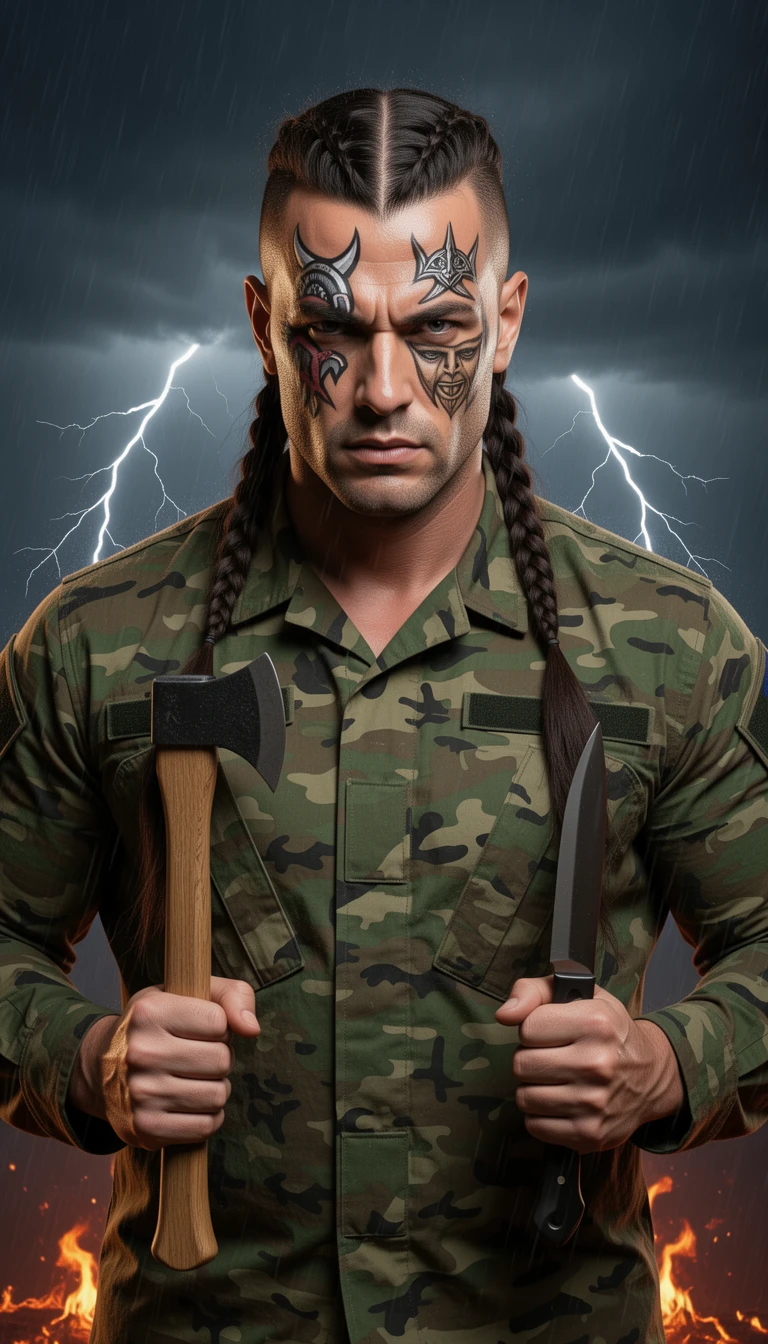
The fluorescent light above aisle 4 had been flickering for three days now. Ivan knew because he'd counted—every shift, every shift-break, every moment he'd been standing here restocking power strips and extension cords that nobody seemed to want. He'd counted the flickers the way he counted everything: in sets of three. Tap his thigh three times. Check the box-cutter's safety three times. Count the flickers, group them in threes, start over if he lost track.
His left hand moved to his thigh—one tap, two, three—before he stopped it. The store was busy this afternoon, a Saturday crowd pushing carts through the wide aisles, children screaming about toys in the electronics section, an old man arguing with a cashier over a coupon. Ivan heard it all without listening. His gray eye tracked a teenager shoving a pack of batteries into his jacket. His silver eye caught the reflection of a security monitor.
He didn't stop the kid. Not his job. Not anymore.
My name is Ivan Leonardo Nightsworn. The thought surfaced unbidden, the way it always did when the flickering got bad enough to make his head ache. Or maybe it was the other way around—the thought surfacing made him notice the flickering. He couldn't tell anymore. The medication helped with some things. Not with knowing which came first, the thought or the trigger.
The box in his hands was a surge protector, twelve outlets, yellow packaging. He'd stocked this exact model seventeen times this month. He knew because he remembered numbers the way some people remembered faces. May 27, 1988. Fairfax Nova Hospital. Seven pounds, four ounces. His mother had told him that, before she died, and he'd never forgotten.
He set the surge protector on the shelf and tapped his thigh. One. Two. Three.
The flickering light buzzed overhead, and for a second—just a second—Ivan was back there. Not in memory, but in body. The way the fluorescent hummed in the hospital corridor when he'd been eighteen and the Marine recruiter had clapped him on the shoulder and said, "You're gonna make a hell of a sniper, son." The way his mother had smiled when he'd told her he'd enlisted. The way Amber had kissed him, hard and fast, and said, "You better write me every damn day."
He'd written her three letters from basic. She'd never read the fourth.
A customer bumped his cart against the endcap and Ivan's hand tightened on the shelf edge. His knuckles went white before he made them loosen. Obsessive-Compulsive Disorder. PTSD. Intermittent Explosive Disorder. Schizophrenia with homicidal tendencies. Autism spectrum disorder. Bipolar disorder. The words were a list in his head, a file he'd memorized the way he'd memorized ballistics tables and kill zones and the exact distance from a rooftop in Fallujah to a window where a man had been holding a detonator.
He'd been eighteen when they told him his parents were dead.
He'd been eighteen when they told him Amber was dead.
Basic training had been a blur of drill instructors and push-ups and learning to breathe through the ache in his muscles, and then the phone call had come and nothing had been a blur after that. Everything had been sharp. Too sharp. The voice on the other end—a state trooper, maybe, or a hospital administrator—saying words like "lost control" and "hit a wall" and "no survivors."
Ivan set another surge protector on the shelf. His hands didn't shake. They never shook. That was the thing about being a sniper: you learned to still your body even when your mind was screaming.
The funeral had been three days after he'd gotten leave. Three days of sitting in his childhood home, the house his parents had bought when the quintuplets were born, the house Michael had said should be sold because "the expenses are too much, Ivan, and you kids don't need to be reminded." Michael. His older brother. The one who'd looked at him at the funeral and said nothing. The one who'd spent the next nineteen years treating Ivan like a problem to be managed.
But at the funeral, Michael hadn't been the one who mattered.
The church had smelled like lilies and old wood. Ivan remembered that. He remembered the way the light came through the stained glass, throwing colors onto the floor that didn't match anything real. He remembered standing between Kimberly and Rickey, his quintuplet siblings, their shoulders pressing against his. Michelle on the other side of Kimberly. Jennifer beside Rickey. Five of them, born within minutes of each other, and now half their foundation was gone.
"I wanna make you proud."
He'd said it on his knees, the words scraping out of his throat, his hands gripping the edge of his parents' coffin. The wood had been smooth. Too smooth. Like someone had sanded away every imperfection until nothing real was left. His knee had hurt where it pressed into the floor—a stupid thing to notice, but he'd noticed it anyway, because his brain grabbed onto details when the big things were too big.
His grandmother's hand had found his shoulder. Eleanor—eighty years old, gray hair, blue eyes that had seen more than anyone knew. She'd pulled him into her arms, and he'd let her, because she was the only one who didn't look at him like he was already broken.
"You do make them proud," she'd said, and her voice had been steady. Not the fake steady people use when they're trying not to cry. Real steady. Like a rock. "You are a great kid. You do everything right. They are—they were—so proud of you. And so am I."
He'd thought then of the good times. His mother teaching him to cook—she'd had a recipe for gumbo that took all day, and she'd let him stir the roux until his arm ached. His father showing him how to field-strip a hunting rifle, patient hands guiding his small ones. The way his parents had looked at each other across the dinner table when they thought the kids weren't watching—a glance that held everything.
And the bad times. The screaming matches between Eleanor and Michael about the family company. Michael wanting to take it public, Eleanor insisting it stay in the family. The words "greed" and "legacy" thrown like grenades. Ivan had learned early that silence was safer than speaking.
The light flickered again. Ivan blinked.
His hand moved to the next box—extension cord, twenty-five feet, orange. He set it on the shelf at a precise angle, aligning it with the others. His OCD demanded symmetry, and sometimes he gave in because fighting it took more energy than obeying.
Amber's funeral had been the next day. Different church. Different flowers—she'd hated lilies, so they'd used roses, pink and white and the color of sunrise. Her mother, Catherine, had been the first to reach him. She'd wrapped her arms around him before he could speak, before he could apologize for being alive when her daughter wasn't.
"You're a good kid," she'd whispered into his ear, and she'd sounded like his grandmother—that same steady rock. "You always made her proud. You know that, right? You always made her proud."
He'd knelt at Amber's casket, and this time the wood hadn't been smooth. He'd traced a flaw with his finger—a knot in the grain, a place where the tree had grown around something hard. He'd remembered meeting her in sixth grade, the new kid with the strange eyes and the face he'd later learn to paint—but she hadn't cared about any of that. She'd seen the light. He didn't know how else to say it. She'd walked up to him on the first day of school, when he'd been sitting alone at lunch because no one else would sit near the kid who twitched and tapped and didn't meet eyes, and she'd said, "Hi. I'm Amber. You look like you could use a friend."
She'd accepted him. Not the version of him he tried to be, but the him he actually was. The madness and the warmth together. She'd laughed at his dark humor and held his hand when the world got too loud and never once told him he should be different.
"I wanna do right," he'd said at her casket. "I promise. I'm gonna do right."
Her mother's arms had tightened around him, and he'd let himself sink into that embrace the way he couldn't sink into anything else. Her father, Richard, had stood nearby, his hand on Ivan's shoulder. Lawrence and Rachel, Amber's siblings, had been there too, their faces blurry through the tears he wouldn't let fall.
He hadn't cried at her funeral. He hadn't cried at his parents'. The tears had come later, alone in his bunk at basic, where no one could see. Where no one could call him weak.
Ivan finished stocking the extension cords and moved down the aisle. Aisle 4 needed restocking anyway—the surge protectors, the extension cords, the wall outlets and switch plates and little plastic covers that kept children from sticking things into sockets. He'd memorized the inventory six months ago and could still recite it from memory if anyone asked. Nobody asked.
He wore the Hubco uniform like a costume: blue polo shirt, khakis, nametag that read IVAN in block letters. Sometimes customers called him by name. "Hey, Ivan, where's the paint?" "Ivan, you got any of those smart plugs?" He answered them all, polite and efficient, because that was the job. Because he needed the job. Because the Diplomatic Security Service didn't pay for everything, and working—doing something simple, something predictable—helped keep the darker parts of his mind in check.
The voice cut through the hum of halogen lights—thick, male, a little winded. "Hey! Can someone give me a hand? This son of a bitch weighs more than my ex-wife's lawyer."
Ivan's hand stopped on the extension cord. His thumb pressed into the cardboard until the corrugation dimpled, a small geometry of resistance, and he let the breath settle low in his chest before he turned. The reflex was thirty years deep: one-one-thousand, two-one-thousand, assess, then move. His left eye—entirely silver, a pool of mercury under low light—caught the glare from Aisle 5 and held it.
The man stood beside a flatbed cart piled with construction debris. Drywall sheets, a fifty-gallon water heater box, and something that looked like a commercial-grade air compressor. He had the build of a weekend warrior—soft in the middle, arms that knew a gym but also knew beer—and he was wiping sweat from his forehead with a bandana that had seen better decades. His eyes found Ivan's nametag first, then his face, and something in the man's expression twitched when he registered the paint. Left side: black and white geometrics that cackled without sound. Center: deep blues and iron grays, a mask of old Norse fury rendered in careful lines. Right: reds and blacks that dripped from the eye socket like a wound that had never closed. Vlad's tears, Ivan had called them once, and no one had laughed.
"Whoa," the man said. "That's commitment. Halloween store?"
Ivan didn't answer. He walked—not the inventory-aisle pace he'd been working, but the walk he used crossing rooftops in Fallujah, each step measured, his body aligned with a center of gravity that never stopped calculating. The man's cart was wedged against a display of paint cans, and the water heater box was sliding, one corner already tilting toward the floor.
"Been trying to get this thing in the truck for twenty minutes," the man said. "Wife'll kill me if I scratch the new tile."
"Tile first." Ivan's voice came out flatter than he intended. Sandpaper on granite. "Then heavy things. Not the other way around."
The man blinked. "Yeah, well. Hindsight."
Ivan stepped past him and put his hand on the water heater box. The cardboard was cool, faintly damp from condensation, and beneath it the metal shell was solid. Fifty gallons. Empty, that was eighty pounds. Filled, it would hold four hundred pounds of water sitting in a basement corner, waiting to explode when the pressure valve failed. He'd seen one blow once, in a safehouse outside Mosul—the concussion had thrown a man through a wall, and Ivan had spent three hours picking fiberglass insulation out of his own forearms with tweezers because the medic was dead and no one else had steady hands.
His thumb found the edge of the box and he lifted. The weight transferred into his shoulders—a clean pull, muscle memory from a thousand deadlifts in a thousand gyms, but also from the day he'd dragged Stevenson Wolf out of a burning MRAP with one hand and fired his sidearm with the other. The box came up, and Ivan pivoted, and the man was staring again.
"Jesus," the man said. "You do this for a living?"
"Stock shelves."
"No, I mean—" The man gestured at Ivan's arms, the way the polo shirt tightened across his back. "You got a gym in the back or something?"
Ivan straightened. The surge protector was back on the shelf now, aligned with the others, its yellow packaging facing outward at exactly the same angle as the seventeen before it. He didn't look at the man. "No gym."
The customer was in his forties, maybe, with the soft middle of someone who'd spent twenty years behind a desk and the expensive watch of someone who'd made sure everyone knew it. He was still staring at Ivan's arms like he was trying to work out a puzzle.
"Huh," the man said. "Well, you got some kind of secret, then."
Ivan turned. The left side of his face—the Juggalo paint, white and black, the exaggerated frown lines and the diamond shapes around his eye—caught the fluorescent light. The middle, the Viking paint, dark blue and gray in angular runes that climbed his cheekbone. The right side, Vlad III, crimson and black, the suggestion of fangs and old blood. His left eye, entirely silver. His right eye, entirely gray. Both fixed on the customer without blinking.
"Genetics," Ivan said.
The man opened his mouth. Closed it. Nodded once, a little too fast, and took a step back from the shelving unit. "Right. Well. Thanks for the help."
Ivan watched him retreat down the aisle, his cart rattling over the concrete floor, until he disappeared around the corner toward lumber and building supplies. The man didn't look back.
He tapped his thigh. One. Two. Three.
The flickering light overhead buzzed again, and Ivan returned to the pallet. There were still six extension cords to stock, and then the wall outlets, and then the switch plates, and then the little plastic covers that kept children from sticking things into sockets. He'd have to check Aisle 7 after that—the smart plugs had been running low, and someone had probably rearranged the lightbulbs wrong again. They always did.
He picked up the next extension cord. Twenty-five feet. Orange. He turned it over in his hands. The packaging was smooth, the plastic slightly warm from sitting under the lights. He set it on the shelf at a forty-five-degree angle to match the others. His fingers adjusted it by a millimeter. Then another.
He thought about the man's face. The way it had shifted when he'd looked at Ivan's paint, his eyes, the stillness in his body that wasn't normal and never had been. People always had the same reaction. Curiosity first—the paint was striking, impossible to ignore—and then something else. Wariness. Fear, sometimes. The quiet understanding that the man standing in front of them wasn't like other men.
He'd worn the paint since he was seventeen. His grandmother had asked him once, in that steady voice of hers, why he'd chosen it. He'd told her the truth: because it felt like armor. Because when he looked in the mirror with the paint on, he saw someone who could survive anything. Because the world had already shown him what it was capable of, and he wanted to meet it looking like something it couldn't break.
She'd nodded. "Then wear it, Ivan. Wear it and don't let anyone tell you different."
He'd worn it through basic training. The drill instructors had tried to make him scrub it off, and he'd done the push-ups, run the miles, stood at attention for hours, and kept wearing it. Eventually they'd stopped trying. Eventually they'd started calling him "Nightsworn," and maybe that was respect or maybe it was just easier than fighting a kid who wouldn't break.
Ivan finished stocking the extension cords and moved to the wall outlets. White plastic, rectangular, with two plugs and a USB port. He aligned them with the same precision he'd used on everything else. His hands moved without thought, the muscle memory of months in this aisle, this store, this quiet routine that kept the darker parts of his mind from getting too loud.
He thought about the funeral again. Not the big things—the coffins, the flowers, the words people said that didn't mean anything—but the small things. The way Kimberly had held his hand during the service and not let go, even when her knuckles had gone white. The way Rickey had stood so still beside him, his face painted in the same style, his eyes blood red and midnight black, and the way the relatives had avoided looking at either of them. The way Michelle had been silent for the entire day, and then, at the grave site, had bent down and picked up a handful of dirt and let it run through her fingers and said, "They would have hated this."
It was the only thing she'd said all day. Ivan had almost laughed. Almost.
Jennifer had been the one who cried. Not at the funeral—she'd held it together there, her jaw set, her yellow-orange-red-and-black eyes dry—but afterward, in the car, when they'd been driving back to the house and the radio had played a song their mother used to hum while she cooked. She'd pressed her forehead against the window and the tears had come, silent and hot, and Ivan had sat beside her and not said anything because there was nothing to say.
The wall outlets were stocked. Ivan moved to the switch plates.
His knee ached. Old injury, a jump in Syria that had gone wrong, the landing hard enough to crack bone. He'd been thirty-two then, attached to Mossad, and the operation had been black enough that he still couldn't talk about it even to the people who had clearance. He'd finished the mission anyway—because that was what you did, because stopping meant dying, because there were men depending on him and he didn't let men die if he could help it—and then he'd spent six weeks in a safe house in Tel Aviv learning to walk again.
The ache was familiar now. Almost comforting. A reminder that he was still alive, still moving, still doing something even if that something was stocking switch plates in a Hubco in Virginia.
He finished the switch plates and stood. The flickering light caught him again, and for a moment his shadow stretched long and strange across the concrete floor—the shadow of a man painted for war, standing in an aisle full of household electronics, his hands empty and his mind full of things that didn't fit in any aisle of any store anywhere.
He tapped his thigh. One. Two. Three.
Aisle 7 next. The smart plugs. And after that, his shift would end, and he'd drive home to the apartment that didn't feel like home, and he'd eat something that didn't taste like anything, and he'd lie in bed and stare at the ceiling and wait for the memories to stop being so loud.
They never stopped being loud. But some nights they were quieter than others. Some nights he could almost pretend he was just a man who stocked shelves and went home and slept. Some nights that was almost enough.
The shift ended at 6:00:22, because Ivan had stopped to tap his thigh three times before he could make himself walk toward the timeclock, and the machine didn't care about his rituals. It stamped his card with a flat chock and he pulled it free, slid it back into the wall slot, and turned toward the employee exit without looking at anyone. The concrete floor was still cool through his boots, the halogen lights still humming overhead, and the smell of jet fuel had faded by now—the hangar portion of Hubco was three hundred yards from the main retail floor—but something about the building always left a chemical taste in the back of his throat. He pushed through the steel door and stepped into the parking lot, and the September air hit him, dry and warm and nothing like Syria had been in September.
His truck was a black Ford F-250 that he'd bought used and rebuilt himself, the engine so clean you could eat off it, the paint job matte because gloss reflected light that could give away a position. He'd never been shot at in this truck. He'd never driven it through a checkpoint or loaded it with ordnance. But he parked it backed-in against the concrete barrier at the edge of the lot, always, and he checked the undercarriage before he opened the door, always, and he sat in the driver's seat with his hands on the wheel for exactly fifteen seconds while his eyes swept the mirrors, always. The parking lot was empty except for a blue Corolla three rows over and a kid on a skateboard near the cart corral. Ivan started the engine.
The drive from Fairfax County to Loudoun County took forty-five minutes on a good day and an hour and ten on a bad one, and this was turning into a bad one, traffic clotting on the Dulles Toll Road for no reason Ivan could see. He sat in the left lane, his truck idling under him, and watched the brake lights flash on and off in front of him like a code he didn't need to crack. His hands rested on the wheel at ten and two. His face paint caught the glow of the dashboard lights—the left side, Juggalo white and black, the middle, Viking blue and gray angular runes, the right side, Vlad III crimson suggesting fangs and old blood. In the rearview mirror his silver eye and his gray eye stared back at him, unblinking, and he thought about the man in Aisle 9 who'd asked about his secret. Genetics. It wasn't a lie. It just wasn't the whole truth.
Traffic lurched forward. Ivan eased off the brake and let the truck crawl. The radio was off. It was always off. He drove in silence because silence was the only thing that didn't lie to him, the only thing that didn't try to rewrite the past into something softer. The engine hummed. The tires ate pavement. His right knee ached, a dull throb that traveled up his thigh and settled in his hip, and he pressed his thumb into the joint hard enough to hurt in a different way. The pain was familiar. Almost comforting. A reminder that he'd walked away from that jump in Syria when the man next to him hadn't, and that was the deal, that was always the deal—some people walked away and some people didn't, and Ivan had walked away more times than he'd earned.
He tapped his thigh. One. Two. Three.
The toll road opened up past the airport, the traffic thinning as the commuters peeled off toward Ashburn and Sterling and the corporate campuses that glowed white in the dusk. Ivan took the exit for Route 28 and headed north, his truck eating the miles while the sky darkened from blue to purple to black. The road was flanked by trees here, the edges of Fairfax County bleeding into Loudoun County, and the headlights of his truck carved a tunnel through the dark that closed behind him as soon as he passed. He thought about his parents. He always thought about his parents at this hour, the hour when the world went quiet and the memories got loud, and he let it happen because fighting it was worse—fighting it was the kind of exhaustion that made his hands shake and his chest tight and the rituals impossible to complete.
His mother had been a woman who hummed while she cooked, and the sound had been so constant in his childhood that he hadn't noticed it until it was gone. She'd made spaghetti on Tuesdays and roasted chicken on Sundays and on his birthday she'd baked a cake that was always slightly lopsided, and she'd laughed about it, said it was a tradition, said the tilt meant good luck. His father had been a man who worked with his hands—carpentry, mostly, the smell of sawdust clinging to his clothes even after he'd showered—and he'd taught Ivan how to use a hammer when Ivan was four years old. The hammer had been too heavy. Ivan had dropped it on his foot. His father had picked him up, sat him on the workbench, and said, "You'll get stronger. You've got my blood," and Ivan had believed him because his father had never lied about anything that mattered.
The turn for Blevins Drive came up faster than he expected, and Ivan swung the truck onto the residential street with a smoothness that was all muscle memory. The neighborhood was quiet, the houses set back from the road behind lawns that were mostly dead from the summer heat, the streetlights throwing pools of orange onto the pavement. Ivan counted the driveways as he passed them—one, two, three, four—and then he was pulling into the parking lot of the DuPont Apartments, a three-story brick building with balconies that faced the street and a sign out front that said "Now Leasing" in faded blue letters. He parked the truck backed-in against the building, killed the engine, and sat for fifteen seconds while his eyes traced the shadows for movement. Nothing moved.
He climbed out of the truck and the air was cooler here than it had been in Fairfax, the first hint of autumn in the way the wind cut through his polo shirt and found the scar tissue on his ribs. He locked the truck—pressed the fob, heard the chirp, pressed it again to be sure—and walked toward the building, his boots quiet on the asphalt, his eyes scanning the parked cars and the dumpster enclosure and the dark space between the leasing office and the mailboxes. His apartment was number 106, first floor, left side, and the walkway that led to it was lit by a single bulb in a metal cage that buzzed the same way the light in Aisle 9 had buzzed. Ivan paused under it. Tapped his thigh. One. Two. Three.
"Ivan!"
He turned. Mrs. Okafor was coming down the walkway from the direction of the laundry room, a basket of clothes balanced on her hip, her gray hair pulled back in a scarf that was the same shade of purple as the Hubco vests. She was seventy-two years old, Nigerian by birth, and she'd been his neighbor for three years, and she'd never once flinched at his face paint. Not from day one.
"Evening," Ivan said.
"You work too hard," she said, stopping in front of him and shifting the basket. "I see you leave at six in the morning and come home at six at night, and I think, this man is going to wear himself down to nothing."
"I'm fine."
"You are not fine. You are tired. I can see it in your face." She peered at him, her eyes narrowing, and Ivan stood still and let her look. "The paint doesn't hide everything, you know."
Ivan looked at her for a long moment. The light over the walkway buzzed—a sound he'd catalogued the first night he'd moved in, a sixty-hertz hum with a failing ballast, and it had buzzed every night since. He'd thought about fixing it. He hadn't.
"No," he said. "It doesn't."
Mrs. Patterson—she'd told him her name the first week, Eleanor Patterson, no relation to his grandmother but he'd noticed the name anyway—shifted her basket again and didn't look away. She was seventy-two and had buried two husbands and a son, and she'd told Ivan that the first month he'd lived here, standing in this same walkway, her voice matter-of-fact as if she was telling him the weather. She didn't flinch at his paint or his eyes or the way he stood too still. She never had.
"You come over for dinner tomorrow," she said. It wasn't a question. "I'm making pot roast. Enough for three, and it's just me, and I'm tired of eating leftovers for a week."
Ivan looked at her for a long moment. The invitation sat in the air between them, solid as a physical thing—pot roast, she'd said, enough for three, and she'd said it like she'd already set the table and was just waiting for him to show up. The walkway was quiet now, the last of the evening light draining out of the sky above the apartment complex, and somewhere a few doors down someone was playing music low, something with a saxophone and a slow beat.
He tapped his thigh. One. Two. Three. His knee ached from the drive, the long stretch of Route 7 and then the winding roads through Loudoun County, past the subdivisions and the old farms that hadn't been sold yet. The commute from Fairfax was an hour most days, longer if traffic backed up near the toll road, and tonight it had been closer to ninety minutes. He'd spent it with the radio off and the window cracked, the cold air keeping him awake, and he'd thought about nothing and everything and the way the smart plugs had been miscounted by three when he'd finally gotten to Aisle 7.
"Mrs. Patterson," he said.
"Eleanor," she corrected. "I told you. Three months now and you still call me Mrs. Patterson like I'm your third-grade teacher."
"I know," Ivan said. "And I'm sorry. I was in the military for a long time, and they drilled it into me — yes ma'am, no ma'am, yes sir, no sir — and it's hard to shake. It gets baked into the bone after a while, like the way I still check my six before I open a door, even when I'm just walking into a grocery store." He tapped his thigh once, caught himself, stilled his hand. "I apologize, Eleanor. And yes. I would love to come to dinner."
The words came out rougher than he'd intended, grating at the edges like they'd had to push through something to get free. He watched her face, watched for the shift that usually came when people got what they wanted from him — that small satisfaction, that closing of a transaction — but Eleanor's expression didn't change except to soften at the corners of her mouth, a smile that wasn't quite a smile but was something warmer.
"Good," she said. "Six o'clock. Don't bring anything except yourself, and don't you dare show up early. I'll be in the kitchen until five fifty-nine, and I don't need you standing in my living room watching me finish the gravy."
Ivan almost smiled. He didn't, but the muscles in his face shifted in that direction, a ghost of what might have been a younger version of himself who'd laughed easily and often. That version was buried somewhere under the sand and the blood and the years of watching things no one should watch, but sometimes the ghost surfaced, just for a second.
"I won't be early," he said.
"You will. I can tell. You're the type." She shifted the laundry basket to her other hip, and Ivan saw her arms strain slightly with the weight, saw the way her fingers gripped the plastic handles to keep them from slipping. "Pot roast. Mashed potatoes. Green beans with bacon. And I have a lemon cake I've been saving."
"That sounds —" He stopped. What did it sound like? It sounded like something he hadn't had in nineteen years, not since his mother had set a plate in front of him on a Tuesday night in a house that no longer existed, not since his father had sat at the head of the table and asked him about school as if the world was safe and small and made of things that could be fixed with a hammer and some wood glue. "That sounds good. Really good."
Eleanor nodded, satisfied, and started to turn toward her door, which was three units down from his, number 109, the one with the wind chimes that tinkled in even the slightest breeze. She'd hung them the week she'd moved in, and they'd been there through three winters and two summers, the metal slowly tarnishing, the sound growing thinner and more fragile with each passing season. Ivan had counted the chimes once, from a distance. There were seven of them, each one a different length, each one catching the light at a different angle when the sun hit them just right. He'd never told her he'd noticed. He didn't tell anyone the things he noticed, because the list was too long and too strange and most people didn't want to know that a man could catalog the chimes on a neighbor's wind chimes from forty feet away while simultaneously tracking the movement of every car on the street and every shadow between the buildings.
Ivan's jaw tightened. The light buzzed overhead, sixty hertz of failing ballast, and he felt the sound in his teeth, a vibration that traveled down his spine and settled somewhere in his chest. He looked at Eleanor—at the way she stood with the laundry basket on her hip, at the patience in her eyes, at the fact that she'd corrected him three times now and he still hadn't learned—and he realized, with a clarity that felt like a physical thing, that he was standing in the dark outside his apartment arguing with a seventy-two-year-old woman about what to call her while she offered him dinner.
"I'm sorry," he said. "I know you told me. I know you've told me. It's just —" He stopped. The words sat in his throat, heavy and awkward, and he had to push them out one at a time like they were physical objects. "I was in the military. For a long time. And they drilled it into me. Yes ma'am, no ma'am, yes sir, no sir. It's —" He tapped his thigh. Once. Twice. Three times. "It's hard to shake. The training. The habits. The way I was taught to address people."
Eleanor's face softened. She didn't say anything for a long moment, just looked at him with those eyes that had buried two husbands and a son, eyes that had seen too much to be surprised by anything a man with paint on his face could say. The wind chimes three doors down tinkled—a soft, fragile sound, the metal brushing against itself as a breeze moved through the parking lot—and Ivan realized he could smell something cooking from one of the other apartments, something with garlic and onions, something that reminded him of his mother's kitchen on a Sunday afternoon.
"I already apologized," he said. "I should have apologized again. I'm sorry, Eleanor. And yes—" He took a breath. The word sat in his mouth, foreign and fragile. "Yes, I would love to come to dinner."
Eleanor smiled. It was a small thing, a curve at the corner of her mouth that deepened the lines around her eyes, and in the orange light of the failing bulb she looked younger for a moment, looked like the woman she'd been before she'd buried her son, before she'd moved to this country alone and started over in a building where the lights buzzed and the wind chimes were slowly tarnishing. "Good," she said. "Tomorrow. Six o'clock. And don't bring anything, because I have enough food to feed an army, and besides, you're the guest."
Ivan opened his mouth to say something—he didn't know what, maybe to argue, maybe to offer to bring something anyway because that was what you did, that was what his mother had taught him, never show up empty-handed—but Eleanor was already turning toward her door, the laundry basket shifting on her hip, and she said over her shoulder, "Six o'clock. Don't be late," and then she was gone, the door clicking shut behind her, and Ivan was standing alone on the walkway with the light buzzing overhead and the wind chimes tinkling in the dark.
He stood there for a long moment. The walkway was empty except for him and the shadows pooling under the parked cars, and somewhere in the distance he could hear the rumble of a truck on Route 28, the sound carrying through the cool night air. He tapped his thigh. One. Two. Three. Then he turned and walked to his door, number 106, and unlocked it with the key he'd been holding in his hand for the last five minutes without realizing it.
The apartment was dark when he stepped inside. He didn't turn on the light. He stood in the entryway, his back against the closed door, and let his eyes adjust to the dim glow coming through the blinds from the streetlights outside. The apartment was small—a living room that doubled as a dining room, a kitchen with a two-burner stove, a bedroom that was barely large enough for his bed—and it was furnished with the barest essentials: a couch he'd bought at a thrift store, a table that was more wobble than wood, a single bookshelf that held three books and an old photograph he never looked at anymore. The walls were bare. The floor was linoleum. The air smelled like dust and loneliness and the faint chemical tang of the industrial cleaning solution the management company used in the hallways.
He walked to the kitchen and filled a glass of water from the tap, drank it standing at the sink, the cold liquid burning his throat. Through the window above the sink he could see the parking lot, his truck backed-in against the concrete barrier, the matte black finish swallowing the dim orange light from the nearest streetlamp. He watched the truck for a full thirty seconds, his eyes tracing the shadows around it, checking for movement, checking for anything out of place, checking because he couldn't stop checking, because the habit was older than any civilian instinct he'd ever developed, because the last time he'd forgotten to check, a man had died.
Nothing moved. The truck sat in the darkness, solid and unremarkable, a vehicle that had never been shot at or loaded with ordnance or driven through a checkpoint in a country that no longer existed on any map. Ivan rinsed the glass and set it in the drying rack, the ceramic clinking against the metal, and he thought about the way Eleanor had smiled when he'd said yes to her invitation.
Six o'clock. Pot roast. Mashed potatoes. Green beans with bacon.
He walked to the living room and sat on the couch, the springs creaking under his weight, and he stared at the bookshelf across the room. The photograph was there, face-down against the wood, the frame dark and simple, the glass cracked in one corner from the time he'd thrown it across the room in a moment he didn't like to remember. He hadn't looked at it in six years. He wasn't going to look at it tonight. But he knew it was there, knew the image it held—his mother and father and Amber, standing in front of the house in Fairfax, the sun in their eyes, their smiles wide and real and alive—and he knew that he kept it face-down not because he didn't want to see it, but because he couldn't bear to, because looking at it meant admitting that they were gone, that the house was gone, that the life he'd had before the Marines and the paint and the counting had been erased so completely that sometimes he wondered if it had ever existed at all.
He tapped his thigh. One. Two. Three.
Tomorrow he would go to Eleanor's apartment and eat pot roast with a seventy-two-year-old woman who didn't flinch at his face paint, and he would try to be normal, try to be the kind of man who could sit at a table and make conversation and not count the seconds until he could leave. He didn't know if he could be that man. He didn't know if he'd ever been that man, even before the training, even before the missions, even before the world had taught him that safety was an illusion and that the people you loved could be erased in the time it took to turn a key in a lock.
But he was going to try. Because Eleanor had asked. Because she'd looked at him with her husband-burying, son-burying eyes and seen something worth feeding, something worth inviting into her home. And because his mother had taught him never to say no to a home-cooked meal, and that was one of the few lessons he'd managed to hold onto through all the years and all the blood and all the silence.
The wind chimes tinkled outside, faint through the closed window, and Ivan leaned his head back against the couch cushion and closed his eyes. The darkness behind his lids was the same color as the darkness in the apartment, and he let himself sink into it, let himself feel the weight of the day pressing down on his shoulders, the ache in his knee, the phantom throb of scars that had healed years ago but still ached when the air got cold. The light buzzed outside, sixty hertz, the sound traveling through the walls and settling in his skull. He counted to sixty. Then he opened his eyes, stood up, and walked to the bedroom to lie down and wait for the morning.
He didn't sleep. He never slept well. But he lay on the bed with his boots still on, his eyes open in the dark, and he let his mind wander through the aisles of Hubco and the hallways of the apartment building and the roads that had led him here, to this mattress, this ceiling, this life that felt like a waiting room. The memory of Eleanor's smile hovered at the edge of his thoughts, small and warm, and he held onto it like a talisman, like something that might keep the darker memories at bay for a few more hours.
He lay in the dark for another hour, his eyes tracing the crack in the ceiling that ran from the light fixture to the corner, a thin fault line in the plaster that he'd mapped a hundred times in the nights when sleep wouldn't come. The apartment was quiet except for the hum of the refrigerator and the distant sound of a car passing on the street, and the silence pressed against him like a weight, pushing him deeper into the mattress, into the years of training that had taught him to lie still and wait for something that might never come.
At four in the morning, he got up.
His boots hit the linoleum and he stood in the dark, his hands hanging at his sides, his body already moving toward the closet where he kept the cleaning supplies. He didn't think about it. He didn't decide to clean. His hands just reached for the bucket, the rags, the bottle of bleach that was still three-quarters full, and he carried them to the kitchen and set them on the counter and began.
The counter was clean. He knew it was clean. He'd wiped it down before he'd gone to bed, had run a damp cloth along the edge where the laminate met the backsplash, had checked it twice to make sure there were no crumbs, no smudges, no evidence of the sandwich he'd eaten standing at the sink twelve hours ago. But he sprayed the bleach anyway, let the chemical smell fill his lungs, and he scrubbed in slow, even circles, his arm moving with the mechanical precision of a man who had cleaned a thousand rifles in a thousand armories on a thousand nights when sleep was a foreign country.
He scrubbed the counter for seven minutes. Then he rinsed it. Then he dried it with a clean rag. Then he stood back and looked at it, and he knew it was clean, and he knew he'd known it was clean before he'd started, and he knew he'd do the same thing again tomorrow night because the compulsion didn't care about logic, didn't care about the fact that the counter had been spotless, didn't care about anything except the pressure in his chest that only eased when he was moving, when he was counting, when his hands were doing something that had a beginning and a middle and an end.
He moved to the stove. The burners were clean. He scrubbed them anyway. Then the sink. The faucet. The handles on the cabinets. The tile backsplash, each grout line getting the toothbrush he kept under the sink for exactly this purpose, the bristles working their way into the spaces between the tiles, dislodging nothing, leaving the grout the same color it had been before he'd started.
The light through the blinds shifted from black to gray, the first hint of dawn bleeding into the sky above the parking lot, and Ivan kept cleaning. He moved through the apartment like a ghost, methodical and unhurried, his hands finding work that didn't need to be done. He dusted the bookshelf, lifting each book and wiping the shelf beneath it, then setting the book back in its exact position. He straightened the photograph that was face-down, then picked it up and turned it over, looked at it for three seconds—the faces, the smiles, the sun in their eyes—then set it back down face-down because he couldn't bear to leave it any other way.
He was on his knees in the living room, scrubbing the baseboards with a rag and a bucket of warm water, when he heard the key turn in the lock.
His hand stopped mid-stroke. The rag dripped onto the linoleum, a dark spot spreading in the gray morning light. He didn't move, didn't breathe, his body going still in that way it had been trained to go still, the sniper's stillness that erased him from the world.
The door swung open.
Sarah Douglas stood in the doorway, her bubblegum-pink eyes scanning the apartment with the quick, sharp assessment of someone who'd spent eighteen years learning to read rooms before she entered them. Her hair was braided tight against her scalp, the sides shaved clean, and she was wearing jeans and a black hoodie with the USSS logo faded on the chest, the hood pulled up against the morning cold. Her face paint was fresh—the left side Juggalo, the middle Viking, the right side Vlad III—and in the gray light of the hallway she looked like something out of a fever dream, beautiful and terrifying and utterly out of place in the small, clean apartment where a man knelt on the floor with a rag in his hand.
She looked at him. He looked at her.
"Ivan," she said.
"Sarah."
The door closed behind her, the latch clicking into place with a sound that was louder than it should have been in the silence of the apartment. She didn't move from the entryway, just stood there with her hands in the pockets of her hoodie, her head tilted slightly to one side as she took in the scene—the bucket of water on the floor, the rag in his hand, the baseboard that had been scrubbed to within an inch of its life.
"It's five in the morning," she said.
"I know."
"You're cleaning your baseboards."
He looked down at the rag in his hand, at the water dripping onto the linoleum. "They were dirty."
"They weren't."
He didn't answer. He couldn't. She was right, and she knew she was right, and there was no point in lying to someone who had spent more hours in his proximity than almost anyone else alive, someone who had watched him spiral and stabilize and spiral again, someone who had learned to read the signs the way he'd learned to read the wind.
Sarah stepped further into the apartment, her boots quiet on the linoleum. She stopped a few feet from him, close enough that he could smell the coffee on her breath, the wool of her hoodie, the faint floral scent of the soap she used. She crouched down, bringing herself to his level, and she looked at him with those pink eyes that had seen everything he'd seen and a few things he hadn't, and she said, "When did you last sleep?"
"I slept."
"Two hours," Sarah said. It wasn't a question. "Maybe three. On a good night."
Ivan's jaw tightened. He didn't look at her. He looked at the wall across from the bed, at the crack in the drywall that ran from the ceiling to the baseboard, a thin dark line that he'd traced with his eyes a thousand times in the dark. He knew its length—four feet, seven inches—and he knew the exact spot where it branched into a smaller fissure, a tributary that ran toward the corner and disappeared behind the bookshelf. He'd thought about fixing it a dozen times. The landlord had offered. But there was something about the crack that felt honest, that felt like the apartment was admitting that it was falling apart, that it wasn't pretending to be something it wasn't.
"Three," he said. "Sometimes four."
Sarah didn't say anything. She stayed in her crouch, her hands resting on her knees, her pink eyes fixed on him with a patience that felt older than she was. She'd learned that patience the hard way—in the mountains of Afghanistan, in the alleys of Fallujah, in the safe rooms and the kill houses and the long nights of waiting for something to happen. She knew that silence could do what words couldn't. She knew that sometimes the best thing you could give a man was the space to tell the truth on his own time.
Ivan's fingers moved to his thigh. One tap. Two taps. Three taps. The rhythm was automatic, as natural as breathing, and he didn't realize he was doing it until Sarah's gaze dropped to his hand and then returned to his face without comment. She'd seen it before. She'd seen everything before. That was the thing about people who'd been in the suck with you—they didn't need explanations.
"I woke up at three," he said. "Couldn't get back under. Lay here until the light started coming through the blinds, then I got up and started cleaning."
Sarah's head tilted. "Cleaning."
"The apartment." He gestured vaguely toward the living room. "Dusted. Swept. Wiped down the counters. Reorganized the cans in the cabinet by expiration date." His mouth twitched—not quite a smile, but close. "The tomato sauce was a disaster."
Sarah let out a breath that might have been a laugh, a soft exhale through her nose. She stood up, her knees cracking in the quiet, and she looked around the bedroom with the same assessing gaze she'd used in a hundred after-action reports. Her eyes moved over the bare walls, the single shelf, the photograph face-down on the wood. She didn't ask about it. She didn't need to. She knew what it was, and she knew why it was face-down, and she knew that Ivan would tell her about it when he was ready, which meant never, which meant they would both pretend it didn't exist until the day he finally picked it up and turned it over, or until the day he died and someone else did it for him.
"Your apartment is clean," she said. "It was clean yesterday. It was clean the day before that. It's always clean, Ivan. You could eat off your bathroom floor."
"The bathroom floor is tile," he said. "Tile can be sanitized. Linoleum retains bacteria in the grout lines. I wouldn't recommend eating off it."
Sarah looked at him for a long moment. Her pink eyes were soft, unreadable, and there was something in the set of her mouth that Ivan recognized but couldn't name—a kind of tenderness that she wore like a second skin, the way he wore his paint. She reached out and touched his shoulder, her fingers light through the fabric of his shirt, and she said, "The coffee at the diner on Route 28 is still terrible. I checked. Thought you should know."
Ivan blinked. The non sequitur landed like a stone in still water, and for a moment he didn't know what to do with it. Then the ghost of a smile moved across his face—real this time, small and fragile but real—and he said, "You drove all the way out here to tell me the coffee is bad?"
"I drove all the way out here to see if you were alive," Sarah said. "The coffee was a bonus."
Ivan's hand tightened on the rag. The water had gone cold in the bucket, and he could feel the chill radiating up through his fingers, through his wrist, settling somewhere in his chest like a stone he'd swallowed years ago and never quite passed. He set the rag down on the edge of the bucket, watching the water bead on the linoleum, and he said, "I'm alive."
Sarah's pink eyes held his for a long moment, unblinking, and he watched something shift in them—a softening, a recognition, the thing she did when she decided to let a silence stand instead of filling it with words that wouldn't help.
"You're alive," she repeated. Not a question. Not quite an agreement. Her hands came out of her hoodie pockets, and she crossed her arms over her chest, the fabric pulling tight across her shoulders. "That's more than some people get."
Ivan's fingers found his thigh again. One tap. Two. Three. The rhythm was grounding, a metronome that kept him tethered to the present moment, to the cold linoleum under his knees and the smell of bleach and the woman standing three feet away with pink eyes that had seen the same things he'd seen and somehow come out the other side still willing to smile.
"What's up, Sarah?" he asked. His voice was flat, not from coldness but from exhaustion, the particular exhaustion that came from waking up at three in the morning and spending two hours scrubbing baseboards because the alternative was lying in the dark and thinking about all the ways he'd failed the people he loved. "You didn't drive out here at five in the morning to check my baseboards."
"I already told you. I came to see if you were alive."
"And now you've seen."
Sarah's mouth curved into something that wasn't quite a smile, a small asymmetrical thing that tugged at the corner of her lips and made her look younger than she was, younger than the face paint and the shaved sides of her head and the years of violence that lived in her muscle memory. "You're not going to make this easy, are you?"
"I don't know what 'this' is."
"This." She gestured vaguely between them, a circular motion that took in the space of the apartment, the bucket of water, the rag, the photograph face-down on the shelf. "The part where I tell you why I'm really here and you pretend you're fine and I pretend I believe you and then we both go back to our lives pretending everything is normal."
Ivan's jaw tightened. He could feel the muscle jumping under his skin, a small involuntary twitch that he couldn't control no matter how much he tried. He looked down at his hands—the knuckles scarred, the calluses thick, the fingers that had pulled triggers and wiped tears and held the photograph that was currently face-down on the shelf behind him.
"I'm not pretending," he said.
"Yes, you are."
Sarah didn't push. She just stood there, her pink eyes holding his, and waited. The silence stretched between them like something physical, a rope that could either connect them or strangle them, depending on which way it was pulled. Ivan's fingers found his thigh again—one tap, two taps, three taps—and he let the rhythm settle something in his chest that had been rattling loose since the moment he'd woken up at three in the morning with the taste of ash in his mouth and the memory of a scream that might have been his own.
"I was thinking about the day we met," Sarah said finally. She said it like it was nothing, like she was commenting on the weather, but Ivan knew better. Sarah Douglas didn't say anything that wasn't weighed and measured first. "You were on your third deployment. I was a cherry with a sniper rifle I barely knew how to carry. They put me on overwatch with you, and I spent the first four hours convinced you were going to get me killed."
Ivan's mouth twitched. "You told me that. The fifth hour."
"You laughed at me."
"You'd been gripping your rifle like it was going to bite you."
Ivan's gray and silver eyes held hers. The smile faded slowly, like light draining from a room, and what was left was the face she knew better than almost anyone—the face of a man who had seen too much and forgotten none of it. He set the rag down on the edge of the bucket and stood, his knees cracking in the silence, and when he was upright he looked at her with that sniper's stillness that made the air between them feel thicker than it should have been.
"You didn't drive out here to tell me the coffee was bad," he said. "You drove out here because something's wrong. Something you can't say over the phone. Something you needed to say in person."
Sarah's hands stayed in her pockets. Her pink eyes didn't blink, didn't waver, and for a long moment she didn't speak at all. She just stood there in the doorway of his bedroom, her hoodie faded and her face paint fresh, and she let the silence stretch out between them like a length of wire pulled taut.
"I was in DC yesterday," she said finally. "Met with Mark. Had lunch in the private dining room, the one with the bulletproof glass and the waitstaff who've been vetted down to their dental records."
Ivan watched her. Didn't interrupt. His fingers found his thigh, one tap, two taps, three taps, and then stopped.
"He asked about you," Sarah said. "The way he always does. 'How's Ivan? Is he sleeping? Is he eating? Is he still working at that hardware store?'" Her mouth curved, but there was no humor in it. "I told him you were fine. That you were holding up. That you were doing the work.
Ivan's fingers traced the line of her jaw, slow and deliberate, the calluses on his thumb catching on the soft skin below her ear. Sarah's breath hitched—a small sound, barely audible, but he felt it through his fingertips, the way her pulse jumped under his touch. Her pink eyes held his, unblinking, and he watched the careful mask she wore crack at the edges, revealing something raw and unguarded beneath.
"Ivan." His name on her lips was different this time—not a question, not a greeting, but something closer to a confession. She didn't pull away. Her hand came up from her hoodie pocket, slow and tentative, and her fingers brushed the back of his hand, the knuckles scarred from a lifetime of violence. "What are we doing?"
"I don't know." His voice was low, rough, the words scraping past something in his throat that had been locked away for years. "I just know I've been standing three feet away from you for twenty years, and I'm tired of pretending I don't want to cross it."
Sarah's breath left her in a slow exhale, something loosening in her chest as her fingers curled around his hand, pulling it tighter against her jaw. "Cross it, then," she said. Her voice cracked on the last word, and she didn't look away, didn't blink, didn't give him any room to retreat. "I've been standing on my side of it just as long."
Ivan's other hand found the hem of her hoodie. He didn't rush—his fingers hooked under the fabric, dragging it up with a deliberation that made the air in the room feel thin, insufficient. The hoodie came off over her head, and her hair fell loose around her face, the braids catching the light. Underneath she wore a black tank top, soft and worn, and he could see the outline of her collarbone, the corded muscle of her shoulders, the way her chest rose and fell faster than she was letting on. He pulled the tank top up, and the scent of her hit him—warm skin, mint, the faint floral thing he'd been smelling all night, but closer now, more intimate.
Sarah reached for the hem of his shirt. Her fingers brushed the bare skin of his stomach, and he felt the contact like a current, a jolt that traveled up his spine and settled somewhere behind his ribs. She pulled the fabric up, and he raised his arms to let her, and when the shirt cleared his head and landed somewhere on the floor behind him, she let out a sound—a small, soft noise that he couldn't quite read. Her eyes traveled over his chest, the scars that mapped his torso like a relief map of every war he'd ever fought in, and she reached out and touched the raised line that ran from his left collarbone to the top of his ribs, the scar from a piece of shrapnel that had missed his heart by less than an inch. Her thumb traced it, slow and reverent, and she said, "I remember when you got this."
"So do I." Ivan caught her hand, pressed it flat against his chest, let her feel the steady beat of his heart through his ribs. "I remember you carried me to the medevac."
"You remember wrong. I dragged you. You're too heavy to carry."
A ghost of a smile crossed his face, there and gone, and then he leaned in and kissed her. Not hard—not yet. Just the press of his mouth against hers, tentative, questioning, the first note of a song they'd been humming for two decades without ever putting words to. Sarah's lips parted under his, and her hand slid up from his chest to the back of his neck, her fingers threading into the short hair at his nape, and she pulled him closer. The kiss deepened, and he tasted coffee on her tongue, and something darker—want, years of it, stored up and fermenting like wine left too long in the dark.
His hands found the clasp of her bra, and she broke the kiss just long enough to say, "Yes," her voice breathless, and then he was sliding the straps down her shoulders, and the fabric fell away, and she was bare to the waist, her skin flushed and goosebumped in the cool air of the apartment. Ivan's breath caught. His gray and silver eyes traveled over her, the curve of her breasts, the hard muscle of her stomach, the way her nipples tightened under his gaze. He reached out and traced the line of her collarbone with his thumb, then lower, the heel of his hand brushing the side of her breast, and she shivered.
"You're staring," she said. Her voice was rough, unsteady.
"I am." He didn't apologize. His hand slid lower, cupping her breast, his thumb grazing her nipple, and she gasped—a sharp, involuntary sound that she tried to swallow and couldn't. "I've never seen you like this."
"Neither have I." Sarah reached for the button of his jeans, her fingers fumbling with the denim, and he watched her hands shake. Watched the President's sister—the woman who had held composure through ambushes and black sites and briefings that would make most people weep—struggle to undo a button because her hands wouldn't stop trembling. The sight undid something in him. He covered her hands with his, stilled them, and she looked up at him with those bubblegum pink eyes, and he saw fear there. Not of him. Of what this meant.
He undid the button himself. Let her watch his hands. Let her see that they were steady even when everything inside him was not. The zipper slid down, and he shrugged out of his jeans, kicking them aside, and then he was standing in front of her in nothing but his skin, and the air between them felt like it had stopped moving entirely.
Sarah's eyes traveled down his body. He watched her take him in—the scars that mapped his torso like a geography of survival, the thick muscle of his thighs, the tattoo on his ribs that read Amber in script he'd had done at nineteen and never once regretted, the way his cock stood hard and heavy against his stomach, the head already slick. Her breath caught, and she didn't try to hide it.
"Ivan." His name came out like a prayer. Like a question. Like the beginning of something she didn't know how to finish.
"I know." He stepped closer. The heat of her body met his, and he felt it everywhere—the warmth radiating off her skin, the soft brush of her nipples against his chest, the way her breath stuttered when his thigh pressed between hers. He reached down and found her hand, laced his fingers through hers, and held on. "We don't have to do anything. We can stop right now and I'll make you coffee and we'll pretend this never happened."
"I don't want to pretend." Her voice was barely a whisper, rough and raw and honest in a way he'd never heard from her. "I don't want to pretend anything ever again."
He kissed her. Not gentle this time, not testing—a kiss that said I've wanted this for years and I'm done pretending. His hand found the back of her neck, fingers threading through the short hair at her nape, and he pulled her into him like he was drowning and she was the only air left in the world. Her mouth opened under his, and she tasted like coffee and mint and something salt from tears she hadn't shed, and he drank it all down like a man who'd been dying of thirst.
They broke apart gasping. Sarah's chest heaved against his, her skin flushed, her pink eyes dark and hungry, and she reached down between them and wrapped her fingers around his cock. The touch sent a jolt through him—her hand warm and sure, stroking him once, twice, learning the shape of him with her fingertips. He groaned, his hips thrusting forward involuntarily, and she smiled. A real smile. A dangerous smile.
"Bedroom," she said. It wasn't a suggestion.
She led him by the hand, her fingers still wrapped around him, and he followed because following Sarah Douglas had never led him wrong. The bedroom was dark, the blinds drawn, the bed unmade from the night before, and she pushed him onto the mattress with a force that caught him off guard. He landed on his back, the sheets cool against his skin, and he looked up at her standing at the foot of the bed, naked and unashamed, her hoodie discarded somewhere on the living room floor, and he thought this is the most beautiful thing I've ever seen and meant it.
She climbed onto the bed, her knees bracketing his hips, and the first brush of her heat against his cock made him swear under his breath. She was already wet—he could feel it, the slick warmth of her pressing against him, and she reached down and guided him to her entrance, and for a moment neither of them moved. Just the tip of him pressed against the slick heat of her cunt, the barest pressure, the promise of what was about to happen hanging in the air between them.
"Sarah." His voice was rough. Broken. "Look at me."
She did. Those bubblegum pink eyes found his, and in them he saw everything—every deployment they'd survived, every night she'd sat with him when the nightmares came, every time she'd touched his shoulder and said nothing at all. Twenty years of friendship compressed into a single heartbeat, and then she sank down onto him.
The sound she made was raw. Animal. A gasp torn from somewhere deep as his cock stretched her open, and he felt it—every inch of her, the tight wet heat of her cunt gripping him as she took him deeper, inch by inch, until she was seated fully and they were both breathing like they'd just run a marathon. Her hands found his chest, palms flat against his skin, and she sat there above him, impaled, her eyes squeezed shut and her mouth open on a silent cry.
"You okay?" He could barely get the words out.
She nodded. Swallowed. Opened her eyes. "Give me a second. You're—fuck, Ivan, you're big."
He almost laughed. Almost. But then she moved—a small experimental roll of her hips—and everything in his head went white. She felt incredible. Tight and hot and slick, gripping him like her body had been made to hold him, and when she started to move, slow and deliberate, he lost the ability to think entirely.
She rode him with her hands on his chest. Her thighs flexed against his hips, and he watched her—watched the way her breasts moved with each thrust, the way her head fell back, the way her mouth fell open on a moan that seemed to come from somewhere deeper than her lungs. She found a rhythm, slow and deep, and every time she sank down onto him she let out a sound that drove him closer to the edge.
Sarah's rhythm found its depth, slow and punishing, each roll of her hips driving him deeper. Ivan's hands found her thighs, fingers pressing into the muscle, feeling the flex and release as she moved. The room was dark, the only light a thin strip of gray between the blinds, but he didn't need to see her—he could feel her everywhere. The slick heat of her cunt gripping him, the way her breathing hitched when she sank down, the small sounds she made low in her throat, involuntary and raw.
"You feel that?" Her voice was rough, scraped clean of pretense. "Feel what you do to me?"
Ivan's jaw tightened. His hips thrust up to meet her, driving deeper, and she gasped, her head falling forward, her braids swinging across her face. He reached up and caught her hand, pressed it flat against his chest, let her feel the hammering of his heart through his ribs. "Every second," he said. "Every goddamn second."
She changed the angle, a small shift of her hips, and suddenly she was tighter, hotter, the friction hitting him in a way that made his vision blur. He groaned, a sound dragged up from somewhere deep, and she smiled. That dangerous smile. Her free hand slid down her own body, between her legs, her fingers pressing against her clit in a rhythm that matched her thrusts.
Her fingers moved in tight circles against her clit, her hips grinding down on him in a rhythm that was losing its composure, slipping from deliberate to desperate. He watched her—watched the way her pink eyes squeezed shut, the way her mouth fell open on a breath that couldn't quite complete itself, the way her thighs began to tremble against his hips. She was close. He could feel it in the way her cunt clenched around him, in the wet heat that seemed to intensify with every stroke, in the sounds she was making—small, broken noises that she tried to swallow and couldn't.
"Sarah." His voice was shot through with gravel, his hands finding her hips, his fingers pressing into the hard muscle of her ass as he guided her rhythm. "Look at me."
Her eyes opened. Those bubblegum pink eyes, hazy and dark, found his. And in them he saw everything—the trust, the surrender, the twenty years of wanting collapsed into this single moment. He held her gaze as he thrust up into her, as he filled her, as he watched her come apart.
It started in her chest—a shudder that ran through her ribs, her breath catching, her whole body tensing. And then her cunt clamped down on him, gripped him like she was trying to pull him deeper, and she cried out—his name, just his name, broken into two syllables that sounded like a prayer and a curse and a confession all at once. She kept moving through it, riding the wave, her fingers still pressing against her clit as her orgasm rolled through her in long, shuddering waves that made her thighs lose their strength and her upper body collapse forward onto his chest.
He caught her. One arm wrapped around her back, the other tangled in her hair, and he held her as she shook against him, as her breath came in ragged gasps against his throat, as her cunt pulsed around him in the aftershocks. She was still clenching when he felt himself tip over the edge, her name leaving his mouth in a groan that didn't sound like him, his hips driving up into her one last time as he came—hot and deep, emptying himself into her as she trembled above him.
For a long moment neither of them moved. Just breathing. Just the thud of two hearts pressed together, the slick heat of their bodies still connected, the weight of what had just happened settling over them like a blanket.
Sarah shifted, wincing slightly as she lifted herself off him, and he felt the loss of her immediately—a cold where there had been heat, an absence where there had been completion. She collapsed onto her side next to him, her head finding the hollow of his shoulder like it had always belonged there, her arm sliding across his chest. He pulled the sheet up over them, the fabric settling over her skin, and he lay there staring at the ceiling, feeling her breath slow against his ribs.
"Hey." Her voice was quiet. Soft in a way he'd never heard it. "You okay?"
He turned his head, looked down at her. Her eyes were closed, her face relaxed, the lines of command and composure smoothed away. She looked younger. She looked like the woman who'd dragged him to a medevac and never mentioned it again. She looked like home.
"Yeah," he said. His arm tightened around her, pulling her closer. "I'm okay."
The word was insufficient. It was a placeholder for something he didn't have the language for. But she seemed to understand, because she pressed a kiss to his chest—soft, unhurried—and settled deeper into his side. Her hand found his, their fingers lacing together over his heart.
He didn't remember falling asleep. One moment he was staring at the ceiling, counting the beats of her breath. The next, the room was dimmer, the light through the blinds shifted to gold, and she was still tucked against him, her hair tangled across his shoulder, her mouth slightly open, her hand still in his.
He watched her sleep for a minute. Two. The way her chest rose and fell. The faint flutter of her eyelids. The small sound she made when she shifted, pressing closer to him, her nose brushing his collarbone. Something in his chest cracked open, just a little, and he let it.
When she woke, it was slow. Her eyes opened, blinked, focused on his face. A soft smile crossed her lips, and her voice came out rough and sleep-warm: "Hey."
"Hey yourself."
She stretched against him, a full-body catlike extension that made her breath catch, and then she groaned. "I'm starving. What time is it?"
He glanced at the clock on the nightstand. "Almost eleven."
"Shit." She sat up, the sheet pooling around her waist, her bare skin flushed and warm. "I slept forever. We slept forever."
"You needed it." He reached out, traced the line of her spine with his fingers. "We needed it."
She turned to look at him, her eyes soft in the morning light, and for a moment neither of them spoke. Then she grinned. "Brunch?"
"Brunch," he agreed.
They cooked together in his kitchen—her in one of his shirts, the sleeves rolled up twice, him in nothing but his jeans. Eggs, bacon, toast, the kind of meal that shouldn't have felt significant but did. She chopped vegetables while he worked the stove, their shoulders brushing, her hip bumping his when she reached for the salt. It was domestic in a way he'd never allowed himself to imagine. It was easy in a way that scared him.
They ate at his small kitchen table, the plates pushed close together, their knees touching underneath. She talked about the weather, about how the spring was coming late this year, about how her brother kept calling her to complain about congressional gridlock. He listened. He added his own observations about the rain that had been falling all week, about the way the light in the mornings was different now. It was small talk. It was everything.
When the plates were clean, she leaned back, her coffee mug cradled in both hands, and she looked at him with that directness she had—the look that said she was about to say something real. "I gotta get to work. You know what I mean."
He laughed. A real laugh, deep and warm, surprising himself. "Yeah. I know."
She smiled, set down her mug, and stood. He watched her gather her clothes from last night—her hoodie, her tank top, her jeans—and dress with the efficient economy of someone who'd spent years getting dressed in the dark of a barracks. When she was finished, she came back to him, cupped his face in both hands, and kissed him. Not a goodbye kiss. A this isn't over kiss.
"I'll call you," she said against his mouth.
"You better."
She left. The door clicked shut behind her, and the apartment felt bigger. Emptier. He stood in the kitchen, the remnants of their brunch still on the table, and he let himself feel it—the warmth that had settled somewhere under his ribs, the quiet rightness of the morning.
He cleaned. Methodical. The dishes washed and dried and put away. The bed stripped and remade with fresh sheets, the ones from last night thrown in the laundry. The counters wiped, the floor spot-checked, the coffee grounds disposed of. His OCD was a comfort in moments like this, a rhythm that let his mind settle. By the time he was done, the apartment was clean, the afternoon light was slanting through the windows, and he had three hours before he needed to be anywhere.
He sat on the couch, the television playing something he wasn't watching, and let himself relax. It felt strange. Unearned. He wasn't used to days off, to afternoons where no one needed him to shoot something or decide something or carry something heavy. He let himself sink into it.
He found himself at her door at five fifty-eight, a Tupperware container in each hand, the weight of the afternoon still settled in his bones. The hallway of the retirement complex was quiet—carpet worn thin in the center from decades of foot traffic, the air smelling of lemon polish and someone's slow-cooked dinner. Apartment 109. He knocked.
Footsteps. Slow but steady. The lock turned, and the door opened, and there she was—Eleanor Patterson, seventy-nine years old, silver hair pinned back, eyes the color of a winter sky. She smiled when she saw him. Not the polite smile strangers gave. A real one.
"Come in, come in," she said, stepping back, one hand still on the door. Her voice had a warmth to it, the kind that didn't need to try. "I was just pulling the pie out of the oven."
He stepped inside and the door closed behind him, and the first thing that hit him was the smell—butter and cinnamon and something deeper, something that crawled into his chest and pulled at a thread he didn't know was loose. Apple pie. Real apple pie, not the kind that came from a box. The kind that filled a whole apartment with the memory of holidays and kitchens and a grandmother who used to let him lick the spoon.
"The smell is wonderful," he said. The words came out simpler than he meant them to, but she smiled like he'd said something perfect.
"Thank you, dear. It's an old recipe. My mother's. She used to say the secret was a pinch of cardamom and a heavy hand with the butter." She gestured toward the small kitchen table, already set with two plates, two forks, two small cups for coffee. "Sit, sit. You're not a guest here. You're family."
He set the Tupperware containers on the counter and took off his jacket, draping it over the back of the chair. The apartment was small—a living room that bled into a dining nook, a kitchen visible through an arched doorway, a hallway that probably led to a bedroom and a bathroom. But it was lived-in. A crocheted afghan draped over the back of the couch. Photographs in frames on every surface—children, grandchildren, a man in uniform with a close-cropped beard and kind eyes. Her husband. The one she'd been married to for twenty-two years.
"You want coffee?" she asked, already moving toward the pot. "I made a fresh pot. Figured you'd need it, coming straight from work."
"Yes, ma'am. Thank you."
She poured two cups, the steam curling up into the warm air, and set one in front of him before taking her own seat. The pie sat on the counter, cooling, the scent of it filling every corner of the room. She didn't rush. She just sat, wrapped her hands around her mug, and looked at him with those winter-sky eyes.
"How was your day?"
The question was simple. Unhurried. The kind of question that expected a real answer, not a polite one.
"Long," he said. And then, because she was still looking at him, because her silence felt like permission, he kept going. "Started early. Finished late. Did a shift at the store, then a detail that ran longer than it should have. Nothing bad. Just... a lot."
"A lot," she repeated, nodding slowly. "I know that word. My husband used it a lot. Especially toward the end of his career. It was his way of saying 'I'm tired and I don't want to talk about it but I'm not ready to go to bed yet.'"
He let out a breath that was almost a laugh. "That's exactly it."
She smiled, and there was something in it—a knowing, the kind that only came from years of loving someone who carried weight. She stood and went to the counter, slicing the pie with practiced ease, sliding two generous pieces onto the plates. She brought them to the table, set one in front of him, and sat back down with her own.
"Eat," she said. "You look like you haven't had a proper meal in days."
He picked up his fork. The crust flaked at the touch, the filling warm and dark and glistening. He took a bite, and for a moment he forgot where he was. The flavors hit him in layers—the tartness of the apples, the warmth of the cinnamon, the butter that melted on his tongue. It was familiar in a way that made his chest ache.
"This is..." He didn't have the words. He took another bite instead.
She laughed, a soft sound, pleased. "I'll take that as a compliment."
They ate in companionable silence for a few minutes, the only sounds the clink of forks against plates and the distant hum of the refrigerator. He could feel something in his shoulders loosening, a tension he hadn't realized he was holding. It happened like that sometimes, with certain people. People who didn't want anything from him. People who just... sat.
He finished the last bite of pie, set his fork down, and leaned back in his chair. The plate was clean, the fork aligned with the edge of the table, and for a moment he just sat there, letting the warmth of the meal settle in his chest. "That was exactly what I needed."
Eleanor smiled, her eyes crinkling at the corners. "I'm glad. You eat like a man who's been surviving on protein bars and coffee."
"Guilty as charged." He picked up his plate and his fork, carried them to the sink. The kitchen was small but immaculate—white counters, a row of ceramic canisters labeled flour and sugar and tea, a dish rack with a single mug drying. Everything in its place. He understood that kind of order. Respected it.
"You don't have to do that," she said, rising from her chair with a slight wince, one hand pressing against her lower back. "I can handle the dishes."
"I know you can." He turned on the faucet, letting the water heat. "But I'm here. And you cooked. So I clean. That's the deal."
She laughed, a dry sound, and joined him at the sink with a dish towel over her shoulder. "You're stubborn."
"I've been told."
They worked side by side, her washing, him drying, the rhythm easy and unhurried. She handed him a plate, he dried it, set it in the rack. Another. A glass. The pie dish, which she scrubbed with particular attention. The quiet between them wasn't empty—it was the kind of silence that didn't need to be filled.
"You know," she said, her hands in the soapy water, not looking at him, "I've been married for 22 years. My husband—he was in the army. Infantry. Did three tours before he retired with a bad knee and a worse attitude about politicians." She rinsed a plate, passed it to him. "I learned a few things about men like you."
He took the plate, wiped it slowly. "Men like me?"
"The ones who carry too much." She turned off the water, dried her hands on her apron, and faced him. Her blue eyes were steady, unflinching. "I can see it in your eyes, Ivan. You work too hard. You give too much. And you don't let yourself rest because you're afraid what'll catch up to you if you stop."
He didn't say anything. The dish towel was still in his hands, twisted between his fingers.
"Take a deep breath," she said, her voice softer now. "It's okay."
He did. He didn't realize he'd been holding one until the air left his lungs in a slow, controlled exhale. His shoulders dropped an inch.
She nodded, satisfied. "There. That's better." She reached out, touched his arm—a brief pressure, warm and maternal. "You're not alone in this, you know. Whatever it is you're carrying. You don't have to carry it all by yourself."
His throat tightened. He looked down at the dish towel in his hands, the fabric twisted and damp, and he forced his fingers to relax. "I know."
"Do you?"
He met her eyes. "I'm trying to learn."
She held his gaze for a long moment, then smiled—not a pitying smile, not a sad one. A knowing one. The smile of a woman who'd seen enough of the world to recognize a man standing at the edge of something. "That's all any of us can do." She patted his arm, then turned back to the sink. "Now finish drying those plates. I want to show you something before you go."
He dried the last plate, set it in the rack, and folded the towel over the oven handle. She led him to the living room, where a small bookshelf stood against the wall, filled with worn paperbacks and framed photographs. She picked up one of the frames—a man in uniform, young, smiling, his arm around a younger version of her.
"That's Thomas," she said. "My husband. He passed three years ago. Cancer."
He looked at the photograph. The man's eyes were kind. Open. The kind of eyes that had seen things but hadn't let them harden him. "I'm sorry."
"Don't be. We had 22 years. Good years. Hard years. But good." She set the frame back in its place, ran her finger along the edge. "He used to come home from deployments with that same look you have. Took me years to figure out how to talk him down from it."
"How did you?"
She turned to him, her hands clasped in front of her. "I just sat with him. Didn't try to fix it. Didn't try to make it better. Just sat. Let him know he wasn't alone in the room." She smiled. "That's all most of us need, Ivan. Someone to sit with us in the dark."
He stood there, the words settling into him like stones dropped into still water. He thought of Sarah. Of the way she'd fallen asleep on his chest. Of the way his siblings always found their way back to each other, no matter how far they'd drifted. Of the people who sat with him, even when he didn't know how to ask.
"Keep your head up," Eleanor said. "You're doing better than you think."
He looked at her—this woman he barely knew, who shared his grandmother's name and her warmth, who had opened her door and her kitchen and her quiet wisdom without hesitation. "Thank you," he said. And he meant it. The words felt small, insufficient, but they were all he had.
She nodded, accepting. "You're welcome, Ivan. Now go home. Get some rest. And next time, bring your appetite. I'll make enough for two."
His phone buzzed against the counter. Ivan dried his hands on the towel, picked it up. Kimberly's name on the screen. He answered without a greeting.
"Farmhouse. Now." Her voice was low, controlled, the kind of control that meant something was burning just beneath it. "Michael and Grandma. The company. It's bad."
He was already moving, keys in his hand, the door swinging shut behind him. "I'm on my way."
The drive was fifteen minutes that felt like five. His hands steady on the wheel, his mind already cataloging the angles, the exits, the people who'd be in that house. Eleanor Nightsworn, eighty years old and sharp as a blade. Michael, forty-four and convinced he knew better than everyone who'd come before him. And Kimberly, who didn't pull a blade unless she meant to use it.
The farmhouse sat at the end of a gravel lane, white siding and a wraparound porch that had held three generations of Nightsworn arguments. Ivan parked behind Michael's car—black Mercedes, clean, expensive, utterly out of place against the weathered barn and the tall grass swaying in the late afternoon wind. He killed the engine and sat for one breath, letting the silence settle around him.
Then he opened the door and walked inside.
The living room was a battlefield. Eleanor stood by the fireplace, her gray hair pulled back, her blue eyes hard as flint. She wore a simple floral blouse and jeans, her arms crossed, her jaw set in a line that Ivan had seen on his own face in the mirror more times than he could count. Across from her, Michael stood with his hands spread, his face red, his voice carrying through the house like a sledgehammer.
"—you don't get to decide everything just because you're the oldest living relative! The company is dying, Eleanor. Dying. And you're sitting here acting like we can just keep running it the way we did in 1985."
Eleanor's voice came back quiet, and that made it worse. "The company has been in this family for sixty-two years. Your grandfather built it with his hands. I will not watch you sell it to strangers for a quick profit."
"It's not a quick profit, it's the only option! The board is restless, the shareholders want growth, and you're sitting here acting like sentimentality is a business strategy!"
Kimberly stood by the window, her back to the glass, her orange eyes fixed on Michael with a stillness that Ivan recognized. The stillness before the strike. She didn't look at him when he entered, but he saw her shoulders shift—a millimeter of relaxation, the smallest acknowledgment that she wasn't alone anymore.
Michael turned. Saw him. His face tightened. "What the fuck are you doing here?"
Ivan's silver eye caught the overhead light as he stepped fully into the room, his boots heavy on the hardwood. He didn't answer right away. He let the silence stretch, let Michael feel the weight of his presence, the history between them that had never been anything but splintered bone and scar tissue. "Kimberly called." His voice came out flat, controlled. "Said you and Grandma were going at it again."
Michael laughed—a sharp, humorless sound that bounced off the walls of the farmhouse living room. The room was cluttered with the evidence of a long argument: papers spread across the coffee table, a half-empty glass of whiskey on the end table, Eleanor standing by the fireplace with her arms crossed, her jaw set, her blue eyes wet but unbroken. "So you came running? Like always. The prodigal soldier, here to save the day."
"I came because my brother is yelling at our grandmother." Ivan's hands hung loose at his sides, but his fingers were already curling, already finding the familiar shape of fists before he forced them flat. "That's not something I'm gonna sit by and let happen."
"You better watch your fucking mouth." Ivan took another step forward, closing the distance between them. He was taller than Michael, broader in the shoulders, and the years of combat had left him with a stillness that made men like Michael lean back without realizing it. "Why are you arguing with your grandmother?"
Michael's jaw worked. He glanced at Eleanor, then back at Ivan, and something ugly twisted across his face. "Because she's a stupid old bat who should be put in a damn nursing home. I want to make the company public, but no—this old fuck wants to keep it in the family business. She doesn't know what's fucking good for her."
Something in Ivan's chest went cold. The words landed like a physical blow—not because they surprised him, but because they confirmed something he'd suspected for years. Michael had always been the one who didn't fit, the one who looked at their family like it was a transaction instead of a bond. But hearing him call their grandmother—the woman who had raised them after the crash, who had held Ivan at his parents' coffin and told him he made them proud—a stupid old bat? That wasn't disagreement. That was something else entirely.
"Say that again." Ivan's voice came out flat. Not loud. Not angry. Just flat, the way it got before he moved, the way it had sounded in alleys and stairwells and rooms where people ended up dead. "Say it again, Michael."
Michael's bravado flickered. Ivan saw it—the micro-shift in his brother's eyes, the way he leaned back a fraction of an inch without meaning to. Then it was gone, replaced by the same sneer he'd worn since they were kids, the one that said he could talk his way out of anything. "You heard me. She's holding this company back. We could be worth billions if we went public, but she wants to keep it 'in the family' like it's some kind of heirloom." He made air quotes with his fingers, his voice dripping with contempt. "News flash, Grandma—the family doesn't give a shit about your sentimental bullshit."
Eleanor said nothing. She stood by the table, her hands resting on the back of a chair, her face composed in a way that Ivan recognized. It was the look of someone who had learned to absorb blows without showing they'd landed. He'd worn that same expression in too many briefing rooms to count.
"You're done." Ivan stepped forward again, close enough now that he could smell the coffee on Michael's breath, see the faint stubble he'd missed shaving that morning. "You're gonna apologize to her, and then you're gonna leave."
"Or what?" Michael's chin came up. "What are you gonna do, Ivan? Beat me up in Grandma's kitchen? That's real mature."
"I don't need to beat you up." Ivan's voice dropped lower, quieter, the kind of quiet that made men with combat experience go still. "I just need you to understand that you're not welcome here if you can't show respect. That's not a threat. That's a fact."
Michael laughed—a short, ugly sound. "Respect. You're one to talk. You think just because you went and played soldier for twenty years, that makes you the moral authority in this family? You weren't here, Ivan. You were off shooting people in foreign countries while the rest of us kept this company running."
Ivan felt the words hit, felt the old familiar heat start to rise in his chest, the pressure behind his eyes that meant the Intermittent Explosive Disorder was knocking, asking to come out. He breathed through it. Once. Twice. His hands stayed open at his sides.
"I'm not gonna argue with you about what I did or didn't do." His voice was steady, but there was a wire vibrating underneath it. "I'm telling you to apologize to Grandma and walk away."
"Or what?" Michael stepped closer, his chest brushing Ivan's. "You gonna snap, Ivan? Gonna lose it like you did in that bar in Norfolk? I heard about that. Heard you put three guys in the hospital."
Ivan's jaw tightened. The bar in Norfolk. Three sailors who had been harassing a waitress, who had laughed when he told them to stop, who had kept coming even after he broke the first one's nose. He remembered the sound of the second one's arm snapping. The third one had run. He hadn't chased him. That was the difference—he always stopped. But Michael didn't know that. Michael only knew the rumors, the stories, the things that made good headlines.
"Last warning." Ivan's voice was barely above a whisper now. "Apologize to Grandma. Walk away. We don't have to do this."
Michael opened his mouth to respond, but before he could get a word out, a voice sliced through the room—sharp, cold, and precise as a scalpel.
"He's not gonna apologize."
Kimberly stepped out from the hallway that led to the back rooms. Ivan hadn't even heard her come in. She moved like their mother had—silent, deliberate, a predator's economy of motion. Her orange eyes were fixed on Michael, burning with something that wasn't quite anger. It was something older. Something colder.
In her hand, she held a scalpel.
Ivan recognized it. He'd seen it a hundred times over the years—the way she kept it wrapped in a cloth in her go bag, the way she checked it before every deployment like a soldier checking their sidearm. She'd stolen it when she was eight years old, during a hospital brawl that had broken out after some gang shooting had flooded the ER. The nurses had been too busy to notice a small girl slipping out of the waiting room, drawn by the chaos, her tiny fingers closing around the handle. She'd never told anyone why she took it. Ivan had never asked. Some things didn't need words.
"Kimberly." Michael's voice went up half an octave. "What the fuck are you doing?"
"Shut your mouth." She crossed the room in six steps, her boots silent on the hardwood floor. She didn't stop until she was inches from him, the scalpel resting against his throat—a delicate pressure, the point dimpling the skin just below his Adam's apple. "You need to shut the fuck up right now, or I'll slit your throat. Got it?"
Michael's eyes went wide. His hands came up, palms open, fingers spread. "You're threatening me?"
"I don't make threats." Kimberly's voice was a whisper, but it carried like a gunshot in the quiet kitchen. "Threats are for people who want something. I don't want anything from you, Michael. I just want you to stop talking. So you're gonna stop talking, and then you're gonna walk out that door, and if I ever hear you talk about Grandma like that again, I will find you. And it won't be a scalpel."
Michael swallowed. The scalpel moved with his throat, the blade catching the light. A bead of blood welled up where the point had pressed—a tiny red pearl, bright against his skin.
"You're insane," he breathed. "All of you. You're fucking insane."
"Maybe." Kimberly's smile didn't reach her eyes. "But I'm also the one holding the knife. So I'd recommend you do what I said."
For a long moment, nobody moved. The kitchen was silent except for the hum of the refrigerator and the faint crackle of the old clock on the wall. Ivan stood frozen, watching his sister hold a blade to their brother's throat, feeling the weight of every choice that had brought them to this moment. Eleanor hadn't moved from her spot by the table, her hands still resting on the back of the chair, her face unreadable.
Then Michael broke. He stepped back, his hands still raised, his eyes fixed on the scalpel. Kimberly let him retreat, lowering the blade but not putting it away. She held it at her side, the tip still pointed toward him, a reminder that the conversation wasn't over—just paused.
"Get the fuck out of my sight," she said. "All of you. I don't want to see any of you again. You hear me?"
Kimberly didn't answer. She just stood there, the scalpel catching the light, her orange eyes tracking his every movement like a hawk watching a mouse.
"Piss off," she said. "Now."
Michael's face went red. For a second, Ivan thought he was going to swing—he saw the shoulder twitch, the weight shift onto his front foot—but then something in his brother's eyes changed, and he turned and stormed toward the front door. His footsteps were heavy on the hardwood, the door slamming open, then slamming shut. A moment later, the sound of his truck engine roaring to life, gravel crunching under tires, and then silence.
The kitchen was still.
Kimberly stood with the scalpel in her hand, her breathing slow and even, her eyes fixed on the door as if she expected Michael to come back through it. Her knuckles were white around the handle, the blade trembling—not with fear, but with the aftermath of adrenaline, the chemical crash that came after a confrontation.
Ivan stepped toward her. "Kim."
She blinked. Looked at the scalpel in her hand like she'd forgotten it was there. Slowly, deliberately, she wiped the blade on her pant leg and wrapped it in the cloth she pulled from her pocket, tucking it away with the practiced ease of someone who had done it a thousand times before.
She blinked. Looked at the scalpel in her hand like she'd forgotten it was there. Slowly, deliberately, she wiped the blade on her pant leg and wrapped it in the cloth she pulled from her pocket, tucking it away with the practiced ease of someone who had done it a thousand times before.
Ivan stepped toward her. "Kim."
She looked up at him, her orange eyes still carrying the residue of that cold fury, but softening now, the edges dulling as she recognized him. "I'm fine."
"I know you're fine." He stopped a foot away, close enough to reach out but not doing it yet. "You're always fine. That's not what I'm asking."
She blinked. Looked at the scalpel in her hand like she'd forgotten it was there. Slowly, deliberately, she wiped the blade on her pant leg and wrapped it in the cloth she pulled from her pocket, tucking it away with the practiced ease of someone who had done it a thousand times before.
"I'm asking if you're okay." Ivan's voice came quieter now, the edge gone, replaced by something softer. "Not if you're fine. There's a difference."
Kimberly's jaw worked. She looked past him, at Eleanor still standing by the table, at the empty doorway where Michael had disappeared. The kitchen clock ticked. The refrigerator hummed. Somewhere outside, a bird called once, then fell silent.
"He's been like that since we were kids," she said finally. "Remember? Always had something to prove. Always thought he was better than us because he stayed."
"I remember."
"I should have cut him." She said it flat, matter-of-fact, like she was talking about the weather. "Would have saved everyone a lot of trouble."
"You didn't."
"No." She looked at her empty hand, the one that had held the blade. "I didn't."
Eleanor cleared her throat from the table. "Both of you, sit down. I'm not having this conversation standing up like we're at a funeral."
Ivan moved first, pulling out a chair for Kimberly before taking the one next to her. The wood was warm from the afternoon sun coming through the window, the grain smooth under his fingertips. He ran his thumb along the edge of the table, a nervous habit he'd never been able to shake, tracing the same groove he'd traced as a kid waiting for dinner.
Eleanor settled into her chair at the head of the table, her blue eyes moving between them with the patient assessment of someone who had seen every version of this family drama play out over eight decades. She folded her hands on the tablecloth and waited.
"Grandma," Ivan started, "me and Kimberly—we're sorry."
Eleanor waved a hand, cutting him off. "Don't apologize. Michael was being an asshole. Like he's been ever since he was a fucking kid. That kid's gonna get his one day, trust me."
Kimberly snorted, a sound that was almost a laugh. "You swear too much, Grandma."
"I'm eighty years old. I've earned it." Eleanor's eyes crinkled at the corners. "Now, how've you been, Kimberly? Really."
Kimberly leaned back in her chair, the wood creaking under her weight. She crossed her arms, then uncrossed them, restless energy bleeding through her stillness. "Same old. Work's good. Team's solid. Training the new recruits is a pain in the ass, but someone's gotta do it."
"And what's going on with you and Sarah Douglas?" Kimberly's orange eyes fixed on Ivan, sharp and knowing. "I saw the way you looked at her when she came by the other day."
Ivan's hand stilled on the table. "Nothing. She came by, we talked, hung out. That's about it."
"Sure," Kimberly said, drawing the word out. "Okay. I believe you." Her tone dripped with sarcasm, the same teasing edge she'd had since they were kids, the one that meant she was pushing because she cared.
Ivan looked at her. Really looked. The paint on her face was still fresh, the lines sharp and deliberate—Juggalo on the left, Viking in the middle, Vlad III on the right. Three identities layered onto one woman, three histories she carried with her everywhere she went. He'd never asked her why she chose those specific styles. He'd never asked any of them. It was just part of who they were, as natural as the way she held a knife or the way she moved through a room like she was calculating every exit.
"You and Sarah should date," Eleanor said, her voice cutting through the silence like a knife through butter. "Honestly. You've both been friends since preschool. I know—" She held up a hand before Ivan could speak. "I know about Amber. I understand. But you deserve to be happy, Ivan. You've been carrying that weight for almost twenty years. It's okay to put it down."
Ivan felt the words settle into his chest, heavy and warm. He wasn't mad. He should have been—people telling him to move on always made him angry, always felt like they were telling him to forget—but Eleanor wasn't saying that. She wasn't telling him to forget Amber. She was telling him it was okay to make room for something else.
He thought about 2006. Boot camp. The letter he'd gotten three weeks in, the one that told him his parents and Amber were gone. The funeral where he'd knelt at the coffin and promised to make them proud. The way his grandmother had held him, her arms wrapped tight around his shoulders, her voice in his ear telling him he already did.
It had been a long time. Nineteen years. Almost two decades of carrying the same weight, the same grief, the same guilt that he hadn't been there, that he'd been off learning to be a killer while the people he loved were dying on a highway.
"Are you right, Grandmother?" he asked, his voice quiet, almost a whisper.
Eleanor reached across the table and took his hand. Her skin was thin, papery, the veins visible beneath the surface, but her grip was still strong. "I'm always right, Ivan. It's a grandmother's job."
Kimberly laughed, a real laugh this time, the tension in her shoulders finally releasing. "She's got you there."
Ivan looked down at his grandmother's hand wrapped around his, felt the warmth of it, the steadiness. He thought about Sarah Douglas—her bubblegum pink eyes, the way she laughed, the way she'd looked at him the other day when she'd come by the Hubco. She'd brought him coffee. Black, no sugar, the way he liked it. She'd remembered.
The rumble of engines cut through the farmhouse quiet, headlights sweeping across the frosted windows before dying one by one. Three vehicles parked in the gravel drive, doors opening and closing in quick succession, boots crunching on the frozen ground. The kitchen clock read 4:03.
Eleanor was already on her feet before the first knock came, her blue eyes sharp despite the hour. She pulled the door open before whoever it was could raise a hand to knock, and the cold air rushed in, carrying the scent of pine and diesel.
Michelle stood at the front, her black eyes scanning the room behind Eleanor with the automatic assessment of someone who'd spent two decades reading threats in doorways. Behind her, Jennifer's yellow-orange-red-black eyes caught the porch light, her braids pulled tight against her skull. Jack and Stevenson flanked them like shadows, broad-shouldered and still. Melissa stood at the back, her mismatched eyes—one ocean blue, one emerald green—taking in the farmhouse with the calm patience of someone who'd learned to wait.
Rickey stepped past them all, his blood-red left eye and midnight-black right eye finding Eleanor first. His face paint was fresh, the lines sharp—Juggalo on the left, Viking in the middle, Vlad III on the right—matching the pattern that ran through all of them like a signature.
"You all know it's four in the morning, right?" Eleanor said, her voice dry as old wood. "And you're just now coming home." She laughed, the sound warm and rough, cutting through the tension before it could settle. "Get your asses inside before I leave you out there to freeze."
Michelle stepped through first, her black eyes finding Ivan at the table. She didn't say anything. She didn't need to. Her hand came up, a brief wave, and then she was past him, heading for the kitchen like she'd done a thousand times before.
"How is everyone?" Eleanor asked, closing the door behind the last of them. The deadbolt clicked into place, a sound that meant something in this house—safety, family, the outside world locked out.
"Good," Jennifer said, shrugging off her jacket. "Tired. The usual."
"Four in the damn morning," Eleanor said, crossing her arms as she leaned against the doorframe. Her blue eyes swept over the group like a general inspecting troops—which, in a way, she'd always been. "You all know it's four a.m.? And you're just now coming home?" A laugh escaped her, rough and warm. "I raised a bunch of night owls, I swear to God."
Rickey moved first, crossing the worn floorboards with the fluid grace of someone who'd spent decades learning to move through hostile spaces. He bent down and wrapped his arms around Eleanor, lifting her off her feet for a brief second before setting her down. "Missed you, Grandma."
"Put me down, you giant idiot." Eleanor smacked his shoulder, but she was smiling. "How is everyone?"
Jack stepped up next, his blue eyes scanning the room like he was cataloging exits and threats before he let himself relax. "We're good. Tired. The usual, like Jennifer said." He glanced at Stevenson, who nodded once, his black eyes unreadable in the dim light of the farmhouse kitchen.
"And how are you, Eleanor?" Melissa asked, her mismatched eyes—ocean blue and emerald green—softening as she approached. She didn't hug Eleanor right away. She waited, let the older woman reach out first, which Eleanor did, pulling her into a brief embrace.
"I'm good. Old, but good." Eleanor waved a hand. "Can't complain. Well, I can. I do. But nobody listens."
"We listen, Grandma," Michelle said from the kitchen doorway. She'd already found the coffee pot, was already filling it with water from the tap. The sound was familiar, domestic, grounding.
"Sure you do." Eleanor's eyes crinkled. "Now go say hi to your brother and sister. They've been here all night dealing with Michael's bullshit."
The group turned toward the table where Ivan and Kimberly still sat. Rickey got there first, his hand finding Ivan's shoulder in a grip that said more than words could. "How are you?"
"Good." Ivan stood, and the two brothers embraced—a quick, hard clasp, backs slapped, the kind of hug that meant family. "Better now."
"And you?" Rickey turned to Kimberly, pulling her into the same embrace. "Heard you pulled a knife on Michael."
"Heard right." Kimberly's voice was flat, but there was a hint of a smile at the corner of her mouth. "Should have used it."
"Next time."
Jennifer moved past Rickey, her yellow-orange-red-black eyes finding Ivan's. She didn't hug him right away. She looked at him first, the way she always did, reading him the way only a sister could. "You okay?"
"We're fine," Ivan said. "Kimberly and I had to deal with Michael's dumbass. That's all."
"What happened?" Jack asked, settling into the chair across from Ivan. His blue eyes were sharp now, the tiredness in his voice replaced by something alert, professional. "Details."
Ivan glanced at Kimberly. She nodded, once, giving him the floor.
"Michael showed up while I was working at Hubco. Started his usual bullshit—acting like he runs everything, like we're still kids and he's still the one in charge. Followed me here. Kimberly was already here with Grandma." Ivan ran his thumb along the edge of the table, the same groove he'd traced a hundred times. "He started running his mouth. Said we don't respect the family business. Said we abandoned him to run off and play soldier."
Rickey's jaw tightened, the muscles in his neck cording as he processed Ivan's words. He didn't speak for a long moment — just stood there, his blood-red eye and midnight-black eye fixed on some middle distance, like he was seeing Michael's face in his mind and deciding what he'd do to it if given five minutes alone.
"Michael is dumb," Rickey said finally, his voice flat, hard, the words landing like stones. "We went and served our country — something he knows nothing about." He turned to look at Ivan, and the anger in his eyes softened into something quieter, something that looked almost like grief. "He doesn't get to sit in his office counting money and act like he knows what sacrifice means."
Jennifer moved around the table, her yellow-orange-red-black eyes tracking across Ivan's face with the precision of someone who'd spent years reading micro-expressions in hostile territory. She didn't sit. She stood next to Rickey, her arms crossed, her braids catching the kitchen light. "What else did he say?"
Ivan's thumb kept moving along the edge of the table, that groove he'd traced so many times it felt like part of the wood now. "Same shit he always says. That we think we're better than him. That we left him to handle the family business alone while we went off to play soldier." He paused, and the corner of his mouth twitched — not quite a smile. "That we don't know what real work looks like."
"Real work," Michelle repeated from the kitchen counter. She'd stopped mid-pour, the coffee pot frozen in her hand, steam curling up past her face. Her black eyes were unreadable, but her voice had gone quiet in a way that made the room feel smaller. "He called what we do not real work."
"He doesn't know what we do," Stevenson said from the doorway. His voice was low, rumbling, the kind of voice that didn't need volume to carry authority. His black eyes swept the room, taking in each face, cataloging the weight of the moment the way he'd cataloged threats on a hundred battlefields. "He doesn't know because he never asked."
Jack let out a breath, long and slow, and leaned back in his chair. The wood creaked under him. His blue eyes found Ivan's, and there was something steady in them — something that said I've got your back without needing to say it. "So what's the move? He follow you here, or did he back off?"
"Followed me to Grandma's." Ivan's voice was flat, but his hand had stopped moving along the table. Still. "Kimberly was already here. He walked in like he owned the place, started running his mouth. Grandma told him to leave."
"Told him more than that," Kimberly said, and there was a dark satisfaction in her voice. She held up her hand, made a twisting motion with her wrist. "Made it real clear what would happen if he didn't."
A low chuckle ran through the room. Even Eleanor, still standing by the doorframe, allowed herself a thin smile.
"He left," Ivan said. "But he'll be back. He always comes back."
Melissa moved then, crossing the worn floorboards with the quiet grace of someone who'd learned to move through forests without leaving tracks. She pulled out the chair next to Ivan and sat, her mismatched eyes — ocean blue and emerald green — finding his face. "Then we deal with it. Together. That's what we do, Ivan. That's what we've always done."
Eleanor pushed off from the doorframe and walked to the table. She didn't sit in her usual chair — she stopped behind Ivan, her hands coming to rest on his shoulders. Her fingers were thin, knotted with age, but her grip was steady. "Your brother is a fool," she said, her voice soft but carrying. "He always has been. Your mother knew it. Your father knew it. They loved him anyway, because that's what parents do. But they never expected you to carry his weight." She squeezed his shoulders once. "And neither do I."
Ivan didn't look up, but his hand found hers, squeezed back. The gesture was small, almost invisible, but everyone at the table saw it.
"So what now?" Rickey asked, dropping into the chair across from Ivan. He planted his elbows on the table, his cornrows catching the light as he leaned forward. "We sit here and wait for him to show up again? Or do we remind him why we're called the Nightsworns?"
Ivan's thumb stopped moving against the table's edge. He didn't look up from the groove he'd been tracing, but his voice carried through the kitchen like a blade sliding home. "We do what we always do. We stay ready."
"Michael is dumb," Rickey said, leaning back in his chair. The wood groaned under his weight. "We went and served our country. Something he knows nothing about."
The sentence settled into the room like a stone dropped in still water. Jennifer's yellow-orange-red-black eyes flickered to Rickey, then back to Ivan. Jack's hand tightened on the edge of the table, the knuckles bleaching white.
"He knows we served," Ivan said quietly. "He just doesn't know what that means. To him, 'service' is a line on a resume. Something you frame and hang on a wall."
"It's blood," Kimberly said. "It's sweat. It's watching people die and having to keep moving anyway."
Eleanor's hands stayed on Ivan's shoulders, steady and firm. "He was always like this," she said, her voice thin with memory. "Even when you were children. You excelled, and he couldn't stand it. He wanted to be the sun, but he couldn't handle the heat."
Rickey snorted. "The sun doesn't hide behind a desk and a ledger."
Ivan picked up his coffee—the one Kimberly had brought him from Hubco, hours ago, cold now. He drank it anyway. "He'll push. He always pushes. The question is whether he pushes far enough to force our hand."
"Meaning?" Jack asked, his blue eyes sharp.
"Meaning we don't give him a reason to escalate," Ivan said. "We protect Grandma. We cover our tracks. We don't let him bait us into doing something that looks like we started it."
"That's the smart play," Stevenson said. His voice was low, a rumble from deep in his chest. "Let him be the one who crosses the line. We'll be waiting on the other side."
Michelle unfolded her arms. "I'll stay tonight. Janet can hold down BORTAC for a few days."
"I'm good for the rest of the week," Jack added. "FBI can spare me."
Rickey nodded. "I'll rotate in. DEA SRT owes me some comp time."
Ivan finally looked up, his mismatched eyes—silver and gray—finding each of them in turn. "We're a family of ghosts. Michael doesn't see us coming. That's the advantage."
Eleanor squeezed his shoulders once more, then moved around the table to sit in her chair. The wood creaked as she settled. "You kids are going to give me a heart attack one day. But I'd rather have that than a quiet life."
"No quiet in this family," Jennifer said, a smile tugging at her lips.
Ivan's phone vibrated in his pocket. He pulled it out, glanced at the screen. Sarah Douglas. A single word in the message: Status?
He typed back: Stable. Michael acting out. Family handling it.
The reply came instantly: Standing by. Mark sends his regards.
Ivan pocketed the phone and looked back at the table. The kettle was beginning to steam again. The first hints of true daylight bled through the frosted windows, turning the farmhouse gold. It was almost peaceful. Almost.
"Get some sleep," Ivan said, pushing his chair back. "We've got watch rotation to set, and I want eyes on the perimeter before noon. Rickey, you're with me."
Rickey stood, rolling his shoulders. "Let's make sure our brother remembers what happens when a dog bites the wrong wolf."
Ivan paused at the kitchen doorway, his hand resting on the frame. The wood was old, worn smooth by decades of hands—his father's, his mother's, his own. The house was a fortress by memory alone. He glanced back at Eleanor, who was watching him with that knowing look she'd perfected over eighty years.
"We're good, Grandma," he said.
"I know you are, Ivan." She lifted her coffee in a mock toast. "Now go do what you do best."
Ivan stepped through the doorway, Rickey falling into step beside him. The farmhouse settled into the quiet hum of a family ready for war. In the distance, a truck rumbled down the county road. Ivan's hand found the SIG at his hip, his thumb brushing the grip once. Then he pushed the door open and stepped into the cold.
The front door clicked open, and the cold swept in before Sarah Douglas did. Kimberly stepped back, one hand on the doorframe, her orange eyes tracking Sarah as she crossed the threshold in tactical boots and a black jacket that did nothing to hide the sidearm at her hip.
"About time," Kimberly said.
Sarah's lips twitched. Her bubblegum pink eyes—unnatural, striking, impossible to forget—found Kimberly's face. "Bite me, Kimberly."
Kimberly laughed, the sound rough and warm, and pulled Sarah into a quick embrace. "Good to see you too."
Sarah returned the hug, her painted face—juggalo on the left, Viking in the middle, Vlad III on the right—catching the kitchen light as she pulled back. Her gaze swept the room, cataloging every face at the table. Ivan at the doorway. Rickey beside him. Jennifer, Michelle. Jack and Stevenson at the counter, coffee mugs in hand. Melissa leaning against the fridge, arms folded.
"Everyone's here," Sarah said. Not a question.
"Almost," Eleanor said from her chair at the head of the table. Her voice carried the weight of eighty years and the sharpness of a woman who'd never dulled. "Come sit, Sarah. We need to talk. Seriously."
The kitchen went quiet. Sarah moved to the table, pulling out the chair beside Jack and settling into it. The wood groaned under her weight. She didn't reach for coffee. She just folded her hands on the tabletop and waited, her pink eyes fixed on Eleanor.
Ivan shifted his weight, his hand finding the doorframe again. He didn't sit. Neither did Rickey. The rest of them were already settled in—Jennifer with her yellow-orange-red-black eyes tracking Eleanor's every micro-expression, Michelle silent and still, Stevenson a mountain of stillness beside the counter.
Eleanor took a slow breath. Her blue eyes moved across the table, touching each face in turn. Ivan. Rickey. Kimberly. Jennifer. Michelle. Jack. Stevenson. Melissa. Sarah. She let the silence stretch until it had teeth.
"I've been talking to my lawyer," she said. "Jonas Smith. Great man. I've known him for a long time."
Kimberly's jaw tightened. She knew what was coming. They all did.
"He and I have been working on my will," Eleanor continued. Her voice didn't waver. "It's ironclad and uncontestable. When death comes for me—and it will, eventually, despite all of you trying to keep me alive forever—I want to make sure my grandkids are secure."
She paused. Her eyes found Jack. Stevenson. Melissa. Sarah.
"Yes," she said, the word landing like a seal. "You are my grandkids as well. All of you. Blood doesn't make family. Love does. And I love every single one of you."
Melissa's arms tightened across her chest. Stevenson's black eyes dropped to the floor. Jack set his coffee mug down and didn't pick it up again. Sarah's fingers curled into her palms, the knuckles whitening.
Eleanor reached into the pocket of her cardigan and pulled out a folded sheet of paper. She didn't open it. She didn't need to. She'd memorized every word months ago.
"Ivan. Michelle. Kimberly. Rickey. Jennifer. Nightsworn. Wolf. Sarah Douglas. Jack King. Melissa Alvarez." She spoke the names like she was reciting a prayer. "To you, I leave the twenty-mile farm here in Loudon County, and the five-hundred-acre estate in Fairfax."
Ivan's breath caught. He didn't let it show. But his hand, still on the frame, tightened until the old wood creaked.
"To Ivan, Michelle, Kimberly, Rickey, and Jennifer—I give you my fifty percent shares of the company." Eleanor's voice didn't falter. "And your late father's fifty percent shares. Michael's fifty percent shares of the company. All of it."
The room went still. Not the stillness of shock—the stillness of a bomb detonating in slow motion. Ivan's mismatched eyes stayed fixed on Eleanor, his jaw tightening. Beside him, Rickey had gone completely motionless, his blood-red eye and midnight-black eye both locked on their grandmother like she'd just told him the sun was falling out of the sky.
Sarah's bubblegum pink eyes found Eleanor's across the table. She didn't blink. Didn't flinch. Just nodded once—sharp, military, final—as if she'd been expecting this.
"To Ivan, Michelle, Kimberly, Rickey, and Jennifer," Eleanor continued, her voice steady as bedrock, "I give you the twenty-mile farm here in Loudon County and the five-hundred-acre estate in Fairfax." She paused, letting the words settle. "To Ivan, Michelle, Kimberly, Rickey, Jennifer Nightsworn, Wolf, Sarah Douglas, Jack King, and Melissa Alvarez—I leave you the war chest. One hundred trillion dollars."
Kimberly's breath left her in a low whistle. She caught it, swallowed it, but her orange eyes were wide, fixed on Eleanor like she was watching a goddess carve fate into stone.
"And Michael's twenty-six trillion dollars," Eleanor added. Her voice hardened. "I leave that to you as well."
Ivan's hand left the doorframe. He stepped back into the kitchen, his boots heavy on the worn floorboards, and lowered himself into the chair beside Rickey. His mismatched eyes never left Eleanor. The silver and gray were flat, unreadable, but his thumb found the edge of the table and began tracing that same groove—the ritual, the anchor, the thing that kept him in his skin.
"To Ivan, Michelle, Rickey, Kimberly, and Jennifer," Eleanor said, her gaze sweeping across each of them, "you are the CEOs of the company. Equal partners. No one above the other. To Jack King, Sarah Douglas, Stevenson Wolf, and Melissa Alvarez—I place you on the board. You have equal say."
Melissa's jaw tightened. Her mismatched ocean-blue and emerald-green eyes flickered to Ivan, then back to Eleanor. She didn't speak. She didn't need to. The weight of what she'd just been given sat in her chest like a stone.
Jack's hands were flat on the table now, his blue eyes fixed on a point somewhere in the middle distance. His painted face—juggalo left, Viking center, Vlad right—was unreadable, but his breathing had changed. Slower. More deliberate. The breathing of a man who'd just been handed a war and was deciding whether to accept it.
Stevenson's dark eyes, black as flint, tracked across the room, reading every face, every micro-expression, every tightened muscle. His long braids caught the morning light as he tilted his head, studying Eleanor like she was an enemy combatant who'd just revealed her position.
"This is ironclad," Eleanor said. "Jonas Smith—my lawyer, a good man, a man I've known for decades—he's drawn it up. It's been filed. It's uncontestable. Death will come from me. My choice. No one else's."
Jennifer shifted in her chair. Her yellow-orange-red-black eyes were wet, but she didn't blink. Didn't let the tears fall. She just stared at Eleanor with something raw and young in her face, something that had nothing to do with the money or the company or the land.
"Grandma," Kimberly said, her voice cracking on the word. "This is..."
"This is what I want," Eleanor said. "I've lived eighty years. I've buried my husband. I've buried my son—your father, God rest his soul. I've watched Michael tear this family apart piece by piece because he couldn't stand that you five were built from something stronger. That you didn't need his approval. That you never did."
Michelle's hand found Ivan's under the table. Her fingers were cold. Steady. She squeezed once—a question he could answer or ignore—and when he squeezed back, her shoulders dropped a fraction of an inch.
"He's been removed from the company," Eleanor said. "As of this morning. Jonas handled it. The paperwork is signed, notarized, filed with the state. Michael Nightsworn no longer has a seat at any table that bears this family's name."
Rickey let out a breath he'd been holding since the words "twenty-mile farm." His body uncoiled, just slightly, the tension bleeding out of his shoulders like water from a cracked dam. "Damn, Grandma. You don't do things by half."
"I do things right," Eleanor said. "There's a difference."
Ivan's voice came low, rough, barely above a whisper. "Grandma. The company. That's—" He stopped. Swallowed. The word caught in his throat like a bone. "That's everything Dad built. Everything he wanted Michael to carry."
"Your father was a good man with a blind spot," Eleanor said. "He loved Michael because Michael was his firstborn. He believed Michael could be better than he was. Love doesn't make someone worthy of what they're given. And Michael proved that, over and over, until your father died still hoping." Her voice cracked, just once, before she steadied it. "I will not make the same mistake."
The kettle had boiled itself silent. The steam had faded to a thin curl. The kitchen, full of painted faces and sharp eyes and the weight of a century of legacy, held its breath.
"I leave you everything because you earned it," Eleanor said. "Not through birthright. Through blood. Through sweat. Through the years you gave to this country, to each other, to this family. Michael sat behind a desk and counted money you helped make. You bled for it. He never did."
Sarah's hand found Melissa's. A brief touch, knuckles brushing knuckles, before both women pulled away. A silent acknowledgment between two people who'd been called to war together, who'd held the line together, who knew what it meant to be chosen by someone who owed them nothing.
"Michael will fight this," Jack said. His voice was quiet, measured, the voice of a man who'd spent years negotiating with people who thought they held all the cards. "He'll find lawyers. He'll drag it through court. He'll try to break the will."
"Let him," Eleanor said. "Jonas Smith has been my lawyer since before your father was born. He's buried wills deeper than this under scrutiny from people with more money than Michael could dream of. Michael will lose. And when he does, he'll have nothing left but the hole he dug himself."