
The morning sun broke over the ridges of the property, painting the pasture grass in shades of gold and green. Ivan stood at the edge of the sentinel pasture, the leather of his work gloves creaking as he flexed his fingers. Thirty mustangs moved as one across the far end of the field, their coats still damp with dew, manes catching light like fire. He watched them for a long moment — the way they moved, the way the lead stallion kept his body between the herd and the unknown — and thought about how animals never forgot what it meant to watch for threats.
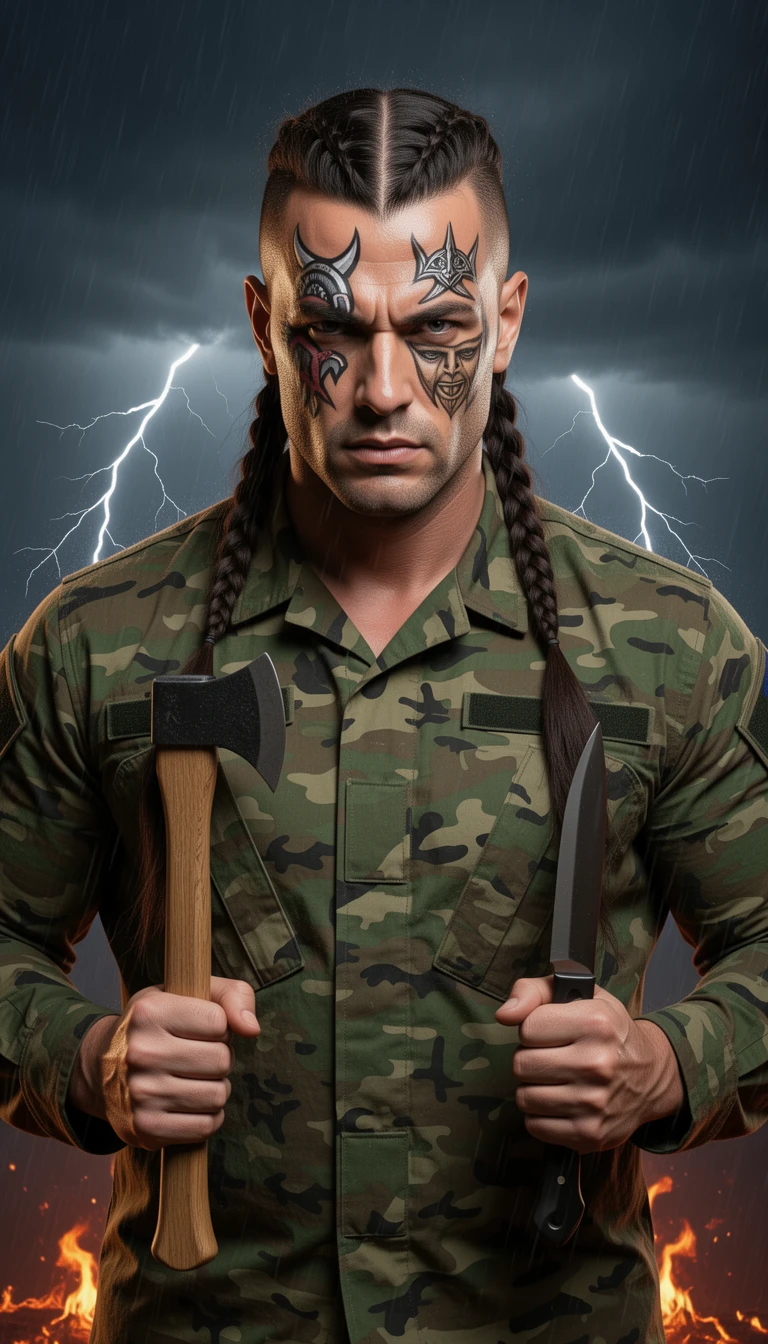
Behind him, the farmhouse door groaned open. Rickey stepped out, a bucket in each hand, his cornrows catching sun on the shaved sides of his skull. The red and black of his painted face had smeared overnight, but he hadn't bothered to reapply. He carried the buckets toward the chicken coops without a word, and Ivan watched his brother's back — the way he moved with the same economy he'd learned in Delta Force, wasting nothing, not even a step.
Ivan turned toward the stables. The Arabians were already restless, their heads hanging over the stall doors, dark eyes tracking him as he approached. He opened the first stall and ran a hand down the mare's neck, feeling the warmth of her, the steady rhythm of her breathing. She leaned into him, trusting, and he felt something in his chest loosen that he hadn't realized was tight.
Jennifer was already in the hog barn, her voice low and steady as she moved through the Berkshire pens. He could hear her through the open windows — not words, just the shape of her presence, the way she spoke to animals the same way she spoke to people: direct, no bullshit, expecting to be understood. He heard a pig grunt in response, and Jennifer laughed, a sound that cut through the morning air like a blade through fog.
Kimberly appeared at the edge of the horse pasture, a halter in one hand, her orange eyes scanning the herd with a sniper's patience. She found the horse she wanted — a bay Tennessee Walker with a white blaze down its nose — and started walking toward it at an angle, unhurried, her body relaxed. The horse watched her approach, ears rotating forward, and Ivan stopped to watch. She didn't reach for the horse. She stopped ten feet away, turned slightly, and waited. The horse took three steps toward her. Kimberly smiled, just a flicker, and let it come the rest of the way.
The morning unfolded like a slow wave. Jack and Wolf had taken the ATV out to check the fence line on the western edge of Zone 1, their voices crackling over the radio every few minutes with updates on washouts and downed posts. Sarah was in the distillery vault, running the morning inventory on the whiskey barrels, her bubblegum pink eyes scanning the ledgers with the same precision she'd used to scan kill boxes through a sniper scope. Melissa worked the sheep pasture, moving through the Hog Island flock with a quiet efficiency, her two-toned eyes — ocean blue and emerald green — tracking each animal as she checked for injuries or illness.
Michelle worked the cattle sector without a word, moving through the Holstein pasture with a bucket of feed, her black eyes missing nothing. A calf had gotten itself tangled in a section of fencing near the automated milking parlor, and she knelt beside it, her movements slow and deliberate as she worked the wire free. The calf bleated, panicked, and Michelle made a sound — low, steady, wordless — that settled the animal like a hand on a shaking shoulder. She freed the leg, ran her hand down its flank, and stood. The calf stayed beside her for three more steps before bounding back to its mother.
Ivan found himself in the poultry enclosure an hour later, his hands deep in a bucket of feed, scattering grain across the ground for the Anconas. They clustered around his boots, alert and hungry, their black-and-white feathers speckled with morning light. He worked the way he'd learned to work — slow, methodical, present. His mind drifted to the will, to Michael, to the hundred trillion sitting in accounts he hadn't even seen yet, and he forced himself back to the feel of feed running through his fingers, the weight of a chicken landing on his boot, the sound of fifty birds eating in a rhythm that felt like peace.
Near noon, Rickey found him in the swine barn, hosing down the Duroc pens. Rickey leaned against the door frame, arms crossed, and watched without speaking.
"You gonna help or just stand there?" Ivan asked, not looking up.
"Just standing."
Ivan snorted. The hose stream hit the concrete, washing grain residue and manure toward the drain. The Durocs were in the outdoor pasture, rooting through the mud, and the barn was quiet except for the water and the distant sound of birds.
"Jack found a break in the fence near the western logging road," Rickey said. "Wolf's fixing it. They'll be back by lunch."
"Anything else?"
"Sarah says the whiskey inventory is good. She's pulling a sample from the '19 batch."
Ivan shut off the hose. The sudden silence felt heavy, and he coiled the line, loop by loop, until his hands had something to do.
"You think Michael's gonna fight it?" Rickey asked.
"Yeah."
"You think he'll win?"
Ivan straightened, looked at his brother. Rickey's face was unreadable, the red and black paint catching light from the open door, his blood-red eye and midnight-black eye fixed on Ivan with a stillness that felt like waiting.
"No," Ivan said. "But that doesn't mean he won't try."
Rickey nodded. He pushed off the door frame and walked toward the horse pasture, his boots crunching on gravel, leaving Ivan alone with the silence and the smell of hay and the weight of a morning that felt like the first day of something he couldn't name yet.
Ivan stepped out of the barn and into the sun. The property stretched around him, thirty-three square miles of grazing land, crops, orchards, and trails that wound through woods and over creeks. He could see Jennifer on horseback at the far edge of the hayfields, cantering along a ridge line, her cornrowed braids streaming behind her. He could see Jack and Wolf's ATV cresting a hill near the logging sector, dust rising in their wake. He could see Sarah walking up from the distillery, a mason jar of whiskey in her hand, her face tilted toward the sun.
She saw him watching and raised the jar. Ivan raised a hand back.
The afternoon came on slow and heavy. They worked through it — mucking stalls, rotating pasture gates, checking water troughs, mending a section of fence near the sheep enclosure that had been compromised by a coyote dig. Wolf found the den, a shallow scrape in the earth beneath an old oak, and he stood over it with his arms crossed, his black eyes tracking the tree line for movement.
"She'll be back," he said. "They always come back."
Jack spat into the dirt. "Then we'll be waiting."
They set a trap — not a kill trap, a capture trap — and marked the location on the farm map. Ivan watched Wolf work, the way his long braids fell forward as he crouched, the way his hands knew what to do without his eyes telling them. Wolf caught him looking and raised an eyebrow.
"You got something to say, Nightsworn?"
"Just watching a master at work."
Wolf's mouth twitched. "Keep watching. You might learn something."
By late afternoon, the light had shifted to amber, and the animals were settling into their evening routines. The Holsteins had gathered near the milking parlor, waiting. The sheep were moving toward the shelter of the tree line. The horses had migrated to the center of the sentinel pasture, where the grass was thickest, and the Mammoth donkeys had positioned themselves at the perimeter — ears rotating, bodies still, watching the darkening edge of the woods with the patience of creatures who knew exactly what they were guarding.
Ivan stood at the fence line, his arms resting on the top rail, and watched the donkeys work. He'd read about them once — how they killed coyotes. Not with teeth, but with their hooves, striking with precision, breaking spines and crushing skulls. The jennies never stopped watching. Never stopped listening. They moved through the herd like shadows, their presence a constant reminder that danger had a cost.
He felt someone step up beside him. He didn't look.
"You've been standing here for ten minutes," Sarah said.
"Counting?"
"Watching."
A pause. The donkeys shifted, one of them turning its head to look directly at them, then turning back to the woods.
"She picked a hell of a day to tell us," Sarah said quietly. "I mean, the will. The cancer. All of it. Then she just — sent us out here to work like nothing happened."
Ivan didn't answer. He watched a jenny move with purpose along the eastern edge of the pasture, her ears locked on something in the darkening brush.
"You think she's right?" Sarah asked. "About Michael?"
"I think she's never been wrong about anything that mattered."
Sarah was quiet for a long time. The sun was falling behind the ridges now, painting the world in shades of burnt orange and deep purple. The donkeys had stopped moving. One of them stamped a hoof. The sound carried.
"Dinner's in an hour," Sarah said. "Kimberly's making that pork thing. The one with the apples."
"I'll be there."
She didn't leave. She stood beside him, shoulder to shoulder, her presence a warm weight in the cooling air. Ivan felt her hand brush his — a deliberate touch, light, asking nothing — and he let it stay. The donkeys stood motionless at the edge of the pasture, their shadows long and still, watching the darkness as it crept in from the treeline.
An hour later, the farmhouse kitchen was thick with the smell of roasting pork and cider. Kimberly moved between the stove and the counter with a rhythm that felt practiced, her orange eyes tracking every pot and pan like she was running an operation. She didn't talk much when she cooked, and no one tried to make her. Jack and Wolf were at the table, a map of the property spread between them, marking coyote sign and fence breaks with red ink. Rickey was at the sink, scrubbing dirt from his hands, his cornrows damp with sweat. Michelle sat in the corner, a cup of coffee cradled in her hands, watching the room with her black eyes that saw everything and said nothing.
Jennifer came in from the back porch, her boots leaving mud on the floor, and kicked them off without a word. She grabbed a glass of water, drank half of it, then sat down at the table and pulled the map toward her.
"The coyote was back," she said. "Wolf's trap was empty, but I saw tracks along the eastern fence line. Fresh. Maybe an hour old."
Jack looked up. "She's testing the perimeter."
"She's hunting," Jennifer said. "She'll be back tonight."
The room went quiet. Ivan leaned against the counter, his arms crossed, watching the faces of his family. Sarah sat down at the table, pulling her mason jar of whiskey with her. Melissa came in from the cellar, a bottle of wine in each hand, and set them on the counter without a word. She looked tired — the kind of tired that came from a full day of physical work, the good kind, the kind that settled in the bones like a blessing.
"Eat first," Kimberly said, not turning from the stove. "Then we can figure out the coyote."
They ate in the kitchen, crowded around the scarred oak table with mismatched chairs and plates passed hand to hand. The pork was tender, the apples caramelized and savory. There was cornbread from a batch Michelle had made that morning, and greens from the garden, and a jug of sweet tea that disappeared faster than it should have. They didn't talk about Michael. They didn't talk about the will. They talked about the farm — about the irrigation system in Zone 2 that needed replacing, about the new foal due next month, about the ATV that kept stalling on inclines. They talked like people who had known each other their whole lives, because they had, and the kitchen filled with the sound of overlapping voices, laughter, the scrape of forks, the clink of glasses.
Ivan sat at the end of the table, eating slowly, watching his family. His sisters. His brothers. His friends. People who had bled with him, killed with him, sat in the dark with him when the world felt like it was ending. And here they were, in a farmhouse at the edge of a hundred and twenty miles of land, eating pork and cornbread, planning fence repairs and coyote traps.
He thought about what Eleanor had said. The family doesn't have to be broken, Ivan. It just has to know what it's protecting.
He reached for another piece of cornbread, and the conversation washed over him like warm water, and for a moment — just a moment — he let himself feel like maybe everything was going to be okay.
Outside, the moon rose over the sentinel pasture. The Mammoth jennies stood at the edges of the herd, their shadows long and still, watching the dark. One of them turned its head toward the farmhouse, listened to the sound of voices and laughter, and turned back to the woods.
Waiting.
The room held the silence. Forks resting on plates. The last of the cider warming in a glass. Ivan's voice had cut through the noise of dinner like a blade through water, and now the family sat in the wake of it, listening to the echo of what he'd laid out.
He hadn't planned to say it all tonight. But the words had come anyway, spilling out in the clipped, precise cadence he used when a plan was already built in his head and just needed air. The Central Citadel. Twenty point one square miles of residential and infrastructure, dead center of the farm. The sibling neighborhood — private estates, each with an encrypted biometric pneumatic elevator dropping straight through bedrock to an underground bunker town. A mirror of the surface, ready for instant escape or combat deployment. The museum — four wings covering the family's history from the Revolutionary War through the Whiskey Rebellion, the Civil War and Underground Railroad, the Royal and Papal Guard displays, the modern military exhibits, the distilling and winemaking wing with the original 1791 moonshine still behind glass. The Joint Public Safety Complex with its hundred-bay garage, NBC decontamination center, four helipads, and subterranean platforms for emergency vehicle deployment. The commercial shopping center — groceries, clinics, supplies, community spaces to support everyone.
He'd stopped then. Looked at the faces around the table. "I want everyone living on the farm. The twenty miles. This is how I see it."
Rickey was the first to break the quiet. He leaned back in his chair, the wood groaning under him, and ran a hand over the shaved side of his head. His blood-red left eye and midnight-black right eye caught the kitchen light at different angles, making him look like something carved from two different stones. "The elevator shafts," he said. "Straight to an underground bunker town. Biometric-locked, encrypted. Every bedroom." He let out a low whistle. "You've been sitting on this one, huh?"
Ivan shrugged. "Had time to think."
Rickey nodded slowly. "I like it. The whole family under one roof — well, under one twenty-mile roof. The museum alone is worth it. People need to know what this family's done. What it's been." He tapped the table with a finger. "But the safety complex — a hundred-bay garage? That's not just for us. That's for a small army."
"We might need one," Ivan said.
Rickey's jaw tightened, but he didn't argue.
Jennifer spoke next, her voice flat, practical. She was still in her work clothes, mud drying on her sleeves, her yellow-orange-red-black eyes fixed on the middle distance like she was running calculations. "The underground bunker town is the key. If Michael brings a legal fight, we'll need somewhere secure to operate from. Somewhere the press can't find us, somewhere the courts can't touch. The elevator shafts are good — they give us rapid deployment to either level. But we need to think about supply lines down there. Water, power, air filtration, medical. How long can we sustain a siege?"
"The bunker town is built to hold two thousand people for six months without resupply," Ivan said. "Grandmother made sure of that. There's a aquifer-fed reservoir, geothermal power, hydroponic gardens, and a fully stocked medical bay."
Jennifer's eyes flickered — something like approval. "Then it works."
Kimberly was quieter. She'd set down her fork and was tracing the edge of her plate with her thumb, her orange eyes unreadable. When she spoke, her voice was low. "The museum. You want to open it to the public?"
"I want it to be a living history," Ivan said. "Not just a building people walk through. I want the family to live there. To work there. To teach there. The distilling exhibit — that's our wine and whiskey operation. The agricultural zones — that's our food. The museum tells the story, but the farm makes it real."
Kimberly was quiet for a long moment. Then she looked up, and there was something bright in her orange eyes — not tears, but close. "Grandmother would have loved this."
No one disagreed.
Michelle didn't speak. She never did, not in words. But she reached across the table and placed her hand on Ivan's wrist — cold, steady, a squeeze that said I'm with you. Her black eyes held his for a second, then she let go and picked up her coffee.
Eleanor was sitting at the head of the table, her hands folded in front of her, her blue eyes clear despite the hour. She'd been silent through Ivan's speech, her face unreadable. Now she spoke, and her voice carried the same bedrock authority it had in the morning.
"You've thought this through," she said. It wasn't a question.
"I've had years," Ivan said.
"And the guards?" Eleanor leaned forward. "You mentioned guards for the families. For anyone close to us."
Ivan nodded. "The family's security detail will live in the sibling neighborhood. I want them integrated — not separate, not hidden. They eat with us, train with us, know us. Their families get housing in the commercial zone. We build a community, not a compound." He paused. "And I want to bring in the Sullivans. The Chens. The Johnsons. Anyone who's been with us, bled with us. They get land. They get homes. They become part of the perimeter."
Eleanor's blue eyes glittered. "You're building a nation, Ivan."
"No. I'm building a family."
Jack King let out a low laugh from his corner of the table, his blue eyes crinkling above the paint on his face. "Hell of a difference."
"There is no difference," Eleanor said quietly. "Not for us."
Stevenson Wolf had been leaning against the counter, his black eyes fixed on Ivan, his long braids catching the light. He didn't speak for a long time. When he did, his voice was rough, like gravel wrapped in silk. "The underground town. How deep?"
"Two hundred feet," Ivan said.
"And the escape tunnels?"
"They run in all four directions. Five miles out. Dispersed exits, camouflaged, with pre-staged vehicles and supplies."
Wolf nodded once. "Then the coyote problem is secondary. The real threat is above ground. This plan gives us a way to disappear if Michael's legal team gets smart. Or if something worse comes."
"Something worse?" Melissa Alvarez asked. Her mismatched eyes — ocean blue and emerald green — were fixed on Wolf.
Wolf didn't answer. He just looked at Ivan.
Melissa seemed to understand. She set her wine glass down and spoke, her voice carrying the weight of someone who'd spent years in Delta Force and Green Berets. "I'll coordinate the security architecture for the citadel. The perimeter fencing, the drone grid, the sensor net. I want biometric locks on every external door, and I want them tied to a central command that only the family can access. The commercial shopping center is a vulnerability — we need to control who shops there and when they leave."
"Make it happen," Ivan said.
Sarah Douglas had been quiet all through dinner. She sat at the far end, her bubblegum-pink eyes distant, her braided hair tucked behind her ears. She'd nursed her mason jar of whiskey through the whole meal, barely touching it. Now she spoke, and her voice was softer than Ivan had heard it in years.
"You're really going to do this."
"I don't have a choice," Ivan said. "Not anymore."
Sarah met his eyes. "Yes, you do. You always have a choice. You're choosing this. That's different."
The table went quiet again. Ivan felt the weight of her words settle in his chest. She was right. He was choosing. Not because Eleanor's will forced him, not because Michael had abandoned them, but because he believed in something worth building. He looked at his family — his blood and his chosen — and for a moment, the farmhouse kitchen felt like the center of the world.
"Then we build," Ivan said.
Jack raised his glass. "To the farm."
"To the farm," they echoed, and the sound of it filled the room.
Outside, the moon had climbed higher, casting silver light across the sentinel pasture. The Mammoth donkeys stood motionless at the edge of the herd, their ears rotating, their shadows long. One of them turned its massive head toward the farmhouse, listened to the murmur of voices, and then turned back to the dark.
The coyote was still out there. Michael was still out there. But for the first time in years, Ivan felt like the ground under his feet was solid.
He reached for his glass and took a long drink.
The whiskey was warm in his chest, spreading slow. Ivan set the glass down and let his hand rest on the scarred oak, the wood grain rough under his palm. The kitchen had settled into the kind of quiet that came after a long meal—bodies full, minds turning, the wine bottle half-empty between Eleanor's hands.
"You mentioned the bunker," Rickey said from across the table. His blood-red eye caught the light as he leaned forward, the midnight black of his other side vanishing into shadow. "The citadel. But you didn't say how deep."
Ivan looked at him. "Deep enough."
"That's not an answer."
"It's the one I've got until I see the surveys." Ivan's voice was flat, but there was something beneath it—a current that made the table lean in. "Grandmother holds the full architectural plans. I've only seen the overview."
Eleanor set the wine bottle down with a soft thud. Her blue eyes moved across the room, touching each face, and when she spoke, her voice carried the weight of eighty years and a thousand decisions.
"SURFACE," she said. "The farm stretches one hundred and twenty miles. The town runs twenty. We have room for thirty thousand—guards, specialized personnel, their families." She paused, letting the number settle. "Right now, we have two thousand guards. One thousand Swiss, one thousand Grenada. Their quarters are complete. The bunker space at Layer 2 is finished. But if we need more, there's always room."
Michelle's hand found the table. She didn't speak—she never did—but her black eyes were fixed on Eleanor, the Viking paint on her face stark in the lamplight.
"Layer 1," Eleanor continued. "Ten meters deep. The infrastructure grid. Hydroponic farms scaled for tens of thousands. Automated water-recycling plants. Industrial air systems. The kind of engineering that keeps a city breathing when the surface stops being safe."
Jack let out a low whistle. "You built a city under the farm."
"I built a future," Eleanor said. "Layer 2 at twenty meters—the civilian refuge. Micro-apartments. Subterranean classrooms. Medical wards. Everything the guards' families need to be comfortable. To feel safe. To feel like they belong somewhere." She looked at Ivan. "That's where your sibling neighborhood lives."
Ivan's jaw tightened. He'd known the broad strokes—his grandmother had sketched the vision years ago, late at night over coffee, when the house was quiet and the weight of the family company pressed on both of them. But hearing her speak the numbers, the depths, the sheer scale of what she'd built—it was different. It was real.
"Layer 3," Eleanor said. "Sixty meters deep. The military garrison. Command decks. Weapon vaults. Armories for an army of eight thousand two hundred and forty men. The tactical tier—designed to coordinate surface defense and deep-ground operations." Her blue eyes glittered. "That's where your MSD teams train, Ivan. Where your security architecture lives."
Melissa's mismatched eyes were wide. "Eight thousand men?"
"In theory," Eleanor said. "Right now, it's a skeleton. But the structure is there. The power grid. The water lines. The air filtration. All waiting."
Kimberly leaned forward, her orange eyes bright. "And Layer 4?"
The room went still.
Eleanor folded her hands on the table. Her voice dropped, not quieter, but deeper—the voice of someone who had carried a secret for decades and was finally laying it down.
"Eighty meters down. The Deep Core. The Cathedral." She let the words hang. "The Family Vault. The ultimate private sanctuary. Inside it: the Crypt of Kings. The Spartan artifacts. The Sacred Sanctuary." She looked at Ivan, and for a moment, her eyes held something he'd never seen in them before—not pride, not sorrow, but a kind of fierce, ancient hope. "Completely sealed. Completely protected. Waiting for the family that would be worthy of it."
No one spoke.
The farmhouse kitchen, with its worn floorboards and dented kerosene lamp, felt suddenly fragile—a husk over something vast and hidden. The coyote outside, the legal threat from Michael, the mundane worries of the day—they shrank against the weight of what Eleanor had just revealed.
Rickey broke the silence first. "You built a nation underground."
"I built a sanctuary," Eleanor said. "There's a difference."
"Is there?" Jack asked, his blue eyes fixed on her. "Because from where I'm sitting, it looks like you've been preparing for a war that hasn't started yet."
Eleanor met his gaze. "The war started the day I was born, Jack. It just hasn't reached our doorstep yet."
Wolf's black eyes were unreadable, his long braids framing a face carved from stone. "You knew. All those years. You knew what was coming."
"I knew what could come," Eleanor said. "I prepared for what I could. The rest is up to this generation." She looked at Ivan. "Up to you."
Ivan felt the weight of it settle into his bones—the same weight he'd carried since he was eighteen, standing over a sniper rifle in the mountains of Afghanistan, watching a village burn in the valley below. The weight of choices that couldn't be unmade. The weight of people who trusted him to see what was coming and stand in front of it.
"The Swiss guards," he said slowly. "The Grenada guards. You chose them specifically."
"I chose loyalty," Eleanor said. "Both units have served the family for three generations. Their commanders trained with your father. Their children grew up with yours—at least, the ones who stayed on the farm." She paused. "The Swiss handle internal security. The Grenada handle external. They don't cross paths. They don't share intelligence. They answer to the same chain of command, but they don't know each other's protocols."
"Need-to-know," Rickey said.
"Exactly."
Jennifer had been silent through the whole exchange, her yellow-orange-red-black eyes fixed on Eleanor's face. Now she spoke, and her voice was quiet, almost reverent. "You built a city. A garrison. A vault. And you never told us."
"I couldn't," Eleanor said. "Not until you were ready. Not until the company was yours."
"And now?"
"Now you know." Eleanor's hands were steady on the table. "Now you decide what to do with it."
Ivan reached for the glass again. The whiskey was nearly gone, just a finger left at the bottom, warm and dark. He didn't drink. He held it, feeling the weight of the glass, the slight give of the worn oak beneath his elbow.
"The hoppers," he said finally. "The underground transport. Are they live?"
Eleanor nodded. "The main line runs from the farmhouse to Layer 2. There's a secondary that connects to the town. A tertiary that runs to the garrison. The vault is only accessible from the Cathedral floor."
"And the Cathedral?"
"Is exactly what it sounds like." Eleanor's voice softened. "A place for the family to gather. To remember. To pray, if that's what you believe in. To sit in silence and know that you're part of something bigger than yourself."
Michelle's hand moved across the table. Her fingers found Ivan's wrist—cold, steady, that same squeeze from dinner. He didn't look at her. He didn't need to. The pressure said everything.
Sarah Douglas hadn't spoken since the revelation. She sat at the far end of the table, her bubblegum-pink eyes distant, her braided hair tucked behind her ears. The whiskey in her mason jar was untouched. She was watching Eleanor with an expression Ivan couldn't read—something between awe and grief.
"You've been carrying this alone," Sarah said. Her voice was soft, barely above a whisper. "All these years."
Eleanor's blue eyes met hers. "I haven't been alone. I've had the family. I've had the guards. I've had the memory of everyone who came before." She paused. "And I've had the certainty that one day, I would sit at this table and tell you all the truth."
"And now you have."
"And now I have." Eleanor's voice cracked, just slightly—the only crack she'd let show all night. "And now I can rest."
The words landed like stones in still water.
No one moved.
Outside, the moon had climbed past the sentinel pasture, casting silver light across the fields. The Mammoth donkeys stood at the edge of the herd, their ears rotating, their shadows long. One of them turned its massive head toward the farmhouse, listened to the silence, and then turned back to the dark.
The coyote was still out there. Michael was still out there. But for a moment—just a moment—the farmhouse kitchen felt like the center of a world that was vast and hidden and waiting.
Ivan set the glass down. The whiskey was gone. His hand was steady.
"We start tomorrow," he said. "Full assessment. I want eyes on every layer, every tunnel, every vault. I want to know what we have, what we need, and what we're missing." He looked at Eleanor. "And I want to see the Cathedral."
Eleanor nodded. "It's ready."
"I know." Ivan pushed back from the table, the chair scraping against the worn floorboards. "Get some sleep. All of you. Tomorrow's going to be a long day."
Rickey stood, his blood-red eye catching the light. "I'll take first watch. The coyote's still out there."
"Take Wolf," Ivan said. "And don't engage unless it's in the trap."
Wolf was already on his feet, his black eyes glinting in the shadows. "We'll be quiet."
The two of them slipped out the back door, their boots barely audible on the porch. The screen door creaked shut behind them, and the kitchen fell into a different kind of quiet—the kind that followed a storm.
Kimberly stood, her orange eyes soft. "I'll take the dishes."
"I'll help," Jennifer said.
The two sisters moved to the sink, their movements synchronized, their voices low. The sound of running water filled the space, and Ivan felt something in his chest loosen—just slightly.
Michelle's hand was still on his wrist. She didn't speak. She never did. But she squeezed once, a question he could answer or ignore.
He answered. "I'm fine."
She didn't believe him. Her black eyes held his for a long moment, and then she let go, rising from the table to join her sisters at the sink.
Sarah was still sitting at the far end, her pink eyes fixed on the empty mason jar. She didn't look up when Ivan approached.
"You knew," she said. "Not the details. But you knew she was building something."
"I knew she was planning," Ivan said. "I didn't know the scale."
"Does it change anything?"
Ivan considered the question. The whiskey was warm in his stomach, the weight of the revelation still settling into his bones. "It changes everything," he said. "And nothing."
Sarah looked up at him, and for a moment, something passed between them—not the heat of the night before, but something quieter. Something that didn't need words.
"I should get some sleep," she said.
"The guest room's made up."
"I know." She stood, her boots scuffing against the floorboards. She paused at the bottom of the stairs, her back to him. "Ivan."
"Yeah?"
"You're not alone in this." She didn't turn around. "None of us are."
Then she climbed the stairs, her footsteps fading into the dark.
Ivan stood in the kitchen, the sound of running water and low voices filling the space around him. The moon cast silver light through the window, falling across the scarred oak table, the dented kerosene lamp, the empty mason jar.
Outside, the coyote howled—close now, closer than before.
The trap was set.
And for the first time in years, Ivan felt like he knew where he was standing.
And for the first time in years, Ivan felt like he knew where he was standing.
The kitchen held him—scarred oak, dented lamp, the faint chemical smell of the kerosene that had burned hours ago. His sisters at the sink, water running, plates clinking. Sarah's footsteps had stopped somewhere above. The coyote had gone quiet.
He didn't move.
Eleanor's voice came from the shadows near the pantry—low, unhurried, as if she'd been waiting for the kitchen to thin out before speaking.
"I wasn't finished."
Ivan turned. She stood in the doorway, her short gray hair catching the moonlight, a teacup cradled in both hands. She hadn't gone to bed after all. Hadn't even changed out of the housedress she'd worn through the will reading.
Kimberly's hands stopped moving in the sink. Jennifer cut the water. Michelle didn't turn, but her shoulders shifted—listening.
"There's more," Eleanor said. Not a question.
"The houses," she said. "The bunkers are one thing. But I had another set built above them. One for each pair." She took a sip of her tea, the ceramic clicking against her lower teeth. "You'll live in pairs. Share the bunker, share the house above it. Close enough to help each other. Far enough to breathe."
She set the cup down on the scarred oak table. Her blue eyes moved through the room, touching each of them in turn.
"Ivan and Sarah."
Kimberly's head came up. Her orange eyes flicked to Ivan, then away. Jennifer's jaw tightened once, then relaxed. Michelle's stillness deepened.
Eleanor didn't pause. "Kimberly and Stevenson. Michelle and Jack. Rickey and Melissa."
The names hung in the air like smoke. Ivan felt them settle into his chest—each pair a door clicking shut, a key turning. His grandmother had been planning this longer than any of them knew. Had been watching them, reading them, arranging them like pieces on a board he hadn't realized she was building.
"Jennifer," Eleanor said, "you'll have the main house. It's yours to run, yours to hold. The epicenter. Everyone comes back here."
Jennifer's hands were still in the dishwater. She didn't turn around. Her shoulders went still, then relaxed—a slow release that Ivan knew meant she was processing, calculating, accepting. "The main house." Her voice was flat, but not cold. "Everyone comes back here."
"The epicenter," Eleanor said. "The hearth. You hold the fire, Jennifer. You always have."
Kimberly's orange eyes moved from Eleanor to Jennifer's back, then to Stevenson. He was leaning against the doorframe, his black eyes fixed on her with an expression Ivan couldn't read—not surprise, not resistance. Something quieter. Something that looked like waiting.
"Stevenson and me," Kimberly said. It wasn't a question. It was a stone dropped into still water.
"You balance each other," Eleanor said. "You're fire. He's shadow. Together, you're a wall nothing gets through."
Michelle was still at the sink, her back to the room. But Ivan saw her hand pause on a plate—just for a heartbeat. Then she set it down, picked up another, and began scrubbing in the same rhythm. She didn't look at Jack. She didn't need to. Jack's blue eyes had found her the moment Eleanor spoke his name, and they hadn't moved since.
"Michelle and Jack," Eleanor said, and her voice softened—just barely. "You've been each other's anchor for twenty years. It's time you had a place to drop it."
Rickey's blood-red eye met Melissa's mismatched gaze across the table. She didn't blink. He didn't look away. Something passed between them—not heat, not yet. But the shape of something that could be, if they let it.
"Rickey and Melissa," Eleanor said. "You've fought side by side. You've bled side by side. Now you'll build side by side."
The silence that followed was thick enough to hold. Ivan stood at the head of the table, the scarred oak beneath his hands, the weight of his grandmother's words pressing into his chest like a brand.
"And Ivan and Sarah." Eleanor's blue eyes found him, held him. "You'll have the house closest to the main road. Space for yourself. Space for each other."
Sarah didn't react. Her pink eyes stayed fixed on the empty mason jar in front of her, her hands flat on the table on either side of it. But Ivan saw her breathing change—a fraction slower, a fraction deeper. The only tell she'd let herself have.
"Each property will have its own bunker entrance," Eleanor continued, "connected to the main tunnel system. Privacy. Distance. But the main house is the heart. Jennifer holds the heart."
Jennifer turned from the sink, drying her hands on a dish towel. Her yellow-orange-red-and-black eyes were dry, but there was something raw in them—something she didn't bother to hide. "And Michael?"
The name landed like a blade on the table.
Eleanor's jaw tightened. "Michael has nothing. He chose nothing. He earned nothing. The law will confirm what I've already decided."
"He won't accept it," Jennifer said. "You know he won't."
"I know." Eleanor's voice was granite. "But acceptance isn't a requirement. Compliance is."
Ivan watched his grandmother—the set of her shoulders, the hard line of her mouth, the way her hands stayed still on the table. She was dying. She'd told them that. But sitting here, in this kitchen, with the weight of a hundred trillion dollars and a hundred years of legacy behind her, she looked like she could live forever through sheer will alone.
"When do we start building?" Rickey asked.
"The survey teams have already marked the plots," Eleanor said. "Construction begins next week. Jonas has the contracts ready. Each property will be self-sufficient within eighteen months."
"Eighteen months," Kimberly repeated. She'd moved closer to Stevenson—not touching, but near enough that their shoulders almost brushed. "That's fast."
"It's necessary." Eleanor looked around the table, her blue eyes touching each of them in turn. "What's coming—and I won't pretend to know exactly what—will find us whether we're ready or not. The only question is how much ground we've fortified when it arrives."
Jack spoke for the first time. His voice was low, measured—the voice of a man who'd learned to choose his words like ammunition. "And the coyote?"
"The coyote is a symptom," Eleanor said. "Not the disease."
The words settled into the room like dust. Ivan felt them in his bones—the same certainty he'd felt in a dozen war zones, the knowledge that the visible threat was never the real one.
"We'll handle the coyote tonight," he said. "And tomorrow, we start building."
He looked at Sarah. She was still staring at the empty mason jar. But her hand had moved—just slightly—so that her fingertips rested an inch from his.
Not touching. But close.
Close enough.
"Ivan's right," Sarah said. Her voice was steady. "We start tomorrow. Tonight, we watch. We wait. We make sure the trap works."
"And if it doesn't?" Melissa asked.
Ivan met her mismatched eyes. "Then we reset and try again. That's what we do."
Melissa nodded. Once. It was all the confirmation anyone needed.
Eleanor pushed back from the table, her joints creaking in protest. She stood slowly, her hand braced against the oak. "I'm going to bed. I've said what I needed to say." She paused at the bottom of the stairs, her back to them. "You're my legacy. All of you. Not the money. Not the land. You."
Then she climbed, her footsteps slow and deliberate, each one a declaration.
The kitchen was quiet. The dishes were done. The coffee had gone cold. Outside, the moon was climbing, silver and indifferent, casting long shadows across the farmhouse floor.
Ivan's hand stayed on the table. Sarah's fingertips were still an inch from his.
And for the first time in years, Ivan felt like he knew where he was standing.
Jennifer's voice cut through the quiet—low, but carrying the same edge she'd used on Michael. "You forgot one more person, Grandmother."
Everyone turned. Jennifer was still at the sink, the dish towel twisted between her hands, her yellow-orange-red-and-black eyes fixed on the space where Eleanor had stood.
The stairs had stopped creaking. Eleanor's voice drifted down, tired but sharp. "Who, child?"
"Robert Davis."
The name landed like a stone in still water. Ivan felt it hit—felt the ripples spread through the room. Sarah's hand, still an inch from his, didn't move. But her breathing changed again, that fraction slower.
Kimberly was the first to speak. "Robert. Shit. I haven't thought about him in—" She stopped, her orange eyes flickering to Ivan. "Years."
"He grew up with us," Jennifer said. "Same age. Same everything. Since preschool." She let that sit. "He was the quiet one. Always in the corner, always watching. Never said much, but he saw everything."
Ivan remembered. Robert Davis. Small for his age, with dark hair that hung in his eyes and a way of moving that made you forget he was in the room until he spoke. They'd played together in these fields, in this house, in the barn that still stood out back. Robert had been the one who found the baby birds that fell from the nest, who bandaged scraped knees without being asked, who sat with Ivan in silence when the nightmares got bad after that first deployment.
"He was military," Jennifer said. "Didn't talk about it. Still doesn't."
Rickey leaned forward, his blood-red and midnight-black eyes narrowing. "What branch?"
"All of them." Jennifer's mouth tightened. "Same as us. Different order. He did his time, got out, went dark. I kept track."
The silence stretched. The bare bulb above them hummed, casting harsh shadows across the scarred oak table.
Michelle moved first. She stepped away from the sink, her black eyes finding Ivan's, holding them. She didn't speak—she never did when she could communicate with a look. But Ivan understood. You know him. You trust him. This matters.
Ivan's hand stayed on the table. "How long since you talked to him?"
"Two years," Jennifer said. "He checks in. Never says where he is. Just that he's alive."
"And you want him paired with you." It wasn't a question. Ivan already knew the answer.
Jennifer's jaw set. "He doesn't have anyone else. His parents died when we were in high school. No siblings. No wife. No kids. He's been alone since he got out, and he's too proud to ask for help."
"You think he'd come?" Jack asked. His voice was measured, careful—the voice of a man who'd learned to weigh every word. "If you asked?"
"I think he'd come if I told him he had to." Jennifer's eyes flickered to Ivan. "And if Ivan asked too."
Every head turned to Ivan. The weight of it settled on his shoulders, familiar and heavy. He'd carried this weight before—in the mountains of Afghanistan, in the alleys of Mogadishu, in the boarded-up safe houses of Eastern Europe. The weight of people trusting him to make the right call.
"Where is he?" Ivan asked.
"Last I knew, Montana." Jennifer's hands were still on the dish towel. "He's got a cabin. No address. No phone. He sends letters."
"Letters." Kimberly's voice was flat. "Who sends letters?"
"Someone who doesn't want to be found."
Ivan stared at the empty mason jar in front of Sarah. The one she'd been watching since Eleanor had spoken. He could see his reflection in the glass—distorted, fragmented, but there. His left eye, silver. His right, gray. The paint on his face, faded from the long day, but still visible. Juggalo on the left. Viking in the middle. Vlad on the right. Three faces, one man.
"You trust him," Ivan said. Not a question.
"With my life." Jennifer's voice was quiet. "With all of yours."
Ivan looked up. Met her eyes. Those yellow-orange-red-and-black irises that had seen the same things he'd seen, done the same things, carried the same weight. She was his sister. His equal. His partner in every fight that mattered.
"Then I'll ask," Ivan said. "But we do it together. You and me."
Jennifer's shoulders dropped. Just slightly. Just enough for Ivan to see the tension she'd been holding.
"Thank you," she said.
"Don't thank me yet." Ivan turned to the group. "We don't know if he'll come. We don't know if he's even alive. But if he is, and if he says yes, then we've got another pair for the compound."
"That makes nine," Rickey said. "Assuming he shows."
"Nine is better than eight," Melissa said. Her mismatched eyes—ocean blue and emerald green—found Ivan's. "And if he's half of what Jennifer says, he's worth the risk."
"He's more than half," Jennifer said. "He's... he's the one who taught me to shoot a rifle. First time. I was twelve. He was twelve. We were in the back field, and he put a tin can on a fence post and said, 'Hit it.' I missed. He hit it five times in a row. Didn't say a word. Just reloaded and handed the rifle back."
The story hung in the air, simple and sharp. Ivan could see it—two kids in the tall grass, the summer heat, the smell of hay and dust. Robert Davis, quiet and precise, teaching without teaching.
"What does he look like now?" Kimberly asked.
Jennifer shrugged. "Last letter was two years ago. He said he'd grown a beard. Said it made him look older." A pause. "He didn't send a picture."
"Sounds like Robert," Jack said. He'd leaned back in his chair, his blue eyes lost somewhere in memory. "I remember him from high school. Kid never said a word, but everyone knew he was the one you didn't want to fight."
"He put Tommy Gallagher in the hospital," Stevenson said. His voice was low, his black eyes unreadable. "Sophomore year. Tommy said something about Jennifer. Robert didn't argue. He just stood up and broke Tommy's nose. Then his jaw. Then his ribs."
Ivan remembered. He'd been there. He'd seen Robert's face in that moment—not angry, not satisfied. Just... empty. Like he'd done what needed to be done and didn't need to feel anything about it.
"He was always like that," Ivan said. "Quiet. Precise. Efficient."
"Sounds like one of us," Rickey said.
"He is one of us." Jennifer's eyes were hard. "He always was. We just forgot."
The words settled. Ivan felt them in his chest, in the space where guilt lived. He hadn't thought about Robert in years. Hadn't wondered where he was, what he was doing, whether he was okay. He'd been too busy—too deep in the work, too focused on the next mission, the next threat, the next thing that needed to die.
"We'll find him," Ivan said. "Tomorrow. Jennifer and I will go to Montana."
"You don't even know where his cabin is," Kimberly said.
"The letters had a return address. A PO box." Jennifer's voice was steady. "I kept them all."
"Then we start there." Ivan pushed back from the table, the chair scraping against the worn floorboards. The sound was loud in the quiet kitchen. "Tonight, we watch for the coyote. Tomorrow, we find Robert."
Sarah moved beside him. She didn't touch him—not yet—but she was close, close enough that he could feel the heat of her arm through the space between them. "I'll come with you."
"You have the White House to manage."
"Mark can handle the White House for one day. You're going into unknown territory with a man none of us has seen in two years. You need backup."
Ivan looked at her. Her bubblegum-pink eyes were steady, unblinking. She wasn't asking. She was telling.
"Fine," he said. "But you follow my lead."
"I always do." The corner of her mouth twitched. "Eventually."
The tension cracked. Just slightly. Just enough for a breath to move through the room.
Kimberly snorted. "That's the Sarah we know."
"She's still the Sarah you know," Sarah said. "I just get to pick which version shows up."
The words hung in the air — Sarah's challenge light but real — and Ivan let them settle. He felt the weight of the night pressing in through the farmhouse walls, the dark outside thick with everything they hadn't said yet. Michelle caught his eye from across the kitchen. She didn't nod. She didn't need to. He knew what she was thinking: go now, before the trail goes cold.
"Jennifer," Ivan said, his voice cutting through the low murmur of the room. "You still have those letters?"
Jennifer's yellow-orange-red-black eyes flickered. "Every one of them. PO box in Montana. Last address was two years ago, but it's all I've got."
"Then that's where we start." Ivan turned to Sarah. "You're serious about coming?"
Her bubblegum-pink eyes held his. "I'm already packed."
He didn't argue. There wasn't time. "Dulles. Seven am. Nonstop to Montana. Be ready."
Kimberly moved toward the door. "I'll have the jet fueled by six."
"Commercial," Ivan said. "Fewer questions."
She stopped. Considered. Nodded once. "I'll book the seats."
The farmhouse exhaled around them. Chairs scraped. Coffee cups found the sink. The plan was in motion, and that was all any of them needed — the shape of a direction, the weight of a purpose. Ivan felt it in his chest, the old familiar pressure of movement, the shift from waiting to acting.
The drive to Dulles was quiet. Sarah sat in the passenger seat of Ivan's truck, her hand resting on the center console, close enough that he could feel the heat of her skin without touching. Jennifer sat in the back, her eyes on the road ahead, her fingers tracing the seam of a worn envelope she'd pulled from her jacket.
The airport was half-empty at six-thirty in the morning. Fluorescent lights hummed over empty gates. A janitor mopped a distant corridor. They moved through security with the ease of people who'd done it a thousand times — shoes off, belts off, laptops out, bodies through the scanner, weapons checked in cases that would be waiting for them on the other side.
The flight was three hours. Ivan spent it watching the clouds, his mind cycling through every possible outcome. Robert alive. Robert dead. Robert willing to help. Robert gone to ground. Each version played out behind his gray and silver eyes, and each one ended the same way — with a question he couldn't answer until they landed.
Sarah slept against his shoulder. Her breathing was slow, even, her body relaxed in a way he rarely saw. He let her stay there. Jennifer watched them from across the aisle, her painted face unreadable, but something soft in the set of her jaw.
Montana hit them with cold air and the smell of pine. The sky was huge, impossibly blue, the mountains rising in the distance like the spine of a sleeping animal. Ivan breathed deep. The air was clean in a way Virginia's never was — no humidity, no traffic, just the sharp bite of altitude and the silence of a place where people were few.
They rented a Jeep at the airport. Jennifer gave the address to the clerk, a woman with gray braids and eyes that had seen too many strangers pass through. She didn't ask questions. She just pointed at a map and said, "That road dead-ends about twelve miles in. After that, you're on your own."
The road was dirt. Then gravel. Then nothing but tire tracks through grass that came up to the Jeep's bumper. Ivan drove. Sarah rode shotgun, her eyes scanning the tree line. Jennifer sat in the back, the envelope open on her lap, a letter in her hands.
"He said the cabin was at the base of a ridge," she said, her voice low. "There's a stream. A woodpile. A flagpole with nothing on it."
Ivan saw the flagpole first. It stood at the edge of a clearing, bare aluminum, maybe twenty feet tall. No flag. Just the pole and the sky behind it.
Then he saw the cabin.
It was small — a single room, maybe two, built from logs that had weathered to a deep, dark brown. A chimney rose from one corner, a thin curl of smoke rising into the still air. The windows were dark. The door was closed.
Ivan killed the engine. The silence rushed in — no birds, no wind, nothing but the tick of cooling metal and the sound of his own breathing.
He stepped out of the Jeep. His boots hit the dirt. The sound was loud in the quiet.
The cabin door opened.
Robert Davis stood in the frame. He was taller than Ivan remembered — six-three, maybe six-four, his frame lean and hard, his shoulders broad under a flannel shirt that had seen better years. His braided mohawk was shot through with gray at the temples, and his hazel eyes — sharp, assessing, older than they'd been two years ago — found Ivan's face and held.
For a long moment, no one spoke.
Then Robert's mouth curved. Not quite a smile. Something older. Something that knew what it meant to see a ghost.
"Ivan Nightsworn." His voice was low, rough, like he hadn't used it in days. "Sarah Douglas." His eyes moved past Ivan, found her. "Jennifer Nightsworn."
He stepped out of the cabin. The door swung shut behind him, and he walked across the clearing with the easy, unhurried gait of a man who knew his ground and knew he owned it.
He stopped three feet from Ivan. Close enough for a handshake. Close enough for a fight.
Robert's hand moved first.
Not to shake. Not to strike. His palm found Ivan's shoulder — callused, rough, the heat of it bleeding through Ivan's jacket — and then Robert's arm was around him, pulling him into a hug that smelled of woodsmoke and pine and old sweat. Ivan's body tensed for a fraction of a second before he let himself be held, his own arms coming up to lock around Robert's back. The man was solid, harder than he'd been two years ago, the muscle denser, the frame leaner. Ivan felt the ridges of scar tissue under the flannel — old wounds, new ones.
"Ivan." Robert's voice was muffled against his shoulder, cracked at the edges. "I'm sorry. I'm so fucking sorry."
Ivan held on. The world shrank to the circle of Robert's arms, the thud of his heartbeat through the layers of fabric, the wetness that was either sweat or tears soaking into his collar. He didn't ask. He just held.
When Robert pulled back, his hazel eyes were bright, the skin around them reddened. He wiped his face with the back of his hand, a rough, angry gesture, and turned to Sarah.
She stepped into his arms without hesitation. Robert's arms wrapped around her like he was holding something precious, something he'd almost lost. Sarah's face pressed into his shoulder, and for a long moment, she didn't move. Her hands found the back of his shirt, gripping the fabric like she was anchoring herself.
"You asshole," she whispered into his flannel. "Two years. Two fucking years."
Robert held her for another beat, then two, his jaw working against the top of her head. When he finally pulled back, his hands stayed on her shoulders, a hesitation in the pressure, like he wasn't sure he was allowed to let go.
Robert's eyes shifted to Jennifer. She hadn't moved from where she stood by the Jeep, her arms crossed, her yellow-orange-red-black eyes unreadable in the mountain light. The envelope was still in her hand, the paper creased from years of folding and unfolding.
"Jenny." His voice softened around the name, a crack in the gravel. "I wrote you back. Every letter. I just never sent them."
Jennifer's jaw tightened. She took a step forward, then another, her boots crunching on the gravel. "I know."
"You know?"
"I found them." She stopped three feet from him, matching the distance he'd held with Ivan. "In a shoebox under your bed. When I came looking for you the first time."
Robert's face did something complicated — surprise, shame, something raw that he tried to swallow and couldn't quite manage. "You came looking for me."
Robert's jaw worked. His hazel eyes flickered between Ivan, Sarah, and Jennifer, and something in them cracked — the hard shell of a man who'd spent two years alone in the Montana woods, surviving on silence and memory.
"Ivan." His voice broke on the first syllable. He stepped forward and wrapped his arms around Ivan's shoulders, pulling him into a hug that was rough and desperate and years overdue. "I'm sorry. I'm so fucking sorry."
Ivan's body went rigid for a heartbeat — the old reflex, the trained response to unexpected contact. Then his arms came up, slow, and he held Robert like a brother. Like someone he'd thought was dead and found breathing.
"You're here," Ivan said. Low. Almost a whisper. "That's all that matters."
Robert pulled back. His eyes were wet. He didn't try to hide it. He turned to Sarah, and she met him halfway, her arms wrapping around his neck, her face pressed into his shoulder.
Robert held Sarah for a long moment, his hand cradling the back of her head like she was something precious. She pulled back first, her bubblegum-pink eyes wet but her jaw set. She didn't say it was okay. She didn't say anything. She just nodded once, and that was enough.
Jennifer stepped forward. She didn't wait for Robert to reach for her. She grabbed the front of his flannel shirt and pulled him into a hug that was more tackle than embrace. Her yellow-orange-red-black eyes squeezed shut. "You stupid son of a bitch," she said into his shoulder. Her voice cracked on the last word.
Robert's laugh was rough, wet. "Missed you too, Jenny."
When she let go, he stepped back and looked at all three of them — really looked, his hazel eyes moving from face to face like he was memorizing them. The Montana light caught the gray in his braided mohawk, the fine lines around his eyes that hadn't been there two years ago.
"I owe you all an explanation," he said. "I know I do."
Ivan shook his head. "You don't owe us anything."
"Bullshit." Robert's voice was flat. Final. "I vanished. No call. No text. No nothing. You showed up at my door and I hugged you like I hadn't spent two years making you think I was dead." He dragged a hand down his face. "That's not nothing. That's not even close to nothing."
Sarah moved first. She walked past him toward the cabin. "Inside," she said. "We're not doing this standing in the dirt."
The cabin was small but warm. A wood stove in the corner, its iron belly glowing orange. A cot against one wall, neatly made. A table with two chairs, a kerosene lamp, a stack of books with their spines cracked. The air smelled of pine smoke and coffee grounds and the particular must of a place lived in alone.
Robert poured water from a kettle into four mismatched mugs. He didn't ask if they wanted it. He just set them on the table and waited until everyone had found a place to sit — Ivan on the edge of the cot, Sarah in one of the chairs, Jennifer leaning against the counter with her arms crossed.
Then Robert sat down across from Sarah and put his hands flat on the table. His fingers were scarred. The nails were clean. A man who'd kept his hands busy even in isolation.
"Marine Recon," he said. "Delta Force. Navy SEAL." He said each word like it was a weight he was setting down. "I did all of it. And it broke something in me. I don't mean the missions. I mean the aftermath. The part where you come home and nothing feels real except the things you did when the world was trying to kill you."
Ivan laughed.
It came out rough, surprised out of him like a cough—a sound that didn't belong in the quiet of the cabin, the weight of Robert's confession still hanging in the air. He wiped his mouth with the back of his hand, shaking his head.
Robert's eyebrows pulled together. "What? What's so funny?"
"Nothing." Ivan's laugh died into a grin that didn't quite reach his silver eye. "Just—you've been gone two years. You missed a lot."
"Yeah, I figured." Robert leaned back in his chair, the wood groaning under his weight. His hazel eyes moved between Ivan, Sarah, and Jennifer. "So? How are they? Kimberly. Michelle. Rickey. Jack. Wolf. Melissa." He paused. "And the queen. Eleanor."
Jennifer shifted against the counter, her arms still crossed. "They're doing good."
"Good." Robert nodded slowly, like he was testing the word. "Just good?"
Jennifer's yellow-orange-red-black eyes flicked to Ivan. A beat passed between them—the kind of look siblings share when there's too much to say and nowhere to start. "Kimberly's running HSI SRT like she was born for it. Michelle's got the Marshals SOG locked down tight. Rickey's DEA team hasn't lost an op in eighteen months."
"That's not just good," Robert said. "That's impressive."
"They're Nightsworns," Ivan said. Simple. Final.
Robert's jaw tightened. He looked down at his scarred hands on the table. "And Jack? Wolf?"
"Jack's still running FBI HRT," Sarah said. She'd pulled her chair closer to the table, her elbows resting on the worn wood. "Wolf's got CIA HRT. They're both cleaning house—anyone who can't keep up gets cut."
Robert's gaze shifted between them, his hazel eyes narrowing. He leaned back in his chair, the wood groaning under his weight. The kerosene lamp flickered, casting long shadows across the scarred table. "So how's Kimberly? Michelle? Rickey? Jack, Wolf, Melissa? And..." He paused, a flicker of something—affection, maybe—crossing his face. "The queen Eleanor?"
Ivan's chest shook. A laugh, low and genuine, escaped him before he could stop it. The sound surprised even him—it rumbled through the small cabin, warming the air. "They're doing good, Robert. They're doing real good."
Jennifer pushed off the counter, her arms still crossed, but her yellow-orange-red-black eyes softened. She walked over to the table and pulled out the other chair, settling into it with the same coiled stillness she carried everywhere. "Kimberly's running HSI SRT like she owns it. Which she basically does. She's got that team running drills so tight they could move in their sleep."
"Michelle's got the Marshals SOG doing things no one thought was possible," Ivan added, his voice settling into the familiar rhythm of family news. "She's got them running joint ops with the FBI now. Jack's HRT team, actually. They took down a trafficking ring last month—twenty-three kids out, zero casualties."
Robert's eyebrows rose. "Zero?"
"Zero," Sarah confirmed. She reached for her mug, wrapped her fingers around the ceramic, let the heat seep into her palms. "Wolf's team was the intel backbone. Melissa's ATF SRT handled the takedown on the ground. It was clean. Textbook."
Robert let out a low whistle. "Jesus. The gang's all still playing."
"Rickey's got DEA SRT running circles around the cartels," Jennifer said. Her voice dropped, a hint of pride bleeding through. "He took down a Sinaloa operation in Phoenix two weeks ago. Walked in, walked out with the head of their US logistics. No shots fired."
"How?" Robert asked, leaning forward.
Ivan's mouth quirked. "He walked in dressed as a janitor. Wheeled a mop bucket past three guards, unlocked the guy's office door, and sat down across from him with a cup of coffee. Told him he had two choices: cooperate and his family gets witness protection, or don't and the cartel finds out he was the one feeding intel to the DEA for the last six months."
Robert stared. Then he laughed—a real laugh, rusty from disuse, but genuine. "That's Rickey."
"And Eleanor?" Robert's voice softened on the name. The queen. The matriarch.
The air in the cabin shifted. Ivan's hand moved to his coffee mug, his fingers tracing the rim. "She's got cancer. Terminal." The words came out flat, practiced, like he'd said them a hundred times already. "She's got maybe six months. She's choosing to go on her own terms."
Robert's face went still. The laugh died in his throat. "Shit, Ivan. I'm sorry."
"She called us all to the farmhouse yesterday," Jennifer said. Her voice was steady, but her hand had moved to the edge of the table, fingers pressing into the wood like she needed something solid. "Read the will. Gave Ivan, Michelle, Kimberly, Rickey, and me equal control of the company. Put Jack, Wolf, Sarah, and Melissa on the board. Left Michael out."
Robert's scarred fingers drummed once on the table. "Michael's going to fight it."
"He'll lose," Ivan said. The certainty in his voice was absolute. "Eleanor's lawyer is Jonas Smith. The man doesn't lose."
"And Michael's got nothing but a burned bridge and a grudge," Jennifer added. Her yellow eyes glinted. "Same as he's always had."
Robert looked at each of them in turn. The wood stove crackled, a log settling, sending a wave of orange light across their faces. "So what now? You go back to the farmhouse? Start running the company?"
Ivan shook his head slowly. "First, we make sure Michael doesn't try something stupid. Second..." He paused, his mismatched eyes—one silver, one gray—fixed on Robert. "We're here. With you."
Robert's throat worked. He looked down at his hands, the calluses, the scars. When he spoke, his voice was rough. "I don't deserve this. Any of it. I walked away."
"You survived," Sarah said quietly. "That's not nothing."
"It feels like nothing." Robert's laugh was bitter, hollow. "Two years in the woods, talking to deer, reading books I've read five times. My squad... my family... I left them all thinking I was dead or gone. And you show up, and you hug me, and you tell me about the company like nothing changed."
Jennifer reached across the table. Her hand landed on his, palm down, fingers covering his scars. "Everything changed, Robert. But not that." She squeezed once. "You're still one of us."
The fire popped. Outside, the wind picked up, rattling the cabin's single window. Robert didn't pull his hand away. He just sat there, breathing, his chest rising and falling under the old flannel, his eyes wet again.
"I don't know how to come back," he said at last. The words were barely a whisper.
Ivan leaned forward, elbows on his knees, his voice dropping to something almost gentle. "You don't have to know how. You just have to let us help you figure it out."
Robert's jaw worked. He looked at Ivan, then Sarah, then Jennifer. The hope in his eyes was fragile, barely a thread, but it was there. "Okay," he said. "Okay."
The word hung in the air, not a promise but a beginning. Sarah took a slow drink of her coffee. Jennifer's hand stayed on Robert's. Ivan sat still as stone, his eyes never leaving his brother's face.
And somewhere in the distance, past the mountains, the sun was starting to rise.
And somewhere in the distance, past the mountains, the sun was starting to rise.
Ivan watched the first sliver of gold creep over the ridge, painting the cabin's single window with pale, watery light. The kerosene lamp had burned low, its flame a tired orange flicker against the dawn. He didn't look away from the window when he spoke. His voice came flat, measured—a man delivering orders he'd already accepted. "Eleanor called this morning. Before we left."
The cabin settled around them. Robert's fingers had stilled on the table. Jennifer's hand stayed on his, a warm weight that neither of them seemed ready to break. Sarah's coffee mug had gone cold in her grip.
"She's got a plan," Ivan said. He turned from the window, his mismatched eyes—one silver, one gray—finding each of them in turn. "Everyone paired up. Staying on the farm. The big one. Hundred and twenty miles out in Loudon County."
Robert's brow furrowed. "The farm? That's where we trained. Ran the obstacle course. Did the survival drills." A pause. "She still owns it?"
"She does." Ivan's jaw tightened. "She wants us there for the next six weeks. Wants everyone together. Says there's work to do, and she wants it done on her land."
"Who's paired with who?" Robert asked. His voice was careful, like he was testing the ground before he stepped on it.
"Me with Sarah." Ivan's eyes flicked to her briefly—something passed between them, unreadable. "Jack with Michelle. Wolf with Kimberly. Rickey with Melissa." He paused, the weight of the next name settling in his chest. "Jennifer with you."
The cabin went silent. The fire popped. A log shifted, sending a cascade of sparks up the chimney.
Robert stared at Ivan. Then his gaze slid to Jennifer, whose hand was still on his. Her yellow-orange-red-black eyes were unreadable, but she didn't pull away. "Me?" Robert's voice cracked on the word. "You're pairing me with Jennifer?"
"Eleanor's orders." Ivan's voice was steady, but something softened in his face. "She said you've been alone long enough. Said it's time you came home."
Robert's throat worked. He looked down at Jennifer's hand on his—the way her fingers covered his scars, the warmth of her palm against his callused skin. "I don't... I haven't seen any of you in years. I don't know how to just show up and be part of this again."
"You don't have to know how," Sarah said quietly. She set her mug down. "You just have to show up. The rest comes."
Jennifer's hand tightened. "You'll be with me the whole time, Robert. We'll work the land. Fix fences. Whatever needs doing. You won't be alone." Her voice dropped. "I won't let you disappear again."
Robert's breath hitched. He stared at the table, at the warped grain of the wood, at the ring where a coffee mug had sat for years. When he spoke, the words were barely audible. "She's really not mad? Eleanor? After I left the way I did?"
Ivan's mismatched eyes met Robert's hazel ones. He held the look, letting the silence stretch, letting the question settle. When he spoke, his voice was low and steady. "Eleanor's never been mad at you, Robert. She's been worried. There's a difference."
Robert's jaw tightened. "Same damn thing, coming from her."
"No, it's not." Sarah leaned forward, her pink eyes catching the lamplight. "Mad would've meant she wrote you off. Worried means she's been waiting for you to come home. She's been asking about you, Robert. Every time I've seen her the last two years, she asks if anyone's heard from you."
Robert's throat worked. He pulled his hand free of Jennifer's, pressed his palms flat against the table, and stared at the wood like it held answers. The kerosene lamp flickered, casting long shadows across his painted face—the Juggalo left, the Viking middle, the Vlad III right, all worn and faded from two years without touch-ups.
"I didn't write," he said. "Didn't call. Didn't leave a note." He laughed, bitter and hollow. "I just walked. She deserves to be mad."
"She deserves to see you," Ivan said. "That's what she wants. And she's running out of time."
The words landed like stones. Robert's head came up, his eyes finding Ivan's silver-and-gray. "Eleanor's really dying?"
"Six months. Maybe less." Ivan didn't look away. "She's choosing when. She's got Jonas Smith ready to fight Michael in court. She's got the company split between us. She's tying up every loose end she can." He paused. "You're one of them, Robert."
Robert's breath caught. His hands trembled, just barely, against the worn oak. "I don't... I don't know what to say to her."
"You don't have to say anything perfect," Jennifer said. Her yellow-orange-red-black eyes were soft, the closest to gentle she ever got. "You just have to show up. Say her name. Let her hug you. That's enough."
The wood stove popped, a log settling, casting a wave of orange light across the small cabin. Outside, birds had started to sing—the first tentative calls of dawn, filtering through the single window. The smell of pine and damp earth drifted in through the cracks in the walls, mixing with the scent of dust and old coffee.
Ivan stood. His knees cracked, the sound loud in the small space. He walked to the window, looked out at the lightening sky, the mountains just visible through the trees. "Eleanor's got a plan for us. For the next few weeks."
Robert's brow furrowed. "A plan?"
"She wants everyone paired up," Ivan said, turning back to face the room. His voice carried the weight of command, the same voice that had called shots in a dozen warzones. "Me with Sarah. Jack with Michelle. Stevenson with Kimberly. Rickey with Melissa. And Jennifer with you."
Robert blinked. "With me?"
"She wants us on the farm," Ivan continued. "The big one. Hundred and twenty miles outside of Loudon. She wants us working the land, fixing it up, getting it ready." He paused. "She wants us together."
Jennifer's hand found Robert's again. Her fingers interlaced with his, callused and warm. "You and me, Robert. We work the farm together. Fix fences, tend livestock, whatever needs doing. But you're with me."
Robert stared at her. His hazel eyes searched her face, looking for the catch, the angle, the thing she wasn't saying. But there was nothing there but the same steady loyalty she'd carried since they were kids.
"You'd really do that?" His voice cracked on the last word. "You'd spend weeks on a farm with me?"
"I'd spend years on a farm with you," Jennifer said. No hesitation. No softening. Just the truth, flat and clean. "You think I'm letting you out of my sight again?"
Robert's laugh was wet, half a sob. He wiped at his eyes with the heel of his hand. "Jesus, Jen."
"Jesus had nothing to do with it," she said, but her mouth quirked, just barely. "That's all me."
Sarah stood. She crossed to the window, stood beside Ivan, her shoulder brushing his. The contact was light, barely a touch, but it grounded them both. "The farm's got a main house, four bunkhouses, a barn that's falling apart, and about eighty miles of fenceline that needs replacing. Plus livestock that's been running feral for two years. It's a lot of work."
Robert let out a breath. "You're not exactly selling it."
"I'm not trying to sell it," Sarah said. "I'm telling you what you're signing up for. It's not easy. It's not comfortable. But you won't be alone."
Robert looked around the room at them—Ivan at the window, Sarah beside him, Jennifer at his side. His family, scattered and broken and here. The word hung in his chest, heavy and unfamiliar. Together.
"I don't know how to do this," he said again. "I don't know how to be around people. I've been alone for two years."
"You learn," Ivan said. "One day at a time. One fence post at a time. One conversation at a time." He met Robert's eyes. "You don't have to be fixed. You just have to be here."
Robert's hands were flat on the table. His knuckles were white. His chest rose and fell in shallow breaths, like he was fighting something—running or staying, he didn't know which. The lamp flickered. The birds sang on.
"Okay," he said at last. The word was barely a whisper. Then louder, stronger: "Okay. I'll go."
Jennifer's hand tightened on his. She didn't smile—she wasn't built for smiling—but something in her face softened, a crack in the armor. "Good."
Ivan nodded once. "We leave at noon. Get your things together. Whatever you want to bring from here." He glanced around the cabin—the cot, the wood stove, the stack of books. "But we're not coming back."
Robert looked at the space he'd called home for two years. The dented kerosene lamp. The scarred table. The books he'd read until the spines broke. The deer he'd watched through the window. The silence that had become a second skin.
He stood. His knees popped, the same way Ivan's had. "I don't have much."
"You don't need much," Sarah said. "You need us. And we're right here."
Robert's eyes glistened. He didn't wipe them this time. He let the tears fall, let them track through the faded paint on his face. "Two years," he said. "I thought I'd never see any of you again."
Jennifer stood. She didn't let go of his hand. "You were wrong."
And somewhere in the distance, past the mountains, the sun cleared the horizon—spilling gold across the valley, warming the old cabin's roof, catching the dust motes floating in the air.