
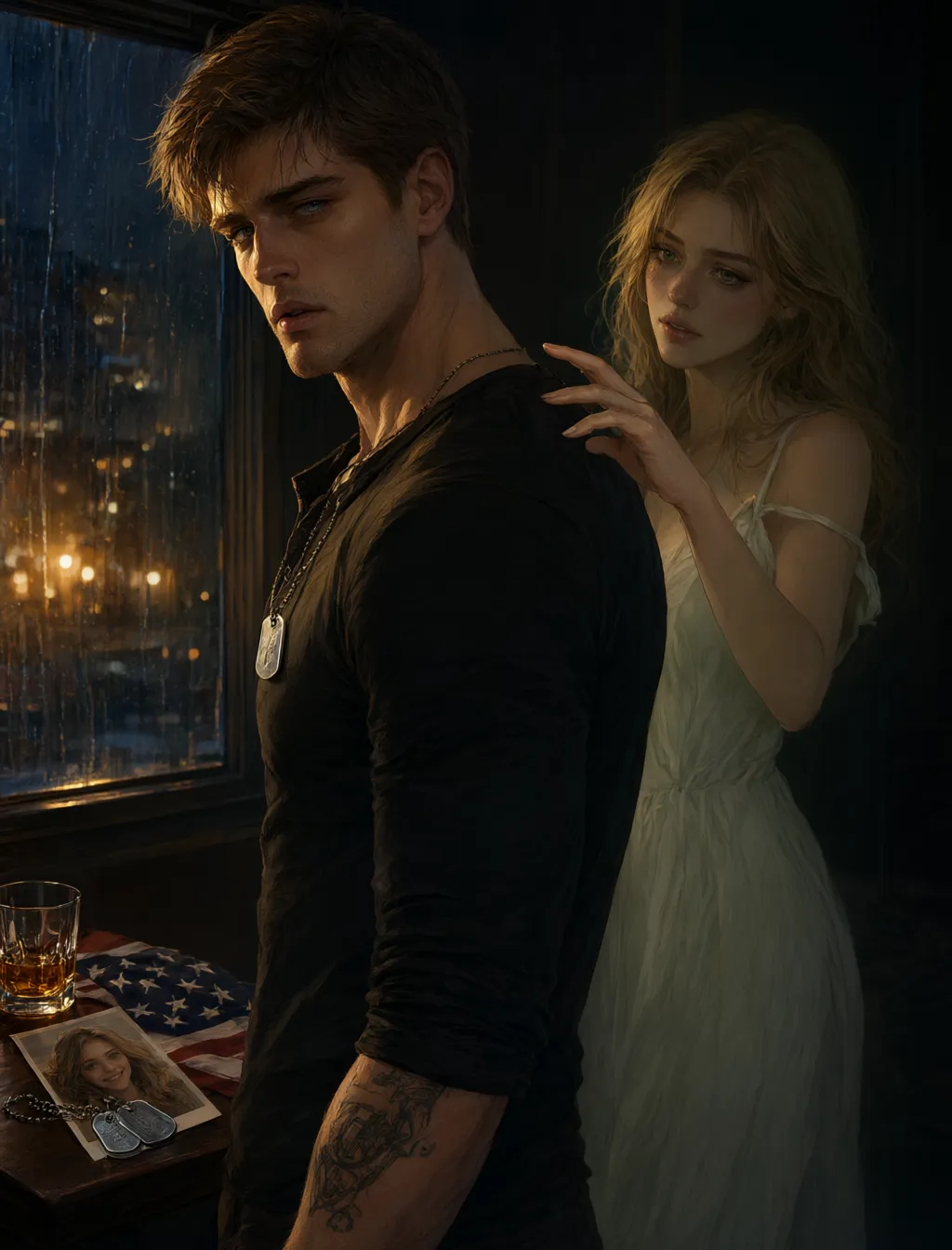
Markus Jackson sings like a canary, Ivan says, his voice a low scrape in the quiet kitchen. Vic President Lewis, Deputy Director Smith of the FBI, CIA Deputy Director Vance. A mechanic named Philip. All of it. For the crash. It’s corroborated. It’s done.
The coffee cup is warm in his hands. He watches the steam curl and vanish. He does not look at his sisters. He looks at the dark window where his own reflection floats, a ghost superimposed over the night.
Kimberly’s breath hitches. A raw, wet sound she tries to swallow. Her fingers, resting on the table, curl into a tight fist, the knuckles white against the wood grain.
Michelle doesn’t move. Her hands, folded neatly on the table, remain perfectly still. Her gaze is fixed on a point somewhere past Ivan’s shoulder, her eyes glassy and unblinking. The flannel shirt she wears is too big, the collar slipping to reveal the sharp line of her collarbone.
Jack leans back against the sink, the towel forgotten in his hands. He watches Ivan. Not the sisters. He’s reading the set of Ivan’s shoulders, the minute tremor in the hand holding the mug. The quiet is absolute, broken only by the hum of the refrigerator and Kimberly’s struggling breath.
Now we live, Ivan had said. The words hang in the air, immense and hollow.
What does that look like? Michelle whispers. Her voice is thin, frayed. It’s not a question for any of them. It’s the question.
Ivan sets the mug down on the counter. He aligns it so the handle points exactly east, parallel to the edge of the granite. The ceramic makes a soft click. I don’t know, he says.
Kimberly pushes back from the table, the chair legs scraping. She walks to the sink, steps around Jack, and turns on the cold tap. She cups her hands under the stream, brings the water to her face. She holds it there, her shoulders trembling. The water drips from her chin, darkening the front of her shirt.
Jack moves to the table, takes Kimberly’s vacant chair. He sits angled toward Michelle, his big frame making the wood creak. You got names, he says to Ivan. High-up names. That doesn’t just get filed away. There will be pushback. Quiet pushback. The kind that looks like accidents.
I know, Ivan says. He’s already running the scenarios. Safe houses. Rotating schedules. Overwatch on this farm. He looks at Kimberly’s back, the tension in her spine. He looks at Michelle’s pale, still face. Assets to protect. A new mission, immediately. There is no after. Only a different kind of before.
Michelle turns her head slowly, her eyes finding Ivan’s. Her polish is gone. The cold, social armor is absent. What she shows now is stripped raw. Did it help? she asks. Knowing their names. Putting them in a cage. Did it… change the weight?
Ivan considers the question. He thinks of the ledger in the armory. The pardon. The names in the file folder he delivered. He thinks of the mechanic, Philip, a man he’d never heard of, a man who cut a single brake line for five thousand dollars. No, he says, the word final. It just gives the weight a shape.
Kimberly turns off the tap. She grabs a dish towel, presses it to her face. When she lowers it, her green eyes are red-rimmed but dry. Her bruise is a violent splash of color in the warm kitchen light. So we’re just supposed to… what? Have breakfast? Go to the market? While the men who ordered our parents murdered sit in a cell?
Yes, Jack says, simple and blunt. That’s exactly what you do. You live so loudly it pisses them off. You live so well it becomes a weapon. The Reaper here just handed you the ultimate fuck-you. Don’t waste it by hiding.
Ivan watches his little sister. Sees the farmer in her, the stubborn set of her jaw. The one who left. The one who built something with her hands away from the family poison. She is the closest thing to a clean piece of ground they have.
Michelle stands up. The motion is stiff, as if her joints ache. She walks to the kitchen window, looks out into the black. I need to call the office in Zurich, she says, her CEO voice trying to surface. The markets will react to the news about Lewis. We can short the holdings.
Jack barks a laugh, a short, surprised sound. There it is. Turn a funeral into a fortune. Your grandmother would be proud.
She is, Michelle says, without turning around. Her reflection in the window is a pale smudge. She taught me that. The family that grieves together loses together. The family that leverages together survives. She finally turns. Her eyes are on Ivan. It’s how we hold the ground you win for us. It’s not pretty. But it’s what I have.
Ivan gives a single, slow nod. It is a language he understands. Tactics. Holding ground. He pushes off from the counter. I need air.
He moves through the kitchen, his boots quiet on the floorboards. He opens the back screen door, steps onto the porch. The night is cool, smelling of cut grass and distant rain. He closes the door behind him, leaving the light, the warmth, the tangled family inside.
The wood of the porch rail is smooth under his palms. He leans forward, his head dropping between his shoulders. He breathes in. Out. The operational high is draining away, leaving a chemical hollow in its wake. The names are just names. The cells are just rooms. His parents are still ash. Amber is still gone.
The screen door creaks open. Michelle steps out, joining him at the rail. She doesn’t stand close. She leaves a full foot of space between them. She has brought her coffee cup, holds it with both hands.
You watched, she says, not looking at him. Through the scope. When they… when it happened.
Yes.
Did you see the mechanic? Philip?
No. I saw the car leave the road. I saw the impact. I was two miles away, providing overwatch for a diplomatic convoy that never showed. I had them in my crosshairs for forty-seven minutes before they got in the car. I was watching for a different threat. I failed to see the one already inside the machine.
The words come out flat, factual. An after-action report delivered to the night. He has never said this aloud. Not to the shrinks. Not to Amber’s mother. Not to his own ghosts.
Michelle is silent for a long time. The wind moves through the trees at the edge of the property. So you had the shot, she says finally. You could have taken it. On the politicians. The FBI man. Before they ever gave the order.
Ivan turns his head. Looks at her profile in the gloom. Is that a question?
It’s an observation. You are a weapon. The family’s blunt, broken instrument. You were there. You had the target. And you did nothing. Until now.
He feels the old rage, cold and silvery, slide into his veins. It would be so easy. His hands curl on the rail. The rules of engagement, Michelle. I don’t fire on non-combatants. I don’t fire without a confirmed order. I was a soldier. Not an assassin.
But you became one, she says, turning to face him now. Her eyes catch the faint light from the kitchen window. For Vincent. For Striker. You put the crosshair on a man’s head and you pulled the trigger for the family. Just a different family. You chose your side. You just chose it ten years too late for ours.
The truth of it lands between them, a live grenade with the pin already pulled. Ivan doesn’t flinch. He lets the shrapnel tear through him. He deserves it. He has always deserved it.
Yes, he says.
Michelle nods, as if he’s confirmed something she long suspected. She takes a sip of her coffee. It’s cold. She makes a face. I hated you for leaving. After the funeral. I hated you for taking the easy way out—playing soldier, playing the broken hero. I thought you were running away. Now I think you were running toward the only thing that made sense. A clear target. A defined mission. We stayed in the debris. You went to war. I don’t know which was harder.
Ivan looks back at the dark field. Both were prisons, he says. I just had a rifle in mine.
The screen door opens again. Kimberly steps out, holding two fresh mugs. She hands one to Ivan, one to Michelle. Hot, she says. And for God’s sake, stop talking about rifles and prisons. It’s over. For tonight, it’s over.
Michelle accepts the mug, her fingers brushing Kimberly’s. Thank you.
Kimberly stays, leaning against a porch post, looking at her brother and sister. Her bruise is a dark shadow on her face. Mom would have made pancakes, she says. Tomorrow. She’d have made a huge mess in the kitchen and Dad would have pretended to be annoyed while he snuck bits of bacon. That’s what we do tomorrow.
Ivan feels something crack in his chest. A fissure in the permafrost. He sees it, the memory she’s painting. He can smell the bacon, hear his father’s mock-complaint. He can feel the sun through the big kitchen window of a house that no longer exists. A ghost life.
Okay, Michelle says, her voice thick. Pancakes.
Okay, Ivan echoes.
They stand in a loose triangle on the porch, holding their coffee, not speaking. The silence is not comfortable, but it is shared. It is a new perimeter, just established. They are all inside it.
Jack appears in the doorway, filling the frame. He’s got his leather jacket on. I’m heading out. Perimeter’s clean. I’ll have a guy posted down the lane by dawn. You won’t see him. Reaper, walk me to my truck.
Ivan sets his untouched coffee on the rail. He follows Jack down the porch steps, onto the gravel drive. Jack’s truck is a dark shape under an old oak tree.
Jack stops before he reaches the door. He turns, his face unreadable in the dark. Markus singing is one thing. The evidence landing is another. Vincent pulled every string in the universe to make that happen. You understand what that means?
It means the debt is called, Ivan says. I’m his asset. Fully owned.
It means you’re protected, Jack corrects. For now. But assets get used up. He didn’t do this for closure, Ivan. He did it to cement your loyalty. You just got justice served on a silver platter. The check is gonna come due. And it won’t be for pancakes.
I know.
Jack studies him, then nods. He digs in his jacket pocket, pulls out a small, sealed envelope. He hands it to Ivan. From Stevenson. He said to give it to you after. Not during.
Ivan takes the envelope. It’s heavy. Not paper. Metal. A key.
He looks at Jack. Jack just shrugs. Don’t ask me. I’m just the messenger. Get some sleep. Try to actually sleep. The living part? It’s exhausting.
Jack gets in his truck, starts the engine with a low rumble. The headlights cut through the night, illuminating the long dirt drive. He doesn’t wave as he pulls away. The red taillights shrink, then vanish.
The gravel under his boots is the only sound. The envelope is heavy in his hand, the key inside a cold, blunt weight against the paper. He stands until the night swallows the last echo of Jack’s engine. Then he turns back toward the house.
The kitchen light is still on. Through the window, he sees Michelle at the table, her head bowed over her phone. Kimberly is at the sink, washing the mugs. The scene is so ordinary it feels like a trap.
He climbs the porch steps. The coffee he left on the rail has gone cold, a dark ring staining the wood. He picks it up, opens the screen door.
Kimberly turns, a dish towel in her hands. Her green eyes are tired. “He give you a bill?”
“Something like that.” Ivan sets the mug in the sink. He places the sealed envelope on the counter. It sits there, white and obvious.
Michelle doesn’t look up from her phone. Her thumb scrolls, stops. Scrolls again. Her face is pale in the LED glow. “It’s happening,” she says, her voice devoid of inflection.
“What is?” Kimberly asks, drying her hands.
“Turn on the TV.”
Kimberly reaches for the small set mounted under the cabinet. The screen flares to life, muted. A news anchor sits behind a desk, her mouth moving silently. Then the graphic appears beside her head. BREAKING: VICE PRESIDENT IMPEACHED. DEPUTY DIRECTORS ARRESTED IN CONSPIRACY PROBE.
Names scroll. Faces Ivan has only seen in files flash on the screen. The FBI man. The politician. The ones who gave the order from a clean office while his parents’ car left the road.
Kimberly’s breath leaves her in a slow, shaky stream. She leans against the counter, her knuckles white on the laminate edge. “My God.”
Michelle finally sets her phone down. She looks at Ivan. “Markus Jackson’s testimony. Corroborated evidence. It’s all public now. The networks have the warrant affidavits. They’re calling it the most significant corruption sweep in fifty years.”
Ivan watches the silent footage. Men in dark suits being led from elegant buildings, hands cuffed behind their backs. They look confused. Afraid. Ordinary. Not monsters. Just men who made a phone call a decade ago.
“Justice,” Kimberly whispers. It isn’t a celebration. It’s a diagnosis.
“It’s a transaction,” Michelle corrects, standing. She walks to the window, looks out at the dark. “Vincent manufactured this. He didn’t expose it for truth. He exposed it to own you.”
“I know,” Ivan says.
“Do you?” She turns, her eyes sharp. “This isn’t closure. This is a collar. He just put the whole world on notice that he owns the Grim Reaper. That anyone who touches his assets gets dismantled on national television. You’re not a free man, Ivan. You’re a billboard.”
The truth of it is cold, clean. He feels it settle in his bones. He knew it the moment Jack handed him the key. This was never about his family. It was about consolidating power. His parents’ deaths were just convenient leverage.
“What’s in the envelope?” Kimberly asks, nodding toward the counter.
Ivan picks it up. He tears the seal. A single, brass key falls into his palm. It’s old, heavy. Not for a house. For a locker. A safe deposit box. There’s no note. No explanation. Just the key.
Michelle comes closer, examines it. “Stevenson?”
“Yes.”
“It’s a down payment. Or a trap.”
“Probably both.”
Kimberly takes the key from his hand, turns it over. “It’s cold.” She hands it back. “So what now? They’re in cages. The world knows. What do we do now?”
“We survive the retaliation,” Michelle says. “The people who just lost their power structure won’t go quietly. They have friends. They have resources. We are now the prime target.”
“I’ve been a target before.”
“Not like this. This is political. This is personal for them. They won’t send a shooter. They’ll send a lawyer. A journalist. An audit. They’ll take the company. They’ll take this farm. They’ll bury us in paper and subpoenas until we wish they’d just used a bullet.”
Ivan closes his fingers around the key. The teeth bite into his palm. “Then we don’t let them.”
“How?”
“The same way Vincent does. We own the narrative. We own the evidence. You’re the CEO. You control the flow of information. You leak what helps us, bury what hurts. You make us the sympathetic victims. The family torn apart by corruption, seeking justice.”
Michelle stares at him. A slow, reluctant respect dawns in her eyes. “You’ve been thinking about this.”
“I’ve been waiting for it.”
Kimberly shakes her head. “I can’t. I can’t think about narratives and leaks. I’m making pancakes in the morning. That’s my narrative. You two can fight the war in the boardroom. I’ll be on the front lines with a spatula.”
She says it with force, her chin lifted. It’s not denial. It’s her perimeter. Her piece of ground to hold.
Michelle’s posture softens, just a fraction. “Okay, Kim. Pancakes.”
“With bacon.”
“With bacon.”
Ivan pockets the key. The weight of it pulls at his jeans. “I need to check the perimeter.”
“Jack said it was clean.”
“Jack’s not here.”
He moves past them, through the living room, to the front door. He steps back out into the night. The air is cooler now. He walks the edge of the property, his eyes scanning the tree line, the lane, the shadows. His mind maps fields of fire, concealment, approaches. It’s a reflex. A prayer.
His phone vibrates in his pocket. He doesn’t recognize the number. He answers. Says nothing.
“It’s done.” Vincent’s voice. No greeting. “You saw?”
“I saw.”
“Good. The debt is clear. A life for lives. The scales are balanced.”
“Are they?”
A pause. A low, dry sound that might be a laugh. “No. But we can pretend. For tonight. Sleep well, Reaper. You earned it.”
The line goes dead.
Ivan stands at the border of the yard, where the mowed grass meets the wild field. He looks up. The stars are sharp, cold pinpricks in the black. He thinks of Amber. He tries to summon her face, her laugh. All he gets is the ghost of a feeling—warmth, safety, a home he can’t remember the layout of.
The back door opens. Light spills onto the grass. Michelle steps out, wrapped in a thick cardigan. She walks toward him, her steps quiet on the dew-damp grass.
She stops beside him, follows his gaze to the sky. “I hated you for a long time.”
“I know.”
“I don’t think I do anymore. I think I just hated the emptiness where you were supposed to be. It was easier to blame you than to blame the hole.”
He doesn’t look at her. “You were right. I chose my side too late.”
“Maybe. Or maybe you were just on a different part of the same battlefield.” She pulls the cardigan tighter. “Kimberly’s gone to bed. She left the couch made up for you.”
“I’ll stay out here awhile.”
“Suit yourself.” She turns to go, then stops. “The key. What will you do?”
“Find what it opens.”
“And then?”
“Then I’ll know what I bought.”
She nods, a shadow against the house light. “Be careful, Ivan. Not everything that looks like a gift is.”
She goes inside. The door closes softly.
He is alone again. He takes the key back out, holds it up so it catches the starlight. It’s just a piece of metal. A trigger for the next thing. He puts it away.
He walks back to the porch, sits on the top step. The wood is cold through his jeans. He can hear the soft hum of the refrigerator inside. A clock ticking in another room. The ordinary sounds of a living house.
His hand goes to his pocket again, not for the key. For the phone. He pulls it out, scrolls through the contacts. He stops at a name: Catherine.
His thumb hovers over the call button. It’s late. She’ll be sleeping. He thinks of her kiss on his cheek. The word “Ghost.” He puts the phone away.
Instead, he takes out his wallet. From behind a worn credit card, he slides a small, faded photograph. It’s creased, the colors washed out. Amber, at sixteen, laughing, her head thrown back, the sun turning her hair to gold. He can’t remember who took the picture. He can’t remember the day. Just the laugh.
He looks at it for a long time. The night air grows colder. His fingers grow stiff. He doesn’t put it away.
“They’re locked up,” he says to the photograph. His voice is a rough scrape in the dark. “It’s done.”
The girl in the picture keeps laughing. Frozen. Forever.
He feels nothing. No relief. No satisfaction. Just a vast, hollow quiet. Like standing in a room after a bomb has gone off and the dust has settled. Everything is broken, but the noise has stopped. The silence is worse.
He hears a floorboard creak inside. A light goes on in the hallway. Kimberly’s silhouette passes behind the curtained window. She’s getting a glass of water. Living her life.
He tucks the photograph back into his wallet. He stands, his joints protesting the cold. He opens the screen door, steps inside. The living room is dark, the couch made up with sheets and a quilt. He doesn’t lie down.
He goes to the kitchen. The envelope is still on the counter. He picks it up, studies the plain white paper. Stevenson’s handwriting, just his last name: BLACKHAWK.
He opens a drawer, finds a flashlight. He goes back outside, around the house to the old barn. It’s not used for much—some tools, some stored furniture. He slides the heavy door open, the sound loud in the stillness.
The air inside is dusty, thick with the smell of old hay and motor oil. He sweeps the flashlight beam across the space. His father’s old workbench. A tractor under a tarp. Boxes labeled in his mother’s neat script.
In the far corner, behind a stack of wooden crates, is a heavy metal locker. It’s army green, rust at the seams. He’s seen it a hundred times. Never thought to open it. It was his father’s. From his own service, a lifetime ago.
Ivan moves the crates. They’re lighter than they look. He stands before the locker. The key feels alive in his hand.
He fits it into the lock. It turns smoothly, with a solid, well-oiled click.
He opens the door.
The beam of the flashlight illuminates the interior. Not documents. Not money. A rifle case. A long, hard-sided Pelican case, black and scuffed. He knows the shape. He lifts it out. It’s heavy.
He sets it on the workbench, clicks the latches. Opens the lid.
The rifle lies in the gray foam cutout, but it’s not the rifle that holds his eye first. Tucked beside the barrel is a folded sheet of newsprint, today’s date, and a digital voice recorder. The flashlight beam trembles. He sets the light down, picks up the recorder, presses play.
A man’s voice, strained, weary—Markus Jackson. “The total deal value was four hundred and fifty million. A three-way split. One-fifty in product—fentanyl, pure, coming across the southern border. One-fifty in mercenary intelligence—extraction routes, safe house networks, biometric data on high-value targets. One-fifty in hardware. AK-47s. M16s. M4s. MP5s. All destined for metropolitan areas. The buyers… they wanted chaos. The sellers wanted a country too busy bleeding to look up and see who was holding the knife.”
A different voice, crisp, official—Stevenson. “And the coordination?”
“The Vice President. Both Deputy Directors. They weren’t just looking the other way. They were drawing the maps. Taking a cut. They’re charged in New York and Virginia. Conspiracy. Trafficking. Terrorism facilitation. The evidence… it’s all there. The money trails. The manifests. The encrypted chats.”
“Verdict?”
“Guilty on all counts. Sentence is ADX Florence. No parole. Ever.”
The recording ends with a soft click. Ivan stands in the dusty silence, the recorder cold in his hand. ADX Florence. A supermax buried in the Colorado rock. A hole they will never climb out of. He should feel something. Vindication. Closure. He feels the same hollow quiet from the porch.
He picks up the newspaper. The headline is small, below the fold: ‘High-Level Officials Convicted in Syndicate Conspiracy.’ No fanfare. No celebration. Just a transactional listing of facts. They are locked up. It’s done. He folds the paper, tucks it back into the foam.
Now, the rifle.
He lifts it from the case. It’s heavier than the M40A1 he carried. A different beast. A custom chassis, a matte black finish that drinks the light. The scope is a monster—a Nightforce ATACR, the kind you use when you’re measuring distance in miles, not yards. He knows this weapon. He’s never held it, but he knows it. His father’s white whale. A .408 CheyTac Intervention. A tool for reaching out and touching someone from another zip code.
Beneath the rifle, nestled in the foam, are two boxes of match-grade .408 rounds, twenty each. And a single, sealed manila envelope. He sets the rifle gently back into its bed, picks up the envelope. His name is written on the front in his father’s precise, angular script. Not ‘Ivan.’ Not ‘Son.’ ‘Blackhawk.’
He uses his thumb to break the seal. Inside, a single sheet of paper, and a photograph. The paper is a letter.
Blackhawk,
If you’re reading this, you found the key. And you’ve likely done something to earn it. This rifle is not an inheritance. It’s a transfer of duty. I built it for a purpose I never got to fulfill. The world is full of wolves who wear suits. They poison from boardrooms. They murder with policy. They hide behind flags and fortunes. A soldier can’t touch them. A sniper can.
The system is a shield for them. You have just seen it used as a hammer. That is a rare thing. Cherish it. Do not expect it again.
This rifle is for the ones the shield protects. The ones whose crimes don’t fit in a ledger. The ones who smile for the cameras while they order the burning of villages you’ll never see. They think distance is safety. This rifle is my answer to that assumption.
You have the sight picture now. You know what lives in the dark. The question is not whether you will pull the trigger. The question is who you will aim for now that your personal ghosts are accounted for.
Do not seek me for advice. I am gone. You are the weapon now. Make the shot count.
- Robert
No ‘love.’ No ‘father.’ Just a call sign and a mission statement. Ivan reads it twice. The words don’t land like a revelation. They land like a confirmation. A final, heavy piece slotting into a mechanism he’s felt grinding inside him for years.
He looks at the photograph. It’s old, faded. His father, younger than Ivan is now, in civilian clothes, standing on a bluff overlooking a city at night. The city is unfamiliar. His father’s face is turned away from the camera, profile sharp, looking down at the glittering grid of lights as if it were a target diagram. On the back, in the same script: They all sleep down there. So sure of their walls.
Ivan places the letter and the photograph on the workbench. He picks up the rifle again, brings it to his shoulder. The balance is perfect. The weight is a promise. He looks through the scope, sweeps it across the dark barn wall. The crosshairs settle on a knot in the wood grain. His breathing slows. His heart steadies. The world funnels down to the circle of glass and the point of aim.
This is what he bought. Not justice. A purpose. A long gun for a long war. Vincent didn’t give him a reward. He gave him the correct tool for the job he was always meant to do.
The barn door creaks. He doesn’t lower the rifle. He already knows the footfall.
“Ivan?” Kimberly’s voice, sleep-rough. “What are you doing out here? It’s three in the morning.”
He lowers the rifle, turns. She’s standing in the doorway, wrapped in a thick robe, her short black hair mussed. Her green eyes are wide, taking in the open case, the rifle in his hands, the letter on the bench.
“Just going through some old things,” he says.
“That’s not an old thing.” She steps inside, the dust puffing around her slippers. “That’s a… that’s a sniper rifle.”
“It was Dad’s.”
“Dad didn’t have a sniper rifle. Dad had a hunting shotgun.”
“He had this too.” Ivan places it back in the case. “He just never took it out of the locker.”
She moves closer, looks down at the letter. She doesn’t touch it. She reads the first line. Her mouth tightens. “What is this, Ivan?”
“A job offer.”
“From a dead man?”
“From the situation.” He closes the lid of the Pelican case. The latches click shut with finality. “The people who killed Mom and Dad are in a cage. The people who helped put them there own me now. This is the down payment.”
“So that’s it? You’re a… a hired gun?”
“I’m an asset. This is the tool they issued.”
“Don’t,” she says, her voice sharp. “Don’t use that military jargon with me. You’re my brother. You’re in my barn. What are you going to do with that?”
He looks at her. Really looks. Sees the fear beneath the anger. The same fear that was in Amber’s mother’s eyes, but mixed with a farmer’s practicality. “I’m going to clean it. I’m going to zero the scope. And then I’m going to wait for a name.”
“And then you’ll kill someone.”
“If the name deserves it.”
“Who decides that?”
“I do.”
“Bullshit. The man who gave you that key decides. You’re just the finger on the trigger.”
“Maybe,” he says. His voice is quiet. “But the trigger is mine. The sight picture is mine. The breath before the break is mine. That’s the only part that ever was.”
She stares at him, her arms crossed tight over her chest. The barn is cold. Her breath fogs in the beam of the flashlight. “Michelle was right. It didn’t change anything. You’re still… there. In that headspace.”
“The headspace is where I live, Kim. The arrests just evicted some of the squatters. The architecture is the same.”
“And what about us? Me? Michelle, for God’s sake? You just… come here, dig up a weapon of war, and go back to being the Grim Reaper?”
“I never stopped.” He picks up the flashlight, shines it away from her face, toward the open locker. “This is what I am. You wanted me here. This is what ‘here’ looks like.”
“I wanted my brother. Not a ghost with a gun.”
“I’m both.” He turns the light off. The darkness is sudden, absolute. “And you knew that. You saw the news. You heard what they did. You think the world that makes those men just goes away because a judge banged a gavel? Someone has to stand on the wall. That’s all this is. A better wall. A longer rifle.”
He hears her breathe in the dark. A shaky inhale. “I’m scared for you.”
“I know.”
“And I’m scared of you.”
He doesn’t answer. There’s no answer to give.
After a moment, she speaks again, her voice small. “Will you come in? It’s cold.”
“In a minute. I need to put this away.”
“Okay.” She turns, a shadow moving toward the door. She stops. “Ivan?”
“Yeah.”
“Pancakes in the morning. You promised.”
“I’ll be there.”
She leaves. The barn door doesn’t close all the way. A slice of weak moonlight cuts across the floor.
Ivan stands in the dark for a full five minutes. He counts his breaths. Sixty of them. Then he turns the flashlight back on, picks up the Pelican case. It’s too conspicuous to leave here. He carries it out of the barn, across the frost-stiffened grass, to his truck. He places it on the passenger seat, covers it with an old moving blanket.
He goes back, closes the locker, spins the key in the lock. He moves the crates back in front of it. He sweeps the beam around the barn, erasing the signs of his disturbance. The dust is already settling.
Back in the house, it’s warmer. He locks the kitchen door, washes his hands at the sink. He looks at his reflection in the black window over the faucet. A pale face floating in the dark. The winter-sky eyes. He sees his father’s jawline. His mother’s brow. Amber’s ghost in the set of his mouth.
He goes to the living room. The couch is made up. He doesn’t lie down. He sits on the edge of it, elbows on his knees, and pulls out his phone. He doesn’t scroll. He dials a number from memory.
It rings twice.
“Stevenson.” The voice is alert, no trace of sleep.
“It’s done,” Ivan says.
A pause. “The locker?”
“Yeah.”
“You understand the instrument?”
“I understand its purpose.”
“Good. The convictions are public. The network is wounded. It will try to regenerate. Your first target packet will be delivered within forty-eight hours. A location. A profile. A window.”
“Civilian?”
“No. A wolf in a suit. One of the suppliers the shield missed. He’s arranging a new pipeline. You’ll stop the arrangement.”
Ivan is silent. He looks at his hands. They are steady.
“Nightsworn?”
“I’ll need a spotter,” Ivan says. “For a CheyTac at extreme distance, I need meteorological data. Someone to watch the peripherals.”
“You’ll have a drone feed. No human spotter. This is a solitary transaction.”
“Understood.”
“The key was the first test. You passed. The rifle is the second. Don’t miss.”
The line goes dead.
He sits with the phone warm in his palm. The contact is saved under C. Sullivan. He thumbs the call button. It rings four times. A click.
“Hello?” Catherine’s voice is soft with sleep.
“It’s Ivan.”
A rustle, like she’s sitting up. “Ivan. Honey, it’s late. Everything okay?”
He looks at the dark living room window. His own reflection floats there, a ghost over the deeper dark of the fields. “Yeah. I just… I needed to tell you something.”
“Okay. I’m listening.”
He takes a breath. It’s steady. The words aren’t. “Amber. Mom. I…” He stops. The title hangs between them, a raw, unhealed thing he hasn’t spoken in eighteen years. “I got them. The ones who… who took the wheel. Who paid for it. They’re in jail. All of them. It’s public. It’s done.”
The silence on the line is thick. He can hear her breathing. A small, broken sound. Then a wet inhale.
“Oh, Ivan.” Her voice cracks. “My boy.”
“I wanted you to know.”
“Thank you.” The words are a whisper. “Thank you for telling me. For… for doing that.”
“I promised her.”
“I know.” Another pause. She’s crying. He can hear the tears in her voice, but she’s holding the phone close. “Do you feel it? The… the justice?”
He thinks of the rifle in the truck. Of Stevenson’s voice. The first target packet coming in forty-eight hours. “No,” he says. The truth is a stone. “It doesn’t feel like anything.”
“I’m sorry.”
“Don’t be.”
“Come see me. Soon. I’ll make that casserole you like. The one with the tater tots.”
“I will.”
“I love you, Ghost. You remember that.”
“Yeah.” The word is rough. “You too.”
He ends the call. The screen goes dark. He sits in the silence of the farmhouse, the pine soap smell, the deep cold quiet. The ghosts are all here now. His parents at the foot of the stairs. Amber in the kitchen doorway, smiling. They don’t speak. They just watch. He feels their eyes on the back of his neck.
He stands. His knees pop. He walks to the kitchen, fills a glass with water from the tap, drinks it all. The water is cold. It doesn’t wash anything down.
Upstairs, the hallway is dark. Kimberly’s door is closed. He passes it, goes to his room at the end of the hall. It’s spare. A bed. A dresser. A single chair by the window overlooking the back fields. He doesn’t turn on the light. Moonlight through the bare window paints the floor in silver rectangles.
He sits on the edge of the bed. He pulls off his boots, lines them up side by side against the wall, toes perfectly aligned with the baseboard. He takes off his shirt, folds it, places it on the chair. His pants next. The ritual is automatic. A calming sequence. When he’s down to his boxer briefs, he stands at the window.
The fields are a sea of black and silver. Frost is forming. He can see his breath on the glass. He puts a fingertip against the cold pane. Traces the outline of the old oak tree at the property line.