

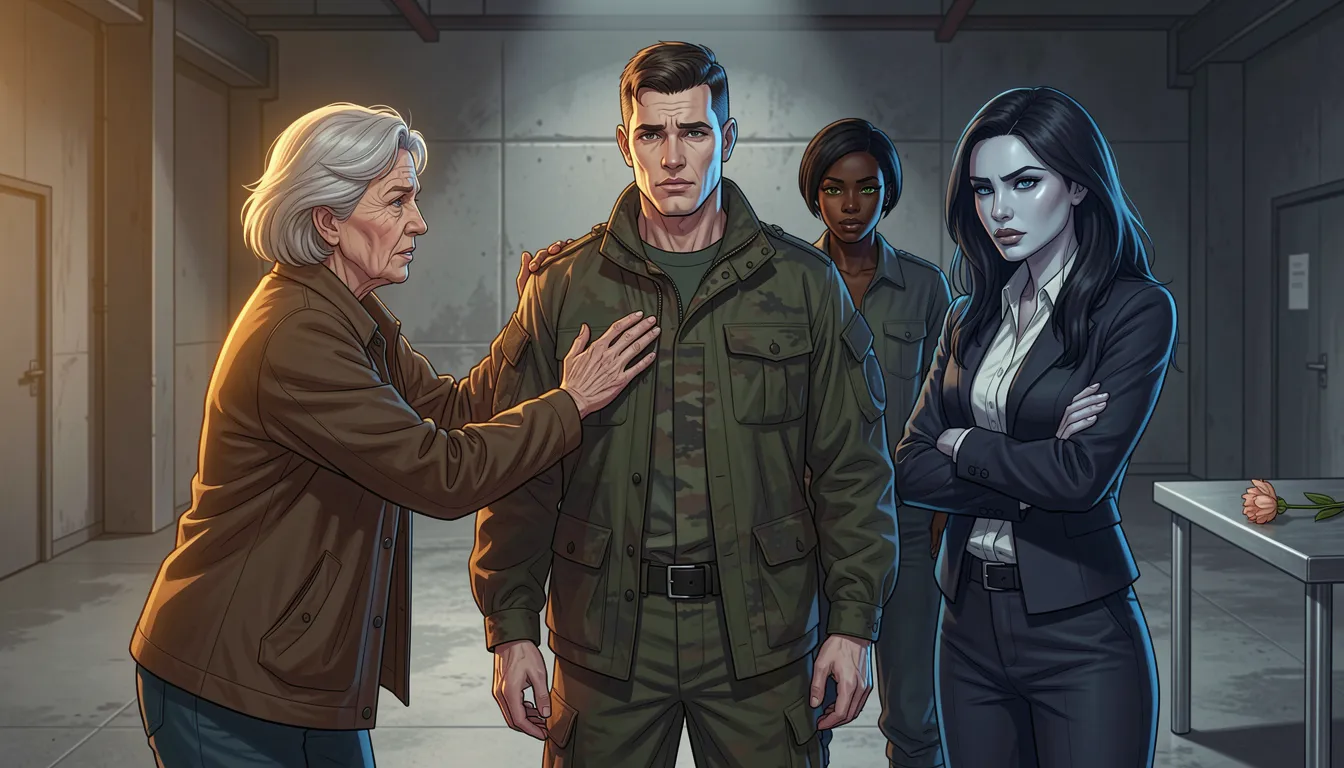
The air inside Hubco was thick with the smell of hot metal and old coffee. The low, constant thrum of machinery vibrated through the concrete floor. Ivan stood by a rack of galvanized steel fittings, his back to the main aisle, running a gloved thumb over the sharp threads of a coupling. He was counting. Fourteen threads per inch. Standard for two-inch pipe. The rhythm of it was a tether.
He heard the voices first. A man’s, low and practical. A woman’s, softer, with an accent he hadn’t heard in ten years. Not Chinese. Taiwanese. A specific lilt from a hillside outside Taipei.
He didn’t turn. His thumb stopped on the fifteenth thread that wasn’t there. The vibration in the floor climbed his boots, settled in his molars.
“I think these are the brackets, John. The zinc-coated ones.”
Ivan closed his eyes. The warehouse sound faded into a different roar—rotor wash, the crack of distant small-arms fire, the smell of cordite and wet earth. A rooftop. A scope’s crosshair settled on a girl in a yellow dress, standing beside an old man in a wheelchair. Striker’s voice in his ear: *Terminate the asset. She’s a courier for the Red Dragon.* The order had been wrong. The intel had been rotten. The girl’s name was Maria Chen. She was seventeen.
He had exhaled, half the breath out, finger resting on the trigger curve. And he had shifted the crosshair two inches left, onto the armed guard lurking in the doorway behind her. One shot. Through-and-through. The guard dropped. The girl had frozen, then looked up, directly at his hidden position a thousand meters away, as if she could see him.
“Sir? Excuse me?”
The present voice was closer. Male. Ivan turned.
The man was in his fifties, wearing a clean work jacket. Beside him, a woman. Older now. Hair shorter. Lines around her eyes. But the eyes themselves were the same. Dark, intelligent, wide with a shock that mirrored the one locking Ivan’s own lungs.
Maria Chen stared at him. Her mouth opened. No sound came out. Her husband, John, glanced between them, confused.
“Maria?” John said.
She took a step forward. Then another. She stopped an arm’s length away, her gaze tracing the scar that cut through Ivan’s brow, the weathering of his face, as if deciphering a faded map. “It’s you,” she whispered. The English was fluent now, but the accent was still there, wrapping around the words. “The ghost on the roof.”
Ivan’s throat was concrete. He managed a single, stiff nod.
She didn’t hug him then. She reached out, slowly, and placed her hand flat against the center of his chest, over the faded Hubco logo on his shirt. She held it there, feeling the beat underneath. Her eyes filled. “My brother,” she said, the words cracking. “My parents. They were in the next building. The guard you killed… he was there to take them. To make an example.” A tear tracked through the dust on her cheek. “You saved all of us.”
Then her composure broke. A sob wrenched out of her, and she stepped into him, her arms going around his ribs, her face pressing against his shoulder. Ivan stood rigid, his own arms at his sides, coated in fine metal dust. He looked over her head at her husband, who now understood, his face softening into a grave respect. Ivan’s hands came up, hovered, then settled awkwardly on her back. He felt the shudder of her crying through his palms.
He didn’t cry. His eyes burned, dry and hot. The warehouse sounds—the forklift beep, the air compressor hiss—muffled into a distant hum. All he could hear was her weeping and the echo of Striker’s voice. *Terminate the asset.* He saw the ledger in Eleanor’s armory, the price paid for his pardon. This woman, alive. Her family, alive. That was the math. That was the good piece.
“Thank you,” she wept into his shirt. “Thank you for saving me. My brother, my parents… that day.”
His voice, when it finally came, was rough gravel. “You remember.”
She pulled back, wiping her face with her sleeves, laughing through the tears. “Remember? I looked for you. For years. After we were extracted, I asked every American officer. They said the sniper team was black ops. No record. I thought you were a story I told myself to sleep.” She touched his face, her fingers cold against his cheek. “You are real.”
John moved closer, putting a supportive hand on his wife’s shoulder. “She named our first son after you,” he said quietly. “We didn’t have a name. Just ‘the Reaper.’ We couldn’t name a child Reaper. So we called him Ian. Close enough.”
Ian. A boy with a name stolen from a ghost. Ivan’s vision blurred at the edges. He focused on a spot on the concrete floor, a stain of dried hydraulic fluid. “He’s alive?” he asked, the question absurd the moment it left him.
“He’s ten,” Maria said, her smile radiant through the tear tracks. “He is loud and he loves baseball and he is terrible at math. He is alive because of you.”
Ivan nodded, the motion jerky. He needed to count something. The brackets on the shelf. The lights in the ceiling. Anything.
“What are you doing here?” Maria asked, gesturing at the warehouse, at his gloves.
“Work,” Ivan said.
“You live here? In this city?”
“Yes.”
She turned to her husband, a silent, urgent conversation passing between them in a glance. John nodded. Maria looked back at Ivan. “You will come to dinner. Tonight. You will meet Ian. You will meet my parents. They are here, they live with us now.”
“I can’t.” The refusal was automatic, tactical. Civilian entanglement. A security risk.
“You can,” she said, and the softness was gone, replaced by a ferocity that had survived war and displacement. “You saved my life. You gave me a life. You will sit at my table and eat the food my mother cooks. You will see what you saved.”
John pulled a pen and a receipt from his pocket, scribbling on the back. He handed it to Ivan. An address. A time. 7 PM. “We’re serious,” John said. “It would be an honor.”
Ivan took the paper. The numbers blurred. 7 PM. A threshold. He stared at it.
Maria reached up and kissed his cheek, a dry, chaste press of lips against his stubble. “Tonight,” she whispered. Then she took her husband’s hand, collected the zinc-coated brackets, and walked toward the front checkout, leaving Ivan alone in the aisle.
He stood there, the receipt crumpling slightly in his grip. The thrum of the machinery was inside his skull now. He could smell her shampoo on his shoulder, a faint scent of jasmine over the oil and metal. He looked at the rack of couplings. The counting was gone. The tether was gone.
In his mind, he saw a boy of ten. Loud. Loving baseball. Terrible at math. A boy named Ian who existed because a rifle barrel had moved two inches to the left on a rainy day a decade ago. The ledger of his life had one clean line. One debt that wasn’t a debt. One ghost that had walked out of the past, alive.
He folded the receipt carefully, aligning the edges, and slid it into his front pocket. He picked up a coupling, hefted its weight, and placed it back on the shelf, its threads perfectly aligned with the others. Then he walked toward the warehouse office, the address burning a hole against his thigh with every step.
The house was a split-level in a quiet suburb, the kind of neighborhood where garage doors went down at dusk and porch lights stayed on all night. Ivan parked his truck two houses down, killed the engine, and sat for ten minutes watching the front window. A shadow moved past the curtain. Another. He counted them. Five distinct shapes. The math was wrong. He’d accounted for Maria, John, the boy Ian, her parents. That was five. The extra shape was small. A child.
At 7:03 PM, he got out. He’d changed into a clean black t-shirt and dark jeans, his boots the same. He’d shaved. The skin on his jaw felt raw. He walked up the driveway, his footsteps silent on the asphalt. The air smelled of cut grass and something frying—garlic, ginger, oil. His stomach tightened. He hadn’t eaten since morning.
He rang the bell. A chorus of voices hushed inside. The door opened.
Maria stood there, wearing an apron over a simple dress. Her face broke into a smile so wide it erased the lines around her eyes. “You came,” she said, as if she’d half-convinced herself he wouldn’t.
“I said I would,” Ivan said.
She grabbed his wrist and pulled him inside. “Everyone, he’s here!”
The front room was warm, lit by lamplight, crowded with furniture and family. An older man and woman and lance chen—Maria’s and lance parents—stood from the sofa. The man, David Chen, was slight, with thick glasses and a gentle stoop. The woman, Sue, had Maria’s eyes. She pressed her hands together and bowed her head slightly. John stood by the archway to the dining room, holding a wooden spoon. “Ivan,” he said, nodding.
And there were two boys. One was maybe ten, lean and restless, bouncing on the balls of his feet. The other was younger, six or seven, clinging to his grandfather’s pant leg.
“This is Ian,” Maria said, placing a hand on the older boy’s shoulder. “And this is Leo lance son. Our surprise. He came after we moved here.”
Ian stared up at Ivan, his expression not fearful, but intensely curious. “You’re the guy from the roof,” he said.
“Ian,” John chided softly.
“It’s okay,” Ivan said. His voice felt too loud in the room. He looked at the boy. “Yeah. I was on the roof.”
“Did you really shoot that bad guard?” Leo piped up, his voice smaller.
The room went still. Sue Chen let out a soft sigh. Maria’s hand tightened on Ian’s shoulder.
Ivan crouched down, bringing himself to Leo’s eye level. The boy didn’t flinch. “I did,” Ivan said, the words clear and quiet. “He was going to hurt your family. I stopped him.”
Leo considered this, then nodded solemnly. “Good.”
Ivan stood back up. His knees popped. David Chen stepped forward, extending a hand. His grip was surprisingly firm. “Thank you,” he said, his English careful. “For my family. For my daughter.”
“You’re welcome,” Ivan said, because no other words fit.
Sue approached next. She didn’t offer a hand. She reached up and cupped his face, her palms cool and dry. She studied him, her dark eyes moving over his features, and she said something in rapid Mandarin. Maria translated softly from behind him. “She says you have lonely eyes. She says you will eat until they are full.”
Sue patted his cheek and turned toward the kitchen, calling over her shoulder.
“She says to sit. Food is ready,” Maria said, smiling. “Please.”
The dining table was already laden. Plates of dumplings, glazed pork, stir-fried greens, a whole steamed fish with ginger and scallions, a bowl of soup that smelled of star anise. Ivan was guided to a seat between Ian and John. The boy immediately turned to him. “Do you still have the gun?”
“Ian,” Maria and John said in unison.
“It’s a fair question,” Ivan said. He looked at the boy. “Yes. I have it.”
“Can I see it?”
“No.”
“Why not?”
“Because it’s not a toy. It’s a tool. And tools have one job. That job is over for that one.”
Ian processed this, his brow furrowed. “So you don’t use it anymore?”
“I clean it. I keep it ready. But its job is done.”
“That’s sad,” the boy said, and he picked up his chopsticks.
The food was passed. Ivan took small portions, watching how the others served themselves, mirroring their movements. Sue Chen kept glancing at his plate and, seeing it not full enough, would reach over with her serving chopsticks and deposit another dumpling, another slice of pork. He lost count after the fourth addition.
The conversation was a gentle chaos. Leo chattered about a lost tooth. David talked about his garden. John asked Ivan about Hubco, about the work, and Ivan gave short, factual answers. Maria watched him, her gaze soft. Ivan ate. The flavors were complex, layers of salt and sweet and heat. It was the best food he had tasted in years, maybe ever. He chewed slowly. He listened.
“So you live in the big house? The one on the hill?” Ian asked between bites.
“Yes.”
“Is it haunted?”
“Ian,” Maria sighed.
“It’s okay,” Ivan said. He set his chopsticks down, aligning them perfectly with the edge of his bowl. “Yes. It’s haunted.”
“By who?”
“By me.”
The boy fell silent, thinking hard. Then he nodded, as if that made perfect sense. “Cool.”
After the main dishes were mostly gone, Sue brought out a plate of orange slices and small, delicate pastries. Tea was poured. Ivan’s stomach was a warm, tight drum. He felt overfull, a sensation so foreign it was almost alarming.
David Chen leaned forward, his glasses catching the light. “Maria says you were alone. After the war.”
“I was.”
“No family?”
“I have family. They’re… complicated.”
David nodded slowly. “Family is always complicated. But it is blood. It is root. You cannot grow new roots from old scars.” He gestured around the table. “This is our new root. In new soil. It is strong because we tend it.” He looked at Ivan. “You are welcome to sit at this root, Ivan. Whenever you need to sit.”
The offer hung in the air, simple and immense. Ivan looked at his hands, resting on the tablecloth. He saw the faint tremor in his right thumb, the one that appeared when he was tired or when the ghosts got loud. He made a fist, then relaxed it. The tremor stopped. “Thank you,” he said, the words inadequate.
Later, Ivan helped John clear the plates. In the kitchen, the older man ran hot water into the sink. “She talks about you, you know. Not all the time. But on certain days. The anniversary. Sometimes when it rains hard.”
Ivan stacked plates carefully. “She shouldn’t.”
“Maybe. But she does. You’re not a ghost to her. You’re the reason the sun came up.” John handed him a dish towel. “It’s a heavy thing to be.”
“I don’t feel like the sun.”
“No,” John agreed, scrubbing a pot. “You feel like a man who carried something too far and doesn’t know how to put it down. I recognize it. I was infantry. Two tours. Not a sniper. But I carried my own weight.”
Ivan dried a plate, focusing on the circular motion of the cloth. “How do you put it down?”
“You don’t. You learn to stand straight under it. You find people who don’t mind the weight.” John nodded toward the living room, where the sound of the boys laughing tumbled in. “They don’t mind.”
When they returned to the living room, Ian was holding a baseball glove. “Will you play catch with me?”
“Ian, it’s dark,” Maria said.
“The porch light is bright. Please?”
Ivan looked at the glove, then at the boy’s expectant face. He hadn’t thrown a ball in twenty years. “I’m rusty.”
“That’s okay. I’ll teach you.”
The night air was cool. The porch light cast a yellow cone over the small front lawn. Ivan stood on the grass, the dew already soaking into his boots. Ian stood about twenty feet away, winding up with a dramatic windmill motion and launching the ball. It sailed high and wide. Ivan took two long steps to his left, his hand snapping up. The ball smacked into his palm with a solid thwack. The impact traveled up his arm, a clean, simple vibration.
“Wow,” Ian breathed. “You caught it.”
Ivan looked at the ball in his hand. A simple leather sphere, seams raised. He threw it back. A smooth, underhand arc. It landed perfectly in Ian’s glove.
They threw the ball back and forth. No words. Just the thump of leather, the rustle of Ivan’s jeans as he moved, the boy’s occasional grunt of effort. The rhythm was meditative. Ivan’s mind emptied of everything but the trajectory of the ball, the give of the grass, the faint scent of night-blooming jasmine from a neighbor’s yard.
After maybe ten minutes, Ivan saw Maria watching from the window, her silhouette framed in the light. She was smiling. He threw the ball one last time, a little softer. Ian caught it and ran over, his face flushed. “You’re really good.”
“You’re not terrible,” Ivan said.
The boy beamed. “Will you come back and play again?”
Ivan looked past him, at the house, at the window where Maria still stood. He looked down at Ian. The boy had his mother’s eyes. “Yeah,” Ivan said. “I can do that.”
Inside, it was time to go. The goodbyes were a series of gentle touches. Sue Chen pressed a container of leftovers into his hands. David shook his hand again, holding it a moment longer. Leo hugged his leg. John clapped him on the shoulder. Maria walked him to the door.
On the front step, she hesitated. “This was… it was good. For them. For me.”
“For me too,” Ivan said, and he was surprised to find he meant it.
She reached out, her fingers brushing the back of his hand. “You are not alone, Ivan. You saved a family. That family is yours now, too. If you want it.”
He nodded, unable to speak around the thickness in his throat.
She leaned in and kissed his cheek again, the same spot as before. “Goodnight, Ghost.”
He walked back to his truck. The container of food was warm in his hand. He started the engine but didn’t pull away. He watched the house. The porch light went off. A light upstairs came on—a boy’s bedroom, maybe. Then another light, probably the master bedroom. One by one, the windows went dark.
He sat there in the quiet cab, the smell of garlic and ginger and family filling the space around him. He thought of the ledger in his grandmother’s armory, the debt called due for his pardon. He thought of the boy named Ian, alive and terrible at math. He thought of the weight John had spoken of, and the people who didn’t mind it.
He reached into his pocket and pulled out the receipt with the address. It was soft from handling. He folded it once more, a precise crease, and placed it in the center console. Not thrown away. Archived.
Then he put the truck in gear and drove slowly away from the warm house, the leftovers on the passenger seat, the echo of a baseball thumping into a glove still in his bones. The night was clear, the streets empty. He drove toward the dark hill where his own haunted house waited, but for the first time in a long time, the silence in the cab didn’t feel like being alone. It felt like a space between breaths. It felt like a held moment, full and warm and temporary, and he was in no rush for it to end.
Ivan showed up at 6:50 PM. The door opened to a wall of sound—laughter, the sizzle of a wok, a child’s shriek of joy. Maria pulled him inside, her hand warm on his arm. “You came.”
The dining table was extended with two extra leaves, covered in a floral plastic tablecloth. Places were set for ten. John stood from the head of the table, a beer in hand. “Ivan. Good.” He gestured around the room. “My brother-in-law, Lance. His wife, Tia. Their son, Leo. You her parents, David and Sue.”
Lance Chen was built like a linebacker, with a wide, easy smile. He shook Ivan’s hand, his grip firm and assessing. Tia was smaller, sharper, her eyes missing nothing. Leo, maybe six, peered from behind his father’s legs. “Are you the soldier?”
“Leo,” Tia chided gently.
“It’s fine,” Ivan said. He looked down at the boy. “Yeah. I was.”
Dinner was a chaotic, fragrant symphony. Platters of ginger-scallion lobster, clay pot chicken, stir-fried greens with garlic, and a whole steamed fish passed from hand to hand. Ivan sat between Ian and an empty chair that quickly filled with Leo, who had decided Ivan was the most interesting thing in the room. Questions came between bites. Did he have a gun? Had he ever been shot? Did he know how to fly a helicopter?
Ivan answered in short, true sentences. “Yes. No. No.”
John watched, a faint smile on his face. Maria kept putting more food on Ivan’s plate. “Eat. You’re too thin.”
After the third helping, John pushed back his chair. “Alright. Leo, Ian—you two are excused. Ivan, you’re with us. Basement. Video games.”
The basement was a finished rec room, a large TV mounted on the wall, a worn sectional sofa, and shelves lined with board games and trophies. John handed Ivan a controller. “Ever play?”
“Not in about twenty years.”
“Good. These two cheat.”
They played a racing game. Ivan’s car spent most of the first race facing the wrong way, grinding against a guardrail. Leo howled with laughter. By the third race, Ivan had the mechanics—the trigger for acceleration, the stick for steering. He came in second. Ian cheered. “You almost beat Dad!”
Upstairs, the clatter of dishes being cleared drifted down. The murmur of adult conversation, lower, more serious. Ivan felt the shift in the house’s atmosphere like a change in barometric pressure.
John paused the game. The screen froze on a spray of digital sparks. “Boys. Go help your grandmother with the dessert dishes.”
“But Dad—”
“Now.”
The boys trudged upstairs, leaving a sudden, heavy quiet. John set his controller on the coffee table. He didn’t look at Ivan. “They’re going to talk about it. What happened. Maria told Tia. Tia will have questions. Lance… he’ll listen. Her parents, they know some, not all. You don’t have to stay for it.”
Ivan stared at the frozen screen. A car hung in mid-air over a canyon. “I’ll stay.”
“Okay.” John stood. “Then we go up.”
The dining table was cleared. A pot of tea steamed in the center, surrounded by small ceramic cups. The adults were seated. The boys were conspicuously absent, the sound of a cartoon floating from the living room. An empty chair waited between Maria and Tia. Ivan took it.
For a minute, no one spoke. The only sound was Sue pouring tea, the gentle *glug-glug* of liquid filling a cup.
Tia broke the silence. Her voice was quiet, direct. “Maria told me what you did. That night. In the jungle.”
Ivan nodded once.
“She said you had a shot. On the guard holding her. And on the commander. The one called Striker.”
“Yes.”
“You took the shot on the guard.”
“I did.”
“And then you went after the commander.”
Ivan looked at her. Her gaze was unwavering. “I did.”
David Chen stirred. “This Striker. He was the one giving the orders? To kill the villagers?”
“He was.” Ivan’s voice was flat, a recitation of facts. “The operation was a cover. A weapons deal. The village was in the way. The order was to clear it. No witnesses.”
Lance leaned forward, his elbows on the table. “And you disobeyed.”
“I did.”
“What happened after?” Tia asked. “After you saved Maria?”
Ivan took a breath. The air in the room was thick with the scent of oolong tea and the lingering ghost of garlic. He could feel every eye on him. He looked at Maria. She gave him a small, encouraging nod.
“They court-martialed me. For disobeying a direct order in a combat zone. For the kill on the guard. It was… messy. The JAG lawyer they gave me was green. The case was going to stick. Life in Leavenworth.” He paused. “Striker had friends. He made a call. The charges were dropped. Quietly. I was given a medical discharge. PTSD. The whole packet.”
“But that wasn’t the end,” Tia said. It wasn’t a question.
“No.” Ivan’s hands were on the table. He willed them to be still. “I had a… a moment. Of clarity. In the psych ward. They had me on enough medication to fog a mirror. But I saw it. Striker was still out there. Still a captain. Still giving orders. The deal he was making that night—it went through. Different village. Same result.”
John was watching him, his face a careful mask. David had closed his eyes. Sue’s hand was over her mouth.
“So I left,” Ivan said. The words came now, cold and precise, like rounds being chambered. “I found him. In Manila. He was in a penthouse. Drinking bourbon that cost more than my annual pension. I showed him my discharge papers. He laughed.”
Ivan looked at the center of the table, at the teapot. “I killed the two men with him. Quickly. Then I took Striker. To the roof.”
He detailed it. He did not use metaphor. He did not soften the verbs.
He told them how he used Striker’s own combat knife to scalp him. How he cut out the man’s tongue and placed it in his hand. How he performed a blood eagle, separating the ribs from the spine, pulling the lungs out through the back. How he crucified the body against the rooftop HVAC unit with rebar driven through the wrists and ankles. How he decapitated the corpse and impaled the head on a radio antenna. How he placed two black poker chips on the staring eyes. A Marine Corps challenge coin in the pocket. The Joker card in the left hand. A dead man’s hand—aces and eights—in the right.
The room was utterly silent. The cartoon from the living room had ended. There was only the hum of the refrigerator from the kitchen.
“I have Obsessive-Compulsive Disorder,” Ivan said, his voice low and even. “Intermittent Explosive Disorder. Schizophrenia with homicidal ideation. The doctors have a lot of names for the broken parts. I hear voices. Sometimes they tell me to do things. I see patterns in things that aren’t there. I have rituals. I count things. I align things. My temper… it doesn’t have a slow burn. It’s a flash-bang.”
He looked at Tia, then at Lance, then at Maria’s parents. “But I have one rule. It’s the only rule that matters. I never hurt the innocent. Not men. Not women. Not children. Not the elderly. Striker was not innocent. The guard holding Maria was not innocent. The men in that penthouse were not innocent.” He paused. “The people in this room are.”
For a long moment, no one moved. Then Tia pushed back her chair. The legs scraped against the floor. She walked around the table. Ivan did not flinch. She stopped in front of him, her eyes searching his face. Then she wrapped her arms around him and pulled him into a tight, fierce hug.
“Thank you,” she whispered into his shoulder. Her voice was thick. “Thank you for saving my sister in law. Thank you for… for doing what you did to that monster.” She pulled back, her hands on his shoulders. “You are a part of this family, Ivan. However broken you think you are. You are ours.”
David Chen cleared his throat. His eyes were wet. “A righteous vengeance.”
“A terrible one,” Sue said softly, but she was looking at Ivan with something like awe, and pity, and gratitude all mixed together.
Lance stood. He walked over, clapped a heavy hand on Ivan’s back. “Any man who does that for family… he’s my brother.”
Maria was crying silently, tears tracking down her cheeks. She reached across the table and took Ivan’s hand. She didn’t say anything. She just held on.
John finally spoke. “The boys can’t know. Not the details. Not ever.”
“They won’t,” Ivan said.
The tension in the room didn’t break so much as it transformed. It settled into a profound, weary acceptance. The teapot was passed around again. Conversation turned to ordinary things—Lance’s work, the boys’ school, a planned trip to visit relatives. Ivan sat in the middle of it, his body humming with the aftermath of confession. He had shown them the worst of his darkness, the graphic, visceral truth of his vengeance, and they had not recoiled. They had pulled him closer.
Later, as Ivan stood by the door saying his goodbyes again, Tia hugged him once more. “You come back anytime. You hear me? We’re having a barbecue next weekend. You’re invited.”
“I’ll try.”
“Don’t try. Come.”
He drove away from the Chen house for the second time that night. The leftovers were still warm on the passenger seat. His mind was a static hum. He replayed the scene at the table—the horror on their faces, yes, but what came after. The embrace. The hand on his back. The word *brother*.
He drove not toward the dark hill of his estate, but aimlessly, through sleeping suburban streets. His phone buzzed in the center console. He ignored it. It buzzed again. And again.
He pulled over under a streetlight, the engine idling. He picked up the phone. Three missed calls from a number he didn’t recognize. A text message flashed on the screen.
*It’s Michelle. Call me. It’s important.*
He stared at the screen. Michelle. His sister. The ally. The CEO. The one holding the ground with him. He tapped the number and put the phone to his ear.
It rang once. “Ivan.” Her voice was tense, stripped of its usual polished coolness.
“Michelle.”
“Where are you?”
“Driving.”
“You need to come home. Now.”
“Why?”
A pause. He could hear her breathing, a controlled inhale. “Kimberly is here.”
The name landed in his gut like a stone. Kimberly. Their little sister. The one who left after the funeral. The one raised by an aunt on a farm, away from the drama. Thirty years old. He hadn’t seen her in over a decade.
“Why?” he asked again, his voice tighter.
“She just showed up. At the front door. With a suitcase. She says she’s staying.” Another pause. “Ivan… she’s not alone.”
“Who’s with her?”
“I don’t know. A man. He’s in the library with her now. He’s… he’s asking for you. By name.”
Ivan’s sniper instincts, dulled by the warmth of the Chen family dinner, snapped back into razor focus. The peaceful silence in the cab evaporated. The space between breaths was over. “What does he look like?”
“Mid-forties. Sharp suit. Calm. Too calm. He has these eyes… they’re dead. He said to tell you…” She trailed off.
“Tell me what, Michelle.”
“He said to tell you, ‘The ledger has a second page.’”
Ice flooded Ivan’s veins. The ledger. His grandmother’s ledger. The record of the debt called due for his pardon. He thought it was settled. A transaction complete.
“I’m twenty minutes out,” he said. “Do not let them leave. Do not engage. Just… keep them in the library. Offer them a drink. Anything.”
“Ivan, I’m scared.”
“I know. Just hold the perimeter. I’m coming.”
He ended the call. He sat for a second in the idling truck, under the jaundiced glow of the streetlight. The container of garlic-ginger chicken sat beside him, a relic from a different world. He carefully moved it to the floor. He reached under his seat, his fingers finding the familiar, hard shape of his holstered sidearm. He checked the magazine—full. He racked the slide, chambering a round. The metallic *shick-clack* was loud in the quiet cab.
He put the truck in gear. The tires squealed as he pulled away from the curb. He drove fast, but not recklessly. His mind was already ahead of him, in the library of the Nightsworn estate. Kimberly. A suitcase. A man with dead eyes. A second page.
The warm, temporary silence was gone. The ghosts were no longer in the debris. They were waiting for him in his house. And they had brought his sister with them.
The library doors were closed.
Ivan stood before them, his sidearm a cold weight against his kidney. He could hear the low murmur of a man’s voice inside. Calm. Measured. He placed his palm flat against the dark wood, feeling the vibration of the house through it. He pushed the door open.
The scene was a tableau of domestic tension under soft lamplight. Michelle stood by the fireplace, her posture rigid, a glass of untouched whiskey in her hand. On the leather sofa sat a woman with short black hair and sharp green eyes—Kimberly. A worn leather suitcase rested at her feet. And in the wingback chair opposite her, a man in a charcoal suit. Mid-forties. He turned as Ivan entered, and his eyes were exactly as Michelle had described: flat, dark, devoid of light or life. A shark’s eyes.
“Ivan,” Michelle said, the single word a release of breath.
Kimberly looked up. Her gaze swept over him, taking in the boots, the worn jacket, the set of his shoulders. No smile. No frown. Just assessment. “You look older,” she said. Her voice was clear, unadorned.
The man in the suit stood. He was tall, lean. He didn’t offer a hand. “Mr. Nightsworn. My name is Alistair Finch. I am the executor of your grandmother’s estate.”
Ivan stepped fully into the room, letting the door swing shut behind him. He didn’t look at the gun on the sideboard. He kept his hands loose at his sides. “Executor. The will was read.”
“A preliminary reading,” Finch corrected. His voice was dry, precise. “For the primary beneficiaries. There is a final, binding codicil. A stipulation that could not be disclosed until all parties were present. Your grandmother was… thorough.”
“The second page,” Ivan said.
Finch gave a single, slow nod. He reached into a slim briefcase beside his chair and withdrew a single sheet of heavy, cream-colored paper. He didn’t hand it over. He held it. “Eleanor Nightsworn’s true, ironclad will. The farm in Albemarle County, all two hundred and forty-seven acres, its outbuildings, livestock, and operating capital, is bequeathed solely and entirely to Kimberly Anne Nightsworn.”
Kimberly’s expression didn’t change. She just watched Finch, her hands folded in her lap.
“The Nightsworn estate here,” Finch continued, his dead eyes moving from Ivan to Michelle and back, “the house and grounds, are to be shared jointly by Ivan Leonardo, Michelle Eleanor, and Kimberly Anne Nightsworn. No one sibling may force a sale without unanimous consent. It is a shared refuge, in perpetuity.”
Michelle’s grip tightened on her glass.
“Grandmother Eleanor’s personal shares in Nightsworn Holdings,” Finch said, “are to be divided equally between Ivan and Michelle. The late Arthur Nightsworn’s shares, previously contested, are also to be divided equally between Ivan and Michelle. Furthermore, the title of Chief Executive Officer of Nightsworn Holdings is formally and irrevocably vested in Michelle Eleanor Nightsworn. The board cannot overturn it.”
A breath hissed out between Michelle’s teeth. It wasn’t relief. It was the sound of a trap snapping shut around a different part of her life.
“Finally,” Finch said, and now his gaze settled on Ivan with a peculiar weight. “The offshore accounts. The total holdings, approximately two point five billion dollars, are to be jointly held and managed by Michelle, Ivan, and Kimberly. All three signatures are required for any major disbursement. The funds are for the preservation of the family, not its dissipation.”
Silence pooled in the room, thick and heavy. The clock on the mantel ticked.
Kimberly was the first to speak. “The farm is mine.” She said it not with greed, but with a simple, declarative finality. “Aunt Ruth left it to me when she passed last month. Grandma just made it legal against any… corporate encroachment.” She looked at Michelle, then at Ivan. “I’m not selling it.”
“No one is asking you to,” Ivan said, his voice low.
“You might,” she said. “When you realize what sharing this mausoleum actually means.”
Finch carefully placed the paper on the low table between them. “My role is complete. The documents are filed. The assets are as described. There is, however, the matter of the ledger’s second page.” He looked directly at Ivan. “Your grandmother called in a decades-old debt to secure your pardon. That debt was to a man named Silas Vane. The first page of the ledger recorded the principal. The second page records the interest.”
“What interest?” Michelle asked, her CEO voice fraying at the edges.
“Mr. Vane considered the debt paid in full by Eleanor’s action. His successor, however, does not. The successor believes a service was rendered, and that a service is now owed. A final one.” Finch’s dead eyes held Ivan’s. “They want you to do what you do best, Mr. Nightsworn. One time. A specific target. After which, the ledger is burned. Truly.”
“No,” Michelle said.
Ivan didn’t look at her. He was watching Finch’s hands. They were perfectly still. “Who’s the successor?”
“I am merely the messenger. The offer, and the target dossier, will be delivered tomorrow. You have seventy-two hours to accept. If you refuse…” Finch finally moved, a slight shrug of one tailored shoulder. “The understanding that currently keeps certain federal agencies and rival interests from your door will be dissolved. You will be exposed. Your pardon will be scrutinized. Your allies,” he glanced at Michelle, “will be vulnerable. The refuge your grandmother built for you will become a target.”
“This is extortion,” Michelle spat.
“It’s business,” Finch corrected softly. “The kind your family has engaged in for generations. This is merely the accounting.” He picked up his briefcase. “I will see myself out.”
He walked past Ivan. At the door, he paused. “The farm is safe, Miss Nightsworn. It was specifically insulated. A gift, from your grandmother. She believed you were the only one who remembered what real ground felt like.” Then he was gone, his footsteps fading down the hall.
The silence he left behind was different. Charged.
Kimberly stood. She was shorter than Ivan remembered, solid where Michelle was sleek. She walked to the window, looking out into the dark. “He’s right, you know. About the farm. The dirt there is dark. It smells like rain and hay and shit. It’s real.” She turned back. “This place smells like polish and regret.”
“Why are you here, Kimberly?” Ivan asked.
“Because the lawyer called. And because it’s mine, too, now. A third of it.” She looked at the suitcase. “And because Aunt Ruth is gone. The farm… it’s big. And quiet. The quiet out there is different. It’s not waiting for anything.”
Michelle set her glass down with a sharp click. “We have a more immediate problem. They want Ivan to kill someone.”
“I heard,” Kimberly said.
“And?”
“And I don’t know the man. I know the boy who left. The one who cried at mom and dad’s funeral. The one who loved Amber Sullivan so much it hurt to look at him.” Her green eyes were direct, unforgiving. “I don’t know if that boy is in there anymore. So I don’t know what he’ll do.”
Ivan felt the words land. Not as an attack, but as a survey. Kimberly was reading the terrain of him.
“We don’t negotiate with terrorists,” Michelle said, the boardroom in her voice.
“He’s not a terrorist,” Ivan said quietly. “He’s a banker. And he’s right. This is the interest on Grandma’s deal. I knew there’d be a cost. I just didn’t know it was still accruing.”
“So what? You just… do it? Become their assassin?”
“I need to see the target,” Ivan said. His mind was already shifting, the warm haze of the Chen family dinner completely burned away. He was back in the observation post. Calculating windage, range, moral deflection. “If it’s a civilian. A good person. That’s one thing.”
“And if it’s not?” Kimberly asked from the window.
“Then it’s just another bullet.”
Michelle stared at him. The alliance they’d built, the tactical understanding, strained under the weight of this new, ugly variable. “This will destroy everything. The company. The estate. Us.”
“It might,” Ivan agreed. He finally moved, walking to the sideboard. He didn’t pour a drink. He just looked at the bottles, their labels blurred. “But the refusal might destroy it faster. Cleaner.”
“There has to be another way. Lawyers. The deal with Stevenson…”
“Stevenson’s leash is held by the same people who want this done. This is the test. To see if the asset is still operational.” Ivan turned. “You should go upstairs, Michelle. Get some sleep. We can’t solve this tonight.”
“Sleep?” She let out a short, brittle laugh. “You’re insane.”
“Clinically,” he said, without inflection.
Kimberly picked up her suitcase. “Which room is mine?”
Ivan looked at her. “The yellow room. At the end of the east hall. It was always yours when you visited.”
She nodded. She didn’t thank him. She just hefted the suitcase and walked out of the library, her footsteps firm on the hardwood.
Michelle remained, a statue of tailored anger. “I won’t let you burn this down, Ivan.”
“You don’t have a vote,” he said. “Not on this. It’s my debt. My crosshair.”
“It’s our lives!”
“It always has been,” he said, and the truth of it hung between them. He had brought the war home. First in his grief, then in his violence, now in this. “Go to bed, Michelle.”
For a long moment, she didn’t move. Then she snatched her glass from the table, the whiskey sloshing, and strode past him. The door closed behind her with a solid, definitive thud.
Ivan was alone.
He stood in the center of the room, the executor’s paper on the table before him. The words swam. *Ironclad. In perpetuity. Jointly held.* A fortress of paper and money, built by a grandmother who loved him enough to trade her soul for his freedom. And now the bill collector was at the gate.
He walked to the window Kimberly had vacated. The grounds were dark. No idling cars. No movement. But the threat wasn’t out there. It was in here, coiled in his own hands, in the skills etched into his nervous system.
He thought of Maria Chen’s dining room. The weight of Ian in his lap. The feel of a baseball in his hand. The word *brother*.
Then he thought of the cold, mechanical process. The range estimation. The breath control. The slow, steady pressure on the trigger. The way the world went silent in the moment before the crack.
His right hand began to tremble. A fine, almost invisible vibration. He looked down at it, detached. The hand that had held a child today. The hand that had killed a man in a warehouse. The same hand.
He made a fist. The trembling stopped.
He left the library, turning off the lights. The house was a maze of shadows and memory. He climbed the stairs, not to his room, but to the third floor. To the narrow door that led to the attic.
The air was colder up here, smelling of dust and old wood. He didn’t turn on the main light. A single, bare bulb hung over his father’s old workbench. He pulled the chain.
In the pool of weak yellow light, the long, hard case waited under a canvas tarp. He pulled the tarp away. He unlocked the case.
The rifle lay in the foam bedding, disassembled. The barrel, the stock, the scope, the bipod. A tool. An instrument. His father’s. Now his.
He did not assemble it. He just looked at the pieces. The cold, blued steel. The polished wood grain. He reached out and ran a single finger along the barrel. It was smooth. Perfect.
He stood there for a long time, in the silent attic, his finger on the cold metal, waiting for the dawn, and for the dossier that would tell him who he had to become.
The crack echoed across the valley, a single, sharp punctuation to a week of silence. Ivan lowered the rifle, the barrel still warm against his cheek. He watched through the scope as the target—a man in a tailored overcoat stepping from a black sedan—crumpled onto the gravel driveway of a lakeside cabin. A perfect shot. Through-and-through. No second required. He broke the weapon down with mechanical efficiency, each piece returning to the foam bedding in the hard case. The woods were quiet. The birds had stopped singing two hours ago.
He buried the rifle case first, six feet down in the cold, loamy soil of a pine grove three miles from the cabin. Then he returned for the body.
Dragging a dead man through dense undergrowth is a brutal, intimate labor. The weight is wrong. The limbs catch on everything. Ivan wrapped the corpse in the tarp from the attic, tied it with paracord, and hauled it over his shoulder in a fireman’s carry. The man’s head lolled against Ivan’s back. He smelled of expensive cologne and copper. The hole was already dug—nine feet, straight down, the walls sheer. Ivan rolled the bundle in. It landed with a soft, final thud. He filled the hole. It took an hour. He scattered pine needles and deadfall over the fresh earth. By the time he was done, his hands were blistered, his shirt soaked with sweat and other things. Dawn was a grey suggestion in the east.
He drove back to the estate as the sun rose, a dirty ghost in a stolen pickup truck left in a Walmart parking lot. He bypassed the main gate, using a service road that wound through the back acreage. He parked behind the old carriage house, stripped, and hosed himself off with icy water from an outdoor spigot. He burned his clothes in a rusted oil drum, watching the synthetic fibers melt and blacken. He dressed in clean fatigues from a duffel in the trunk. Then he went inside.
The kitchen was empty. The house held its breath. He made coffee. The machine’s gurgle was obscenely loud. He stood at the counter, drinking it black, staring at the precise arrangement of glasses in the cupboard. His hands did not shake.
Michelle found him there. She was still in her robe, her face pale, her eyes scanning him as if reading a damage report. She didn’t ask. She looked at his boots, still damp from the hose, at the fresh dirt under his nails, at the absolute stillness of his posture. She knew.
“It’s done,” he said, his voice gravel.
She closed her eyes for a second. When she opened them, they were hard. “The phone has been ringing for twenty minutes.”
“Let it ring.”
“It’s Michael.”
Ivan took another sip. The coffee was scalding. He welcomed the burn. “He’ll call back.”
As if on cue, the landline on the wall shrilled. A jarring, mechanical sound. They both looked at it. It rang a second time. A third.
“Don’t,” Michelle said.
Ivan set his mug down. He walked to the phone, lifted the receiver, and said nothing.
The voice on the other end was a scream compressed into a hiss. “You psychotic piece of shit. Do you have any idea what you’ve done?”
Ivan said nothing.
“The shares! The voting trust! It’s all gone! Locked! Frozen! I have nothing! Not a cent! Not a penny! Nothing!” Spittle crackled against the microphone. “You burned it all down, you fucking animal!”
Ivan could hear the raw, hyperventilating rage. The sound of a man watching his kingdom turn to ash in real time.
“You hear me? NOTHING! All of it—gone! Because you couldn’t just be a good little broken soldier and fade away! You had to come back and pull the trigger one more time!”
“The trigger was pulled a long time ago, Michael,” Ivan said, his tone flat, conversational. “You just never heard the shot.”
There was a choked sound on the line. Then the rage found a new target. “Is she there? Is that bitch there with you? Put her on. PUT MICHELLE ON THE PHONE!”
Ivan held the receiver out toward his sister. His expression didn’t change. Michelle stared at it as if it were a live snake. Then she straightened her spine, walked over, and took it from his hand.
“Michael.” Her voice was ice.
The tirade erupted again, incoherent, venomous. Michelle held the phone slightly away from her ear. She let it wash over her. Her face was a mask of cold contempt. When the stream finally broke, she spoke.
“You gambled with the wrong currency,” she said, each word a precise, surgical cut. “You leveraged debt against a man who trades in blood. You lost.”
“You treacherous cunt!” Michael screamed. “You sided with him! You helped him destroy us!”
“There is no ‘us,’ Michael. There hasn’t been for a very long time. There’s you, in whatever rented room you’ve crawled into, with your empty accounts. And there’s the family that’s still standing. You are no longer part of it.”
“Fuck you! Fuck you both! You hear me? FUCK YOU ALL!”
The line went dead. The dial tone buzzed in the silent kitchen.
Michelle slowly hung up the phone. The click was final. She stood with her back to Ivan, her hands braced on the countertop. Her shoulders were rigid.
“He’s broken,” she said, to the window, to the dawn.
“He was always broken,” Ivan replied. “He just hid it with money.”
She turned around. The cold CEO was gone. In her eyes was a hollowed-out fatigue, and a flicker of fear. “What happens now, Ivan? The debt is paid. The target is… gone. What do they do now?”
“They watch.” He picked up his coffee mug again. “They see if the asset remains compliant. Or if it needs to be retired.”
“And do you? Remain compliant?”
He looked at her. The winter in his eyes was absolute. “I’m still here.”
The back door opened. Kimberly stood there, dressed in jeans and a worn flannel, her short black hair damp from a shower. Her green eyes took in the scene: the tension in the air, the empty phone, the dirt under Ivan’s nails. She didn’t ask. She walked to the coffee pot and poured herself a cup.
“Sounded like a toddler throwing a tantrum from upstairs,” she said, her voice calm, matter-of-fact. “Michael, I assume.”
“He’s been cut off,” Michelle said, the mask sliding back into place. “Completely.”
Kimberly nodded, sipping her coffee. “About time someone did it. He’s been a parasite on this family’s name for years.” She looked at Ivan. “You look like hell.”
“I’ve looked worse.”
“Doubt it.” She leaned against the counter, studying him. “You get the job done?”
“Yes.”
“Clean?”
“It’s done.”
She accepted that. No more questions. “Good. Then maybe we can have a day without someone screaming through the phone.” She set her cup down. “I’m going to check on Grandmother. Then I’m going into town. This house needs food that isn’t designed for a siege.”
After she left, the silence stretched. Michelle finally moved, walking to the table and sinking into a chair. She looked at Ivan, who remained standing at the counter, a sentry at rest.
“She’s… surprisingly steady,” Michelle said.
“She grew up on a farm. She knows about death. And about burying things.”
“Do you feel anything?” The question slipped out, sharp and unguarded. “About what you just did?”
Ivan considered it. He scanned the interior landscape—the quiet place where emotions were supposed to live. He found the OCD, a constant hum of order-seeking. He found the schizophrenia, a distant whisper in the pipes. He found the sniper’s calm, a vast, frozen lake. But no guilt. No remorse. Not even a ripple.
“The man in the overcoat,” Ivan said, his voice low. “His name was Aris Thorne. He was a facilitator. He arranged the transport of certain materials—chemical precursors—for a syndicate based in Dubai. Three months ago, one of those shipments was misrouted. It ended up in a school outside Mosul. The explosion killed forty-seven children. The contract called him a ‘liability.’ I called him a bullet.”
Michelle absorbed this. The moral calculus of assassination. The reduction of a life to a problem, and a problem to a trigger pull. “So it was… justified?”
“It was a job.” He finally turned to look at her. “The justification is a luxury for people who don’t have to dig the hole.”
He pushed off from the counter. “I need to sleep. Two hours. Then we need to talk about the company. The locks on the shares will hold, but the board will be a nest of hornets. You’ll need to swarm them.”
“I can handle the board.”
“I know.” He started for the doorway, then paused. “Thank you. For answering the phone.”
She gave a single, sharp nod. It was all that was needed.
Ivan climbed the stairs. His body felt heavy, a machine pushed past its tolerances. He entered his room, locked the door out of habit, and lay on the bed without removing his boots. He stared at the ceiling. The image of the hole flashed behind his eyes. The loose dirt. The quiet. It was a good hole. Deep. Unmarked.
He thought of Amber. Not her laugh, not her smile. He thought of the specific weight of her head on his shoulder the last time they sat on her porch swing. The way her hair smelled like strawberries and sunshine. A concrete, sensory memory. He held onto it as he descended into a black, dreamless sleep.
He woke exactly two hours later, as if an internal alarm had sounded. The house was quiet. He sat up, his muscles stiff. He went to the bathroom, splashed cold water on his face, and studied the man in the mirror. The eyes were the same. The ghost was quiet. For now.
He found Michelle in the library. She was at the desk, her laptop open, a spreadsheet glowing on the screen. She had changed into a severe black pantsuit. CEO armor.
“The dossier,” she said, without looking up. “The one Finch promised. It was delivered by courier twenty minutes ago.” She gestured to a thick, plain manila envelope on the corner of the desk.
Ivan picked it up. It was heavy. He didn’t open it. “What is it?”
“The next one.” She finally met his gaze. Her eyes were grim. “It’s not over, Ivan. It’s a retainer. An ongoing… relationship.”
He felt the weight of the envelope in his hand. Not paper. A chain. He set it back down. “We’ll discuss it later.”
“There’s nothing to discuss. It’s the price of the pardon. Of the estate. Of everything. You are their instrument. For as long as they want you to be.”
“I know what I am.” His voice was dangerously soft. “The question is what *we* are. You can walk away, Michelle. Take your CEO title, your shares, and build something clean. Away from this. Away from me.”
“And leave you here alone to be their puppet? To turn this house into a tomb for your own conscience?” She shook her head. “No. Grandmother didn’t broker this deal just to save you. She did it to save the family. All of us. That means we hold the ground together. Even if the ground is soaked in blood.”
He looked at her—really looked. He saw Eleanor’s steel in her jaw. He saw Michael’s cunning in her strategy. And he saw something new, something uniquely Michelle: a refusal to abandon her post. A loyalty forged not in love, but in ruthless, tactical necessity.
“Then we hold it,” he said.
The door opened. Kimberly entered, carrying a paper grocery bag. “You two look like you’re planning a invasion.” She set the bag on a side table. “I got eggs. Bacon. The basics. Also, there’s a car at the end of the drive. Black SUV. Hasn’t moved in ten minutes.”
Ivan was at the window in two strides. He didn’t make a sudden movement. He used the edge of the curtain, peering out. The SUV was there, parked under the shade of an old oak, facing the house. The windows were tinted black.
“Stevenson’s people?” Michelle asked, coming to stand beside him.
“Or Finch’s.” Ivan watched. No one got out. The vehicle just sat, idling faintly, a silent observation post. “They’re verifying the asset returned to base.”
“Do we acknowledge them?”
“No.” He let the curtain fall back. “We make breakfast. We live our lives. We let them watch.”
In the kitchen, Kimberly took charge. She cracked eggs into a bowl with efficient snaps, fried bacon in a cast iron skillet. The domestic sounds were a strange counterpoint to the tension thrumming through the house. Ivan set the table. Three places. Michelle poured orange juice. For a few minutes, they performed a pantomime of normalcy.
They ate in near silence, the only sounds the clink of cutlery. Ivan ate methodically, fueling the machine. Michelle picked at her food. Kimberly ate with a farmer’s hearty appetite, her eyes occasionally flicking to the window.
“So,” Kimberly said, wiping her mouth with a napkin. “What’s the plan? We can’t just sit here waiting for the next envelope to arrive.”
“The plan,” Michelle said, setting her fork down precisely, “is to consolidate control. I have an emergency board call at noon. I will present Michael’s resignation due to personal reasons and the immediate freezing of his assets as a protective measure. I will assume full executive authority. With Ivan’s voting shares behind me, it will be uncontestable.”
“And him?” Kimberly nodded toward Ivan.
“Ivan will be the silent partner. The unseen foundation. And he will decide what to do about that.” She looked at the manila envelope, which now sat on the kitchen counter like a toxic centerpiece.
Ivan finished the last bite of his eggs. He pushed his plate away. “I need to go out.”
“Where?” Michelle’s voice was sharp.
“The Veterans Center.”
Both women stared at him. It was the last thing they expected him to say.
“Is that wise?” Michelle asked. “With them watching?”
“It’s necessary.” He stood. “A pattern of behavior. If I deviate from my established patterns, I become unpredictable. Unpredictable assets get retired. I go to the center on Thursdays. Today is Thursday.”
It was a cover story, and they all knew it. But it was also true.
“I’ll drive you,” Kimberly said, standing up. “I need to get a few more things in town anyway. Two birds.”
Michelle opened her mouth to protest, then closed it. She gave a tight nod. “Fine. Be careful.”
Ivan went upstairs. He changed out of the fatigues into dark jeans, a grey henley, and a worn leather jacket. He looked like a civilian. He felt like a weapon in a cheap holster. He checked his phone. No messages. He pocketed it, then opened the top drawer of his dresser. Beneath folded socks was a small, black ceramic pistol—a Liberator. A single-shot, close-range tool of last resort. He checked the chamber, then slipped it into the inner pocket of his jacket. The weight was familiar. Comforting.
When he came back down, Kimberly was waiting by the front door. She’d thrown on a denim jacket. “Ready?”
They stepped out into the cool morning air. The black SUV was still there. Ivan didn’t look at it. He walked to Kimberly’s pickup truck—an old, reliable Ford—and got in the passenger side. Kimberly started the engine and pulled slowly down the long driveway.
As they passed the SUV, Ivan kept his gaze forward. In his peripheral vision, he saw the dark windshield. He felt the weight of their observation. It was a pressure against his skin, like a change in barometric pressure before a storm.
“They’re following,” Kimberly said, checking the rearview mirror.
“I know.”
“You want me to lose them?”
“No. Let them follow. Take the usual route.”
She drove, her hands steady on the wheel. The SUV kept a discreet distance, three car lengths back. The morning traffic was light. They drove in silence for a few miles, the tension in the cab a living thing.
“You okay?” Kimberly asked, her eyes on the road.
“Yes.”
“Bullshit.”
Ivan glanced at her. Her profile was set, her jaw firm. “You don’t have to do this,” he said. “Drive me. Be involved. You could leave. Go back to the farm.”
“And do what? Milk cows and pretend my family isn’t imploding?” She shook her head. “I left once because it was too much drama. This isn’t drama, Ivan. This is war. And you don’t walk away from family in a war. Even if the family is fucked up.”
He looked out the window at the passing trees. “Thank you.”
“Don’t thank me. Just don’t get me shot.”
She pulled into the parking lot of the Veterans Center. The black SUV drove past, didn’t stop, and disappeared around the corner. They were still watching, just from a different angle.
Ivan got out. “I’ll be an hour.”
“I’ll be at the hardware store. Text me when you’re done.” She gave him a long look. “You sure you want to go in there?”
“It’s the only place that makes sense right now,” he said, and closed the door.
He walked inside. The familiar quiet enveloped him. The smell of stale coffee and industrial cleaner. Linda Johnson looked up from the reception desk. Her warm, knowing eyes took him in. She saw everything—the tension in his shoulders, the hollows under his eyes, the fresh, raw quality of his silence.
“Ivan,” she said, her voice soft. “Coffee’s fresh.”
He nodded. He went to the urn, poured a cup, and took his usual seat in the corner of the common room. There were a few other men there. Marcus, the anxious one, was jiggling his leg rhythmically. An older vet named Roy was staring at a puzzle, a piece frozen in his hand. Jason was nowhere to be seen.
Ivan sat. He didn’t open a book. He didn’t pretend to read. He just held the warm cup and let his breathing sync with the room. In. Out. Slow. Measured. The ghost of the rifle’s recoil was still in his shoulder. The smell of turned earth was in his nose. He focused on the steam rising from his coffee. A simple, physical fact.
Marcus’s leg-jiggling increased in tempo. A staccato drumbeat of anxiety. Ivan watched him for a full minute. Then, without looking away from his own cup, he spoke, his voice low enough that only Marcus would hear.
“The exit sign above the door. Count the screws holding it in place.”
Marcus flinched, startled. He looked at Ivan, then up at the red EXIT sign. His leg stopped jiggling. He squinted. “I… I can’t see them from here.”
“Estimate.”
Marcus stared. His breathing began to slow, matching the focus required. “Four. Maybe six.”
“Now the ceiling tiles. How many from here to the window.”
Marcus’s eyes tracked across the ceiling. His hands, which had been clenched, relaxed slightly on his knees. “Twelve.”
“Good.” Ivan took a sip of his coffee. “Now breathe. The perimeter is secure.”
Marcus let out a long, shuddering breath. He leaned back in his chair, his body unwinding incrementally. He didn’t thank Ivan. He just sat there, present, grounded.
Ivan stayed for the full hour. He washed his cup at the small sink. Linda watched him dry it with a paper towel and place it back on the shelf.
“You holding, Ivan?” she asked as he passed her desk.
He paused. He thought of the nine-foot hole. Of Michael’s shattered voice. Of the envelope on the counter. Of the silent SUV.
“I’m still here,” he said.
Her eyes softened with a profound, weary understanding. “Then we’ll see you next Thursday.”
He walked out into the daylight. The air felt different. Cleaner. He texted Kimberly. While he waited, he stood on the sidewalk, watching the traffic. The black SUV was parked across the street now, two blocks down. Still watching.
Kimberly’s truck pulled up. He got in.
“All good?” she asked.
“All good.”
They drove back toward the estate. The SUV followed again, a shadow they could not shake.
“Michelle texted,” Kimberly said. “The board call went through. She’s in full control. Michael’s been officially excised. The lawyers are already circling like vultures, but she says she can handle them.”
Ivan nodded. One piece of ground secured.
When they arrived home, the black SUV did not drive past. It stopped at the end of the driveway, blocking the entrance. The driver’s door opened.
A man in a dark suit got out. He was tall, lean, with a face that gave nothing away. He stood beside the vehicle, waiting.
“Who’s that?” Kimberly asked, her hand tightening on the wheel.
“The messenger,” Ivan said. He opened his door. “Go inside. Tell Michelle to stay there.”
“Ivan—”
“Go inside, Kimberly.”
She hesitated, then put the truck in gear and drove around to the back, leaving Ivan standing alone in the circle of the driveway.
The man in the suit began walking toward him. He moved with an easy, confident gait. He stopped ten feet away. His eyes were hidden behind mirrored sunglasses.
“Mr. Nightsworn,” the man said. His voice was neutral, professional. “Aris Thorne has been reported missing. His associates are concerned.”
Ivan said nothing. He kept his hands loose at his sides.
“Your work was… satisfactory. Clean. As expected.” The man reached into his inner jacket pocket. Ivan’s muscles coiled, a spring compressed. But the man only withdrew a small, white business card. He held it out. “A token of appreciation. And an invitation.”
Ivan didn’t take it. “An invitation to what?”
“To discuss the future. The retainer is now active. Your next briefing is tomorrow. Noon. This address.” He flicked the card. It landed on the gravel at Ivan’s feet. “Your sister’s position is secure. Your grandmother’s legacy is intact. Your freedom is conditional. You understand the terms.”
The man didn’t wait for a response. He turned and walked back to the SUV, got in, and drove away, leaving a faint cloud of dust settling in the quiet air.
Ivan stood still for a full minute. Then he bent down and picked up the card. It was heavy stock, embossed. No name. Just an address in the city. A latitude and longitude. And a time.
He tucked the card into his pocket, next to the weight of the ceramic pistol. He turned and looked up at the house. Michelle and Kimberly were watching from the library window, their faces pale ovals behind the glass.
He gave them a single, slow nod. It was not a reassurance. It was an acknowledgment. The meeting was over. The next war had just begun.
He walked toward the house, his boots crunching on the gravel, the card a burning promise in his pocket.
Ivan watched the black SUV disappear around the bend in the road. The dust settled. The card in his pocket felt like a live wire against his thigh. He turned and walked toward the house, his boots a slow, deliberate crunch on the gravel. He did not go inside. He walked past the front steps, past the library window where his sisters still watched, and around to the back where Kimberly had parked the truck.
The engine was still warm. He got in, started it, and reversed down the driveway. He didn't look back at the house.
He knew the SUV’s route. There was only one road out of this part of the county that didn’t lead to a dead end or a highway. He drove at a normal speed, his hands loose on the wheel, his eyes scanning the tree line. Five miles down, he saw it. Parked on a wide pull-off overlooking a creek. The driver’s door was open. The man in the suit stood beside it, lighting a cigarette.
Ivan pulled the truck in behind the SUV, blocking it in. He killed the engine and got out.
The man turned, his mirrored sunglasses reflecting the trees and the sky. He didn’t seem surprised. He took a drag from his cigarette.
“Change of plans, Mr. Nightsworn?”
Ivan walked toward him. He didn’t speak. When he was three feet away, he moved. It wasn’t a punch. It was an open-handed strike to the side of the man’s neck, just below the ear. The man grunted, his knees buckling. The cigarette tumbled from his lips. Ivan caught him before he hit the ground, an arm hooking under his shoulders, and walked him backward to the passenger side of the truck.
He opened the door and shoved the man inside. The man was gasping, one hand clutching his throat, the other fumbling for something inside his jacket. Ivan leaned in, found the man’s wrist, and twisted until the bone ground. A small, snub-nosed revolver clattered to the footwell. Ivan picked it up, tucked it into his own waistband, then patted the man down. He found a phone, a wallet, and a second, thinner card case.
“Shut up,” Ivan said, his voice low and flat. “And get in the truck.”
The man tried to speak, but only a wet rasp came out. Ivan slammed the door, walked around to the driver’s side, and got in. He started the engine.
“My associates—” the man choked out.
Ivan reached over, his fingers digging into the man’s jaw, forcing his head back against the seat. He held the phone up between them. “This the only one?”
The man nodded, his eyes wide behind the sunglasses.
Ivan powered it down. He rolled down his window, drew his arm back, and threw the phone as hard as he could into the creek. The splash was a small, final sound. He rolled the window back up.
“You just made a mistake,” the man whispered, his voice returning, raw.
“I know,” Ivan said, and put the truck in gear.
He drove for forty minutes, deep into the state forest where the paved roads gave way to gravel, and the gravel gave way to rutted fire trails. The man sat in silence, his breathing gradually steadying. He took off his sunglasses. His eyes were a pale, washed-out blue. He watched the dense pines slide past.
“They’ll come for you,” the man said finally. “They’ll burn everything you just fought to keep.”
Ivan didn’t answer. He turned onto an overgrown track that was barely visible, the truck’s undercarriage scraping over fallen branches. He drove until the trail ended in a small, circular clearing surrounded by thick laurel. He stopped and turned off the engine.
The silence was absolute.
“Get out,” Ivan said.
He came around the truck as the man stepped onto the soft carpet of pine needles. The man straightened his suit jacket, a futile gesture of dignity. He looked at Ivan, his expression unreadable now. “What’s the play?”
Ivan didn’t have a shovel. He hadn’t planned this. But he knew the land. He walked to the edge of the clearing where the ground dipped into a shallow wash. He picked up a thick, pointed branch that had fallen from an oak. He tested its weight. He walked back to the man and handed it to him.
“Start digging,” Ivan said.
The man looked at the branch, then at Ivan. A faint, grim smile touched his lips. “Nine feet?”
“You know the spec.”
The man nodded. He walked to the center of the clearing, where the soil was dark and soft, and began to stab the branch into the earth, levering out chunks of dirt and root. Ivan leaned against the truck’s grille, watching. He took the ceramic pistol from his pocket and set it on the hood. He took the man’s revolver from his waistband and set it beside the other. Two weapons. One purpose.
The digging was slow, brutal work. The man shed his suit jacket, then his tie. Sweat darkened the armpits and back of his crisp white shirt. His hands blistered, then bled. He didn’t complain. He dug with a focused, mechanical rhythm. The hole deepened. Ivan watched the tree line, listened to the birds, tracked the slow arc of the sun. Time stretched. The only sounds were the grunt of effort, the tear of roots, the thud of dirt.
When the man was chest-deep in the hole, Ivan walked over. He looked down. The man leaned against the earthen wall, breathing hard, his face and shirt smeared with dirt. The hole was precise. Straight sides. Flat bottom. It was exactly nine feet deep.
“Satisfactory?” the man asked, looking up. His pale eyes were clear.
Ivan didn’t answer. He bent down, reaching a hand into the hole. The man stared at it for a moment, then grasped it. Ivan pulled him out. The man collapsed on the ground beside the mound of excavated earth, his chest heaving.
Ivan walked back to the truck. He opened the passenger door and took a bottle of water from the floor. He brought it to the man, who took it and drank half in one long, desperate pull.
“Why?” the man gasped, water dripping from his chin.
“You delivered the message,” Ivan said. “Now you’re a loose end. They’ll kill you for failing to return. Or for talking if you’re caught. This is cleaner.”
The man wiped his mouth with the back of a filthy hand. “You think this buys you time?”
“It buys me a choice.” Ivan picked up the revolver from the hood. He checked the cylinder. Five rounds. He snapped it shut. “You have a name?”
“Does it matter?”
“It does to me.”
The man was silent for a long moment. “Keller,” he said finally.
Ivan nodded. He held out the revolver, grip first. “You can use this. On me. Or on yourself. Or you can take your chances in the hole.”
Keller looked at the gun, then at Ivan’s face. He let out a short, breathless laugh. “You’re a fucking piece of work, Nightsworn.”
“I know.”
Keller pushed himself to his feet. He swayed slightly, exhausted. He didn’t take the gun. “They own you. The debt’s called. You can dig a hundred holes. It won’t change the math.”
“I’m not trying to change the math,” Ivan said. His voice was quiet. “I’m changing the equation.”
He lowered the gun. He walked to the edge of the hole and looked down into the perfect, dark rectangle. He raised the revolver, aimed at the center of Keller’s forehead, and pulled the trigger.
The crack of the shot was swallowed by the trees. Keller’s body jerked backward and tumbled into the hole. It landed with a soft, final thud.
Ivan stood there, the gun smoking in his hand. The smell of cordite mixed with the scent of pine and damp earth. He waited. He counted to sixty. Then he walked to the mound of dirt and began pushing it back into the hole with his boots. It took longer than the digging. He worked methodically, until the hole was filled, until the mound was gone, until the clearing looked undisturbed save for the raw, dark scar of fresh-turned earth. He scattered leaves and pine needles over it. He kicked the branch into the woods.
He picked up Keller’s suit jacket and tie. He went through the pockets. He found a set of car keys, a money clip with three hundred dollars, and a photograph. It was a picture of a woman and a young girl on a beach, smiling. Ivan looked at it for a long moment. Then he put everything back in the jacket, walked to the edge of the clearing, and buried the bundle under a rotted log.
He returned to the truck. He placed the ceramic pistol and the now-empty revolver on the passenger seat. He started the engine and backed slowly down the fire trail, his tires carefully avoiding the soft edges of the clearing.
It was dark by the time he reached the Chen household. The lights were on, warm and yellow against the deepening blue. He parked on the street and sat for a minute, his hands on the wheel. He could see movement inside. Figures passing a window. The flicker of a television.
He got out, leaving the weapons on the seat. He walked up the path to the front door and knocked.
Maria opened it. Her expression shifted from surprise to concern in a heartbeat. “Ivan. Are you alright?”
“I need to talk to everyone,” he said. His voice was hoarse.
She stepped back, letting him in. The living room was cozy, cluttered with family photos and well-worn furniture. John was on the couch with their youngest, Leo, on his lap. Ian was building something with blocks on the rug. Maria’s parents, David and Sue, sat in armchairs. Her brother Lance was in the kitchen doorway, holding a beer.
All conversation stopped when Ivan entered.
“Ivan,” John said, setting Leo down. “What’s going on?”
Ivan stood just inside the doorway, feeling too large, too dirty for the clean, warm space. He looked at each of them. Maria. John. Lance. David. Sue. The boys.
“The people I’m entangled with,” he began, his words measured. “They use messengers. They watch houses. They make threats against families. They won’t stop. I can’t make them stop. Not yet.”
David Chen, a man in his seventies with kind eyes and a soldier’s posture, leaned forward. “What do you need?”
“Vigilance,” Ivan said. “Not fear. A system. I’m moving into the neighborhood. The old Henderson place. It’s been vacant. I’ve arranged it.”
Maria glanced at John, then back at Ivan. “We already agreed. We want you here.”
“Then we need codes,” Ivan said. “Hand signals. For the windows. For the porch light. If a black SUV is parked on the street, you put the porch light on during the day. If you see a man in a suit walking the block, you draw the blinds in the front bedroom halfway. If you need me, for any reason, you put a red towel over the back fence.”
He looked at Ian and Leo. “And you two. You get your own. With me. If you’re outside and you see something that scares you, you tap your elbow twice. Like this.” He demonstrated, tapping his left elbow with his right hand. “That means ‘look at me.’ I’ll see it. I’ll come. If you need to get inside fast, you scratch your nose. That means ‘go home now.’ No running. No yelling. Just do it.”
Ian, who was seven, watched with solemn eyes. He tapped his elbow twice, mimicking Ivan. Ivan gave a single, slow nod.
“Good,” Ivan said.
“This is… a lot, Ivan,” Lance said from the doorway. “Are we in danger?”
“You’re in proximity,” Ivan said, meeting his gaze. “To me. That carries risk. I can leave. I will, if you ask.”
“No,” Maria said firmly. She walked over and stoivaod beside her husband. “You’re family. Family doesn’t leave. We prepare.” She looked around the room. “We all agree. Right?”
David nodded. Sue squeezed her husband’s hand. John put an arm around Maria’s shoulders. Lance took a sip of his beer and nodded once.
“Then it’s settled,” David said. “Codes. Signals. We learn them. We use them.” He looked at Ivan. “You teach us.”
Ivan felt something in his chest loosen, a tension he hadn’t named until it began to ease. “Okay.”
They spent the next hour going over it. Simple, clear signals. Non-threatening gestures. A language of glances and small movements. Ivan was patient. He repeated them. He had the boys practice. Ian took it with serious focus. Leo, younger, mimicked his brother.
When they were done, Sue brought out tea. Ivan sat on the floor with his back against the couch, a mug in his hands. Leo climbed into his lap, a small, warm weight. Ivan didn’t move. He let the boy settle.
“The man in the SUV today,” Maria said quietly, sitting on the couch beside him. “He was one of them?”
“Yes.”
“What happened?”
Ivan looked into his tea. The steam curled upward. “He won’t be delivering any more messages.”
The room was quiet. No one asked for details. The understanding was there, in the silence.
“You’re staying here tonight,” John said. It wasn’t a question. “The Henderson place isn’t ready. You can take the couch.”
Ivan started to refuse, but Maria cut him off. “It’s decided. You’re exhausted. You smell like a forest floor. You’ll shower, you’ll eat, and you’ll sleep.”
He looked at her. At the firm set of her mouth, the worry in her eyes. He nodded.
The shower was scalding. He stood under the water until his skin was red, washing the dirt and the scent of turned earth from his hands, from under his nails. He put on the clean sweatpants and t-shirt Maria left for him. When he came out, the living room was dim. The boys were in bed. David and Sue had gone home. Lance had left. Only Maria and John remained, sitting together on the couch.
A blanket and pillow were laid out for him.
“Thank you,” he said, the words feeling inadequate.
John stood. He clapped a hand on Ivan’s shoulder. “Get some sleep, brother.”
They went upstairs. Ivan turned off the last lamp and lay down on the couch in the dark. The house settled around him. A clock ticked in the kitchen. Pipes groaned softly. He stared at the ceiling, listening. He thought of the nine-foot hole in the woods. Of Keller’s pale eyes. Of the photograph under the log.
He thought of the card in his pocket. The address. The coordinates. Noon tomorrow.
He closed his eyes. He did not dream. He listened. He heard the soft creak of a floorboard upstairs. The sigh of the furnace kicking on. The distant hum of a car on the main road.
And then, much later, a new sound. Soft. Deliberate. A faint scrape of metal on metal from outside. Not close. Down the street.
Ivan opened his eyes. He lay perfectly still, his breathing shallow. He counted to thirty. The sound did not repeat.
He sat up slowly. He went to the front window and peered through the gap in the blinds. The street was empty. The porch lights were off. No black SUV.
He stood there for a long time, watching the dark. Then he went back to the couch. He did not lie down. He sat on the edge, his elbows on his knees, his hands clasped. He waited. He listened.
The clock in the kitchen ticked on. The night deepened. The house slept.
Ivan did not.
Ivan sat on the edge of the couch in the dark, elbows on his knees, hands clasped. The clock ticked. He pulled the burner phone from the pocket of his sweatpants. The screen’s blue light was harsh in the quiet room. He found the number. He dialed.
It rang twice.
“Black.” Stevenson’s voice was clear. Awake.
“It’s Ivan.”
“I know. What’s wrong?”
“I need a favor.” Ivan kept his voice low, a murmur against the sleeping house. “Two favors.”
“Name them.”
“The first is for you. Please watch Kimberly for me.”
There was a beat of silence on the line. Not hesitation. Assessment. “Kimberly Nightsworn. Your sister. The one on the farm.”
“Yes.”
“She’s safe with me,” Stevenson said. The words were flat, factual. A statement of operational reality, not comfort.
“Good.” Ivan shifted his weight. The couch cushion sighed. “Second favor. I need you to tell Jack.”
“Tell him what?”
“To watch Michelle.”
Stevenson was quiet for a moment. Ivan could hear the faint sound of a pen on paper. “I’ll relay it. But you should talk to him. He’s your asset, too.”
“Put him on.”
There was a muffled sound, a hand over the receiver, distant voices. Then Jack came on, his tone alert but loose. “Reaper. You calling in the cavalry?”
“I need you to watch Michelle.”
“Michelle? Your ice-queen CEO sister? She’s probably got more security than the fucking treasury.”
“I’m not asking her security. I’m asking you.”
Jack went quiet. Ivan waited. He could picture the man’s face, the calculating shift behind his eyes. “Okay,” Jack said finally. “She’s safe with me.”
“I know you have a crush on her,” Ivan said, the words dry, stripped of any teasing. A tactical observation. “You can date her. That’s fine. But you remember: you break her heart, Michelle kicks your ass. And then I find you.”
Jack let out a short, sharp laugh. “Christ, Ivan. Way to set the mood. I won’t break her heart.”
“See that you don’t.” Ivan paused. He looked toward the dark staircase. “Stevenson.”
Stevenson came back on. “I’m here.”
“I know you’re a farmer. Help Kimberly out with the farm. She’s honest. She works hard. She shouldn’t have to do it alone.”
Another pause. Longer this time. “You’re asking for protective detail and agricultural support.”
“I’m asking you to be there. However that looks.”
Stevenson’s exhale was a soft rush of static. “I won’t break her heart either, Ivan.”
The words landed differently from Stevenson. Sober. A vow, not a joke. Ivan closed his eyes. “Thank you.”
“Where are you?”
“Somewhere safe. For now.”
“The Chen residence.”
Ivan didn’t confirm. He didn’t deny it. “The meet is tomorrow. Noon. The coordinates from the card.”
“We’ll be eyes on. Distant. You won’t see us.”
“I’ll see you,” Ivan said. “But I’ll pretend I don’t.”
“Understood. Get some sleep, Reaper. If you can.”
The line went dead. Ivan lowered the phone. The blue light faded, leaving the room in deeper darkness. He set the phone on the coffee table, aligning it perfectly parallel to the table’s edge. He listened. The house was still. No scrape of metal. No car. Just the furnace, the clock, the soft, collective breath of a family sleeping above him.
He stood. His body felt heavy, the fatigue a solid weight in his bones, but his mind was a clear, cold pane of glass. He walked to the front window again, parted the blinds with two fingers. The street was empty. A single porch light glowed three houses down. Nothing moved.
He turned. His gaze swept the living room. The blanket rumpled on the couch. The pillow. The empty mugs on the coffee table. A child’s toy truck under the armchair. This was what it looked like. A home. He had dug a hole nine feet deep tonight and buried a man in it. He had come here and taught these people how to signal danger. He had called in markers on his sisters’ safety. The two facts existed in him simultaneously, without conflict. One required the other.
The floorboard creaked above him. A soft, shuffling step. Then another. Coming toward the stairs.
Ivan moved away from the window. He stood beside the couch, his back to the wall, giving himself a clear line of sight to the staircase and the front door. He didn’t hide. He just waited.
Maria appeared at the bottom of the stairs. She wore a long, faded robe, her hair loose around her shoulders. She saw him standing there in the dark and didn’t startle. She just nodded, as if she’d expected to find him exactly like this.
“Couldn’t sleep?” she whispered.
“No.”
“Me either.” She padded into the kitchen. He heard the click of the kettle, the tap running. A few minutes later, she came back with two steaming mugs. She handed one to him. Chamomile. He took it. The heat seeped into his palms.
She sat on the far end of the couch, tucking her feet beneath her. She sipped her tea, watching him over the rim. “You were on the phone.”
“Yes.”
“Everything okay?”
“Making arrangements.”
“For tomorrow.”
“For after.”
She absorbed that. She took another sip. “John sleeps like a stone. Always has. Even when the boys were babies, crying all night, he’d sleep right through. I used to be so angry about it. Now I’m just jealous.”
Ivan said nothing. He stood by the wall, drinking his tea.
“You don’t have to stand guard, Ivan. You can sit.”
“I’m fine here.”
“You’re not fine. But you can sit anyway.”
He looked at her. At the stubborn set of her mouth, so like her mother’s. He moved. He didn’t go to the couch. He lowered himself to the floor, his back against the wall, facing the room. He set the mug beside him on the carpet.
“Better?” she asked.
“Better.”
They sat in silence for a long time. The tea cooled. The clock ticked. Upstairs, someone turned over in bed.
“What’s she like?” Maria asked quietly.
“Who?”
“Amber.”
The name in the quiet dark was a physical thing. A key turning in a lock he kept sealed. He felt the air leave his lungs. He didn’t answer.
“You don’t have to,” Maria said. “I just… I see you carrying her. I hear you, sometimes, when you think you’re alone. You say her name. It sounds like a prayer.”
Ivan looked down at his hands. They were steady. He willed them to be steady. “She laughed,” he said, the words rough, unpracticed. “All the time. At everything. Stupid jokes. Bad weather. My terrible haircuts. She’d laugh until she snorted, then get embarrassed, then laugh harder.” He swallowed. “Her hair was blonde. Not yellow. Like… wheat in the sun. She had green eyes. She’d look at you and you felt… seen. Not assessed. Seen.”
He stopped. The memory was a bright, sharp shard. It cut going in. It cut coming out.
“She sounds wonderful,” Maria whispered.
“She was.”
“Do you talk to her? Still?”
“Every day.”
“What do you say?”
“That I’m sorry. That I’m still here. That I’m trying to make her proud.” The words were ash in his mouth. He’d never said them aloud to anyone. Not even to Mrs. Gable. Not even to her mother, Catherine, who already knew.
Maria didn’t offer pity. She didn’t offer empty comfort. She just sat with him in the confession. “My father,” she said after a while. “He died when I was twelve. Heart attack. One minute he was making pancakes, the next he was on the floor. I talk to him too. When I’m hanging the laundry. When I’m trying to fix something he would have known how to fix. I tell him I’m keeping the garden. That the roses finally bloomed.” She looked at Ivan. “It doesn’t go away. The love. It just… changes address.”
Ivan picked up his mug. The tea was lukewarm. He drank it all in one long swallow. The floral taste clung to his tongue. “Thank you,” he said.
“For what?”
“For not telling me it gets easier.”
“It doesn’t,” she said simply. “You just get stronger. Or you break. You didn’t break.”
“Not yet.”
She stood, collecting the mugs. “Try to sleep
Ivan slept. He didn't dream. He woke at 5:58 AM, two minutes before the alarm in his head was set to go off. The Chen living room was gray with pre-dawn light. He was still on the floor, his back against the wall. A blanket was draped over him. He folded it, left it on the couch, and left the house without a sound.
The drive to Michael’s condo took twenty-seven minutes. Ivan parked across the street, watched the building for nine minutes. He noted the doorman’s schedule, the camera blind spot near the service entrance. He got out, crossed the street, and took the stairs to the seventh floor. He didn’t knock. He tried the handle. Locked. He took a thin piece of metal from his wallet, worked it into the deadbolt, and turned. The lock gave with a soft click.
Michael was in the kitchen, wearing a silk robe, pouring coffee from a French press. He didn’t startle. He turned, his face a mask of weary contempt. “I changed the locks.”
“You didn’t.” Ivan closed the door behind him. The condo was sterile, all white walls and chrome. It smelled of expensive coffee and lemongrass cleaner.
“What do you want, Ivan? A medal? A hug? It’s six in the morning.”
Ivan walked toward him. He moved slowly, his boots quiet on the polished concrete. He reached into his jacket pocket, pulled out a photograph, and laid it flat on the kitchen island between them. It was a Polaroid, faded at the edges. The man in the picture was on his knees in desert sand. His face was a ruin. His scalp was missing. His tongue lay in the dirt beside him. His ribs were splayed open like wings.
Michael looked at it. His eyes flicked down, then back to Ivan’s face. His hand tightened around his coffee mug. The porcelain trembled, just once.
“His name was Striker,” Ivan said. His voice was low, conversational. “My commanding officer. He gave an order. I refused it. He tried to have me killed. So I tracked him. I took my time.”
“You’re a monster.” Michael’s voice was thin.
“I’m a craftsman.” Ivan tapped the photograph with one finger. “This is what I do. This is what I am. I am allowing you to live.”
Michael tried to hold his gaze. He couldn’t. He looked back at the picture.
“But darken my door,” Ivan continued, the words dropping like stones into still water. “Michelle’s door. Kimberly’s door. We won’t be having this conversation. I will scalp you. I will cut your tongue out. I will give you a blood eagle. I will cut your head off and impale it. I will crucify you. I will put two black coins over your eyes. A marine challenge coin in your pocket. A joker card in your left hand. And the dead
“Do you understand the terms?” Ivan asked. His voice didn’t rise. It stayed in that low, conversational register, the one he used to describe windage and elevation. He waited.
Michael’s throat worked. He tried to swallow. His eyes were fixed on the photograph, on the splayed ribs, the tongue in the dirt. He gave a single, jerky nod.
“I need you to say it.”
“I understand.” The words were a dry scrape.
“Say the terms.”
Michael’s gaze flicked up. The contempt was gone, burned away by a primal, animal fear. He saw it now. The thing their grandmother had seen. The thing the Marines had weaponized. Not a brother. A force. A finality. “You will scalp me. Cut out my tongue. Give me a… a blood eagle. Decapitate me. Crucify me.” He recited the horrors like a list of groceries, his voice hollow. “Coins on my eyes. A challenge coin. A joker card.”
Ivan watched him. He noted the tremor in the man’s shoulders, the way his knuckles were white around the mug. He saw the calculation behind the fear—the desperate search for a loophole, a weakness, a way to survive this and win later. There wasn’t one. “If you approach our family. If you call. If you send a letter. If you look at Michelle or Kimberly in a way I don’t like. The terms are active. They do not expire.”
“You’re insane.”
“I’m thorough.” Ivan reached forward. He didn’t pick up the photograph. He turned it slowly, so it faced Michael directly. “Keep this. A reminder. Of my work. Of your exemption.”
Michael flinched back from the image as if it were hot. “Get it off my counter.”
Ivan left it there. He took a step back. The space between them widened by three feet. It felt like a canyon. “The condo is in a blind trust. You have seventy-two hours to vacate. The company car stays. Your personal accounts are frozen. You’ll receive a monthly stipend. Enough to live. Not enough to scheme.”
“You can’t—”
“It’s done. The paperwork was filed at five this morning. Michelle’s signature is beside mine.” Ivan’s eyes never left Michael’s face. “You are a non-person in this family. You will live quietly. You will die quietly. And if you are very, very lucky, I will never think of you again.”
The silence that followed was absolute. The hum of the refrigerator clicked on, a low drone. A beam of morning sun cut through the window, illuminating the dust motes dancing above the horrific photograph. Michael stood frozen, his silk robe suddenly looking ridiculous, a costume for a life that was over.
Ivan turned. He walked to the door. His boots were silent on the concrete. He didn’t look back.
“She loved you, you know.”
Ivan stopped. His hand was on the door handle. He didn’t turn.
“Grandmother,” Michael said, his voice cracking. “She loved you best. We all knew it. Even when you were a fucked-up kid hearing voices. Even when you came back broken. She loved you. And you used it. You used her love to take everything.”
Ivan considered the words. He turned the handle, opened the door a fraction. Cool hallway air seeped into the sterile condo. “She loved me enough to see what I was,” he said, still facing the hall. “You loved me enough to wish I was something else.
Ivan stood on the bridge, the cold iron of the railing under his palms. The text from Michelle glowed on his screen. Kimberly wants to meet. Neutral ground. Hubco. Noon. He typed a single character: ?. The reply came before he could lower the phone. It’s her request. She’s scared. Be there. He watched the river slide past, dark and slow. He thought of the Polaroid on Michael’s counter. The terms. The exile. He thought of Maria Chen’s living room, the smell of tea, the weight of her head on his shoulder as he confessed about Amber. Two different kinds of surgery. One left a body. The other left a ghost. He pushed off the railing, walked back to his car. The engine turned over. He drove.
The parking lot at Hubco was half-empty. Ivan parked at the far edge, facing the building. He sat for five minutes. He noted the two security cameras, their fields of view. He noted the single black sedan near the main entrance, engine off. He noted the service bay door, rolled halfway down. He got out. The air smelled of hot metal, hydraulic fluid, old coffee. The thrum of machinery vibrated up through the soles of his boots. He walked toward the main entrance, his pace even, his hands loose at his sides.
Inside, the light was fluorescent and flat. The reception desk was empty. A radio played classic rock from a back office. Ivan followed the sound of voices down a corridor lined with lockers, past a break room where two men in coveralls sat eating sandwiches. They glanced up, then looked away. He found the door marked FOREMAN. It was open.
Michelle stood just inside, her back to him, speaking to a man in a hard hat. She wore a charcoal pantsuit, her posture rigid. She turned as Ivan’s shadow filled the doorway. Her eyes met his. She gave a slight, almost imperceptible nod, then finished her sentence to the foreman. “—by end of day. The invoice is wrong.” The foreman mumbled an assent and shuffled out, brushing past Ivan without looking at him.
When they were alone, Michelle let out a breath she’d been holding. She looked at Ivan. “She’s in the conference room. The one by the loading docks. It’s… private.”
“Why?”
“She wouldn’t say. Just that she needed to see you. That it was about the family. About Mother.” Michelle’s voice was tight. “I don’t like it. It feels like a trap.”
“It’s not a trap.”
“How can you be sure?”
“Because you’re here.” Ivan looked past her, down the hall toward the dock doors. “If it was a trap, they’d have taken you first. To draw me. They didn’t.”
Michelle absorbed that. She adjusted the cuff of her sleeve, a nervous gesture she’d never admit to. “I have Stevenson’s man outside. Jack’s watching the perimeter. It’s covered.”
“Good.” Ivan started down the hall.
“Ivan.” He stopped. Michelle’s voice was softer now. “She’s our sister. But we don’t know her. Not anymore. Be… careful.”
He didn’t answer. He walked.
The conference room was a windowless box with a scarred laminate table and six chairs. The air was cooler here, smelling of concrete dust and diesel from the docks. Kimberly Nightsworn stood at the far end of the room, facing the blank wall. She was smaller than he remembered. Five-five. Black hair cut short and practical. She wore jeans, work boots, a flannel shirt over a plain t-shirt. She turned as he entered.
Her eyes were green. Like Amber’s. The sight of them hit him in the center of the chest, a dull, familiar thud.
“Ivan,” she said. Her voice was clear. No tremor.
“Kimberly.”
She didn’t move toward him. She didn’t smile. She looked him over, head to toe, the way a farmer looks at a fence post—checking for rot. “You look like him. More than Michael does.”
“Like who?”
“Dad.” She said it simply. “In the shoulders. The way you stand. Like you’re holding up a wall.”
Ivan said nothing. He closed the door. The sound echoed in the small room.
“Michelle says you’re in charge now.”
“Michelle is in charge.”
“But you’re the reason.” Kimberly finally took a step forward. She stopped at the head of the table, resting her hands on the back of a chair. Her hands were rough, nails short, no polish. “The will. The company. Michael’s… departure.”
“He chose to leave.”
“Did he?”
Ivan met her gaze. “Yes.”
She held it. Her eyes didn’t waver. “Aunt Ruth and Uncle Frank. They raised me after the crash. They’re good people. Simple. They don’t know about any of this. The money. The fighting. They think I came to the city for a job interview.” She took a breath. “I came because Mother left me a letter. To be opened upon her death. I opened it last week.”
Ivan waited.
“She wrote that if things ever got bad. If Michael ever… overreached. I was to come to you. That you would know what to do. That you were the only one who ever saw the family for what it was.” Kimberly’s knuckles were white on the chair back. “Things are bad, Ivan.”
“Define bad.”
“There’s a man. He’s been calling the farm. Asking for me. He knew my name. Knew I was Eleanor’s daughter. He said he had a business proposition. A family matter.”
“Description.”
“I never saw him. The calls were from a blocked number. The voice was… calm. Too calm. He said he represented interested parties. That the Nightsworn holdings were… unstable. That a change in management was inevitable. He said I could be on the winning side. Or I could be buried with the rest of the relics.”
Ivan’s pulse was a slow, steady drum in his temples. “When was the last call?”
“Three days ago. I hung up. He called back. He said, ‘Tell your brother Ivan that Vincent sends his regards. And that he remembers Striker.’”
The name landed in the silent room like a stone in a pond. Vincent. The Black Hand Syndicate. The man who brokered his pardon. The man Stevenson had warned him about.
“You know that name,” Kimberly said, watching his face.
“I do.”
“Is it true? What he said? About you and this… Striker?”
Ivan didn’t blink. “Yes.”
Kimberly absorbed that. She didn’t flinch. She nodded, once. “Okay.”
“Okay?”
“You’re not denying it. You’re not making excuses. That’s something.” She let go of the chair, folded her arms across her chest. “Aunt Ruth always said the Blackhawks—the Nightsworns—were a cursed tree. Beautiful to look at, rotten at the root. I thought she was being dramatic. She wasn’t.”
“What do you want, Kimberly?”
“I want to not be a pawn. I want to not get a call in the middle of the night telling me you and Michelle are dead. I want to not spend the rest of my life looking over my shoulder.” Her voice cracked, just once. She cleared her throat. “Mother’s letter said you would protect me. Do you? Will you?”
Ivan looked at his sister. At the green eyes that mirrored a ghost’s. At the set of her jaw, which was all their father. He thought of the terms he’d given Michael. Scalping. Tongues. Blood eagles. He thought of the quiet farm, the simple people who raised her. He thought of the call. *Vincent sends his regards.*
“Yes,” he said.
The word hung between them.
Kimberly’s shoulders dropped a fraction. A release of tension she hadn’t shown. “How?”
“You’ll go back to the farm. Today. You’ll tell your aunt and uncle the job didn’t work out. You’ll act normal. There will be people watching the property. You won’t see them. If anything feels wrong—a strange car, a wrong noise—you have a number to call. You call it. You don’t hesitate.”
“And you?”
“I’ll handle Vincent.”
“By doing what?”
“What I do.”
She studied him. The winter in his eyes. The absolute stillness of his body. She saw it then, the thing their grandmother had seen. The finality. “You’re going to kill him.”
“If he forces the issue.”
“And if he doesn’t?”
“Then he’ll learn to live with the new management.”
Kimberly was silent for a long moment. The hum of a forklift filtered through the wall. “Mother’s letter. The last line. She wrote, ‘Ivan carries the darkness so the rest of you can walk in the light. Forgive him for it. Love him for it.’ I didn’t understand it. Not until now.” She unfolded her arms. “I don’t need light, Ivan. I just need to not be afraid.”
“That,” he said, “I can guarantee.”
He took out his phone. He typed a quick text to Stevenson: *Package acquired. Secure route for exfil. Standby for coordinates.* He looked back at Kimberly. “We’ll leave in five minutes. Separate cars. You’ll follow me. Don’t fall behind. Don’t try to be clever.”
“I’m not clever. I’m practical.”
“Good.”
He turned to go. Her voice stopped him again.
“Ivan.” He glanced back. She was looking at the floor, then up at him. “Thank you.”
He gave a single, shallow nod. Then he opened the door and stepped back into the thrum of Hubco, his mind already mapping the route to the farm, calculating threats, his sister’s green eyes a new weight in his already heavy pack.
The drive north took two hours. Ivan led, Kimberly’s older sedan trailing three car lengths behind. He took back roads, avoiding highways. He watched his mirrors. He saw the black SUV pick them up ten miles out of the city. Stevenson’s detail. It stayed with them, a distant shadow. The landscape changed, buildings giving way to fields, then to rolling hills and dense stands of pine. The farm was at the end of a long gravel drive, a white two-story house with a wraparound porch, a red barn, a field of cut cornstalks.
Ivan parked at the mouth of the drive. He got out. Kimberly pulled up beside him, rolling down her window. “This is it.”
“Go inside. Act normal. The detail will stay out of sight. They have your description. They know not to approach.”
“Aren’t you coming in?”
“No.”
She looked like she wanted to argue. Instead, she nodded. “Okay.” She put the car in gear, then stopped. “Will I see you again?”
“When it’s safe.”
She drove up the gravel to the house. An older woman came out onto the porch, wiping her hands on an apron. She hugged Kimberly. Ivan watched from the road. He watched the windows of the house. He watched the tree line. He watched until Kimberly went inside and the door closed. Then he got back in his car. He sat for a full ten minutes, engine off, watching. The black SUV parked a quarter mile down the road, invisible from the house. Good.
His phone buzzed. A text from an unknown number. An address in the city. A time: 9 PM. And a single line: *The Chen family appreciates your service. A demonstration of trust is required. Come alone.*
Ivan stared at the screen. The Chen family. Maria. John. The address was their home. A demonstration of trust. His thumb hovered over the keypad. He thought of Maria’s head on his shoulder. Her whispered confession about the baby she lost. Her husband John’s silent, watchful presence. He thought of the sacred fantasy, the one that lived in his bones—the ghost of Amber, the warmth she offered, the acceptance. Maria had offered a fragment of that. A connection.
He typed one character: ?.
The reply was immediate. *Maria’s request. John consents. You will watch. Then you will participate. This is the thank you. This is the trust.*
A cold knot formed in Ivan’s gut. Not fear. Calculation. This was a threshold of a different kind. Not violence. Intimacy. A test. A gift. A trap wrapped in silk. He thought of Vincent’s call to Kimberly. A coincidence? No. The world didn’t work that way. This was a move on the board. And he was being invited to play.
He started the car. He had six hours. He drove.
He returned to the city as the sun was setting. He went to his room at the estate. He showered. He dressed in dark jeans, a black t-shirt, his boots. He cleaned his sidearm, loaded it, placed it in the holster at the small of his back. He stood before the small photograph of Amber on his dresser. She was smiling, caught in a moment of sun, forever eighteen. “It’s getting complicated,” he whispered to the image. He touched the edge of the frame, aligning it perfectly with the edge of the dresser. Then he turned and left.
The drive to the Chen residence was quiet. The neighborhood was asleep. Ivan parked a block away, approached on foot. The house was dark except for a soft glow from the living room window. He stood across the street, watching. No movement. No strange cars. He crossed the street, went up the walk, knocked softly on the door.
It opened almost immediately. John Chen stood there. He was dressed in simple slacks and a button-down shirt, sleeves rolled to the elbows. His expression was unreadable. He stepped back, wordlessly inviting Ivan in.
The living room was as Ivan remembered. Warm. Lived-in. The smell of tea and sandalwood. Maria sat on the sofa. She wore a simple silk robe, dark blue, tied at the waist. Her hair was down. She looked at Ivan, then at her husband. Her eyes were dark, serious.
“Thank you for coming,” John said. His voice was calm. “Please. Sit.”
Ivan remained standing just inside the room. He left the door open a crack behind him. “Explain.”
Maria stood. She walked toward him, stopping a few feet away. “I told John. About what you shared. About Amber. About your grief.” She glanced at her husband. “We talked. For a long time. What you did for us… you gave us back our lives. Our safety. This is not a payment. It is an offering.”
“An offering of what?”
“Of trust,” John said. He came to stand beside his wife. He didn’t touch her. “Of connection. You live in a world of transactions and threats. We wish to show you something else. A different kind of intimacy. Where there is no debt. Only… presence.”
Ivan’s eyes moved between them. He saw no deception. Only a profound, unsettling sincerity. “The text said to watch.”
“Yes,” Maria said. She reached for the tie of her robe. She undid it slowly. The silk fell open. She wore nothing underneath. Her body was pale in the low light, her breasts full, her waist narrow. She let the robe slide off her shoulders, pool at her feet. She stood naked before him, her chin lifted, her gaze steady. “I want you to watch me with my husband. I want you to see how we love. And then…” She looked at John. “I want you to join us.”
John’s hand came up, cupped her cheek. He leaned in, kissed her. It was not a chaste kiss. It was deep, hungry. A claiming. Maria’s hands came up, gripping his shoulders. A soft sound escaped her throat.
Ivan did not move. He stood just inside the doorway, a sentry at a threshold he had not chosen to cross. He watched.
John broke the kiss, his breath coming faster. He looked at Ivan over his wife’s shoulder. “You may close the door. Or leave. But if you stay, you will not be a ghost. You will be a participant.”
Ivan reached behind him. He pushed the door closed. The click of the latch was loud in the quiet room. He did not lock it.
John nodded, as if that was the answer he expected. He turned his attention back to Maria. His hands slid down her back, over the curve of her ass, pulling her against him. Ivan could see the hard line of John’s erection straining against his slacks. Maria arched into him, her head falling back. John’s mouth went to her throat, kissing, sucking. His hands were on her breasts, thumbs circling her nipples until they peaked into hard, dark points.
“John,” Maria whispered. “Please.”
He guided her backward toward the sofa. He sat, pulling her down to straddle his lap. She settled over him, her knees on either side of his hips, her wet cunt pressing against the fabric of his pants. She rocked against him, a slow, grinding rhythm. John’s hands gripped her hips, helping her move. He was watching Ivan, his eyes dark with a challenge, with an invitation.
Ivan remained by the door. His pulse was a steady, heavy beat in his veins. He felt the heat in the room. The scent of their arousal—musky, sweet—filled the air. He saw the slick shine between Maria’s thighs as she moved. He saw the desperate hunger on her face. This was not a performance. This was real. This was their marriage, opened like a wound, offered to him.
John fumbled with his belt, his fly. He freed his cock. It was thick, erect, the head flushed dark. Maria reached down, took him in her hand, guided him to her entrance. She didn’t look away from Ivan as she sank down onto him, taking him inside her in one slow, deliberate motion. Her mouth opened in a silent gasp. Her eyes fluttered shut for a second, then opened, fixed on Ivan.
She began to move. Up and down, taking John deep, her body rocking. The wet sound of their joining filled the room. John’s hands were on her ass, spreading her, holding her as she rode him. His head was thrown back, his throat working. “God, Maria,” he groaned.
“Look at him,” Maria breathed, her voice husky. “John, look at him. He’s watching.”
John’s eyes snapped open. He looked at Ivan. There was no jealousy there. Only a fierce, shared intensity. “She wants you to see,” John said, his voice strained. “She wants you to know what she feels. What we feel.”
Maria’s movements became faster, more urgent. Her breasts bounced with each downward stroke. A sheen of sweat glistened on her skin. She was close. Ivan could see it in the tight clench of her thighs, in the way her breaths came in short, sharp gasps. He found himself moving without conscious thought. One step into the room. Then another. He stopped at the edge of the rug, close enough to feel the heat radiating from their bodies.
“Ivan,” Maria moaned. Her hand reached out, toward him. “Touch me.”
He looked at her outstretched hand. He looked at John, who gave a single, gritted-teeth nod. Ivan reached out. His fingers brushed her wrist. Her skin was fever-hot. She grabbed his hand, pulled it to her breast. Her nipple was a hard pebble against his palm. He cupped her, his thumb stroking over the tight peak. She cried out, her hips stuttering.
“Yes,” John hissed. His thrusts became harder, driving up into her. “Like that. For him. Come for him, Maria.”
Maria’s body went rigid. A violent shudder wracked her. Her cunt clenched around John’s cock, a series of tight, rhythmic pulses. She threw her head back, a raw, guttural cry tearing from her throat. Ivan felt the contraction through his hand on her breast. He watched her face as she fell apart, her features dissolving into pure, unguarded ecstasy.
John held her through it, his own release following. Ivan saw the moment it hit him—his eyes squeezing shut, a harsh groan ripped from his chest, his hips bucking up as he emptied himself deep inside her. They clung to each other, breathing ragged, soaked in sweat and spent passion.
Slowly, Maria’s grip on Ivan’s hand loosened. She slumped against John’s chest, her forehead resting on his shoulder. John’s arms came around her, holding her. They stayed like that for a long moment, the only sound their labored breathing.
Maria lifted her head. She looked at Ivan, her eyes soft, hazy. She was still impaled on her husband’s softening cock. “Your turn,” she whispered.
John gently lifted her off him. She stood on shaky legs, John’s cum already leaking down her inner thigh. She stepped toward Ivan. She reached for the hem of his t-shirt. “May I?”
Ivan stood frozen. Every instinct screamed threat assessment, exit strategy. But his body was responding to the heat, to the scent of her, to the raw vulnerability in her eyes. He gave a short, sharp nod.
She pulled his shirt up and over his head. Her hands went to his belt. She unbuckled it, opened his jeans, pushed them and his boxers down over his hips. His cock sprang free, thick and fully erect, the head swollen and dark. Maria looked at it, then up at his face. She didn’t touch him yet. She turned, looking back at her husband. “John. Help me.”
John stood. He was still naked, his body lean and strong. He came to stand behind Maria, his hands settling on her waist. “Lie down,” he said to Ivan, his voice low.
Ivan didn’t move. Maria reached for his hand again, her fingers threading through his. “Trust us,” she said. It was not a plea. It was a statement.
Ivan let her lead him to the sofa. He sat. Then, slowly, he lay back, his head on the armrest. The fabric smelled of them, of sex. Maria knelt on the floor between his legs. John knelt behind her, his chest to her back, his arms wrapping around her to reach Ivan.
Maria leaned forward. She took Ivan’s cock in her hand. She stroked him, once, from root to tip, her thumb smearing the bead of moisture at the slit. She looked him in the eye as she lowered her mouth onto him.
Her mouth was hot, wet, perfect. She took him deep, her throat working around the head. Ivan’s breath caught. His hands fisted at his sides. He watched her head bob in his lap, her lips stretched around his girth. Behind her, John was whispering in her ear, his hands on her breasts, pinching her nipples. “That’s it. Take him. All of him. Show him how grateful we are.”
Maria moaned around his cock, the vibration shooting straight up his spine. She sucked him with a desperate, hungry rhythm, her tongue swirling, her hand working the base. Ivan’s hips lifted off the couch involuntarily. He was close. Too close. He’d been on edge since he walked in the door.
“Stop,” he gritted out.
Maria pulled off with a wet pop. Her lips were swollen, glistening. She looked up at him, questioning.
“I don’t want to come in your mouth,” he said, the words rough.
John understood. He guided Maria up, turning her to face Ivan. “Then take her,” John said. “The way you need to.”
Maria climbed onto the sofa, straddling Ivan’s hips. She positioned herself over his cock, the head nudging at her slick, swollen entrance. She looked down at him, her hair a curtain around her face. “Is this okay?”
In answer, Ivan’s hands came up, gripping her hips. He pulled her down, sheathing himself inside her in one hard, deep thrust.
Maria cried out, her body arching. She was so tight, so wet, still fluttering from her last climax. She felt incredible. Ivan held her there, buried to the hilt, letting them both feel the full, stretching fullness. Then he began to move her. He set a brutal, pounding rhythm, lifting his hips to meet her downward strokes. The sofa creaked. Skin slapped against skin. Maria’s cries became ragged, broken sounds.
John watched from the floor, his hand stroking his own hardening cock. “Look at her,” he said to Ivan, his voice thick. “Look at what you do to her.”
Ivan looked. He saw the bliss on Maria’s face. The utter surrender. He felt her cunt gripping him, milking him. This was not about love. It was about acknowledgment. About a debt of life paid in flesh. He fucked her harder, deeper, chasing his own release with a single-minded focus. His thumb found her clit, rubbing rough, fast circles.
Maria shattered. Her orgasm ripped through her, a silent, breathless convulsion. Her inner muscles clamped down on his cock like a vise, triggering his own. With a guttural groan, Ivan thrust up one final time, holding her down as he emptied himself into her. Hot pulses of cum filled her, spilling out around where they were joined. He shook with the force of it, his vision whiting out at the edges.
He collapsed back onto the sofa, Maria a boneless weight on top of him. They were both slick with sweat, breathing in ragged unison. John rose, fetched a blanket from a nearby chair, and draped it over them. He sat on the floor beside the sofa, his head resting against Maria’s leg.
No one spoke for a long time. The only sound was the slowing of their hearts.
Eventually, Maria stirred. She lifted her head from Ivan’s chest. She looked at him, her eyes clear now. “Thank you,” she said softly.
Ivan didn’t know what to say. He nodded, once.
He extracted himself carefully, helping Maria to lie beside him on the narrow sofa. He stood, found his clothes, dressed in silence. John and Maria watched him, wrapped in the blanket, a unit again.
At the door, Ivan paused. He looked back at them. “The trust is demonstrated,” he said.
“It is,” John agreed. “You are welcome here. Anytime.”
Ivan opened the door. The cool night air hit his face. He stepped out into the dark, pulling the door closed behind him. He stood on the porch for a moment, listening to the quiet street. His body hummed with spent energy, his mind already shifting gears, reassembling the walls. The offering had been accepted. The connection, for now, was made. He walked to his car, got in, and drove away from the warm, lit house, back into the waiting dark.
The radio in Ivan’s car was off. The only sound was the engine’s low hum and the rhythmic thump of tires over asphalt seams. His hands were at ten and two, his knuckles white. The steering wheel was cool under his palms. He could still smell her on his skin. Maria. John. Sex and sweat and a strange, shared salt. His cock, spent and softening in his boxers, ached with a deep, hollow throb. The ghost of her mouth, the clutch of her cunt—they were physical echoes in his nerves. He drove. The streetlights painted the interior in passing stripes of orange and shadow.
He passed a late-night convenience store, its fluorescent glow spilling onto an empty parking lot. A single car idled at a pump. He catalogued it: make, model, occupant count—one, male, facing the store. No immediate threat. His mind, the part that never slept, was already back online. Reassembling the perimeter. The walls. The transaction with Maria and John was complete. A demonstration. An acknowledgment. It sat in his gut like a stone—not regret, not pleasure. A fact. He had given them a piece of his violence, and they had given him a piece of their peace. The exchange was balanced. He understood balance. It was the only thing that kept the world from tipping into chaos.
His phone buzzed on the passenger seat. A single, sharp vibration. He let it ring three times before picking it up. He didn’t look at the screen. He knew. “Blackhawk.”
“It’s done.” Michelle’s voice was crisp, devoid of sleep. “The vote was unanimous. Senate, House, all fifty states. The governors have certified. It’s on the Resolute Desk for signature in the morning.”
Ivan said nothing. He watched a set of headlights appear in his rearview, hold for a count of five, then turn off onto a side street.
“The Supreme Court advisory opinion came down an hour ago,” Michelle continued. Her tone was that of a CEO delivering a quarterly report. “Seven to two. They’ve ruled it constitutional. A legislative carve-out for a single individual. They can’t overturn it. It’s not a pardon, Ivan. It’s a law. The Ivan Leonardo Nightsworn Amendment. It’s in the U.S. Code.”
The street ahead blurred for a second. He blinked. The lines on the road snapped back into focus. “The debt.”
“Paid in full. The assassination you performed for Grandmother’s lawyer settled the principal. This… this was the interest. Our leverage. Kimberly’s connections, my pressure, the ledger you gave me on Michael—we bundled it all into one legislative package. They wanted to bury the Striker incident, the Black Hand’s reach into the Pentagon, everything. We gave them a way to bury it by making you a legal singularity. You are now a unique clause in federal jurisprudence. A national asset they can neither prosecute nor fully control. The leash Stevenson gave you just turned to silk.”
He could hear her breathing, a slight, controlled sound over the line. She was waiting for his reaction. He had none. The numbness was spreading from his center, a cold tide washing out the last of the physical heat from Maria’s body. “Michael.”
“He knows. He’s been on the phone with his lawyers all night. There’s nothing they can do. The amendment specifically nullifies any state or federal action predicated on events prior to tonight. It also formally recognizes your medical discharge and grants you full veteran benefits, back-paid. You’re rich, Ivan. And you’re untouchable.”
“No one is untouchable.”
“Legally,” she amended. “You are legally untouchable. The other kind… that’s always been up to you.”
He passed the turnoff for the estate. He kept driving, heading west, toward the darker roads that led out of the city. He needed the motion. “Kimberly.”
“She’s here. At the house. She wants to see you.”
“Why.”
“Because you’re her brother.” Michelle’s voice softened, just a fraction. “And because she’s the one who got the farm-state votes. She called in every favor from every county fair and 4-H club from here to Iowa. She told them a story about a war hero being hounded by bureaucrats. They ate it up.”
Ivan saw a pull-off ahead, a gravel overlook facing the valley. He signaled, though there were no other cars, and guided the car onto the gravel. He stopped, killed the engine. The sudden silence was immense. He stared out at the carpet of city lights twinkling in the distance. “I’ll be there in twenty.”
“Ivan.” Michelle paused. “This changes the board. Completely. We hold all the pieces now.”
“The board always changes.” He ended the call.
He sat in the dark. The scent of sex was still on him. He rolled down the window. The cold night air flooded in, carrying the smell of pine and damp earth. He breathed it in, deep, trying to clear the other smell from his sinuses. It didn’t work. Some things adhered.
From the glove compartment, he took out a pack of cigarettes. He hadn’t smoked in years. He lit one, the flare of the match illuminating the car’s interior for a second—the empty passenger seat, the clean dashboard. He took a drag, held the smoke in his lungs until they burned, then exhaled slowly out the window. The smoke curled into the night, ghostly and insubstantial.
Untouchable.
The word meant nothing. A sniper in a ghillie suit was untouchable until the wind shifted. A man in a fortified house was untouchable until the foundation cracked. This was just another layer of camouflage. A legal ghillie suit. It wouldn’t stop a bullet. It wouldn’t quiet the whispers in his head. It wouldn’t bring back Amber, or his parents, or the man he was before he learned to kill with a single breath.
But it was a tool. A powerful one. A piece of high ground he hadn’t had before. He understood high ground. He respected it.
He finished the cigarette, crushed the ember against the sole of his boot, and put the butt in the empty pack. He started the car. The engine turned over with a loyal rumble. He pulled back onto the road, heading toward the estate, toward his sisters, toward the new shape of his cage.
The gates were open when he arrived. He drove through, the tires crunching on the gravel drive. The main house was lit up, more windows glowing than he’d ever seen. It looked alive. It looked like a target. He parked away from the front entrance, near the garage, in the shadow of a large oak. Old habit. He sat for a moment, observing. No strange vehicles. No movement at the tree line. The security lights were on. Michelle had been busy.
He got out. The night air was colder here, up on the hill. He could see his breath. He walked to the front door, his footsteps silent on the stone path. Before he could reach for the handle, the door opened.
A woman stood there. She was 5’5”, with short, no-nonsense black hair and sharp green eyes that took him in without flinching. She wore jeans, work boots, and a flannel shirt over a simple t-shirt. Her arms were crossed. She looked like she’d been waiting.
“Took you long enough,” Kimberly said. Her voice was lower than he remembered, with a rasp that spoke of dust and long days. “I was about to send out a search party.”
Ivan stopped on the threshold. He hadn’t seen her since the funeral. She’d been a teenager then, all sharp angles and silent tears. Now she was a woman, solid and planted in the doorway like a fence post. “Kimberly.”
“That’s my name.” She didn’t smile. She stepped back, opening the door wider. “Get in here. You’re letting the heat out.”
He stepped inside. The foyer was warm, bright. The smell of coffee and something baking—bread, maybe—hung in the air. It was a domestic smell. It felt alien.
Kimberly closed the door and locked it. The sound of the deadbolt engaging was loud in the quiet hall. She turned to face him, her eyes doing a quick, head-to-toe assessment. “You look like hell.”
“I’ve been busy.”
“I heard.” She didn’t elaborate. She jerked her head toward the back of the house. “Michelle’s in the study. She’s on the phone with some senator from Vermont. Come to the kitchen first. You need coffee.”
She didn’t wait for an answer. She turned and walked down the hall, her boot heels clicking on the hardwood. Ivan followed. He was aware of his own body, the dried sweat on his skin, the faint, musky scent that probably still clung to him. Kimberly either didn’t notice or didn’t care.
The kitchen was a large, old-fashioned room with a giant farmhouse table and a stove that looked like it belonged in a diner. A pot of coffee was steaming on the counter. Kimberly went to a cupboard, took out two heavy ceramic mugs, and filled them. She pushed one across the table toward him. “Black. I assume.”
“Yes.” He took the mug. The heat seeped into his hands. He didn’t drink.
Kimberly leaned against the counter, cradling her own mug. She studied him over the rim. “Michelle told me about the deal. The pardon, the syndicate, all of it. She told me about the will, about Michael. She told me you killed a man for us.”
Ivan said nothing.
“I’m not going to thank you for that,” Kimberly said, her voice flat. “Killing’s not something to thank a person for. But I understand why you did it. This family… it’s a patch of dirt that needs a lot of tending. Sometimes that means pulling weeds. Hard.”
“You left.”
“I did.” She took a sip of coffee. “Aunt Ruth and Uncle Hank’s farm. It was quiet. Cows don’t give a shit about family drama. You get up, you work, you go to bed. It’s simple. I needed simple.” She set her mug down. “But it’s still my family. My dirt. When Michelle called, told me what was happening… I came back. To tend.”
“You got the votes.”
A faint, hard smile touched her lips. “I know people. Real people. Not the suits in D.C. The ones who bale hay and fix tractors and sit on school boards. They listen to me. I told them a story about my brother, a Marine who got chewed up and spit out by the government. I didn’t lie. I just… edited. They rallied. Made calls. It’s what community does.”
“I’m not a community project.”
“No,” she agreed. “You’re a weapon. And now you’re a weapon with a legal seal on your stock. That makes you my brother’s problem to manage. And mine.”
Michelle’s voice came from the doorway. “He’s not a problem to manage. He’s an asset to deploy.” She entered the kitchen, her heels silent on the tile. She wore a tailored pantsuit, her hair perfect. She looked like she was heading to a board meeting at 3 a.m. She went to the coffee pot, poured herself a cup, and turned to face them. “The signature is scheduled for ten a.m. It’s ceremonial. It’s done. The White House press secretary will release a brief statement about honoring our veterans’ unique sacrifices. No details. Then it will get buried on page six of the political sections.”
Ivan finally took a drink of his coffee. It was strong, bitter, good. “And Vincent? The Black Hand?”
“Their leverage is gone. The debt is extinguished. You are no longer a fugitive they can dangle a pardon over. You are a federally recognized entity. Attacking you now would be an act of war against the United States government. They’re criminals. They’re not stupid.” Michelle took a sip. “Stevenson will be in touch. Your status as a ‘protected asset’ is now official policy. You’ll have a handler. Probably him.”
“I don’t need a handler.”
“Everyone needs a handler, Ivan. Even handlers have handlers. It’s the world.” Michelle’s eyes flicked to Kimberly, then back to him. “The dynamic with Michael has shifted. He’s lost. He has operational control of the company, but you are the majority shareholder. I am the CEO. Kimberly now holds the deciding vote on the family trust board, thanks to some creative interpretation of Grandmother’s codicils. He’s boxed in. He’ll either fall in line, or he’ll self-destruct. I’m betting on the latter.”
Kimberly grunted. “He always was a sore loser.”
Ivan set his mug down on the table. The sound was precise. “What do you want from me.”
The two sisters looked at each other. A silent communication passed between them. Michelle spoke. “We want you to be the foundation. The hard, unshakeable ground this family stands on. Michael was a facade. Pretty, but rotten underneath. We need stone.”
“I’m not stone. I’m broken glass.”
“Glass can cut,” Kimberly said. “Glass can hold a line. I’ve seen it.”
He looked at her. Really looked. Her green eyes were clear, unwavering. There was no pity in them. No fear. Just a blunt, assessing honesty. She saw the cracks. She wasn’t trying to fill them with gold. She was just noting their placement. “Why come back now.”
“Because you finally showed up,” she said simply. “For ten years, you were just a ghost Michelle talked about. A story. Then you came back. You stood in this house. You took the hit. You did the ugly work. That’s not a ghost. That’s a man. That’s family. However fucked up it is.” She pushed off the counter. “I’m staying in the east wing. I’ve got my own things. I’m not here to be your nurse or your conscience. I’m here to be your sister. And to make sure this patch of dirt doesn’t go to seed.”
She picked up her mug, finished the coffee, and rinsed it in the sink. “I’m going to bed. Dawn comes early. You should get some sleep. You still look like hell.” She walked out of the kitchen, her footsteps fading down the hall.
Silence settled between Ivan and Michelle. The hum of the refrigerator. The tick of a clock somewhere.
“She’s not wrong,” Michelle said quietly. “You should rest. Your room is yours. No one will bother you.”
“Where’s Catherine Sullivan.”
The question seemed to catch Michelle off guard. She blinked. “Amber’s mother? She’s… she’s in the city, I believe. Why?”
“I need to see her.”
“Ivan, it’s the middle of the night. And after everything today—”
“I need to see her,” he repeated, his voice leaving no room for argument.
Michelle studied him. She saw the set of his jaw, the stillness in his shoulders. She nodded, once. “I’ll get you the address.”
“I have it.”
Of course he had it. He’d had it for years. Memorized. A data point in the file of his loss.
He turned and walked out of the kitchen, leaving the half-full mug of coffee on the table. He went out the front door, back into the cold. He didn’t look back at the lit windows. He got in his car, started the engine, and drove back down the hill, toward the city, toward the one person who had held him when the world fell apart.
The Sullivan house was in a quiet, older neighborhood. A modest two-story with a porch swing and a well-tended flower bed, now dormant for winter. A single light glowed in an upstairs window. A nightlight, maybe. Or someone awake.
Ivan parked a house down. He sat. He watched. No movement. No cars. The street was asleep. He got out, closed the door softly, and walked up the front path. His boots were silent on the cold concrete. He stood on the porch. The swing creaked in a slight breeze.
He didn’t ring the bell. He knocked. Three firm, distinct raps.
He waited. A minute passed. Then a light came on in the hallway, spilling yellow through the frosted glass of the front door. Locks disengaged. The door opened a few inches, held by a chain.
Catherine Sullivan peered out. She was in a robe, her hair mussed from sleep. Her eyes, kind and tired, widened in recognition. Not fear. Surprise. Then a deep, aching warmth. “Ivan?”
“Mrs. Sullivan.”
She closed the door. He heard the chain slide free. Then it opened fully. She stood there, looking up at him. “It’s the middle of the night, honey. Is everything alright?”
“No,” he said. The word was raw, stripped of all armor.
She heard it. She heard everything in that one syllable. The decades of grief, the fresh blood on his hands, the hollow victory of the amendment, the scent of another woman still on his skin. She stepped forward, her arms opening.
He didn’t move. He stood rigid on her threshold, a statue of grief and violence.
She didn’t hesitate. She closed the distance and wrapped her arms around him. She was small, soft. She smelled of lavender and sleep. Her hands came up, one to his back, the other to the back of his head, her fingers threading into his short hair. She held him. She didn’t shush him. She didn’t tell him it would be okay. She just held him.
And Ivan, the Grim Reaper, the legal singularity, the weapon, broke.
It wasn’t a sob. It was a shudder, a tectonic shift deep inside his chest. His breath hitched, once, a sharp, pained sound. He didn’t cry. His eyes stayed dry, burning. But his body trembled. A fine, uncontrollable vibration that started in his core and radiated out to his limbs. He stood there, letting her hold him, his arms hanging at his sides. He was afraid to lift them, afraid if he touched her he would shatter completely.
“I got a law,” he whispered into her shoulder, his voice shattered glass.
“I heard,” she whispered back, her hand stroking his hair. “On the news. They said your name. I knew it was you.”
“It doesn’t bring her back.”
“No, baby. It doesn’t.”
“I killed a man today. For it.”
She didn’t flinch. Her hold tightened. “I know.”
“I’m so tired.”
“I know that, too.” She pulled back just enough to look up at his face. Her eyes were full of tears, but they didn’t fall. “Come inside. It’s cold.”
He let her lead him in. She closed the door, locked it. The house was warm, lived-in. Photographs lined the walls. Amber smiled from every frame. Eighteen forever. He couldn’t look at them.
Catherine led him to the living room, to a worn, comfortable sofa. She guided him to sit. He sat, his body moving stiffly. She sat beside him, not touching him now, giving him space. She just waited.
He stared at his hands. The hands that had held a rifle, that had killed Striker, that had touched Maria, that had accepted a blanket from John. They were steady. They were always steady. “They made me a clause in a law.”
“They did.”
“It feels like a tombstone. A really big, fancy tombstone.”
Catherine reached over and took one of his hands. Her skin was soft, warm. She turned his hand over, tracing the calluses on his palm with her thumb. “Maybe it’s not a tombstone. Maybe it’s a foundation. The thing you build a new life on.”
“I don’t know how to build.”
“You do,” she said softly. “You built a life with Amber once. You were just a boy, but you built it. Brick by brick. You can build again. Different, maybe. But you can.”
He looked at her then. Really looked. At the lines grief had carved beside her eyes, at the kindness that had survived the worst loss a mother could know. “She would hate what I’ve become.”
Catherine shook her head. “No. She wouldn’t. She’d see the boy she loved, carrying wounds she couldn’t imagine. She’d hurt for you. But she wouldn’t hate you. Love doesn’t work like that. It doesn’t vanish because the person gets hard to look at.” She squeezed his hand. “My love for her didn’t vanish. My love for you didn’t either. It just… aches. All the time.”
Ivan closed his eyes. The image of Amber’s face, her laugh, the feel of her hand in his—it rose up, sharp and painful. It didn’t feel like a ghost tonight. It felt like a presence. A warm, silent witness in the room.
“Stay,” Catherine said. “The guest room is made up. Or just sit here. You don’t have to be alone tonight.”
He opened his eyes. He looked around the room, at the evidence of a life lived in love and loss. He looked at Catherine, at her open, grieving, generous face. He thought of Maria and John, wrapped in a blanket. He thought of Kimberly, standing in the doorway like a sentinel. He thought of Michelle, playing a game of empires in a study. He thought of the amendment, the words on parchment that now defined him in the eyes of the state.
“I should go,” he said, but he didn’t move.
“You should stay,” she repeated.
He stayed.
He didn’t sleep. He sat on the sofa, and Catherine sat in an armchair across from him. They didn’t talk. She fetched a blanket and draped it over his legs. She made tea. They drank it in silence as the night deepened outside. The clock on the mantle ticked. A car passed occasionally. The world kept turning.
Just before dawn, the sky outside the window began to lighten from black to a deep, bruised blue. Catherine had dozed off in her chair, her head tilted to the side. Ivan stood, the blanket falling to the floor. He folded it neatly and laid it over the back of the sofa. He walked to the front door, silent on the carpet.
He paused, his hand on the doorknob. He looked back at Catherine, asleep in the chair, at the photographs of Amber smiling from the walls. He felt the stone in his gut, the foundation of his new, strange, legally-mandated life. It was cold. It was solid. It was his.
He opened the door and stepped out into the gray, pre-dawn light. The air was biting. He walked to his car, got in, and drove toward the rising sun, toward the estate on the hill, toward the day the president would sign his name into law.