
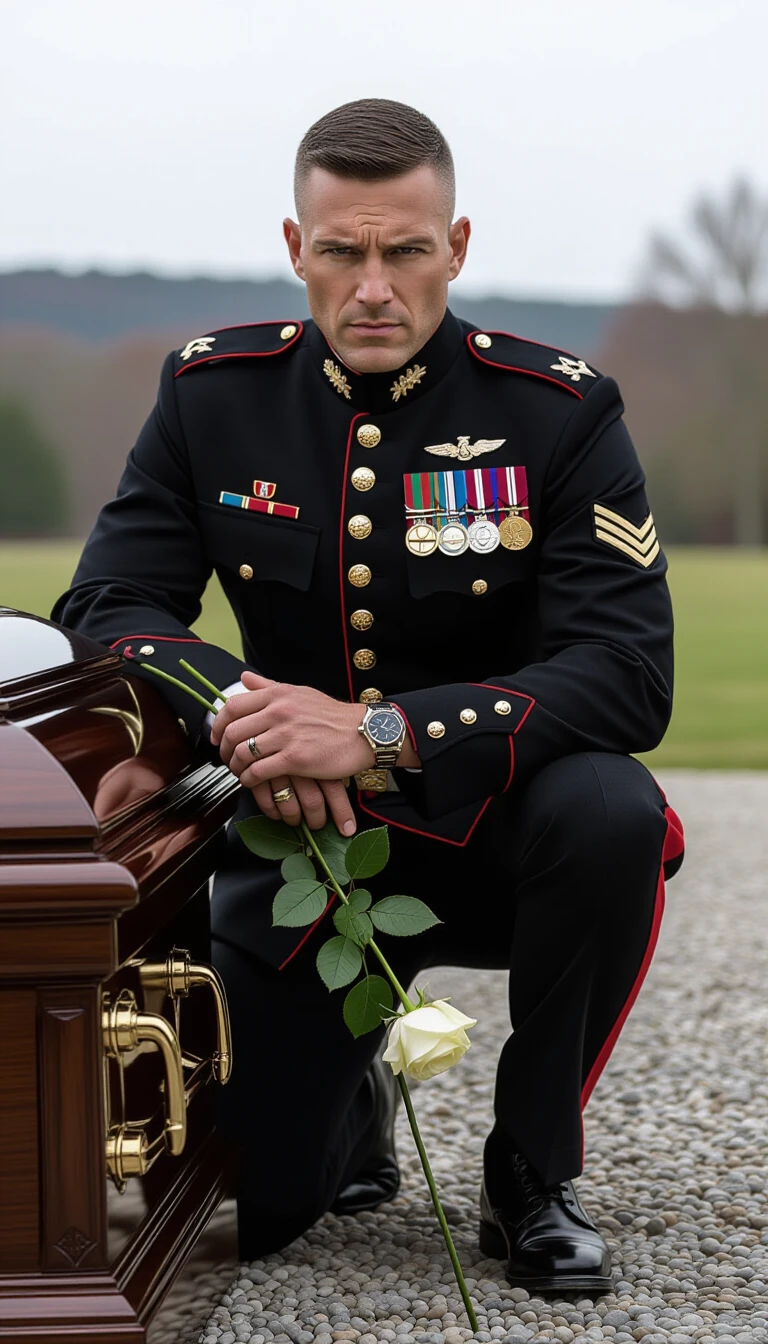
The Fairfax County courthouse lobby smelled of floor wax and stale coffee, fluorescent lights humming overhead in that flat, endless way that made everything look slightly green. Ivan stood with his back against the wall near courtroom three, his suit jacket feeling like someone else's skin against his shoulders. Kimberly stood to his left, her arms crossed tight, purple eyes fixed on the double doors where Michael had disappeared with his lawyer twenty minutes ago.
Michelle leaned against the wall beside her, long hair pulled back, orange eyes tracking every person who walked past. Jack and Stevenson flanked them both, silent, present, the way they'd done on a dozen operations where the only thing that mattered was holding the line. Sarah Douglas stood apart by the water fountain, her pink eyes unreadable, her shaved-sides cut catching the fluorescent light. She'd insisted on coming. Mark had wanted to send a lawyer from the White House counsel's office. Sarah had said no.
"They're taking a long time," Kimberly said, her voice low.
"That's the point," Stevenson said. He stood with his arms loose at his sides, his long braided hair falling over one shoulder. "He wants us to stew."
"I don't stew."
"You do, actually. You've tapped your thumb against your leg forty-seven times since we sat down."
Kimberly stopped. Looked at her hand. Didn't smile.
Ivan said nothing. His eyes tracked the courtroom doors. Counting the ceiling tiles above them. Thirty-three across. Sixteen and a half from the door to the bench, if the layout matched every other courtroom he'd seen. His thumb pressed against his thigh twice, then stopped.
The doors opened.
Michael walked out first, his red eyes flat, his jaw tight. His lawyer followed—a man in a charcoal suit with the kind of glasses that cost more than Ivan's first car. Michael's gaze swept the hallway, found his siblings, and something cold settled behind his face.
"They're ready for you," his lawyer said. Not to Ivan. To Melissa Rains, who stood near the doors with a leather portfolio tucked under her arm.
Melissa Rains was maybe forty-five, with silver-streaked black hair pulled into a tight bun and the kind of stillness that came from prosecuting cases that made national news. She worked for the Justice Department's Civil Division. Mark had called in a favor. She'd called back within an hour.
"Mr. Nightsworn," she said, and her voice was quiet, precise. "You and your sisters sit at the petitioner's table. Everyone else sits behind the bar. Do not speak unless the judge addresses you directly."
Ivan nodded.
She looked at him for a beat longer than necessary. "He's going to try to make this personal. Don't let him."
"He won't," Ivan said.
Melissa held his gaze, then pushed through the doors.
The courtroom was smaller than Ivan expected. Wood paneling on the walls, a raised bench with the seal of Virginia behind it, the American flag and the state flag flanking the judge's chair. The gallery held four rows of benches, mostly empty. A clerk sat at a desk near the bench. A court reporter adjusted her machine. The bailiff stood by the side door, his hands clasped behind his back, his face neutral.
Ivan took the table on the left. Kimberly sat beside him, Michelle on her other side. Michael and his lawyer sat at the table on the right. Michael didn't look at them. His lawyer was arranging papers, lining up the edges like a man who believed neatness won cases.
Jack, Stevenson, and Sarah settled into the first row behind Ivan. Sarah sat at the end, close enough that if he turned his head, he'd see her pink eyes watching his back.
The bailiff's voice cut through the room. "All rise. The Honorable Margaret Chen presiding."
The judge entered from a side door—a woman in her late fifties, silver-gray hair cut short, reading glasses perched on her nose, black robe settled over her shoulders. She moved like someone who'd spent thirty years on the bench and had stopped being impressed by anything a lawyer could say. She sat. The room sat.
"This is the matter of the Estate of Eleanor Nightsworn," Judge Chen said, flipping open a file. "Petitioner Michael Nightsworn challenges the validity of the will dated October fifteenth of this year. Respondents are Ivan Nightsworn, Kimberly Nightsworn, and Michelle Nightsworn. Counsel, please note your appearances."
Michael's lawyer stood. "Ronald Hayes for the petitioner, Your Honor."
Melissa Rains stood. "Melissa Rains for the respondents. The United States Department of Justice appears as amicus curiae in this matter."
Judge Chen's eyebrows rose a fraction. "The Department of Justice. That's unusual for a probate matter."
"The estate in question involves property protected under federal statute, Your Honor. We have a brief on file."
Judge Chen flipped a page. "I've read it. Mr. Hayes, you may proceed."
Ronald Hayes straightened his tie and walked toward the bench. He had the measured pace of a man who believed in his case, the kind of lawyer who practiced his pauses in the mirror. "Your Honor, this is a straightforward matter of testamentary capacity and undue influence. The decedent, Eleanor Nightsworn, was eighty years old and in declining health. Her will, executed just weeks before her death, disinherits her eldest grandson Michael Nightsworn—who ran the family business for twelve years—and replaces him with a board that includes Sarah Douglas, the sister of the President of the United States."
He let that land.
"The timing alone raises questions. The decedent was hospitalized. She was medicated. She was surrounded by Ivan Nightsworn and those loyal to him. And in that vulnerable state, she signed a document that stripped her eldest grandson of everything."
Ivan's hands stayed flat on the table. His silver eyes watched Hayes the way he'd watched targets through a scope—still, patient, reading the wind.
Hayes continued. "The presence of the President's sister on the board creates a clear conflict of interest. It suggests that this will serves political interests, not the decedent's actual wishes. We ask the court to set aside this will and reinstate the prior testamentary documents that properly recognized Michael Nightsworn as the rightful heir to the Nightsworn legacy."
Judge Chen listened without expression. When Hayes finished, she turned to Melissa Rains. "Counsel."
Melissa stood slowly, smoothing her jacket. She didn't walk to the bench. She stayed at the table, one hand resting on her portfolio.
"Your Honor, Mr. Hayes raises questions about timing and capacity. The evidence will show that Eleanor Nightsworn was of sound mind when she executed this will. She was examined by her physician the morning of the signing, who certified her mental clarity. The will was witnessed by two independent parties—a nurse and a notary public—neither of whom have any connection to the respondents."
"That's standard procedure," Hayes said. "It doesn't address the—"
"I'm not finished, counsel."
Judge Chen raised a hand. "Let her finish, Mr. Hayes."
Melissa nodded. "Beyond the question of capacity, Your Honor, there is a more fundamental issue. The property at the center of this dispute—the Nightsworn farm in Fairfax County—is not merely a private estate. It is a National Historic Landmark, registered with the National Register of Historic Places. It is also a Virginia state landmark, listed on the state registry, and falls within a local historic district."
She opened her portfolio and removed a sheaf of documents.
"Furthermore, the Nightsworn family holds contractual agreements with the Holy See—agreements that date back to the first Pope, Saint Peter, in the first century AD. They hold similar agreements with the British royal family, originating in 972 AD under King Edgar."
The courtroom went still.
Hayes turned. "Your Honor, this is—this is absurd. We're here to discuss a will, not medieval—"
"Sit down, Mr. Hayes." Judge Chen's voice was flat. "I want to hear this."
Melissa continued. "In 1607, King James I granted the Nightsworn family the land in question, with the express approval of Pope Paul V. The grant stipulated that the land would remain under the protection of both the Crown and the Vatican. In the 1700s, one thousand Swiss Guards and one thousand Grenadier Guards were stationed on the property to protect its contents—a deployment that has continued, uninterrupted, for over three hundred years."
She set down another document.
"When George Washington became President, he was briefed on the nature of the property and its protections. He honored the existing treaties and ordered the land placed under federal protection. The governors of Virginia at the time—Beverly Randolph, Henry Lee, and Robert Brooke—each issued executive orders declaring the land protected at the state level."
Melissa looked up, meeting the judge's eyes.
"Your Honor, the Nightsworn farm is not merely a piece of real estate. It is a protected site under federal law, state law, and international treaty. The disposition of its ownership is not solely a matter of probate. It involves national security interests that the Department of Justice is obligated to protect."
Judge Chen leaned back in her chair. Her reading glasses had slipped down her nose. She didn't push them up.
"Mr. Hayes. Your response?"
Hayes stood again, his composure cracking at the edges. "Your Honor, this is a remarkable story, but it has no bearing on the legal question before this court. My client's grandmother was manipulated into disinheriting him. The presence of Sarah Douglas on the board is a conflict of interest, plain and simple. The President's sister should not be on the board of a private family estate."
Judge Chen looked at Sarah Douglas, who sat motionless in the first row, her pink eyes fixed on the judge.
"Ms. Douglas. How long have you known the Nightsworn family?"
Sarah stood. Her voice was calm, measured, the voice of someone who'd grown up in the public eye and learned exactly how much to say. "Since preschool, Your Honor. I grew up with Ivan, Kimberly, and Michelle. We've been friends for over thirty years."
Judge Chen nodded. "Mr. King. Mr. Wolf. Please stand."
Jack and Stevenson rose. Jack in a dark suit that fit his athletic frame, his blue eyes steady. Stevenson in a jacket over a collared shirt, his black eyes unreadable under the fluorescent lights.
"Mr. King. How do you know the Nightsworn family?"
"Since preschool, Your Honor." Jack's voice carried the flat cadence of someone used to giving reports. "I served with Ivan Nightsworn in the United States Navy as a SEAL. I'm currently the team leader of the FBI's Hostage Rescue Team."
"Mr. Wolf."
Stevenson's voice was lower, quieter, the voice of a man who'd learned to be heard without raising it. "Same. Preschool. I was Ivan's spotter in the Marine Corps. I lead the CIA's HRT unit."
Judge Chen looked at the three of them for a long moment. Then she turned back to Hayes.
"Mr. Hayes, you're asking me to set aside a will because the board includes the President's sister. But I've just heard from three witnesses—all of whom have known this family since childhood. Two of them served in elite military units alongside Mr. Ivan Nightsworn. The third is a lifelong friend. The board composition reflects relationships that have existed for decades, not political connections."
She removed her glasses and pinched the bridge of her nose.
"I see no conflict of interest. I see a family choosing to trust the people closest to them."
Hayes opened his mouth. Judge Chen held up a hand.
"And even if I did find a conflict, Mr. Hayes, Ms. Rains has made a compelling argument that this property is not subject to ordinary probate. The federal and state protections she described are matters of public record. I can confirm them myself within the hour."
She set her glasses back on her nose.
"But beyond all of that, you've presented no evidence of undue influence. No evidence of diminished capacity. Your entire argument rests on timing and the composition of the board, and neither is sufficient to overturn a will that was properly executed, properly witnessed, and properly certified."
Michael shifted in his seat. His jaw was tight enough that Ivan could see the muscle jumping in his cheek.
Judge Chen looked at Michael directly. "Mr. Nightsworn, I understand that this outcome must be difficult for you. But the law is clear. Your grandmother had the right to distribute her estate as she saw fit. She chose to do so in a way that excluded you. That is not, in itself, grounds to set aside the will."
Michael's voice came out low and hard. "She was manipulated. She didn't know what she was doing."
"The evidence says otherwise." Judge Chen closed the file. "My hands are tied. I cannot grant the relief you seek. The will of Eleanor Nightsworn stands as written."
She struck her gavel once.
"This case is dismissed."
The sound of the gavel hung in the air like a shot.
Kimberly exhaled. It wasn't loud—a soft release of breath she'd been holding since they walked in. Michelle reached under the table and squeezed her sister's hand. Ivan didn't move. His eyes stayed on Michael.
Michael sat motionless for a count of five. Then he stood, slowly, the way a man stands when he's deciding whether to leave or break something. His lawyer was already packing his briefcase, not meeting anyone's eyes.
Michael turned. Looked at Ivan.
Something passed between them—not words, not hatred, not even grief. Something older. Something that had been growing since they were children, since the first time Michael had shoved him into a wall and called him a waste of space.
Ivan held his gaze.
Michael broke it first. He walked out of the courtroom without looking back, the door swinging shut behind him with a soft click of the latch.
Hayes followed, his briefcase clutched under his arm.
The silence they left behind felt different. Thinner. Like the room could finally breathe.
Sarah stood first. She walked to the table and put her hand on Ivan's shoulder. "It's done."
Ivan nodded. His hands were still flat on the table. His thumb pressed into the wood once, twice, three times. Then stopped.
"Let's go home," he said.
Ivan's hands stayed flat on the table. The wood grain ran in long lines under his fingers, each one a track he could follow if he wanted to lose himself in counting. He didn't. He pushed up from the bench and stood.
Sarah's hand stayed on his shoulder. Warm. Solid. Grounding.
"Melissa." His voice came out quiet, the way it did when he was shifting from one state to another. "I need a minute."
Melissa Rains looked up from the file she was closing. She was mid-fifties, silver-streaked hair pulled back, the kind of face that had seen enough courtroom battles to know when one was really over. "Take it."
Ivan didn't take it. He walked to her table instead, his boots quiet on the courthouse linoleum. The room had emptied except for his people—Kimberly and Michelle still at the respondents' table, Jack leaning against the back wall with his arms crossed, Stevenson standing by the door like he was waiting for someone to try something stupid.
"What happens now?" Ivan asked.
Melissa closed her briefcase and looked at him. "Legally? Nothing. The will stands. Michael can't contest it again—the judge's ruling is final on these grounds. He'd need new evidence of fraud or forgery, and he doesn't have it."
"That's not what I'm asking."
She studied him for a moment. Then she sat back down, gestured to the chair beside her. Ivan sat.
"The estate is protected," she said. "The farm, the assets, the company—they're all in the trust Eleanor set up. Michael had access to the company accounts as COO, but the will stripped him of voting shares. He's an employee now. You and your sisters control the board."
"He's still at the company."
"Yes." Melissa didn't sugarcoat it. "He can't touch the money, but he can make things difficult. He knows the operations. He has relationships with vendors, clients, staff. If he wants to cause problems, he has the tools."
Ivan's thumb found the edge of the table. Pressed. Released. Pressed.
"What do I need to do?"
Melissa opened her briefcase again and pulled out a card. She slid it across the table. "My partner specializes in corporate restructuring. He can help you review the company's governance, make sure the transition is clean. Michael can't block it, but he can slow it down if you don't have the right procedures in place."
Ivan took the card. Looked at the name—Daniel Cross, Partner, Cross & Associates, Corporate Law. He tucked it into his jacket pocket without putting it in a wallet. Just the card, against his chest, next to the ring box.
"And the farm?"
"Protected by the same federal and international agreements I cited today. Judge Chen acknowledged them in her ruling. That's public record now. Anyone who tries to challenge the property's status will have to go through multiple layers of federal court, and they'll lose at every one."
"But Michael knows about it."
Melissa's pause was careful. "He knows there's a farm. He knows Eleanor left it to you. He doesn't know what's under it."
"He knows enough to be curious."
"Curious isn't dangerous. Not legally. If he starts asking questions, you call me. I'll remind him of the NDA he signed when he first joined the company board."
Ivan nodded. His hands were still now, resting on his thighs. The sniper's stillness had returned.
"I want to make sure this never happens again," he said. "Not with Michael. Not with anyone."
Melissa's expression softened, just slightly. "You can't prevent every challenge, Ivan. The law is a living thing. People find new angles, new arguments, new loopholes. What you can do is build a structure that makes those challenges impossible to win."
"Then that's what we do."
Behind him, Kimberly stood. Her chair scraped the floor, a soft sound that cut through the hum of the courthouse. "We should head back. The guards are waiting for their briefing."
Ivan looked at Melissa one more time. "Thank you."
"You're welcome. Your grandmother built something remarkable. It's my job to make sure it stays standing."
Ivan rose. Sarah fell into step beside him, her hand finding his elbow for half a second—a touch that said I'm here without needing words. Jack pushed off the wall. Stevenson held the door.
They walked out of the courtroom in a loose formation, the way people did when they'd learned to move together without thinking about it. The hallway was empty except for a bailiff at the far end, reading something on his phone.
The courthouse lobby smelled of floor wax and stale coffee. Fluorescent lights hummed overhead, casting everything in that flat, bloodless glow that made every face look tired. Ivan's boots clicked on the linoleum, a steady rhythm he could count if he let himself.
He didn't.
He walked to the glass doors and pushed through into the November afternoon. The cold hit him—sharp, clean, smelling of wet asphalt and distant woodsmoke. The sky was a pale gray, the sun a smear behind clouds.
Kimberly came up beside him. Her purple eyes found his. "You okay?"
Ivan thought about it. The answer wasn't a word. It was the feel of the card in his pocket, the weight of the ring box, the memory of Eleanor's hand in his as she took her last breath.
"Yeah," he said. And meant it. "We're good."
Michelle joined them, her orange eyes catching the gray light. "I called ahead. Maria's at the farm with John. They brought the boy."
Ivan's chest did something it hadn't done in a long time. It loosened.
"Good," he said. "Let's go home."
The Supreme Court building rose against the gray November sky, marble columns stretching toward clouds that promised rain before evening. Ivan stood at the base of the steps, his dress shoes polished to a mirror shine, his jacket buttoned against the cold that seeped through the wool. Beside him, Kimberly and Michelle flanked him the way they always did now—shoulders back, chins up, the triplet formation that said we move together or not at all.
"You ready?" Kimberly asked. Her purple eyes found his, steady and sure.
Ivan looked up at the building. He'd been in courthouses before. Testified in military tribunals. Given statements in classified hearings where the room had no windows and the only light came from bulbs that hummed. This was different. This was his grandmother's legacy on a table, and his brother on the other side of it, holding a knife.
"Yeah."
They climbed the steps together. Jack and Stevenson walked behind them, close enough to touch, far enough to give space. Sarah Douglas moved at Ivan's left elbow, her pink eyes scanning the crowd of reporters that had gathered on the sidewalk, cameras clicking, voices calling questions he didn't hear.
Inside, the marble floors gleamed under chandeliers that threw light across the rotunda. The air smelled of old wood and paper, the kind of smell that said this building has been here longer than anyone alive. Ivan's boots echoed as they walked, a rhythm he could have counted if he'd wanted to. He didn't.
The courtroom was full. Every bench occupied—reporters, legal analysts, curiosity-seekers who'd read about the case and wanted to see the spectacle. Ivan recognized faces from the farm: Lynda Johnson in the third row with James and Jacob, her hazel eyes finding his and holding for a moment. The Chen family sat behind them—David, Sue, Lance, Tia, Maria and John with little Ian asleep in his father's arms. Catherine Sullivan held her husband's hand in the back row, her blue eyes wet. She'd come for Ivan. He knew it the way he knew his own heartbeat.
At the front of the room, nine justices sat in high-backed leather chairs, their robes black and absolute. The Chief Justice—a woman in her sixties with silver-streaked hair and eyes that had seen everything—adjusted her glasses and looked over the crowded room.
"We will hear oral arguments in the matter of Nightsworn v. Estate of Eleanor Nightsworn."
Michael's lawyer stood first. A thin man in an expensive suit, his hair slicked back, his voice practiced and smooth. He argued conflict of interest—Sarah Douglas on the board, the President's sister, the appearance of impropriety. He gestured at Sarah as he spoke, his hand sweeping toward her like he was presenting evidence.
"Your Honors, the question before this court is whether a sitting President's sister can serve on a corporate board without creating an inherent conflict of interest. The appearance alone—"
"Counselor." Justice Okonkwo leaned forward, his deep voice cutting through the lawyer's rhythm. "You're asking us to rule that a professional relationship formed in preschool constitutes a conflict of interest."
"Your Honor, the timing of the appointment—"
"The timing is irrelevant if the relationship predates the appointment by thirty years." Justice Okonkwo's eyes were flat. "Ms. Douglas has known the Nightsworn family since childhood. Is that your argument? That lifelong friendships should be dissolved when one friend enters public service?"
Michael's lawyer opened his mouth, closed it. "Your Honor, the President could use his office to benefit—"
"Do you have evidence that he has?"
The silence stretched. The lawyer's jaw tightened. "No, Your Honor."
"Then proceed to the estate arguments."
Michael's lawyer shifted. He talked about the will—undue influence, testamentary capacity, the speed of the second will's execution. He painted Eleanor as a vulnerable woman, manipulated in her final days, surrounded by people who wanted her money.
Ivan's hands stayed still on the table in front of him. His thumb wanted to tap. He kept it flat.
When Michael's lawyer finished, Melissa Rains stood. She was smaller than her opponent, her suit dark gray, her hair pulled back. She looked like a librarian. She spoke like a blade.
"Your Honors, the respondent's argument rests on a fundamental misunderstanding of the Nightsworn family's legal standing. This is not merely a will contest. This is a challenge to treaties that have been recognized by the United States government since the administration of George Washington."
She walked toward the justices, her heels clicking on the marble floor. "The farm and estate in question are protected under multiple layers of law. The family holds treaties with the Vatican—treaties recognized by every Pope since Saint Peter. They hold treaties with the British royal family—treaties recognized by every King of England since the first."
Justice Morrison, a thin man with wire-rimmed glasses, leaned forward. "You're asking this court to honor treaties with the Vatican?"
"I'm asking this court to honor treaties that have been incorporated into United States federal law. In 1607, King James I granted a charter protecting the land. Pope Paul V issued a parallel decree. In the 1700s, the Swiss Guard and the Grenadier Guards were formally attached to the property. George Washington, as President, affirmed these protections. The governors of Virginia—Beverley Randolph, Henry 'Light-Horse Harry' Lee, Robert Brooke, James Wood—each signed documents recognizing the estate's protected status."
Melissa pulled a folder from her briefcase. "I have here the original charters, the presidential affirmations, and the state-level recognitions. The farm and estate are on the National Register of Historic Places. They are a National Historic Landmark. They are on the Virginia state historical registry. They are designated as a local historical district. Michael Nightsworn is not challenging a will. He is challenging two thousand years of legal precedent."
Michael's lawyer stood. "Your Honors, this is absurd. The estate—"
"Sit down, Counselor." Chief Justice Hart's voice was calm. Final. "Let her finish."
Michael's lawyer sat. His face was red.
Melissa continued. She walked through the history—the treaties, the charters, the presidential affirmations. She showed copies of documents signed by Washington, by the Virginia governors, by popes and kings. She laid out the legal framework like a map, every piece connected, every line carrying weight.
And then she turned to Sarah Douglas.
"Sarah Douglas has known the Nightsworn family since preschool. She attended kindergarten with Ivan, Kimberly, and Michelle Nightsworn. She attended elementary school, middle school, high school with them. She has never used her brother's office to benefit the company. She has never asked him to. She has never needed to. Because she, like her brother, understands the difference between public duty and private interest."
Sarah stood when Melissa gestured. She walked to the witness stand, her pink eyes clear, her short hair catching the light. She swore the oath in a steady voice and sat, her hands folded in her lap.
"Ms. Douglas," Melissa said, "can you tell the court about your role on the Nightsworn board?"
"I serve as an advisor on matters of security and legal compliance. I have no voting power over financial decisions. I do not participate in discussions regarding company contracts, vendor selection, or resource allocation. My role is limited to ensuring the company operates within federal and international law."
"And your brother, the President. Has he ever asked you to influence the board's decisions?"
"No." Sarah's voice was firm. "He has never asked. He has never suggested. He has never implied. My brother and I have too much respect for this country and for each other to use our positions for personal gain. We know what the right thing looks like. We do it."
Justice Park, a younger woman with sharp eyes, leaned forward. "Ms. Douglas, you're saying that neither you nor the President has ever used your professional duties to influence the company's decisions?"
"Yes, Your Honor. We are practicing self-government. We are fulfilling our duties of loyalty to the company and to the country without interference. My brother runs the country. I advise a family I've known since I was five years old. There is no conflict because neither of us would allow one to exist."
The courtroom was silent. Even the reporters had stopped scribbling.
Justice Park sat back. She exchanged a look with Chief Justice Hart.
Melissa turned to Michael's lawyer. "Your witness."
Michael's lawyer stood. He tried. He asked about meetings, about calls, about any favor Sarah had ever asked her brother. Sarah answered each question the same way: No. No. Never. She was calm. She was unshakable. She was Eleanor's choice, and she knew it.
After an hour, the justices retired to deliberate. The courtroom emptied slowly, people filing into the hallways, talking in low voices. Ivan stayed at the table. His sisters stayed with him. Jack and Stevenson leaned against the wall, watching the doors. Sarah sat beside Ivan, her hand resting on his forearm.
"You did good," Ivan said.
She smiled—a small, tired thing. "I told the truth. That's all I ever do."
The justices returned in forty-seven minutes. Ivan counted. He always counted.
Chief Justice Hart adjusted her glasses and looked at Michael's lawyer, then at Melissa, then at Ivan. Her voice carried through the silent room.
"We have reached a decision. On the matter of conflict of interest, we rule against the appellant, nine to zero. Sarah Douglas has demonstrated that her role on the board is limited to security and legal compliance. There is no evidence that the President has used his office to benefit the company. There is no appearance of impropriety because there is no impropriety. The appellant has shown nothing."
Michael's lawyer opened his mouth. Closed it.
"On the matter of the will," Chief Justice Hart continued, "we rule against the appellant, nine to zero. The evidence of Eleanor Nightsworn's testamentary capacity is overwhelming. The second will was properly executed and witnessed. The appellant's argument regarding undue influence is unsupported."
She paused. The room held its breath.
"On the matter of the farm and estate, we rule against the appellant, nine to zero. Our hands are tied. The treaties with the Vatican and the British royal family have been recognized by the United States government since its founding. The property is protected under federal law, state law, and international agreement. We cannot overturn two thousand years of legal precedent because one man wants his grandmother's money."
Michael's lawyer sat down. His face was white.
Chief Justice Hart looked at Michael Nightsworn directly. Her voice softened, just slightly. "Michael Nightsworn, you have not shown this court anything that proves conflict of interest, undue influence, or any legal basis for overturning your grandmother's will. This case is dismissed with prejudice."
She struck her gavel. The sound echoed through the marble room.
Ivan let out a breath he hadn't realized he was holding. Beside him, Kimberly's hand found his under the table. Michelle's hand found his other one. They sat there, three palms pressed together, breathing.
Michael stood. He didn't look at them. He walked out of the courtroom with his lawyer, his back straight, his fists clenched. The doors swung shut behind him.
Ivan watched him go. He felt something—not satisfaction, not relief. Something quieter. Something that felt like the moment after a shot, when the recoil settles and you know the round hit its mark.
Melissa came over. She shook his hand, her grip firm. "It's over. He can't appeal. The Supreme Court ruling is final."
"Thank you." Ivan's voice was rough.
"Your grandmother knew what she was doing. She built this to last." Melissa smiled—a real smile, not a lawyer's smile. "Now go home. You've got a farm to run."
Ivan stood. His sisters stood with him. Jack and Stevenson pushed off the wall. Sarah fell into step beside him. The group moved toward the doors, a loose formation born of years, of trust, of love.
They walked out of the Supreme Court building into the cold November afternoon. The sky had cleared, the clouds breaking apart to reveal pale sunlight. The marble steps gleamed wet, reflecting the gray sky.
Ivan stopped at the bottom. He reached into his jacket pocket and pulled out the card Melissa had given him—Daniel Cross's card, for the corporate restructuring. He looked at it for a long moment. Then he tucked it back, next to the ring box, next to the weight of everything Eleanor had given him.
Kimberly came up beside him. "Home?"
Ivan looked at her. At Michelle. At Jack and Stevenson and Sarah. At the family that had chosen him, had stood beside him, had fought for him.
"Yeah," he said. "Home."
They walked down the steps together, the November light catching their faces, and behind them, the Supreme Court building stood silent and absolute, its marble columns holding up the weight of a nation that had just learned a family's secret and chosen to protect it.
Ivan pulled out his phone as they reached the bottom of the steps. The November cold bit through his jacket, but he barely felt it. He found Mark Douglas's contact and pressed call.
The line rang twice. Three times. Then the President's voice came through, tired and sharp. "Tell me."
"Mr. President. We won."
A long breath on the other end. Then a sound that might have been a laugh or a sigh—Ivan couldn't tell which. "Thank God."
"Nine to zero," Ivan said. "On all three counts. Justice Park and Chief Justice Hart were... thorough."
"I read the transcripts as they came in. Sarah told me what she said on the stand." A pause. "Your brother's a moron."
Ivan blinked. "Sir?"
"To sit there and say we do stupid stuff—that we're all corrupt—is ignorant of him. He had nothing. He knew he had nothing. He just wanted to hurt you."
Ivan looked at his sisters, standing a few feet away, watching him. Kimberly's hand was on Michelle's shoulder. Jack and Stevenson flanked them, scanning the street out of habit. Sarah stood apart, her phone pressed to her ear—probably talking to Mark too.
"He wanted to hurt all of us," Ivan said. "But he couldn't. Eleanor built it too well."
"She did." The President's voice softened. "She trusted you, Ivan. She trusted you with everything. And you didn't let her down."
Ivan's throat tightened. He pressed his thumb against the edge of his phone, counting the seconds. One. Two. Three. "Thank you, sir."
"Don't thank me. You did the work. You showed up. You let Sarah speak. You let Melissa do her job. You trusted the people around you." A pause. "That's not easy for men like us."
"No, sir. It's not."
"But you're learning." The President's voice was quiet now. Almost gentle. "You're a great brother, Ivan. To your sisters. To Jack and Stevenson. To Sarah. Hell, to me."
Ivan's hand tightened on the phone. The ring box pressed against his ribs from the inside pocket of his jacket. "You're welcome, brother."
The word hung in the cold air. Brother. He'd never said it to Mark before. Not like that.
A long silence on the line. When the President spoke again, his voice was rough. "Get home, Ivan. Get some rest. You've got a farm to run, and I've got a country to lie to about why the Supreme Court just ruled on a family inheritance case."
"They know?"
"They know enough. That it was about a will. That the family had connections. The rest stays where it belongs."
Ivan nodded, even though Mark couldn't see him. "Understood."
"Take care of them, Ivan. Take care of yourself."
"I will, sir."
"I know you will." The line went dead.
Ivan lowered the phone. He stood there for a moment, the cold wind tugging at his collar, the marble steps stretching up behind him, the city spread out before him. He could hear traffic, horns, the distant wail of a siren. Normal sounds. The sounds of a world that didn't know what had just happened, what had been protected, what two thousand years of secret history had just survived.
Kimberly came up beside him. "Mark?"
"Yeah." Ivan pocketed the phone. "He said thank you. For everything."
"He said more than that."
Ivan looked at her. His sister. His triplet. The one who had held him at their parents' funeral, at Amber's funeral, at Eleanor's. The one who had never let go.
"He called me a good brother."
Kimberly's eyes—that pale purple that had always seemed too bright, too knowing—softened. "You are."
Michelle came up on his other side. "You always were, Ivan. You just didn't see it."
Ivan's jaw tightened. He looked down at his hands. Steady. Always steady. Even when everything inside him was breaking apart, his hands stayed steady. That was what the Corps had given him. That, and the ability to kill. He'd spent nineteen years trying to balance those two things—the steadiness and the destruction. Trying to figure out if he could be one without the other.
"Let's go home," he said.
Jack appeared at his elbow. "Cars are here. Secret Service has the perimeter clear."
Ivan looked up. Three black SUVs waited at the curb, their engines idling, their occupants watching. He recognized the driver of the lead vehicle—a young agent with a crew cut and a face that said he'd seen worse days than this.
"President's detail?" Ivan asked.
"Loaned," Jack said. "Mark's orders. Until we get you all back to the farm."
Ivan nodded. He turned to look at the Supreme Court building one last time. The marble columns. The inscription above the entrance: EQUAL JUSTICE UNDER LAW. He'd read that a hundred times in his life, in articles, in movies, in passing. It had never meant anything to him before. Not really. He'd spent his career outside the law, in the shadows where the law didn't reach, doing things the law could never sanction. But today, the law had protected him. Today, the law had chosen to believe Eleanor's vision over Michael's bitterness. Today, the law had done what Eleanor had always said it would: it had held.
"Ivan." Sarah's voice. Soft. Close.
He turned. She stood a few feet away, her pink eyes steady on his, her short hair ruffled by the wind. She looked tired. She looked beautiful. She looked like someone who had just testified before the Supreme Court of the United States and hadn't flinched once.
"Thank you," he said. "For what you said in there."
She shook her head. "I told the truth. That's all I ever do."
"I know. That's why it mattered."
Something passed between them—not words, not quite. A recognition. A knowing. Sarah had been Eleanor's choice, but she had also been Ivan's, long before either of them had known it. She had shown up. She had stayed. She had believed in him when believing meant something.
"Come on," she said. "Let's get out of this cold."
Ivan followed her to the cars. His sisters flanked him, Jack and Stevenson taking rear guard out of habit. The Secret Service agents opened doors, scanned the street one last time, and then they were moving, the SUVs pulling away from the curb, the Supreme Court building shrinking in the rear window.
Ivan sat in the back seat, Kimberly on one side, Michelle on the other. Sarah sat up front, next to the driver. Jack and Stevenson were in the vehicle behind them.
For a long moment, no one spoke.
Then Kimberly reached over and took Ivan's hand. Her palm was warm, her grip firm. Michelle took his other hand. They sat there, three triplets, hands linked, breathing together.
"We did it," Michelle said. Her voice was barely a whisper.
"We did," Kimberly said.
Ivan looked at them. His sisters. His family. The people who had never stopped believing in him, even when he'd given them every reason to walk away.
"No," he said. "Eleanor did it. She built this. We just... held onto it."
Kimberly squeezed his hand. "That's all she ever asked."
The SUV turned onto the highway, heading north toward Virginia. The city fell away behind them, the monuments and buildings shrinking into the gray November sky. Ivan watched them go. He thought about Eleanor, about the weight she'd carried for eighty years, about the secret she'd guarded through wars and presidents and the slow erosion of time. He thought about his parents, about Amber, about everyone he'd lost and everyone he still had.
He thought about the ring box in his pocket. The ring meant for Amber. The ring he'd carried for nineteen years, across continents and battlefields, through all the darkness he'd walked through. He still didn't know what to do with it. He still didn't know if he was allowed to let go.
But today, for the first time in a long time, he felt like he might be heading toward an answer.
The farm came into view an hour later. The long gravel drive, the old white farmhouse, the east field where Stevenson had found the spring. There were vehicles parked in the yard—familiar ones. The Chen family's minivan. Lynda Johnson's sedan. A truck that belonged to one of the Swiss Guard advance team.
Ivan's heart beat faster. Not from fear. From something he wasn't ready to name.
The SUV pulled to a stop. Ivan got out. The cold air hit him, carrying the smell of wet earth and fallen leaves. He stood there for a moment, breathing it in, letting it settle into his bones.
The farmhouse door opened. Maria stepped out, her blue-and-red hair bright against the gray sky. Behind her, John appeared, holding their son Ian on his hip. Lance and Tia came out next, then David and Sue Chen, then Lynda and James and Jacob.
They were all there. All of them. Waiting for him.
Ivan walked toward them. His sisters followed. Jack and Stevenson came up from the second vehicle. Sarah fell into step beside him.
Maria met him halfway. She didn't say anything. She just wrapped her arms around him and held on, her face pressed into his chest, her body warm and solid against his.
Ivan closed his eyes. He let himself be held.
"We heard," Maria whispered. "We heard everything."
Ivan's arms came up around her. He held her tight. "It's over."
"I know." She pulled back, just enough to look at him. Her eyes were bright, not with tears, but with something fiercer. "Now you're really home."
Ivan looked at her. At John, who was smiling. At Ian, who was reaching for him with small, insistent hands. At the Chens, who had traveled across an ocean to be here. At Lynda, who had given him a path forward when he'd had none. At James and Jacob, who had chosen to believe in him. At his sisters, his friends, the woman whose voice had helped save Eleanor's legacy.
Home.
He reached into his pocket. Not for the ring box—he wasn't ready for that, not yet. But for something else. Stevenson's map. The one they'd drawn in the east field, marking out the irrigation lines and the bunker locations and the places where they'd build the future.
He unfolded it. The paper was creased, the ink smudged from Stevenson's fingers, but the lines were still clear. The plan was still there.
"We've got work to do," Ivan said.
Maria smiled. "We know."
John stepped forward. "We brought food. Sue's been cooking all morning."
David Chen laughed. "My wife has been cooking since she heard about the court date. She was sure you'd win. She wanted to celebrate."
Sue emerged from the farmhouse, wiping her hands on her apron. "Come inside. All of you. You need to eat. You need to rest."
Ivan looked at the farmhouse. The lights were on inside, warm and golden against the gray afternoon. Smoke rose from the chimney. The kitchen window was steamed up from cooking.
He folded the map and tucked it back into his pocket. He took a breath. He let it out.
Then he walked inside, his family behind him, the weight of Eleanor's legacy on his shoulders, the ring box pressed against his heart, and the cold of November at his back.
Inside, the farmhouse kitchen was warm and loud. Sue Chen stood at the stove, stirring something that smelled of ginger and garlic. Tia was at the counter, chopping vegetables with quick, practiced strokes. David and Lance had pulled chairs up to the table, talking low and easy. Lynda sat with James, Jacob hovering near the window, watching the field where the first Swiss Guard vehicles had appeared at the tree line.
Maria guided Ivan to a chair. He sat. The warmth pressed against him from all sides—the steam from the pots, the press of bodies, the low hum of conversation. He let it happen. Let himself be placed, be fed, be held by the simple machinery of people who wanted him to rest.
Sue brought him a bowl of pho. The broth was dark and fragrant, steam curling into his face. "Eat," she said. "You look like you haven't slept in days."
Ivan picked up the spoon. The first sip burned his tongue. He didn't care.
John settled across from him, Ian balanced on his knee. The boy was watching Ivan with the wide, unblinking stare that only toddlers could manage—curious, unafraid. Ivan met his gaze. Held it. Ian smiled, showing four teeth, and reached for him.
"He likes you," John said.
Ivan looked at the small hand reaching across the table. He didn't know what to do with it. He'd never known what to do with children. But Ian was still reaching, patient and insistent, and something in Ivan's chest shifted.
He reached back. Ian grabbed his finger. Held tight.
"He knows," Maria said softly, appearing at Ivan's shoulder. "He knows you're safe."
Ivan looked at Ian's hand wrapped around his finger. Small. Warm. Trusting. He hadn't felt safe in nineteen years. He didn't know how to receive that word from anyone else. But Ian didn't know any of that. Ian just saw a hand and reached for it.
The kitchen kept moving around them. Plates appeared. Bowls were filled. Chairs scraped against the worn floorboards as everyone found a place. Ivan ate. He let them fill his bowl when it was empty. He let Maria's hand rest on his shoulder. He let the noise wash over him, the voices of people who had crossed oceans and years to be here.
But there was a weight in his pocket. The ring box. And behind it, another weight—the question he'd been carrying since the Supreme Court ruling. Since Eleanor died. Since he'd knelt in the east field with his hand pressed into damp soil and promised to build something.
The Sullivans weren't here. He'd called them. He'd told them the court case was over, that the farm was safe, that everything Eleanor had built would stand. Catherine had said they'd drive up. They should have been here by now.
Ivan set down his spoon. The pho was half-finished. He didn't have the stomach for the rest.
"I need to make a call," he said.
Maria looked at him. She didn't ask questions. She just nodded and stepped back, giving him room.
Ivan stood. He pulled out his phone and walked to the mudroom, where the noise of the kitchen faded to a low hum. The floor was cold through his boots. The window above the washer looked out at the gravel drive, the bare trees, the gray sky.
He dialed Catherine's number.
She answered on the second ring. "Ivan." Her voice was warm, familiar. "We're almost there. Maybe twenty minutes out."
"Good," he said. And then, before he could second-guess himself: "I have something I want to ask you. All of you."
A pause. "What is it?"
"Better if I say it in person."
"All right, Ivan." Another pause, softer this time. "We'll be there soon."
He hung up. Stood there for a moment, the phone cold in his hand, the ring box heavy in his pocket. He hadn't asked them yet. He didn't know if he had the right. The Sullivans were Amber's family. He had no claim on them. No blood tie. Just nineteen years of grief and a ring he'd never given to their daughter.
But Eleanor had built a legacy that could protect people. Not just blood. Not just the Nightsworn name. Anyone who needed to be safe.
And if that was true, it had to start somewhere.
He walked back into the kitchen. Kimberly was at the table now, talking low with Stevenson. Michelle was helping Sue plate more food. Jack had Jacob cornered near the window, probably telling him some story that was half-truth and all embellishment. Sarah was on the phone in the corner, her voice clipped and professional—probably Mark, calling to check in.
Ivan sat back down. Maria slid a cup of coffee in front of him. He wrapped his hands around it, let the heat soak into his palms.
"The Sullivans are coming," he said.
Maria's eyes softened. "Good."
"I want to offer them a bunker home. Same as we're building for everyone. Connected to the main system."
The table went quiet. Kimberly looked up. Michelle stopped mid-reach for a bowl. Stevenson set down his fork.
Jack was the first to speak. "That's a big offer, brother."
"I know."
"You sure?"
Ivan looked at the coffee in his hands. The ring box pressed against his ribs. "They're the only family Amber had. If I'm building a future, I want them in it."
Stevenson nodded slowly. "It's the right move."
Kimberly stood. She crossed the kitchen and sat down beside him, her knee brushing his. "You're not doing this alone, Ivan. Whatever you offer them, we back it."
Michelle came around the table too. "She's right. The bunker plan covers everyone we trust. The Sullivans are family."
Ivan looked at his sisters. At Jack and Stevenson, who had followed him through the worst of it. At Sarah, who had finished her call and was watching him with steady pink eyes. At the Chens and the Smiths and the Johnsons, all of them waiting to see what he would do next.
He didn't know if he deserved their faith. But he was tired of running from it.
Twenty minutes passed. The kitchen slowly emptied as people found places to settle—the living room, the porch, the back field where the Swiss Guard advance team had set up a temporary command post. Ivan stayed at the table, coffee gone cold, watching the gravel drive through the window.
A car appeared. A sedan, dark blue, moving slow over the ruts. It pulled to a stop behind Lynda's car.
Ivan stood.
Catherine Sullivan got out first. She was wearing a black coat, her gray hair pulled back, her face etched with the same grief she'd worn at her daughter's funeral. But her eyes found Ivan immediately, and there was warmth in them. There was always warmth.
Richard came around the driver's side. Taller than Ivan remembered, his shoulders rounded by age and loss. Lawrence stepped out next, his long hair pulled into a loose ponytail, his green eyes scanning the farm with the careful assessment of a man who'd built his own life from the ground up. Rachel last, her blue-and-shaved head catching the gray light, her athletic frame moving with the coiled energy of someone who didn't sit still easily.
Ivan walked out to meet them. The cold hit him immediately, the November wind cutting through his shirt. He didn't feel it.
Catherine met him halfway. She didn't speak. She just wrapped her arms around him and held on, the same way she'd held him at Amber's funeral, the same way she'd held him when he'd knelt at their daughter's coffin and whispered that he was going to marry her.
"Ivan," she said. Her voice cracked. "Ivan."
He held her. Let himself be held. "You came."
"Of course we came." She pulled back, her hands still on his shoulders, her blue eyes searching his face. "You called. We came."
Richard stepped up. He didn't hug—the Sullivans had always been Catherine's warmth, Richard's solid presence—but he put a hand on Ivan's shoulder and squeezed. "Good to see you, son."
"You too, sir."
Lawrence and Rachel hung back, but their faces were open, waiting. Ivan nodded at them. They nodded back.
"Come inside," Ivan said. "There's food. And I need to talk to you."
The kitchen was quiet when they filed in. Sue had put the leftovers away, but she'd left a pot of tea on the stove. Ivan poured cups for all of them. His hands didn't shake. He was surprised by that.
They sat around the table. The same table where Ivan had learned the family secret. The same table where Eleanor had told him he was the one to carry her charge. The same table where Kimberly and Michelle and Stevenson had drawn the first lines of what the future would look like.
Catherine held her tea but didn't drink it. "What is it, Ivan?"
He sat down across from her. The ring box was in his pocket. He could feel it with every breath.
"I'm building something," he said. "Here. On this farm. Eleanor left it to me, and to my sisters, and to the people we trust. We're building bunker homes—safe houses, connected by tunnels, with everything we need to protect the people who matter."
Richard frowned. "Protect from what?"
Ivan met his eyes. "Everything."
There was a long silence. Lawrence set down his tea. "You're serious."
"I am."
Rachel leaned forward. "What does this have to do with us?"
Ivan looked at her. Rachel had Amber's stubbornness, Amber's way of cutting straight to the point. He'd always liked that about her.
"I want to build one for you," he said. "For each of you. Your own house over a bunker, connected to the main system. A place where you'll always be safe. A place where you belong to this."
Catherine's breath caught. She set down her tea. "Ivan—"
"I know it's a lot." He kept his voice steady. "I know I don't have the right to ask. You're not Nightsworns. You don't owe anything to Eleanor's legacy." He paused. "But Amber was going to be my wife. And you were going to be my family. And I've carried that ring for nineteen years because I couldn't let her go."
He pulled the ring box from his pocket. Set it on the table between them. He didn't open it.
"I'm not asking you to replace her," he said. "I'm not asking you to pretend I'm something I'm not. I'm asking you to let me protect you. The way I couldn't protect her."
Catherine stared at the ring box. Her hand trembled as she reached for it, but she didn't open it either. She just touched it, her fingers resting on the worn velvet.
"You kept it," she whispered.
"Yes, ma'am."
"All these years."
"Yes, ma'am."
She looked up at him. Her eyes were wet, but she didn't cry. Catherine Sullivan had been crying for nineteen years. She was done. Now she was just looking at the man who had loved her daughter, the man who had carried a ring through war and grief and madness, the man who was still trying to build something good out of the wreckage.
"You ask Richard," she said. "And Lawrence. And Rachel. But I'll tell you my answer now."
Ivan waited.
"Yes," Catherine said. "We'll take your bunker. We'll be part of whatever you're building." She picked up the ring box and held it out to him. "But you keep this. You carry it until you're ready to give it to someone else. Because that's what Amber would have wanted."
Ivan took the ring box. His fingers closed around it. The velvet was worn smooth from nineteen years of handling, nineteen years of grief and hope and indecision.
"You loved her," Catherine said. "That never stops. But it changes. And when it changes enough to let you love someone else—" She smiled. "You'll know."
Ivan put the ring box back in his pocket. He didn't say anything. He didn't have to.
Richard cleared his throat. "I've got a house in Fairfax. Built it myself, thirty years ago. If I'm moving to a bunker, I'm bringing my tools."
Lawrence laughed. The sound broke the tension, warm and unexpected. "Dad, you've got enough tools to build a whole subdivision."
"Exactly. I'll be useful."
Rachel looked at Ivan. "What about the timeline?"
"We break ground in two weeks. The Swiss Guard advance team is mapping the underground layout now. Stevenson's got irrigation figured out. We'll build the bunkers first, then the houses on top."
She nodded. "I own a contracting company in Richmond. I can bring my crew."
Ivan blinked. "You—"
"Amber was my sister." Rachel's voice was steady. "You want to build something for her. I want to build it with you."
Ivan looked at her. At Lawrence. At Richard. At Catherine, who was watching him with the same warmth she'd shown at Amber's funeral, the same warmth that had held him when he'd fallen apart.
"Okay," he said. "Okay."
They sat there for a long moment, the kitchen quiet around them, the weight of Eleanor's legacy and Amber's memory pressing in from all sides. But it didn't feel like a burden. It felt like a foundation.
The farmhouse door opened. Cold air swept in. Stevenson appeared in the doorway, his long braids dusted with frost, his black eyes bright.
"Ivan. You need to see this."
Ivan turned from the Sullivans. The kitchen felt fuller now, bodies and breath and the smell of coffee and cold air from the door Stevenson had left cracked. Maria stood near the counter with Ian balanced on her hip, John's hand resting on her lower back. Lance and Tia sat at the long table, their chairs close together. David and Sue stood by the window, watching the frost creep up the glass.
Ivan crossed to them. His boots made soft sounds on the worn floorboards. He stopped in front of Maria first, because she was the one who had come when he called, because she had driven hours with her family to be here, because she had already given him more than he had any right to ask for.
"Maria." He said her name like it mattered. "John."
Maria shifted Ian to her other hip. Her blue-and-red hair caught the kitchen light, and her eyes were steady on his. "Yeah?"
"I want to build you a bunker home here. Connected to the main system. A house on top, with an elevator down." He paused. "For you and John and Ian. So you're always protected. So you always have a place here."
Maria's breath caught. She looked at John, who was already nodding, already reaching for her hand.
"Ivan," John said slowly, "you sure about that? That's a lot."
"I'm sure."
Maria set Ian down. The toddler immediately grabbed her leg, but she didn't seem to notice. She was looking at Ivan like she was seeing something new, something she hadn't expected.
"You're building a fortress," she said.
"I'm building a home." Ivan's voice was quiet. "For everyone I've got left. For everyone who matters." He looked at Ian, who was staring up at him with wide eyes. "For the people who deserve to grow up safe."
John stepped forward. He didn't say anything. He just held out his hand.
Ivan took it.
"We'd be honored," John said.
Ivan held Stevenson's gaze for a long moment, then raised his hand. A wait. Stevenson nodded once and stayed in the doorway, frost curling off his braids, black eyes tracking the room.
Ivan turned. He crossed the worn floorboards, the wood familiar under his boots, and stopped in front of Lynda Johnson. She stood with James's arm around her waist, Jacob rigid at her side, a small island of three in the sea of bodies and breath and warm kitchen light.
"Lynda."
She looked up. Her hazel eyes held that steady nurse's calm, the same calm she'd shown at Forward Base, the same calm that had held him when he'd sobbed into her shoulder about Eleanor dying.
"Forward Base," Ivan said. "You told me it was a path to healing." He paused. "I want to make it a home."
Lynda's brow furrowed. "Ivan—"
"Let me build you a bunker home here. Connected to the main system. A house on top, with an elevator down." He kept his voice quiet, level. "The Vatican is sending medical staff. The British Crown is sending trauma specialists. The best in the world, Lynda. For Forward Base. For your veterans."
Lynda's mouth opened. Nothing came out.
James stepped forward. His blue eyes were sharp, assessing. "You're serious."
"I don't make offers I don't mean."
James studied him for a long moment. Then he nodded slowly. "We've been running Forward Base out of a converted warehouse in Richmond. Leaking roof. Broken HVAC. Lynda pays for half the supplies out of her own pocket." He looked at his wife, and his voice roughened. "She's been carrying it alone."
"She's not alone anymore."
Lynda's breath came out shuddery. "Ivan, that's… that's too much. You don't owe me—"
"It's not about owing." Ivan's voice dropped. "You held me when I fell apart. You told me I could heal. Let me do the same for you."
Lynda's face crumpled. She didn't sob. She just sat down on the nearest chair, her shoulders shaking, James's hand immediately finding her back, rubbing slow circles.
Jacob stepped forward. He was twenty-two, Striker's son, with the same build and the same eyes but a different set to his jaw—softer, less hardened by years of killing.
"Ivan." His voice cracked. He hated that it cracked. Ivan saw him hate it, and held his gaze anyway. "I hated you. For years. I wanted to kill you myself."
"I know."
"My dad was a monster." Jacob's jaw tightened. "I found the files. After what you told us. I dug. I found the mission logs, the black site records, the names." His voice dropped. "He killed kids, Ivan. He killed families. He was going to make you kill a teenage girl."
Ivan didn't say anything. He just stood there, letting Jacob work through it.
"You were right to do it." Jacob's eyes were wet, but he didn't look away. "I wanted to tell you to your face. You were right. And I'm sorry I hated you."
Ivan reached out. His hand landed on Jacob's shoulder, firm and warm. "You were a kid who lost his father. You don't owe me an apology for that."
Jacob's breath hitched. He nodded once, sharp, and stepped back into his mother's orbit.
The floorboards creaked. Michelle stood up from the long table, her orange eyes catching the light, her medium build squared like she was stepping into a briefing room.
"Lynda." Everyone turned. Michelle straightened her jacket. "The Nightsworn company is making a donation." She paused. "One hundred million dollars."
She said it without ceremony. The number dropped into the room like a stone into deep water.
"For Forward Base," Michelle continued. "For the veterans. For the infrastructure, the staff, the programs. This is what Eleanor wanted. This is what we're doing."
The silence that followed was absolute.
Lynda stared at her. Jacob's mouth fell open. James let out a low whistle, long and slow.
Then Lynda put her head in her hands.
It wasn't crying—not exactly. It was the sound of someone who had been carrying a weight for so long that she'd forgotten it was there, and suddenly finding it lifted. Her shoulders heaved. James knelt beside her, his arm around her, his forehead pressed to her temple.
Ivan stood still. He let the moment breathe.
Kimberly crossed to Michelle and took her hand. The twins—triplets, he corrected himself, always triplets—stood shoulder to shoulder, purple eyes and orange eyes both fixed on the room they were rebuilding.
"That's real?" Jacob asked. His voice was hoarse. "That's not a PR stunt?"
"It's already transferred," Michelle said. "I called the bank this morning."
Jacob stared at her. Then he looked at Ivan. "You're really doing this. Building a fortress. Building a future. For everyone."
Ivan shook his head. "We're doing it. All of us." He looked at Lynda, who was still shaking in James's arms. "You held me when I couldn't hold myself. That's not something you forget. That's not something I'll ever be able to repay. But I can try."
Lynda lifted her head. Her face was wet, her hazel eyes bright. "Ivan Leonardo Nightsworn." Her voice was thick. "You are a good man."
Ivan didn't know what to say to that. So he just stood there, letting the words land, letting them sit in his chest like something he was still learning to believe.
Maria appeared at his elbow. Ian was asleep on her hip, his small face pressed into her neck. "You okay?" she asked softly.
Ivan looked at her. At the blue-and-red hair, the steady eyes, the toddler breathing slow and even against her shoulder. "I think I might be," he said.
Maria smiled. It was small, but it was real.
Stevenson hadn't moved from the doorway. His long braids were dusted with frost now, the cold air curling around his boots, his black eyes fixed on Ivan with an intensity that said he was still waiting.
Ivan felt the weight of that wait.
He looked at Lynda, at James, at Jacob—a family that had come into his life through blood and betrayal and was now choosing to stay. He looked at Maria and John and Ian, at Lance and Tia, at David and Sue Chen, at the Sullivans still clustered around the table. He looked at Jack King, who was leaning against the counter with his arms crossed, watching everything with that quiet Navy SEAL stillness. He looked at Sarah Douglas, pink eyes sharp, already pulling out her phone to coordinate security.
He looked at his sisters. Kimberly and Michelle, standing together, the unbreakable center of everything he was building.
"I'll be back," Ivan said.
He crossed to Stevenson. The cold from the doorway hit him before he reached it, the warm air of the kitchen warring with the Virginia winter outside.
"What is it?" Ivan asked.
Stevenson's voice dropped. "We got a ping on the perimeter. Not a threat. But he insists on talking to you. Says he's an old friend of Eleanor's."
Ivan's jaw tightened. "Name?"
"Wouldn't give one. Said you'd know him when you saw him." Stevenson's black eyes held his. "He's driving an old Jeep. Washington plates. Been sitting at the east gate for twenty minutes."
Ivan looked past Stevenson, into the dark beyond the doorframe. The farm stretched out under a cold November sky, frost glinting on the grass, the east field disappearing into shadow.
He turned back to the kitchen. To the warmth. To the family he was building.
"Keep him there," Ivan said. "I'll be out in a minute."
Stevenson nodded. He stepped back into the cold, the door swinging shut behind him.
Ivan stood in the threshold for a long moment, one hand on the frame, the ring box a familiar weight in his pocket. He could feel the press of everyone behind him—their faith, their hope, their trust—and the weight of it was the lightest thing he'd ever carried.
He looked at the ceiling, at the old wooden beams, at the place where Eleanor had built a legacy that spanned two thousand years.
"I've got this, Grandma," he whispered.
Then he opened the door and stepped out into the cold.
The cold hit Ivan's face as he stepped through the kitchen door, the warmth of the farmhouse bleeding out into the November dark. Frost crackled under his boots on the porch steps. His breath plumed white. The east gate was a hundred yards out, down the gravel path that cut between the sleeping fields, and he could just make out the shape of an old Jeep in the distance, its headlights off, just a darker silhouette against the treeline.
Stevenson stood at the edge of the porch, braids dusted with frost, his breath steady and slow. He didn't say anything. He didn't have to. Ivan nodded once and started walking.
The gravel crunched under his boots. The cold seeped through his hoodie, through the jeans he'd thrown on after the kitchen had gotten too warm with too many bodies. His breath came in white clouds. The ring box was a solid weight in his pocket, and he touched it once, the way a man might touch a talisman, before he reached the gate.
The old man stood beside the Jeep. He was tall—taller than Ivan remembered anyone being at Eleanor's side—with broad shoulders under a worn canvas coat and silver hair that caught what little light the moon gave. His face was lined and weathered, the kind of face that had seen decades of weather and war and whatever else the world threw at a man who chose to stand in it. He leaned on a wooden walking stick, but the way he held it said the stick was more habit than need.
Ivan stopped at the gate. The chain-link fence was new—installed two days ago by the advance security team Mark had sent. A padlock the size of Ivan's fist held the gate closed.
The old man looked at him. His eyes were pale—gray like the winter sky, or maybe blue, hard to tell in the dark—and they held Ivan's without blinking.
"You look like her," the old man said. His voice was rough, worn from years of use, but steady. "Eleanor. You have her eyes."
Ivan didn't reach for the lock. "Who are you?"
The old man smiled. It was a small thing, barely a curve at the corner of his mouth, but it softened the lines of his face. "Someone who loved your grandmother. And someone she trusted with more than her life."
Ivan stood still. His hands stayed at his sides. His fingers wanted to twitch—three taps on his thigh, the old ritual—but he held them still. "That's not a name."
"No." The old man shifted his weight, the walking stick pressing into the frozen ground. "She told me you'd be cautious. That you'd have questions. She said you'd earned the right to ask them."
Ivan's jaw tightened. The cold bit at his ears, at his knuckles, but he didn't move. "You knew her well."
"I knew her for sixty-three years." The old man's voice didn't waver. "I was there when she buried your grandfather. I was there when she buried your father. And I was there when she told me, three weeks before she died, that you were the one she was passing everything to."
The silence stretched. The wind moved through the bare branches of the oak trees that lined the drive, a low rustle like distant water.
"What's your name?" Ivan asked.
The old man reached into his coat. Ivan's body tensed before his mind caught up—the sniper's instinct, the readiness that never quite turned off. But the old man's movement was slow, deliberate, and his hand emerged holding a leather wallet. He flipped it open.
Inside was a Vatican ID. The seal was old—not the modern one, but the older emblem, the crossed keys and the triregnum. A photo showed a younger version of the man in front of him, dark hair streaked with gray, the same steady eyes.
Name: Cardinal Thomas Ashworth. Office: Archivist of the Holy See.
Ivan stared at it. "You're a cardinal."
"I was." The old man—Thomas—closed the wallet and tucked it away. "I retired seven years ago. But I never stopped serving." He paused. "Eleanor and I worked together for decades. Protecting what you just inherited."
The words landed like stones in Ivan's chest. He thought of the bunker beneath the farmhouse. The three sarcophagi. The nails. The spear. The cross. The weight of two thousand years pressing down on his shoulders.
"She told you about the vault," Ivan said.
"She told me about everything." Thomas's gray-blue eyes held his. "She told me about the will. About Michael. About the charge she was leaving to you and your sisters. And she asked me to come find you, after she was gone, to offer you whatever help I could."
Ivan's throat was dry. "Why would she do that?"
"Because she knew the burden wouldn't be light. And she knew you'd need people you could trust." Thomas took a step closer to the gate. "I'm not here to take anything from you, Ivan. I'm not here to advise you on what to do or how to do it. I'm here because I made a promise to a woman I loved, and I intend to keep it."
The cold was settling into Ivan's bones. His shoulders ached from the tension he'd been carrying for weeks. Months. Years.
"What kind of help?" he asked.
"The kind that knows where bodies are buried. The kind that has files on every organization that's ever tried to find what you're protecting. The kind that still has friends in the Vatican and in a dozen intelligence agencies who owe me favors." Thomas's voice dropped. "And the kind that knows what happens when people like Michael decide they want what they can't have."
Ivan's hand twitched. He let it. Three taps on his thigh, quick and quiet, the rhythm grounding him.
"Michael's going to challenge the will," Ivan said. "He already has a lawyer."
"I know." Thomas nodded slowly. "Eleanor knew it too. She planned for it."
"Planned how?"
The old man's smile returned, thin and knowing. "She was Eleanor Nightsworn, son. She was always three moves ahead."
Ivan stood in the cold, looking at the man on the other side of the gate. A cardinal. A friend of his grandmother's. A keeper of secrets that went back millennia.
"You're staying out here all night?" Ivan asked.
"If that's what it takes."
Ivan reached into his pocket. His fingers brushed the ring box, then found the key. He unlocked the padlock and swung the gate open.
"Come inside," he said. "It's cold."
Thomas nodded. He stepped through the gate, his walking stick tapping against the frozen gravel, and fell into step beside Ivan as they walked back toward the farmhouse.
The kitchen was warm when they entered. The light fell across the table where the Sullivans still sat, where Maria held Ian against her shoulder, where Lynda was wiping her eyes with the back of her hand. Everyone looked up when the door opened.
Sarah Douglas was the first to recognize him. Her pink eyes widened, and she stood so fast her chair scraped against the floor. "Cardinal Ashworth?"
Thomas inclined his head. "Sarah. You've grown."
"You know each other?" Ivan asked.
Sarah's voice was tight. "The Cardinal was at the Vatican when Mark and I visited. He was the one who showed us the—" She stopped. Her eyes flicked to Ivan. "The archives."
Thomas's smile was small. "The archives, yes. Among other things."
Kimberly stood. Her purple eyes were sharp, wary. "What are you doing here?"
"Your grandmother asked me to come." Thomas set his walking stick against the wall and unbuttoned his canvas coat. Underneath, he wore a simple black sweater and collared shirt. No vestments. No insignia. "She wanted me to tell you something. All three of you." He looked at Ivan, then at Kimberly, then at Michelle, who had risen to stand beside her sister. "She wanted you to know that you are not alone. That the charge she passed to you is one that has been carried by many hands for two thousand years. And that you have allies you have not yet met."
Michelle's orange eyes were steady. "Why didn't she tell us herself?"
"Because some things are better learned through trust than through explanation," Thomas said. "And because she knew you would need to see my face before you believed my words."
The kitchen was silent. The only sound was the wind outside and the soft breathing of the sleeping child in Maria's arms.
Ivan looked at the ring box in his pocket. He looked at the Sullivans—Amber's family, who had come to him in grief and stayed in hope. He looked at Lynda, still red-eyed, her husband's arm around her. He looked at Maria, who had been a girl when he saved her and was now a woman building something new.
He looked at the cardinal.
"Sit down," Ivan said. "We have coffee. And there's a lot you need to know."
Thomas nodded. He pulled out a chair at the end of the table. The wood creaked under his weight as he settled, and for a moment, just a moment, he looked old—tired in a way that had nothing to do with the cold.
Ivan poured him a cup of coffee from the pot on the stove. Black, no sugar. He set it in front of the old man.
Thomas wrapped his hands around the mug. His fingers were knotted with age, the veins prominent, but his grip was steady.
"Thank you," he said.
Ivan sat across from him. The ring box pressed against his thigh. The warmth of the kitchen settled around them like a blanket, and for the first time since Eleanor's funeral, Ivan felt something that might have been the beginning of hope.
Ivan's fingers found the ring box in his pocket. He didn't pull it out, just pressed against the worn leather, feeling the edges through the fabric. Thomas's eyes tracked the movement.
"You carry something important," Thomas said. It wasn't a question.
Ivan's hand stilled. "Engagement ring. Was going to give it to someone. Nineteen years ago."
"And you still carry it."
"I made a promise." Ivan's voice was flat. "At her coffin. Said I was gonna marry her. Said I'd make her proud."
Thomas nodded slowly. He didn't offer comfort—just acknowledgment. The silence sat between them like a third presence at the table.
"Eleanor told me about Amber," Thomas said. "She told me about a lot of things."
Ivan looked up. His silver eyes caught the kitchen light. "What else did she tell you?"
"Everything." Thomas wrapped his hands around the coffee mug. The heat rose between his fingers. "She told me about the vault. About the tombs. About the nails and the spear and the cross. She told me what she was passing to you."
The kitchen went quiet. Kimberly's hand stopped mid-reach for the sugar bowl. Michelle's orange eyes locked onto the old man. Sarah straightened in her chair, her pink eyes narrow.
"How much do you know?" Ivan asked.
"I know what lies beneath this farmhouse," Thomas said. "I know the charge your grandmother carried. I know the weight of two thousand years." He paused. "And I know why she chose you."
Ivan's jaw tightened. "Why?"
"Because you understand sacrifice." Thomas's voice was soft. "You gave up everything for a girl you didn't know. You killed your own team. You killed your handler. You burned your career to save a stranger." He leaned forward. "Eleanor saw that. She saw that you would carry the weight and not complain. That you would protect the secret with your life. That you would die before you let it fall into the wrong hands."
"I'm not special," Ivan said. "I just did what was right."
"That's exactly what makes you special."
Ivan looked down at the table. His thumb tapped three times against his thigh. The rhythm was quiet, almost invisible. Thomas noticed but said nothing.
"The vault," Ivan said after a long moment. "What do you know about it that I don't?"
Thomas set down the mug. His knotted fingers clasped together on the table. "I know that it's not the only one."
The words hung in the air. Kimberly's breath caught. Michelle's eyes went wide.
"What do you mean?" Ivan asked.
"Your grandmother was the keeper of the primary vault," Thomas said. "The main chamber. But there are others. Scattered across Europe. Across the Middle East. Across the world." He paused. "The Nightsworn family has been guarding the central truth for two thousand years, but the Church has been guarding the rest."
"The rest of what?"
Thomas's eyes were old. Older than his body. "There are other tombs. Other relics. Other truths that have been kept hidden since the days of the Apostles." He leaned back. "Eleanor knew about them. She spent her life studying them. And before she died, she asked me to tell you."
"Tell me what?"
"That you are not just a guardian of a secret," Thomas said. "You are a guardian of a legacy. And that legacy extends far beyond this farmhouse."
Ivan's hand went back to the ring box. He pressed it against his thigh, grounding himself. "What else?"
Thomas reached into his coat. Slow, careful. His hand emerged with a leather-bound journal, worn at the edges, the spine cracked. He set it on the table.
"Eleanor's notes," he said. "Everything she knew. Everything she suspected. Everything she planned."
Ivan looked at the journal. It was thick—three hundred pages, maybe more. The leather was dark with age and handling. "Why didn't she give it to me herself?"
"Because she wanted you to trust me first." Thomas's voice was gentle. "She wanted you to see my face, hear my voice, know that I was real. She knew you'd need an ally who wasn't family. Someone who could help you navigate the world outside this farmhouse."
"And that's you?"
"If you'll have me."
Ivan reached out and touched the journal. The leather was cool under his fingers. He didn't open it. Not yet. "What about Michael?"
Thomas's expression didn't change. "Eleanor loved Michael. But she didn't trust him. Not with this." He paused. "She said he'd already broken her trust once. She couldn't give him another chance."
"He broke it by treating me like shit," Ivan said. "That's not the same as—"
"It is," Thomas said. "To her. Because if he couldn't love his own brother, how could he be trusted with the truth that binds humanity together?"
Ivan's hand went still. He looked at the journal. The ring box pressed against his thigh. The weight of his grandmother's death settled around him like a coat that didn't quite fit.
"He's going to challenge the will," Ivan said. "He already has a lawyer."
"I know." Thomas nodded. "Eleanor knew too. She planned for it."
"Planned how?"
"The will is ironclad. It's been vetted by the best lawyers in the country. By the Vatican's legal team. By the British Crown's solicitors." Thomas's voice was calm. "Michael can challenge it, but he won't win. The estate is protected by treaties that go back centuries."
"What happens when he loses?" Sarah asked. Her pink eyes were sharp, calculating. "He's not going to just walk away."
Thomas looked at her. "No. He won't. But that's where you come in."
"Me?"
"You're the President's sister. You have access, influence, and a brother who trusts you." Thomas's voice was steady. "When Michael loses, he'll look for other ways to hurt Ivan. He'll try to expose the family secrets. He'll try to destroy the business. He'll try to take everything Eleanor built." He paused. "Your job is to make sure he can't."
Sarah's jaw tightened. "You want me to use my brother's office to—"
"I want you to protect the legacy," Thomas said. "By any means necessary."
The kitchen was silent. Maria shifted Ian in her arms, the baby's soft breathing the only sound. Lynda wiped her eyes again. James put his hand on her shoulder.
Ivan looked at the journal. He looked at Thomas. He looked at the ring box in his pocket.
"What's on page one?" he asked.
Thomas almost smiled. "A map. Of the other vaults." He pushed the journal across the table. "Your grandmother wanted you to find them. To see what she saw. To know what she knew."
Ivan opened the journal. The first page was yellowed, the ink faded. A map of Europe, hand-drawn, with markings in Eleanor's script. Small crosses marked locations. Notes in the margins in Latin.
"Where do I start?" Ivan asked.
"Rome," Thomas said. "The Vatican archives. That's where Eleanor made her last discovery. And where you'll find the key to everything else."
Ivan closed the journal. His thumb tapped the cover three times. The ring box pressed against his thigh, a small weight, a constant reminder of the promise he'd made.
"Thank you," he said. "For bringing this. For coming."
Thomas inclined his head. "I made a promise to your grandmother. I intend to keep it."
The wind rattled the windows. The kitchen light flickered. In the distance, Ivan heard the sound of trucks—the guard rotation, changing shifts at the gate. The world outside was still turning. The farmhouse was still standing. And somewhere, in the darkness, Michael was planning his next move.
Ivan looked at the journal. He looked at the family around the table. He looked at the ring box in his pocket. And for the first time since Eleanor's funeral, he felt something that might have been the shape of a path forward.
"Tomorrow," he said. "We start planning."
The Fairfax County courthouse lobby smelled of floor wax and stale coffee, fluorescent lights humming overhead. Ivan stood near the marble column, his dress shoes planted on the linoleum, hands loose at his sides. The air-conditioning raised goosebumps on his arms beneath the suit jacket Kimberly had made him wear.
"You're tapping."
Kimberly's voice, low. He looked down. His thumb was beating against his thigh—three taps, pause, three taps. He stopped.
"Sorry."
"Don't be sorry." She stood beside him, her purple eyes fixed on the courtroom doors. "Just breathe."
Michelle stood on his other side, arms crossed, her orange eyes tracking the lawyers moving through the lobby. Jack and Stevenson leaned against the far wall, both in suits that looked like they'd rather be carrying rifles. Sarah stood near the water fountain, her pink eyes scanning every face that entered.
The doors opened. Michael walked out with his lawyer—a thin man in an expensive suit, carrying a leather briefcase that probably cost more than Ivan's truck. Michael's red eyes found Ivan immediately. His jaw tightened.
"Brother." The word came out like a curse.
"Michael."
"You think this is over." Michael stepped closer. His lawyer put a hand on his arm, but Michael shook it off. "You think because Grandma wrote some letter, because you have some Vatican lawyers, that you've won."
Ivan didn't move. "I didn't come here to win. I came here because you called me."
"Don't." Michael's voice cracked. "Don't stand there like you're the victim. Like you're the good one. You left. You joined the military. You were gone for years. I stayed. I ran the company. I took care of her."
"And she still chose me," Ivan said quietly.
The words hung in the air. Michael's face went pale, then red. His hands curled into fists at his sides.
"You don't deserve it," Michael said. "You never deserved anything. They should have sent you away. They should have—"
"Michael."
Kimberly's voice cut through. She stepped forward, her short hair catching the fluorescent light, her eyes hard. "Stop."
"You stay out of this."
"No." She crossed her arms. "You're my brother. Both of you are. And I'm tired of watching this."
"She disinherited me." Michael's voice shook. "She gave everything to him. Everything."
"Because you were cruel," Michelle said. Her voice was softer than Kimberly's, but no less firm. "Because when Ivan came home, you treated him like garbage. Because you never—"
"I never what?" Michael spun to face her. "I never worshipped him? I never pretended he was a hero? He's a killer. He's a—"
"Careful."
Stevenson's voice from across the lobby. He hadn't moved from the wall, but his hand had drifted toward his side—a habit, muscle memory from years of carrying. His black eyes were fixed on Michael.
"You're in a courthouse," Stevenson said. "With witnesses. And cameras." He nodded toward the ceiling. "Say what you need to say in front of a judge."
Michael's lawyer stepped forward. "Mr. Nightsworn, we should prepare for the hearing."
Michael didn't move. His red eyes stayed on Ivan. "This isn't over."
"I know." Ivan met his gaze. "It's never been over. Not since we were kids."
Something flickered in Michael's face—anger, hurt, something older that Ivan didn't want to name. Then he turned and walked toward the courtroom, his lawyer following.
Ivan let out a breath he didn't realize he'd been holding.
"You okay?" Jack asked, pushing off the wall.
"No." Ivan's thumb found his thigh again. Three taps. Pause. Three taps. "But I will be."
The courtroom was paneled in dark wood, the fluorescent lights replaced by warm overhead fixtures that cast long shadows across the gallery. Ivan sat at the defendant's table between Kimberly and Michelle, their lawyers from the Vatican and British Crown arranged beside them. The Sullivans sat in the first row behind them—Catherine's hand gripping Richard's, Lawrence and Rachel flanking them like guards. Lynda sat next to James, Jacob on her other side, her gray-striped hair pulled back tight. Maria and John sat further back with Ian asleep in Maria's arms, Lance and Tia beside them, David and Sue Chen behind them like a wall of quiet support.
Michael sat at the plaintiff's table with his lawyer. His back was straight, his hands folded on the table. He didn't look at Ivan.
The judge entered. Everyone stood.
The hearing was technical at first—motions, objections, the reading of Eleanor's will. Michael's lawyer argued that the will was signed under duress, that Eleanor was of unsound mind, that the exclusion of a direct heir was unnatural and suspicious. Ivan's lawyers countered with medical records, psychiatric evaluations, Eleanor's own letters.
"Mrs. Nightsworn was of sound mind," the Vatican's lawyer said—a woman in her fifties with silver hair and calm eyes. "She was examined by three independent physicians in the months before her death. All three certified her competence."
"Those physicians were Catholic," Michael's lawyer said.
"And therefore incapable of objective evaluation?" The woman's voice was dry. "Your Honor, the plaintiff is grasping at straws."
The judge—a gray-haired man with tired eyes—looked at Michael. "Mr. Nightsworn, do you have evidence of coercion or undue influence?"
Michael's lawyer opened his mouth, but Michael spoke first.
"My grandmother was manipulated." His voice was steady. "By my brother. By the people around him. She was old. She was dying. She didn't know what she was doing."
"She wrote me a letter," Ivan said quietly.
Everyone turned. Michael's jaw tightened.
"Your Honor," Ivan said, standing. He reached into his jacket and pulled out a folded envelope. "My grandmother wrote me a letter before she died. It's dated. It's in her handwriting. It says she made her decisions willingly, and that she loved us both."
"That's not admissible—" Michael's lawyer started.
"Your Honor, this letter is referenced in the will itself," Ivan's lawyer said. "It's a supporting document."
The judge held out his hand. Ivan crossed to the bench and handed him the letter. The judge unfolded it, reading in silence. His expression didn't change, but something in his eyes softened.
"This letter," the judge said, "mentions the defendant's military service. It mentions the plaintiff's role in the company. It mentions—" He paused. "It mentions that she was proud of both of you."
Michael's face went white.
"She also mentions," the judge continued, "that she made her decision after careful consideration. That she believed the defendant was better suited to carry on the family legacy." He looked up. "And she asks the plaintiff to forgive her."
The courtroom was silent. Ivan stood at the bench, the letter still in the judge's hands, the weight of Eleanor's words pressing down on everyone in the room.
"Your Honor," Michael's lawyer said, "that letter could have been written under—"
"It was notarized." The judge held up the letter. "By a licensed notary. With witnesses." He set the letter down. "This court recognizes the validity of Eleanor Nightsworn's will."
Michael stood. "You can't—"
"I can, and I have." The judge's voice was firm. "The will is upheld. All assets, properties, and titles pass to Ivan Leonardo Nightsworn and his designated trustees."
Michael's hands were shaking. "She was my grandmother. She was supposed to—"
"She loved you." Ivan's voice cut through. Quiet. Steady. "She told me. Before she died. She said she loved you, and she was sorry she had to make this choice."
"Don't." Michael's voice was raw. "Don't you fucking dare."
"I'm not trying to hurt you." Ivan stepped closer. "I'm trying to tell you the truth. She didn't hate you. She just—"
"She chose you." Michael's red eyes were wet. "She always chose you."
He turned and walked out of the courtroom. The door closed behind him with a soft click.
Ivan stood there, the letter still in the judge's hands, the silence pressing in from all sides. Kimberly was beside him then, her hand on his arm, grounding him. Michelle on his other side, her hand on his shoulder.
"It's over," Kimberly said.
Ivan shook his head. "It's not. He's not going to stop."
"Let him try." Stevenson's voice from the gallery. "We've got six thousand guards, a vault full of relics, and the President on speed dial."
Jack snorted. "And a helicopter. Don't forget the helicopter."
Ivan almost smiled. Almost.
Sarah stepped forward. "There's something else." Her pink eyes found Ivan's. "Thomas called. He said Michael was excommunicated this morning."
The words landed like a stone in still water.
"Excommunicated?" Michelle's voice was sharp. "For what?"
"For challenging the will," Sarah said. "The Vatican considers the Nightsworn estate a protected trust under their jurisdiction. By challenging it in secular court, he violated the terms of the original agreement."
Ivan stared at her. "He doesn't know, does he?"
"He didn't when I left." Sarah's voice was quiet. "He will soon."
Kimberly's hand tightened on Ivan's arm. "This is going to destroy him."
Ivan looked at the door Michael had walked through. He thought about Eleanor's letter—the words she'd written, the apology she'd offered. He thought about Michael standing in the farmhouse kitchen, alone, watching the family gather around a table he wasn't invited to.
"He did this to himself," Ivan said. But the words tasted wrong.
"Doesn't make it hurt less," Catherine said from the gallery. Her blue eyes were soft, motherly. "He's still your brother. He's still her grandson."
Ivan nodded. His thumb found his thigh. Three taps. Pause. Three taps.
Outside the courthouse, the afternoon light was thin and gray. The guards—Swiss Guard in plain clothes, U.S. special forces in civilian vehicles—were positioned at every corner, invisible to anyone who didn't know what to look for. Ivan stood at the top of the steps, the ring box pressing against his thigh, Eleanor's letter folded in his inner pocket.
Michael was standing by his car, his hands in his pockets, staring at the courthouse doors. He looked smaller than Ivan remembered. Defeated.
Ivan walked down the steps. Kimberly started to follow, but he held up a hand. She stopped.
Michael saw him coming. He didn't move.
"I'm not here to gloat," Ivan said, stopping a few feet away.
"Then why are you here?" Michael's voice was flat.
"Because you're my brother."
Michael laughed—a harsh, broken sound. "You don't get to say that. Not after everything."
"I know." Ivan's hands stayed at his sides. "I know I don't get to say it. But I'm saying it anyway."
Michael looked at him. His red eyes were dry now, but there was something underneath—a crack in the armor, a wound that had never healed.
"She excommunicated me," he said. "From the church. From the family legacy. From everything."
"I know."
"And you're going to tell me it's for the best."
"No." Ivan shook his head. "I'm going to tell you that you can still choose."
"Choose what?"
"Who you want to be." Ivan's voice was quiet. "She gave me the legacy. But she gave you a chance to build something of your own. Without the weight of two thousand years on your shoulders."
Michael stared at him. "You actually believe that."
"I have to." Ivan's hand touched his pocket—the ring box. "I have to believe that we can be better than what we were. That we can choose differently." He paused. "Amber believed that. She saw the warmth in me, not the madness. She made me want to be good."
"I'm not Amber."
"No. You're my brother. And I don't want to fight you for the rest of my life."
Michael was silent for a long moment. The wind picked up, carrying the smell of rain. Somewhere in the distance, a siren wailed and faded.
"I can't just forgive you," Michael said. "I can't just pretend this didn't happen."
"I'm not asking you to." Ivan met his gaze. "I'm asking you to stop trying to destroy me."
Michael's jaw worked. He looked at the courthouse, at the guards, at the family waiting on the steps. Then he looked back at Ivan.
"I'm going to need time."
"Take all the time you need."
Michael nodded once, then turned and got into his car. The engine started. The car pulled away.
Ivan stood there, watching until the taillights disappeared around the corner. The ring box pressed against his thigh. Eleanor's letter sat warm against his chest. Somewhere in the distance, thunder rolled.
Kimberly came down the steps and stood beside him. She didn't say anything. She just stood there, her shoulder brushing his, grounding him in the present.
"It's going to rain," she said.
"Yeah."
"We should go home."
Ivan looked at the gray sky. He thought about Eleanor's journal, open on the kitchen table. About the map of Europe, the markings in Latin, the weight of two thousand years pressing down on him. About the vaults waiting to be found, the secrets waiting to be uncovered, the legacy waiting to be carried.
"Yeah," he said. "Let's go home."
The fluorescent lights of the Supreme Court building hummed overhead as Ivan sat on the hard wooden bench, his dress blues pressed and clean, the ring box a familiar weight against his thigh. Kimberly sat to his left, Michelle to his right. Jack and Stevenson flanked them like sentinels. Sarah Douglas sat behind them, her pink eyes fixed on the bench where nine justices would decide the fate of Eleanor's will.
The air in the chamber was still, thick with the scent of old wood and polished brass. Lawyers whispered in clusters. Michael sat across the aisle with his counsel Marcus Finch, his red eyes fixed straight ahead, refusing to look at Ivan.
"All rise."
The justices filed in, black robes rustling. The Chief Justice took his seat, adjusted his glasses, and looked out at the crowded chamber. His eyes found Ivan for just a moment—a flicker of recognition, or maybe just curiosity. Then he turned to the papers before him.
"This court has reviewed the petition in the matter of Nightsworn v. Estate of Eleanor Nightsworn." His voice carried through the chamber without amplification. "The petitioner challenges the validity of treaties dating back to the Vatican Concordat of 1217 and the British Crown Treaty of 1651, which grant protected status to the Nightsworn family holdings."
Marcus Finch rose. "Your Honor, may it please the court—these treaties predate the United States Constitution. They cannot bind a sovereign nation that did not exist when they were signed."
"Mr. Finch." Justice Morrison leaned forward, her gray eyes sharp. "Are you arguing that the United States is not bound by treaties ratified by its predecessor states?"
"I am arguing that no treaty can supersede the rights of an individual citizen to challenge a will under U.S. law—"
"The treaties don't supersede the will," Justice Morrison said. "They protect the property. The will was adjudicated in state court. Your client lost."
"The will was procured through undue influence—"
"That argument was rejected by three courts." Justice Thomas spoke without looking up from his notes. "The Supreme Court of Virginia found Eleanor Nightsworn competent. The Federal District Court found no evidence of coercion. The Circuit Court of Appeals affirmed."
Finch's jaw tightened. "The presence of Sarah Douglas on the board—"
"Ms. Douglas has no authority over the Nightsworn family trust," Melissa Rains said, rising smoothly. She was calm, her hands resting on the podium. "She holds an advisory position. She has no vote. No control over assets. The will was reviewed by three independent attorneys before Eleanor Nightsworn signed it. All three testified to her sound mind."
The Chief Justice nodded. "We have read the transcripts. The evidence is clear."
Michael's hands gripped the railing in front of him. Ivan watched his brother's knuckles go white, the pulse jumping in his throat. Michael didn't look at Ivan. He didn't look at anyone. He just stared at the bench like a man watching a door close.
"The treaties," the Chief Justice continued, "predate the United States by more than a century. They were recognized by the Continental Congress in 1776, affirmed by the first Senate in 1789, and reaffirmed by every administration since. They are not optional. They are the law." He paused. "The question before this court is whether a will that transfers property protected by those treaties can be challenged under state law."
"It cannot," Justice Morrison said. "The treaties are supreme. Article VI. The Constitution is clear."
"But the petitioner argues—" Finch started.
"We have read the brief." Justice Alverez's voice was flat. "The argument is creative. It is not persuasive."
The Chief Justice held up a hand. "This court will now vote."
The chamber went silent. Ivan could hear his own heartbeat, slow and steady, counting the seconds. One. Two. Three. He tapped his thigh three times without thinking. Kimberly's hand found his, squeezed once, then released.
The Chief Justice looked at each of his colleagues in turn. Nods. Quiet voices. Then he turned back to the chamber.
"The ruling is nine to zero. The petition is denied. The will of Eleanor Nightsworn stands." He removed his glasses. "The treaties are law. They predate this nation, and they will outlive it. This court will not dismantle two thousand years of protection because one man feels entitled to what was never his." He looked at Michael. "The case is closed."
His gavel struck the wood. The sound echoed through the chamber like a gunshot.
Ivan let out a breath he hadn't realized he was holding. Beside him, Michelle was crying—silent tears streaming down her face. Kimberly's hand found his again, gripping tight. Behind them, Sarah exhaled, long and slow.
"It's over," Stevenson said, his voice low.
"No." Ivan shook his head. "It's just beginning."
Michael rose from his seat. He didn't look at Ivan. He didn't look at anyone. He walked down the aisle, his footsteps echoing on the marble floor, and pushed through the heavy doors into the gray afternoon light.
Ivan watched him go. The ring box pressed against his thigh. Eleanor's letter sat warm against his chest—unread, but present, a weight he carried without yet understanding.
"Go," Kimberly said. "Before he disappears."
Ivan looked at her. "What?"
"Go talk to him. While there's still time." Her purple eyes held his. "She would have wanted you to try."
Ivan hesitated. Then he stood, adjusted his jacket, and walked down the aisle after his brother.
The courthouse steps were cold under his feet. The sky was gray, heavy with November clouds. Michael stood by his car, his hand on the door handle, not moving.
"Michael."
Michael stopped. He didn't turn around.
"What do you want, Ivan?"
Ivan walked down the steps, stopping a few feet away. "I wanted to say—"
"Don't." Michael's voice cracked. "Don't stand there and tell me you're sorry. Don't tell me you understand. You don't."
"I know."
"You know nothing." Michael turned. His eyes were wet, his face twisted. "You were always the favorite. You killed people for a living, and she still loved you more. I ran the company. I kept the family together. I did everything right. And she gave you everything."
Ivan didn't speak. He just stood there, letting the words hit him.
"She excommunicated me," Michael said. "From the church. From the legacy. From everything. And you—" He pointed at Ivan, his hand shaking. "You get to stand there and be the good one. The one who makes her proud."
"I didn't ask for this."
"No. You just killed your way into it."
The words hung in the air. Ivan felt them land, felt the weight of them settle into his chest. He didn't flinch. He didn't look away.
"You're right," he said. "I killed people. I did things that would make you sick. I have nightmares about faces I can't remember and names I never knew." He paused. "But I'm not that person anymore. I'm trying to be better."
"Good for you."
"I'm not here to gloat."
"Then why are you here?"
"Because you're my brother."
Michael laughed—a harsh, broken sound. "You don't get to say that. Not after everything."
"I know." Ivan's hands stayed at his sides. "I know I don't get to say it. But I'm saying it anyway."
Michael looked at him. His red eyes were dry now, but there was something underneath—a crack in the armor, a wound that had never healed.
"She excommunicated me," he said. "From the church. From the family legacy. From everything."
"I know."
"And you're going to tell me it's for the best."
"No." Ivan shook his head. "I'm going to tell you that you can still choose."
"Choose what?"
"Who you want to be." Ivan's voice was quiet. "She gave me the legacy. But she gave you a chance to build something of your own. Without the weight of two thousand years on your shoulders."
Michael stared at him. "You actually believe that."
"I have to." Ivan's hand touched his pocket—the ring box. "I have to believe that we can be better than what we were. That we can choose differently." He paused. "Amber believed that. She saw the warmth in me, not the madness. She made me want to be good."
"I'm not Amber."
"No. You're my brother. And I don't want to fight you for the rest of my life."
Michael was silent for a long moment. The wind picked up, carrying the smell of rain. Somewhere in the distance, a siren wailed and faded.
"I can't just forgive you," Michael said. "I can't just pretend this didn't happen."
"I'm not asking you to." Ivan met his gaze. "I'm asking you to stop trying to destroy me."
Michael's jaw worked. He looked at the courthouse, at the guards, at the family waiting on the steps. Then he looked back at Ivan.
"I'm going to need time."
"Take all the time you need."
Michael nodded once, then turned and got into his car. The engine started. The car pulled away.
Ivan stood there, watching until the taillights disappeared around the corner. The ring box pressed against his thigh. Eleanor's letter sat warm against his chest. Somewhere in the distance, thunder rolled.
Kimberly came down the steps and stood beside him. She didn't say anything. She just stood there, her shoulder brushing his, grounding him in the present.
"It's going to rain," she said.
"Yeah."
"We should go home."
Ivan looked at the gray sky. He thought about Eleanor's journal, open on the kitchen table. About the map of Europe, the markings in Latin, the weight of two thousand years pressing down on him. About the vaults waiting to be found, the secrets waiting to be uncovered, the legacy waiting to be carried.
"Yeah," he said. "Let's go home."
The flight to Heathrow took seven hours. Michael spent most of it staring at the back of the seat in front of him, replaying Eleanor's letter in his head. You were always looking for what you deserved instead of what you could build. He'd read it so many times the paper had gone soft at the folds, the ink bleeding at the creases where his fingers had gripped too hard.
London in November was gray and cold, the kind of cold that got into bone and stayed. Michael took a cab from the airport to a hotel near the Royal Courts of Justice. He didn't sleep. He lay on the bed in his suit, watching the ceiling, thinking about the farmhouse, about Ivan kneeling in the east field, about the way Kimberly had looked at him in the courthouse lobby—not with anger, but with something worse. Pity.
At eight in the morning, he walked to the court. The building was old in a way America didn't have—stone worn smooth by centuries of rain, iron gates black with age, a clock tower that had been marking time when his ancestors were still Roman legionaries. He stopped at the bottom of the steps and looked up at the facade. Somewhere inside, there was a record of the original charter. King James I, 1606. The Nightsworn family, sworn to protect the Crown's most sacred trust.
He'd read the history Eleanor had left in her files. The Nocturnus Vindices had served every monarch since the Norman Conquest. They'd guarded Vatican secrets, protected the bloodline of Christ, carried the weight of two thousand years of faith and blood. And now Eleanor had given it all to Ivan.
Michael's lawyer was a barrister named Alistair Finch (no relation to the Virginia Finch, though Michael had wondered). Finch was tall, gray-haired, with the kind of English reserve that made American aggression look like a tantrum. They met in a consultation room off the main hall, the wood paneling dark with age, a portrait of some long-dead judge staring down at them.
"The court has reviewed your petition," Finch said, his voice measured. "They've assigned it to the Queen's Bench Division, before Justice Hayworth. He's... traditional."
"Traditional how?"
"He believes in the continuity of British law. Precedent. The sort of thing that makes American challenges to centuries-old treaties... difficult."
Michael's jaw tightened. "The treaty violates American sovereignty. No foreign entity should have legal standing to override U.S. property law."
"The court will hear your argument." Finch closed his file. "They will also hear the Crown's response."
The hearing was set for ten. Michael sat in the gallery while the court filled—clerks, solicitors, a few observers who looked like academics or historians. The chamber was oak and leather, the air smelling of old paper and furniture polish. When Justice Hayworth entered, everyone stood. He was in his sixties, with white hair and the kind of face that had been carved by decades of difficult rulings.
Finch presented Michael's argument cleanly. The Eleanor Nightsworn estate was an American asset. The farmhouse sat on Virginia soil. The British Crown had no standing to dictate its disposition through a seventeenth-century treaty that predated the United States itself. Michael listened, watching Hayworth's face for any flicker of sympathy. He saw none.
When Finch finished, the Crown's solicitor rose. She was a woman in her forties, dark hair pulled back, her voice calm and precise. She spoke of the Treaty of Perpetual Trust, signed by James I in 1606, renewed by every subsequent monarch, ratified by Parliament in 1689, 1742, 1815, and 1903. She spoke of the Nightsworn family's role as Defenders of the Night, guardians of the Holy Bloodline, protectors of relics that predated the English monarchy itself. She spoke of the Vatican's concordat with the Crown, and of the international protections granted to the site under the Hague Convention for the Protection of Cultural Property.
Michael's hands gripped the edge of his seat. He could feel the room closing in.
"The petitioner argues," the solicitor said, "that American law supersedes these treaties. But the treaties were not between the Crown and the United States. They were between the Crown and the Nightsworn family—a family that existed before America was colonized, before the United States was founded, before the concept of American sovereignty was written into law. The family's obligations are not territorial. They are blood-bound."
Justice Hayworth turned to Finch. "Mr. Finch, your client is a Nightsworn by blood, is he not?"
"He is, my lord."
"Then the obligations bind him as well." Hayworth's voice was flat. "The treaty is not a property arrangement. It is a sacred trust. The Crown has recognized the Nightsworn family's authority over the site for four centuries. We do not intend to stop now."
Michael stood. "With respect, my lord—"
"Sit down, Mr. Nightsworn." Hayworth's eyes were cold. "You are not a party to this proceeding. Your lawyer is."
Michael sat. His blood was hot, his hands shaking. He'd come all this way, spent all this money, and the old man in the wig was dismissing him like a schoolboy.
Finch tried again. "My lord, the will explicitly disinherits my client. He is not seeking to break the treaty—he is seeking to establish that the treaty does not apply to American soil. The farmhouse is in Virginia. Virginia law should govern its disposition."
"The farmhouse is in Virginia," Hayworth said slowly, "but the trust is not. The trust exists in the space between nations—in the recognition of a sacred duty that transcends borders. The Crown has recognized that duty since 1606. The Vatican has recognized it since the fourth century. The United States government has recognized it through the President's personal involvement in this case." He paused. "I am not going to overturn four hundred years of treaty law because a disinherited grandson wants to contest his grandmother's will."
Michael felt the words like a blade. Disinherited grandson. That was all he was now. A footnote in the family history. The one who couldn't handle the truth.
Finch made a few more arguments—procedural points, jurisdictional challenges, a last-ditch appeal to the principle of sovereign equality. Hayworth dismissed each one with the patience of a man who had heard it all before. At eleven-thirty, he issued his ruling.
"The petition is denied. The Treaty of Perpetual Trust remains in full force. The Nightsworn family's authority over the site is confirmed. The Crown will continue to recognize Ivan Leonardo Nightsworn as the legitimate bearer of the family charge." He closed his file. "This court is adjourned."
The gallery emptied. Michael sat in his seat, staring at the empty bench. Finch came over and stood beside him, saying something about appeals, about the European Court of Human Rights, about the possibility of a jurisdictional challenge in the International Court of Justice. Michael heard none of it. He was thinking about Eleanor's letter again. You were always looking for what you deserved instead of what you could build.
He walked out of the courthouse into the gray London afternoon. The rain had started—a fine, cold mist that clung to his face and soaked through his jacket. He stood at the bottom of the steps, looking at the traffic, the black cabs, the tourists with umbrellas, the ordinary life of a city that had been old when his ancestors first swore their oath.
He pulled out his phone. No messages. No calls. He'd been gone three days and no one had reached out. Michael, Kimberly, even Jack—they'd let him go. They'd let him come here and lose, and they'd gone back to the farmhouse to build their future without him.
The ring box. He thought about the ring box in Ivan's pocket, the one meant for Amber. The one he'd carried for nineteen years. Michael had never understood that—holding onto a dead woman's ring for two decades. He'd thought it was weakness, sentimentality, the kind of thing a broken man did to keep himself tethered to a past that was never coming back. But now, standing in the London rain, he wondered if it was something else. Maybe it was faith. Maybe Ivan had been holding onto the belief that love didn't end just because the person was gone. Maybe that was the warmth Amber had seen in him. The thing Michael had never been able to see.
He walked to a pub on a side street, ordered a pint he didn't drink, and sat in the corner watching the rain streak the windows. He thought about calling Finch back, about the European Court of Human Rights, about fighting this all the way to the Hague. But he knew, somewhere deep, that it wouldn't matter. The treaties were too old, the web too wide, the family too bound to the secrets they carried. Eleanor had built a fortress around the legacy, and she'd made sure Michael couldn't get inside.
He finished the pint, left a note on the bar, and walked back to his hotel. The next morning, he flew home.
——
Ivan was in the east field when the text came through. He pulled off his work gloves and checked his phone—an unknown number, but the area code was London.
Lost. Coming home. —M
He stared at the message for a long time. Stevenson was beside him, checking the irrigation lines they'd laid the day before. He noticed Ivan's stillness and straightened.
"Everything okay?"
Ivan showed him the phone. Stevenson read it, then handed it back without comment.
"He's in pain." Stevenson's voice was quiet. "Pain makes people stupid."
"I know." Ivan pocketed the phone. "I've been stupid plenty of times."
"Difference is, you learned." Stevenson turned back to the irrigation line. "He hasn't yet."
Ivan looked at the message again. Lost. Coming home. Home. Michael hadn't called the farmhouse home in years. Maybe never. But he'd used the word. That meant something.
He typed back: Kitchen's always open.
Then he put the phone away and picked up his gloves. The east field stretched in front of him, damp soil and new grass, the first signs of the spring they were planning. He thought about Eleanor's journal, open on the kitchen table, the map of Europe marked with locations she'd never visited. He thought about the vaults waiting to be found, the secrets waiting to be uncovered, the weight of two thousand years pressing down on him. And he thought about Michael, somewhere over the Atlantic, carrying nothing but loss and a letter he couldn't stop reading.
"We should get back," Ivan said. "Kimberly's making dinner."
Stevenson nodded. They walked toward the farmhouse together, the sky gray overhead, the fields quiet around them. Somewhere in the distance, a flock of birds lifted from a tree and scattered across the horizon.
Ivan's hand brushed his pocket. The ring box was still there. It was always there.
He landed in Rome at dawn. The airport was modern, glass and steel, but the moment he stepped outside the air was different—older, heavier, thick with something he couldn't name. The taxi driver spoke no English. Michael sat in the back, watching the city unfold through the window, columns and arches and statues that had been standing since before his ancestors swore their first oath.
The courtroom was in a building that predated the United States by a thousand years. The floors were marble worn smooth by centuries of footsteps, the walls lined with paintings of men in robes who looked at him like he was a temporary inconvenience. Finch had flown in separately, looking pale and out of his depth. He'd hired local counsel, a Roman lawyer named Conti who spoke in rapid Italian and smelled of cigarettes.
"They will not be friendly," Conti said. "The Vatican has its own lawyers. They have been preparing for this since your grandmother's letter reached the Holy See."
Michael sat at the table. The judge entered, a thin man with white hair and black eyes that seemed to see through the flesh to the bone beneath. The Vatican's lawyer was a cardinal named Bellini, old and serene, his face a map of certainty. He spoke English with an accent that made every word sound like a verdict.
"The Nightsworn family," Bellini said, "has served as the Shield of the Holy See since the first Pope. This is not a contract. It is not a treaty in the modern sense. It is a sacred bond, sealed in blood and faith, renewed by every generation." He paused, looking directly at Michael. "Your grandmother understood this. She chose the child who understood it too."
Michael's lawyer argued jurisdiction. He argued that the United States was a sovereign nation, that no foreign power—not the Vatican, not the British Crown—had the right to determine the inheritance of an American citizen on American soil. He cited cases, precedents, constitutional principles. The judge listened without expression. Bellini responded slowly, patiently, as if explaining basic arithmetic to a child.
"The Treaty of Perpetual Trust was recognized by the United States government at its founding. It was reaffirmed by every administration since. It is not a foreign power imposing its will. It is a contract that your client's family freely entered, freely maintained, and freely chose to pass to his brother." Bellini opened a folder. "We have testimonies from every living Nightsworn who was present at the reading of the will. We have medical records confirming Eleanor Nightsworn's mental competence. We have letters from her to her attorneys, drafted over a period of ten years, explicitly stating her intentions."
Michael felt the words land like blows. Ten years. She'd been planning this for ten years. She'd been watching him, judging him, finding him wanting, long before Ivan came home.
The judge asked Michael a question in Italian. Conti translated: "He wants to know if you have any evidence of undue influence. Any evidence that your grandmother was coerced or manipulated."
Michael didn't have any. He'd hoped the threat of a challenge would be enough, that the family would settle, that he'd walk away with something. But they hadn't settled. They'd brought the full weight of two thousand years of history down on him.
"No," he said. His voice was flat. Dead.
Bellini rose again. "Mr. Nightsworn, your family did not inherit a duty. They volunteered for one. You cannot waive a duty you never accepted. But neither can you dissolve a bond you were never part of." He closed the folder. "Your grandmother knew this. That is why she chose your brother."
The judge ruled in ten minutes. The petition was denied. The treaty stood. Michael was ordered to pay court costs and legal fees for both parties. He sat in the marble hallway afterward, staring at the floor, while Finch and Conti argued in rapid Italian about appeals, about the European Court, about the possibility of taking it to the Hague.
He flew home the next day. The flight was long, the cabin cold, the wine sour. He didn't sleep. He sat in the dark, watching the map on the seatback screen, the little icon moving across the Atlantic, carrying him back to a country that had already rejected him.
Washington DC was gray when he landed. He took a cab straight to the Capitol, still wearing the same suit, unshaven, hollow-eyed. He'd called in favors, called in markers, called in every political debt he'd accumulated in twenty years of running the family company. He got a meeting with a subcommittee on foreign affairs.
The room was smaller than he'd expected. Beige. Fluorescent. The chairs were upholstered in a fabric that smelled like decades of stale decisions. The chairman was a man from Ohio who kept checking his watch.
Michael made his case. He talked about sovereignty, about federal law, about the rights of American citizens to have their inheritance determined by American courts. He talked about his grandmother's isolation in her final years, about Ivan's influence, about the impropriety of a sitting President's sister sitting on the board of a family trust.
The chairman listened. Then he leaned forward.
"Mr. Nightsworn, we've reviewed the treaty. We've reviewed the briefs from the Vatican, the British Crown, and the State Department. We've spoken to the President." He paused. "This treaty has been in effect since before the United States existed. It was reaffirmed by every administration since Washington. It's not a probate issue. It's a matter of national security and international faith." He closed the folder. "The subcommittee has no interest in overturning it. The hearing is adjourned."
The gavel fell. Michael sat there as the committee members filed out, their briefcases clicking, their shoes shuffling, their conversations already moving on to the next thing. A staffer touched his shoulder and asked if he needed anything. He didn't answer.
He walked out of the building into the gray afternoon. The sky was low and heavy, threatening rain that never came. He stood at the bottom of the steps, the Capitol behind him, the city spread out in front of him, and felt the full weight of his defeat settle into his bones.
He'd lost everything. The company. The trust. The family legacy. His pride. His place in the world. He'd spent his entire life building himself up, accumulating power and money and influence, and it had taken him less than a month to watch it all burn. Eleanor had known. She'd seen it coming. She'd tried to warn him, in her letter, in the silence between them, in the way she'd looked at him during their last conversation—like she was mourning someone who was still alive.