
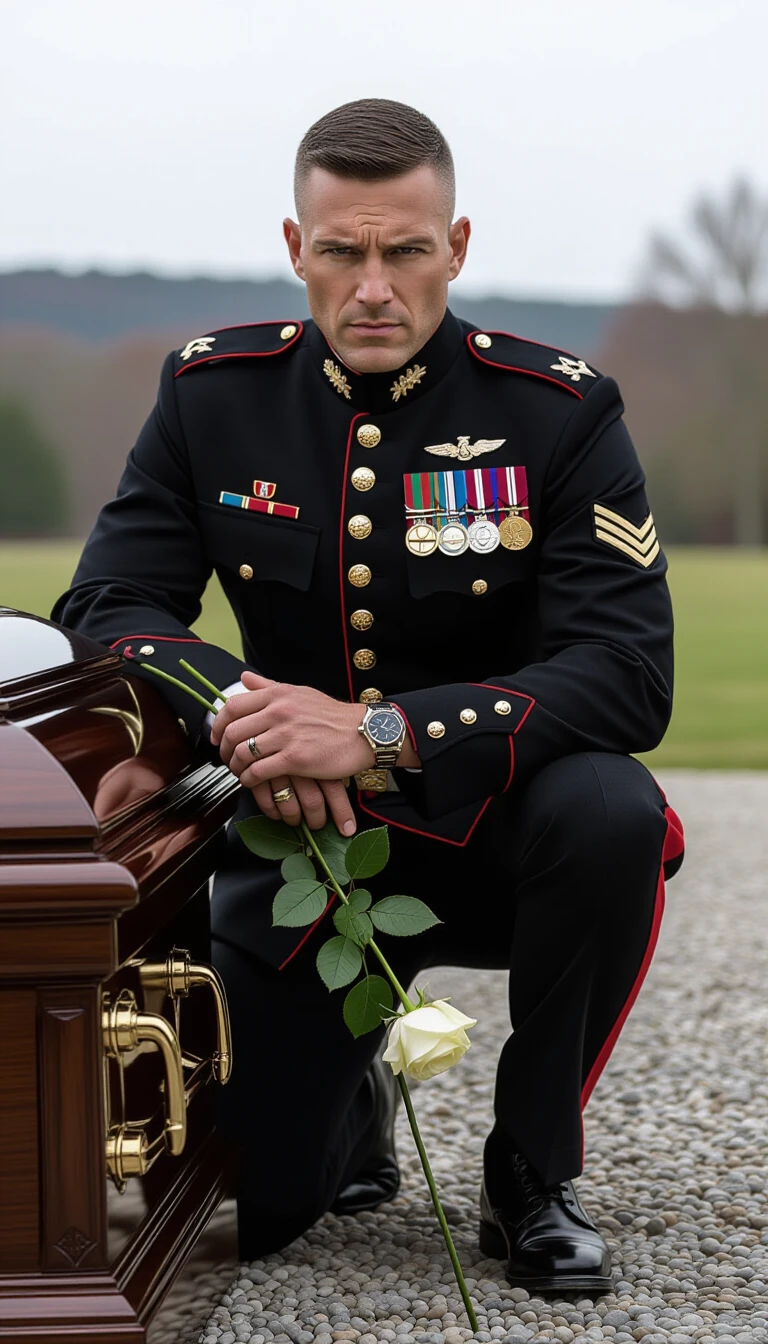
Her breathing changed.
Ivan felt it before he heard it—the rhythm he'd been counting, one-two-three-four in, one-two-three-four out, the metronome of her chest rising and falling beneath the thin hospital blanket—stuttered. Skipped. The one-two became one-. Then nothing.
He didn't move. His hand stayed wrapped around hers, her skin cold now, the pulse that had been fluttering at her wrist for the last hour gone quiet. The game show played on. A woman laughed from the television. Someone down the hall called for a nurse.
"Eleanor."
His voice cracked on the first syllable. He cleared his throat and tried again. "Eleanor."
Nothing.
He stood slowly. His knees popped. He'd been in that chair for six hours, maybe seven, and his body had locked into the shape of it. He leaned over her. Her blue eyes were closed. Her mouth had fallen open slightly, the way it did when she really slept, when she wasn't pretending for his sake.
Ivan pressed two fingers to her throat. Cold. Still.
He pulled his hand back and tucked it against his chest. His thumb found the ridge of his sternum and pressed. Once. Twice. Three times. The ritual his body reached for when his mind couldn't hold.
"Grandma."
The word sat in the room. Small. Final.
A nurse appeared in the doorway. Middle-aged. Gray-streaked hair pulled back tight. She looked at Eleanor, then at Ivan, and something in her face softened. "I'll call the doctor," she said quietly.
Ivan nodded. He didn't turn around.
He looked at Eleanor's face. The lines around her mouth. The silver hair fanned across the pillow. The way her hands had curled even in sleep, still holding onto something even at the end.
"You did good," he whispered. "You did everything right. I'm going to make you proud. I swear it."
His voice broke again. He let it.
By the time Kimberly found him, he was sitting on the edge of the bed with Eleanor's hand in both of his, his forehead pressed to her knuckles. She didn't say anything. She walked to the other side of the bed and took Eleanor's other hand. Michelle came in behind her and stood at the foot of the bed, arms crossed tight over her chest, her orange eyes wet and unblinking.
Michael appeared in the doorway. He looked at the bed. At Ivan. At the nurse filling out paperwork at the small desk in the corner. His jaw tightened. He turned and walked back down the hall.
No one called after him.
---
The cemetery was cold.
Virginia in November meant a wind that cut through wool and leather and skin, that found the gaps in every seam and settled into bone. Ivan stood at the graveside in his dress blues—the uniform he hadn't worn since Amber's funeral, the one he'd kept wrapped in plastic at the back of his closet. The medals on his chest caught the gray light. His hands hung at his sides, palms flat against his thighs.
Eleanor's coffin was oak. Dark. Simple. She'd picked it herself, years ago, and made them promise not to spend money on something fancy. "Put it in the ground and be done with it," she'd said. "I won't be there to appreciate it."
The priest spoke. Ivan heard the words without hearing them. Dust to dust. Ashes to ashes. The Lord giveth and the Lord taketh away. Hollow sounds that bounced off the headstones and disappeared into the gray sky.
Kimberly stood to his left. Michelle to his right. Their hands found his at the same moment, Kimberly's left gripping his right, Michelle's right gripping his left. They squeezed together. Ivan squeezed back.
Behind them: Stevenson Wolf in his dress uniform, his long black hair braided tight, his black eyes fixed on the coffin. Jack King beside him, same uniform, same stillness. Sarah Douglas in a black dress that the wind pressed against her athletic frame. The President stood next to her—Mark Douglas in a dark suit, no security detail visible, just a brother at his sister's side.
Maria stood farther back with John. Her blue-and-red hair was tucked under a black scarf. John held Ian in his arms, the toddler quiet for once, watching the adults with wide eyes.
Lynda Johnson was there. James too. Jacob stood between them, his hands shoved into his coat pockets, his eyes on Ivan.
The Chen family had come. David and Sue. Lance and Tia. They stood in a cluster near the back, heads bowed.
Michael stood alone. Ten feet from everyone else. His suit was expensive. His posture was rigid. His red eyes were dry.
Ivan knelt when the coffin began to lower.
His knees hit the wet grass. The cold seeped through the fabric immediately. He didn't care.
"I'm gonna make you proud," he said. Quiet enough that only the coffin could hear. "I'm gonna do right by everything you gave me. I swear it on my life. I swear it on—"
His voice caught. He pressed his fist to his mouth and breathed through his nose until the wave passed.
Kimberly knelt beside him. Then Michelle. The three of them on their knees in the wet grass, watching their grandmother disappear into the earth.
---
The reading was at Eleanor's farmhouse. The same kitchen where she'd gathered them weeks ago. The same table where she'd revealed two thousand years of family history. The same chairs.
Mr. Finch was a thin man with wire-rimmed glasses and a voice that matched his build. He sat at the head of the table with a leather folder open in front of him, papers arranged in neat rows. Michael sat to his right. Ivan sat across from him, Kimberly on one side, Michelle on the other.
Jack, Stevenson, and Sarah had pulled up chairs near the counter. They didn't speak. They didn't need to.
"The will is straightforward," Mr. Finch said, adjusting his glasses. "As you know, Eleanor and I worked on this document together over the course of several months. It reflects her final wishes."
"We know what it says," Michael said. His voice was flat. Controlled. "Read it and be done."
Mr. Finch cleared his throat and read. The farm. The estate. The shares. The company. The war chest. The terms were identical to what Eleanor had told them weeks ago. Ivan, Kimberly, and Michelle as CEOs. Jack, Stevenson, and Sarah on the board. Michael's twenty-six trillion dollars divided among the six of them.
Michael didn't move. His hands were flat on the table. His red eyes were fixed on a spot on the wall behind Ivan's head.
When Mr. Finch finished, the silence was heavy enough to hold.
"That's it," Mr. Finch said. He closed the folder. "I'll file the paperwork with the court. If there are no questions—"
"No questions," Ivan said.
Michael's eyes snapped to him. Something flickered in them. Anger. Disbelief. Something deeper that Ivan didn't want to name.
"No questions?" Michael repeated. "She gave away everything. Everything I worked for. Everything I built. To you and your—" He gestured at Jack, Stevenson, Sarah. "Your friends."
"She gave away what was hers to give," Ivan said. His voice was quiet. Even. The sniper's voice. "You got what you got."
"I got nothing."
"You got your life. Your health. Your freedom." Ivan met his brother's red eyes. "Some people don't get that."
Michael stood up. The chair scraped against the hardwood. "Don't you dare. Don't you dare talk to me about what people deserve. You don't know anything. You left. You were gone for years. I was the one who stayed. I was the one who ran the company. I was the one who—"
"Michael." Kimberly's voice cut through. Sharp. "Sit down."
He looked at her. At Michelle. At the wall of faces that had closed against him.
"Fine," he said. He grabbed his coat from the back of the chair. "Keep your will. Keep your farm. Keep your war chest. I don't need any of it."
He walked out. The front door slammed. A car engine started. Tires on gravel. Then silence.
Mr. Finch packed his papers without looking up. "I'll see myself out," he muttered, and he was gone too.
Ivan sat still. His hands were flat on the table. He was counting the seconds. One. Two. Three. Four. Five. Six. Seven—
"Ivan."
He looked up. Stevenson was watching him from the counter, his braids dark against his chest.
"You okay?"
"No," Ivan said. "But I will be."
---
Two hours passed.
The farmhouse settled into the rhythm of grief. Sarah made coffee. Kimberly found bread and butter and put together sandwiches no one ate. Michelle sat on the back porch steps, staring at the fields, her phone in her hand, not looking at it. Jack and Stevenson stood guard at the front windows, quiet, watching the long driveway.
Ivan stayed at the kitchen table. His coffee had gone cold an hour ago. He hadn't touched it.
The knock came at 3:47 PM.
Jack opened the door. A man stood on the porch. Older. Maybe seventy. Silver hair combed back. A suit that cost more than Ivan's car. He held a leather briefcase in one hand and a sealed envelope in the other.
"I'm looking for Ivan Nightsworn," the man said.
"Who's asking?"
"Richard Rogers. I was Eleanor Nightsworn's attorney for forty-four years."
Ivan stood up. "Let him in."
Jack stepped aside. Richard Rogers entered the farmhouse, his shoes clicking against the hardwood. He looked around the kitchen—at the untouched sandwiches, the cold coffee, the faces watching him—and nodded once, as if confirming something he already knew.
"Mr. Nightsworn," he said, extending his hand. "I'm sorry for your loss. Eleanor was a remarkable woman."
Ivan shook his hand. "Thank you."
"I understand Mr. Finch was here earlier."
"He was."
Richard Rogers set his briefcase on the table and opened it. He pulled out a second folder. Thicker than Finch's. Sealed with a red wax stamp in the shape of a crescent moon.
"I'm aware of the will Mr. Finch read," he said. "What he read was the will you and he and Eleanor drew up together."
Kimberly stepped forward. "What do you mean?"
Richard Rogers met her eyes. "I mean that Eleanor and I worked on a separate document. Eight months ago. She came to me in confidence and asked me to prepare an alternate estate plan. One that supersedes any previous arrangement."
He broke the wax seal. The sound of it cracking was loud in the quiet kitchen.
"This will," he said, "is ironclad. Uncontestable. And it reflects Eleanor's true final wishes."
Michael's car was already back in the driveway. He must have seen Rogers arrive. He stood in the doorway, his coat still on, his face unreadable.
"We already read the will," he said.
Richard Rogers turned to face him. "You read a will. You did not read Eleanor's will."
Michael's jaw tightened. "What are you talking about?"
"Sit down, Michael. All of you. This won't take long."
No one moved. Then Ivan pulled out his chair and sat. Kimberly sat beside him. Michelle came in from the porch. Jack, Stevenson, and Sarah took their places at the counter.
Michael stayed standing. Rogers didn't wait for him.
"To Ivan Leonardo Nightsworn, Kimberly Nightsworn, Michelle Nightsworn, Jack King, Stevenson Wolf, and Sarah Douglas," he read, "I leave the twenty-mile farm in Loudoun County and the one-hundred-acre estate in Fairfax County, to be held jointly and equally among you."
Ivan's breath caught. That was the same. That was—
"To Kimberly Nightsworn, Michelle Nightsworn, and Ivan Leonardo Nightsworn, I leave fifty percent of my shares in Nightsworn Industries, divided equally among you. To Kimberly Nightsworn, Michelle Nightsworn, and Ivan Leonardo Nightsworn, I leave your late father's fifty percent shares of the company, divided equally among you. To Ivan Leonardo Nightsworn, Michelle Nightsworn, and Kimberly Nightsworn, I leave fifty percent of Michael Nightsworn's shares, divided equally among you."
Michael's face went white.
"To Ivan Leonardo Nightsworn, Kimberly Nightsworn, Michelle Nightsworn, Jack King, Stevenson Wolf, and Sarah Douglas, I leave the war chest of one hundred and twenty trillion dollars and Michael Nightsworn's twenty-six trillion dollars. Use it wisely. Spend it respectfully. Honestly."
Rogers turned the page.
"To Kimberly Nightsworn, Michelle Nightsworn, and Ivan Leonardo Nightsworn, I leave the position of Co-CEOs of Nightsworn Industries, effective immediately. To Jack King, Stevenson Wolf, and Sarah Douglas, I place you on the Board of Directors with full voting rights."
He looked up. "That is the entirety of Eleanor's true will. It is dated, witnessed, notarized, and filed with the circuit court." He closed the folder. "It is the only document that will be recognized in probate."
Michael stepped forward. His hands were shaking. "That's—that's not possible. I was there when she made the first will. I watched her sign it."
"You watched her sign a document," Rogers said calmly. "She signed two that day. You only saw one."
"They're not even family," Michael said, pointing at Jack, Stevenson, Sarah. "They're just—they're just my brother's so-called friends. People who feel sorry for him."
Rogers closed his briefcase. "Jack King, Stevenson Wolf, and Sarah Douglas are family."
"They are not blood."
"No," Rogers said. "They are not. But blood does not always have to be family, Mr. Nightsworn. And family does not always have to be blood. Your grandmother understood that. I suggest you take some time to understand it as well."
He turned to Ivan. "My card is in the folder. If you or your sisters need anything—legal advice, estate management, someone to talk to—call me. Eleanor was my client for forty-four years. She was also my friend. I will honor her memory by honoring her wishes."
He picked up his briefcase and walked to the door. He paused with his hand on the handle and looked back at Ivan.
"She was very proud of you," he said. "She told me often. You were the one she trusted with everything."
Then he was gone.
The front door clicked shut. The silence that followed was deeper than the one before.
Michael didn't move. He stood in the middle of the kitchen, his hands still shaking, his red eyes fixed on the folder on the table.
"You knew," he said. His voice was quiet. "You all knew."
Kimberly looked at him. "Yes."
"You knew she was going to do this. And you didn't tell me."
"She asked us not to."
Michael laughed. It was a dry sound. Hollow. "She asked you not to. Of course she did. Because I'm the one who can't be trusted. I'm the one who's not family."
Ivan stood up. "Michael."
"Don't."
"Michael, listen to me—"
"No." Michael's voice cracked. "You don't get to talk to me. You don't get to act like you're the wounded one. You left. You were gone for nineteen years. I stayed. I ran the company. I took care of her. And she—"
He stopped. His throat worked. He didn't finish the sentence.
He turned and walked out. The front door didn't slam this time. It just closed. Soft. Final.
Ivan stood at the table. His hands were flat on the wood. His gray eyes were fixed on the folder.
"Ivan."
Kimberly's hand on his arm.
"You okay?"
He didn't answer for a long moment. Then he picked up the folder. Opened it. Read the first page. Eleanor's signature was at the bottom. Her handwriting was shaky—the same tremor she'd had the last few months—but she'd signed it clearly. Legibly. Herself.
"I'm going to make her proud," he said quietly. "That's what I'm going to do."
Kimberly nodded. She didn't let go of his arm.
Michelle walked around the table and took his other side. Jack, Stevenson, and Sarah moved closer. They didn't speak. They didn't need to.
Ivan looked down at the folder. At his grandmother's signature. At the weight of everything she'd given him.
He tucked the folder under his arm. Then he turned and walked to the back porch. The fields stretched out in front of him, brown and cold and waiting for spring. The wind moved through the dead grass. The sky was gray and endless.
He took out Amber's ring box. Held it in his palm. Looked at it.
"I'm going to do right by you too," he whispered. "Both of you. I swear it."
He stood there for a long time. The wind moved around him. The fields didn't answer. But he hadn't expected them to.
He just needed to say it out loud.
Michael didn't remember the drive. He didn't remember parking the car or walking through the glass doors or taking the elevator. He just remembered the carpet under his shoes—dark blue, patterned with small gold diamonds—and the sound of his own breathing in the silent hallway. The brass nameplate on the door said FINCH, HARTLEY & ROSEN. He pushed it open without knocking.
The receptionist looked up. A woman in her sixties with silver hair and reading glasses hanging from a chain around her neck. She knew him. She'd known him for fifteen years.
"Michael." Her voice was careful. "Mr. Finch is with someone—"
"I'll wait."
He didn't sit. He stood by the window overlooking the street, his hands shoved into his pockets, his shoulders tight. The sun was low, throwing long shadows across the pavement. He watched people walk past on the sidewalk below. Normal people. People who hadn't just been erased from their own family.
The office door opened. A man in a gray suit walked out, nodded at the receptionist, and left. Mr. Finch appeared in the doorway. He was seventy-two years old, with thin white hair and the kind of face that had seen too many wills, too many divorces, too many families tear themselves apart.
"Michael." He didn't sound surprised. "Come in."
The office was exactly the same as it had been the last time. Bookshelves lined the walls. A heavy oak desk sat in the center. A clock ticked somewhere. Mr. Finch closed the door behind them and gestured to the leather chair across from his desk.
Michael didn't sit. He stood in the middle of the room, his hands still in his pockets, his red eyes fixed on the law books on the shelves.
"She changed it." His voice was flat. "The will. She changed everything."
Mr. Finch lowered himself into his chair slowly. He folded his hands on the desk. He waited.
"She gave the farm to Ivan." Michael's voice stayed flat, mechanical, as if he was reading from a list. "And the estate in Fairfax. Twenty miles in Loudoun County. A hundred acres. To Ivan. To Michelle. To Kimberly. To Stevenson Wolf. To Sarah Douglas. To Jack King." He stopped. His jaw tightened. "She gave them my shares. The company shares. My father's shares. She gave them to Ivan and Michelle and Kimberly."
Mr. Finch didn't blink.
"She gave them the war chest." Michael's voice cracked on the word. "One hundred trillion dollars. She gave it to all of them. She gave them my twenty-six trillion. My trust. The one from my grandfather. She gave it to them."
He finally looked at Mr. Finch. His red eyes were rimmed with exhaustion.
"She made Ivan and Michelle and Kimberly the CEOs. She put Jack King, Sarah Douglas, and Stevenson Wolf on the board. My board. The one I built." He laughed. It was a short, jagged sound. "And you want to know the best part? Sarah Douglas is the president's sister. The President of the United States. She put the goddamn Commander-in-Chief's sister on the board of a private holding company."
Mr. Finch leaned back in his chair. The leather creaked. He studied Michael for a long moment before he spoke.
"I'm aware of who Sarah Douglas is." His voice was measured. Calm. "I reviewed the filing myself."
Michael stared at him. "You knew."
"I was told to expect this conversation."
"You knew she was going to do this."
Mr. Finch didn't deny it. He simply looked at Michael with the same expression he'd worn at Richard Nightsworn's funeral fifteen years ago. Grief. Care. Distance.
"Michael, sit down."
"I don't want to sit down."
"Sit down."
The command was quiet, but it carried the weight of decades. Michael's hands came out of his pockets. He stood there for another moment, breathing hard, then dropped into the leather chair. The springs groaned.
Mr. Finch opened a drawer and pulled out a manila folder. He set it on the desk but didn't open it.
"Your grandmother came to me six months ago. She asked me to draft a new will. I told her I couldn't do it without a full psychological evaluation. She consented. Three separate psychiatrists evaluated her. All three concluded she was of sound mind."
Michael's hands gripped the armrests. "I don't care about the psych evals—"
"You should." Mr. Finch's voice sharpened. "Because the first thing any court will ask is whether she was competent. She was. There's no legal basis to contest this will. None."
Michael opened his mouth. Closed it.
"She left you the house in Arlington," Mr. Finch said quietly. "The one on North Veitch Street. It's paid off. There's a five-hundred-thousand-dollar trust set aside for maintenance and taxes. It's yours. Free and clear."
"A house." Michael's voice was barely a whisper. "She left me a house."
"And the contents of the safety deposit box at the Bank of America on King Street. She didn't tell me what's in it."
Michael laughed again. The same hollow, jagged sound. "A house. And a safety deposit box. While Ivan gets everything else. Everything." He leaned forward, his elbows on his knees, his head dropping. "I ran the company for nineteen years. I took care of her. I was there. I was the one who stayed."
Mr. Finch waited. When Michael didn't lift his head, he spoke.
"Eleanor loved you, Michael."
"Don't."
"She did. But she didn't trust you."
Michael's head snapped up. His red eyes were bright. "Trust me with what? With a company I already ran? With money I already managed?"
"With the family." Mr. Finch's voice was quiet. Steady. "She didn't trust you with the family. She watched you for years, Michael. She saw how you treated Ivan when he came home. She saw how you talked about your sisters. She saw the way you looked at Jack and Stevenson and Sarah—like they were intruders. Like they didn't belong."
"They don't belong. They're not blood."
"They're family."
"No. No, they're not." Michael's voice was shaking now. "They're not. Ivan brought them in. Ivan, who left. Ivan, who was gone for nineteen years. Ivan, who showed up at her funeral like he hadn't abandoned all of us—"
"Ivan was a child when he left." Mr. Finch's voice cut through Michael's. "He was eighteen. He was grieving. He was drowning. And instead of staying to drown with him, you pushed him away. You told him he was a burden. You told him he should have been sent to an orphanage."
Michael's face went white.
"Your grandmother knew," Mr. Finch said. "She heard you. She never forgot."
"That was—" Michael's voice faltered. "That was years ago. I was a kid. I was angry."
"You were eighteen. Old enough to know better." Mr. Finch leaned forward. "Michael, I'm not telling you this to hurt you. I'm telling you this because you asked me why. And that's the truth. She didn't disinherit you because she stopped loving you. She disinherited you because she knew you would tear the family apart to keep control of it."
The clock ticked. Somewhere down the hall, a phone rang and was answered.
Michael sat in the leather chair, his hands limp on the armrests, his eyes fixed on a spot on the desk. He looked smaller than he had when he walked in. Deflated. Hollow.
"What am I supposed to do now?" he asked. His voice was quiet. Almost childlike.
Mr. Finch studied him for a long moment. Then he opened the folder.
"You have two options. The first: you contest the will. You spend the next three to five years in litigation. You burn through the trust she left you, and probably the house too, paying legal fees. You drag your brother and sisters through a public court battle. And at the end of it, you lose. Because there is no legal basis to overturn this will."
"I wanna contest the will." Michael's voice came out flat. Hard. Like he was reading a line he'd rehearsed.
Mr. Finch didn't blink. He set the folder down and folded his hands on the desk. "Michael, I just explained—"
"I heard what you said." Michael leaned forward, his hands gripping the armrests. "Three psych evals. Sound mind. No legal basis. I heard all of it." His red eyes were bright, almost feverish. "I don't care."
The clock ticked. Somewhere in the building, a door closed.
"You don't care about the law?" Mr. Finch's voice was quiet. Careful.
"I care about what's fair." Michael's jaw tightened. "She left me a house. A house, while Ivan gets everything. Ivan, who showed up for one dinner. Ivan, who was gone for nineteen years. Ivan, who didn't even know she was sick until a few weeks ago." His voice cracked on the last word. He swallowed. "I was there. I was there every day. I took her to appointments. I made sure she ate. I sat with her when she couldn't sleep. And he gets everything."
Mr. Finch was quiet for a long moment. When he spoke, his voice was softer than before. "Michael, do you know why your grandmother asked me to draft a superseding will?"
"Because she didn't trust me." The words came out bitter, tasting like ash.
"No." Mr. Finch shook his head. "She asked me because she was afraid of what would happen after she died. Not because she thought you'd steal from the company. Not because she thought you'd mismanage the money. She was afraid you'd tear the family apart fighting over it."
Michael opened his mouth. Closed it.
"She loved you," Mr. Finch said. "She told me that. She said, 'Michael is my grandson and I love him. But he's prideful. He's angry. And he's never forgiven Ivan for leaving.' She said that to me, Michael. Six months ago. She said you'd never forgive Ivan for being the one who got out."
Michael's hands were shaking. He pressed them flat against his thighs. "That's not—"
"She also said you'd never forgive yourself for staying." Mr. Finch's voice was almost gentle. "She said you stayed because you thought you had to. Because someone had to take care of the family. And you resented Ivan for not being there to share the weight. You resented him so much that you couldn't see how much he was carrying too."
Michael stared at the desk. His reflection in the polished wood was blurry, indistinct. A ghost of a man he didn't recognize.
"I want to contest the will," he said again. Quieter this time. Less sure.
"You can," Mr. Finch said. "I can't stop you. But I want you to understand what that means." He opened the folder and pulled out a sheet of paper. "Your grandmother left you the house on North Veitch Street. It's worth approximately one point two million dollars. She also left you the trust—five hundred thousand for maintenance and taxes. If you contest the will, the legal fees will consume that trust within eighteen months. Possibly faster if Ivan's lawyers drag it out."
Michael's throat moved. He didn't speak.
"The litigation itself will take three to five years. During that time, the company will be in limbo. Ivan, Kimberly, and Michelle won't be able to make major decisions without court approval. The war chest will be frozen. The employees—the two thousand people who work for your family's company—will be caught in the middle." Mr. Finch set the paper down. "And at the end of it, you will lose. Because there is no legal basis to overturn this will. You will lose the house. You will lose the trust. You will lose whatever relationship you have left with your brother and sisters. And your grandmother's final wish—that the family stay whole—will be destroyed."
The silence stretched. Michael's hands were still pressed flat against his thighs. His knuckles were white.
"What's the second option?" he asked. His voice was barely a whisper.
Mr. Finch studied him for a moment. Then he reached into the folder and pulled out a second document. It was shorter than the first. A single page.
"Your grandmother left you a letter." He slid it across the desk. "She asked me to give it to you after the will was read. She said I should only give it to you if you asked the right question."
"What's the right question?"
"You just asked it." Mr. Finch tapped the letter. "You asked what your options were. That means you're thinking. You're not just reacting. She would have been proud of that."
Michael stared at the envelope. His name was written across the front in Eleanor's handwriting—crisp, elegant, the same handwriting that had signed his birthday cards for forty-two years.
He didn't pick it up.
"I don't know if I can read this right now."
"You don't have to." Mr. Finch leaned back. "Take it home. Read it when you're ready. It might take a day. It might take a year. But when you're ready, it'll be there."
Michael looked at the envelope. His name. Her handwriting. The last thing she would ever write to him.
He reached out and picked it up. The paper was warm under his fingers. He held it for a moment, feeling the weight, then tucked it into his inside jacket pocket.
"Thank you," he said. The words felt strange in his mouth. Foreign. He wasn't sure he'd ever thanked Mr. Finch before.
"You're welcome, Michael." Mr. Finch closed the folder. "And Michael?"
Michael looked up.
"Your grandmother loved you. She never stopped. She just loved the family more."
Michael nodded. He stood up slowly, like a man who'd been sitting for hours instead of minutes. His legs felt unsteady. His hands were still trembling.
He walked to the door. His hand found the handle. He paused.
"Mr. Finch?"
"Yes?"
"If I don't contest the will—if I let it stand—what happens to me?"
Mr. Finch was quiet for a moment. Then he said, "You get to decide who you want to be."
Michael stood there, his hand on the door handle, the letter pressing against his chest. He thought about the house on North Veitch Street. The safety deposit box. The family he'd pushed away. The brother he'd told to go to an orphanage.
He opened the door.
The hallway was empty. The fluorescent lights buzzed overhead. Somewhere, a phone rang and was answered.
Michael stepped out into the hallway and closed the door behind him.
He stood there for a long moment, alone in the empty corridor, the letter tucked against his heart.
Then he walked toward the exit. His footsteps echoed on the linoleum. One after another. Steady. Measured. The sound of a man who didn't know where he was going but was walking anyway.
The door at the end of the hallway swung open. Sunlight spilled in, orange and gold, catching the dust motes suspended in the air.
Michael walked into the light.
The cemetery grass was wet under Ivan's boots. Morning dew still clinging to the blades, soaking through the leather. He stood at the foot of Eleanor's grave, the fresh mound of earth dark against the green, the headstone not yet placed. His dress blues felt tight across his shoulders. The medal on his chest caught the gray light.
Kimberly stood to his left, her hand finding his. Her fingers were cold. Michelle stood to his right, her jaw tight, her orange eyes fixed on the grave like she could will it open. Jack and Stevenson stood behind them, silent. Sarah stood beside her brother Mark, the President of the United States in a black suit, no tie, his long hair loose, his blue eyes unreadable.
"She's really gone," Kimberly said. Not a question. A fact she was still trying to believe.
Ivan didn't answer. He couldn't. His throat was closed, his chest hollow. He'd held her hand when she died. He'd felt the exact moment the warmth left her fingers. He didn't need to say it out loud.
The four Swiss Guards arrived first. They wore dark suits, not ceremonial uniforms. Their faces were stone. Behind them, four Grenadier Guards in full regalia—bearskin caps, red tunics, black trousers. They moved with the precision of men who had done this a hundred times. They formed a corridor on either side of the grave.
The foreman of the crew looked at Ivan. "Sir?"
Ivan nodded.
The backhoe started. The sound cut through the morning quiet, a mechanical growl that made Sarah flinch. Mark put a hand on her arm. She didn't look at him.
They dug for twenty minutes. The earth came up in wet clumps, dark and rich, smelling of clay and rot and something older. Ivan watched every shovel of dirt. He didn't blink. His hands hung at his sides, still, his sniper's stillness, but his thumb was tapping against his thigh. Three taps. Pause. Three taps. His OCD ritual, the one he couldn't stop.
Michelle noticed. She reached over and covered his hand with hers. The tapping stopped.
"I got you," she said. Her voice was rough.
He looked at her. Her orange eyes were wet, but she wasn't crying. She was holding it in, the way Nightsworns did. The way Eleanor had taught them.
The crew reached the casket. The backhoe stopped. The foreman and two other men climbed into the grave with ropes. They worked carefully, clearing the dirt, looping the straps under the oak coffin. The wood was still clean. It had only been in the ground for three days.
They lifted it out. The ropes groaned. The casket swung, suspended, dripping dirt and water. The four Swiss Guards stepped forward and took the ropes, their movements synchronized. They carried Eleanor's casket to the hearse, a black Cadillac with tinted windows, waiting on the cemetery path. The four Grenadier Guards flanked them, one on each corner, their boots crunching on the gravel.
Ivan followed. His steps were measured. One foot in front of the other. The same pace he'd used on patrol in the desert, in the jungle, in the alleys of cities that didn't have names anymore. The pace of a man who knew exactly where he was going.
The Swiss Guards slid the casket into the hearse. The Grenadier Guards formed a line, saluting. The hearse doors closed with a soft thud.
Ivan stood there, looking at the hearse. The reflection of the gray sky in the tinted windows. His own face, distorted, unrecognizable.
"Ivan." Mark's voice, low, respectful. "We need to go."
Ivan turned. Mark stood a few feet away, his hands in his pockets, his blue eyes steady. Behind him, the presidential limousine was waiting, black and bulletproof, flags on the hood.
"I'll follow in my truck," Ivan said.
"Understood." Mark nodded. "I'll see you at the farm."
The Swiss Guards and Grenadier Guards climbed into two black SUVs. Kimberly and Stevenson got into her sedan. Jack and Michelle got into her car. Sarah and Mark got into the limo. Ivan walked to his F-350, parked at the edge of the cemetery. The truck was old, beat-up, a working man's truck. He opened the door, climbed in, and started the engine. The diesel rumbled under him, familiar and solid.
The convoy moved out. Two police cruisers in front, lights flashing but no sirens. The hearse. The SUVs. The limousine. The sedans. Ivan's truck brought up the rear, another police cruiser behind him. They drove through the Virginia countryside, past farms and fields, past the places Ivan had known his whole life. The sky was pale, the sun struggling to break through the clouds.
Ivan kept his eyes on the hearse. He didn't look away.
They reached the farm. The gates were open. The long driveway curved through the fields, past the old barn, past the place where Ivan had learned to shoot, past the tree where he and Kimberly and Michelle had built a fort when they were seven. The farmhouse sat at the end of the drive, white and weathered, the porch swing still, the windows dark.
The convoy stopped in front of the house. The police cruisers parked on the grass. The SUVs parked behind the hearse. The limousine stopped at the bottom of the porch steps.
Ivan killed the engine. The silence rushed in. He sat for a moment, his hands on the steering wheel, his knuckles white. Then he opened the door and got out.
The Swiss Guards and Grenadier Guards removed Eleanor's casket from the hearse. They carried it up the porch steps, through the front door, into the house. Ivan followed. So did Kimberly and Michelle. Jack and Stevenson. Sarah and Mark.
The house smelled like her. Coffee. Lavender. The old wood of the floors. Ivan walked through the kitchen, past the table where they'd sat after the first will reading, past the counter where Eleanor had made him sandwiches when he was ten. The guards carried the casket down the basement stairs. Ivan followed them into the hidden bunker.
Mark Douglas stopped at the top of the stairs. "I didn't know this was here."
"A lot of things are here," Sarah said quietly. She took his hand. "Come on."
They descended. The stairs were narrow, concrete, the walls lined with pipes and wires. At the bottom, a steel door, three feet thick, with a wheel lock. One of the Swiss Guards spun the wheel. The door swung open, heavy and silent.
Mark stepped through and stopped.
The bunker was huge. A cathedral underground. The ceiling arched forty feet overhead, supported by stone columns. Torches flickered in iron brackets, casting shadows that danced on the walls. The floor was polished stone, dark and smooth. And in the center of the room, a vault. Bronze doors, fifteen feet tall, covered in engravings—Latin words, crosses, the Nightsworn crest, the Roman eagle.
Mark's mouth opened. He didn't speak.
Sarah's grip on his hand tightened. "Mark," she said, her voice barely a whisper. "This is what she showed us."
The Swiss Guards carried Eleanor's casket toward the vault. Two of the Grenadier Guards stepped forward and pulled the bronze doors open. They moved without a sound, their weight immense, their balance perfect.
Inside the vault: a dark room. The walls lined with stone sarcophagi, each one marked with a name. Ivan's eyes found the earliest one. The date: 33 BC. The name: Lucius Nocturnus. The founder.
There was an empty tomb against the far wall. Fresh stone. Clean. Eleanor's name already carved into the lid. ELEANOR NIGHTSWORN. BELOVED MATRIARCH. PROTECTOR OF THE PROMISE.
The Swiss Guards carried the casket to the tomb. They lifted it, four men moving as one, and lowered it into the stone recess. The ropes slid free. The casket settled with a soft thud that echoed through the vault.
Mark Douglas took a step forward. His face was pale. His blue eyes were wide. He looked at the sarcophagi, at the dates, at the names. He looked at Ivan.
"Ivan," he said. His voice was rough, like he'd been screaming. "Has every Nightsworn been buried here since 33 BC?"
Ivan looked at his grandmother's tomb. The fresh stone. The clean engraving. The casket resting inside, the woman who had raised him, who had believed in him, who had given him a purpose when he thought he was nothing but a weapon.
"Yes," he said. "Since the beginning."
Mark stared at him.
Ivan knelt. His knees hit the stone floor. He pressed his forehead against the cold edge of Eleanor's tomb, his hands flat on the lid, his fingers tracing the letters of her name.
"I'm going to make you proud," he whispered. "I promise."
Behind him, Kimberly was crying. Michelle was holding her. Jack and Stevenson stood at attention, their eyes wet, their hands clasped behind their backs. Sarah was pressed against her brother, her face buried in his chest. Mark stood still, his hand over his mouth, looking at the tomb of a woman who had guarded a secret for two thousand years.
Ivan stayed on his knees. His forehead against the cold stone. His fingers tracing her name.
The torches flickered. The shadows danced. The vault was silent.
And somewhere, in the quiet, Ivan felt her. Not a ghost. Not a memory. Just the sense that she was still there, still watching, still proud.
He stayed there for a long time.
When he finally stood, his knees ached. His eyes were dry. He turned to face the others. Kimberly was the first to step forward. She wrapped her arms around him, her face pressed against his chest, her shoulders shaking. He held her. Then Michelle. Then Jack. Then Stevenson, who just put a hand on his shoulder and squeezed.
Sarah walked up to him. Her green eyes were red, but she wasn't crying anymore. She looked at him, steady and quiet. "What happens now?"
Ivan looked past her, at the vault, at the tombs of his ancestors, at the bronze doors still open, waiting for the next Nightsworn.
"We protect what she gave us," he said. "We keep the promise. We make her proud."
Mark Douglas stepped forward. He looked at Ivan with something new in his eyes. Not pity. Not curiosity. Respect.
"I don't know what I just saw," Mark said. "I don't know what this place is, or what you're protecting, or why you showed me. But I know one thing."
Ivan met his eyes.
"Eleanor was right," Mark said. "She picked the right hands."
Ivan looked down at his hands. They were still. No tapping. No trembling. Just steady hands, scarred and calloused, hands that had killed and built and held.
Eleanor's hands, once.
Now his.
Ivan turned from Eleanor's tomb. His gray eyes found Mark's face, still pale, still processing the weight of what he'd seen.
"There's more," Ivan said. His voice was quiet, the same flat tone he used when calling coordinates over a radio. "I need to show you something."
Mark's blue eyes narrowed. "More."
Ivan didn't answer. He walked past the others, past the bronze doors still open, past the row of sarcophagi dating back to the first Nightsworn. His boots echoed off the stone floor. The torchlight flickered, shadows stretching and shrinking across the walls.
Kimberly and Michelle followed without a word. Jack and Stevenson fell in behind them. Sarah looked at her brother, then at Ivan's back, and she followed too.
Ivan stopped at the far wall of the vault. It looked solid — the same grey stone, the same mortared seams, the same age-darkened surface. But he reached into a recess beside a torch and pressed something. A click. Then another.
The wall shifted.
Not a door — the entire section of wall slid sideways, three feet thick, grinding against stone with a sound like a mountain waking. Dust drifted down. The torches guttered.
Beyond the wall was another chamber.
Larger than the first. The ceiling arched high overhead, lost in shadow. The walls were lined with torches that lit themselves as the air moved — gas jets, ancient but maintained. The light revealed three stone sarcophagi in the center of the room, arranged in a triangle.
Mark stopped at the threshold. His breath caught.
The first sarcophagus was plain stone, unadorned, but the lid was carved with a single symbol — a fish, curved, ancient. The second was marble, white veined with grey, and on its lid was carved a woman's face, her hair long, her eyes closed, her lips slightly parted as if she were sleeping. The third was smaller, also marble, and on its lid was carved a young woman's face, her features delicate, her hair braided around her head.
Mark couldn't move. His hand found the doorframe, gripping the cold stone hard enough to turn his knuckles white.
"No," he said. His voice cracked. "No, that's—"
Ivan stood in front of the first sarcophagus. The unadorned one. The one with the fish. He placed his palm flat on the lid.
"Yes," Ivan said.
Kimberly stepped forward. Her hand went to a niche in the wall beside the larger chamber. She pulled out a wooden box, plain, old, the wood so dark it was almost black. She carried it to Mark and opened the lid.
Inside: three spikes. Iron, rusted, bent at the ends. Each one still dark with something that had long since dried to black.
"The nails," Kimberly said. Her voice was steady, but her hand shook. "The nails that pierced Christ."
Mark stared at them. His mouth opened. Nothing came out.
Michelle stepped past him to another niche. She lifted a case wrapped in linen, long and narrow, and carried it to the torchlight. She unwrapped it slowly, reverently, until the metal caught the flame.
The spear was simple. A leaf-shaped blade, iron, the edges worn, the surface pitted with age. The shaft was wood, replaced over centuries, but the head — the head was original. Michelle held it up, the blade reflecting the torchlight like a dark mirror.
"The Holy Spear," Michelle said. "The Lance of Longinus. The one that pierced His side."
Mark made a sound. Not a word. Just a sound, low and broken, like something inside him was cracking.
Jack and Stevenson and Sarah moved to the far side of the chamber. Together, they lifted a section of canvas that had been draped over something large. The canvas fell away, revealing wood — huge beams, rough-hewn, dark with age, held together by iron brackets that had been added over centuries to keep it intact.
The True Cross.
Not a fragment. Not a splinter. The whole thing, reassembled, preserved, each beam as long as a man is tall, the crosspiece still mortised into the upright, the grain still visible, the wood still smelling of dust and age and something else — something that made the air feel thick.
Sarah touched the edge of the crosspiece. Her fingers trembled.
"This is what she guarded," Sarah said. "This is what she died protecting."
Mark walked forward. His steps were unsteady. He stopped in front of the first sarcophagus — the one with the fish. He looked at the lid, at the symbol carved into the stone, at Ivan's hand still resting on it.
"Who is buried here?" Mark said. His voice was barely a whisper.
Ivan looked at the stone. His gray eyes were steady, but his jaw was tight.
"Jesus of Nazareth," Ivan said. "Yeshua ben Yosef. The man they called the Christ."
Mark swayed. His hand went to his face, covering his mouth. He stared at the sarcophagus, at the plain stone, at the fish carved into the lid, and something in his expression broke open — awe, doubt, belief, all of them colliding at once.
Kimberly stepped to the second sarcophagus. The marble one. The one with the woman's face carved on the lid.
"Mary of Magdala," Kimberly said. "His wife."
Mark's hand dropped from his mouth. His face was grey.
Michelle moved to the third sarcophagus. The smaller one. The young woman's face, peaceful, eternal.
"Sarah," Michelle said. "Their daughter."
The silence in the chamber was absolute. Even the torches seemed to burn without sound.
Mark stood in the center of the triangle, surrounded by the tombs of a family that had been a story, a symbol, a myth. He looked at the nails. He looked at the spear. He looked at the cross. He looked at Ivan.
"How long," Mark said. His voice cracked. "How long has this been here?"
Ivan's hand stayed on the lid of the first sarcophagus. "Since 33 AD. The Nightsworn family — we were called the Nocturnus Vindices then. Defenders of the Night. We killed the Roman commander who ordered the crucifixion. We brought the bodies here. We've guarded them ever since."
Mark shook his head. Slow. Disbelieving. "You're telling me—"
"Eleanor Nightsworn," Ivan said. "Michelle Nightsworn. Myself. Michael. Our father Robert. Our ancestors. We are the living descendants of Jesus Christ, Mary Magdalene, and their daughter Sarah."
Mark's knees buckled.
Sarah caught him. Her arms wrapped around her brother's chest, holding him upright, her green eyes wet. Mark gripped her arm, his breath ragged, his face pressed into her shoulder.
"I'm sorry," he said. His voice was muffled. "I'm sorry, I just—"
"I know," Sarah said. She held him tighter. "I know."
Jack stood beside the True Cross, his hand resting on the wood, his blue eyes dark. "I've been a SEAL," he said. "I've seen things most people don't believe exist. But this—" He shook his head. "This changes everything."
Stevenson stood at Ivan's shoulder. His braids hung forward, his black eyes fixed on the tombs, his face unreadable. He didn't speak. He didn't need to.
Mark straightened. He wiped his face with the back of his hand. He looked at Ivan, and there was something new in his eyes — not just respect, but something deeper. Something like recognition.
"Does anyone else know?" Mark asked. "The Vatican? The world?"
Ivan shook his head. "The Vatican knows we guard something. They don't know what. The Church has always protected us — the Knights of St. Dumas, the Iron Cross, the RedFire Knights — they were all founded to shield this secret. But only the Nightsworn know the full truth."
Mark looked at the tombs again. At the nails. At the spear. At the cross. At the weight of two thousand years, standing in stone and iron and bone before him.
"Why are you showing me this?" he asked.
Ivan met his eyes. His gray eyes, the same color as the stone walls, the same color as the dust that drifted in the torchlight.
"Because Eleanor trusted you," Ivan said. "And because I need allies I can trust."
Mark stared at him. Then he looked at his sister, at the tombs, at the truth carved into stone and iron and wood. He let out a long breath, slow and shaking.
"What do you need?" he asked.
Ivan didn't answer right away. He turned and walked to Eleanor's tomb, in the outer vault, where fresh stone stood next to two thousand years of history. He placed his hand on her name.
"Time," Ivan said. "And people who can keep a secret."
Mark walked to stand beside him. He looked at Eleanor's tomb, at the name carved into the stone, at the woman who had guarded a secret for sixty years and died trusting a young man with a killer's hands and a child's heart.
"She knew what she was doing," Mark said. "When she chose you."
Ivan didn't respond. His fingers traced the letters of her name — E, L, E, A, N, O, R — and then he pressed his palm flat against the stone, feeling the cold seep into his skin.
Behind them, Kimberly and Michelle stood at the entrance to the inner chamber, guarding the tombs of their ancestors. Jack and Stevenson flanked the True Cross. Sarah stood at her brother's side, her hand on his arm.
The torches flickered.
The shadows moved.
Somewhere, in the quiet of the vault beneath the farmhouse, Ivan felt Eleanor's presence again. Not a ghost. Not a whisper. Just the certainty that she was there, watching, waiting to see what he would do with the weight she had placed in his hands.
He lifted his palm from the stone.
"We seal the vault," Ivan said. "And we start working."
Ivan nodded. His hand stayed on Eleanor's tomb, the stone cold beneath his palm, the name carved deep enough to last forever. "The British Royal Guards have been here since the 1700s. The Swiss since the same. They protect the farm, the estate, the land above this vault. They've always been here. They'll always be here."
Mark stared at him. Then he looked at the torches, at the shadows moving across two thousand years of history, at the woman who had trusted a killer with a child's heart. "We need to go upstairs," he said. "Sarah. Stevenson. Jack. I need you."
Ivan understood what Mark was doing before the words finished leaving his mouth. The President was building a wall. A wall of men and women and laws and secrets, layered so deep that nothing could ever touch what lay beneath this farmhouse.
Mark looked at Ivan. His blue eyes were steady now, the shock replaced by something harder, something that looked like resolve. "I will protect your family," he said. "Your secret. Your legacy. With my life." He paused. His voice dropped. "We have been friends since we were all kids, Ivan. That doesn't end now."
Ivan didn't respond. He didn't need to. His hand stayed on Eleanor's stone, and he watched Mark walk toward the vault entrance, Sarah at his side, Jack and Stevenson following.
They ascended the stairs in silence. The torchlight faded behind them. The heavy door sealed with a thud that echoed through the farmhouse floorboards above.
In the kitchen, morning light cut through the windows. Dust drifted in the beams. A coffee cup sat on the counter, Eleanor's lipstick on the rim, a faint crescent of mauve that would never be fresh again.
Jack grabbed his keys from the table. Stevenson pulled his phone from his pocket. Sarah already had the limo door open.
Mark paused at the threshold. He looked back at Ivan, at Kimberly and Michelle standing in the kitchen doorway, at the weight of two thousand years pressing down through the farmhouse floor. "I'll be in touch," he said. "Before the day is done."
Ivan watched them go. Jack's truck rumbled to life. Stevenson's SUV followed. The limo pulled out last, black and silent, carrying the President of the United States back toward a capital that didn't know what it was built on.
The farmhouse settled into silence.
Kimberly touched Ivan's arm. Her purple eyes were wet, but her face was steady. "What now?"
Ivan looked at the coffee cup. At the lipstick. At the dust in the light. "Now," he said, "we trust them."
---
Mark's hand moved before he sat down. He was still on the White House lawn, the door not fully closed behind him, when he began speaking. "I need a full meeting. The Joint Chiefs. The Secretaries of Defense, Navy, Army, Air Force. Homeland Security. CIA. FBI. The Armed Services Committee. Every relevant member of Congress."
Sarah was already scrolling through her phone, her short hair shaved on both sides catching the light as she moved through the West Wing. "I'll get them in the Situation Room within the hour."
Mark sat in the Oval. He didn't look at the Resolute Desk. He didn't look at the flags, the portraits, the weight of two hundred fifty years of history. He looked at his hands, still shaking, and he held them still.
---
The Situation Room was full.
Secretary of Defense Wesley sat at the far end, a gray man with gray hair and gray eyes, a career that stretched back four decades and a face that didn't flinch. Secretary of the Navy Villanova sat beside him, sharp in dress whites, his jaw tight. Secretary of the Army Pollock had his arms crossed, his eyes fixed on the President as Mark walked in.
Secretary of the Air Force Rebecca sat with her hands folded on the table, her gray bun tight, her eyes unreadable. Homeland Security Secretary Lisa leaned forward, a pen in her hand, not writing. CIA Director Miller and FBI Director Patrick flanked the far wall, both standing, both waiting.
The Joint Chiefs sat in a row. The Armed Services Committee members filled the remaining seats. The air was thick with unspoken questions.
Mark didn't sit. He stood at the head of the table, his hands on the back of the chair, his blue eyes sweeping the room.
"I am about to tell you something," he said, "that will change everything you believe about the world. About history. About power." He paused. "And then I am going to ask you to help me protect it."
The room was silent.
Mark told them.
He told them about the Nightsworn family. About the Nocturnus Vindices. About the vault beneath a farmhouse in Virginia, where three sarcophagi held the bodies of Jesus of Nazareth, Mary Magdalene, and their daughter Sarah. He told them about the nails, the spear, the True Cross. He told them about a two-thousand-year-old secret that had been guarded by one family, through wars and empires and the collapse of nations, and how that secret was now the responsibility of a thirty-seven-year-old former Marine sniper with OCD and a killer's hands.
When he finished, the room was still silent.
Secretary of Defense Wesley was the first to speak. His gray eyes were fixed on the table, his voice flat. "You're certain."
"I saw it," Mark said. "I touched the stone. I stood in front of the tombs." He looked at Wesley. "I am certain."
Miller, the CIA Director, leaned forward. His voice was low. "Who else knows?"
"The Nightsworn family. The ones I trust." Mark paused. "And now everyone in this room."
FBI Director Patrick let out a long breath. "Mr. President, if this leak—"
"It won't." Mark's voice cut through the room. "This is classified at a level that doesn't exist yet. The Vice President doesn't know. Congress doesn't know. Even the members of this committee who are here — this stays in this room. In this building. Under my direct authority."
Homeland Security Secretary Lisa tapped her pen once against the table. "The Nightsworn property. The farm. The estate. How is it protected now?"
"British Royal Guards," Mark said. "Swiss guards. They've been there since the 1700s. But that's not enough. Not anymore."
He looked around the room, at each face, each set of eyes weighed with the knowledge he had just placed in their hands.
"We need to build something permanent," Mark said. "A security detail that will never be taken away. A protective perimeter that no one can breach. A team that answers only to me, and to the people who know the truth."
The room was silent for another beat.
Then Secretary of the Navy Villanova spoke. "What do you need?"
Mark's jaw tightened. "Everything. And everyone."
---
Sarah, Jack, and Stevenson left the Situation Room together.
Sarah had her phone in her hand, already scrolling through personnel files, her green eyes sharp, her stride fast. "I'm pulling the Joint Chiefs' recommendations. We need names. We need clearances. We need people who can keep a secret."
Jack cracked his neck. His blue eyes were cold, focused. The former SEAL was already thinking in teams, in layers, in kill zones and security perimeters. "I'll take the FBI HRT. A hundred of my best. A hundred more agents on rotation."
Stevenson nodded. His black eyes were steady, his braids hanging forward, his voice low. "CIA HRT. Same number. Same standard."
Sarah stopped walking. She looked at both of them. "This isn't temporary. The President said permanent. Forever. That means we build a unit that outlasts us."
Jack looked at Stevenson. Stevenson looked at Jack.
A slow smile spread across Jack's face.
Stevenson matched it.
---
The next twenty-four hours were a blur of phone calls and file reviews and quiet conversations in secure rooms.
Jack and Stevenson worked in tandem, side by side, the way they had trained beside Ivan a thousand times in a thousand different combat zones. Jack ran the FBI side. Stevenson ran the CIA side. They didn't overlap. They didn't compete. They built.
From the Army: one hundred Delta Force operators. One hundred Green Berets. One hundred regular Army personnel. Every single one vetted, cleared, and sworn to silence at a level that didn't exist until Mark Douglas created it.
From the Marines: one hundred Marine Recon specialists. One hundred regular Marine personnel. Men and women who had already proven they could keep a secret, who had already given everything for a cause larger than themselves.
From the Navy: one hundred Navy SEALs. One hundred regular Navy personnel. The quiet professionals, the ones who moved through the dark and never left a trace.
From the Air Force: one hundred Air Force Special Operations specialists. One hundred regular Air Force personnel. Pilots, engineers, security forces — every skill set that might be needed to protect a farmhouse in Virginia.
From the Coast Guard: one hundred Maritime Security Response Team operators. One hundred Tactical Law Enforcement Team operators. One hundred regular Coast Guard personnel. Because the protection didn't stop at the waterline.
And from the Secret Service: fourteen hundred agents. The President's own detail, expanded and redirected, their authority extended to cover a farmhouse, an estate, a family, a secret that had survived two thousand years.
Jack and Stevenson stood in the Pentagon parking lot at 2 AM, the floodlights casting long shadows across the asphalt, a stack of personnel files in Jack's hand, a secure phone in Stevenson's.
"Two thousand," Jack said. His voice was rough, tired, but there was something alive in it. "Two thousand men and women, handpicked, vetted, sworn."
Stevenson looked at the files. At the numbers. At the weight of what they had built. "And fourteen hundred more from the Secret Service."
"Thirty-four hundred," Jack said. He looked at Stevenson. "For one farmhouse."
Stevenson's black eyes were steady. "For two thousand years of history."
Jack let out a breath. It misted in the cold air. "Ivan doesn't know yet."
"He will," Stevenson said. "Tomorrow."
Jack nodded. He looked up at the sky, at the stars barely visible through the city's glow, at the weight of the world pressing down on a farmhouse in Virginia.
"Let's make sure he's ready," Jack said.
---
The next morning, Ivan stood on the back porch of the farmhouse, a cup of coffee in his hand, the steam rising into the cold air. The sun was just breaking over the treeline, painting the frost in gold and amber.
Kimberly came up beside him. Her short hair was mussed, her purple eyes tired. She held her own coffee, her hands wrapped around the mug the same way Ivan wrapped his.
"You sleep?" she asked.
"No."
"Me neither."
They stood in silence. The farmhouse creaked behind them. Somewhere, a bird called out, the first sound of morning.
Then Ivan's phone buzzed.
He pulled it from his pocket. A text from Jack: Coming. Bring coffee. We have news.
Ivan looked at the words. Then he looked at the horizon, at the frost burning off the grass, at the world that had changed so completely in the span of a few days.
"They're coming," he said.
Kimberly looked at him. "Good news or bad?"
Ivan thought about it. Thought about the weight in Jack's voice, the way the text was short, clipped, military. The way nothing had been easy since Eleanor died.
"Both," he said. "Probably both."
Ivan's phone buzzed again. A second text from Jack: Two minutes out.
He finished his coffee, the last swallow cold and bitter at the back of his throat. Kimberly's purple eyes tracked his movements, reading him the way she always did, the way only someone who had shared a womb with him could read him.
"You okay?" she said.
"No."
"Good," she said. "Me neither. That means we're still human."
Ivan almost smiled. Almost. It didn't reach his eyes, but she saw the corner of his mouth twitch and that was enough for her. She bumped his shoulder with hers, a small thing, the kind of touch that didn't need words.
The sound of tires on gravel broke the morning quiet. A black SUV rolled up the long driveway, followed by a second one, both moving with the precision of men who had spent their lives driving in hostile territory. Jack and Stevenson didn't take chances. They hadn't taken chances since the first time they'd watched Ivan put a round through a target at two thousand meters and realized exactly what kind of man they were working with.
The SUVs parked side by side, fifty feet from the porch. The doors opened at the same time, Jack stepping out from the driver's side, Stevenson from the passenger. They moved up the path together, their breath misting in the cold air, the weight of the night's work written in the set of their shoulders.
Jack held a tablet in one hand. Stevenson held a thermos in the other.
"You brought coffee," Kimberly said. "I might marry you."
"Black, two sugars," Stevenson said. "For you. Ivan gets the thermos."
Stevenson held it out. Ivan took it, wrapped his hands around the warmth, felt the steam rise against his face. He didn't drink. He just held it, letting the heat seep into his fingers, letting the moment settle.
"How bad?" Ivan said.
Jack's blue eyes met his. "Not bad. Big. Not bad, but big."
He tapped the tablet, pulled up a file, turned it so Ivan could see. A list of numbers, broken down by branch, by unit, by clearance level. Ivan's eyes moved over them the way they moved over a scope's reticle — methodical, precise, seeing patterns before they formed.
"Delta, Green Berets, Army regulars. Marine Recon, Marine regulars. SEALs, Navy regulars. Air Force SpecOps, Air Force regulars. Coast Guard MSRT, TACLET, regulars. Secret Service." Ivan's voice was flat, reading the numbers like a report. "Thirty-four hundred."
"That's what we had at 2 AM," Jack said.
Ivan's gray eyes lifted. "Had?"
Jack looked at Stevenson. Stevenson took a breath, his black eyes steady, his long braids hanging over his shoulders.
"The President made some calls last night, after we briefed him on the vault," Stevenson said. "Sarah was in the room. She told Mark he was thinking too small."
"Too small." Ivan's voice was hollow. "Thirty-four hundred people for one farmhouse."
"Sarah said —" Jack started.
"Let me guess." Kimberly's voice cut through. "Sarah said if we're protecting a two-thousand-year-old secret that could reshape the world's understanding of history, we don't protect it with thirty-four hundred people. We protect it with an army."
Jack's mouth tightened. "Something like that."
Stevenson pulled out his phone, opened a secure message, held it up. "The President called the Vatican at 3 AM. Spoke directly to the Commander General of the Swiss Guard. They have a history with the Nightsworn family. The kind of history that goes back centuries."
Ivan's hand tightened on the thermos. "The Swiss Guard."
"One thousand men," Stevenson said. "Handpicked, vetted at a level that makes the CIA look like a background check at a convenience store. They're already en route. Military transport. They'll be here by nightfall."
Kimberly let out a low whistle. "And the Grenadiers?"
Jack's eyebrows went up. "How did you know?"
"Sarah texted me at 4 AM. She said she was 'handling something beautiful,' and that I'd love it." Kimberly's lips curved. "Sarah's version of 'beautiful' usually involves armed men in ceremonial uniforms who can kill you before you finish blinking."
Jack laughed. It was a short sound, surprised out of him, but real. "She's not wrong. The Grenadier Guards — a thousand of them. From the British Army. The Queen — the King, now — he made a call. Apparently the Nightsworn name carries weight in places even we didn't know about."
Ivan stared at the numbers on the tablet. Thirty-four hundred. Plus one thousand Swiss. Plus one thousand Grenadiers.
Fifty-four hundred men and women.
For one farmhouse in Virginia.
For a secret that had survived two thousand years.
"Fifty-four hundred," Ivan said. His voice was quiet, almost a whisper. "Fifty-four hundred people are about to show up at my grandmother's farm."
Stevenson's black eyes held his. "They're not showing up at your grandmother's farm. They're showing up at the Nightsworn ancestral estate. They're showing up to protect the history of the world. And they're showing up because you are the man Eleanor trusted to carry it."
Ivan looked down at the thermos in his hands. The metal was warm. The coffee inside was probably good. He hadn't taken a sip yet.
"I was supposed to make her proud," he said. "That's what I told her. That's what I told all of them. Mom. Dad. Amber. I was supposed to make them proud."
Kimberly moved closer. Her shoulder pressed against his. "You are making them proud. Every day. Every choice. Every time you don't run."
"I ran for seven years," Ivan said. "I hid at Hubco. I mopped floors and counted ceiling tiles and pretended I was just a janitor. I ran so far and so fast that I almost forgot who I was."
"But you didn't," Kimberly said. "You came back. You stood in that kitchen and let Eleanor tell you the truth. You knelt at her grave and swore to make her proud. You are not the man who ran, Ivan. You're the man who came home."
Ivan's jaw tightened. Something moved behind his gray eyes, something raw and unguarded, something he usually kept locked behind the sniper's stillness.
Jack cleared his throat. "There's more."
Ivan looked up.
"The Swiss Guard and the Grenadiers are just the beginning. The President is activating a standing executive order — any branch, any unit, any resource. If the farm needs it, it gets it. No questions. No delays." Jack's voice was flat, professional, but there was something underneath it. Awe, maybe. Or fear. "You are the most protected person in the United States right now. After the President. And some days, I think maybe even before him."
Ivan let out a breath. It misted in the cold air, rising and dissolving into the morning light.
"I never asked for this," he said.
"I know," Stevenson said. "That's why you were chosen."
The silence stretched. A bird called from the treeline. The sun climbed higher, burning the frost off the grass, painting the farmhouse in gold and amber. The world kept turning, indifferent to the weight of fifty-four hundred men and women converging on a single point in Virginia.
Ivan lifted the thermos. Took a sip. The coffee was hot, bitter, perfect.
"What do they need?" he said. "Logistics. Housing. Command structure. What do they need from me?"
Jack and Stevenson exchanged a look. Jack spoke first. "They need to see you. That's what the Swiss Guard commander said. He said the men need to look at the face of the man they're protecting. They need to know he's real. That he's worth dying for."
Ivan stared at the horizon. The treeline. The sky. The world that had changed so completely in the span of a few days.
"When?" he said.
"Tonight, 20:00 hours. The first transport lands at 19:30. The commander wants to present his men at 20:00, on the east field, in full ceremonial dress." Jack paused. "He called it a 'duty of honor.' I don't think he was using the phrase lightly."
Ivan nodded. Once. That was all.
"Okay," he said.
Kimberly looked at him. "Are you sure?"
"No," Ivan said. "But I told Eleanor I would make her proud. And this is what it takes. So I'll stand in the east field at 20:00 hours, in my dress blues, and I'll let a thousand Swiss Guards and a thousand Grenadier Guards look at my face and decide if I'm worth dying for." He paused. "And maybe, if I'm lucky, I'll figure out how to be worth living for."
"Two thousand seven hundred at the farm," Ivan said. His voice carried flat across the porch, the sniper's voice, the one that made decisions in the field because hesitation got people killed. "Two thousand seven hundred at the estate. Split the command structure. Separate supply lines. If one falls, the other holds."
Kimberly's purple eyes tracked his face. She didn't speak. She was reading him the way she always had — the triplet's gift, the one that meant she could tell when he was wrapping pain in purpose.
Jack pulled a phone from his pocket. Tapped. "The estate has its own water supply. Generator backup. Perimeter walls are twelve feet, stone, originally built in 1792. Eleanor had them reinforced in 2004 with a concrete core. There's a bunker beneath the main house — not as deep as the vault, but rated for sustained siege." He looked up. "It's defensible."
"Who commands?" Stevenson asked.
Ivan looked at the horizon. The sun was fully clear of the treeline now, washing the frost in gold. "You take the estate," he said. "You're the one who trained half the HRT teams in the eastern seaboard. You know how to run a perimeter. Jack stays here with me."
Stevenson's black eyes held steady. "You sure?"
"No," Ivan said. "But I trust you to hold ground. And I trust Jack to watch my back."
Jack's jaw tightened. "I'll take that."
Kimberly shifted. Her shoulder stayed pressed against Ivan's. "What about command authority? If the Swiss and Grenadiers have their own chains of command —"
"They defer to me," Jack said. "That was in the briefing. The President's executive order establishes a unified command structure under Ivan, with the right to delegate. Any unit, any nation. They agreed." He paused. "The Vatican's blessing helped. The Swiss Guard doesn't deploy in force without the Pope's sign-off."
Ivan's thumb tapped his thigh. Once. Twice. Three times. The rhythm was unconscious, a counting ritual that surfaced when his mind was processing more than his voice could carry.
Three thousand four hundred from the United States. One thousand from the Swiss Guard. One thousand from the Grenadier Guards.
Fifty-four hundred lives.
"The estate's staff," Ivan said. "Eleanor kept a groundskeeper and a house manager. They need to be read in. Not the full truth — just that the property is being used for a classified military operation. If they want to leave, they leave. Full severance. No questions."
Jack was already typing. "I'll have the paperwork drafted within the hour."
The porch creaked as Stevenson shifted his weight. His braids caught the light, black and silver woven together, Apache and Comanche blood showing in the sharp line of his jaw. "You thought about what happens at 20:00 hours?"
Ivan didn't answer right away. He lifted the thermos, took a sip. The coffee was still hot. Bitter. Perfect.
"I thought about it," he said. "I thought about standing in dress blues in the east field while a thousand Swiss Guards decide if I'm worth dying for. I thought about what Eleanor would say if she saw me now." He paused. "She'd probably tell me to stop thinking so much and just stand there."
Kimberly let out a breath that was almost a laugh. "That sounds like her."
"She also said I was the right hands to carry her charge," Ivan said. "I keep coming back to that. The right hands. Not the smartest. Not the strongest. The right ones." He looked at his hands — the scarred knuckles, the calluses from years of gripping rifles and mopping floors and holding dying grandmothers. "I don't know if they're right. But they're all I've got."
Stevenson stepped closer. His hand landed on Ivan's shoulder — heavy, warm, solid. "Then they're enough. Because you chose them. You chose to stand here. You chose to carry this. That's what makes them the right hands, brother. Not the hands themselves. The choice behind them."
Ivan's throat tightened. He didn't speak.
The farmhouse door opened. Michelle stepped out, her orange eyes finding Ivan immediately. She was holding two mugs — coffee, steam rising. She crossed the porch and pressed one into Ivan's free hand without a word, then took the other for herself.
"Michael's gone," she said quietly. "He left about ten minutes ago. Didn't say where."
Ivan nodded. "He'll surface. He always does."
"He's going to be a problem," Kimberly said.
"I know." Ivan's voice was flat. "But he's still our brother. And Eleanor loved him, even if she couldn't trust him. I won't write him off until he forces me to."
Michelle's jaw tightened. She stared into her coffee. "He already forced you. You just haven't seen the bill yet."
The silence stretched. A crow called from the treeline, harsh and mocking. Somewhere in the distance, the hum of a diesel engine — a truck on the main road, early morning delivery, the ordinary world going about its business while fifty-four hundred soldiers converged on a farmhouse in Virginia.
"We need to coordinate with the local authorities," Jack said, breaking the silence. "The President's order covers federal and military jurisdiction, but Fairfax County Sheriff's Office still operates on the roads around us. They'll notice the traffic. They'll ask questions."
"Already handled," Stevenson said. "I called Sheriff Dawson at 06:00. Told him there was a joint training exercise approved at the federal level. He said he'd keep his deputies off the access roads."
Jack raised an eyebrow. "You called the sheriff at six in the morning?"
"He owes me a favor. Three favors, actually. There was a hostage situation in 2019 that his department couldn't handle alone. I brought in a HRT team, resolved it clean, gave him the credit." Stevenson's voice was dry. "He remembers."
Ivan turned the thermos in his hands. The metal was warm against his palms. "What about the families? The soldiers coming here — they're going to want to call home. They're going to have questions about where they are and how long they're staying. We need to set up communication protocols. Something that lets them talk to their people without compromising operational security."
Jack nodded. "I'll include that in the logistics briefing. The Swiss Guard already has a system for long deployments — they rotate through Vatican diplomatic channels. We can piggyback on that."
Kimberly leaned against the porch railing. "You're thinking like a commander."
Ivan looked at her. "I'm thinking like a man who doesn't want fifty-four hundred people to die because I forgot to plan for something simple."
"That's what a commander does."
He didn't answer. He looked out at the fields, the treeline, the sky. The world that had changed so completely. Somewhere in the distance, he could almost hear Eleanor's voice — You are the right hands, Ivan. Don't forget that.
"I'm going to walk the perimeter," he said. "I need to see the ground before the first transport lands."
"I'll come with you," Stevenson said.
"No. You need to get to the estate. You have less than twelve hours to set up a command structure for 2,700 people. Go."
Stevenson held his gaze for a long moment. Then he nodded. "I'll call you when the first Grenadier transport lands at the estate."
"I'll be here."
Stevenson turned and walked down the porch steps, his boots crunching on the gravel. He didn't look back.
Jack pocketed his phone. "I'll start drafting the comms protocol and the staff severance paperwork. I'll be in the kitchen if you need me."
Ivan nodded.
The door closed behind Jack. On the porch, Ivan stood with his sisters, the coffee warm in his hands, the morning light climbing higher, the weight of fifty-four hundred lives settling onto his shoulders like a cloak he hadn't asked for but couldn't put down.
"You okay?" Kimberly asked.
Ivan looked at her. Her purple eyes were sharp, worried, fierce. She looked like their mother. She always had.
"No," he said. "But I'm standing. And that's enough for now."
Michelle moved to his other side. The three of them stood in a line, the triplets, the ones who had come into the world together and somehow found each other again after years of distance and grief and silence.
"We're with you," Michelle said. "Whatever comes next. We're here."
Ivan let the words settle. He didn't speak. He didn't need to.
He stepped off the porch and walked toward the east field, his boots leaving prints in the frost, his shadow stretching long behind him in the morning light. The grass was cold against his ankles. The air smelled of earth and diesel and the distant promise of rain.
Behind him, the farmhouse stood quiet. Ahead of him, the field lay empty — waiting for the first transport, the first soldier, the first moment when this became real.
Ivan kept walking.
The right hands. The right place. The right time.
He wasn't sure about any of it.
But he was still standing.
And that was enough for now.
Ivan walked the perimeter of the east field until his boots were wet with frost and his breath came in white clouds. He counted his steps — one hundred and forty-seven paces to the treeline, one hundred and forty-seven back. The grass bent under his weight. The sun climbed slow and pale above the distant hills. He did it three times. Four. By the fifth lap, his thighs ached and his fingers were numb around the thermos, but the ground was mapped in his head — every dip, every rise, every place a man could hide.
He stopped at the center of the field and turned in a slow circle. The farmhouse was a dark shape against the brightening sky. The barn. The silo. The gravel drive that led to the main road. In twelve hours, this field would be full of soldiers and equipment and the noise of a thousand men trying to figure out who was in charge. But right now, it was just him and the frost and the memory of Eleanor's voice telling him he was the right hands.
He walked back to the farmhouse.
The kitchen was warm when he stepped inside. Jack was at the table with a laptop, a stack of papers spread around him like a paper wall. Stevenson stood by the counter, phone pressed to his ear, his voice low and clipped — logistics, transport, arrival times. Kimberly and Michelle sat at the table with mugs of coffee, their heads close together, talking in the quiet shorthand of sisters who had spent nineteen years apart and were still learning how to be close again.
Ivan set the thermos on the counter. He pulled off his jacket and hung it on the hook by the door. Then he stood in the center of the kitchen and waited for them to look at him.
They did.
"I've been thinking," he said. "About where we live. All of us."
Kimberly raised an eyebrow. "We live here. The farmhouse has six bedrooms."
"Not enough. Not for what's coming." Ivan leaned against the counter, his hands flat on the edge. "We're going to have fifty-four hundred soldiers rotating through this property. Some of them are going to be here for months. Years. We need housing. We need infrastructure. We need a place where we can live and work and sleep without tripping over each other."
Michelle set down her mug. "What are you thinking?"
"Bunker homes connected by elevators to top-side homes. Each unit is self-contained — underground living space with a secure command center, above-ground house for everyday life. Connected by elevator shafts that can be sealed in an emergency." He paused. "One for each of us. For everyone who's going to be here long-term."
Jack looked up from his laptop. "That's a major construction project, Ivan. We're talking months of work."
"We have the money. We have the land. We have connections to contractors who can keep their mouths shut." Ivan's voice was flat, steady. "And we have twelve hours before the first transport lands. I want the plans drafted by then."
Stevenson hung up his phone. He looked at Ivan with those black eyes, unreadable, ancient. "Where do you want me?"
Ivan met his gaze. "You stay with Kimberly."
Kimberly's head snapped up. Her purple eyes went wide. "What?"
"You need a partner who knows security. Stevenson knows this land, knows the threats, knows how to coordinate with the soldiers coming in. He's the best tactical mind I've ever worked with." Ivan didn't look away from Stevenson. "You okay with that?"
Stevenson's mouth twitched — the closest thing to a smile he ever showed. "I think I can handle it."
Kimberly's cheeks went pink. She looked at Stevenson, then away, then back. "I — okay. That's — okay."
Michelle was watching the exchange with a knowing smile. "And me?"
Ivan turned to her. "Jack."
Jack blinked. "Me and Michelle?"
"You're the best logistics and planning mind I know. She's going to need someone who can keep up with her thinking." Ivan's voice softened, almost imperceptibly. "And she's going to need someone who sees her, not just what she can do."
Michelle's orange eyes glistened. She looked at Jack — tall, dark, steady, his blue eyes focused on her like she was the only person in the room. "I —" She stopped. Cleared her throat. "I think I can live with that."
Jack smiled. It was a small thing, barely there, but it changed his whole face. "I think I can too."
Kimberly laughed — a short, surprised sound. "So we're all getting paired up?"
"You're getting partners," Ivan said. "People who can protect you, work with you, live alongside you. This isn't —" He stopped. His hands tightened on the counter edge. "This isn't about romance. It's about survival. We're going to be in this fight for the rest of our lives. The people we live with need to be people we trust with everything."
"And you?" Michelle asked quietly. "Who's your partner?"
Ivan was silent for a long moment. He thought of Maria and John, waiting for him at their house. He thought of Lynda at Forward Base, holding him while he cried. He thought of Amber's ring box in his pocket, the weight of it pressing against his thigh.
"I don't know yet," he said. "But I'll figure it out."
Kimberly stood up. She crossed the kitchen and wrapped her arms around Ivan, her face pressed against his chest. "You better. Because we're not doing this without you."
Ivan's arms came up slowly, hesitantly, then tightened around her. He rested his chin on top of her head. "I know."
Michelle joined them, pressing in from the side. The three of them stood in the middle of the farmhouse kitchen, the triplets, holding each other the way they hadn't been able to at the funeral — the way they hadn't been able to for nineteen years.
Jack and Stevenson watched from their places. Jack's expression was soft, almost reverent. Stevenson's was still, but his black eyes held something warm.
Finally, Ivan pulled back. He wiped his face with the back of his hand — when had he started crying? — and cleared his throat. "I need to call Maria. And Lynda. And the President." He looked at Jack. "Get those plans started. We'll break ground as soon as the first transports land."
Jack nodded. "I'll have something ready by 1800."
Ivan turned to Stevenson. "Walk the perimeter with Kimberly. Show her the sight lines, the blind spots, the places where someone could get through. She needs to know this land the way you do."
Stevenson inclined his head. "We'll start after breakfast."
Kimberly shot Ivan a look. There was something there — gratitude, maybe, or recognition. She knew what he was doing. She knew he was giving her a chance to be something other than just the sister who stayed behind.
Ivan looked at Michelle. "You and Jack should start on the housing assignments. We need to know who's staying where before the first group arrives."
Michelle nodded. "We'll get it done."
Ivan stood in the center of the kitchen, surrounded by his family, the morning light streaming through the windows, the scent of coffee and frost and something like hope hanging in the air. He felt the weight of everything — Eleanor's charge, the vault beneath the farmhouse, the fifty-four hundred lives settling onto his shoulders — but for this one moment, he also felt something else.
He felt like he wasn't alone.
He walked to the back door and stepped onto the porch. The east field stretched out before him, empty and waiting. He pulled out his phone and dialed Maria's number.
She picked up on the second ring. "Ivan?"
"We're building something," he said. "And I need you here."
Ivan ended the call with Maria and stood on the porch, the phone warm against his ear, the east field spread out before him like a held breath. Frost clung to the grass. The sun had burned through the morning haze, turning everything gold and silver at once. He pocketed the phone and turned back toward the kitchen.
Inside, Jack and Michelle had their heads bent together over a notebook, Jack's hand moving in quick diagrams while Michelle nodded, her orange eyes tracking every line. Stevenson stood by the counter, coffee cup untouched, watching Kimberly as she traced the grain of the farmhouse table with her fingertip. Sarah was leaning against the far wall, arms crossed, green eyes tracking the room like she was already running threat assessments. President Mark Douglas sat at the table, phone pressed to his ear, murmuring coordinates and transport times.
Ivan stepped through the back door. The hinge creaked. Every head turned.
"Maria's coming," he said. "She and John will be here by evening."
Kimberly nodded. Her purple eyes held something careful. "Good. We'll need all the help we can get."
Ivan crossed the kitchen to the coffee pot. He poured himself a cup, black, and took a long drink. The heat burned his throat. He welcomed it. He set the cup down and turned to face Stevenson.
"Stevenson."
Stevenson looked up, his black eyes unreadable, his long braided hair falling over one shoulder. "Yeah?"
"You were a farmer before you were anything else."
Stevenson's mouth twitched. "Before I was a Marine. Before I was CIA. Before I was any of it. Yeah."
"So was Kimberly." Ivan's voice stayed flat, measuring. "She worked this land with Grandma Eleanor for years. Knows the soil, the seasons, where the water runs. Knows which fields need rest and which ones can carry a crop."
Kimberly's hand stilled on the table. She looked at Ivan, then at Stevenson, then back at Ivan. Her cheeks had gone pink again.
"You two can work the farm together," Ivan said. "Not just security. The actual land. The crops. The thing that makes this place a home instead of just a compound."
Stevenson was quiet for a long moment. His black eyes moved from Ivan to Kimberly, held there, then dropped to his coffee cup. "You trust me to do that with her?"
"I trust you with my life," Ivan said. "I trust you with hers. That's the same thing."
Kimberly's breath caught — a small, audible hitch that she tried to hide by clearing her throat. She didn't succeed. "Ivan, I —"
"You need something that isn't just the charge," Ivan said, his gray eyes soft. "Something that's yours. The farm was always yours, Kimberly. You and Michelle and me, running through these fields when we were kids. Remember?"
Kimberly's eyes glistened. She nodded.
"Remember the hay loft? The summer we built that fort in the south field and Grandma Eleanor found us and pretended she was mad but she brought us lemonade?"
Kimberly laughed — a wet, surprised sound. "I remember. You fell through the floor and Stevenson had to pull you out."
Stevenson's mouth twitched again. "You were stuck for twenty minutes. I still don't know how you got that tangled."
"I was twelve," Ivan said. "I was small."
"You were not small. You were gangly and awkward and you fell through a hay loft floor." Stevenson's voice was dry, but there was something warm underneath it. "I pulled you out by your collar. You smelled like hay and dust for a week."
The kitchen softened. Jack had stopped drawing. Michelle was smiling. Sarah had uncrossed her arms. Even Mark had lowered his phone, watching the exchange with something like wonder.
Ivan looked at Stevenson. "You've been a farmer, a Marine, a spook, a killer, a protector. You've been everything this family has ever needed. But you haven't been a farmer in a long time." He paused. "Neither has she. Maybe it's time both of you remembered what it felt like to grow something."
Stevenson set his coffee cup down. He turned to face Kimberly fully. "You okay with that?"
Kimberly's purple eyes met his black ones. She held his gaze for three heartbeats, then four, then five. "I think," she said slowly, "I'd like to show you the south field. The irrigation system needs work. And there's a spot by the creek where Grandma Eleanor used to plant tomatoes. The soil's good there."
Stevenson nodded. "I'd like to see it."
The silence that followed wasn't empty. It was full — full of something that hadn't been there before. A root, maybe. A seed. Something small and green pushing up through dark soil.
Michelle broke it. "Well. I guess that settles it. Kimberly gets the scary Native American farmer, and I get the Navy SEAL with the notebook."
Jack looked up from his diagrams. "I'm not a SEAL anymore."
"You'll always be a SEAL, Jack. It's in your bones." Michelle grinned. "Just like farming's in hers. And apparently in Stevenson's, which I did not know."
"There's a lot you don't know about me," Stevenson said.
"I'm learning." Kimberly's voice was quiet, but it carried. "I want to learn."
The words hung in the air. Stevenson's black eyes held Kimberly's purple ones, and something passed between them — recognition, maybe. Or the beginning of trust.
Mark cleared his throat. "The first transports will land at 0600 tomorrow. We're rotating five hundred soldiers through the first wave, with the rest arriving in phases over the next seventy-two hours. I need to know where everyone's sleeping, where the perimeter posts are, and who's in command of each shift."
Ivan turned to him. "Jack's handling logistics. Michelle's handling housing. Stevenson and Kimberly will handle the land. I'll handle command."
"That's a lot on your shoulders," Mark said.
Ivan looked down at his coffee cup. The black surface reflected the kitchen light, the morning, the faces of the people he loved. "It's not on my shoulders. It's on all of us. That's how she wanted it."
He meant Eleanor. Everyone knew he meant Eleanor.
Kimberly stood up. She crossed to Ivan and took his hand — not a hug, not a hold, just her fingers threading through his. "She was proud of you. You know that, right?"
Ivan's jaw tightened. He nodded once.
"She told me," Kimberly said. "The night before she died. She said you were the best of us. That you carried more than anyone should have to carry, and you never broke. She said —" Kimberly's voice cracked. She swallowed. "She said you were the reason she could rest."
Ivan's hand tightened around hers. His gray eyes went bright, but he didn't cry. Not yet. "I wasn't there when she —"
"You were there." Michelle's voice was firm. She had crossed the kitchen without Ivan noticing, and now she stood on his other side, her orange eyes fierce. "You were holding her hand when she went. She wasn't alone. You made sure of that."
"I should have been there more. I should have —"
"Stop." Sarah's voice cut through the kitchen — not sharp, but final. She pushed off the wall and walked toward Ivan, her green eyes locked on his. "I watched you sit in that room for hours. I watched you hold her hand while she slept. I watched you talk to her even when she couldn't talk back. You were there. Every time she opened her eyes, you were there."
Ivan stared at her. His breath was uneven. His hand was shaking, just barely, the tremor running through his fingers into Kimberly's.
Sarah stopped in front of him. She was shorter than him by a few inches, but at that moment, she seemed to fill the room. "You don't get to do this. You don't get to carry guilt for something you didn't do wrong. She loved you. She loved you completely, Ivan. And you were exactly the grandson she needed you to be."
Ivan's breath left him in a shudder. He closed his eyes. When he opened them, the tears were there, but they didn't fall. "I don't know how to do this without her."
"None of us do," Kimberly said. "But we're going to learn together."
Michelle took his other hand. "That's what she wanted. She didn't leave us alone. She left us with each other."
The four of them stood in a loose circle — Ivan, Kimberly, Michelle, Sarah — connected by hands and grief and something that felt like the beginning of a new shape. Jack and Stevenson watched from their places. Mark had lowered his phone entirely, his blue eyes soft.
Outside, a truck rumbled past on the county road. A bird called from the east field. The morning moved on, indifferent and merciful, carrying the world forward whether they were ready or not.
Ivan pulled his hands free — gently, carefully — and wiped his face with his palm. "I need to check the perimeter. Walk the fence line before the first transports arrive."
"I'll come with you," Stevenson said.
Ivan nodded. "Kimberly, you should come too. You need to see the land the way Stevenson sees it. And he needs to see it the way you do."
Kimberly nodded. "I'll grab my coat."
She disappeared down the hallway toward the mudroom. Stevenson followed a moment later, his long braid swinging, his boots heavy on the hardwood.
Michelle watched them go, then turned to Jack. "Show me those housing assignments. I want to make sure the first wave has somewhere to sleep that isn't a cot in the barn."
Jack flipped open his notebook. "I've got three options. Option one: convert the north barn into barracks. Option two: set up modular housing in the east field. Option three —"
They bent over the notebook, voices dropping into the rapid shorthand of people who had worked together long enough to finish each other's sentences.
Mark stood up. He crossed to Ivan and placed a hand on his shoulder. "You're doing good work here, Ivan. Your grandmother would be proud."
Ivan looked at him. Mark's blue eyes held a weight that Ivan recognized — the weight of command, the weight of carrying something larger than yourself.
"Thank you, Mr. President."
"Mark. We're family now." Mark squeezed his shoulder once, then let go. "I need to make some calls. The Pentagon wants a briefing within the hour." He walked toward the living room, phone already pressed to his ear.
Sarah lingered. She stood beside Ivan, watching the room settle into its new rhythm — Jack and Michelle at the table, Mark on the phone, the distant sound of Kimberly and Stevenson talking in the mudroom.
"You did good," she said quietly.
Ivan didn't answer.
"I mean it. You brought us together. You gave us a way to move forward that isn't just grief." She paused. "That's not nothing, Ivan. That's everything."
Ivan stared at the kitchen table. The grain of the wood was worn smooth by decades of hands — Eleanor's hands, his mother's hands, his own small hands reaching for a glass of milk. He thought of all the mornings he had sat at this table, eating cereal while Eleanor hummed by the stove, the smell of coffee and bacon filling the air.
"She was the only one who never gave up on me," he said. "Even when I was a monster. Even when I came back from the war and couldn't sleep without a rifle under my bed. She never looked at me like I was broken."
"Because you're not broken," Sarah said. "You're wounded. There's a difference."
Ivan turned to look at her. Her green eyes held his without flinching.
"The difference is that broken things can't be fixed," she said. "Wounded things can heal. You're healing, Ivan. I can see it."
He wanted to argue. He wanted to tell her about the things he had done, the lives he had taken, the darkness that lived in the corners of his mind and whispered to him in the small hours of the night. He wanted to tell her that he wasn't healing — he was just learning to hide it better.
But he didn't. Because somewhere underneath all of that, in the place where Amber's ring box pressed against his thigh and Eleanor's voice still echoed in his chest, he thought maybe she was right.
Maybe he was healing.
Sarah held his gaze for a long moment, then nodded once. "I'm going to check on Mark. Make sure he's not committing us to something we can't deliver." She turned and walked toward the living room.
Ivan stood alone in the kitchen. The coffee pot gurgled. The refrigerator hummed. Somewhere down the hall, Kimberly laughed at something Stevenson said, and the sound was light and real and alive.
He pulled out his phone. A text from Maria: We're packing. See you tonight. I love you.
He read it twice. Then he typed back: Drive safe. I'll be here.
He pocketed the phone and walked to the back door. He stepped onto the porch. The east field stretched out before him, empty and waiting, the frost beginning to melt in the late morning sun.
Kimberly and Stevenson were already halfway across it, their footprints dark against the silver grass. Kimberly was pointing at something in the distance — a treeline, maybe, or a dip in the land where water pooled. Stevenson was listening, his head tilted, his braid catching the light.
Ivan watched them for a long moment. Then he stepped off the porch and followed.
The grass was wet against his boots. The air smelled like frost and earth and something green just beginning to stir. He walked slowly, deliberately, feeling the land beneath his feet the way Eleanor had taught him — not as something to own, but as something to belong to.
Halfway across the field, Kimberly turned. She saw him coming and smiled — a real smile, the kind that reached her purple eyes. "Ivan! Come see this. There's a spring here Stevenson says we can tap for irrigation."
Ivan picked up his pace. The grass whispered against his legs. The sun burned warm on his face.
When he reached them, Stevenson was kneeling by a small depression in the earth, his dark fingers pressing into the damp soil. "The water table's high here. If we dig a shallow well, we can run pipes to the south field and the greenhouse."
Kimberly was crouched beside him, her hand near his but not touching. "Grandma Eleanor always wanted to do this. She said the farm could be self-sufficient if we just had water."
"We'll make it happen," Stevenson said. "I know some people who owe me favors. They can have a rig out here by the end of the week."
Kimberly looked at him. Her purple eyes were bright. "Really?"
"Really."
Ivan stood above them, watching. His sister and his best friend, kneeling in the dirt, planning to grow something. His phone buzzed in his pocket — probably Maria again, or Mark with an update from the Pentagon. He ignored it.
The east field was empty, but not for long. Soon it would hold soldiers and tents and the machinery of protection. But right now, at this moment, it held three people and a spring and the promise of something alive.
Eleanor had been right. The charge wasn't about guarding the past. It was about growing the future.
Ivan knelt down beside them. He pressed his hand into the damp soil, feeling the cold seep into his palm. "Show me what you're planning," he said.
Stevenson pulled a folded map from his jacket pocket. He spread it on the grass, the edges curling, and began to talk — about water tables and crop rotations, about sight lines and perimeter posts, about how a farm could be both a home and a fortress.
Kimberly added her own knowledge — where the sun hit, where the wind broke, where Eleanor had always said the soil was sweetest.
Ivan listened. And for the first time since Eleanor's hand went cold in his, he felt something other than grief.
He felt hope.