
“Stand still.”
Ivy stood still.
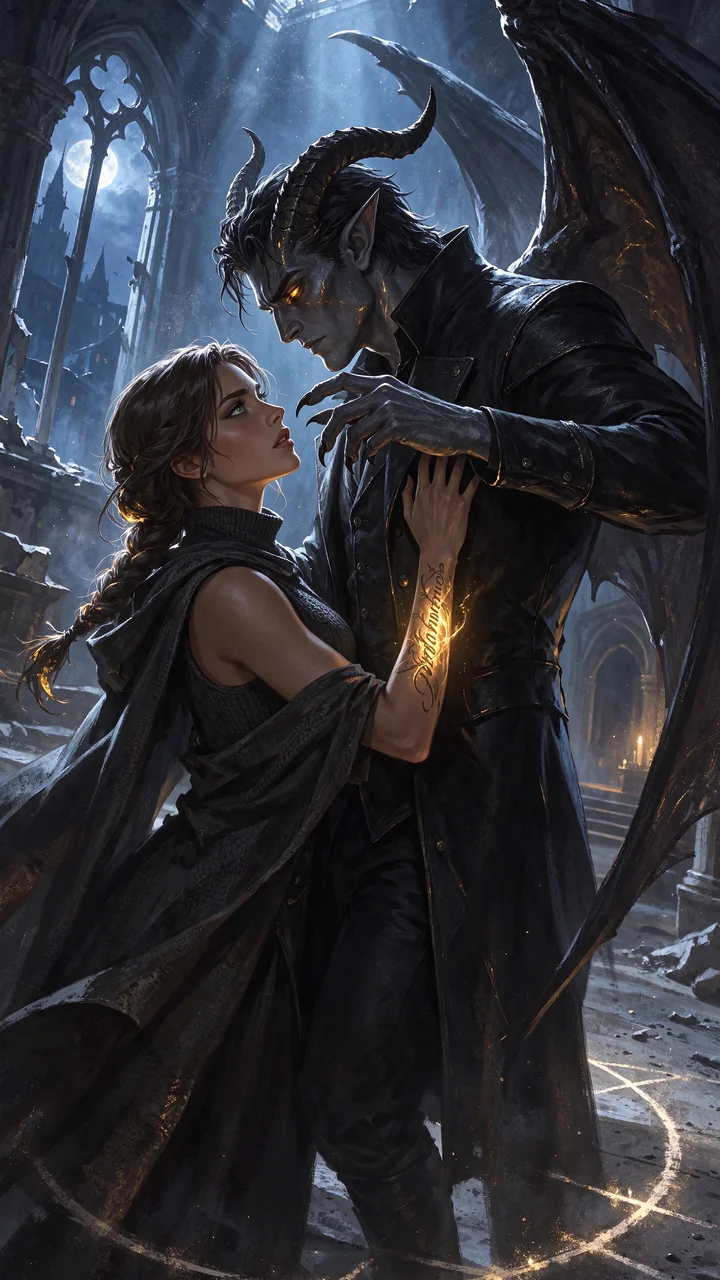
It was harder than it sounded. The chalk circle took up most of the floor between her easel and the radiator, drawn over two years of paint drips, and inside it the loft felt smaller and warmer and far too quiet. Rain needled the tall factory windows. The candles she had lit along the sill, because overhead light felt wrong for this, guttered every time he moved, and he had come down out of the rafters and folded his wings and not moved since.
He walked around her once. She did not turn her head to follow. She knew exactly where he was by the heat, a slow smoky warmth like a woodstove in the next room, and by the faint scrape of horn against a lamp chain when he passed behind her.
“Now say your name.”
“Ivy Calder.”
“No.” He stopped in front of her. “You said it as if it were printed on a form. Say it as if it belongs to you.”
Her throat tightened, absurdly. She looked past him at the canvases leaning against the brick, half-finished, turned to face the wall, because for eight months she had not been able to look at her own work without seeing his signature on it.
“Ivy Calder,” she said.
“Again.”
“Ivy Calder.” Louder. Her chin came up.
“Again, and look at me.”
She looked at him. Amber eyes, the slit pupils wide in the candlelight. “Ivy Calder.”
“There,” he said softly. “Now we both know whose hands those are.”
“Give me your wrist.”
She held it out. He turned it palm up with the flat of one claw, never the point, and traced the line of script that curled there. Her skin did not break. It did something else. The ink warmed and then glowed, a dull ember red beneath the black, and the heat climbed her arm and spread across her chest as though he had opened a stove door inside her.
“A second clause,” he said, “if you want it. While you paint, inside the circle, you let me guide your hands.”
“Guide them where?”
“Wherever you were too frightened to go.”
She should have laughed. “I haven’t painted anything of my own since March.”
“I know. I can smell the dust on your turpentine.” His claw rested on her pulse. “Yes or no, Ivy.”
“Yes.”
The glow ran ahead of his touch, and a second line wrote itself beneath the first in that slanting stranger’s hand. Within the chalk, her hands in his.
He moved behind her. She heard the brass clasps shift, the soft fold of wings drawn close so they would not knock the easel, and then his hands came around and settled over hers. Huge. Hot as a kiln brick. The claws lay along the backs of her fingers without pressing. An hour ago she had put a primed board on the easel and told herself it was for show.
“Pick up the brush you want,” he said, low at her ear. “Not the one you think you should.”
She picked up the filbert with the ruined ferrule. Of course he noticed.
They painted. Or she painted, and he steered: the faintest pressure at her knuckles when she hesitated, the faintest pressure when she went too careful. A shoreline came out of the grey, dark and wet, a figure standing in the shallows. His breath stirred the loose hairs at her nape. Her shoulders rested against his coat. Every place a clasp touched her through her sweater was a small cold coin in all that heat, and she could not stop counting them.
He was not touching her anywhere he had not asked to. She knew that. She knew it so exactly that the knowing became its own kind of ache.
She wanted to see what he would do.
“Vellum,” she whispered.
He was gone from her back before the word was finished. Not flung, not wounded. Simply gone, three paces off at the edge of the chalk, hands at his sides, wings folded. He did not ask why. He did not ask if she was all right in the voice men used when they meant are you sure. He waited, perfectly courteous, perfectly still, while the candle flames stood up straight again.
The cold where he had been was enormous.
“I was testing you,” she said.
“I know.”
“You’re not angry.”
“You read the terms,” Vhoren said. “So did I.”
She looked at the board. The figure in the shallows was hers. It was the first thing in eight months that was entirely hers, and she had made it with his hands around hers, and she had sent them away with one word, and they had gone.
She wanted them back so badly her fingers shook on the brush.
She did not say so. She scuffed the circle open with her toe, and he bowed, and the dark took him up through the rafters.
. . .
Vhoren did not return to the Court.
He sat on the factory’s slate roof with rain running off his horns and looked at his hands. They smelled of linseed. Eleven hundred years of contracts, a hundred stop-words, and he had honoured every one without feeling anything but the clean click of a lock. Tonight the word had been hers, and stopping had been the easiest thing he had ever done.
Every moment after had been the hardest.
There was a law older than the Court. He had never needed to think about it. He thought about it now, until the rain gave out.
. . .
Dani Reyes let herself in at nine with two coffees and a paper bag of conchas, took one look at the easel, and set everything down on the floor.
“You painted.”
“I painted.”
“Something with a person in it.” Dani pushed her gold glasses up her nose and leaned in close enough to smell the wet paint. “Ivy. This is good. This is the good kind of scary. Who is she?”
“Nobody.”
“Liar.” Dani turned to hug her and stopped, because Ivy had pushed up her sleeves to wash brushes and her left wrist was bare.
Dani caught her hand. Her own forearms were a garden of black-line ferns and foxglove, and her thumb, which had steadied a tattoo machine for eleven years, moved very gently over the script.
“This isn’t a tattoo.”
“No.”
“Don’t no me.” Dani tilted the wrist toward the window. Her lips moved as she read, and all the warmth went out of her face. “My abuela had a name for this hand. She used to scare us with it at Christmas. Who’s holding the pen?”
“His name is Vhoren. He’s very careful. I made him put everything in writing. No harm. I can leave. I have a word.”
“Love that for you. Did he mention the Ink Law?”
“The what?”
Dani took her glasses off, which she only did for funerals and breakups. “The demon holds the pen. Fine. But the law holds the demon. If he ever wants the one he’s writing on, really wants her, not the deal, her, the Court takes his name. And a demon with no name isn’t exiled, babe. He’s unmade. Rubbed out like a bad sketch.”
Ivy thought of the cold where he had stood. “He doesn’t want me. He’s very professional.”
“Uh huh.” Dani put her glasses back on. “You’re blushing at your own wrist.”
“I’m not.”
“You are cadmium red, medium.” Dani pointed a concha at her. “Ask him. If he lies, call me, and I’ll bring salt, my abuela’s rosary, and a very big lighter.”
. . .
By night the rain had stopped and the windows were black glass. Ivy drew the circle faster this time. When he came down out of the rafters she was already inside it.
“Friday,” she said before he could speak. “Vaughn’s opening. My original stretchers are still in his storeroom, my initials pencilled on the bars. That’s proof. Can you look like a man?”
“For an evening.” He considered. “Badly.”
“Badly is fine. Everyone will be looking at the walls.” She held her wrist up between them. “Dani read this. She told me about the Ink Law. That if you want the one who holds your contract, they unmake you.” Her heart was knocking against her ribs. “Is it true?”
He did not answer.
He did not move either. The candles burned steady. The gold in his skin brightened slowly, the way coals do when someone breathes on them, and his eyes, which had always met hers, dropped to her mouth and stayed there.
“Vhoren. Is it true?”
Nothing. Only that look, patient and starving, the look of something that had read every clause of its own sentence and signed anyway.
“Friday,” he said at last.
He was still looking at her mouth.