
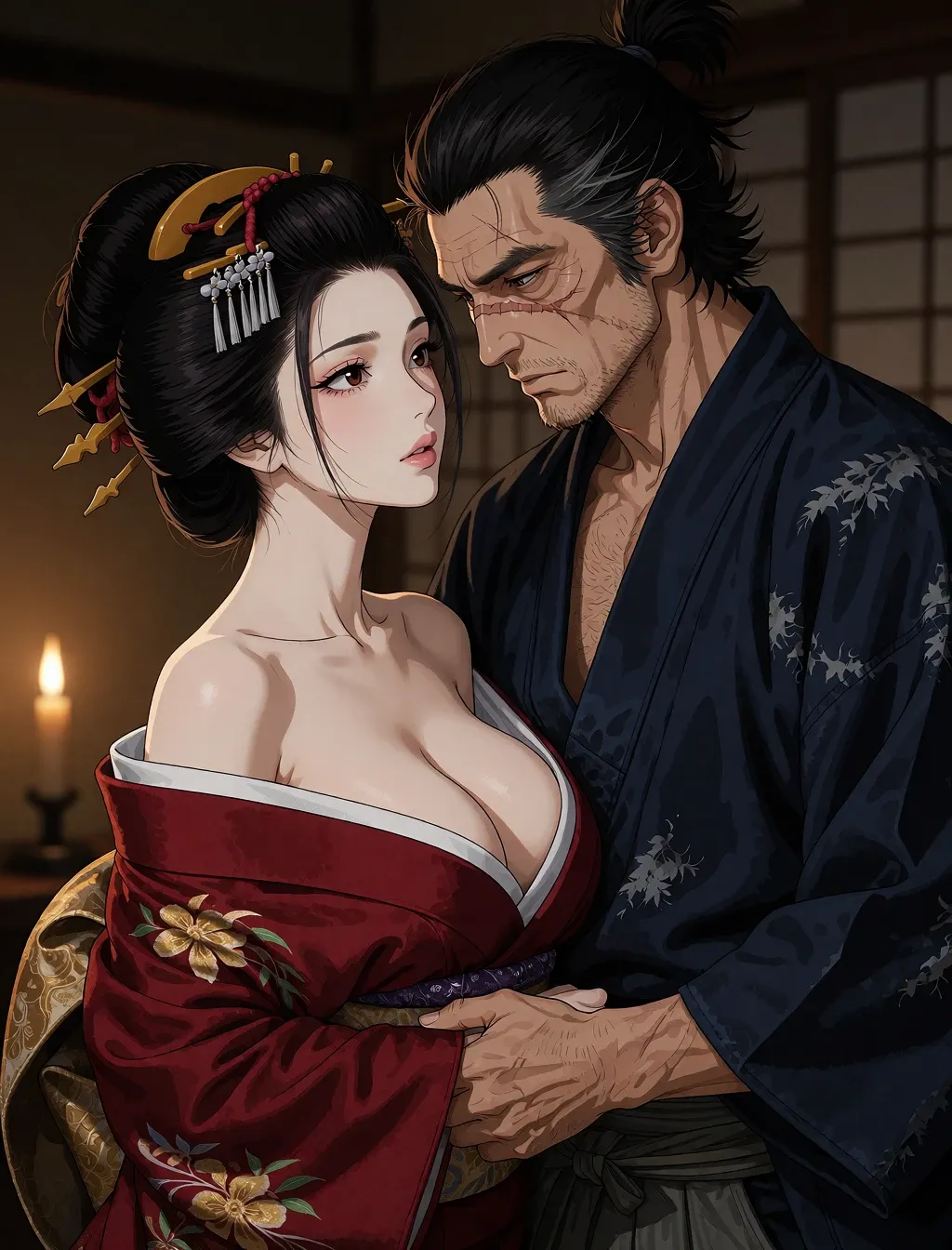
The ledger lay open on the lacquered stand, and the last line of it was a debt of eleven mon, and Kiyonoe held the brush over it for the space of three breaths before she drew the stroke through. The ink was fresh-ground and it shone where the lamplight caught it, wet and black, the final character of twelve years struck out with one clean motion of her wrist.
The madam of the House of Hanabishi sat across from her with her hands folded in her sleeves and did not speak. She was sixty-one years old, her hair gone silver at the temples, and she had bought and sold more girls than she could count and remembered every one of their names. She looked at the ledger, and then at Kiyonoe, and her mouth made a small flat line that was not displeasure and was not quite anything else.
"You have counted it three times," the madam said.
"Four." Kiyonoe set the brush down on the rest and turned the ledger around so that it faced the older woman. "Count it yourself."
The madam drew the book to her and ran her finger down the columns, her lips moving without sound. The room was very quiet. From the stair beyond the shoji came the soft shuffle of the younger girls, who had been told to keep to their rooms and had not, and who were now gathered on the third step in a knot of bright sleeves, peering through the gap where the screen did not quite meet the frame.
"It is clear," the madam said at last. She closed the book. "Twelve years and it is clear. I did not think—" She stopped herself and shook her head. "No. That is a lie. I thought it would never be. I am glad to be wrong."
Kiyonoe bowed, and the bow was deep and correct, and when she came up her eyes were dry. She had thought she would weep. She had lain awake the night before expecting it, rehearsing it, and now the moment had come and gone and there was nothing in her chest but a kind of wide stillness, like a room after the furniture has been carried out.
"The outer robe," the madam said, rising. "The tortoiseshell combs. The three winter kimono and the one with the cranes. Those are the house's."
"I know what is the house's."
"And the comb your mother left you is your own, and no one will say otherwise, and if anyone does, send them to me." The madam went to the stand in the corner where the robes hung in their layers, and she lifted the great outer robe from its peg with both hands, the silk heavy and stiff with gold thread, and she held it a moment, and then laid it over the arm of the stand as though it were a thing that had died.
Kiyonoe stood. She went to the screen that divided the front room from her own chamber and drew it back, and there on the rack was the plain travelling kimono she had bought three days before from a vendor in the eastern wards who had not known her and had charged her the price he would have charged any woman. It was indigo, good cotton, a little coarse after the silk. She had washed it herself in the basin behind the kitchen so that it would smell of nothing but soap and river water.
She untied her obi. It was the wide one, the brocade, and it took her a long moment to work the knot loose, and when it came free she let it fall and did not pick it up. Then the outer robe, and the middle robe beneath it, and the under-robe, each of them laid aside in turn, and she stood in her skin in the lamplight with her back to the screen and the girls on the stair gone utterly silent.
"Turn around," she said, not loudly.
There was a scuffling on the boards, and small feet retreating, and then nothing.
She dressed herself. The cotton was cool and it did not slide the way silk slid; it caught at her shoulders and had to be tugged, and the obi was a plain one, narrow, and she tied it in front because she was not a courtesan anymore and there was no one to tie it behind her. She took the pins from her hair one by one and laid them in a row on the stand — the long kanzashi with the tortoiseshell flower, the little comb, the twelve that had counted the years — and last of all the comb her mother had left her, which she did not lay down but held in her fist a moment and then thrust back into the knot at the crown of her head, where it sat crooked and she did not straighten it.
The madam watched all of this from the doorway. "The house will speak of you for a long while," she said. "Not all of it kind. A woman who walks out of the Willow Gate on her own feet is a story that makes the others restless."
"Then tell them the story of a woman who paid her debts," Kiyonoe said, and she took up the small bundle she had packed — a change of linen, the comb, a purse with eleven mon in it and not one coin more — and she went past the madam into the corridor.
The corridor was dark and smelled of the cedar polish and the old smoke of a hundred nights. She walked it without hurrying. At the head of the stair the girls had gathered again, and this time they did not hide; they stood in a row on the top step, six of them, the youngest twelve and the eldest nineteen, and the eldest — O-Haru, who would be oiran in her place if the house found the money to make her one — stepped forward and bowed, and then the others bowed, all together, and Kiyonoe stopped.
"Do not bow to me," she said. "I am not the oiran. I am a woman going to the road."
"You are the oiran," O-Haru said, into the boards, "until the gate closes behind you. That is the rule."
Kiyonoe looked at the tops of their heads, at the careful partings in their oiled hair, and for a moment the wide stillness in her chest narrowed to something that hurt. "Then mind the rule," she said, and her voice was steady. "And mind the ledger. It is the only thing in this house that does not lie."
She went down the stair, and the girls parted for her, and at the bottom, in the entry where the geta stood in their rows and the big lantern hung from the beam, Gennosuke Hayama was waiting. He was forty-two years old and he had a scar from his left brow to his cheekbone. He stood with his pack already shouldered and his sword thrust through his belt instead of carried in his hand, which she had never once seen him do in the month he had knelt at her door. His grey eyes came up to her face and stayed there. He bowed — not the deep guard's bow, but a shorter one, a man's bow to an equal — and she found that she had to look away from it.
"Kiyonoe-sama," he said.
"Not that either," she said. She took her travelling sandals from the rack and sat on the step to put them on, and the straps were stiff and cut into her heel, and she had to work them with her fingers. "There is no -sama on the Tokaido road. There is a woman with a bundle and a man with a sword. That is all."
He was silent a moment. Then: "What shall I call you, then?"
She stood up in the sandals and found her balance in them. "Kiyonoe," she said. "Only that. And I will call you Gennosuke, and the neighbors at the inn will think we are husband and wife, and we will let them."
He nodded once, and something moved at the corner of his mouth that in another man might have been the beginning of a smile. *Husband and wife.* He had never in his life had a word like that to carry, and now she had handed it to him in the entry of a brothel as though it were a parcel of no particular weight.
The gatekeeper was lighting the lanterns. He went along the row of them with his long taper, and each one caught and bloomed gold and threw the gateposts into relief, and he came to the last and touched the flame to it and it flared, and he turned and saw her and bowed, low, the bow he gave the oiran. Kiyonoe walked past him and did not return it, and the not-returning was a strange and naked feeling, like stepping off a stair in the dark and finding the floor where she had expected another step.
Then she was through the gate, and the Willow Gate was behind her, and the quarter was behind her, and the evening crowd of the quarter closed around her the way water closes, and she walked in it a free woman for the first time in twelve years.
The road out of Edo was gravel and it was hard under thin soles. They walked as the last of the light went and the sky over the roofs went from red to a deep blue and then to nothing, and behind them the city put out its lamps one district at a time, and ahead of them the Tokaido ran straight and pale between the pines. Gennosuke walked a half-step behind her on the left, where he had always walked, and after the first mile she slowed until he came up beside her, and after the second she took his arm because the gravel turned her ankle, and he did not say anything about it, but his arm was steady under her hand and he did not pull it away.
"You are quiet," she said.
"I am always quiet."
"You are quieter than always."
He walked a while. The pines made a sound in the wind that was not quite the sound of the sea. "I am counting the miles," he said at last. "I have not had a place to go in a long time. It is a strange thing, to have one. I keep looking back to see if it is still there."
She did not look back. She had looked back enough in twelve years to last her. "It is there," she said. "It will be there tomorrow, and the day after, and it will not be ours. That is the whole of its virtue."
The inn was the third one they came to, a low building set back from the road with a cedar bath behind it and a stable that smelled of hay and horse. The innkeeper was a broad woman with a towel over her shoulder who looked at the two of them — a woman in indigo cotton with a crooked comb and a scarred man with a sword — and asked no questions, because on the Tokaido a woman and a man traveling together were either married or running, and either way it was not her business. She took their coins and showed them up the stair.
The room was small and clean. There was a futon already turned down in the middle of the tatami, and a low table with a teapot on it, and one paper lantern in the corner. The shoji that made the outer wall had been pushed back into its groove so that the room opened onto the night, and the moon was up over the pines and it laid a flat white bar of itself across the tatami and across the futon and across the teapot, and the night air came in cool and smelled of pine and of the river somewhere below.
Kiyonoe stood in the doorway and looked at it. The lantern was lit and the moon was bright and the two lights lay on the floor together and did not quite touch. She had slept in a hundred rooms and none of them had ever been this one.
"Gennosuke," she said. "Shut the door."
He shut it. The latch dropped into its notch with a small wooden sound, and the corridor and the inn and the road and Edo and the twelve years were on the other side of it, and they were alone in the room with the moon.
She turned to him. The lantern light came up under his jaw and made the scar a pale line down his face, and his grey eyes were on her and had not left her since the gate, and she crossed the tatami to him and put her palm flat on his chest, over the worn cotton, over the heart that was going hard and quick under her hand.
"You have guarded my door for a month," she said. "You have killed for me on the stair. You have carried my bundle six miles and never once asked me where we are going."
"You will tell me when you are ready."
"Kyoto," she said. "There is a teahouse there with a good roof and a bad reputation, and the man who owns it is old and wants to sell, and I have eleven mon and a name that is worth nothing outside the Willow Gate, and I will talk him down." She felt his heart under her hand. "That is where we are going. Now stop being my guard."
He did not move for a moment. Then his hands came up and took her by the waist, and he drew her in against him, and she felt the whole length of him through the cotton — the lean hard body of him, the sword at his hip pressing cold against her thigh — and she put her arms up around his neck and kissed him.
It was not the kiss of the rain-window or the boat. There was no crowd to swallow her name and no blinds to hide them. There was a shut door and a moon and a futon. She kissed him slowly, her mouth opening under his, and his hand came up into her hair and found the crooked comb and carefully, carefully drew it out, and laid it on the low table as though it were the most valuable thing in the room.
"It was my mother's," she said against his mouth.
"I know."
"How do you know?"
"Because you have worn it every day for a month and never once let the house's girls touch it." His thumb moved at her temple. "And because you hold your head differently when it is in."
She laughed, and the laugh surprised her, and she kissed him again to stop it. His hands went to the knot of her obi, and this time it was her own plain knot. It came loose at a single pull, and the cotton fell open. He pushed it back off her shoulders and it dropped to the tatami in a pool of indigo. She stood in her under-robe with the moon on her and watched his face, and his face did what it did — nothing, almost nothing, a tightening at the jaw. Then he bent his head and put his mouth to the base of her throat and she felt the heat of it go all the way down her.
*She is not afraid,* he thought. *She stands in the moonlight and she is not afraid of me at all, and I have never been given anything like it.*
He knelt. It was not the guard's kneel at her door; it was a man going down before something he wanted, and his hands went to her hips and his mouth followed, down the under-robe where it hung open, over her belly, and she drew a breath and her fingers came down into his hair and held his head there.
"Not yet," she said, and her voice had gone low. "Get up. Get out of those clothes. I want to see you."
He rose and undressed. The worn kimono came off and the under-robe after it, and the sword he set against the wall, upright, in its stand, where a man sets his sword when he means to be a while. In the lantern light his body was what a hard life had made of it — a long old scar across his ribs, a newer one on the forearm from the stair, the corded muscle of a man who had not eaten well in years and was strong anyway. His cock stood up from the dark hair at his groin, thick and flushed. She looked at it and then at his face, and his face was not doing nothing now. His jaw was tight and his breath came short, and she liked that. She liked it very much.
She pushed him back onto the futon. He went down and propped himself on his elbows and she came over him on her hands and knees, and she put her mouth to his chest, to the old scar, to the flat of his stomach, and worked her way down, and he said her name once — "Kiyonoe" — as though he were warning her of something.
"Be quiet," she said. "You have been quiet for a month. Let me have my turn."
She took his cock in her hand. It was hot and it moved under her fingers, and there was already a bead of wet at the tip. She smeared it with her thumb and watched his stomach go tight. Then she put her mouth to it and took him in, and the sound he made was not a word at all.
She went slowly. She had learned a great deal in twelve years, and she had never once done this because she wanted to, and the wanting made it a different thing entirely. She took him down until the head of him pressed at the back of her throat and held it there, breathing through her nose, and then drew off slow, her lips tight, her tongue flat along the underside, and did it again. His hand came into her hair — not pushing, just resting there, shaking — and his hips lifted a little off the futon. He mastered them and put them back down.
"Kiyonoe." His voice was rough. "You will finish me if you—"
She drew off him with a wet sound and looked up the length of his body. "Then do not finish," she said. "I am not done with you."
She came up over him and turned, and lay down across him the other way, her knees on either side of his head, her cunt open above his face. The moon lay across her back. She bent her head and took his cock back into her mouth. He made a hoarse sound against her thigh, and then his hands closed on her hips and drew her down, and his mouth found her.
She had to stop what she was doing. She lay still with him in her mouth and her eyes shut and felt his tongue work, flat and then pointed, up the length of her, and then the wet heat of his mouth closing on her clit. She made a sound that was muffled by his cock and ground herself down against his face. He licked her like a man who had been waiting to, like a man who had thought about it every night for a month with his sword across his knees and the door between them. His tongue pushed into her and came out wet and went back, and his hands held her hips down so she could not get away from it. She did not want to get away from it. She forgot entirely about his cock for a while and simply lay there and shook.
"Gennosuke," she gasped, "Gennosuke, I am going to—" and he did not stop. She did not want him to stop, and it came up through her in a long rolling wave. She cried out against his hipbone and her thighs clamped hard on either side of his head and her cunt clenched against his mouth.
When she could move again she rolled off him and lay on her back on the futon, breathing, the moon in her eyes.
He came up over her. His mouth was wet and his chin was wet and he did not wipe it. He kissed her, and she tasted herself on him. She reached down between them and took his cock and put it against her. He pushed into her.
She was slick and open. He went in to the root in one long stroke and she felt every inch of it, the stretch of it, the fullness of him filling her up. He held there, his forehead against hers, breathing hard. She wrapped her legs around his back and pulled him deeper and he groaned.
"Slow," she said. "We have all night. We have every night."
So he went slow. He drew out almost to the head of it and pushed back in, and the wet sound of it filled the little room, and the futon rustled under them, and the moon bar moved a little across the tatami as the night went on. She got her hand between them and rubbed her clit with two fingers while he fucked her. She watched his face, and his face was not doing nothing at all now. His mouth was open. His grey eyes were almost black. The scar stood out pale on his flushed cheek, and he said her name over and over, low, like a man saying a prayer he had not been taught.
She came again first, her cunt clenching and gripping him. She said his name and dug her nails into his shoulder, and his rhythm broke. He drove into her deep and hard and short. She felt him swell inside her. He said, "Kiyonoe, I cannot—" and she said, "Then do not, do not, come in me," and he did.
She felt it — the hot pulse of it, the way his cock jerked and emptied and flooded her, the way his whole body locked and shook over her and his breath went out of him in a broken sound. He held there, deep. She held him with her arms and her legs both, and the two of them lay shaking together in the moonlight while the last of it left him.
After a while he moved to draw out, and she tightened her legs and would not let him.
"Not yet," she said. "Stay."
He stayed. He put his face down in the hollow of her shoulder, and his weight came onto her and she took it, and the moon moved on the tatami, and somewhere below in the stable a horse shifted and blew out its breath. His hand found her hair and stroked it back from her damp forehead, over and over, and it was not the courtesan's hair anymore, and it was not the guard's hand.
"Kyoto," he said, into her shoulder. "A teahouse."
"With a good roof and a bad reputation."
"And what will we serve in it?"
She considered this, looking past his shoulder at the moon. "Tea," she said. "And a little sake. And I will sit with the ones who need to be listened to, and charge them for it, and you will stand at the door and look frightening, and when the last of them has gone home we will close the shutters and go up the stair together." She turned her head and pressed her mouth to his temple, to the edge of the scar. "That is the whole of the plan. There is no more of it. I have never had a plan that was not written down in a ledger, and this one is not written down anywhere at all."
He lifted his head and looked at her. In the lantern light, with the moon behind him, she could not read his face, and then he smiled — a small, crooked, unpracticed thing, and it changed him entirely, and she had never seen it before and would have paid any price to see it again.
"Then we will have to write it," he said.
She reached up and drew the comb — her mother's comb, which he had laid on the low table — and set it back into her hair, crooked, where it belonged. Then she turned on the futon and blew out the lantern, and the little room went dark but for the moon.
Outside, the pines moved in the wind, and the Tokaido ran on into the dark toward Kyoto, and the shoji stood open to the night.
The dark was not complete. The moon laid its white bar across the futon and across her hip, and by that light she found him again — his hand on her waist, his breath still not even. She turned toward him under the thin cover of the night and put her palm flat on his chest, and his heart was still going hard.
"You are not finished," she said.
"I am an old man."
"You are forty-two." She slid her hand down his stomach, through the coarse hair, and found his cock where it lay against his thigh, wet and half-soft from her. She closed her fingers around it. "And you are not old."
He drew a breath through his teeth as she worked him. It thickened in her hand, filled, stood up again under her thumb, and she felt the pulse run through it, quick and hot.
"Kiyonoe." His voice had gone rough as gravel. "You will be sore."
"I am not sore." She pushed the cover back off them both and swung her leg over him, and the moon fell on her thighs and on the wet shine between them. "I have waited twelve years to be sore. Lie still."
She took him in her hand and guided the head of him to her cunt and sank down onto it. She was still slick with him, with what he had spent in her, and he went in easy and deep. She stopped when he was to the root and sat there, full, her hands on his chest, and let herself feel it — the stretch of him, the blunt press of him high inside her, the way her body had to make room.
His hands came up to her hips. "Gods," he said, very quietly, as though the word had escaped him.
"That is better than silence."
She began to move. Slow at first, lifting until he was nearly out of her and settling back down, and the wet sound of it was loud in the little room, and the futon whispered under her knees. His eyes were open and fixed on her face, and she watched him watch her. She rolled her hips the way she had learned to roll them for men who paid, except that this was not for pay and there was nothing in her now but the wanting.
"Harder," he said.
"You are my guard no longer. Do not give me orders."
But she went harder. She planted her hands on his chest and rode him, and her breasts moved with it, and the moon slid over her skin in bars. His jaw was tight and his hands were hard on her hips, helping her, lifting her and bringing her down. She felt him swelling inside her, felt him reach the place that made her breath catch.
"There," she said. "There—"
He shifted under her, got his thumb between them, and found her clit, and the first touch of it made her cry out. He worked it in small circles, wet with her. She lost the rhythm entirely and simply ground down on him and let him do it.
"Gennosuke—"
"Say it again."
"Gennosuke." She said it into the dark. It broke in the middle of the word, and her cunt clenched hard around his cock and the pleasure came up through her in a long shudder that would not stop. She heard herself make a sound she had never made, a low helpless cry, and her thighs shook and her nails dug into his chest, and still he worked her, slow and steady, until the last of it had run through her. She sagged forward onto her hands.
He was still hard inside her. She looked down at him and his face was terrible and beautiful, his teeth set, the scar pale across his flushed cheek.
"Now you," she said. "Come in me. I want to feel it."
He rolled her onto her back. He came up over her and drove into her deep. She wrapped her legs around his back and pulled him in. He fucked her hard and short, his breath going out of him in grunts, the whole weight of him over her. She reached up and took his face in both her hands and made him look at her.
"Kiyonoe," he said. "Kiyonoe—"
He drove in to the root and held. She felt him swell and jerk and then the hot flood of it, pulse after pulse, and his whole body locked and shook and a broken sound came out of him, half a groan and half her name. She held him with her arms and her legs and felt him empty into her, felt the heat of it spread. She pressed her mouth to his throat and stayed there while the shaking went out of him.
After a while he lay down on her, heavy, his face in her hair, breathing like a man who has run a long way.
"I have never," he said, into her neck, and did not finish it.
"Nor I."
He lifted his head. "You have had a hundred men."
"A hundred men paid the house for the oiran's time." She stroked the hair back from his brow, over the scar. "I have never once had a man in my body because I wanted him there. Not until you. That is the difference, and it is the whole difference, and I will thank you not to make me say it twice."
He was quiet. Then he put his forehead down against hers.
"I have nothing," he said. "No house. No lord. A sword and a scarred face and a name nobody knows. If you are going to Kyoto to buy a teahouse, you had better know what you are taking with you."
"I know exactly what I am taking."
"A man who cannot even keep a door."
"You kept it for a month," she said, "and then you came through it, and I am the one who opened it. Do not put yourself down in my bed. I have chosen, and I do not choose badly."
He drew out of her then, slowly, and she felt the loss of him and then the wet seep of what he had left, running warm down between her thighs onto the futon. He lay beside her and pulled the cover up over them both, and the night air from the open shoji came cool across their faces, and the pines went on moving in the wind.
He was silent a long while. She thought he had gone to sleep. Then he said, "There is something I have not told you."
"Tell me."
"The men on the stair. I did not kill them both cleanly. The one who ran — I let him run." He turned his head on the futon to look at her. "I could have taken him. He was slow and he was frightened. I let him go over the wall because I did not want to leave you alone in the corridor with the other one still moving. But he will talk. Whoever hired him will hear that the Hanabishi oiran walked out of the Willow Gate on the same night."
She lay still and looked up at the dark ceiling. "Ryōsuke," she said.
"Perhaps. Perhaps the lord who sent word. It does not matter. What matters is that a man who has been shamed will not let it lie, and there is a road between here and Kyoto, and it is not a secret road." He was quiet a moment. "I have been a ronin for eleven years. I know how a grudge travels. It travels faster than a woman in cotton and a man with a pack."
"Then we do not sleep in inns that take our names," she said. "We sleep in the ones that do not. And you sleep with your sword near your hand, and I sleep with my eyes open, and we go on."
"You are not afraid."
"I am afraid," she said. "I have been afraid for twelve years, and I have learned to walk in it. It is a thing you can learn." She turned on her side to face him. "But I will tell you what I am not afraid of. I am not afraid of being poor. I am not afraid of the road. And I am not afraid of you, Gennosuke Hayama, and that is the strangest thing that has happened to me in a great while."
He looked at her across the pillow. In the moonlight his grey eyes were almost pale, and there was something in his face she had not seen there before — not the guard's watchfulness, not the man's hunger, but something quieter and more dangerous, a kind of settling.
"Then I will tell you what I am," he said. "I am yours. Not the house's. Not hired. Yours. You did not buy me and you cannot dismiss me, and if a man with a grudge comes down the Tokaido after you, he will have to come through me first, and I have been through worse than him." He reached out and touched the crooked comb in her hair, very lightly. "That is all I have to give. It is not a house and it is not eleven mon. But it is not nothing."
She did not answer at once. She lay and looked at him, and the wide stillness that had been in her chest since the ledger closed filled up with something warm and frightening, and she did not name it, because she had learned long ago that the things you name are the things that get taken.
"Then we are settled," she said at last. "You are mine and I am yours, and we have a road and a plan and a comb, and in the morning we will walk to the next post town and find a cart going west." She reached over and drew the cover up over his shoulder. "Now sleep. You have a door to keep tomorrow, and this time it will be a real door, with a roof over it, and I will be on the other side of it, and you will not have to kneel."
He closed his eyes. His hand found hers under the cover and held it, and his breathing went slow and deep, and the moon bar crept across the tatami toward the wall.
Kiyonoe lay awake a while longer, listening to the pines and the river and the small sounds of the inn settling, and to the man beside her breathing in his sleep. Then she turned her face to the open shoji and the dark road beyond it, and she did not blow out any lantern, because there was none left burning, and she did not close the screen, because she had spent twelve years behind screens and she was done with them.
In the morning she would put on the indigo cotton and the crooked comb and walk out onto the Tokaido with a ronin at her side, and the road would run on ahead of them, pale between the pines, all the way to Kyoto.
The moon bar had climbed to the wall and thinned to a hand's width when she woke. She had not meant to sleep. The room was grey now, the pines gone quiet, and the cold had come in through the open shoji and laid itself along her shoulder.
Beside her, Gennosuke was awake. She knew it before she looked — the change in his breathing, the stillness that was not sleep. He was on his back with his sword laid along his right side, his hand loose on the scabbard, and he was watching the open screen.
"You did not sleep," she said.
"A little."
"You watched the road instead."
"I watched the road." He turned his head. In the grey his scar was only a shadow, but his eyes had that pale look they took in low light, and they went over her face as though checking it was still there. "There is a man at the ford. He has been there since the moon was high. He has not moved."
She sat up. The cover fell from her, and the cold took her properly, and she did not reach for it. "A fisherman."
"A fisherman would have a line in the water. He is sitting on a stone with his hands empty, facing this inn."
"Then we are found."
"We are seen. It is not the same." He was already sitting up, already reaching for his robe, and there was nothing of the lover left in the way he moved, only the man who had kept a door for a month. "Dress. Not the cotton — the cotton is a woman walking west and that is what he is looking for. The grey, and the kerchief over your hair. We go out the back through the kitchen yard, and we go north along the river before we turn west, and we are a day longer on the road and a day harder to follow."
She was up and had the grey robe off the peg before he had finished. Her fingers were steady. Twelve years of walking into rooms with her chin up had made them steady, and she noticed, distantly, that this was the first time the steadiness had been good for anything but a performance.
"You are not going to kill him," she said. It was not a question.
"No." He tied his obi and pulled it tight with his teeth. "If I kill him, his master knows for certain and sends men who are better. If I let him see us leave north, his master thinks we are going north, and he is a fool, and I have bought us a week." He slid the katana through his sash and looked at her. "You said you were not afraid of the road. Here is the road. It is not the Tokaido. It is a fisherman's path through the reeds and it will be wet to the knee."
"I have walked wet to the knee before." She wound the kerchief over her hair and tucked the crooked comb beneath it, and she felt it there against her scalp, her mother's tortoiseshell, the one thing with no price. "Go. I am behind you."
They went down the back stair and through the kitchen yard where the innkeeper's wife was already at the fire, and the woman looked up and opened her mouth and Gennosuke put two mon on the chopping block without breaking stride, and the mouth closed again. Then they were through the gate and into the reeds, and the river was a grey sheet in the half-light, and the mud took her sandals to the ankle and she did not slow.
They walked north with the water on their right. The reeds were taller than her and they whispered and closed behind them, and once a heron went up out of the shallows with a sound like a torn cloth and her heart went with it, and Gennosuke's hand came back and touched her wrist and did not leave it until the bird was a speck.
"He is still at the ford," he said, low. "He will sit there until the sun is up and the fishermen come, and then he will have to explain himself to them, and that will take him the morning."
"And us?"
"Us, we will be at the bend by the sun, and there is a ferryman there who owes me." He said it flatly, without pride. "I pulled his boy out of the water at Kawasaki nine years ago. He will not ask our names."
She looked at the back of him, at the worn grey of his robe and the way he set his feet in the mud so that the footing held, and she thought: nine years he has been carrying that, and he spent it without a moment's thought, the way a rich man spends a coin.
The sky went from grey to the colour of a plum skin, then to a thin gold along the eastern reeds. They came out of the marsh onto a track of packed earth, and there was the river wide and slow, and a flat-bottomed ferry tied to a post, and a man on the bank mending a net who looked up and then stood up very fast.
"Hayama-dono."
"Ferryman." Gennosuke bowed, and it was a shallow bow, and the ferryman returned it deeper. "Two across, and no names, and I have money."
The ferryman looked at Kiyonoe, at the grey robe and the kerchief and the mud to her knees, and he was a man of perhaps fifty who had seen a great deal and said little, and he did not ask. He looked at the mud, and then at the way she stood, and something in his face changed — she had been looked at by a thousand men and she knew the difference between a man seeing an oiran and a man seeing a woman who had walked all night.
"The wife has rice on," he said. "You will eat before you cross. It is not a kindness, it is a debt, and I have been carrying it a long while."
They ate in the ferryman's yard on a bench in the first sun, and the rice was hot and there was a strip of salted fish and a dish of pickled radish, and Kiyonoe ate all of it and then sat with her hands around the bowl and let the warmth get into them. Gennosuke ate with the ferryman's boy watching him, and the boy was perhaps eleven and had a wooden sword at his hip, and Gennosuke looked at the sword and then at the boy and said, "Your grip is too high. Move your hand down a finger's width and it will not turn in your palm." The boy moved his hand and looked up, and Gennosuke nodded once and went back to his rice, and the boy's face was a thing to see.
Kiyonoe watched this and did not smile, because if she smiled she would have to stop, and she had not yet decided whether she was allowed to.
They crossed at the sun's full rising. The ferry was slow and the water was loud against the flat boards, and she sat in the bow with her hand on the gunwale and looked back at the eastern bank, at the reeds and the track and the ford beyond it, and there was no one on it. The ferryman poled and said nothing. Gennosuke sat with his sword across his knees and his eyes on the far bank, and the sun came up over his shoulder and put the scar into relief, that pale line from brow to cheekbone, and she looked at it a long time and thought that she had spent twelve years being looked at and had never once learned how to look.
On the western bank there was a road going south and a road going west, and the west one ran up into low hills with pines on them and a village she could not see yet, and beyond it, somewhere past a great many more hills and rivers and post towns, Kyoto.
Gennosuke put out his hand to help her up the bank, and she took it, and he did not let go when she was up.
"There will be more of them," he said. "Not today. Not this week. But a man who has been shamed does not stop being shamed because his hireling sat on a stone. There will be more of them, and I will be watching for them, and you will be walking beside me and not knowing, and that is how it will be."
"I know how it will be."
"Do you."
She turned and faced him on the empty road. "I have had twelve years of men who wanted a thing from me and called it love. A man who wants my body says pretty things and pays the house and goes home to his wife. You have not once asked me for anything. You gave me your sword arm and your month at the door and your ferryman's debt and your two mon to a woman at a fire, and you have asked me for nothing, and I am not a fool, Gennosuke Hayama. I know what that is. It is the only thing worth walking to Kyoto for."
He looked at her. The road was empty and the sun was on them and the ferryman was already poling back across, and he stood there with his hand still holding hers and his jaw working as though he were trying to find a sentence and could not.
"Then I will ask you for one thing," he said at last.
"Ask."
"When we have the teahouse. When the ledger is ash and there is a door and a roof and a kettle. Do not be the oiran in it. Not for me and not for the customers. Be the woman who walked the reeds with mud to her knees and did not slow." He stopped. Then, quieter: "I have never had a home. I would not know how to live in one with a legend in it. I would know how to live in one with you."
She stood in the road with the sun on her face and the crooked comb under her kerchief and her mother's tortoiseshell against her scalp, and for a moment the whole width of the country seemed to lie open ahead of her, hills and rivers and a great many post towns, and at the end of it a small house with a kettle and a door that he would keep and she would not have to kneel behind.
"Then that is settled too," she said.
They walked west. The road went up into the pines and the morning came on warm, and she did not look back at the river, and he did not look back at the road behind them, and the two of them went on together into the hills, and the sun rose over the shoulder of the world and laid the road out pale and long and empty ahead of them, all the way to Kyoto.