
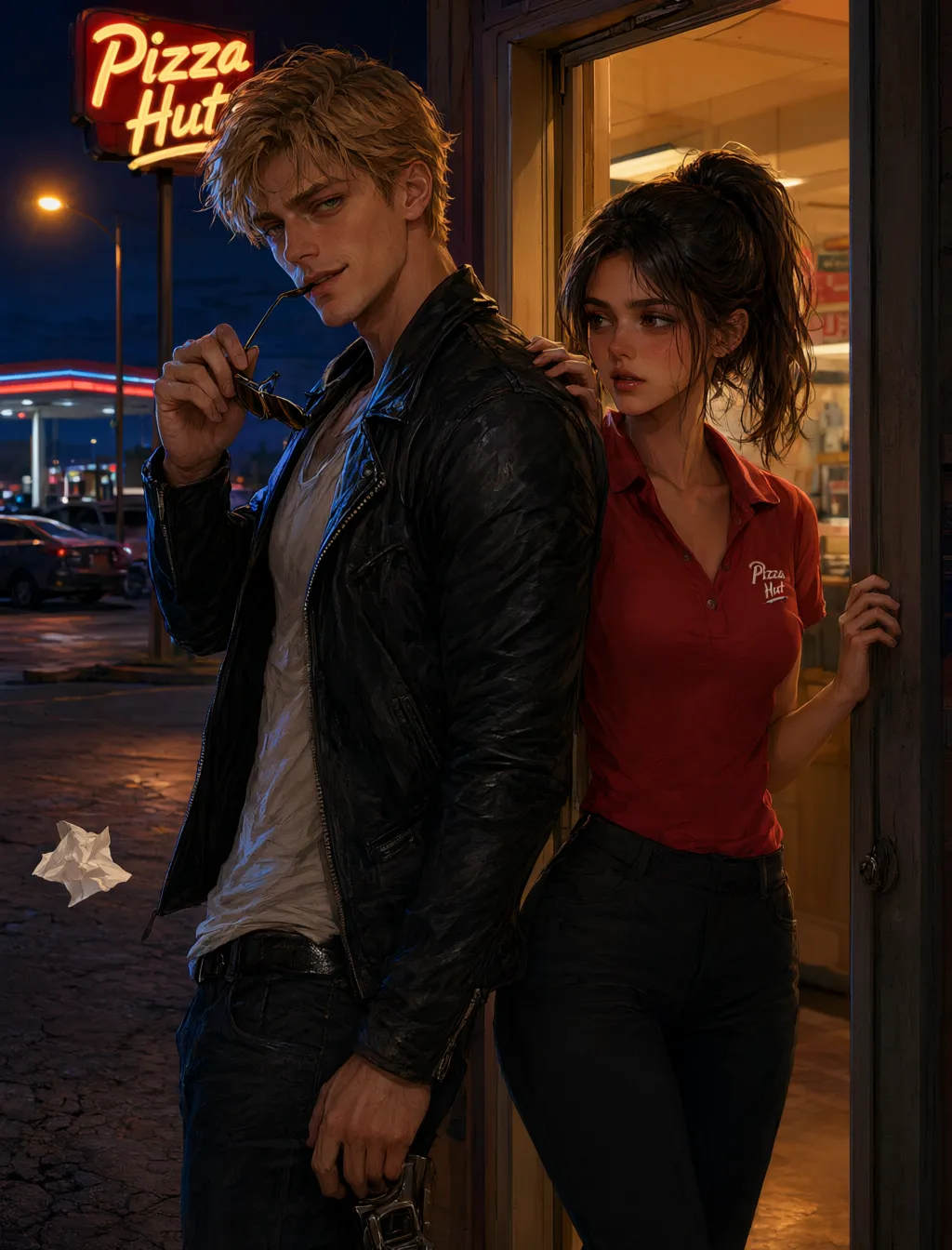
The bell above the door chimed, and Jasmynn's head snapped up, her heart slamming against her ribs so hard she felt it in her throat. The air left her lungs in a rush, her fingers curling into the wet rag like she might need to throw it—or hold on to something solid.
But it wasn't Carl.
It was the afternoon delivery driver, a kid she recognized but couldn't name, maybe nineteen, with acne scars and a red polo that was two sizes too big. He stood just inside the door, one hand raised in an apologetic wave, a white plastic bag dangling from the other.
"Hey, uh, Jasmynn? Sorry—I forgot the marinara for the front line." He held up the bag like evidence. "Carlos sent me back. Said you'd kill him if the lunch rush ran out."
She blinked. The world snapped back into focus—the hum of the soda machine, the grease-slicked heat from the ovens, the smell of baked dough and garlic that lived in her hair and her clothes and her dreams. She was at work. She was the manager. She was supposed to be counting inventory, not counting minutes until she could see a man who'd walked out on her three years ago.
"Right," she said, and her voice came out steady, professional, the voice she used for angry customers and late deliveries. "Front line's fine. We've still got half a bag."
The kid shuffled forward, his sneakers squeaking on the tile. He set the bag on the counter between them, sheepish, not quite meeting her eyes. "Yeah, but Carlos said—"
"I'll take it." She reached for the bag, her fingers brushing the warm plastic. "Tell Carlos I got it."
"Cool. Thanks." He lingered for a second, like he wanted to say something else, then shrugged and headed back toward the kitchen, the swinging door flapping behind him.
The bell didn't ring again. The door sighed shut. And Jasmynn was alone behind the counter, a bag of marinara in her stiff fingers, the smell of warm bread and tomato and oregano filling her senses.
The smell of her life now.
She stood there, not moving, the plastic bag warm against her palm. The clock on the wall above the soda machine read 3:12. One hour and forty-eight minutes until her shift ended. Two hours since Carl had walked in with that crooked grin and turned everything inside her upside down.
She could walk out right now.
The thought came sharp and clear, cutting through the fog of garlic and grease. She could drop the bag, leave the keys on the counter, walk across the street in her uniform, and slide into the cracked vinyl booth across from him before he finished his coffee. No one would stop her. The kid in the red polo wouldn't know what to do. Carlos could handle the dinner rush. The store wouldn't burn down without her.
She could just go.
Her fingers tightened around the plastic bag, the edges digging into her palm.
The rag lay by the register, wet and forgotten, the faint smell of bleach rising from it. She'd been wiping the same spot on the counter when Carl walked in. The same spot she'd been wiping when he left three years ago, too, before the fight that ended everything. Before he'd stood in this very store, in this very light, and told her he couldn't do it anymore—couldn't be what she needed, couldn't stay still, couldn't watch her become someone he didn't recognize.
And she'd let him go. She'd stood behind this counter, rag in hand, and watched him walk out into the afternoon sun, his leather jacket a dark silhouette against the brightness, and she hadn't run after him. She'd told herself it was for the best. That she was tired of the chaos, tired of the uncertainty, tired of loving someone who couldn't love her back the way she needed.
She'd built this life instead. The reliable job. The predictable hours. The apartment with the leaky faucet she'd learned to fix herself. The friends who called her boring but meant it fondly. She'd traded thrill for stability, adventure for safety, and she'd told herself it was growing up.
And now Carl was back, sitting in a diner across the street, waiting for her to show up.
The bag of marinara was still in her hands. She should put it in the warmers. She should check the front line. She should do literally anything except stand here like a statue, gripping a bag of sauce like it was the only thing keeping her upright.
She set the bag on the counter. Slowly. Deliberately. The plastic crinkled as it settled, and she stared at it, at the bright red label, at the expiration date stamped in black ink. Three months from now. She'd still be here in three months. Still wiping the same counter. Still smelling the same grease. Still counting down the hours until she could go home to her empty apartment and her leaky faucet and her single glass of wine before bed.
Or she could walk out right now.
The thought came again, insistent, a pulse beneath her skin. She could feel it in her chest, in the tightness behind her ribs, in the way her fingers itched to grab her keys from the back office and just go. She could picture it: pushing through the door, the afternoon air hitting her face, crossing the street with her heart pounding, pushing open the diner door, and seeing him look up from his coffee with that smile that said he knew she'd come.
She could picture it so clearly it hurt.
But she didn't move.
Her feet stayed planted on the tile, her uniform shirt clinging to her back, the heat from the ovens pressing against her skin. The clock ticked. 3:13 now. One minute gone. One hundred and seven to go.
She could do this. She could finish her shift, walk across the street like a normal person, and have a normal conversation with a man who'd once meant everything to her. She could be calm and collected and in control. She could ask him what he wanted, hear him out, and then go home to her leaky faucet and her single glass of wine and her life that made sense.
She could do that.
Her hand drifted to the rag, the familiar weight of it, the dampness seeping into her fingers. She picked it up, and before she knew what she was doing, she was wiping the counter again, slow circles over the same spot, the motion automatic, soothing, a rhythm she'd performed a thousand times.
The laminate was clean. Had been clean for minutes. But she couldn't stop.
The light hummed above her. The soda machine kicked on, a low rumble that vibrated through the floor. Through the window, she could see the diner across the street, its neon sign flickering in the afternoon sun. She could see the cars passing, the people walking, the ordinary world going about its ordinary business.
Somewhere in that diner, Carl was sitting in a booth, waiting for her. He'd probably ordered coffee, black, the same way he always drank it. He'd probably taken off his jacket, draped it over the seat beside him. He was probably running his thumb along the rim of his cup, that restless energy barely contained beneath the surface, his pale green eyes scanning the door every time it opened.
She knew him. She knew the way he sat, the way he waited, the way he'd look up when she finally walked in, that crooked grin spreading across his face like he'd won something just by her showing up.
And she wanted to see it. God, she wanted to see it. She wanted to walk across that street and slide into the booth across from him and let him talk, let him explain, let him pull her back into whatever chaos he was offering. She wanted to feel alive again, the way she'd felt when she was with him, the way she hadn't felt in three years.
But she was afraid.
The word sat in her chest, heavy and cold. She was afraid of what he'd say. Afraid of what she'd feel. Afraid that if she walked into that diner, she'd walk out of it someone different, someone who couldn't go back to wiping counters and counting inventory and pretending this life was enough.
She was afraid of wanting him as much as she did.
The rag moved in circles, over and over, the same spot, the same motion, the same clean laminate gleaming under the fluorescent lights. Her reflection stared back at her, distorted in the polished surface, and she barely recognized herself. The woman in the reflection looked tired. Buried. Like she'd been underwater for three years and was only now realizing she'd forgotten how to breathe.
Carl had always made her breathe. He'd made her feel like the world was wider than this counter, bigger than this store, more than the endless cycle of opening and closing and wiping and counting. He'd taken her on adventures she still thought about in the quiet hours of the night—road trips with no destination, nights spent under stars she couldn't name, mornings waking up in strange places with his arm heavy across her waist and his breath warm on her neck.
And he'd left. He'd walked out, and she'd let him, and she'd spent three years convincing herself it was the right thing, the grown-up thing, the safe thing.
But safe didn't feel like this. Safe didn't feel like standing behind a counter with a wet rag in her hand, watching the clock tick, feeling the minutes drain out of her like water through a sieve. Safe didn't feel like this hollow ache in her chest, this constant low-grade thrum of something missing.
Maybe safe was just another word for dead.
The thought hit her hard, and she stopped wiping. The rag hung limp in her hand, dripping onto the clean counter. She stared at it, at the droplets spreading across the laminate, at her own reflection warped in the water.
The clock read 3:15.
One hour and forty-five minutes.
She could still go. She could drop the rag, grab her keys, and be across the street in two minutes. Carl would look up, and smile, and she'd sit down, and they'd talk, and maybe—maybe—she'd find out if the thing between them was still alive, or if it was just a ghost she'd been carrying all these years.
But she didn't move.
She stood there, rag in hand, the smell of grease and garlic filling her lungs, the fluorescent light buzzing above her, the clock ticking forward, one minute at a time, carrying her closer to the moment when she'd have to decide.
The bag of marinara sat on the counter, still warm, still waiting to be put away. The rag was wet and forgotten. The clock still read 3:15.
And Jasmynn hadn't moved yet.