
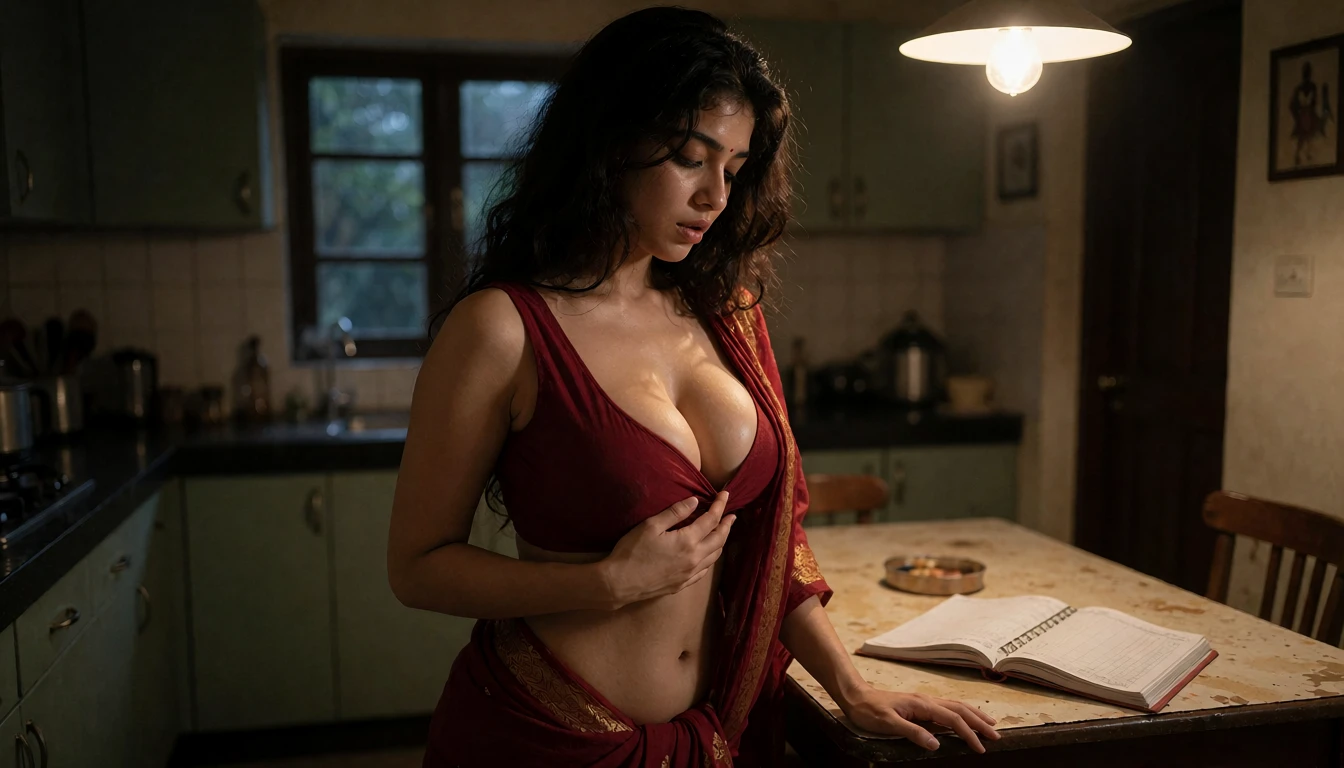

Sandip's mouth was open. The word sat on his tongue like a stone he'd been carrying all evening, polished by rehearsal, warmed by the beer he hadn't touched. He had practiced it in the bathroom mirror before Abdul arrived, had said it to his own reflection with his hands braced on the sink: Stay. A command. A keeping. The word a man says when he means this is mine and I am not letting go.
What came out was different.
"Stay?" The question mark bent it, turned it upward at the end like a plea, like he was asking permission instead of giving an order. Like he was the one who needed to be kept.
Kamala's eyes went sharp across the table's edge.
The heavy oak was cool under his palms, the grain familiar from seven years of meals, of newspapers, of her hands setting down plates. The lemon polish smell rose off it, faint and clean, and underneath it the musk of their argument, the salt of raised voices, the particular sour note of fear. The ledger lay open between them, its pages shifted, the dark cloth cover catching the lamplight. The total was still there. He had looked at it so many times in the last eleven days that the numbers had stopped meaning anything—they were just marks now, scratches in a stranger's hand.
Abdul shifted in the long chair at the side of the room.
Sandip heard the creak of the old wood, the settling of a big man's weight. He did not look at him. He could not look at him. He could feel Abdul's gaze like a weight on the side of his face, patient, waiting, the way a man waits for a kettle to boil.
"Sandip."
Her voice was low. Not soft. Low, the way she got when she was holding something back. He had heard that voice across this table for seven years, had learned its registers the way he had learned the tap's drip, the fan's wobble, the particular sound of her breathing in the dark.
He looked at her.
She was sitting at the short end of the table, the way she always did, her sari a deep green tonight, the fabric pooled around her hips. Her hands were flat on the wood, fingers spread, and he could see the faint tremor in them, the only sign that the last hour had cost her anything at all. Her face was still, composed, the face she wore for the neighbors, for the milkman, for the aunt who came every Durga Pujo and asked when they would have children.
But her eyes were not composed.
They were sharp. Cutting sharp. The sharp of the knife in the drawer, the one she had taken out and laid on the counter, the one that had sat between them all night while the tap dripped and the clock moved past nine.
"Say it again," she said. "Properly."
The words landed on the table between them and lay there.
Sandip felt his mouth open again. Felt the word Stay rise in his throat, and felt it bend again, the question mark curling around it like smoke. He closed his mouth. Opened it. Closed it.
Abdul shifted again. Sandip heard the creak of the chair, the settling of a big man's weight, and then a sound that might have been a breath, might have been the beginning of a word. He did not let him speak. He could not let him speak. If Abdul spoke now, whatever came out would be the deal, the arrangement, the eleven-day-old lie that had brought them all to this table, and Sandip would lose the thing he had been trying to say since Tuesday.
He did not know what the thing was.
He only knew it was not the sale.
And it was not the keeping, either—not the keeping he had rehearsed, the word he had said to the mirror with his hands braced on the sink. That word had been a door he could close. This was something else. Something that opened.
He looked at Kamala's hands.
They were still flat on the wood, still trembling faintly, and he remembered the feel of them from the night before—her palm pressed over his heart, her fingers curling into the cloth of his shirt. She had asked him what he wanted, and he had opened his mouth, and the word had not come. She had asked him again, and again the word had not come. He had stood in the kitchen with her hand on his chest and the knife on the counter and the tap dripping, and he had not been able to say it.
He had never been able to say it.
Seven years. Seven years of this table, this flat, this woman. Seven years of watching her move through the rooms with her hips swaying and her sari riding low on her navel, seven years of watching men's heads turn when she walked past, seven years of lying beside her in the dark and not once—not once—asking her for anything.
He had sold her instead.
That was the truth of it. That was the word he could not unsay. Tuesday, he had reached across this table—this same table, this same wood, this same lemon polish smell—and he had sold her to a man with a ledger. He had signed his name at the bottom of a page and incurred a debt with interest carried forward in the cousin's hand, and he had done it because he could not ask her for what he wanted.
Because he did not know how to want.
Because wanting meant risk, and risk meant losing, and losing meant being alone in this flat with the tap dripping and the fan wobbling and no one to watch.
"Sandip."
Her voice again. Softer this time. Not soft—softer. The edge still there, but blunted, like she was giving him room to step into.
He looked at her face.
Something had changed in it. The sharpness was still in her eyes, but her mouth had softened, the full lower lip no longer pressed thin. She was watching him the way she watched the water come to a boil, patient, expectant, ready to move the moment it did.
"Say it again," she said. "Properly."
The word Stay rose in his throat again.
He did not say it.
He said something else.
"Choose."
The word came out flat, without the question mark, without the bend. It landed on the table between them and lay there, and for a moment no one moved.
Then Kamala's hand moved.
Not to pull. Not to push. It lifted off the wood and crossed the small distance between them, and Sandip felt it land flat on his chest, fingers pressing the cloth of his shirt, the heat of her palm bleeding through the cotton. She pressed once, hard, like she was testing something, like she was checking that he was real.
"Again," she said.
Her voice was barely a whisper.
"Choose," he said.
The word was steadier this time. He felt it in his chest, in the place where her hand rested, felt it rise through his throat and out of his mouth and land on the table, and this time it did not sound like a question. It sounded like a door opening.
He reached for her wrist.
His thumb found her pulse before his fingers closed around her arm. He felt it jumping under his thumb, fast and light, the same pulse he had felt the night before when she had pressed his palm over her heart. He had never touched her like this. Seven years, and he had never once reached across this table and taken hold of her.
He pulled.
The ledger slid aside, its pages shifting, the dark cloth cover scraping against the wood. Kamala's chair scraped too, the legs catching on the floor, and then she was coming toward him across the table's edge, her sari catching on the corner, her body leaning into the pull of his hand.
He caught her.
His other hand found her waist, the curve of it, the warmth of it through the silk. He pulled her the rest of the way, and she came, her knees brushing the table's edge, her hands coming up to his shoulders, her face close to his.
He could smell her. Not the lemon polish, not the musk of the argument, but her—the oil in her hair, the faint sweetness of her skin, the particular smell he had woken up beside for seven years and never once let himself breathe in.
He kissed her.
The table was between them, the hard edge pressing into his thighs and her hips, the ledger somewhere to the side, forgotten. He kissed her with the wood between them, with Abdul's weight in the long chair at the side of the room, with the lamplight pooling on the table and the tap dripping in the kitchen and the fan turning overhead with its familiar wobble.
Her mouth opened under his.
He felt it—the small surrender of it, the way her lips parted, the way her breath caught and then released. He felt her body soften against him, the tension draining out of her shoulders, her hands sliding from his shoulders to his neck, her fingers curling into the hair at the nape of it.
She kissed him back.
Not the way she had kissed him before, in the dark of their bedroom, dutiful and quick. This was something else. This was her mouth opening under his and her tongue finding his, this was her body pressing against the table's edge to get closer to him, this was a sound in her throat, low and small, that he had never heard her make.
He made one too.
He did not know what it was. A breath, a word, a sound he had been holding in his chest for seven years. It came out into her mouth and she took it, swallowed it, gave it back to him in the press of her lips and the shift of her body.
Abdul shifted in the long chair.
Sandip heard the creak of the wood, the settling of a big man's weight, and he felt the room come back in around them—the lamp, the ledger, the open drawer, the knife that was still inside it, waiting. He felt Kamala feel it too; her mouth paused, her hands tightened on the back of his neck, and then she pulled back, just enough to look at him.
Her eyes were dark. Wet. He could see the lamplight in them, could see herself reflected, small and strange.
Her hand was still on his chest.
He could feel his heart under it, hammering against his ribs like a thing that had just learned to beat.
"Sandip," she said.
Her voice was rough. The edge was gone from it, and something else was in its place, something he had never heard from her before. It was not soft. It was not sharp. It was the sound of a door opening.
He waited.
The word sat in his mouth again, not Stay, not Choose, but something else, something that had been waiting in him for seven years, waiting for her to ask.
"What do you want?" she said.
Her question hung between them, not in the air but in the space her hand still occupied on his chest, in the pressure of her palm against his hammering heart. He could feel the answer rising in him, could feel it taking shape somewhere below his throat, and for the first time in seven years he did not try to swallow it down.
He looked at her. Really looked. At the henna-dark hair falling across her cheek, at the full lower lip still wet from his kiss, at the pulse he could feel jumping under his thumb on her wrist. She was still leaning toward him across the table's edge, her body not quite touching his, her sari bunched where it had caught on the corner. The lamplight caught the hollow of her throat, and he watched her swallow, watched her wait.
"I want," he said, and stopped. The words were unfamiliar in his mouth, like a language he had heard spoken all his life but never once tried to speak himself. He felt Abdul's weight shift in the chair at the side of the room, felt the big man's patience like a third presence at the table, and he did not look at him. He kept his eyes on Kamala's face, on the sharpness that had softened into something he was almost afraid to name.
"I want you to stay," he said. "But not because I'm keeping you. Because you're choosing to."