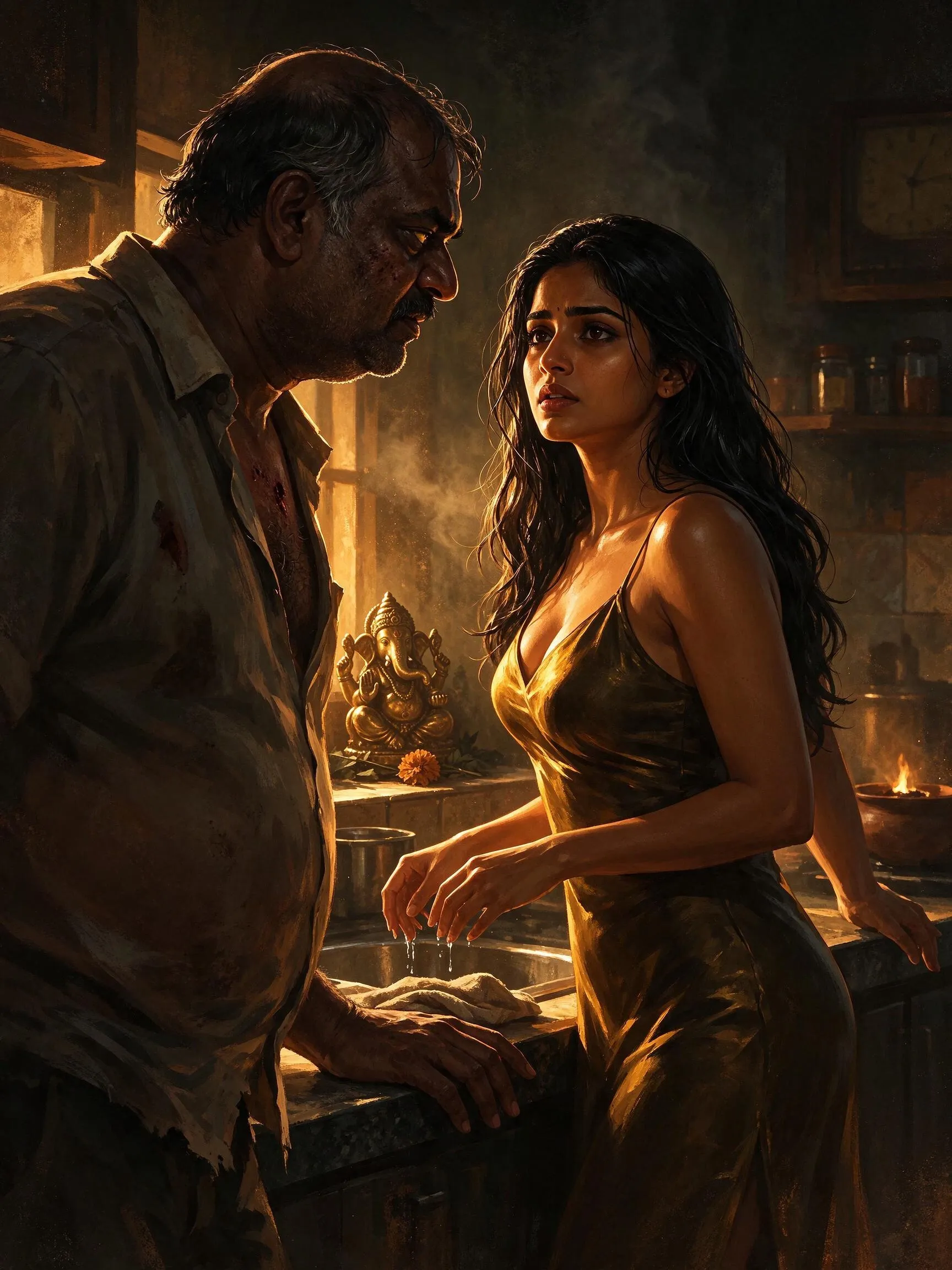
The tap ran cold over her wrists. Emma had meant to wait for it to warm, but her hands were already in, already red to the knuckle, and turning it off now felt like admitting she'd been standing there doing nothing for a long time. The bleach bit at the small cuts around her nails. Behind her, the kitchen breathed: the fridge's low hum, the clock over the door, the smell of Jai's cologne gone stale in the corners where he'd paced.
She had scrubbed the same plate twice. Set it in the rack. Picked it up again.
In the front room, the sofa springs had gone quiet. That was the thing — for an hour there'd been the old man shifting, coughing, muttering in his sleep like a dog dreaming, and now nothing. She'd checked on him twice. Both times his chest had risen and fallen under the torn shirt and she'd backed out with her heart going like a bird in a jar.
"You're very thorough."
She didn't scream. That was the strange part — she wanted to, felt the scream climb all the way to her teeth, and then it just sat there while she turned, dishwater running off her fingers in thin ropes and spotting the floor.
Ramesh stood in the doorway with one shoulder against the frame, arms loose at his sides. The kitchen light was behind her, so it fell on him full and unforgiving: the gray-streaked hair matted flat to his scalp, the pockmarked cheeks, the shirt stiff with something dark that had dried to a shine. His bare feet were black to the ankle. He looked, she thought, like a man who had been dug up rather than one who had walked in.
"You should be resting," she said. Her voice came out steady. She was proud of that.
"I rested." He smiled with the yellow of his teeth. "Your sofa's better than the ground. Much better than the ground, madam."
"Then go back to it." She reached for the tap, turned it on, turned it off again. "It's late. My husband's just gone up. He has a meeting in the morning, he needs—"
"He's a busy man."
"He is."
"Corporate." Ramesh said the word slowly, tasting it. "Big company. Nice car. Nice house." His gaze went around the kitchen — the steel sink, the spice rack, the little brass Ganesh by the window with a marigold dried to a husk at his feet — and came back to her. "Nice wife."
She dried her hands on the towel, folded it, set it square on the counter. Her mother had done that. Fold the towel, square the corners, and the world stays where it should. "What do you want?"
"Want?" He pushed off the frame and took a step in. His feet made almost no sound. The smell came ahead of him — street and sweat and something sour underneath, old clothes left wet. "I'm just talking. You don't have to be frightened of me. I'm the one who got hit, remember."
"I'm not frightened."
"No?" He tilted his head. "You keep looking at the door."
She stopped looking at the door.
He came another two steps and the clean air of her kitchen went with him — the lemon soap, the bleach, all of it pushed back to the walls. He stopped at the corner of the counter, close enough that she could see the wet in the corners of his yellowed eyes, the little broken veins in his nose. She had the counter between them at the hip. She kept it there.
"Your husband," Ramesh said, "he was very drunk tonight."
"He wasn't—" She heard herself and stopped. "He'd had a few. It was a party."
"A few." The old man nodded, agreeable as a priest. "A few. And the road was dark, and I was in it, and he didn't see me, and then —" he made a soft sound with his mouth, a puff, the sound of a thing being struck — "down I go. That's how it happens. Nobody's fault. Nobody's fault at all."
"We brought you home. We didn't leave you." Her hands had found the edge of the counter and she made herself let go of it. "We could have left you."
"You could have." He said it like a compliment. "Good people. That's what I said to myself on that sofa. Good people, this one and his wife." Then he let his eyes come up her body, unhurried, and she felt it the way you feel a hand. "And then I thought — good people, they've got a lot to lose. More than me. I've got a torn shirt and a bad knee. What have you got?"
"Don't."
"I'm asking a question, madam. That's all."
She turned her back to him and put her hands in the water again, and the water had gone cold and greasy and she didn't care. Behind her, the floorboards gave once. Twice.
"If I was to walk down to that police station tonight," Ramesh said, pleasantly, from somewhere behind her shoulder now, "and say — a car hit me. A drunk man, a big car, a nice house. What would happen to him?"
Emma's hands went still in the water. A plate stood upright in the rack, dripping. The clock over the door ticked and she heard every single one.
"He'd lose his job," she said. Her voice had gone thin. "He'd lose everything. They don't — his company, they don't tolerate that. Any of that. The police would call them by morning and he'd be finished, and the loan on this house, and his mother's treatment, and—" She stopped. She had said too much. She always said too much.
"Everything," Ramesh repeated softly. "That's what I thought."
She turned around.
He was close. Closer than the counter should have allowed — he had come round the corner of it, and now he stood where Jai stood when Jai washed up beside her, in the space that belonged to a husband, and the torn shirt was an arm's length from her face and she could see the gray of him, the dirt in the creases of his neck.
"So then," he said. "You'd do anything I said. Wouldn't you."
It wasn't a question the way he said it. It had a shape that only took one answer, and the answer was already standing in her mouth, and she hated it, and she gave it anyway.
She nodded. Once. Her chin went down and came up, small and tight, and her eyes stayed on the collar of his ruined shirt because she could not make them go anywhere else.
"Say it."
"I—" Her throat stuck. "Yes."
"Yes what."
"Yes." Her hands had found the towel again. She was holding it against her stomach like a child holds a cloth. "Yes. Anything. Only don't say anything to anyone. Please. He's a good man. He's just — he had a few drinks, that's all it was, he's never—"
"Shh." Ramesh put up one dirty hand, and she stopped as if he'd closed her mouth. "You're a good wife. I can see that. A good wife." The hand came down. "You've got a good heart, madam. And a good heart, it does what it's told when the thing it loves is in the fire."
The tap dripped. She hadn't turned it off all the way, and the sound of it was suddenly the loudest thing in the house — one drop, then the wait, then another. She could hear the upstairs floor creak as Jai moved around above them, and she thought, wildly, of calling up to him. Nothing to call. There was nothing to call.
"Would you like to know what I want?" Ramesh said.
"You've had dinner. You've had a shower. You've got the room—"
"I'm not talking about the room."
She looked up at him then, because there was no way not to, and his yellowed eyes were not looking at her face. They had dropped, and they were resting where her dress had caught the damp against her chest, and they were not moving, and the frankness of it turned her cold from the scalp down.
"You're a beautiful woman," he said, matter-of-fact, like he was reporting the weather. "I saw you in that car, you know. When I was lying in the road, before your husband picked me up. I saw you get out the other side and stand in the headlights. That dress you had on." He sucked his teeth. "I thought I'd died. Truly. I thought, this is it, Ramesh, you've gone at last, and this is what's waiting on the other side."
"Don't talk to me like that."
"I'm only saying what I saw."
"Please." She said it louder than she meant to and then, immediately, softer, because the floor above had gone quiet. "Please. He's awake up there. He'll hear you."
Ramesh smiled. It was a slow, patient smile, the smile of a man who had all night and knew it. "Then you'd better not make a noise, madam," he said. "Hadn't you."
The clock ticked. The tap dripped. Emma stood with the wet towel pressed to her stomach and the counter at her back and the whole quiet weight of her house pressing in on her from every side, and she did not make a noise.
He did not move.
That was the thing she could not get her mind around — that he simply stood there, an arm's length away, and let the silence do the work. His hands hung at his sides, loose and patient, and one thumb rubbed slow against the seam of his ragged trousers, back and forth, back and forth, the only part of him in motion. Behind him the back door stood ajar the width of a hand, and the night air coming through it carried the wet green smell of the compound wall and someone's jasmine, and it touched the back of her neck where the dress had gone damp.
"You're shaking," Ramesh said.
"I'm cold."
"It's a warm night." He said it gently, as though he were sorry to correct her. "You've been standing at that sink a long while. Water goes cold, doesn't it. Rots the hands." His eyes went down to where she had the towel crushed against her middle. "You should have asked me to dry. I'm good with my hands."
The tap let go of another drop. She heard the whole fall of it into the steel — the small bright note of it, and then the hollow after, and she thought if she stood there a moment longer listening to it she would start to cry, which was the one thing in the world she could not afford to do with Jai's floorboards groaning over her head.
She reached behind her, felt for the spout, and turned it off hard. The quiet that came down then was worse. It had a shape, that quiet — it was the shape of the two of them in the kitchen, and the shape of the floor above where her husband was walking around in his undershirt with his phone in his hand, and the shape of the nod she had just given, sitting out in the open air between them like a dish of milk.
"I'll finish up here," she said. "You should sleep. You've — you were hit tonight. You need to sleep." Her voice had gone high and hostessy and she hated the sound of it, the sound of her own mother at a family function, offering tea to a man who had come to the door with a knife. "There's a lock on the guest room. I'll show you—"
"I know where the room is." Ramesh turned his head and looked at her properly then, and the kitchen light caught the road-dirt in the creases of his collar, the fine gray powder of the street dried into the weave of the fabric. "I had a shower in it. I know where it is, madam. What I don't know—" he let the sentence hang, and his thumb went on rubbing the seam— "is what a good wife thinks about, standing alone at her sink at this hour. When the dishes are done. When the house is quiet."
"I think about the dishes."
"No." He shook his head, slow, almost fond. "No, you don't. You think about your husband up there, and whether he'll remember any of it in the morning, and whether the old man on the sofa is going to go to the police. That's what you think about. I've seen that face before. On my own mother, God rest her. It's the face of somebody carrying a thing too heavy for them." He lifted one shoulder. "And then I come and stand in your kitchen and I offer to carry a bit of it. And you look at me like I'm the devil."
"You are not carrying anything for me."
"Aren't I?" He smiled again, and this time it reached the yellow of his eyes. "I'm carrying the whole house, madam. Every brick of it. You just haven't noticed yet."
She turned away from him — not to the sink this time, but to the counter, and began to move the dried plates into the cupboard one by one, and her hands were not steady and a saucer rang against a bowl and she had to stop and set it down and start again. The cupboard smelled of the sambar she had made on Sunday. The brass Ganesh by the window had a fresh garland on it, and she looked at the little god and thought, absurdly, you saw all of this, and the little god went on smiling his painted smile with the marigold at his feet.
"Your husband," Ramesh said from behind her, and now he was at the counter's edge again, she could hear his bare foot settle on the tile, "he went up without saying goodnight to you."
"He has a meeting. He was tired."
"He was tired." The old man said it the way she imagined a judge might say a thing, weighing it. "A man gets hit by a car with his wife in it, and he goes up to bed, and he doesn't come down and put his hands on his wife's shoulders and say — thank you. Thank you for helping me. Thank you for not screaming, thank you for the old man on the sofa. Nothing." He clicked his tongue. "And you're standing down here with the cold water and the dishes. Hm."
She did not turn around. "Don't."
"I'm only saying what I see."
"You don't see anything." Her voice cracked on the last word and she pressed her lips together and set the last plate on the shelf and closed the cupboard door with both hands, and the little latch clicked, and it was the most final sound she had made all night. "You don't know him. You don't know anything about him. He works twelve hours and he comes home and he — you don't know him."
"No," Ramesh agreed. "I don't." He was quiet a moment. "But I know a man who's frightened. And I know what a frightened man does to a woman who loves him. He uses her up."
Emma stood with her palm flat on the cupboard door and her forehead nearly touching it and the floor cool through the thin soles of her slippers. Somewhere in the house a pipe knocked, once, and settled. Upstairs the shower started — Jai had finally gone in — and the sound of it came down through the ceiling, the hiss of the spray, the change in the note when he stepped under it.
"There," Ramesh said softly, and it was almost kind. "Now he's in the shower. He won't hear a thing for ten minutes. Fifteen, a man like that, he'll stand in there a long while." He shifted his weight, and the floorboard under him gave its small complaint. "So. Ten minutes. What shall we do with them, madam?"