
The key was still on the blanket when the lights went out, and Liam lay with his cheek on his folded arm and watched the wet shine of it go dull in the dark, and the cage sat cold and heavy between his thighs and did not let him forget one thing.
He woke before the alarm. He always did now. Dmitri's breathing filled the cell, slow and deep, and Liam lay still under it and counted the bars he could see against the corridor light and thought about the key.
The alarm went at half past five, and Dmitri rose without a word and pulled his jumpsuit up over his shoulders and zipped it and went out to the yard, and Liam was left with the cell, with the sink, with the mirror over it. He washed himself at the sink, and the water was cold and the soap was gray and smelled of nothing, and he did his mouth with his finger and the salt and got the taste of brass out of it at last. He put the lipstick on. He had learned to do it in the little mirror without turning his head, and he did it now, and his mouth went red and his face went strange the way it always did, a girl's face looking back at him over a boy's shoulders.
He put the pink collar on. He put the black one under it, and the ring of it lay against his throat below the pink leather, and he turned his head to feel it move. Then he put on the dress he was allowed to wear on the block, the gray thing that hung to his knees, and he sat on the edge of the bunk with his hands in his lap and waited, because he had been told to wait, and waiting was the work now.
At six the door opened. It was not Dmitri. It was Warden Cross, in her gray suit with the silver pin at the collar, and she stood in the doorway with a clipboard against her hip and looked at him the way a woman looks at a room she is about to rearrange.
"Up," she said. "You're late for your fitting."
"I didn't know—"
"You know now." She turned and was already going down the tier, and Liam got up and followed her, and the men at the bars watched him go and one of them said something low and the others laughed, and Liam kept his eyes on the gray back of her suit and his hands at his sides.
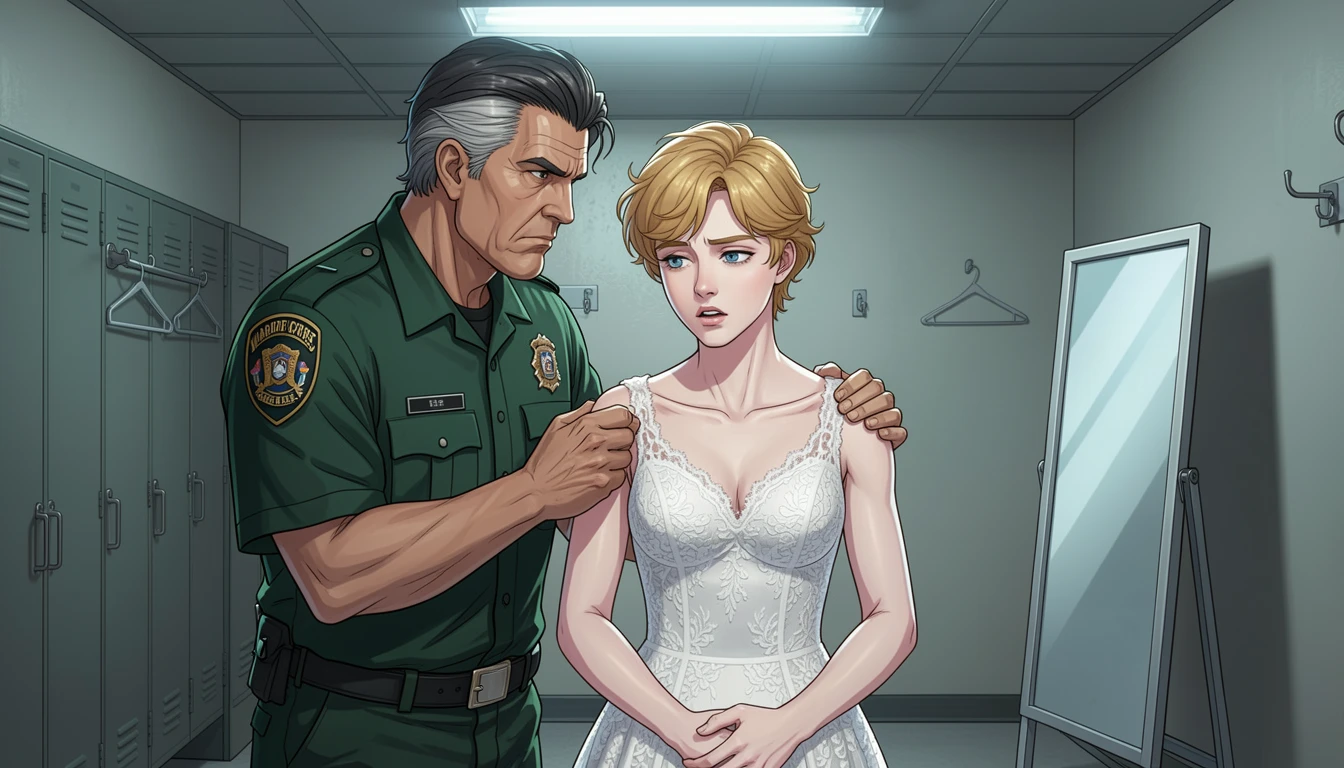
The dressing room was not the one Vera and June had used. It was deeper in the block, down a corridor Liam had never been taken, past a door that Cross unlocked and locked again behind them, and the air in it was thick and sweet with perfume that had been there so long it had gone into the walls, and under it, faint and sharp, a metallic tang from the brass fittings on the racks and the long mirror and the little hooks along the wall.
Velvet curtains hung at the windows, heavy and dark red, and they swallowed every sound so completely that Liam heard his own breathing come back to him off the cloth, and the tick of a hook somewhere as it settled. The mirror stood at the end of a low wooden platform, and it was tall as a door and framed in tarnished brass, and it was cold in the room the way a window is cold.
"Strip to your underthings," Cross said. She was already at the rack, her fingers walking along the hangers. "And stand on the platform."
Liam undid the gray dress and stepped out of it and folded it and set it on the chair, and then he stood in his bra and his panties on the wooden platform, and the wood was cold through his soles and the mirror was cold where his shoulder came near it, and he looked at himself and then away.
"Look at yourself," Cross said, without turning. "You'll be looked at on Saturday. You may as well start now."
So he looked. The girl in the glass had honey-blond hair and red lips and a pink collar that said Daddy's Girl and small breasts under white cotton and the beginnings of hips, and the gray block light made her look like a photograph of someone who had died. He did not know her. He had known her less every week.
Cross came back with the dress over her arm, and it was white, and it was heavy, and it had been made for him — he could see that in the way the waist was cut, narrow and high, and the way the skirt fell in long folds from the hip. There was lace at the neck and the cuffs, and a row of small covered buttons down the back that caught the light like a row of teeth.
"Arms up," she said.
He raised his arms and she dropped the dress over his head, and the white came down around him and the lining was cold and smooth and smelled of the shop it had come from, and then his head came through the neck and he was inside it.
"Turn."
He turned and she began at the waist, drawing the laces, and the first pull took his breath and the second took the rest of it, and the dress closed around his ribs like a hand. She pulled and set and pulled again, working up his back, and the drag of the laces was a long sound in the velvet room, and Liam's breath came short and high and he put his hand out and found the edge of the mirror and held it.
"You're not breathing," Cross said.
"It's tight."
"It's a wedding dress." She pulled again and the hooks went home, one and then another, and the tick of them was loud so close to his ear. "Brides don't breathe. Brides endure."
She worked the last of the laces and tied them and stepped back, and Liam stood with his hand on the glass and his heart going under the white and the dress holding him up like a hand at his back.
"Now," Cross said. "The hem."
She knelt and took the hem in her hands and turned it, and the white pooled at Liam's feet on the wooden platform, and she looked up at him the way a tailor looks at a wall. "You're short in the leg. I told them that. The hem will have to come up a half inch or you'll be walking on it into the chaplain's shoes." She made a mark with a pin and sat back on her heels. "Now. Tell me what you've arranged."
Liam looked at her. "Arranged."
"Arranged." She stood, and her knees cracked, and she brushed her hands off. "The bridesmaids. Who's standing up with you."
The room was very quiet. Liam heard his own breath go in and out of the dress.
"I—" he said. "I thought—"
"You thought." Cross's voice was level and flat and did not move. "Who."
"I don't—" He looked at the mirror, at the girl in white with her mouth open. "There's June," he said. "Vera's girl. She helped me with—with the things. She could—"
"June is a fitter's daughter who sold you a brassiere. She is not a bridesmaid." Cross walked a slow half circle around him, and the metallic tang of the brass came sharp off the rack as she passed it. "The flowers. What flowers."
Liam's hand tightened on the edge of the mirror. "I don't know flowers."
"You don't know flowers." She stopped at his shoulder. "The cake, then. You'll have ordered a cake."
He said nothing. The velvet swallowed the nothing.
"The shoes," Cross said. "The evening wear for after. The jewelry. The rings. The chaplain — have you spoken to the chaplain, has anyone spoken to the chaplain, does he know there is to be a wedding in this block on Saturday and not a hanging?" She turned and looked at him full in the face. "The license. The witnesses. The two names on the paper. The stamp."
"I thought you were doing it," Liam said.
The silence after that was a different kind of silence. Cross's face did not change, and that was worse than if it had. She stood with her hands folded in front of her and looked at him for a long moment, and Liam heard the tick of a hook settling somewhere along the wall and his own heart under the white.
"You thought I was doing it," she said at last.
"You did the surgery," Liam said. "You did the dress. You did the—the room. The girls. You do everything, you always—"
"I do everything," Cross said. "Yes. I do everything, and so you have done nothing, and in two days you will stand in the mess hall and be married, and there will be no flowers and no cake and no one standing up with you, and you will not have spoken one word to the man who is to say the words over you." She took a breath through her nose. "Two days, Liam. Not two months. Two days."
"I didn't know I was supposed to—"
"You didn't know." Cross stepped in close and her voice dropped, and it was not loud, and it was worse for not being loud. "You are to be a wife. Do you understand what that word is? It is not a collar and a dress. A wife thinks ahead of the day. A wife lies awake the night before and counts what is not yet done. A wife knows the flowers and the cake and the shoes and the words she will say and the words she will hear and the order of the whole day from the waking to the bedding, and she has arranged it, every part of it, so that when the day comes she does not stand in the middle of the mess hall with her mouth open like a girl who has been handed a dress."
Liam's eyes stung. He looked at the mirror and the girl in white looked back with red lips and wet eyes and the pink collar saying Daddy's Girl under the white lace, and he did not know what to do with his hands.
"I'm sorry," he said.
"Don't be sorry. Sorry is for after. Sorry is a thing you say when the cake has fallen." Cross turned him by the shoulder — her grip was hard through the white and the mirror came cold against his other shoulder — and she set him square in front of the glass. "Look at her."
He looked.
"She is going to be married on Saturday," Cross said, "in front of the whole block, and she is going to be looked at, and everything that is not done by then will be seen to be not done. Every missing flower. Every empty chair." Her hand stayed on his shoulder. "So from this moment you will think like a wife. You will behave like a wife. You will lie in that cell tonight and you will imagine the day — every hour of it, from the cold water in the morning to the white on your back — and you will find what is missing and you will bring it to me and we will arrange it. Do you understand me?"
The dress was tight and the mirror was cold and the velvet ate the sound of his own breathing. "Yes," Liam said.
"Say it properly."
"I understand you." His voice came out small and steady, and he did not know where the steadiness came from. "I'll think like a wife."
"Good." Cross let go of his shoulder and stepped back, and her heels were loud on the wood, and then quiet again as she went to the rack. "Then we'll begin with the hem, and you'll tell me while I pin it who you mean to have stand at your side, and you will not say June unless you can tell me what color she'll wear and where she'll stand and what she'll hold in her hands."
Liam stood in front of the mirror with the white pooled at his feet and the cold of the glass at his shoulder, and he looked at the girl in the dress, and the girl in the dress looked back, and under the lace at his throat the black ring of the collar caught the light and did not let go.
The pin went in at his ankle and Cross sat back on her heels and looked up at him and waited.
"Green," Liam said.
"Green."
"June's dress. Green. Not—not the green of the block. A soft green. The color of the—" He stopped. He did not have the word. He had never had the word for colors, not the way girls did. "The color of the leaves before they go dark. In the spring."
Cross held the pin between her teeth a moment and then took it out. "And where does she stand."
"At my side. On my left, because—" He thought of the mirror, of the way the ring of the black collar sat at his throat. "Because the right side is for the—the one who is given away. She stands at my left and she holds—" His hand moved at his side, closed on nothing. "She holds my flowers until the words are said. Then she takes them back."
Cross stood up. She brushed her knees and looked at him a long moment, and something in her face had gone from flat to considering, the way a woman's face does when a thing she expected to be bad has turned out to be merely wrong. "That is a bridesmaid," she said. "That is a bridesmaid and not a fitter's girl. You may have her."
Liam let out a breath he had not known he was holding, and the dress let it out with him.
"Now," Cross said, and went to the door. "There is a telephone in the corridor office. You'll call her yourself. A wife does her own calling."
The corridor office was a closet with a desk in it and a telephone the color of old bone, and Cross stood in the doorway with her arms folded and watched him lift the receiver and hold it to his ear the way he had seen it done in films. The dial tone was a low hum. He did not know the number. Cross said it, slow, twice, and he turned the dial with a finger that had gone cold, and it rang, and it rang, and it rang.
"Vera's," a girl's voice said.
"June." His own voice came out strange. "It's—it's Liam. The one with the—" He could not say it. "The dress."
"Liam." Her voice changed, went warm. "Is it the fit? Did something tear?"
"No. It's—" He looked at Cross in the doorway and Cross looked back and did not help him. "I'm to be married Saturday. In the mess hall. And I don't have—" His hand tightened on the bone-colored receiver. "I don't have shoes. Or flowers. Or a cake. Or anything. And Cross says a wife arranges these things and I don't know how, June, I don't know the first thing, I don't even know what color I'm allowed—"
"Breathe." Her voice was steady and close, as if she were in the room. "Breathe, and listen. I'll do the shoes. You'll need white, low, because you'll be standing a long while and you're not used to heels and you'll want to be sure of your feet. Nothing with a strap that cuts. I know a girl who does a white satin pump in a small size, she'll have it by Friday. The jewelry — you'll want something at your throat that isn't the collar, and something in your ears that isn't the hoops, and I'll bring both. Pearls, I think. Pearls are quiet and they don't fight the white."
Liam wrote it down on the corner of a form on the desk, in letters that came out too large. Shoes — white. Pearls.
"The flowers," June said. "You'll want white and green together, because green is what you're putting your girl in. Roses are dear and they'll droop in the heat of that hall. I'll bring carnations and fern and a little white stock for the smell. And the cake—" She paused. "How many men?"
"The block," Liam said. "All of them."
"Then a sheet cake, and I'll have it iced plain white with a border, and I'll bring a bride and groom for the top that I can find. It won't be a grand cake, Liam. It'll be a good one."
"June—" He could not finish it. His eyes had gone hot and the words had gone sideways in his throat. "I don't have any money."
"You let me worry about the money." Her voice had gone firm, the way a woman's does when she has decided a thing. "You've got enough to carry. I'll bring it all Friday evening and we'll lay it out and you'll see it and you'll feel better. Now. Is there a chaplain?"
"I don't know."
"Then find out. A wedding isn't a wedding without the words."
He hung up the receiver and stood with his hand still on it, and Cross said, "Well?"
"She's doing the shoes and the pearls and the flowers and the cake," Liam said. "She says to find the chaplain."
"Then find the chaplain," Cross said, and opened the door.
The chaplain's office was at the end of the administrative corridor, past a window that looked out on the yard where the men were walking their slow circles in the gray morning. He was a small old man with white hair cut close and a face like a soft pear, and he had a Bible on the desk and a cup of tea beside it and he looked up at Liam and then at Cross and then back at Liam, and his eyebrows went up very slightly and came down again.
"This is the one," Cross said. "Saturday. Three o'clock. The mess hall."
"Three o'clock," the chaplain said, and wrote it in a book. "And the names?"
"Liam Carter," Liam said, and then, because it was the truth and the truth had to be said, "and Dmitri Fedorov."
The chaplain's pen stopped. He looked at Liam over the top of his little glasses, and he did not look away for a long moment, and then he wrote the name down. "I've married worse," he said. "I married a man to a woman who'd put a knife in him inside the year. She didn't, as it happened. He put one in her. I've stopped guessing." He set the pen down. "Sit."
Liam sat. The chair was hard and the dress was tight and he sat forward on the edge of it with his hands folded in his lap.
"You know what a wife is," the chaplain said.
"I'm learning."
"You're not learning. You're being taught, which is different, and the ones who teach you are teaching you what they want. So I'll tell you what the words mean, and you'll take it or leave it." He folded his hands on the Bible. "A wife is a helpmeet. That's the word. It means a help that is fit for him — not a servant, not a slave, a help that fits. She keeps his house and his name and his bed, and she does it not because she is made to but because it is hers to do, and a man who has a wife has a thing the men without one do not have, and he knows it, and if he is a good man he is grateful and if he is a bad man he is not, and either way she has done her part."
"And children," Liam said. The word came out before he had decided to say it.
The chaplain looked at him. "And children," he said. "The first command was to be fruitful. A wife who can bear is a wife who has done the whole of it. A wife who cannot—" He turned his cup a quarter turn on the desk. "A wife who cannot is still a wife. The words don't say otherwise. But a man wants a child the way a man wants a name that outlives him, and the women who cannot give it spend their lives knowing it." He looked at Liam's face and his own face changed. "You're young."
"Nineteen."
"Nineteen." The chaplain sat back. "I married a girl of nineteen once. She cried through the whole of it and I thought it was joy and it was not. She was gone by the spring." He picked up his tea and drank and set it down. "I'll say the words over you on Saturday and I'll say them properly, and I'll not ask you if you're willing, because I know the answer and so do you, and I'd rather not have it said out loud in front of the block. But I'll tell you this and then you'll go. A wife keeps her own counsel. Whatever that man is to you, whatever he does to you and whatever you do for him, there is a room in you that is yours and no one else's, and if you give that room away you'll have nothing left to be a wife out of. Keep the room." He picked up his pen again. "Three o'clock. I'll be there at two and I'll want the certificate and the two witnesses. Bring them."
Liam stood. His legs had gone a little unsteady and the dress was tight and he put his hand on the back of the chair. "Thank you," he said.
"Don't thank me yet," the chaplain said, and went back to his book.
Cross walked him back as far as the tier door and left him there without a word, and Liam went up the stairs with his hand on the rail and the white dress folded over his arm in its paper, and the men at the bars watched him go and said nothing, and that was worse than the laughing had been. The cell door was open. Dmitri sat on the edge of his bunk with his elbows on his knees and his hands hanging, and he looked up when Liam came in and his gray eyes went over him once, top to bottom, and stayed on the paper parcel.
"Well," he said.
Liam set the parcel on the shelf and turned and stood with his back to the bars and his hands at his sides. "The chaplain says three o'clock Saturday," he said. "He wants the certificate and two witnesses. June is doing the shoes and the pearls and the flowers and the cake. And I told Cross June would stand at my left in green and hold my flowers, and Cross said I might have her."
Dmitri did not move. "That's one," he said.
"One what?"
"One witness. A wedding wants two." He reached to the shelf beside him and took down a pack of cigarettes and shook one out and did not light it. "You've done more in a morning than you did in a week. I'll give you that." He put the cigarette between his lips and struck a match and the flame made his scar jump. "But you come to me with one side of the aisle filled and the other side empty, and you stand there in the white and the block looks at the empty chair and knows why it's empty." He shook the match out. "You want the block to know why it's empty?"
"No."
"Then we fill it." Dmitri smoked and looked at the far wall and thought, and Liam had learned by now to be quiet while Dmitri thought. "There's a women's prison an hour from here. Minimum. I did a stretch of work in the laundry contract out of it, years back, before this. There's two in it I know — Dara and Nika. Girls who came up the hard way and came out the other side of it whole, and they don't scare and they don't simper and they'd stand at a wedding in this block and make it look like a wedding and not a joke." He tapped the ash into the little tin on the shelf. "I'll ask them. They'll come if I ask."
Liam stood very still. "They'd come here. Into the block."
"For a wedding? In their good clothes, with a gift in their hands? They'd come." Dmitri looked at him then, and the look was not the flat one and it was not the hungry one; it was the one that came when he had decided a thing and was turning it over to see if it would hold. "You'll want to be careful with them. They're not like the men here. They've been looked at their whole lives and they've learned to look back, and if you're shy of them they'll know it in a breath and they'll be kind about it, and kindness from a woman like that will take the legs out from under you if you're not ready." He drew on the cigarette. "Be ready."
"I'll be ready," Liam said.
Dmitri nodded once and stood and went to the bars and put his hand through and said something to a man in the corridor that Liam did not catch, and the man went off at a jog. Dmitri came back and sat down again and looked at Liam where he stood with his back to the bars and the gray dress hanging to his knees and the red on his mouth and the black ring at his throat under the pink.
"Come here," he said.
Liam came. He stood between Dmitri's knees and Dmitri put his hands on Liam's hips and held him there, and his thumbs found the bones under the gray cloth and pressed, and Liam felt the pressure go through him and settle low and warm, and the cage sat cold and heavy and did not let him forget one thing.
"You did the work," Dmitri said. "You went out and you did it and you came back and you told me. That's a wife." His hands tightened. "Now. Before they come. Tell me what's still missing, and don't tell me nothing, because there's always a thing."
Liam thought. The dress was tight and the hands were warm and the chaplain's voice was still in his ear, keep the room. "The certificate," he said. "The paper with the two names on it. The chaplain wants it and I don't know who makes it."
"Cross makes it," Dmitri said. "Cross makes it and stamps it and it goes in a file and it's as legal as anything in this place is legal." He let go of Liam's hips and sat back. "Anything else."
"The—" Liam's hand moved to his throat and touched the pink collar and then the black ring under it. "The chaplain said something at my throat that isn't the collar. June's bringing pearls. But the collar—"
"The collar stays," Dmitri said. "The pearls go over it or under it, I don't care, but the collar stays on you Saturday and every day after. You're not a girl who takes her collar off for a photograph." He stood, and he was tall in the cell and the light from the corridor came through the bars and laid stripes across his chest. "Dara and Nika will be here Friday. You'll meet them and you'll be polite and you'll not stare at them and you'll not ask them what they are, because they'll tell you or they won't and it's not yours to ask." He picked up his cigarettes and put them in his pocket. "And you'll tell Cross there's two more at the table and she'll find chairs."
Liam nodded. His hands had gone still at his sides and his heart was going, and he did not know if it was fear or the other thing, the thing that came when a door opened that he had not known was there.
"Dmitri," he said.
Dmitri turned in the doorway. "What."
"The chaplain said a wife keeps a room in her that's hers." Liam's voice was steady and he did not know where it came from, and he said it anyway, looking at the crooked nose and the scar and the gray eyes. "He said if she gives it away she's got nothing left to be a wife out of."
The cell was quiet. Dmitri looked at him for a long moment, and the stripes of corridor light lay across his face and did not move.
"He's a clever old man," Dmitri said at last. "I'll want to hear what else he told you." And he went out, and his boots went down the tier, and the door at the end of it opened and closed.
Liam stood alone in the cell with the paper parcel on the shelf and the folded white dress inside it and the cage cold between his thighs, and he put his hand flat on the gray cloth over his stomach and felt it rise and fall, and he began, as he had been told, to imagine the day — the cold water in the morning, the white on his back, the two women coming up the corridor with a gift in their hands.
The cold water came first, as he had been told it would. Liam stood at the sink in the dark with the block still asleep around him and washed himself with the gray soap and did not let himself hurry, and the water ran down his chest and over the small soft weight of his breasts and the gooseflesh came up on his arms, and he thought: this is the last morning I wake up as a girl who is not married.
The dress was on the shelf in its paper. He did not take it down. He did not need to. He had lain awake half the night with the shape of it in his head, and now he laid the day out in the dark the way the chaplain had said a wife must — from the waking to the bedding, in order, every hour of it, and found the missing parts and named them.
The white on his back. That came first. The dress had gone on over his head in the dressing room and the lining had been cold and the laces had taken his breath, and it would be worse on the day, because June's shoes would lift him off his heels and change the way the hem hung and the whole thing would have to be set again. He saw Cross on her knees at his ankle with the pin in her teeth. He saw the white come up a half inch and the pin go in and the fold settle.
Under it — this was the part he had not known to think about until June had said it, and it had come out of her the way a thing comes out of a girl who has been dressing for a day her whole life. The white virgin lingerie, she had called it, and she had turned a little pink when she said it and gone on anyway. White cotton, plain and high at the neck, because a bride's first layer is not for the man, it is for the day. And under that, a garter belt. Blue, she had said. Something borrowed and something blue in one, and Liam had not understood and had not asked and had held the receiver and listened to her describe the clasp and the way it sat at the top of the thigh and the way it would show if the dress lifted when he walked.
He put his hand under the gray cloth now and found the top of his thigh and pressed, and thought of the blue clasp there in the dark, and the cage sat cold and would not let him have a single thought of his own without it.
The bouquet came next. Carnations and fern and a little white stock for the smell, and June's hands on the stems, and the ribbon wound round and round and the ends trailing. He would hold it at his waist in both hands, because a bride with one hand free is a bride who is thinking about something else, and he would smell the stock before he went in, once, and then he would not smell anything again until it was over.
The veil. He had not thought about the veil at all until the dark gave it to him — white tulle, fine as breath, and it would go over his hair and down over his face and the whole block would look at him through it and see a girl, and he would see them through it and see nothing clear. That was the mercy of it. He would not have to see their faces. He would see shapes and colors and the white blur of the mess hall and the red of his own mouth if he looked down.
And Cross at the door of it, at his side, with her hand on his arm.
That was the strangest part of the imagining, and it took him the longest. He had thought it would be Dmitri who came for him, and it was not. It was Cross in her gray suit with the silver pin, and she would take his arm and he would put his hand over hers the way he had seen brides do in films, and they would walk the length of the mess hall together, and she would not say a word to him and he would not need her to. She had made him. She had cut him open and put the girl in. It was right that she gave him away.
The mess hall would be rearranged. The tables pushed to the walls and the chairs in rows and the men in them, and the men would have washed, or some of them would have, and they would turn in their seats to watch him come. Dara and Nika in the front, in their good clothes, with a gift in their hands and the hard easy way about them that Dmitri had said would take the legs out from under him if he was not ready. He would be ready. He would look at them once and nod and be a wife about it.
And at the end of the aisle, under a window with the gray light coming through it, Dmitri.
He made himself see it. The jumpsuit, because a man in this place does not have a suit and would not wear one if he did. The crooked nose and the scar through the eyebrow and the gray eyes that went over him once, top to bottom, and stayed. The way he stood with his hands at his sides and did not fidget and did not smile, and the whole block quiet behind him.
The chaplain would say the words. Liam did not have them all — he had heard them at other people's weddings and they had gone through him like water through a sieve — but he knew the shape of them. The questions. The two yeses. He would say his yes and it would come out small and steady the way his voice had come out in the dressing room, and he would not look at the men, and he would not cry, and the chaplain would close his book and say the thing he said at the end, and then there would be the kiss.
The kiss. Liam lay still and thought about the kiss and the cage sat cold and heavy and did not let him forget one thing.
Dmitri would put his hand on the back of Liam's neck under the veil. That hand, hard and warm and certain, and the thumb would find the place behind his ear where the skin was thin, and he would tip Liam's face up, and the veil would come between them and Dmitri would not bother to lift it, he would kiss him through it, and the tulle would be nothing between their mouths. It would be quick. It would not be quick. Liam did not know which and lay in the dark and could not decide, and the not knowing was a hot thing in his chest.
Then the cake. June's sheet cake, plain white with a border, and the little bride and groom on the top that she would find somewhere, and a knife, and his hand on the knife and Dmitri's hand over his, and the blade going down through the icing and the white sponge under it, and the men cheering and somebody shouting something filthy and Dmitri not caring. Liam would feed him a piece and his fingers would be in the man's mouth and Dmitri would take them and hold them there a beat too long so the whole block saw.
And after — the dance.
He did not know about the dance. There was no music in this block and no room for it, and yet the imagining gave him one anyway: the tables cleared back, and one of the men with a radio, and a slow song he did not know the name of, and Dmitri's hand at his waist and his own hand on Dmitri's shoulder and the white dress turning on the concrete floor. He would not know the steps. He would follow. That was the whole of it, the following, and he had got good at it, and he thought that on that floor with that hand at his waist he might be good at it in a way that did not feel like being led to a slaughter.
Then the evening, and the room.
This was the part he had heard about and had not let himself think about properly, and now in the dark with the block asleep he let himself think about it. A bridal bedroom. There was one — Dmitri had arranged it, or Cross had, or the two of them between them, and Liam had heard it the way he heard everything now, in pieces, from men who did not know he was listening. A room off the end of the tier past a door that was usually locked. A four poster bed. He had never seen a four poster bed outside of a film and he could not make his mind hold the whole of it, only the posts going up into the dark and the curtains at them and the white on the mattress, and himself on the white in the white dress with the veil pushed back and the blue clasp at his thigh.
And Dmitri in the doorway.
Would he be rough. Liam turned it over and could not find the answer, and the not finding was worse than either. He had had the man's hands on him hard enough to leave marks. He had had them slow and deliberate and patient in the dark, and both of them had been Dmitri, and both of them had made him the same helpless small thing under them. On the wedding night — would it be the hand at the back of the neck and the quick taking, the dress shoved up and the bride bent over the foot of the four poster with the veil still on her hair? Or would it be slow. Would he undo the buttons down the back one at a time, the row of small covered teeth, and lay the white dress over the chair and set the veil on top of it, and take the pearls off Liam's throat himself, and the black ring of the collar stay where it was?
Liam's hand had gone flat on his stomach again and did not move. He thought of the garter belt, blue, and Dmitri's fingers finding the clasp of it in the dark, and the way the man would look at it — not laughing, Dmitri did not laugh at a thing like that, he would look at it the way he looked at a thing that was his and had been got ready for him. He would put his thumb under the blue strap and pull it and let it snap back against the thigh. And Liam would say his name.
He would say husband. That was what Dmitri had promised, in the cell, before any of it — that he would have Liam on the wedding night calling him husband. Liam lay in the dark and tried the word out with no sound, only his mouth shaping it against the blanket, and it did not fit yet. It would fit. The dress would fit and the shoes would fit and the word would fit, and he would say it and Dmitri would hear it and that would be the end of the girl who was not married and the beginning of the wife.
The alarm on the shelf ticked toward half past five. Liam lay with his eyes open and the day laid out end to end in his head like a dress laid flat on a bed, every part of it in its place, and the only thing he did not have was the answer to the one question he could not put down.
He heard the boots on the tier before the door opened. Dmitri came in with the corridor light behind him and the smell of the yard on him, cold and tobacco and the wet concrete of the morning, and he stood in the middle of the cell and looked at Liam on the bunk.
"You're awake," he said.
"I was thinking about the day."
"Good." Dmitri pulled the jumpsuit off his shoulders and hung it and stood in his undershirt and his shorts, and the tattoos moved over his arms as he reached for the shelf. "Tell me what you saw."
Liam sat up. The blanket fell to his waist and the cage was cold and he did not cover it. "Cross walks me up the aisle," he said. "Not you. She gives me away, because she made me. June's shoes lift me and the hem has to be set again. The veil goes over my face so I don't have to see them looking." He stopped and found the next thing. "The chaplain says the words and I say yes and then you kiss me through the veil and you don't lift it."
Dmitri turned from the shelf with the cigarettes in his hand and looked at him a long moment. "Through the veil," he said.
"Yes."
"Why."
Liam thought about it. "Because it's mine to lift or yours, and if you don't lift it, it stays mine." He heard himself say it and did not know where it had come from, and he went on before he could lose it. "And the cake. And the dance. And then the room with the four poster bed."
Dmitri struck the match. The flame jumped and his scar jumped with it, and he held it to the cigarette and shook it out and the smoke came slow out of him. "And in the room," he said. "What did you see in the room."
Liam's hands were in his lap and his heart was going and he made himself say it. "I don't know if you'll be rough with me or gentle. I lay here half the night and I couldn't work it out. I've had you both ways and I don't know which one a wedding night is."
Dmitri smoked and looked at him. The corridor light came through the bars and laid its stripes across the cell and across the bed and across Liam's bare knees, and the man did not answer for a while, and the not answering was its own answer. It was worse than either.
"You'll find out," he said at last, and tapped the ash into the tin, and turned to the sink.
Liam sat on the edge of the bunk with the blanket at his waist and watched the broad back of him at the gray water, and the day was laid out in his head from the cold water to the four poster bed, and there was one hour of it he could not see into, and the man who could see into it was washing his hands and would not say.