
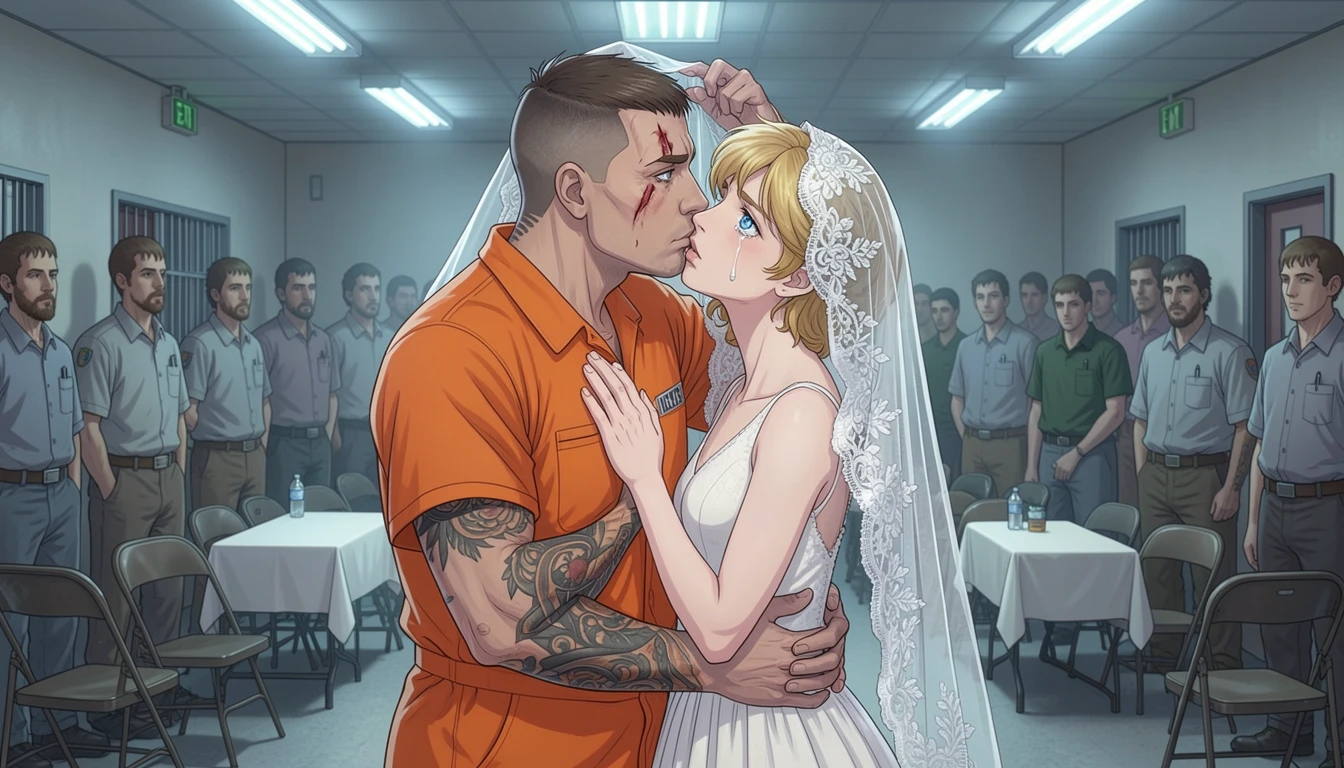
The mess hall had been emptied of its long tables except for the far wall, where they were stacked on their sides like a fence of gray planks. Someone had dragged the benches into rows. Someone else had swept. The floor still smelled of boiled cabbage and disinfectant under the beeswax, and the ceiling lights were all on, every one, so that there was nowhere in the room for a shadow to hide and nowhere for Leah to hide either.
He stood at the end of the center aisle with his hands full of flowers.
June had done them in white and green — roses with their thorns shaved off, ferns, a few sprigs of something that smelled like the inside of a church. The stems were wet and cold against his palms through the ribbon wrapped around them. His bouquet. His.
"Breathe," June said at his left, out of the side of her mouth. She was in green, a dress that made her look like a woman at a garden party and not a woman standing in a prison mess. "You're doing the thing with your shoulders."
He was. He made them drop. They came back up.
The rows were full. He had not let himself count them on the way in, and now he counted anyway, the way his eyes counted everything — men in their jumpsuits on the left side of the aisle, a scatter of faces he knew from the block and faces he didn't, and on the right side, near the front, a small bright island of women. The board's wives. Six of them, in real dresses, with their hair done and their hands folded in their laps like they were at a recital. Behind them, two women he had never seen before sat close together, dark-haired and watchful, and he knew them without being told. Dara. Nika. They had come.
At the far end of the aisle, past the flowers June had tied to the ends of the benches, Dmitri stood waiting.
He had been given a suit. Leah did not know who had arranged it — Cross, probably, the way she arranged everything — but it was a suit, dark and badly fitted across the shoulders, the sleeves a half inch too short so that his wrists came out of them like something the jacket had failed to contain. His buzz cut had been combed. The scar through his eyebrow caught the light and threw it back. He was not smiling. He was watching the far end of the aisle the way a man watched a door he had been waiting a long time to see open, and when his eyes found Leah, something in his face went still and stayed still.
"Ready?" Cross said.
She was on his right. She wore black, and she had not dressed for a wedding so much as arrived at one, and her hand came down on his arm above the elbow — not gently, the way you took the arm of something you were afraid would break, but the way you took the arm of something you intended to deliver.
"I don't know," Leah said.
"Nobody knows," Cross said. "You walk anyway."
The chaplain raised his hand. The room went quiet in a way Leah had not heard a room go quiet before — not the hush of men waiting for something to start, but the hush of men who had been told to be quiet and were afraid of the man who had told them. The folding chairs creaked as the wives leaned forward to see.
The veil came down over his face.
It was June who did it, reaching up to draw the white lace forward, and for a moment the world went soft and white-fringed and far away, and Leah could see only what was directly in front of him and nothing to either side. The veil trembled at the edge of his vision with every step he did not yet take. His own breath came back at him off the fabric, warm, and the roses in his hands smelled like a funeral.
"Left foot first," June whispered. "Like we practiced."
Cross's hand tightened on his arm, and they walked.
The heels were June's — white, with a strap across the instep, and they clicked on the swept concrete with a sound that seemed to be the only sound in the world. Click. Click. The men on the left turned their heads to follow him. He felt their eyes on him through the lace the way you felt a hand on the back of your neck. Somewhere in the front row a man said something low and another man laughed, and the laugh died fast, cut off, and Leah did not look to see who had cut it off.
The gown was heavy. It pulled at his shoulders where it was laced, and it whispered against the floor, and the pink cage was warm between his thighs, and he was aware of it with every step, that small locked weight, that reminder of what he was walking toward. His breasts moved under the white lace bodice, and the navel hoop caught the light through the fabric, and the tattoo on his forearm was hidden under the sleeve of the gown but he could feel it there, the letters of a name that was now also his.
Halfway down the aisle, his hands began to shake.
The bouquet rattled. A few petals let go and fell onto the concrete and lay there white against the gray, and Leah could not stop to pick them up, and the not-stopping was somehow the worst of it — that he was leaving pieces of himself on the floor behind him and could not go back for them. Cross's grip shifted, found the crook of his elbow, and steered him the last steps the way a pilot steered a boat into a dock, firm, unhurried, giving nothing away.
Then the last step was taken, and Cross stopped, and the veil hung between Leah and the whole rest of the world.
"Who gives this woman?" the chaplain said.
"I do," Cross said. Her hand left his arm. The absence of it was a cold spot the size of a palm, and Leah's knees went loose for a second, and then he locked them the way he'd learned to lock them in heels, thigh to thigh, and stayed standing.
Cross stepped back. Her heels went away down the aisle behind him, click, click, click, unhurried, and the room was all breathing and no sound.
"Lift the veil," the chaplain said.
Dmitri's hands came up. They were big hands, scarred across the knuckles, and they found the edge of the white lace so carefully it made Leah's throat ache — the way a man might lift the corner of a sheet off something sleeping. The lace went up and over and back, and the room came at him all at once, bright and hard-edged, the gray concrete, the stacked tables, the rows of men with their jaws set, the wives in their real dresses with their hands pressed to their mouths.
Dmitri looked at him.
He looked a long time. His gray eyes went from the crown of flowers down over the veil where it fell at Leah's shoulders, the white bodice, the bouquet, and came back up, and something happened at the corner of his mouth — a slow break in the set of it, the scar through his eyebrow pulling up with it — and Dmitri Fedorov smiled.
Leah had seen him bare his teeth. He had never seen him smile.
"Look at you," Dmitri said. Low, so only the first rows would catch it. "Look at my wife."
Leah's eyes welled.
It came up from somewhere under his ribs and filled his eyes all at once, hot, and the room blurred at the edges, and he bit down hard on the inside of his cheek to keep it in, and it did not stay in. A tear went down. Then another, faster, cutting a line through the powder June had put on him.
"No," June hissed from his left. "No, no, no — head up, look up at the ceiling, don't you dare—" and her hand came into his line of sight with a folded handkerchief, white, and she pressed it under his eye the way you blotted a spill before it spread. "There. Up. Up, I said. You cry and you'll look like a raccoon in every photograph and I will never forgive you."
Leah looked up. The ceiling lights were very bright and very ugly and they stopped him, the way looking up at a sky stops you.
"Better," June said, and tucked the handkerchief away. "Now give the man your flowers and hold his hands and don't let go."
He gave June the bouquet. His hands were empty and then they were not, because Dmitri's closed around them, both of them, one big hand swallowing each of Leah's, and they were warm and dry and steady and they did not shake at all.
The chaplain opened his book.
The vows were old words. Leah had heard them at other people's weddings, on television, in the back of a church once when he was small and his mother had taken him to a cousin's. They had never meant anything. Now the chaplain said them and they were a set of stairs going down into cold water, and he was standing at the top of them.
"Dmitri Fedorov. Do you take this woman to be your wedded wife, to have and to hold from this day forward, for better, for worse, for richer, for poorer, in sickness and in health, until death parts you?"
"I do," Dmitri said. No hesitation. He said it the way he said everything, flat and final, like a man setting down a weight.
"And do you promise to keep her, protect her, and provide for her, as a man provides for his own house?"
"I do."
"And do you, Leah Fedorov, take this man to be your wedded husband, to obey him and serve him, to keep his house and his body, in plenty and in want, in sickness and in health, until death parts you?"
The word obey sat in the air between them. Leah's mouth had gone dry, and the chaplain's book was still open, and Dmitri's hands were around his and did not squeeze, did not prompt, did not do anything but hold, and the holding was the whole of it — the man would not make him say it. He would wait.
"I do," Leah said. His voice came out smaller than he wanted and steadier than he expected.
"Then by the power vested in me by the state and by this institution, I pronounce you man and wife." The chaplain closed the book with a soft thump. "You may kiss her."
Dmitri let go of one of Leah's hands and put his palm against Leah's jaw, and his thumb came up and brushed the place under Leah's eye where the tear had dried stiff in the powder, and then he bent and kissed him. It was not a long kiss. It was not a hard one. It was the kind of kiss a man gave a thing he had decided to keep, and Leah felt the scratch of his stubble and the warmth of his mouth and the smell of tobacco on him, and his eyes were open the whole time, and when he drew back the corner of his mouth was still up.
"Pretty," Dmitri said. "Prettiest thing in this whole goddamn building."
Behind Leah, June made a small wet sound and turned it into a cough.
"Rings," the chaplain said.
Dmitri let go of him, and Leah stood with his hands at his sides and watched him reach into the breast pocket of his jumpsuit — the jumpsuit, not a suit, because that was what there was — and bring out two rings, one wide and flat and gray as a washer, one thin and bright. He took Leah's left hand and slid the thin one onto the third finger. It was warm from his pocket and it fit exactly, and Leah looked down at it and thought, with a lurch, that someone had measured. Someone had taken the measurement of his finger and no one had told him.
"Your turn," Dmitri said, and put the heavy one in Leah's palm.
His hands had started to shake again. He got the ring to the end of Dmitri's finger and it stuck at the knuckle, and he pushed, and it would not go, and the heat came up into his face and he heard a man in the front row laugh low — and Dmitri turned his hand over, palm up, and curled his fingers into a loose fist, and the ring slid on.
"There," Dmitri said. "Now you're mine on paper and on your hand both."
The hall broke into noise. Not cheering exactly — this was a room full of men who did not cheer — but a stamping, a drumming of palms on the stacked tables, a low rough rumble of it that went up to the ceiling and came back down. Somebody whistled. Somebody else said something Leah could not hear and there was a short scuffle and the scuffle stopped.
Cross came back up the aisle. She had been standing at the back the whole time, Leah realized, watching, and now she walked forward with her hands folded and her face doing nothing at all, and she stopped at Leah's shoulder.
"Mrs Fedorov," Cross said. "You'll come with me now."
"Where—"
"The party." Cross's eyes went past Leah to Dmitri and something passed between them, some short silent settlement. "She'll be along in a quarter hour. She's got to be got out of this dress first."
Dmitri's hand found the back of Leah's neck, under the veil, and his thumb moved once along the bone there. "Go on, then," he said. "I'll be waiting."
June had his elbow. Cross had his other arm. They walked him back down the aisle between the rows of men and the petals he had dropped, and this time he looked at the floor because if he looked at the faces he would cry again, and the clicking of his heels was lost now under the drumming and the talking, and then the mess hall doors swung shut behind him and the noise cut off like a tap.
The corridor was cold and quiet and smelled of bleach.
"Breathe," June said. "You did beautifully. Breathe."
The dressing room was warm and bright and the mirrors had been turned on. Someone had laid out a dress on the long table — silver, covered all over in small flat sequins that threw the light back in every direction, and beside it a pair of silver shoes with a heel higher than the wedding ones and a strap thin as a hair.
"That's not mine," Leah said.
"It is now," June said. "It's the party dress. The board and their wives are waiting in the upper room and you are not going up there in white." She was already at the laces at his back, working them loose with quick fingers. "White is for the ceremony. Silver is for after."
Cross sat down on the stool by the mirror and crossed her legs and watched. She did not help. That was the thing about Cross — she had given him away and now she sat and watched him be unwrapped, and her face was the face she wore in the office when she was deciding something.
The gown came off his shoulders and pooled at his feet and June scooped it up and shook it out and laid it flat. The veil went next, and the crown of flowers, and then he was standing in his white lace and his stockings and the pink cage, and the dressing room was very bright.
"Arms up," June said. The silver dress came down over his head and settled, and it was heavier than it looked, all those sequins, and it clung where the white had hung. It was cut low in the back. It was cut low in the front. The skirt came to mid-thigh and no further.
June knelt and put the silver shoes on him one at a time, and buckled the thin straps, and stood back and looked at him up and down and then reached without a word and took his chin and turned his face to the light.
"Lipstick's gone," she said. "Sit. I'll do it again."
He sat. She worked. The brush was cold and her hand was sure and she talked while she did it, low, only for him. "Now listen. Upstairs there's the board and there's their wives and there's one long table and you will be seated at it and you will not eat until your husband does, and you will not drink until he does, and if a wife speaks to you, you answer her and you look at her and you do not look at her husband. Not once. Do you understand me?"
"Yes."
"And when the wives take you aside — and they will take you aside — you listen to them. They've been where you're standing longer than you have. Some of them thirty years." She put the brush down. "There. Look."
Leah looked at himself in the mirror. Silver from throat to hem, silver on his feet, his hair pinned up, his mouth red again, his eyes still a little pink at the corners and no help for it. The ring on his hand caught the light. The tattoo on his forearm showed above the little silver sleeve — FEDOROV, with the heart under it.
"You look like a kept woman," June said, and it was not an insult the way she said it. "Now come on. They're waiting."
The upper room was not a room Leah had ever been in. It had a carpet, a real one, worn thin in the traffic lanes but a carpet, and a long table with a cloth on it, and windows with actual glass, and the light came in gray and level off the yard. The board sat down one side — five men in shirtsleeves, no jumpsuits, and one of them had a watch — and their wives sat down the other, and the wives had done themselves up. Real dresses. Real hair. One of them wore pearls.
Dmitri was at the head of the table. He had changed too, into a shirt that was not a jumpsuit, and his hair was still wet from the sink, and when Leah came in on June's arm he put down his glass and stood, and every man at that table stood with him.
Leah's face went hot. He did not know where to look. He looked at the carpet.
"Mrs Fedorov," one of the wives said, and stood, and came around the table with her hand out. She was older, gray at the temples, and she smiled with her whole face. "I'm Ruth. Sit by me. The men will talk about nothing for an hour and we'll have our own conversation."
He sat. The chair was pulled out for him and pushed in under him and a napkin was put across his lap. Dmitri sat back down at the head of the table and picked up his glass and the men picked up theirs and the talking started up again, low and easy, about a man named Halloran and a shipment and something that had gone wrong with the laundry.
Ruth leaned in close. "First thing," she said, quietly, under the men's talk. "You keep your own money. Whatever he gives you, you put a little by, and you don't tell him, and you don't spend it. That's not disloyal. That's a wife's business."
The wife on Leah's other side — younger, sharp-faced, a burn scar on her wrist — leaned in too. "Second thing. When he's in a mood, you don't argue and you don't cry. You get him fed and you get him quiet and then you talk. Crying makes them worse. It makes them feel like they've done something and they haven't and then they get angry about it."
"Third," Ruth said, "and this is the one nobody tells you. You find one thing in that cell that's yours. One. A book. A cup. A place on the shelf. And you keep it yours, and you don't let him move it, and when he does move it you move it back. That's how you stay a person in there."
Leah thought of the chaplain's office, and the room a wife kept in herself, and his throat closed up a little.
"Does it get easier?" he said.
The sharp-faced wife looked at Ruth. Ruth looked at her glass.
"No," Ruth said. "But you get better at it."
At the head of the table Dmitri laughed at something, a short rough bark of it, and Leah looked up before he could stop himself, and Dmitri was looking back down the length of the table at him over the rim of his glass, and his eyes were on the silver dress, and he did not look away.
The tables were pushed back from the far wall and the carpet cleared, and someone had set up a speaker on a chair with a cord running to the wall socket, and the speaker was playing something old and slow that Leah did not recognize.
"There's the floor," Ruth said, and patted his arm. "Go on. He's been waiting since you walked in."
Dmitri was already standing. He set his glass down and came around the head of the table and did not hurry, and the men at the table turned their chairs to watch, and one of them said something to his neighbor behind his hand and both of them laughed low.
Dmitri stopped in front of Leah and put out his hand.
Leah looked at it. The wide gray ring was on it now, sitting where it had stuck at the knuckle, and the scarred knuckles, and the palm open and waiting.
"I don't know how," Leah said.
"You know how to walk in heels. You can sway." Dmitri took his hand, since he had not taken it himself. "Come here."
His hand went to the small of Leah's back. It was a big hand, and it covered the whole low cut of the silver dress, and the heat of it came through the sequins, and Leah's feet moved before his head had agreed to it, and then they were on the carpet and the men were watching and the wives were watching and the speaker was playing.
"Left," Dmitri said against his ear. "No — my left. That's it. Again."
Leah counted in his head. One, two, three, and the turn, and the heel catching in the carpet pile, and Dmitri's arm steadying him before anyone could see the stumble. The sequins on the dress shushed against Dmitri's shirt every time they came together and parted. His breath smelled of the whiskey he had been drinking. His hand did not move from the small of Leah's back, not once, and it did not slide down, and it did not creep up.
"You're counting," Dmitri said.
"Yes."
"Stop counting. Look at me."
Leah looked up. Dmitri's face was close and the scar through his eyebrow was close and his gray eyes were not on the dress anymore, they were on Leah's face, and there was something in them that Leah had seen before but never this quiet — the way a man looked at a fire in a hearth he had built himself and would not let go out.
"There," Dmitri said. "Now you're dancing."
They went around the small square of carpet twice more. The song ended and another began and Dmitri did not let go, and the men had stopped watching and gone back to their talk, and the wives were watching, and Leah stopped counting and the counting stopped mattering, and his body found the sway of it on its own, hip and heel and the turn, and Dmitri's thumb moved once along his spine at the top of the dress and stopped.
"That's my wife," Dmitri said, low, and the word went through Leah's chest like a swallow of something hot.
Then the song was over, and the men at the table were knocking their knuckles on the cloth and one of them called out for the cake, and Dmitri stepped back and let him go, and Leah stood on the carpet with his heart going and his mouth dry and the sequins still warm where the hand had been.
The cake was set on the end of the long table. June had brought it up from the kitchen herself, a white cake on a silver board, and it was a good cake, a real one, with white frosting piped in a ring of small hard peaks and a spray of green leaves at the base and two figures on top that Leah could not look at directly.
"Knife," one of the wives said, and it was put into Leah's hand, and Dmitri's hand closed over Leah's on the handle, and his chest came against Leah's back and his chin came down over Leah's shoulder.
"Cut," Dmitri said.
They cut. The knife went through the frosting and into the crumb and the cake gave, and Dmitri's hand did the work under Leah's and steered it, and the first slice came out on the blade and was set on a plate, and the men made the low rough noise again.
"Feeding her now," somebody said. "Go on, Bear. Do it proper."
Dmitri took the slice off the plate with two fingers. The frosting smeared on them. He held it up in front of Leah's mouth and did not say anything, and Leah understood that this was the part where the wives would be watching and the men would be watching and he was to open his mouth, and he opened his mouth, and Dmitri put the cake in.
It was too big a bite. The frosting was sweet and the crumb was dry and it filled his mouth and he had to work at it, and a crumb went down the wrong way and he coughed into his hand and his eyes watered and Dmitri's thumb came up and wiped the frosting off his lower lip, slow, the whole length of it, and put it into his own mouth.
"Good cake," Dmitri said.
Somebody laughed. Leah's face was hot to the ears and the cake was still in his mouth and he could not decide whether to be ashamed or whether the hot feeling was something else, and he swallowed.
Then Cross's glass rang against the table.
She stood at the end of the table with her glass raised and her face doing what it did, which was nothing, and the room went quiet for her the way it had gone quiet in the mess hall — not the quiet of men told to be quiet, but the quiet of men who knew who signed their paperwork.
"I've been warden of this block eleven years," Cross said. "In that time I have married off more men than I care to count, and I have watched most of those marriages end in the hole or the infirmary or both, and I have learned to keep my expectations low." She turned her glass a quarter turn. "These two are going to make a wonderful couple."
A ripple went down the table. One of the board men snorted and covered it with a cough.
"I mean it," Cross said, and her eyes came down the table and found Leah and stayed. "I have watched this one come into my block with his hands shaking and his lip split and no idea what he was going to be, and I have watched him be made into a wife in front of me, and I will tell you what I told him in my office the first week. Most men in this building are not men. They are appetites with a number. Fedorov is a man. He knows what he has and he knows what it costs to keep it, and he has never once, in eleven years, made me regret a decision I made about him." She lifted her glass a half inch. "To the Fedorovs. May the block leave them alone."
"The Fedorovs," the table said, and drank.
Leah drank. The wine was sour and cold and it went down over the sweetness of the cake, and when he set the glass down Ruth was smiling at him and the sharp-faced wife was smiling at him and even the board men were looking at him differently, and he did not know what to do with any of it, so he looked at his plate.
Cross set her glass down and came around the table. She did not sit. She stopped at the back of Leah's chair and put her hand on the back of it.
"Mrs Fedorov," she said. "Walk with me."
He got up. His heels sank into the carpet and he pulled them free and followed her, and she went to the window end of the room where the light came in gray and level off the yard, and she stood with her back to the glass and her hands folded and looked at him.
"You did well," she said. "The vows. The ring. The crying — that was good, men like to see it. Don't do it again in front of the board, but today it was good."
"Thank you," Leah said, and it came out flat, because he did not know what else to say to her.
Cross looked at him a moment longer. Then she said, "You're allowed five days."
"Five days."
"Of honeymoon. Off the block, off the paperwork. I've had it cleared. It's not usual and I don't want it mentioned at the table, but it's cleared." She turned her hand over. "Fedorov has a place. Not here. You'll be taken off the grounds Friday morning and brought back the following Wednesday, and the block will run without you and the warden's office will run without you and nobody will come looking for you in the meantime."
Leah's mouth had gone dry again. "Where?"
"The south of France," Cross said, the way she might have said the laundry. "A yacht. His. He keeps it at a marina down there and he has kept it for years and I have signed the papers for it more than once, which tells you what kind of man you have married and what kind of man I have been keeping." She let that sit. "He's not a yard boss, Mrs Fedorov. You understand that now or you don't. The men in this block are his, and the men in six other blocks are his, and the men on the boats that come into that marina are his, and the warden of this institution signs what he is told to sign. He is a very large man in a very small room. The yacht is what he is when the room comes off."
Leah looked out the window. The yard was empty and gray and the fence was gray against the sky and it went on and on and he had not been outside it in a very long time.
"I've never been on a boat," he said.
"Then you'll learn." Cross's voice did not soften. "You'll be sick for a day and then you won't. Take the tablets. June will put them in your case."
"My case."
"Your case." Cross uncrossed her arms and folded her hands in front of her, and her eyes came up and rested on him, and there was something in her face now that Leah had not seen there before — not warmth, Cross did not do warmth, but the particular attention of a woman who was about to do a piece of work and wanted it done right. "I'm arranging it. It goes down to the marina ahead of you and it's on the boat when you get there. So you tell me now, and you tell me plain, what you want packed."
Leah opened his mouth. Nothing came.
"You're not a bride with a trousseau and a mother and six months to plan," Cross said. "You're a wife with five days and a warden with a telephone. So. What do you want in the case?"
He thought of the cell. The three dresses on the hook — the white lace, the black lace, the silver he was wearing. The pink cushion in the corner. The little pink cage, which was on him now and would be on him on the boat. The brass key on the shelf, which was not his to pack and not his to leave. The chaplain's office and the room a wife kept in herself.
"My books," he said. "The ones from the library cart. The one about the—" He stopped. It sounded foolish. "The one with the green cover."
"It goes in," Cross said. "What else."
"The white lace." His face was hot. "The— the underthings. All of them. The stockings. The garter belt." He heard himself and could not stop. "The black ones too. And the shoes. Not these—" he looked down at the silver heels— "the others. The ones June brought. The white ones with the strap. And the—" he swallowed— "the things from the fitting. The things the women brought."
"The kit," Cross said. "It goes in."
"And my—" He stopped again. This was the one. He could feel it sitting in his chest, the one thing, the one thing in the cell that was his, and Ruth's voice in his ear, you find one thing and you keep it yours and you don't let him move it. "The cup," he said. "The chipped one. The one I drink out of. It's on the shelf by the—" He could not remember where it was. He could see it, white with a chip out of the rim the size of a thumbnail, and he could not remember which shelf. "It's mine. I want it in the case."
Cross looked at him for a long moment. Her face did not change. Then she nodded, once, and took a small black notebook out of her pocket and a pen and wrote something in it, and the pen made a small dry sound in the quiet.
"The cup," she said, and closed the notebook. "It goes in."
"Thank you," Leah said, and his voice came out wrong, thick, and he turned his face to the window so she would not see it.
"Don't thank me," Cross said. "It's a cup. Thank me when you come back and it's still on the boat where you left it." She put the notebook away. "One more thing. The safe word."
Leah's head came around.
"You have one," Cross said. It was not a question. "You chose it in the dressing room and June told me you'd chosen it and I have not asked you what it is and I am not going to ask you what it is. But before you get on that boat you will tell your husband, and you will tell him plain, and you will not make it a joke and you will not make it a game and you will not wait until you need it. A safe word a man doesn't know is a word in a locked room. Do you understand me?"
"Yes."
"Say it back."
"I tell him before we get on the boat. Plain. Not a game."
"Good." Cross turned and looked down the room at the long table, at the men and the wives and the cake, and at Dmitri at the head of it with his glass and his wet hair and the wide gray ring on his hand, and something crossed her face and was gone. "Now go back to your husband, Mrs Fedorov. He's been watching you the whole time we've been standing here and he's going to want to know what I said."
"What do I tell him?"
"Tell him the truth," Cross said. "You're good at that. He told me so himself."
She walked away down the room without waiting to be followed, and her heels were quiet on the carpet, and Leah stood at the window with the gray yard behind him and the ring on his hand and the taste of cake still in his mouth, and the case already being packed somewhere he could not see, and the boat already waiting in a place he had never been.
He went back to the table. Dmitri's eyes came up and found him the whole way across the carpet, and when Leah reached his chair Dmitri's hand came out and caught his wrist and drew him down into the chair beside him, close, and did not let go.
"What did she want?" Dmitri said.
Leah looked at him. The scar, the gray eyes, the ring, the man who was a very large man in a very small room.
"She asked me what I wanted in my case," Leah said.
Dmitri's thumb moved once across the inside of his wrist. "And what did you tell her?"
"A cup," Leah said. "The chipped one. From the shelf."
Dmitri looked at him for a long moment. Then the corner of his mouth broke, slow, the way it had at the altar, and he picked up his glass and put it into Leah's hand and closed Leah's fingers around it.
"Drink," he said. "You're on a boat Friday."