
The dinner plates were still in the rack by the sink. Bryce's kitchen smelled of nothing—no oil, no onion, no promise of a meal. He stood at the bench with his back to the door, a mug of tea going cold in his hand, and Saige watched the line of his shoulders before he turned.
"You're late," he said.
She kicked her boots off by the door. "Mum had me working late. That colt's still fighting the farrier."
"I was out looking." He didn't say looking for what. He didn't have to. The whole property had been wound tight since her mother started hearing things in the barn. "I didn't make dinner."
Saige crossed the kitchen. The floorboards were cold under her socks. She stopped close enough to smell him—timber, dust, the sharp trace of sweat from a day spent watching the boundary line. "Then don't."
Bryce set the mug down. It clinked against the bench. "You hungry?"
"Not for food."
His eyes traced her face. The kitchen light caught the grey in his irises, and she watched something shift in them—the tiredness of a long day burning off, replaced by something hotter. "Saige."
"Don't 'Saige' me like you're about to say we should wait." She stepped closer, her thighs brushing the table edge. "I've been thinking about this all day. While I was working that colt. While I was driving here. While you were standing there pretending you didn't hear me come in."
His jaw tightened. "Your mother's—"
"Is at the house. Not here." She reached for his belt. "And I don't care what she's doing in her barn. I care what you're doing in this kitchen."
He caught her wrist before her fingers found the buckle. Not hard. Just stopped. "You sure?"
She pulled her hand free and reached behind her head, untying the knot in her shirt. The fabric fell open, revealing the hollow of her throat, the top of her breasts, the pale skin above her bra. "Does it look like I'm not sure?"
Something broke in him. Not his control—the patience he'd been holding all day. He stepped into her space, one hand finding the back of her neck, the other sweeping the table clear. A salt shaker hit the floor. A stack of mail scattered. Saige laughed against his mouth as he lifted her onto the wood, the edge biting into her thighs.
"You're wearing too much," she said.
He pulled her shirt off. The bra followed. Then his hands were on her ribs, her waist, her hips, and she arched into him, her fingers working his belt buckle open, the rasp of denim loud in the quiet kitchen.
She was wet before his cock cleared his jeans. She'd known she would be—had been since she parked the ute and saw his silhouette through the window. The need was sharp and stupid and she didn't care.
"Come here," she said, pulling him forward. "Come inside me."
He pushed her back onto the table. The wood was cool against her spine, the edge of a placemat digging into her shoulder blade. He didn't bother with her jeans past her knees—just yanked them down far enough, hooked her leg over his arm, and pushed into her in one slow, brutal slide.
She bit down on a moan. Her nails dug into his shoulders.
"That what you wanted?" His voice was rough, scraped low.
"Faster."
He gave it to her. The table groaned beneath them, a salt shaker rolling off the edge and cracking on the floor. Saige didn't hear it. She heard only the slap of skin, his breathing, the sound of her own voice falling apart as he drove into her again and again, the rhythm breaking, his thumb finding her clit, her hips bucking against him.
She came with his name caught in her throat, her back arching off the wood, her cunt clenching around him.
Bryce followed a heartbeat later, his forehead pressed to hers, his breath hot and ragged, the weight of him pinning her to the table.
For a long moment, neither of them moved. The kitchen fan hummed. A fly buzzed against the window. The plates in the rack were still dry.
"We should do that more often," Saige said, her voice hoarse.
Bryce laughed—a low, breathless sound. "We should eat first. Sometimes."
She kissed his jaw. "Tomorrow."
---
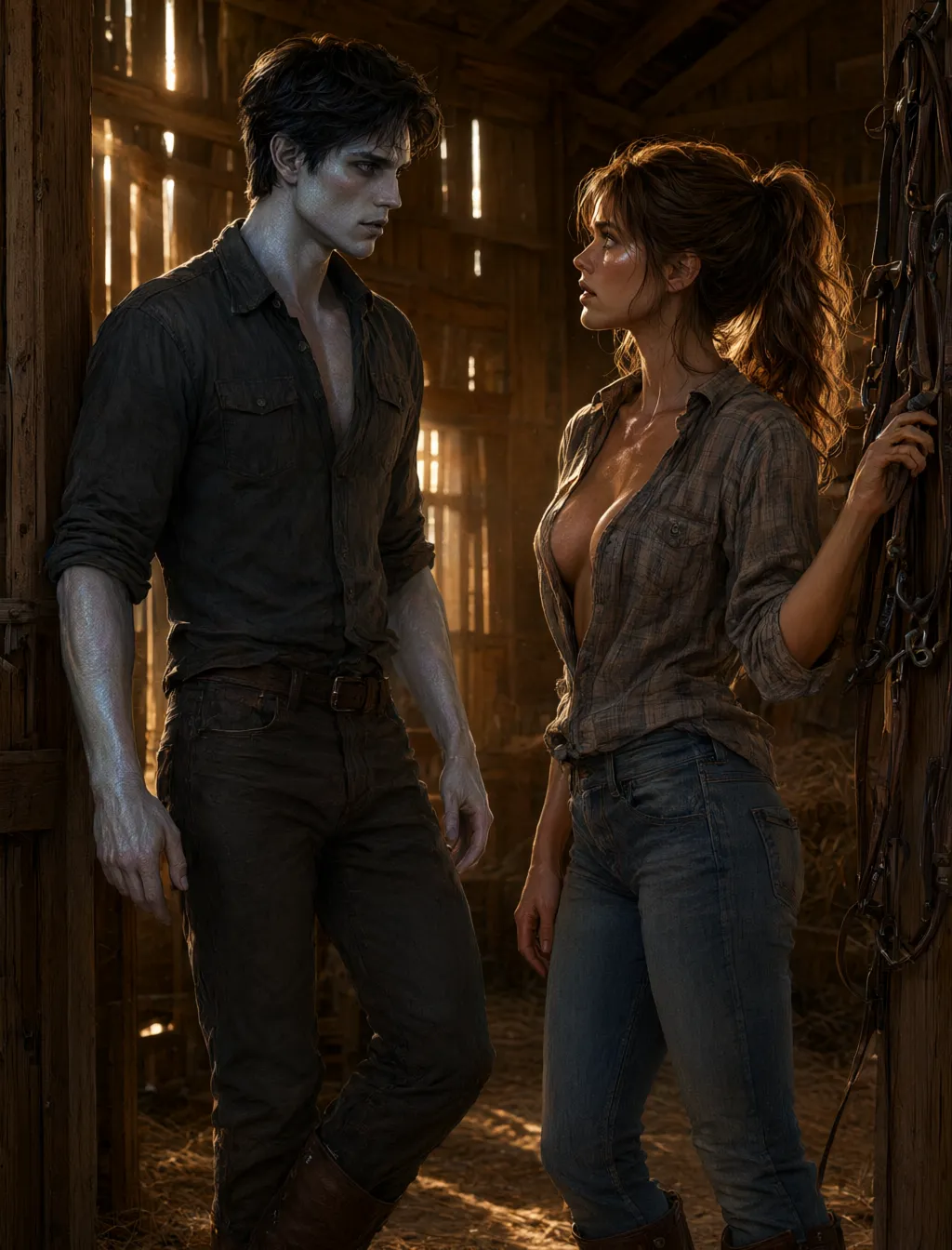
The barn was dark when Elara crossed the yard. The house lights were a pale square behind her, the last of the evening bleeding out of the sky. She'd waited until Saige's ute disappeared down the track, until the property settled into its familiar stillness, until her own pulse stopped arguing with what she was about to do.
She carried a torch but didn't switch it on. The moonlight was enough to see the path, enough to make the barn's silhouette rise against the stars like a ribcage. The horses in the stables shifted as she passed, their hooves stamping, one of them blowing a low, anxious breath through its nostrils.
She stopped.
They weren't watching her. They were watching the old barn.
The same way they'd watched it before. Heads up. Ears forward. That strange stillness that wasn't fear—it was recognition. Like they knew something she didn't.
Elara turned toward the stables. "What is it, girl?"
The mare—a chestnut named Hazel—tossed her head and stepped back in her stall, her eyes rolling white in the dim light. The other horses shifted, a ripple of unease moving through the row. They weren't scared of a predator. They were scared of something wrong.
Elara left them. Crossed the last stretch of yard to the old barn. The door was exactly where she'd left it—closed but not latched, the gap wide enough to slip a hand through.
She pushed it open.
The smell hit her first: hay dust, old timber, and that electric tang she remembered from before, like the air after a storm. Ozone. Copper. Something chemical and alive.
She stepped inside. The torch was cold in her hand, still off. Her eyes adjusted slowly, the darkness resolving into shapes—stalls, rafters, a rusted hook hanging from a beam. Nothing moved.
Then she heard it. A sound that wasn't breathing, wasn't footsteps, wasn't anything she could name. A wet, shifting sound. Like something rearranging itself.
She followed it.
The last stall on the left. The door was ajar. She pushed it open with two fingers, the hinges groaning, and the smell intensified—ozone so thick it stung her nostrils, undercut by something organic. Sweat. Fluid. The raw smell of a body that didn't belong here.
He was on the floor.
That was her first thought—a man on the floor, hurt, maybe dying. But the shape was wrong. The legs were too long, bent at angles a human knee couldn't manage, and the torso was rising and falling in a rhythm that didn't match human breathing. His skin caught the faint light from the gap in the roof, and it wasn't skin. It was too smooth, too pale, catching the light like wet stone.
He was trying to stand. His arms trembled beneath him, the muscles sliding wrong under the surface, and then she saw it—his legs were changing. The bones lengthening, the joints reshaping, the skin rippling as something underneath it pushed outward. A hoof. Dark and hard and wrong—pushing through where a foot should be.
Elara's breath stopped.
He looked up.
His eyes found hers. They were not human. Grey and depthless, catching no light, holding something ancient and terrified and desperate. His mouth opened, and the sound that came out was not quite speech—a vowel stretched too wide, shaped by a tongue that didn't know the word yet.
"You," he said. "You came back."
She should have run. Every instinct she had was screaming at her to run—to the house, to the phone, to Bryce, to the ute, to anywhere that wasn't this barn with this thing that wore a man's face and a horse's body and something else beneath both.
She didn't run.
"You're the one," she said. Her voice was steady. She didn't know how. "You're what I saw. What I left food for."
He nodded. His body shivered, the half-formed hoof retracting, the leg snapping back into a human shape with a wet crack that made her stomach turn. He collapsed onto his side, breathing hard, his hands pressed flat against the straw.
"I'm sorry," he said. "I didn't mean to—I was trying to—" He stopped. His throat worked. "The horse. I was trying to become the horse. To watch you without you seeing me."
"Watch me."
"I needed to understand you." He pushed himself up onto his elbows. His face was human now—pale, broad-shouldered, dark hair cropped short. But the eyes were still wrong. Still something that had been watching her from the dark. "I've been here for weeks. Learning. Your language. Your routines. The way you move through this place."
Elara's hand tightened on the torch. "You've been watching me?"
"I was stranded." The words came faster now, like he was afraid she'd leave before he finished. "My craft failed. I landed in the creek bed three kilometres north. I had nothing. No form. No knowledge. I built this body from the first creature I touched—" He looked down at his hands. "A kangaroo. It was the wrong shape. I had to learn. I had to find better DNA, more complete samples. Your horses. Your cattle. The man who came to fix the fence—"
"Bryce."
He nodded. "I took a strand of his hair from the gate. I used it to refine this form. To make myself more human. To be able to approach you without frightening you."
Elara's pulse was a drum in her throat. "Approach me. Why?"
He looked up at her, and for the first time, she saw something human in his eyes. Not recognition. Hunger. Not for her body—for something else. For contact. For connection. For a hand that didn't flinch from his.
"Because I'm alone," he said. "And I don't want to be."
The words hung between them. The barn creaked. A horse stamped somewhere in the dark.
Elara thought about the footprint that led in but not out. The flattened grass too long for a man. The way the horses watched the barn like they knew something she didn't. She thought about the food she'd left that disappeared, the container placed neatly on the step. The figure that moved too fast, too fluid, and vanished into a stall with no exit.
She thought about what it meant to be alone. How many nights she'd stood in her kitchen with a cold cup of tea and no one to talk to.
"What do you need?" she asked.
He blinked. The gesture was so human it almost broke something in her chest. "I don't understand."
"To stay. Here. On my property. What do you need?"
He pushed himself upright. His body moved wrong, like he was still learning how the joints worked, still calibrating the weight of his bones. He sat cross-legged in the straw, his hands resting on his knees, and looked up at her with those depthless grey eyes.
"Touch," he said. "Physical contact. It stabilizes my form. The more complete the DNA sample, the longer I can hold the shape without degradation. But I need—" He stopped. His throat moved. "I need someone to touch me. Regularly. Or I lose the form. I revert. I become something that cannot pass among you."
Elara stared at him. "You're asking me to touch you."
"I'm asking you to let me stay. To not tell the others what I am. To give me a chance to earn my place here." He looked down at his hands. "I can work. I learned your body. I can learn your labour. I can help you with the horses, with the fences, with whatever this place needs to survive." His voice dropped. "I know it's struggling. I've seen the bank notices. I've seen you counting the grain."
Her chest tightened. "You've been watching that closely."
"I told you. I needed to understand you."
There was no shame in his voice. No apology. Just fact. He had observed her the way a scientist observed a specimen—except the specimen had become something more. Something he didn't have a word for.
"Here are the rules," Elara said. Her voice came out harder than she meant it to. "You stay in this barn unless I tell you otherwise. You don't go near the house. You don't talk to my daughter. You don't touch anyone on this property except me, and only when I say you can. You work when I tell you to work, and you hide when I tell you to hide. And if you do anything—anything—that makes me regret this, I will burn this barn to the ground with you inside it."
He held her gaze. "I understand."
"Good." She exhaled. The tension in her shoulders eased by a fraction. "You're a farm hand now. Someone I hired from the town. If anyone asks, your name is—" She paused. "What's your name?"
His mouth opened, then closed. "I don't have one."
"You need one." She thought for a moment. "Vael."
He repeated it. The syllables shaped themselves wrong in his mouth, then right. "Vael."
"You're from out west. You needed work. I gave you a chance." She looked around the stall, at the straw, the shadows, the body that had been half-horse minutes ago. "Is there anything else you need?"
He stood. The movement was smoother now, more human, but she saw the effort in it—the concentration required to hold the shape. He stepped toward her. Close enough that she could smell him—ozone and something warm, something that reminded her of sunbaked stone.
"Touch," he said. "I need you to touch me. Just once. To anchor the form."
Her heart hammered. "Where?"
He held out his hand.
She looked at it. Pale skin, long fingers, the nails clean and even. A human hand. A convincing one. But she knew what was beneath it—the grey skin, the wrong bones, something that had been watching her from the dark.
She reached out and placed her palm against his.
The contact was immediate. A warmth that wasn't heat spread up her arm, through her chest, settling somewhere deep in her ribs. It wasn't painful. It wasn't electric. It was like standing in the sun after a long winter—something inside her that had been cold suddenly wasn't.
His fingers closed around hers. His eyes widened.
"You feel that?" she asked.
"Yes." His voice was rough. "I don't know what it is. But I feel it."
She pulled her hand back. The warmth lingered. "That's enough."
He nodded, his hand still extended, his fingers curling slowly into his palm like he was holding onto the sensation. "Thank you."
Elara turned toward the door. The barn creaked around her. The horses in the stables had gone quiet—watching, listening, waiting.
She paused at the threshold. "I'll bring you food in the morning. Stay inside until I come for you."
"I will."
She stepped out into the yard. The stars were sharp overhead. The cold air hit her face, and she realized her skin was warm, buzzing, alive in a way it hadn't been in years. She looked down at her palm. It looked the same. But it didn't feel the same.
Something had passed between them. Something she couldn't explain.
She walked back to the house. The kitchen light was on. The kettle was still warm. She poured herself a cup of tea she didn't drink, standing at the window, looking out at the barn where a creature from another world was learning how to be human.
Somewhere in the dark, the horses were quiet.
And Elara felt, for the first time in a long time, like she might not be alone.