
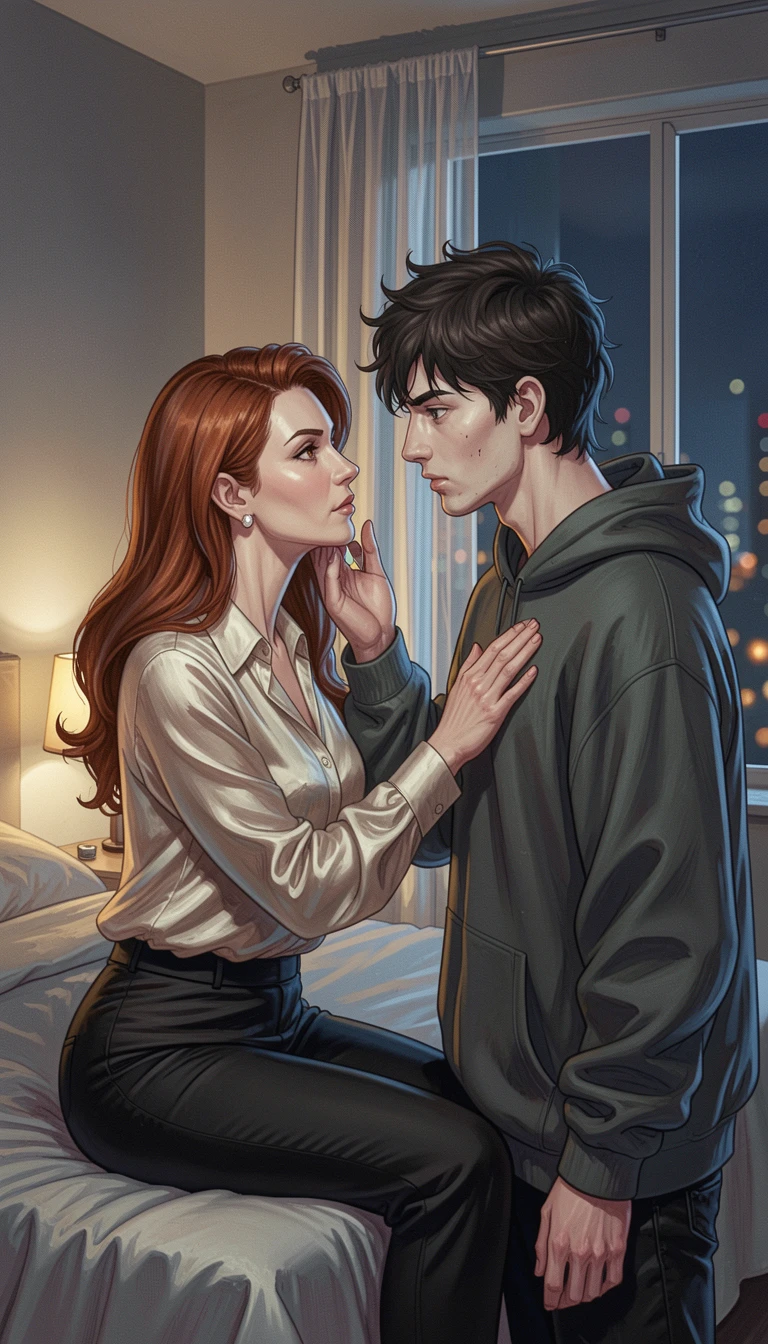
The alarm went off at six-forty, and Vivienne's eyes opened on a dark room she hadn't set it in. The sound was wrong — a soft digital chime, rising and falling, nothing like the clipped buzz she'd used for fifteen years. She lay still and let it ring twice before her hand found the phone on the nightstand, and the screen glowed up at her with a time she hadn't chosen and a label that read Morning, sweetheart.
She sat up too fast. The welts on her ass dragged against the sheet, and she hissed through her teeth and held the edge of the mattress until the burn settled into a low, steady throb she could carry. The phone was his now, or it might as well have been — she'd stopped pretending otherwise somewhere between the hardware store and the shoulder of that road. He'd set an alarm in her phone. He'd typed sweetheart into it. She turned the screen face-down on the nightstand and swung her legs off the bed.
The hallway was dim, the runner soft under her bare feet, and the house had that early-morning stillness where every sound traveled. From downstairs came a rhythmic thud — slow, heavy, patient — and under it the low hum of the refrigerator and, further off, the sound of someone laughing at something on a phone. She stood at the top of the stairs a moment, one hand on the banister, and listened to her own house the way she'd listen to a stranger's.
Then she went down, one step at a time, her weight kept off the worst of it, her palm flat on the rail. The silk of her nightgown whispered against the wood. Halfway down she caught her reflection in the tall hall mirror — auburn hair loose and flattened on one side, the bruise on her cheekbone faded to a yellow-green smear under the powder she'd slept in, no lipstick, no pearls, nothing of the woman who arranged coasters and hired staff. She looked away before she could finish the thought.
The kitchen was bright with the gray light off the pool, steel counters throwing it back cold. Nate stood at the butcher's block with his back to her, a knife in his hand and a pile of strawberries bleeding onto the board. He brought the blade down — thud — and swept the halves aside with the flat of it, unhurried, like a man who'd been standing there for an hour and intended to stand there for another.
Sera sat at the table in her college sweatshirt, ponytail high, phone propped against the fruit bowl, laughing at something with her whole face. She didn't look up. "Oh my God, no, she did not —" she said into the phone, and laughed again, and the sound filled the room in a way that made it feel almost normal, almost like any morning, almost like the house hadn't changed shape around all of them.
Nate turned his head and looked at Vivienne in the doorway. He didn't smile. He just watched her the way he watched everything — gray eyes flat and patient, taking in the nightgown and the limp and the hand still braced on the doorframe, filing all of it away. Then he went back to the strawberries.
"Morning," he said.
"Morning," Sera echoed, without looking up.
Vivienne crossed to the counter because standing in the doorway was a kind of waiting, and she would not wait in her own kitchen. The steel was cold under her palms — she laid both hands flat on it, felt the chill climb her wrists, and stood there looking out at the pool, at the cover still on it, at the cedar hedge dark green against the fence. Behind her the knife came down again. Thud.
"You're up early," she said. Her voice came out level. She was proud of it for about a second.
"Couldn't sleep," Nate said. "Thought I'd make breakfast." He slid a mug across the counter toward her — ceramic, white, steam curling off the top in a thin rope — and it stopped an inch from her hand. "Coffee."
She looked at it. Steam. The smell of it, dark and roasted, the same smell that had been in the mug yesterday in the kitchen, the cup she'd drunk from because she was thirsty and because he'd handed it to her and because it had never once occurred to her that a cup of coffee could be a hand closing around her throat. Her stomach turned over, slow and cold.
"No," she said. "Thank you."
Too quick. She heard it as it left her — the speed of it, the way the two words clipped off the end like she'd bitten them. Her hands stayed flat on the counter, fingers spread, and she made herself not move them, not pull them back, not do anything at all with them that he could read.
Sera's thumb kept scrolling. She hadn't heard, or hadn't cared enough to hear.
Nate's eyes narrowed. He looked at her a moment — at the mug, at her hands, at her face — and then he reached across, took the mug back, and drank from it himself. He didn't say anything. He just held her gaze over the rim while he swallowed, and set it down, and went back to the strawberries, and let the silence stretch out between them like something he was laying on the counter to see how long it would be.
Vivienne stood there with her hands on the steel and her heart going and nothing to do with either of them. He knows why I said no. Of course he knew. He'd put the roofie in the cup himself. He knew exactly what she was refusing and exactly what it cost her to refuse it in front of Sera, where she couldn't say the real reason, where she had to stand there like a woman who simply didn't want coffee and let him drink it in front of her like a man who'd never done anything to her at all.
"Mom, did you see the group chat?" Sera said, finally looking up. "Kayla's posting about the gallery thing again. She's so jealous, it's actually funny."
"I haven't looked at my phone," Vivienne said. Which was true, and also a lie, and she hated that both of those things could be true at once.
"The internship's confirmed, by the way. I start Monday." Sera stood and stretched, and her chair scraped back. "So I'll need the car. Like, all week. Is that okay?"
"Of course," Vivienne said. "Take it."
"You're the best." Sera came around the table and kissed her on the cheek — a quick, warm press of lips, the way she'd done since she was a girl — and Vivienne caught the smell of her shampoo and felt something in her chest go tight and small. She didn't look at Nate while her stepdaughter kissed her. She looked at the pool.
"Bye, Nate," Sera said, already halfway to the hall, keys jingling in her hand.
"Bye," he said.
The front door opened and closed. The car started in the drive, backed out, and the sound of it faded down the street and was gone, and the house settled back into its hum — the refrigerator, the pool pump, the small ticking of the oven clock — and Vivienne was alone in the kitchen with him.
She stayed where she was. Both hands on the counter, eyes on the pool. If she turned around she'd have to look at him, and if she looked at him she'd have to decide what her face was doing, and she was suddenly very tired of deciding what her face was doing.
Behind her, the chair scraped the tile.
She heard him stand. She heard him cross the kitchen — three steps, four — and then his hand came down on the back of her chair, the one she wasn't sitting in, the one at the head of the counter where she'd stood a hundred mornings with her coffee and her lists and her clipped little orders, and his fingers curled around the wood and stayed there.
He was close. Close enough that she could smell him — soap and the cold iron smell of the knife and something underneath it, warm and male and entirely too near. He didn't touch her. He didn't have to. He stood at her shoulder with his hand on the chair and let her feel the whole length of him standing there.
"You think I need the coffee to make you behave?" he said.
Low. Quiet. Not angry — that was the worst of it, there was no anger in it at all, just the flat patience of a man stating a fact he'd already checked. The words landed in the kitchen and sat there in the silence, and Vivienne stared out at the covered pool and the dark hedge and did not answer.
She could feel him waiting. Not impatient — he never was — just standing there with his hand on her chair, giving her the silence to fill, the way he'd given her the silence in the car and the silence on the couch and the silence at her bedroom door last night, when the knob had turned against the deadbolt and he'd moved on down the hall like a man checking the weather. She knew, standing there, that he wasn't going to fill it. That whatever happened next in this kitchen was going to happen because she said something, or didn't, and that both of those were answers.
Her hands stayed flat on the cold steel. Her rings were on the nightstand upstairs — she'd taken them off to sleep and hadn't put them back on, and her left hand looked strange and bare against the counter, the tan line pale around her finger. She looked at it and thought, absurdly, that she should have put them on. That a woman with her rings on would have something to say here.
"Sera's gone," Nate said, when the silence had stretched as far as it would go. "Harry's in Frankfurt till Thursday." He said it the way a man reads off a schedule. "It's just us."
Vivienne closed her eyes. Behind her lids the pool was still there, gray and flat, and the hedge, and the little shed at the back of the yard where the mower lived. She thought about Thursday. She thought about the days between now and Thursday, and counted them the way she'd counted the hours last night, and found the number no better in the daylight than it had been in the dark.
"I know," she said.
The word sat in the room and did nothing. She'd meant it to buy her a second, a breath, a small patch of floor to stand on — and instead it just lay there between them, flat and useless, the way a coin looks when you've spent it and it wasn't enough. Behind her, his hand stayed on the chair. He hadn't moved. She could hear him not moving, which was somehow worse than if he had.
"You know," he repeated, slow, like he was turning the word over to see the other side of it. "Good. That's a start."
The oven clock ticked. Somewhere down the hall the furnace kicked on with its low whoosh, and the floor vent by the pantry breathed warm air against her ankle, and she hated the house for it — for being so ordinary, for going on being a house while she stood in it with her hands spread on the cold steel like a woman being booked. The pool cover had a seam of water sitting on it, gray and still. A leaf had blown onto it in the night and lay there, brown and curled, going nowhere.
"Turn around," Nate said.
She didn't. Her fingers pressed flat, the pads going white at the tips, and she kept her eyes on the leaf. If she turned around she'd have to look at him, and looking at him was agreeing to something she hadn't agreed to yet, and she was not going to be the one who made it easy. Twenty years of running rooms had taught her one thing that still worked: the person who moves first, loses. So she stood still and made him wait, and the waiting cost her — her calf started to ache from holding the weight off her heel, and the bruise on her cheek throbbed faintly under the powder, and she felt the sweat start along her hairline in the warm vent air.
He let her. That was the thing she kept forgetting and kept having to learn again — he always let her. He had all morning. He had until Thursday. He had, she understood with a slow cold drop in her stomach, however long it took, and she was the one standing in her nightgown with no rings on and a limp she couldn't hide.
"I said turn around."
Still quiet. Still no anger. He said it the way he'd said coffee — an offer, almost, the way you'd hold a door. And that was what did it, in the end, not the words but the patience under them, the sense that he'd already seen the whole morning play out and was only waiting for her to catch up to the script. She turned.
He was closer than she'd thought. The butcher's block was between them and still he filled the space — the oversized hoodie, the dark hair fallen over his brow, the gray eyes going over her face the way he'd gone over the mug, unhurried, item by item. The knife lay on the board behind him with the blade turned in, strawberries bleeding red onto the wood. He had a smear of juice on his thumb. He didn't wipe it off.
"You've got powder on your face," he said. "You slept in it."
Her hand went up before she could stop it — two fingers to the cheekbone, the old reflex, the gesture she'd made a hundred times in a hundred mirrors. She caught herself halfway and put the hand back down on the counter, and his mouth moved, just slightly, at the corner. Not a smile. The place a smile would go.
"It's fine," he said. "I like it. You look like you tried." He picked up the mug again — the one he'd drunk from, the one she'd refused — and held it out to her across the block, steam still coming off it, his fingers curled around the white ceramic exactly the way they'd curled around the back of her chair. "Last chance. You want it or not?"
She looked at the cup and she looked at his face and she understood, standing there in the warm vent air with the furnace humming and the leaf going nowhere on the pool cover, that this was the actual question, and it had never been about coffee. He was asking whether she'd take anything from his hand at all — and he was asking it in a way that meant the answer would stand for the whole day, maybe the whole week, maybe until Thursday and past it. Refuse it and she was a woman who still thought she got to say no. Take it and she was a woman who'd already said yes to something bigger than a cup.
Her hand came off the counter. She hated it — she watched it happen, watched her own fingers reach across the block and close around the warm ceramic above his, and she hated the steadiness of it, the way it didn't even tremble, the way some part of her had decided before the rest of her caught up. The heat of the cup went into her palm. The smell of it came up — dark, roasted, the same smell from the car, from yesterday, from the cup that had ended with her bent over his lap on a gravel shoulder with her skirt around her waist.
She didn't drink it. She just held it, both hands around it now, letting it warm her cold fingers, and looked at him over the rim the way he'd looked at her over it — and he watched her do it with his head tilted, reading her, and she had the sudden vertiginous sense that she'd just passed a test she hadn't been told she was taking, and that passing it was worse than failing would have been.
"There," he said. "That wasn't so hard."
He turned back to the board and swept the strawberries into a bowl with the flat of the knife, and the ordinary clatter of it — ceramic on wood, fruit against fruit — filled the kitchen like nothing at all had happened, like they were two people making breakfast on a Tuesday, like she wasn't standing there holding a cup she was afraid to drink with her rings off and her ass still burning under the silk. He set the bowl on the counter between them. He pushed it an inch toward her with one juice-stained thumb.
"Eat something," he said. "You're going to need it. We've got the whole day."
The whole day. She held the mug and looked at the bowl and did the arithmetic she'd been avoiding since she opened her eyes in the dark — the mall, the clothes, whatever he'd decided the day was going to be — and the number came out the same as it always came out now. She lifted the cup to her mouth and drank, because her throat was dry and because he was watching and because there was no version of this where she didn't, and the coffee was good, and hot, and tasted like nothing she could name except the inside of her own fear.
She set the mug down on the steel and turned to the refrigerator because standing still with his eyes on her was a thing she was done doing for the morning. The handle was cold. Inside, the shelves were arranged the way she arranged them — dairy on the left, produce in the drawers, the eggs in their little tray — and the sameness of it steadied her a little, the way a familiar room can when everything else has gone strange. She took out the eggs and the butter and the carton of cream, and she took her time with it, because time was the only thing in this kitchen she still got to spend.
"You're cooking," Nate said behind her. Not a question.
"I'm hungry." She set the pan on the burner and turned it on, and the gas caught with its soft blue pop. "You said to eat something. I'm eating something."
"Good." He'd pulled out one of the counter stools and sat down on it, the way he sat in everything — loose, unhurried, taking up exactly as much room as he wanted and no more. He pushed the bowl of strawberries along the counter until it sat within her reach. "Use those too."
She did. She sliced them into the bowl with the paring knife, one at a time, and the smell of them came up sweet and cold, and the butter hissed in the pan, and for a minute the kitchen sounded like a kitchen. She cracked two eggs against the rim and let them fall, and the yolks held, and she watched them set at the edges the way she'd watched a thousand eggs set, and she thought about how many mornings she'd stood at this exact burner with the coffee going and her phone on the counter and a list in her head, and how none of those mornings had been like this one.
She scrambled them with the flat of the spatula. The cream went in, a splash, and the eggs went soft and pale yellow, and she slid them onto a plate and set the plate down across from the stool, because if she was going to be in this kitchen with him she was at least going to do it sitting down.
He didn't touch the plate. He watched her sit.
She ate standing at the counter instead — fork, bite, swallow, the eggs hot and bland and fine — and she let the silence go on until it was hers to break, and then she broke it, because a question she asked was a question she owned, and she was running very low on things she owned.
"So," she said, and the fork scraped the plate. "The mall. What did you have in mind?"
Nate reached over and took a strawberry out of the bowl and ate it, and chewed, and swallowed, and she waited through all three of those things with the fork in her hand and her eyes on the plate, which was the closest thing to patience she had left.
"We wander," he said.
"Wander."
"Through the mall. We walk, and if a shop looks good we go in it." He took another strawberry. "Spontaneous. I don't have a route taped to the floor, if that's what you're asking."
"You had a route yesterday."
"Yesterday was the TV." He said it easily, like the TV was a small errand and not the thing that had taken her secret money and her dignity and put them both in his pocket. "Today's different. Today's the wardrobe."
Vivienne set the fork down. "The wardrobe."
"Yours." He looked at her — the nightgown, the loose hair, the bare left hand — and did it slowly, the way he did everything, so that she could feel each item being counted. "New clothes. Things I like. You've been walking around this house in Harry's taste for fifteen years and it's starting to show."
She felt the heat come up her neck and hated it, hated that of all the things he'd said to her in three days this was the one that got under her skin, a comment about her clothes, her clothes, the one thing in her life she'd always been able to control. "And what does that mean," she said, flat. "What does 'things you like' mean."
"You'll see when we get there." He pushed the plate an inch toward her. "Eat."
She ate. The eggs had gone lukewarm. She ate them anyway, because the alternative was to stand there and be looked at while she didn't, and she'd had enough of being looked at for one morning.
"And then?" she said, when the plate was mostly clean.
"Then I have an idea."
"What idea."
"One thing at a time." He stood up off the stool and carried his mug to the sink and rinsed it, and the water ran, and she watched his back — the oversized hoodie, the shoulders under it wider than they'd been a year ago, the way he moved through her kitchen like he'd been living in it his whole life instead of three years. "It depends on your behavior."
There it was. She'd known it was coming — she'd known it since the coffee, since the chair, since the whole day had started arranging itself around her like a hand closing — and still the word landed in her stomach like a swallowed stone. Behavior. As if she were a child. As if the last three days hadn't been her behaving, over and over, in ways she'd never have believed she could behave, on a couch and in a car and at a counter with her rings off.
He shut the water off and turned, and the dish towel went over his shoulder, and he looked at her with that flat patient gray that had stopped being a boy's look somewhere in the last three days.
"But that won't be a problem now, will it," he said.
She didn't answer.
"Because you did say yesterday that it wouldn't be." He said it gently. That was the worst of it, always — the gentleness, the way he could lay out the whole shape of what she'd said and done and make it sound like a kindness. "You said you understood. You said you were sorry. I remember it pretty clearly. Do you?"
"Yes," she said, because the alternative was to make him ask again, and she'd learned what asking again cost.
"Good. So let's just say I'd be very disappointed if you were to force my hand again." He let that sit. "Very disappointed. You don't want that."
She stood at the counter with the empty plate in front of her and her hands at her sides and understood, with a clarity that felt almost like relief, that he wasn't threatening her. He was informing her. He'd already decided how the day would go, and the only variable left in it was her, and he was telling her — politely, over breakfast, in her own kitchen — that he'd rather she didn't make it hard on either of them.
She opened her mouth to say something. She wasn't sure what. Something level, something with an edge on it, something that would put a wall between her and the word good that was already forming somewhere behind her teeth.
He didn't wait for it.
He crossed the kitchen in three steps and his hand came up and cracked across her face — not hard, not the way he'd hit her in the car, nothing like that, a little slap, almost casual, the kind of slap you'd give a dog that had wandered onto the wrong side of the yard. The sound of it was small. The sting bloomed across her cheek and was gone almost as fast as it came, and somehow that was worse than a real blow, the smallness of it, the way it didn't even give her anything to hold against him.
Her head had turned with it. Before she could turn it back his hand was on her jaw.
His fingers closed along the bone, thumb on one side, fingers on the other, and he turned her face up and held it there, and she had to look at him — there was no version of this where she didn't look at him — and she looked. His eyes were close. His hand was warm. The juice stain was still on his thumb, and she could smell the strawberries on it, and under that the soap, and under that him.
"Good girl," he said.
Two words. Quiet. He said them the way you'd say them to something you were proud of, and he held her jaw a beat longer than he needed to, long enough for the words to get all the way in, and then he let her go — fingers sliding off her jaw, hand dropping to his side — and stepped back, and picked up the bowl of strawberries, and ate one.
"We're gonna have a great day," he said.
Vivienne stood at the counter with her cheek still warm and her jaw still feeling the shape of his hand and her heart going hard and slow under the silk, and she didn't say anything at all. There wasn't anything to say. He'd already said it, both of them, the whole thing, in four words and a slap and the way he'd let her go — and the plate was empty in front of her and the pan was cooling on the burner and somewhere upstairs her phone was still lying face-down on the nightstand with an alarm in it that said Morning, sweetheart.
"Go get dressed," he said. "Something easy to get out of. We'll be in a lot of fitting rooms."
She turned and walked out of the kitchen, and she felt his eyes on her the whole way — on the nightgown, on her bare feet, on the small hitch in her step where the welts pulled — and she didn't look back, and she climbed the stairs one at a time with her hand on the rail, and in the hallway she stopped outside her own bedroom door and stood there a moment with her palm flat on the wood.
Easy to get out of. She looked down at her left hand, at the pale band of skin where the rings should have been, and she thought about the mall, and the fitting rooms, and the idea he hadn't told her yet, and the word behavior, and she pushed the door open and went in to get dressed.
The bedroom was cool and dim, the blinds still angled shut the way she'd left them, and for a moment she just stood inside the door and let it be quiet. Her own room. Her own air. The bed was made — she made it every morning, a habit from a life before this one — and the nightstand had her book on it, face-down, spine cracked, and her phone beside it, still dark, still face-down too, and she looked at the phone the way you look at a dog that's bitten you and might again.
She went to the closet.
It was a walk-in, cedar-lined, arranged by season and then by color, and she stood in the doorway of it and felt, absurdly, like a stranger. Something easy to get out of. She ran her hand along the hangers — the silk blouses, the cashmere, the linen she'd bought in Nice, the black dress she'd worn to Harry's company dinner where she'd held the whole table in her palm for two hours — and none of it was easy. All of it was armor. All of it was the version of her that walked into rooms and owned them, and the boy downstairs had just told her to put on something he could peel off her in a fitting room with a bored salesgirl standing ten feet away.
She pulled out a dress. Cream linen, sleeveless, a simple thing she'd bought for a garden party three summers ago, and it had a side zip and a hook at the back of the neck and nothing underneath it but her. She laid it across the bed and stood over it a moment.
Then she went to the bathroom and looked at herself in the mirror, and that was the thing she'd been avoiding since she came upstairs, and now she made herself do it. The cheekbone was the worst of it — the bruise from the car had gone yellow at the edges and purple in the middle, and it sat high on her face where no hairstyle would hide it. She touched it with two fingers, lightly, and it didn't hurt, and that was somehow worse, the way the body absorbed what the mind couldn't. Her jaw had no mark on it. His hand had been there and left nothing, and she could still feel the shape of it anyway, the thumb and the fingers, the pressure along the bone.
She brushed her teeth. She washed her face with cold water and the expensive serum and the cream, and she did it slowly, because this was the last thing in the day that was hers, and she knew it, and she took her time. Then she pulled the nightgown off over her head and stood in the cool of the bathroom and looked at her own body the way he'd looked at it.
The dress went on. The zip went up. The hook caught at the back of her neck, and she reached behind herself and found it blind, the way she had a hundred times, and she looked at herself in the mirror and saw a woman who could walk into any room in the city and be looked at.
She almost felt better.
She chose the sandals — low heel, the ones that wouldn't make her wobble on a mall floor — and she did her hair the way she did it when she wanted to look like she hadn't done it, which took longer than doing it properly. She put on the pearl studs. She left the wedding ring where it was, on the dresser, in the little dish, and she looked at it for a moment and then she didn't.
Downstairs, the house had gone quiet the way it did when he was waiting. She came down the stairs with her hand on the rail and her heels making their small sound on the wood, and at the bottom of the steps she stopped, because he was standing in the hall by the front door with his keys already in his hand and his hoodie zipped, and he looked up at her the way he looked at everything — slow, complete, like he was filing it.
He didn't say anything at first. He just looked, all the way down the dress and back up, and she stood on the last step with her hand still on the rail and let him, because there was no version of this where she didn't.
"Better," he said.
"It's a dress I already owned."
"I know." He opened the door. "That's not what I meant."
The morning was bright and already warm, and the driveway smelled like cut grass from the neighbor's yard, and she walked to the car with her purse on her shoulder and her sunglasses in her hand and did not put them on yet, because the bruise was under them and she wanted to know what the world did with it before she hid it. He opened the passenger door for her. She looked at him. He looked back. She got in.
He drove the way he did everything — without hurry — and the mall was twenty minutes out on the highway, and for the first ten of those minutes neither of them said anything. She watched the strip malls go by, the gas stations, the car wash, the same road she'd driven a hundred times to a hundred errands, and it occurred to her that she'd never once in fifteen years driven this road without knowing where she was going. That was the thing. Not the slap, not the couch, not the car on the gravel shoulder — it was this, the not-knowing, the way the whole day sat in front of her like a wrapped box with his handwriting on it.
"You're quiet," he said.
"I'm thinking."
"About?"
"About what 'things you like' means." She kept her eyes on the road. "Because I've been trying to work it out since the kitchen and I can't, and I don't like not being able to work things out."
He smiled at the windshield. It was a small smile, almost private, and she caught it in her peripheral vision and hated how much she wanted to know what it meant.
"You'll find out in about fifteen minutes," he said.
"That's not an answer."
"It's the only one you're getting." He signaled and changed lanes, easy, and the car settled. "You want to know what I like, Vivienne? I'll tell you what I like. I like watching you figure out that you don't get to know things in advance anymore. That's what I like. It's the whole thing. You spent twenty years being the person who knows, and now you're the person who finds out, and every time you find out, I get to watch your face do it."
She didn't answer that. There wasn't an answer to it that didn't hand him something, and she'd learned that much in three days, at least — that every word out of her mouth was a coin and he was collecting them.
The mall came up on the right, big and pale and glassy, the parking lot already half full at mid-morning, and he pulled into a space near the entrance and shut the engine off and sat there a moment with his hands on the wheel. Then he turned to her and looked at her the way he'd looked at her in the kitchen, and she felt her spine go straight on its own, the way it did now, before her mind had even caught up.
"Rules," he said.
"Rules."
"You walk beside me. Not ahead, not behind. Beside." He counted them off on his fingers, unhurried. "You don't talk to anyone unless I talk to them first. You don't tell anyone your name unless I do. You don't argue with me in front of people — and if you do, we leave, and we deal with it in the car, and you remember what that's like." He let that sit. "And when I hand you something in a fitting room, you try it on. All of it. No 'that's not my style.' No 'I don't wear that.' You put it on and you come out and you let me look at you."
She looked at her own hands in her lap. The nails were done — she'd done them herself, last week, a pale pink, the same shade she'd worn for years — and she looked at them because they were the only thing in the car that was still entirely hers.
"And if I don't?" she said.
"Then I send the text." He said it the way you'd say the time. "I don't want to. I told you that. But you keep asking me what happens if you don't, and the answer keeps being the same, and at some point you're going to have to stop asking."
She got out of the car. He got out on his side and came around and they walked in together, and the automatic doors slid open and the cold of the mall hit her face and she felt the bruise on her cheekbone tighten in it, and she put her sunglasses on, and beside her he walked with his hands in his hoodie pocket and his eyes already moving across the concourse the way a man walks into a room he owns.
"Where first?" she said.
"I told you." He nodded down the corridor, toward the bright storefronts and the escalator and the noise of it. "We wander."
She didn't move. Her feet stayed planted on the polished tile and her arms stayed at her sides, and she let him stand there in the middle of the concourse with his hand hanging in the air between them like a man holding out a coat she was supposed to take.
"Vivienne," he said.
"I heard you." She looked past him down the corridor — the escalator, the bright storefronts, a knot of teenagers laughing outside a pretzel stand, a mother pushing a stroller, all of it going on around them the way the world went on. Nobody was looking at her. That was the thing she kept noticing, over and over, in this new life. Nobody was ever looking at her, and it never helped. "I'm not holding your hand in a mall."
"You are."
"I'm forty-four years old."
"I know how old you are." He said it flat, without heat, and his hand didn't drop. "You're also the woman who bought me a television yesterday with money she stole from her husband. So age isn't really the part of this I'm thinking about."
A woman walked past them with a shopping bag and a phone at her ear, close enough that Vivienne caught a whiff of her perfume, close enough that if she'd turned her head she could have said something. Help me. She could feel the shape of the words in her mouth, the way you feel a coin in your pocket you know you're not going to spend. She looked at the woman's back as it went, and then she looked at Nate's hand, still out, still waiting, and she put her palm into it.
His fingers closed over hers. Not hard. He didn't need hard. He just wrapped her hand up in his — warm, dry, the juice stain long since wiped away — and laced his fingers through hers the way you'd hold a girl you were taking to prom, and started walking, and she walked beside him because the rule was beside and because her hand was in his now and there wasn't any version of the next step that wasn't this one.
She felt the eyes. That was the worst part, and she hadn't expected it — the low burn of it, the way the whole concourse seemed to tilt and notice, even though she knew, rationally, that nobody was looking. A woman in a cream dress holding hands with a boy in an oversized hoodie. Mother and son, probably, to anyone who bothered to think about it at all. A nice thing, even. A woman out with her kid. She could feel the lie of it sitting on her skin like a coat that didn't fit, and she kept her eyes forward and her chin up, because that was what she had, the chin, the walk, the twenty years of owning rooms, and she spent all of it on the length of the corridor.
He stopped in front of a storefront with no mannequins in the window and a name in thin gold script she didn't recognize. Inside, the light was soft and warm, and the racks went back deep, and there were women in there — a couple of them, browsing, a salesgirl folding something at a table. Young clothes. Fresher than her wardrobe, that was the word he'd used, and standing on the threshold looking in at the crop tops and the little skirts and the slip dresses on their thin hangers, she understood exactly what he'd meant.
"No," she said.
"It's a store, Vivienne. They sell clothes."
"I know what they sell."
"Then you know why we're here." He pulled her through the door and the cold of the mall gave way to the warm smell of new fabric and scented candles, and the salesgirl looked up from her table and smiled at them, and Nate smiled back at her — an easy, pleasant smile, a boy out shopping with his mother — and Vivienne stood in the middle of the store with her hand still in his and her sunglasses on and her heart going hard under the linen.
He let go of her hand. She flexed her fingers once, twice, feeling the shape his grip had left, and watched him walk to the racks. He moved through the store like he'd been in it before — unhurried, hands out, flicking hangers aside one at a time — and she stood where he'd left her because the rule was beside and because following him was worse than waiting for him.
"This," he said, and pulled something off the rack. A skirt. Black, short, the kind of thing Sera would have worn at nineteen. He held it up against the light, considering it, and then held it out toward her. "And this." A camisole, thin as tissue, the color of milk. "And these." A pair of shorts, denim, cut high. "And this one." A nightgown — cream, lace at the hem, the kind of thing a woman wore for a man, not for sleeping.
He laid them over his arm one by one, and the pile grew, and Vivienne watched it grow and said nothing, because what was there to say. She'd bought him a television. She'd stood in a hardware store while he called her his girlfriend. She'd held a cup of coffee she was afraid to drink and drunk it anyway. The pile on his arm was just the next thing, and the next thing was always just the next thing now.
"Go try these on," he said.
"There's a fitting room." She nodded toward the back of the store, where a curtain hung across a doorway and a row of hooks waited. "I'll take them in. You wait here."
"No." He said it easily. "I'll come in with you."
The words landed in the middle of the store and sat there. The salesgirl was folding something and didn't look up. The other women were at the far racks, absorbed. Nobody had heard, or nobody had understood, and Vivienne stood in the warm scented air with her sunglasses on and felt the floor tilt under her.
"No," she said. Reflex. It was out before she'd thought it, and she heard the speed of it, the same clipped speed as the coffee — the no of a woman who still thought she got to say no, and she knew, the instant it left her, that he'd heard that too. "I'm not — you're not coming in there with me. That's not happening."
"It's a fitting room."
"It's a fitting room and you're nineteen and you're my —" She stopped. She wasn't going to say it. Not here. Not with the salesgirl ten feet away and the whole bright store around them. "You're not coming in there. I'll try them on and come out and you can look at them from out here, which is what people do, which is the entire point of a fitting room."
"I'd rather be in there."
"I don't care what you'd rather."
He tilted his head. That slow tilt, the one that meant he was reading her, and she hated it, hated the way it made her feel like a page he was turning. "Do you need some more punishments to help you?" he said. Quiet. Almost kind. "Because I can help you, if that's what you need. But I'd rather you just did it."
The heat came up her neck and into her face, and under it, sharp and clear, the thing she'd been holding onto since the kitchen: the line. She'd let him slap her. She'd let him spank her over his lap in a car on a gravel shoulder and she'd said she was sorry. She'd let him put his hand on her jaw and call her a good girl. But undressing for him — standing in a little curtained box with her stepson watching her pull a camisole over her head and step out of her underwear — that was a different country. That was a border she could still see, and she was standing on it, and she was not going to cross it just because the boy in the hoodie told her to.
"Go to hell," she said.
She said it low. She said it steady. She said it looking straight at him through her sunglasses, and she meant it, and for one second — one clean, bright second — she was the woman who arranged coasters and hired staff and held a whole dinner table in her palm for two hours, and it felt so good she almost smiled.
Nate looked at her for a moment. Then he put the pile of clothes down on the table beside them — set it down carefully, like a man putting down his keys — and his hand came up and closed in her hair.
Hard.
He got a fistful of it at the back of her head, close to the scalp, and he turned and walked, and Vivienne went with him because her head went with him, because the alternative was to leave a chunk of her own hair in his hand on the floor of a store. Her sunglasses came off — knocked loose, skittering across the tile — and her purse slid off her shoulder and swung from her elbow, and she heard herself make a sound, a small sharp sound, and she heard the salesgirl say "Ma'am?" somewhere behind her, and Nate didn't stop, didn't look back, didn't slow down.
He walked her across the store by her hair.
She went. Her heels clattered on the tile and her hands came up to his wrist — not to fight him, just to hold on, to take some of the pull off her scalp — and she went, bent slightly, her chin down, her eyes on the floor, past the racks and the table and the salesgirl standing there with a shirt half-folded in her hands, and the fitting-room curtain was in front of them and then they were through it.
Inside, it was small and warm and smelled of the candles and of the women who'd been in before her. A bench along one wall. A mirror. A hook. The curtain swung shut behind them and cut the store off — the light went dimmer, the noise went soft, and it was just the two of them in a little box of a room with a mirror on the wall.
He let go of her hair. She straightened up, one hand going to the back of her head, and turned on him, and she was going to say something — she had it ready, she had it loaded — but his hands were already on her wrists.
He took them both, one in each of his, and brought them together, and lifted them, and put them behind her head. The third time. She knew the shape of it now — the pull across her shoulders, the way her elbows had to bend, the way her whole body went taut and forward and off its balance. He held her wrists there, crossed and pinned behind her skull, and she was already fighting, already twisting, her heels scrabbling at the floor, and he simply sat down on the bench and pulled her down across his knees.
She landed with a grunt, the air knocked out of her, her face down near the floor and her hips up over his thigh and her wrists still caught in his grip behind her head. The bench creaked. The mirror showed her the side of her own body, the cream dress riding up her thighs, her legs kicking, and she saw herself the way she'd seen herself in the hall mirror that morning — a woman in a little box of a room with nothing of herself left in her hands.
"Let me go," she said. "Nate. Let me go."
He didn't answer. His free hand came down on the back of her thigh, above the hem, and then it slid up, slow, and took the hem of the dress with it, and pushed the cream linen up over her hips and out of the way, and bunched it at the small of her back.
The air hit her bare skin. Her ass was up, and the light was on it, and she felt the cool of the room on the welts from yesterday — the long raised lines still hot under the skin, one of them scabbed where it had broken — and she stopped kicking, for a second, because the shame of it went through her like a shock and left her still.
He looked at it. She could feel him looking. His hand came down flat and rested on her, palm covering one cheek, and she felt the heat of his hand soak into the welts, and she made a sound into the floor that she hated.
"Look at that," he said. Quiet. Almost admiring. His hand moved, slow, over the red and the raised lines, feeling them, tracing them, the way a man runs his hand over a piece of work he did himself. "Still there from yesterday. Still red. You've been carrying these around all morning under that dress and nobody knew."
"Stop," she said. "Stop touching me."
"You know what fits this one?" His thumb pressed gently on the worst welt, and she flinched and bit down on the sound. "You told me no in front of people. You told me to go to hell in front of people. So the punishment that fits the crime — that's what we said, right, that's the deal — is fifty on each one." He tapped the left cheek, then the right. "Fifty and fifty. And then we go back out there and you try the clothes on like I asked."
"No." It came out high. It came out pleading, and she heard it, and she hated it, and she tried again lower, tried to find the flat voice, the clipped voice, the one that ran rooms. "No — Nate, you can't. We're in a store. There are people —"
"Nobody's coming in." He shifted his weight on the bench, settling her more firmly across his knees, and his grip on her wrists tightened. "They heard a woman tell her kid to go to hell and then they heard the kid walk her back here. Nobody's coming in."
His hand came up.
She braced — she couldn't help it, her whole body went tight and small — and the first one landed on her left cheek with a crack that sounded enormous in the little room, and the sting went through her like a struck match, right on top of yesterday's welts, and she gasped and jerked and her legs kicked once against the bench.
Then the right. Crack. Same place, mirrored, the same fire, and she heard herself gasp again, and the sound of it in the small room was the only sound besides the smack of his hand on her skin.
"One," he said.
Left. Right. Left. Right. He went slow — slower than in the car, slower than on the couch, each one its own event, each one landing and then waiting while the sting flowered and spread, so she felt every single one instead of the blur of them. Her wrists twisted in his grip and got nowhere. Her heels found the floor and pushed and got nowhere. Her breath came out in short hard huffs against the carpet, and between the huffs the small sounds got out — the little "ah" at each landing, the way her voice climbed at the end of it — and she couldn't stop them, and she hated that she couldn't stop them more than she hated the hand.
"Ten," he said. "Fifteen."
Her ass was on fire. The welts from yesterday had woken up under his hand and they burned now with a doubled heat, the old ache and the new sting layered on each other, and she could feel the skin going hot and tight, could feel each new print of his palm sitting on top of the last. She twisted again, hard, throwing her weight, and his grip on her wrists didn't give at all, and his other hand didn't pause, and she understood, lying there with her face on the carpet and her hips up, that she was not getting out of his hold. She was not getting up. She was going to lie here and take the whole fifty and fifty and there was nothing in the world she could do about it.
"Twenty," he said.
The sobs started somewhere around there. Not loud — she wasn't going to give him loud — but they were there, a broken catch in her breathing between the strikes, a wetness coming into her eyes that she pressed into the carpet so he wouldn't see. Her hair had come loose from behind her ear and lay across her face. Her dress was bunched at her back and her underwear was still on — he hadn't taken it down, she realized, he was spanking her through the thin cotton of it, and somehow that was worse, the way he'd left her that one scrap of covering so she could feel it doing nothing.
"Twenty-five." His voice hadn't changed. Not once. Flat and patient and almost gentle, counting the way you'd count coins. "Halfway. You're doing good, Vivienne. You're doing better than yesterday."
"Please —" It got out of her before she could catch it, and she heard the word and hated it and couldn't take it back. "Please, Nate, I —"
"Please what?" His hand came down again, left, right, and she sobbed into the carpet. "Please stop? You know how to make it stop. Say the thing."
She knew the thing. She'd said it before, in the car, on the gravel shoulder with her skirt around her waist, and she knew what he wanted — the words, the apology, the little surrender laid out on the floor of a fitting room like an offering. And she didn't want to give it. Even here, even now, with her ass burning and her wrists pinned and her face wet against the carpet, some last hard piece of her refused to hand it over, and she set her teeth and said nothing and took the next one and the next.
"Thirty."
Left. Right. Left. Right. The rhythm went on, and she went with it, and the fight went out of her legs first — they stopped kicking and just lay there, twitching at each landing — and then out of her shoulders, and then out of her voice, which went from words to sounds to a thin broken thread of noise she couldn't have spelled if she'd tried. Her whole world had shrunk to the bench and the hand and the small hot room, and there was a strange, terrible quietness coming down over her, the way there had been in the car, the way there had been on the couch — the quietness of a body that had stopped arguing with what was happening to it.
"Thirty-five."
Her ass was one long burn now, the two cheeks the same fire, the welts from yesterday lost somewhere inside the new heat. She could feel the wet of her own tears on the carpet under her cheek, and she could feel, under the shame and the sting, something else she didn't want to name — a low heavy warmth low in her belly that had nothing to do with the punishment and everything to do with the way her body had gone still and soft under his hand, the way it always did, the way she hated it for doing.
"Forty."
He paused. His hand rested flat on her, both cheeks at once, and she felt the heat of his palm and the weight of it, and she lay there and breathed and shook and waited.
"You feel that?" he said. "That's what a lesson feels like. You're going to sit down at dinner tonight and you're going to feel this, and every time you feel it you're going to remember the fitting room. And tomorrow, when you put on whatever we buy today, you're going to remember it again. That's how it works. That's how you learn."
She didn't answer. She couldn't. Her throat was closed and her eyes were wet and the only thing in her was the burn and the wait.
His hand came up again.
"Forty-one."
"Forty-two."
His hand came down slower now. She felt the air move before it landed — the small pause he built in, the way he held his palm up a beat longer than he had to so she'd know it was coming — and then it cracked across the right cheek and the fire went through her from the top of her spine to the backs of her knees. It wasn't the same as the ones before. He was putting his shoulder into it now. The sound in the little room was flat and loud and the sting sat on top of the welts from yesterday and burned through them, and she heard herself make a sound into the carpet that wasn't a word.
"Forty-three."
Left. The bench creaked under her weight and his. Her wrists had gone numb in his grip — she couldn't feel her fingers anymore, only the pull across her shoulders — and her heels had stopped finding the floor. She'd given up on the floor. She'd given up on the door and the salesgirl and the women at the racks and the whole bright store on the other side of the curtain, and there was nothing left in her but the small hot box and the hand and the count.
"Forty-four."
He landed it low, on the crease under her cheek where the skin was softest, and her whole body came off his thigh an inch and dropped back, and the sound she made was high and short and she bit it off against the carpet so hard her teeth ached. She could taste the fiber of it now, wool and dust and the faint chemical ghost of the scented candles, and her own tears, salt and thin.
"That one landed different, didn't it," he said. Not a question. "You feel where that one went? That's the one you'll feel when you sit down tonight."
She didn't answer. She couldn't get her breath organized enough to answer.
"Forty-five."
Right. The same place, mirrored, and this time she heard her own voice come out of her — a long wavering note that broke in the middle and turned into a sob, and she pressed her forehead into the carpet and ground it there and hated every part of it. Her ass was one continuous sheet of heat now. The two cheeks had stopped being two things. The old welts and the new prints had merged into a single burn that ran from the top of her thighs to the small of her back, and every strike he landed anywhere on it sent a pulse of fire out through her hips and down her legs and up into her belly, and she could feel the sweat in the small of her back under the bunched linen of her dress, and she could feel the wet on her face, and she could feel — worse than any of it — the low heavy warmth between her legs that had been building since somewhere around twenty and that she could not make stop and could not explain and would not look at.
"Forty-six."
He was going slower and slower. She understood what he was doing now, in the small part of her mind that was still doing arithmetic. He wasn't trying to get it over with. He was making it last. Every strike was its own event, with its own wind-up and its own landing and its own long red aftermath while she lay there and waited for the next, and the waiting was worse than the strikes, and he knew that, and that was the point. He'd said it in the car and he'd said it in the kitchen and he was saying it again now with his hand: he had all day. He had until Thursday. He could do this as long as it took.
"Forty-seven."
Left. She'd stopped fighting the grip on her wrists. Her hands hung limp behind her head, crossed, her fingers curled and useless, and she lay across his knees and took it and sobbed and hated herself for the softness that had come into her body, the way her hips had stopped bucking and started to just lie there and receive it, the way some animal part of her had decided that stillness was the way through.
"Forty-eight."
Right. She heard herself say something into the carpet — not a word, a shape of a word, the beginning of please — and she swallowed it back and it came out as a moan instead, and she felt his hand pause on her, flat and warm, both cheeks at once, and she felt him breathe.
"Two more," he said. "You're almost there. You've been good, Vivienne. You've been very good since about thirty."
The praise went into her like a swallowed pill and she hated how her body took it. Hated the way her shoulders loosened a fraction under his hand. Hated that some part of her, some base and stupid part, wanted to be told she'd been good again.
"Forty-nine."
He landed it hard and flat across both cheeks at once, a full-palm crack that caught the whole burning surface, and the sound she made was the loudest one yet — a raw open sob that came up from somewhere under her ribs — and her legs kicked once against the bench and then lay still.
"Fifty."
The last one. He put everything into it. She felt the wind-up in the shift of his weight and the tightening of his grip on her wrists, and she braced and it didn't matter, and the strike landed across the worst of the welts and the fire went white for a second and she screamed into the carpet, a muffled animal sound, and then it was over, and the room was very quiet, and the only sound in it was her own breathing, wet and broken, and the small creak of the bench under the two of them.
He held her there. His hand stayed flat on her ass, covering both cheeks, and the heat of his palm sank into the burn and did nothing to ease it, and she lay across his knees with her face in the carpet and her wrists still caught behind her head and her dress bunched at her back and her underwear still on, damp now, and she cried the way you cry when you're not sure you're going to stop.
"There," he said. "Fifty and fifty. That's the deal we made."
She didn't move. She couldn't. Her body had gone soft and heavy and useless, the way it had on the couch, the way it had in the car, and she lay there and let the crying come and hated the crying and hated the softness and hated the low warm ache between her legs that the crying did nothing to touch.
"So," he said. His thumb moved, slow, along the crease under one cheek, tracing the line where the skin was hottest. She flinched and gasped and her hips jerked on their own. "Here's the question. Do you need more, or are you going to behave now?"
She didn't answer. Her throat was closed. The words were somewhere behind it and she couldn't get them out, and she lay there with her mouth open against the carpet and said nothing at all.
"I asked you a question." His voice hadn't risen. It never rose. "Do you need another fifty, or are you going to undress and try on the clothes I picked out, in front of me, the way I asked?"
Still nothing. She could hear herself not answering. She could hear the small wet catch of her own breathing and the oven of her own silence, and she could feel him waiting above her, patient, his hand still resting on the burn, and she knew — she knew — that the waiting was a fork and that whichever way she didn't choose, he'd choose for her.
"Vivienne."
"Nooo."
It came out of her in one long broken syllable, high and thin and childish, and she heard it and hated it and couldn't take it back. Not the no of the woman who ran rooms. Not the no she'd said in the store. This was a different animal entirely — a raw pleading no, the no of a body that had had enough and was begging, and it hung in the little room and sat there and she pressed her face into the carpet and sobbed around the shape of it.
"No what?" he said.
"No —" Her voice broke again and she had to start over. "No more. Please. No more."
"No more what? Say it properly."
"No more —" She swallowed. The carpet was wet under her cheek and her hair was stuck to her face and her wrists had gone from numb to aching in his grip. "No more fifty. Please."
"That's better." His hand moved on her again — not striking, just moving, slow and flat, wandering over the burning surface the way you'd run your hand over a horse you were calming. She gasped at the first touch and then again at the second, because every place his palm landed was a place the fire was already worst, and the pressure of it sent little shocks through her that had nothing to do with pain and everything to do with the heat between her legs, and she hated that too, hated that her body had stopped sorting the two things apart.
"So you don't need more," he said. "That means you're going to behave. Say it."
She lay there with his hand on her and her own breath ragged in her throat and did the arithmetic one more time, the way she'd done it all morning. Thursday. Harry's flight. The phone call before he boards, the way he always called before he boarded. Two days. Two days and this would be over, or at least this part of it, and the house would go back to being a house, and she would go back to being the woman who arranged coasters and hired staff. Two days. She could carry two days. She'd carried worse. She'd buried a husband and carried that, and this was only a boy with his hand on her ass and a phone in his pocket, and two days was nothing, and she could say anything for two days.
"I'm sorry," she said.
The words came out slow and cautious, each one set down like a foot on ice. Her voice was wrecked — raw from the crying, thin at the edges, nothing like the clipped patrician voice she used on staff and caterers and the wives at Harry's dinners. She heard herself and hated herself and kept going anyway, because the alternative was another fifty and she had learned, in three days, exactly how much she could take and exactly how much more he was willing to give.
"I'm sorry for my behavior. In the store." She swallowed. "I shouldn't have — said that. In front of people."
"No," he agreed. "You shouldn't have."
"I'm ready." Her hands curled behind her head, the fingers finding each other. "I'll try the clothes. In front of you. Like you said."
She didn't believe a word of it. That was the thing she held onto, lying there with her face in the carpet — that she didn't mean any of it, that it was a lie she was telling to buy two days, that the woman who said I'm sorry and I'm ready was a performance and the real her was somewhere above it, watching, keeping score. She told herself that the way you tell yourself a story at night to get to sleep. She told herself it the way she'd told herself, on the couch, that she was only doing it because of the account. She told herself it the way she'd told herself, in the car, that she was only doing it because of the account. And each time she told herself the story, the story got a little thinner, and the woman in it got a little further away, and she could feel that happening now and could not stop it and lay there and let it happen anyway.
"Good girl," he said.
Two words. The same two words from the kitchen. They landed in the little room and sat there, and she felt them land, and her body did something under them — a small slackening, a small give — that she hated more than the spanking.
His hand was still on her. He let it rest a moment longer, warm and flat across the burn, and then he moved it — slow, deliberate, a long stroke from the top of one cheek all the way down to the crease of her thigh and back up.
Then he lifted his hand and brought it down one more time — light, almost playful, a little humiliating slap across both cheeks, the kind of slap you'd give something you owned — and she felt it everywhere. It went through her hips and up her spine and down into her legs and up into her belly and she gasped and sobbed at the same time, one sound made of two, and her whole body curled and uncurled under it, and the sting of it sat on top of the fifty and bloomed, and she hated him, and she hated her own body more.
"That one was just because," he said.
He let go of her wrists.
The release was almost painful — her arms came loose and dropped and the blood went rushing back into her hands with a hot pins-and-needles burn, and she brought them down under her and pressed her palms flat to the carpet and lay there a moment, breathing, feeling her own pulse come back into her fingers. Her hair hung around her face. Her dress was still bunched at her back. Her ass was on fire and her legs were shaking and she could feel the wet of herself against the cotton of her underwear, and she did not move, because moving meant getting up, and getting up meant the mirror and the store and the rest of the day.
"Stay there," he said.
She heard him stand. The bench creaked and released, and his weight came off her and her body sagged into the empty space where his thigh had been, and she lay across the bench with her cheek on the carpet and her arms under her and watched his sneakers move past her on the tile — the scuffed gray canvas of them, the laces, the way he walked without hurrying even now — and then the curtain rustled and the store light came in and went out again as he stepped through it, and she was alone in the little room.
She lay there and breathed. The candles smelled like vanilla and something else, sandalwood maybe, and the mirror on the wall showed her the side of her own body — the cream dress rucked up, the pale skin, the red of her ass just visible at the edge of the frame — and she looked at it and looked away and pressed her forehead into the carpet and did the arithmetic one more time. Thursday. The call before the plane tomorrow. Two days before Harry’s back home.
Two days. She could carry two days.
Outside the curtain, she heard his voice, easy and pleasant, the voice of a boy out shopping with his mother. "Hey — sorry, I left the pile on the table. The black skirt and the camisole and the shorts and the nightgown. Yeah, all of it. Thanks."
The salesgirl said something back that Vivienne couldn't make out, and then there was the sound of hangers sliding on a rail, and footsteps coming back across the tile, and the curtain rustled at the edge.