
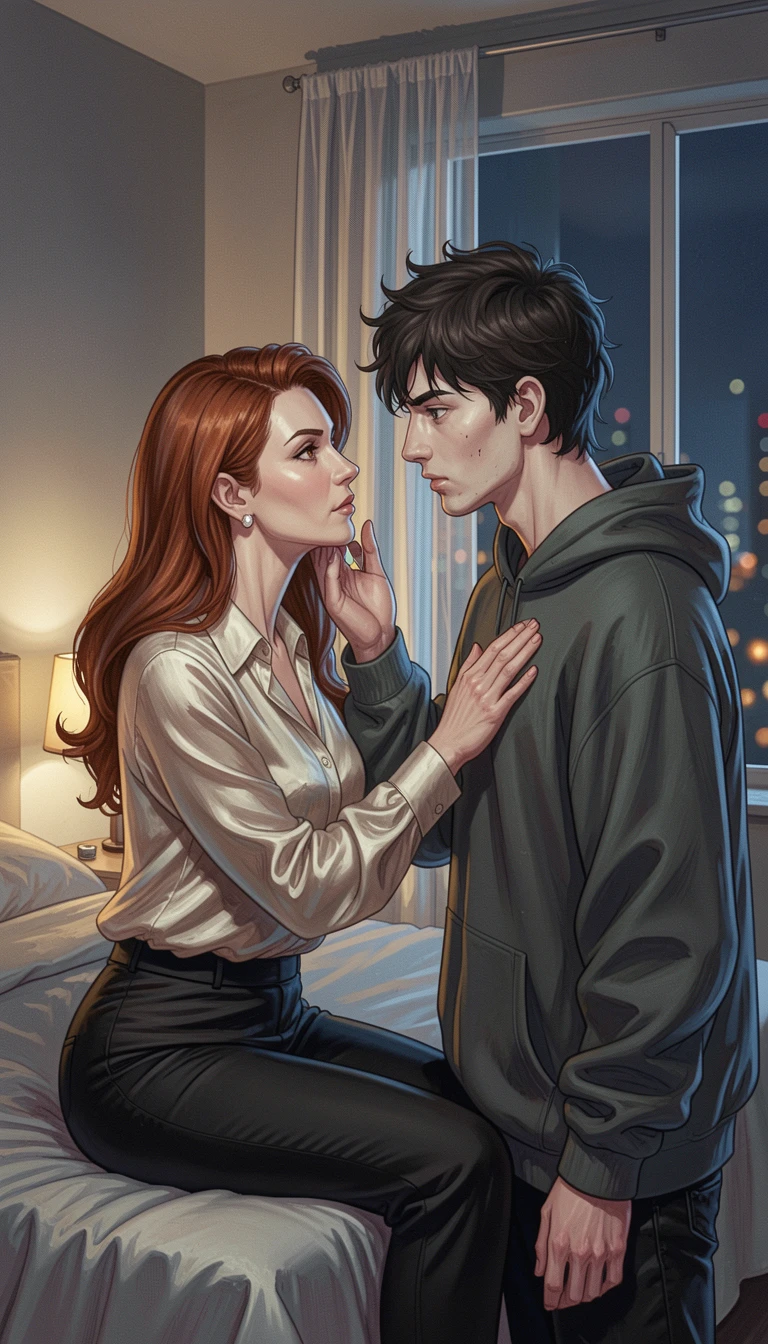
The game show host was mid-sentence, his grin stretched wide under the studio lights, when the screen cut to black and then to the newsroom. A woman in a tailored blazer sat behind a desk that hadn't been there a second ago, her hands folded on top of a stack of papers, and her mouth was already moving before Vivienne's brain caught up to the change. The remote was in her hand. She didn't remember picking it up. Her knuckles were white around it, the plastic creaking faintly under her grip, and she stood there in the middle of the living room with her ivory blouse still tucked and her hair still pinned and her wedding ring cutting a cold circle into her finger, and she watched the woman's lips shape words that didn't make sense yet.
"—contact with Singapore Airlines Flight 227 has been lost. The aircraft was en route to—"
The floor lamp buzzed. The couch behind her creaked, and she heard Nate shift his weight, and she did not turn around. Her eyes were fixed on the screen, on the chyron crawling under the anchor's face, on the words SINGAPORE — LOS ANGELES — SIGNAL LOST repeating in a loop like a heartbeat. The anchor tucked a strand of dark hair behind her ear, mid-sentence, the way she always did, and Vivienne thought, absurdly, that she'd seen this woman a thousand times and never once wondered what her name was.
"That's his flight."
Nate's voice came from behind her, flat and quiet, and it was the flatness that made her turn. He was standing now, phone in his hand, screen dark, and his face—she had spent five days learning that face, the small smile that lived at the corner of his mouth when he gave an order, the way his gray eyes went flat and patient when he was deciding what to do to her next. None of that was there. His mouth was slightly open, and his skin had gone the color of the wall behind him, and for a second, one second, he looked like what he was. Nineteen. A boy in an oversized hoodie with dark circles under his eyes and a jaw that hadn't finished hardening, standing in his father's living room, staring at a television that had just told him his father might be dead.
She didn't know which of them was more afraid. The thought arrived and she pushed it away, but it left a mark, like a thumb pressed into soft fruit.
"How do you know it's his flight?" Her voice came out steadier than she expected. The remote was still in her hand. She made herself set it down on the arm of the couch, and her fingers didn't want to let go.
"He sent me the itinerary." Nate didn't look at her. "Tuesday. Singapore to LAX, direct. Flight 227." He said the numbers like they were something he'd memorized, and maybe he had, maybe he'd been tracking his father's trips for years, the way he tracked everything else. "It's the only Singapore flight that lands at two."
The anchor was still talking. She had a calm, measured voice, the kind that was trained to deliver catastrophe without cracking, and she was saying that the airline had confirmed the loss of contact, that search efforts were underway, that the families of the passengers were being notified. The chyron changed. LIVE: FLIGHT 227. The words sat on the screen like they'd been carved there.
Vivienne looked down at her phone. The screen was dark. She pressed the side button and it woke, and there was nothing—no missed calls, no texts, no voicemail, just the lock screen with the time, 3:04, and the little map widget she'd never been able to turn off, the one that showed a blinking red dot somewhere over the Pacific, a plane icon, her husband's shared location. She had set that up years ago, when he'd first started traveling, so she could watch him come home. The red dot blinked. It had been blinking for hours. It was not moving.
"He was supposed to be home."
Nate's voice cracked. It actually cracked, the way a boy's voice cracks, and Vivienne's head came up. He was still standing by the couch, still holding his phone, and his hand was shaking—just slightly, a tremor in the fingers, and she watched him notice it and press the phone against his thigh to make it stop. He looked at her, and his eyes were wet. Not crying. Not yet. But wet, and bright, and stripped of everything she'd come to hate about them.
"He was supposed to be home," he said again, and this time it wasn't a statement. It was a question. It was a boy asking a woman who had always had the answers whether the world was still the shape he thought it was.
Vivienne's chest did something complicated. She had spent five days hating him—hating the way he looked at her, hating the way he touched her, hating the small satisfied sound he made when she obeyed. She had lain awake at night with her palms flat on the mattress and her jaw clenched and imagined, in detail, the things she would say to Harry when he came home, the way she would explain, the way she would make Nate pay. And now Harry was a blinking red dot over the Pacific, and the boy who had done all of it was standing in front of her looking like he might come apart, and she could not find the hate anywhere in her body. It had been there an hour ago. It had been there ten minutes ago, when she'd stood at the window doing her arithmetic. She reached for it and her hand closed on nothing.
"Sit down," she said.
He didn't move.
"Nate." She heard her own voice, the patrician clip of it, the tone she used on caterers and contractors and people who disappointed her, and she hated how easily it came. "Sit down before you fall down."
He sat. He sat down on the cracked leather couch, on the edge of it, elbows on his knees, phone hanging between his hands, and he stared at the television. The leather creaked under him. The anchor was repeating the same words she'd said three minutes ago, the same words she'd say again in three more, and the repetition had a rhythm to it now, a kind of liturgical drone, and Vivienne found herself listening for the exact moment the sentence looped, the small click of the recording, like a needle finding the groove.
She should call someone. She should call the airline, she should call Harry's office, she should call—she didn't know who. The police? The airport? There was a protocol for this, she was sure, a sequence of phone calls that wives made when their husbands' planes went missing, and she had never learned it because she had never once believed it would be her. She had believed in car accidents. She had believed in heart attacks. She had believed in the phone call in the middle of the night, the one that had come for her first husband, the one that had taught her that the world could take a person out of your life between one breath and the next. But she had not believed in this. Planes did not simply stop.
"He called me just this morning," Nate said. His voice was steadier now, but only just. "Before he boarded. He said he'd see me Thursday."
"Thursday."
"He wanted to talk to me about something. He didn't say what." Nate's jaw worked. "He never says what."
Vivienne sat down. Not beside him—there was a cushion between them, a deliberate distance, the space she always kept—but she sat, and the leather was cold and sticky against the back of her thighs, and it smelled of dust and old whiskey, the way it always did, the way it had smelled the first night Nate made her stand in front of him and she'd stared at it and breathed it in while he told her what she was. She pushed the memory down. She put her phone on the cushion between them, screen up, the red dot blinking its patient blink, and both of them looked at it.
"He's not answering," she said. "I've called four times."
"He won't answer." Nate's voice was quiet. "If the plane's—" He stopped. Started again. "If something happened, the phone's in the water. Or the—" He didn't finish.
The word he wouldn't say sat in the room with them. Vivienne looked at the television, at the anchor's composed face, at the chyron, at the little graphic in the corner showing the flight path, a dotted line arcing across the ocean and stopping in the middle of nowhere. A search area. They were calling it a search area. The word was doing a lot of work.
"Sera," she said.
"What?"
"Sera's asleep. She has a gallery thing at nine tomorrow." Vivienne's hands were folded in her lap, and she was looking at them, at the ring on her finger, at the way the diamond caught the light from the lamp. She'd put it back on this afternoon. She'd put it back on for Harry, because he was coming home, because she was going to sit across from him at dinner and smile and be his wife, and now the ring was on her finger and Harry was a dot on a map. "She doesn't know. She can't know yet. Not until we know something."
"What do we know?"
The question was simple and it went through her like a wire. She didn't have an answer. She had a television and a phone and a boy on the couch beside her, and none of it added up to knowledge. It added up to waiting. It added up to the worst kind of waiting, the kind where the thing you were waiting for might already have happened, might have happened hours ago, might be happening right now in the dark water while the two of you sat on a couch and watched a woman read the same sentence for the ninth time.
"We know his flight lost contact," she said. "We know they're searching. We know he was supposed to be here at two and it's three-oh-six." She looked at the clock on the stove, visible through the doorway into the kitchen, the green numbers glowing. "We know he's never been late without calling."
"Not once."
They sat with that. The lamp buzzed. Somewhere in the house, the fridge hummed, and the furnace kicked on with a low groan, and the ordinary sounds of a house doing its ordinary things felt obscene, felt like a lie the house was telling, and Vivienne wanted to go around the room and turn everything off, the lamp, the fridge, the furnace, the television, everything that was pretending the world hadn't just tilted.
Nate's phone buzzed. Both of them flinched. He looked at the screen and his face did something—a flash of hope, then nothing, then something worse than nothing. He turned the screen toward her. A news alert. The same words. He set the phone face down on the couch cushion, and the two of them looked at it like it might bite.
"I don't know what to do," he said.
It was the most honest thing he had ever said to her. Five days of orders, five days of that flat patient voice telling her what to wear and how to stand and when to say his name, and this was the first time he had admitted he didn't know. Vivienne looked at him. His hoodie was wrinkled. There was a stain on the sleeve, coffee or something darker. His hair was a mess, the way it always was, and his hands were hanging between his knees, and his shoulders—his broad shoulders, his father's shoulders—were curved forward like he was carrying something heavy.
"We wait," she said. "We call the airline. We call his office in the morning. We don't wake Sera." She heard herself building the list, the way she built lists for everything, the way she organized the spice rack and the household accounts and her own life into columns and rows. The list was the only thing keeping her voice level. "And we don't tell anyone anything until we know something. Not the neighbors. Not his mother. Not—"
"Not anyone."
He nodded. Slowly. He looked at her, and there was something in his eyes she hadn't seen before, something that wasn't hunger and wasn't control and wasn't the flat patient calculation she'd learned to dread. It was younger than that. It was the look of a boy who had just realized that the person he'd been tormenting for five days was the only person in the house who knew what to do.
"You're good at this," he said. "The—the lists. The knowing what to do."
"I've had practice." She didn't mean to say it. It came out flat and cold, and she heard the thing underneath it, the first husband, the phone call, the funeral, the year she'd spent learning to be a widow before she learned to be a wife again. Nate didn't ask. He just looked at her, and for once he didn't push.
The anchor's voice changed. Both of them turned to the screen. A correspondent was standing outside an airport, in front of a wall of glass, and behind him people were moving in that blurred urgent way of people who had somewhere to be. He was saying that the airline had opened a family assistance center, that a hotline had been established, that—Vivienne was already reaching for her phone, already typing the number into the notes app, her thumb moving fast and precise, and she didn't realize she was crying until a tear hit the back of her hand and she looked at it, surprised, as if it had fallen from somewhere else.
She wiped her face with the heel of her hand. She would not do this here. She would not do this in front of him. She had spent five days refusing to give him the satisfaction of her tears, and she was not going to hand them over now, not over this, not when he was sitting there looking at her with those wet gray eyes.
"I'll call," she said. "You—stay here. Watch the screen. If anything changes—"
"I'll tell you."
She stood up. Her legs were not entirely steady. She walked toward the kitchen doorway, toward the phone, toward the number she had just typed into her notes, and she was three steps away when the sound came—a small, broken sound, half a cough and half a sob, and she stopped.
She turned around.
Nate was sitting on the couch with his face in his hands. His shoulders were shaking. He was crying the way boys cry when they've forgotten how, in short, jagged breaths, his fingers pressed into his eyes, his whole body curled forward over his own knees. He looked small. He looked nineteen. He looked like a kid who had spent years waiting for a father who was always somewhere else, and who had just been told that the somewhere else might be the last place his father ever was.
Vivienne stood in the doorway and looked at him, and the hate she had been reaching for all night was still not there. There was something else in its place, something she didn't have a name for, something that felt like the moment before you touch a hot stove and know you're going to touch it anyway. She thought about Harry. She thought about the way he filled a room, the way he said "How's everyone?" and accepted "Fine," the way he had no idea what had been happening in his own house for the last five days. She thought about how she had been counting the hours until he came home so she could tell him, so she could end it, so she could watch him destroy his son. And now the hours had run out and there was no home for him to come to, and the boy on the couch was the only other person in the world who knew what she was feeling, and she hated that most of all.
She crossed the room. She didn't decide to. Her feet just did it, the way her hand had found the remote an hour ago, the way her body kept moving ahead of her mind. She sat down on the couch beside him—no cushion between them this time—and she reached out and put her hand on his arm.
He went still. She felt it, the way every muscle in his forearm locked under her palm, the way his breathing stopped mid-jag. His hoodie was soft and worn under her fingers, and beneath it his arm was warm, and she could feel the tremor running through him, the same tremor she'd seen in his hand when he'd pressed his phone against his thigh to make it stop. He lifted his head out of his hands and looked at her, and his face was wet and open and completely unguarded, and she had no idea what he was going to do.
Then his hand came up and closed around her wrist.
Hard. Hard enough that she felt the bones shift under his fingers, hard enough that the ring on her finger bit into her own skin, and she sucked in a breath through her teeth and didn't pull away. His grip was a vise. It was the grip of a drowning person, and his eyes were fixed on hers, and the television behind them kept talking, the anchor's calm voice looping through the same grave sentences, and the clock on the stove ticked past three, and neither of them moved.
His fingers opened. One by one, like he had to think about each of them, and her wrist came free and throbbed where he'd held it, the blood rushing back in a hot crawl up her forearm. He stood up. The couch springs groaned, and he was on his feet in front of her, and she stayed seated, looking up at him, and from this angle he looked wrong—too tall, too young, his face a ruin of wet skin and red eyes, tears still coming and him not bothering to wipe them now, letting them fall off his jaw onto the collar of his hoodie, dark spots spreading in the gray cotton.
"I need to walk." His voice came out thick and wrecked. He looked around the room like he'd misplaced something, patted the pocket of his hoodie, found his phone, checked the screen—still the same alert, still the same words—and shoved it away again. "I'll be back. I just—I need to walk."
Vivienne stood. Her knees were water. "I could come." The words were out before she'd decided to say them, and she heard them land and couldn't take them back, and she didn't entirely want to. "Nate. You shouldn't be out there alone right now. The roads, the—" She didn't finish it. She didn't know what she was warning him against. The dark, the traffic, the thing in his own head. All of it. "I'll get my coat."
"No." He shook his head, hard, once, the way a dog shakes off water. "No. I need to be alone. I can't—" He stopped. His jaw worked. "I can't have you looking at me right now."
She understood that better than she wanted to. She had spent five days with his eyes on her, and she knew exactly what it cost to be seen at the bottom of yourself. She stood there with her hands at her sides and let him have it, the one thing he'd asked for that wasn't a command, and it felt strange in her chest, like a muscle she hadn't used in a long time.
He walked to the hall. She followed him as far as the living room doorway and stopped, because there was nowhere else to go, because the front door was the only way out and he was the one using it. He pulled his hoodie off the hook by the door—the good one, the wool coat his father had bought him last winter, and he shrugged into it with his back to her, and she watched the shape of his shoulders under the fabric, broad and hunched, and she thought, absurdly, that he'd forgotten his gloves. He reached for the handle and then he stopped, hand on the brass, and turned his head just far enough that she could see the edge of his face.
"Stay here," he said.
It was flat. It was the voice. Five days of that voice telling her what to wear and how to stand and when to say his name, and here it was again, coming out of a boy with tears drying on his chin, and her whole body went tight at the sound of it, the way it always did, a wire pulled taut behind her sternum. He wasn't asking. He wasn't even looking at her now—he was looking at the door, at the dark rectangle of the front window, at whatever was out there waiting for him to step into it.
"Stay here," he said again. "Don't leave the house. Don't call anyone. I'll be back."
The door opened. Cold air came in, sharp and clean, and it smelled like the cedar hedge and wet pavement and the neighbor's woodsmoke, and it cut through the stale heat of the living room like a blade. He stepped out onto the porch. The door swung shut behind him, and the latch clicked, and then the deadbolt—he turned it from the outside, she heard the small grinding turn of it, the sound of a lock being set by someone who had the key and was not coming back through it for a while.
Vivienne stood in the doorway with her arms wrapped around herself and listened to him go. Footsteps down the porch steps. The scrape of the gate. Then nothing but the furnace and the fridge and the anchor's voice behind her, still looping, still calm, still telling the same grave sentence to a room that had stopped hearing it. And she stood there in the yellow light with her wedding ring cold on her finger and her wrist still throbbing where he'd held it, and she felt two things at once, the way you feel heat and cold when you step into a bath that hasn't been mixed right.
She waited for the headlights. That was the first thing she did, the way she did everything—a task, a column in the ledger—and she stood at the front window with two fingers hooked into the curtain's edge and watched the dark road through the gap. The streetlamp at the corner buzzed. A car went by that wasn't his, and then another, and then nothing, and the nothing stretched until it stopped being a wait and became a fact. He had walked. She didn't know which direction. He hadn't taken the car keys off the hook by the door—she checked, twice—which meant he was on foot in the cold with no gloves and no destination, and that was his choice, and she had let him make it.
The hate came back first. It always did. It came back while she was standing there with her fingers in the curtain, and it was clean and familiar and she reached for it like a coat. He locked me in. He had turned the deadbolt from the outside and put the key in his pocket and told her not to leave, not to call, and she was a grown woman standing in her own house doing arithmetic on how long she had before she disobeyed him. The phone was in her hand. The number was in her notes. Harry's office, the airline, the family assistance line the correspondent had read out—she had all of it, all of it, and no reason on earth to obey a nineteen-year-old boy except the one reason that had been sitting in his head for five days. She could feel the draft in her mind the way she could feel the shaved strip at her nape: a thing she had learned to carry without touching.
And then the other thing came back, the way it had come back when he'd put his face in his hands, and she stood in the dark window and hated that too. Because she had watched him cry. She had watched the boy's face come apart, and she knew what that was, she had known it since the year she spent as a widow—the specific animal terror of a phone that rings at the wrong hour, the way your whole body learns to dread a sound. She had sat in a kitchen with a cup of coffee going cold and listened to a stranger's voice tell her that her husband was dead, and she had felt the floor of her life open up under her, and she had spent the years since building a new floor out of lists and order and control so that nothing could ever open under her again. And tonight the floor had opened under the boy on the couch, and she had put her hand on his arm. She had reached for him. The memory of it made her stomach turn over—not shame, exactly. Something worse. Something like recognition.
"You are not his mother," she said out loud, to the empty room, and her voice sounded strange in the yellow light, too loud over the anchor's looping calm. "You are not his anything." The words did nothing. They sat there in the air with the dust and the TV glow, and she turned away from the window because there was nothing out there but the streetlamp and the dark, and she went to the kitchen because the kitchen was where the phone was plugged in and the kettle was and the lists were, and doing something with her hands was the only thing that had ever worked.
She filled the kettle. She set it on the burner and didn't turn the burner on—she stood with her hand on the dial and didn't turn it, because the house was too quiet and the click of the ignition would have been a sound she made, and she didn't want to hear herself make sounds in this house tonight. The refrigerator hummed. Somewhere upstairs, a floorboard settled, and her heart kicked once before she remembered it was just the house, just the old wood cooling, Sera asleep in her room with the door shut and no idea that the world had changed shape under her at three o'clock in the afternoon. We don't wake Sera. She had said that like it was a rule, like it was a thing she could control, and she stood in her kitchen with her hand on a cold burner and understood that she was going to have to be the one to tell her. Tomorrow. Or the day after. Or never, if the phone rang and it was him, if the door opened and it was him, if the whole terrible arithmetic came out even after all.
Four hours. The clock on the stove said 7:12, and Vivienne had been standing in the kitchen long enough that her feet had gone from aching to numb to something past numb, a dull throb that she only noticed when she shifted her weight. She had turned the burner on eventually. She had made the tea. She had drunk half of it and let the rest go cold beside the sink, and she had not called anyone, and she had not left the house, and she had not woken Sera, and the list of things she had not done was longer than the list of things she had, and she was standing in the middle of her own kitchen doing arithmetic on a boy who had walked out the door at three o'clock and not come back.
She hated him. She wanted that on the record, even if the only record was the inside of her own skull. She hated him for the last five days, for the couch and the way he said her name like he owned the syllables. She hated him for walking out into the cold without gloves and leaving her standing at a window with her fingers hooked in the curtain, because that was another thing he had done to her, another leash, another way of making her wait for him. But the hate had a crack in it now, and the crack was worry, and she could not stand the two of them sitting in her chest side by side like that, hate and worry, the way you cannot stand two radios playing different stations in the same room.
She had checked the news four times. The chyron had changed twice. The search area had a name now, a grid of coordinates in the North Pacific, and the airline had confirmed that the aircraft had not squawked, had not declared an emergency, had simply stopped being on the radar the way a light stops being on when you flip the switch. The anchor had been replaced by a different anchor, a man with a square jaw and a funeral voice, and the words were the same words in a different mouth, and Vivienne had turned the volume down until it was just a murmur, because she could not listen to it anymore and she could not turn it off.
She heard the floorboard on the stairs. The third one from the top, the one that always creaked, and her whole body went cold and then hot and then cold again, because she had been listening for the front door for four hours and she had not been listening for the stairs, and Sera was coming down them.
She reached for the remote. It was on the counter, six feet away, and she was already too late, she knew she was too late, and she crossed the kitchen anyway, her hand out, and she got her fingers around it just as Sera's bare feet hit the tile of the hall and her voice came around the corner, sleep-rough and puzzled.
"Why is the news on?"
Sera stood in the kitchen doorway in a college sweatshirt and socks, her honey-blonde hair loose and flattened on one side, and she was squinting at the television through the doorway into the living room, at the square-jawed man and the map and the words on the screen. "Is that a plane crash? I thought you were watching your game show." She rubbed one eye with the heel of her hand and yawned, and then she looked at Vivienne, and whatever was on Vivienne's face stopped her cold. The yawn died halfway. Her hand came down slowly.
"Viv?"
"It's not—" Vivienne started, and her voice came out wrong, scraped and thin, and she heard it and hated it and could not fix it. "Sera, go back upstairs. I'll come up in a minute. I'll explain in a minute."
Sera did not go upstairs. She took two steps into the room instead, her eyes moving from Vivienne's face to the television and back, and Vivienne felt the exact moment it happened, the exact moment the pieces came together behind her stepdaughter's green eyes, because Sera's face changed, the way a face changes when you tell someone a thing they already half knew. The map. The plane. The time. Her father's itinerary, which he always forwarded to both of them, which was probably sitting in Sera's inbox right now, unread, from Tuesday.
"That's Dad's flight," Sera said. It wasn't a question. Her voice had gone flat and quiet, the way her father's voice went when he was doing sums in his head. "Singapore to LAX. That's the flight he takes. That's—Viv, that's his flight."
Vivienne set the remote down on the counter. There was no point in it now. She looked at her stepdaughter standing in the kitchen in her socks with her hair on one side and her face going pale, and she thought about the list she had made, the neat little list, we don't wake Sera, we don't tell anyone until we know, and how the list had lasted exactly four hours and eleven minutes, and how there was no version of this house where a girl came down the stairs and did not see the news.
"He didn't land," Vivienne said. "He was supposed to land at two. He hasn't called. The airline lost contact with the plane this afternoon." She said it flat, the way she said hard things, the way she had said your father is dead to a different person in a different kitchen a lifetime ago, and she watched Sera's hands come up and fold across her stomach like she was holding something in. "They're searching. That's all we know. They're searching, and we don't know anything yet, and you need to breathe, Sera, look at me and breathe."
Sera's mouth opened and closed. She took a breath, a shallow one, and then another, and her eyes were wet but not spilling, and she was looking at Vivienne's face now, really looking, at the tear tracks Vivienne had wiped with the heel of her hand an hour ago and not wiped well, at the mess of her pinned hair, at the way her blouse was creased where she had wrapped her arms around herself. "You've been crying," Sera said. "You've been down here alone crying and you didn't come get me."
"I didn't want to—"
"You didn't want to what?" And there it was, the edge, the sharp green flash, the thing Sera had inherited from her mother, the thing that cut through pretense. "You didn't want to tell me my dad's plane is missing? You were just going to stand in the kitchen and—" She stopped. Her jaw worked. She pressed the heel of her hand against her eye, hard, and when she took it away her lashes were wet. "Where's Nate?"
Vivienne's stomach dropped. She had been not-thinking about Nate for four hours the way you not-think about a tooth, and now the question was in the room and there was no good answer to it, and she stood there with her mouth half-open while the front door opened.
The sound of it went through her like a shock of cold water. The latch, the hinge, the gust of night air that came down the hall and touched her ankles. She was moving before she decided to, past Sera, into the hall, and the hate came up in her throat so fast and so hot that it burned, because he was back, he was back and he had left her standing at that window for four hours with her hate and her worry fighting in her chest, and now he was walking in like he had every right to, and she was so relieved she could have hit him.
He stood just inside the door with his back against it, and he was gray with cold, his cheeks raw, his hair wet from the mist, and his wool coat was open and his hands were jammed in his pockets and there was no color in his face at all. He looked at her. She looked at him. And the worry that had been eating her alive for four hours folded up and went away, quietly, like a servant dismissed, and the hate came back and took the whole room, and she was glad, she was glad, because she knew exactly where she stood with the hate and she had not known where she stood with the other thing, and she did not want to know.
"You're back," she said. It came out flat and patrician and cold. "Four hours. You walked out of this house for four hours and didn't take your phone, didn't take the car, didn't—" She stopped. Sera was behind her in the hall, and Sera did not know, and there was a version of this that had to be performed, and Vivienne performed it,
—and the performance was this: a wife's flat reproach to a boy who'd been out in the cold too long, nothing underneath it, nothing in the words that Sera could hear and turn over later in her bed. "You didn't take your phone. You didn't take the car. Do you have any idea—" She let it break off there, let it land as ordinary anger, and her hands stayed at her sides, and her face stayed the face she had spent twenty years learning to wear.
Nate pushed off the door. He didn't look at her. He looked past her, down the hall, at Sera standing in the kitchen doorway with her hair flattened on one side and her lashes wet, and his face went still—not the flicker she'd braced for, but something colder, a flat, fast recalculation, the look of a man who had walked in expecting one room and found another. He toed off his shoes without untying them, one heel, then the other, and left them where they fell. "What's she doing up?" he said. To Vivienne. Like Sera wasn't standing right there.
"Dad's plane," Sera said. Her voice came out steady and awful, the way a voice goes when a person is holding it together with both hands. "It's missing. They lost contact this afternoon. Viv's been down here watching it for four hours." She looked at Nate, and her jaw was set, and there was something in her face that Vivienne recognized—the same flat sum-in-the-head look Harry got, the same green stare. "Where were you?"
"Out." He said it to the floor. His hands came out of his pockets and hung at his sides, and they were red to the knuckles, and Vivienne saw them and hated herself for seeing them, for noticing the cold in his fingers the way she'd noticed the cold in his face. "I went for a walk. I didn't know." He looked up then, at the television through the doorway, at the map and the square-jawed man and the words crawling under the picture, and his face did the thing again, that turn under water, and this time it stayed a beat too long. "Is that his flight?"
"Yes," Sera said. "That's his flight." She took a step toward him, and her hands were fists at her sides, and Vivienne watched her stepdaughter's whole body lean into the question like a blade. "You were gone four hours Viv said. You didn't take your phone, you didn't take the car, and my dad's plane is in the ocean somewhere, and you're standing there asking me if that's his flight." She stopped. Her breath came out of her in a hard little sound. "You knew. You knew before you went out. You were sitting in this room with her when the news came on and then you just—left."
"Sera." Vivienne's voice came out sharper than she meant it, and both of them turned. She stood in the middle of the hall with her arms crossed over her creased blouse, and she felt the shaved strip at her nape go cold the way it did when she moved her head too fast, and she made herself slow down, made herself the woman who ordered the house. "That's enough. He's your brother. He didn't know any more than we did. Nobody in this house knew anything until four o'clock." The lie came out smooth and she hated the smoothness of it, hated how easy the performance sat on her tongue after five days of practice. "We're all scared. Yelling at each other in the hall isn't going to bring the plane down any faster."
Sera's mouth twisted. She looked from Vivienne to Nate and back, and Vivienne saw the calculation go through her, the thing that made Sera the one who noticed—the way Vivienne's blouse was buttoned wrong, one button off, the way she stood between them, the way she'd answered too fast. "Fine," Sera said, and it wasn't fine, and all three of them knew it. "Fine. I'm going to call the airline. Somebody in this house should be doing something." She turned and went down the hall toward the kitchen, and her socks made no sound on the tile, and Vivienne heard her pull the phone off the wall and start punching numbers with a hard, deliberate thumb.
Nate had not moved. He stood with his back to the door and his coat still open and his hands red at his sides, and he was looking at her now—really looking, the way he did when the performance was over and there was no one else in the room. His gray eyes were flat and cold and there was no color in his face at all, and Vivienne felt the hate come up in her chest and take the whole space behind her ribs, clean and hot and welcome. "Don't," she said, low, so Sera wouldn't hear. "Don't you dare say a word to me. Four hours. You left me standing at that window for four hours and you didn't—" Her voice caught, and she stopped it, and she pressed her lips together until they went white, because she would not let him see the catch.
He looked at her for a long moment. Then he reached past her—slow, deliberate, his sleeve brushing her arm—and turned the deadbolt back the way he'd turned it, and she heard the small grinding click of it, the sound of a lock being undone, and it was the exact sound that had been sitting in her chest for four hours. "I know where I stand with you," he said, quiet. "You just spent four hours figuring out where you stand with me. Don't waste it." He stepped past her into the hall, toward the kitchen, toward Sera and the phone, and his shoulder caught hers as he went, not hard, just enough to move her, and she stood in the doorway with the cold coming off the door and the deadbolt open and her hate burning in her throat, and she did not know, anymore, which of the two of them had just won something.
Sera set the phone back in its cradle with a click that sounded too loud in the quiet of the kitchen. "They didn't tell me anything I didn't already know. They're still searching. They'll know more in the morning." She stood there with her hand on the receiver, her college sweatshirt hanging off one shoulder, and the three of them were a strange constellation in the yellow kitchen light—Sera by the wall phone, Nate leaning against the doorframe, Vivienne with her cold tea still sitting by the sink. The television murmured in the other room, the square-jawed man's funeral voice reduced to a drone, and nobody moved to change it.
"We should sleep," Vivienne said. It came out like a question, and she hated that, hated the way her voice had gone thin and unfamiliar over the last four hours. "There's nothing else we can do tonight. If there's news, they'll call. We need to be—" She stopped. She didn't know what they needed to be. Alert. Ready. Functional. All the words she'd learned to say to herself in the year after her first husband's funeral, all the words that had carried her through, and they sat in her mouth now like gravel. "We need to sleep."
Sera looked at her for a long moment, and then she nodded, a small tired dip of her chin. She crossed the kitchen and put her hand on Vivienne's arm—a touch so unexpected that Vivienne's breath caught—and squeezed once, briefly, the way you squeeze a person's arm when you don't have the words for what you're both afraid of. "You should sleep too," Sera said. "You look like you've been up for days." She didn't wait for an answer. She went past them both, up the stairs, her socks silent on the wood, and a moment later they heard her door close softly, the click of the latch, and then nothing.
The kitchen fell quiet after Sera's door closed, the way a room goes quiet when the last voice leaves it. Vivienne stood with her arms wrapped around herself, the creased silk of her blouse cold against her forearms, and she could feel the weight of the last four hours sitting in her chest like a stone she'd swallowed. She did not look at him. She could not look at him. She stared at her cold tea by the sink, at the film of cream congealed on its surface, and she heard him move—the soft shift of his weight against the doorframe, the rustle of his wool coat as he pushed off it.
"I'm going up," he said. Not to her. Past her, at the stairs, at the hallway, at anything that wasn't her face. She heard his bare feet on the wood—he'd left his shoes by the door, heel-crushed, and she thought of them lying there in the dark hall like a shed skin—and she listened to him climb, the third stair creaking the way it always creaked, the way it had creaked when Sera came down. She waited for him to say something else. She waited for the quiet, precise voice that had been living in her ear for five days, the voice that said *don't waste it* and *I know where I stand with you*. But he said nothing. His door opened and closed, a soft click, and then there was nothing but the television murmuring in the living room, the square-jawed man still talking about the search area, the grid of coordinates in the North Pacific.
Vivienne stood alone in the kitchen for a long moment. Her hands came up and pressed flat against her face, and she stood there with her palms against her eyes, breathing in the dark, and she thought about the ring in the dish upstairs, the one she'd put back on this afternoon for a man who wasn't coming home tonight. She thought about the shaved strip at her nape, cold against her fingers when she finally lowered her hands. Then she turned off the kitchen light and climbed the stairs in the dark, and she did not look at the closed door at the end of the hall, and she did not let herself think about which of them had just won something, because she was too tired to know, and too afraid to find out.