
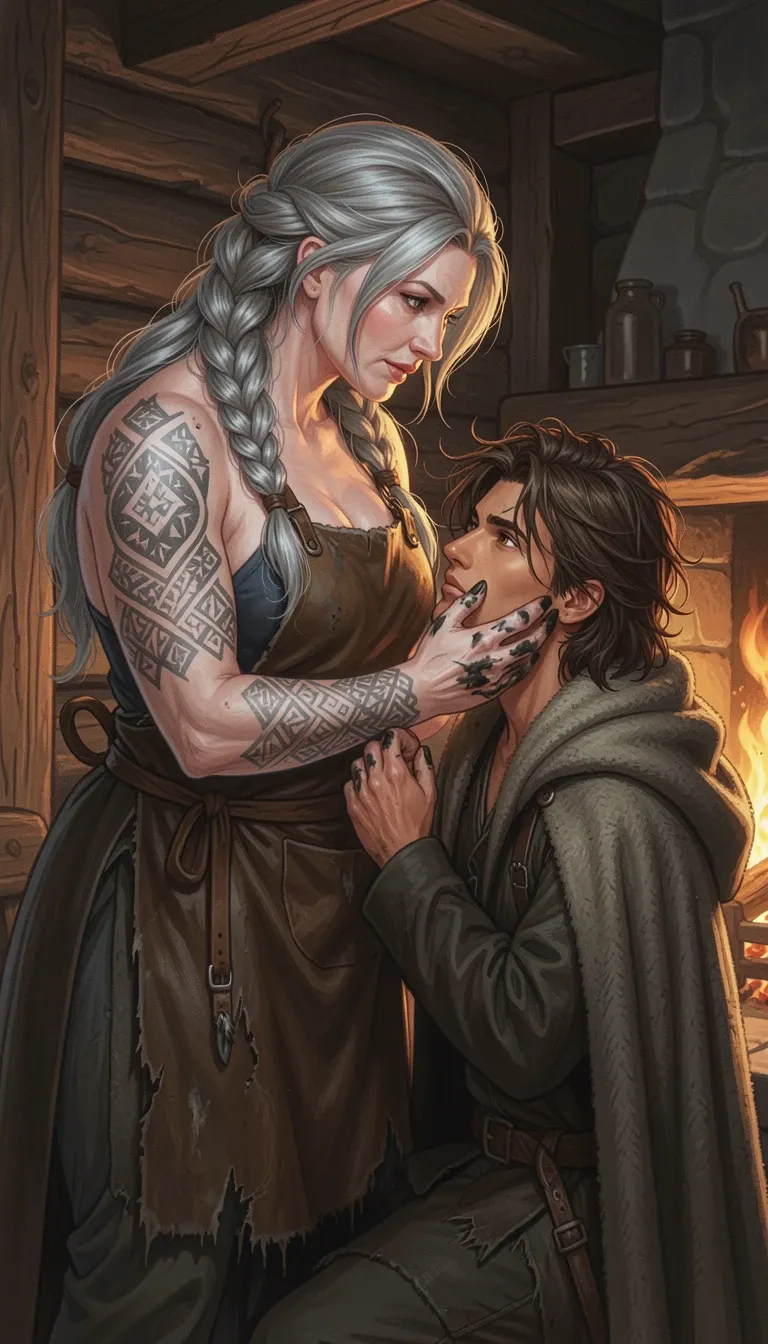
The storm had been at the shutters for three days and showed no sign of tiring. Hrafna sat in the great chair drawn up to the hearth, her feet bare on the flagstones, and watched the fire take the new log at its heart. Behind her the inn creaked and leaned against the wind the way it had leaned for four hundred years, and would lean for four hundred more, and did not need her to hold it up.
Pell lay small on the fur at her feet. Not asleep. She could tell by his breathing — the small quick rhythm of a man thinking too hard to let go.
"Sit up," she said.
He sat up. The blanket fell off him and he caught it, and she watched him do the arithmetic of a man who had been the size of her hand for a night and still had not got used to it — the way he glanced at the chair leg beside him, thick as a tree, and then at her, and then away.
She reached down to the shelf beside the chair and brought up a small clay pot, stoppered with wax, and set it on the rug between them. Beside it she laid a twist of cloth. The pot was one of the little cups from the upper shelf, the ones she used for measuring out dried herbs, and it looked, in the firelight, exactly the size of a thing a man might carry in his pocket.
"Lacquer," she said. "For my nails. It's gone to winter and there's no one on the pass to see them but you, and you've seen them bare for a night, so I'll have them done."
Pell looked at the pot. Then at her feet, drawn up on the flagstones, the toes long and pale and the nails broad and plain in the firelight. His throat moved.
"I've never painted a nail in my life," he said. "I've painted coastlines. I've painted a mountain that took me nine days to walk around. I've never—"
"Then you'll learn it tonight," she said. "There's no one on the pass to see the mess."
He crawled to the pot. It came up to his chest when he knelt beside it, and he worked the wax stopper loose with both hands and a grunt, and the smell came up out of it — sharp, resinous, sweet underneath, the smell of the north's dark winters. The brush was laid across the top, a fine thing of squirrel hair bound to a sliver of birch, and when he picked it up it was the length of his arm.
"It's too big," he said.
"Then use the tip of it." She stretched her left foot out toward him, and the firelight ran along the top of it, and the toes spread and settled. "Start at the little one. It's the shortest and it'll teach you least painfully."
He looked up at her. There was a question in his face that he did not ask — she could see him decide not to ask it, and swallow it, and take the brush in both hands instead.
The little toe was still longer than his forearm. He learned that first, kneeling beside it with the brush held out in front of him like a spear. The nail was small by her measure and vast by his, a pale half-moon the size of his two palms laid together, and the cuticle at its base was a ridge of skin he could have lain down in.
He put the tip of the brush to the nail and drew it.
The lacquer went on thin and dark. Too thin. He drew again, and the second stroke laid a wet red line beside the first, and the two of them sat on the nail like a pair of surveyor's marks on a blank map, and he heard himself make a small sound of disgust.
"Slower," Hrafna said. She had not moved. Her voice came down from the chair the way weather comes down a mountain. "You're painting the nail, not the skin. If you get it on the skin it'll stain and I'll have red cuticles till spring."
"I know," he said. "I know. I'm—" He set the brush down across the pot and rubbed his face with both hands, and the lacquer on his fingers smeared red across his cheek. "It's a different scale of mistake, that's all. On a map a bad line is a bad line. Here a bad line is the whole toe."
"Then don't make a bad line," she said.
He picked the brush back up.
The work took him a long time. Longer than the little toe had any right to take. He learned to load the brush lighter and draw it in one slow pass from the cuticle to the tip, and to hold his breath at the end of each stroke so his hand would not shake, and to wipe the brush on the twist of cloth between toes. By the second toe he had found a rhythm. By the third he had stopped thinking about the size of the thing and started thinking about the shape of it — the way the nail curved down at the edges, the way the lacquer caught the fire and went from dark to bright when he tilted his head.
Hrafna said nothing at all. That was the strange part. He had expected correction and got silence, and the silence was heavier than any correction. He kept glancing up at her — at the underside of her jaw, at her braid hanging down over the chair arm, at the small tired lines at the corners of her eyes that he had first seen last night and had not stopped seeing since — and every time he looked she was watching him work, and every time he looked away again too fast.
"You're watching me," he said, on the fourth toe.
"Aye."
"Why?"
"Because it's the first time in four hundred years a man has done a thing for me with his hands and not asked me for anything after," she said. "Let me watch it a while."
He painted the fourth toe and did not look up for a long time.
The fire burned down and he fed it a stick — it took both arms and a shove, and the sparks went up the chimney like a flock startled off a roof. The cold worked at the shutters. On the far side of the room the wind found a gap in the boards and made a sound like a man whistling through his teeth, and Pell, kneeling on the fur with the brush in his hand, felt the heat on his left side and the cold on his right and understood that he was as warm as he had ever been in his life.
The big toe was the last and the worst. The nail was broad as his palm laid flat. He had to walk along the top of the foot to reach it, step by step over the ridge of tendon and the slope of bone, and when he knelt at the base of the nail the whole foot shifted under him — a slow roll, like a ship at anchor — and he put both hands flat to keep his balance and felt the heat of her skin come up through his palms.
"Careful," she said. "I can feel you walking on me."
"Does it hurt?"
"No." A pause. "It's like being walked on by a bird. Don't stop."
He painted the big nail in four slow passes and his hand did not shake once. When it was done he sat back on his heels and looked at the foot — five nails gone dark red, glossy, the firelight sliding across them — and something in his chest turned over and lay still.
"Done," he said. "The left."
Hrafna lifted the foot and turned it in the firelight, slowly, the way a jeweler turns a stone. The lacquer caught the light and threw it back. She turned it the other way. Her face gave nothing away, and Pell, kneeling on the fur with his heart going, watched her face and could not read it, and the not-reading was worse than a scolding.
"It'll do," she said at last. "The big one's uneven at the edge."
"I know. It's—"
"I said it'll do." She set the foot down. "Now the other thing."
He looked up at her. "The other thing?"
"You didn't think I'd have you paint them and not clean them after," she said. "The lacquer's wet yet. You'll lick it off the skin where I've got it, and you'll go over every toe after, root to tip, and get the taste of the lacquer out of your mouth before you start the next one, because I'll not have you smearing red on the second foot." She settled back in the chair. "Go on. Little one first. You know the way of it now."
Pell knelt on the fur and looked at the left foot with its five dark red nails. The firelight was on it. The wind was at the shutters. He had spent an hour learning the shape of it with a brush and now he would learn it with his mouth, and the thought of it went down his spine like a draught under a door.
He bent and put his mouth to the little toe.
The lacquer was still wet. It tasted of resin and of something bitter underneath, and under that, faintly, of her skin. He ran his tongue along the edge of the nail where the brush had strayed, and found the thin red line he had left on the cuticle, and licked it away in one slow stroke, and the skin under his tongue was warm and dry and smelled of woodsmoke.
"Root to tip," she said above him. "Not just the stray. All of it."
He licked the little toe root to tip. The nail was smooth under his tongue where the lacquer had gone on clean, and the cuticle was a ridge he could trace, and the toe itself was longer than his whole hand. He could not get his mouth around it, only lay his tongue along it and drag, slow, from the base of the nail to the tip and back. The lacquer came off on his tongue in a bitter film. He wiped his mouth on the cloth and went to the next toe.
The second toe took longer. He found the line of the nail with his tongue and followed it, and where the lacquer had pooled at the edge he worked at it until it was gone, and the toe shifted under his mouth — a small involuntary curl — and he heard her breath change above him.
"You're good at this," she said. "For a man who's never done it."
"I'm good at going slow," he said, against her toe. "It's the only thing I'm good at. Maps take months. A coast takes a year if you want it right."
"Then take a year."
He licked the third toe root to tip and the fourth toe root to tip, and by the fifth he had stopped wiping his mouth on the cloth and was swallowing the lacquer down instead. It sat bitter in his throat and he did not mind it. He crawled up over the top of the foot to the big toe — the foot rolling under him again, slow, and this time he did not put his hands down to steady himself; he let it roll and kept his balance and felt her feel him do it. He knelt at the base of the big nail and licked the whole broad length of it, root to tip, in one long stroke of his tongue.
Hrafna made a sound. Low in her chest. Not a word.
He did it again. And again, slower, working the edge where the lacquer had gone uneven, and the taste of resin and her skin was in his mouth and the fire was hot on his back and the wind was rattling the shutters over his head, and he was as hard as he had ever been in his life and did not know what to do about it and did not stop.
"Enough," she said, at last, and her voice had gone rough at the edges. "It's clean. All of it. Come away."
He sat back on his heels on the fur, breathing hard, his mouth tasting of lacquer and her. The left foot lay on the flagstones, five nails dark red and glossy and clean, and he had done that, and the doing of it sat in his chest like a stone he had carried up a mountain and set down.
"Now," Hrafna said, "the other one."
And her right foot came off the floor and down across his back.
It did not crush him. It did not need to. It came down slow and flat and laid him out on the fur, chest to the rug, the breath going out of him in a grunt, his cheek turned to the wool and the brush still in his hand. The weight of her sole spread from his shoulders to his hips and pressed him into the fur until the fur was up against his chest and his belly and the whole front of him, and the shutters rattled above his head, and the storm went on, and Hrafna said nothing at all.