
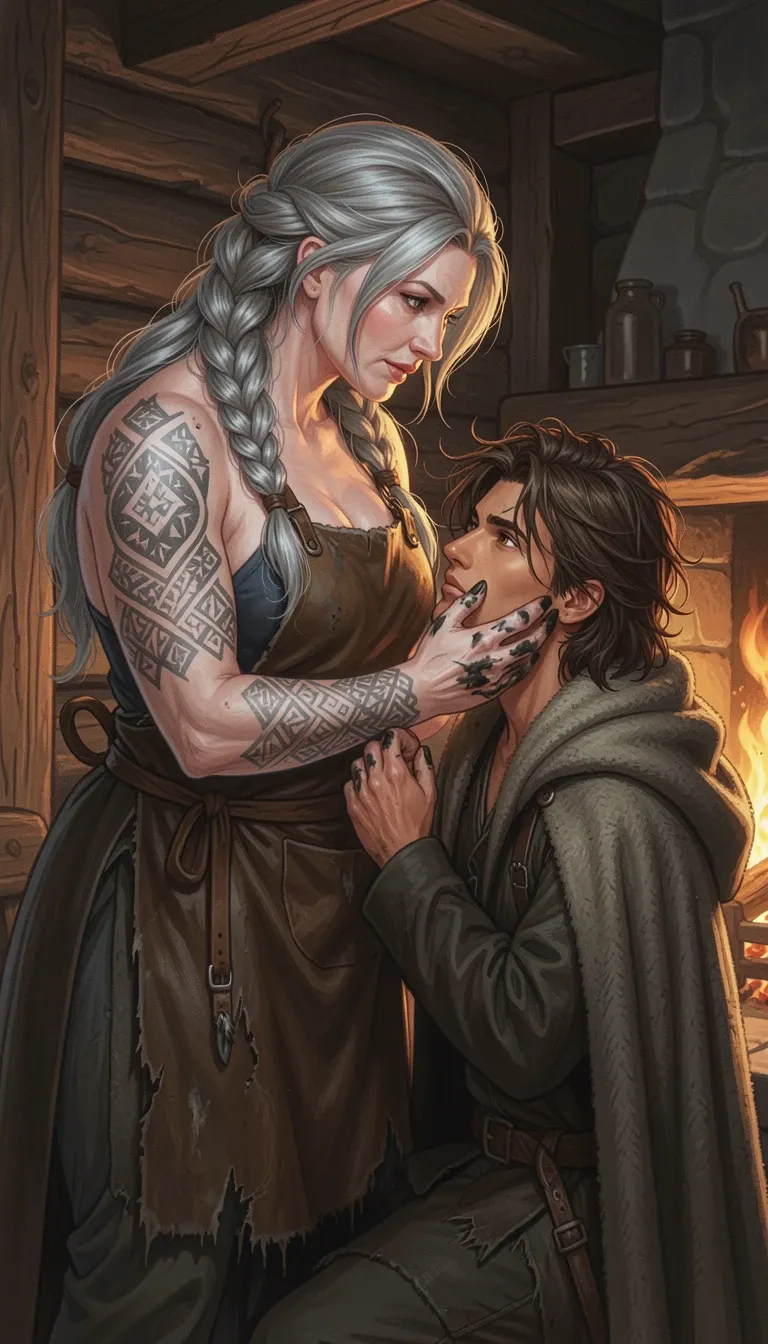
The fire had burned down to the good part—the deep orange heart of it, the logs gone to embers and ash—when Pell finally said it out loud.
Hrafna sat with her back against the hearthstone and her feet stretched toward the warmth, and her feet were the whole of the room. That was the thing about an inn built for a giantess: the benches were the size of tables, the tables the size of barges, and the hearth so wide a man could have walked into it and not touched either wall. Pell sat on the low stool she kept for human guests, and the stool was next to her ankle. Not her foot. Her ankle. The bone of it rose out of the floor like a stone post, and above it her heel, and beyond that her sole, firelit, the skin of it weathered and pale and creased in ways that made him think of the old maps—the ones where the cartographer had given up on accuracy and drawn the mountains as sleeping bodies.
Snow worked at the walls. Not the soft hiss of it, either—the hard, driven tap of a storm that had been at the pass for three days and would be at it for three more. Every so often the wind found a gap in the chinking and pushed a thin whistle through, and the fire leaned, and Hrafna's toes curled and uncurled in their slow, absent way, the way a person's fingers move when they are thinking.
She had not spoken in an hour. She rarely did. But her silence was not the closed kind. It was the kind that sat beside you and let you be.
Pell had a map on his knees and had not looked at it in an hour.
"Hrafna."
The fire cracked. She turned her head—slow, unhurried, the braid sliding over her shoulder, silver in it catching the light. Her eyes were the grey of the sky over the pass before snow, and they found him the way they always did, without hurry, as though he were a thing worth the looking.
"Mm."
"I want to ask you something." His voice came out wrong. He cleared his throat and tried again. "And I'd have you hear me out before you say no. Or yes. Either."
One corner of her mouth moved. "That bad."
"It's not—" He stopped. Started over. The ink on his fingers had gone dry and he rubbed at it without noticing, the old habit. "You carried me in from the blizzard. Four winters back."
"I remember."
"I've thought about it every day since." That landed in the room and sat there. The fire popped. Pell kept his eyes on his own hands because looking at her was too much just then, and he had to get the whole of it out before he lost the nerve. "Not the snow. Not the being carried. Well—some of the being carried. But mostly—" He breathed. "You set me down by the fire and you took off my boots and you rubbed the frost out of my feet with your thumbs, and I was so cold I couldn't feel it, and you said, There. Now you'll keep them. And I thought, I would give anything to be small enough to be held in those hands again."
The silence after that was a long one. Hrafna did not laugh, did not soften, did not do any of the things a smaller woman might have done to make it easy for him. She looked at him the way she looked at weather coming over the ridge—reading it, weighing it.
"You've a strange way of asking for a thing," she said at last.
"I haven't asked yet." Pell set the map aside, off his knees, on the floor, and stood. Standing didn't help much—her seated, he came up to her chest, and that was with her stooped—but it helped some. "You've a rune. The one in the box with the iron bands. I've seen you take it out and look at it and put it back. You told me once it changes a man's size."
Her eyes did not move from his face. "I told you that."
"You told me that." He swallowed. "Hrafna. I want you to use it on me. Small. Small as your hand—smaller. I want to—" The word he had rehearsed in his head for a week went out of it entirely. What came out instead was the truth, unpolished. "I want to worship you. All of you. Not the way a man worships from across a room. I want to be at your feet with my mouth on them and know that's the whole of what I am, just then, and be glad of it."
Hrafna was quiet for so long the fire burned down another finger's width.
"You'd be helpless," she said.
"I know it."
"A mouse under my heel. Less." She turned her foot, slow, deliberate, and the sole of it caught the firelight and went from shadow to glowing amber, the hard pale callus of the ball of it, the deep crease beneath the toes, the broad flat pad of the big toe. "You seen my feet, Pell? Truly seen them? I've walked this pass four hundred years. There's stone in the skin of them. A man your size doesn't come back from a wrong step."
"I know it."
"And you'd trust me not to make one."
"I'd trust you." He said it plain, no ornament, and saw something in her face shift—a tightening at the corner of her eye, a thing she covered at once by looking into the fire. "I've trusted you with my life already. You carried me out of a storm I should have died in. This is smaller than that. It's only my pride I'm setting down."
"Pride." She said the word as though tasting it. "Is that what it is."
"It's what I've got that's in the way." Pell's hands had gone to the edge of his cloak and were gripping it. He made them let go. "You're lonely, Hrafna. Don't tell me you're not—I've watched you three winters and I know what a person looks like when no one's touched them in a long while. And I'm—" His voice cracked, and he did not smooth it over. "I'm a man who's wanted you since the first night, and I'm tired of wanting you from the height of a stool. Let me come down. Let me be small enough that there's nothing between us but what I do with my mouth. That's all I'm asking. That, and your leave to ask it."
The wind pushed at the walls. Hrafna looked at him a long time, and the firelight moved on her face, and Pell stood in it and did not look away, though his heart was going like a hare's and his palms had gone wet.
Then she rose.
It was a thing to watch, her rising. She came up off the floor in stages, the way a mountain comes up out of the dark at dawn, and when she was standing the top of her head was lost in the shadow of the rafters and the room had gotten smaller around her. Pell did not move. He had learned, those first weeks, not to move when she stood.
She crossed to the shelf above the bar—three steps for her, and each one a small earthquake in the floorboards—and took down the iron-banded box, and set it on the bar, and opened it. The rune inside was a flat disc of dark stone, no bigger than a saucer in her hand, and it had a hole through the middle and marks cut around the rim that Pell's eyes could not follow, the way eyes can't follow a thing that's turning while you look at it.
"You'll want to sit," she said.
"I'll stand."
"You'll sit." Not unkind. "It's a hard change on the body. The first time especially. You'll be sick as a dog if you're standing when it takes."
Pell sat. The stool put him at the height of her ankle again, and she came back across the room and stood over him, and the firelight went out of the room entirely, and there was only the shadow of her and the heat of her and the smell of her—woodsmoke and wool and something under it, clean and warm, the smell of a body that has been working and is not ashamed of it.
She crouched. Even crouched she was enormous. She set the rune on the floor between them and looked at him across it.
"Last chance to be a sensible man," she said.
"I've never once been sensible about you."
Hrafna's mouth did the thing again—that small movement at the corner, gone almost before it came. She put her thumb on the rune.
The room turned over.
It was not pain, exactly. It was as though the floor had come up to meet him and the ceiling had come down and both of them had missed, and in the missing there was a long sick moment where his body did not know how big it was. His stomach lurched. The stool went out from under him—no, the stool was still there, he had simply gotten small enough that the seat of it was a plain now, a wide wooden plain, and he was on his hands and knees on it, retching dry, the grain of the wood the size of riverbeds under his palms.
Then the sickness passed, the way seasickness passes, all at once, and Pell opened his eyes.
The world was made of her.
Her foot stood beside the stool like a cliff at the edge of a harbor. He could see the whole of it now, the way a man sees a thing he has only ever glimpsed—the arch of it rising overhead, the heel behind like a rounded tower, the toes lined up at the far end, each one a boulder, each nail a shield of dull horn. The skin of the sole was a country. It had ridges in it, and valleys, and the firelight lay along the high places and left the creases in shadow, and he could see where the callus had gone hard and yellow at the ball of it, and where it had cracked, and where it had healed over, four hundred years of walking the pass written in it.
He was small enough that he could have lain down in the crease beneath her toes and been hidden.
"Breathe," Hrafna said, and her voice came down around him like weather. He felt it in his chest more than heard it. "There. You've got your legs under you. Breathe."
Pell breathed. Then he laughed—a cracked, wild little sound that was half terror and half joy, and it came out of him small and high and he did not care. "You're—" He looked up. And up. Her face was a pale moon a long way overhead, her eyes two grey lights in it, and she was watching him with an expression he could not read and would have given a year of his life to read. "You're the whole sky," he said.
"Get up, then," she said. "If you're going to worship me, worship me. Don't kneel in a heap on my stool and gawk."
He got up.
It took him a moment to find his feet on the wood—the grain was rough enough to trip a man his size—and then he stood, and the top of his head came to the middle of her ankle. He could have reached out and laid his palm flat on the bone of it. He did. It was warm, and hard as a tree, and she did not move, and something in the not-moving was a permission greater than any word.
"Down," she said.
He went down. Off the stool, onto the hearthstone, and the stone was warm from the fire and gritty under his hands, and he crawled—actually crawled, on his hands and knees, the way a man crawls to a shrine—around the base of her foot to the front of it, where the toes were, where the firelight was strongest.
Her foot filled the world. The sole of it faced him, tilted back a little where she had her weight on the heel, and he could see the whole landscape of it—the broad pad of the big toe, the four smaller toes ranked beside it, the deep crease where the toes met the sole, the long fall of the arch. It smelled of woodsmoke and warm leather and, under that, of her—a clean, salt, animal smell that went straight to the back of his throat and made his eyes sting.
He put his mouth on it.
The pad of her big toe was the size of his two hands together. He kissed it first, the way a man kisses a relic, and the skin was hard and warm and tasted of salt and ash and the faint bitterness of the fire's smoke, and he kissed it again, open-mouthed, and then he dragged his tongue along the underside of it, slow, from the base of the nail to the crease of the joint, and felt the grain of the callus catch on his tongue like the grain of old wood.
Overhead, Hrafna made a sound. It was not a word. It was a low thing, down in her chest, and it came down through the floor into his bones.
"Again," she said.
He did it again. And again. He licked the whole pad of the toe until it was wet and shining in the firelight, and then he took the end of it into his mouth—as much of it as would go, which was not much, the toe was too big for him. He had to open his jaw wide and take it in and suck, and the suction pulled the hard skin against his tongue. He could feel the pulse in it, faint and slow, hers, four hundred years of slow giant's blood moving under his mouth.
Her toes curled. He felt the whole foot shift, the great arch lifting, the sole pressing forward a fraction, and he had to brace his hands against the ball of it to keep from being pushed over. The callus was slick now with his spit. It tasted of her.
"Small thing," Hrafna said, and her voice had gone rough in a way it had not been rough before. "You've a mouth on you."
Pell pulled off the toe with a wet sound and looked up along the length of her leg. "I've wanted to put it there for four winters," he said. His voice was wrecked. "I'm not going to hurry now."
He bent and took the next toe, the one beside it, and sucked that one too, and the one beside that, working along the row of them, licking the creases between, dragging his tongue up into the deep fold where the toes met the sole and tasting the salt gathered there. The skin was softer in the creases and harder on the pads, and he learned the whole of it with his mouth the way he learned a coastline—slow, thorough, going back over the places he'd missed, marking the shape of it in his memory because he knew, he knew, he would be drawing this foot from memory for the rest of his life.
Above him the fire cracked and settled. The snow went on at the walls. And Hrafna's breathing had changed—he could hear it now, a long slow pull and a longer slower let-go, and between them a silence that was not the silence of a woman being patient. It was the silence of a woman being careful.
"Enough of the toes," she said at last. "Lie down."
He looked up. "Lie down?"
"On your back. At the sole of my foot." Her mouth was a hard line and her eyes were bright and she was not looking at his face, she was looking at the fire. "You wanted to worship all of me. Lie down and I'll show you what the sole of a giant's foot can do to a man who's fool enough to put his mouth to it."
Pell lay down.
The hearthstone was warm and gritty under his back. He looked up the long slope of her foot—the toes overhead like a row of standing stones, the sole tilted toward him, the firelight red along the arch of it—and his heart was going so hard he could hear it in his ears, and his cock was so hard it ached, had been aching since the first kiss he'd laid on her toe. He did not care, he did not care, he was small and warm and hers and there was nothing in the world but the smell of her foot and the heat of the fire and the sound of the snow.
Hrafna shifted her weight. The foot came down—slow, so slow, the way a cliff gives way—and the sole of it settled over him, and the world went dark and warm and heavy, and he could feel the whole vast weight of her held back, held just at the edge of crushing, the callus of her sole pressing down on his chest and his belly and his hips, and it was the most terrifying and the most wanted thing that had ever happened to him.
Then something moved. Down at the end of him, where his cock stood up hard against his belly, something warm and hard and blunt found it. Her big toe. The pad of it, wet from his own mouth, pressed against the length of him, and she began, slowly, to rub.