

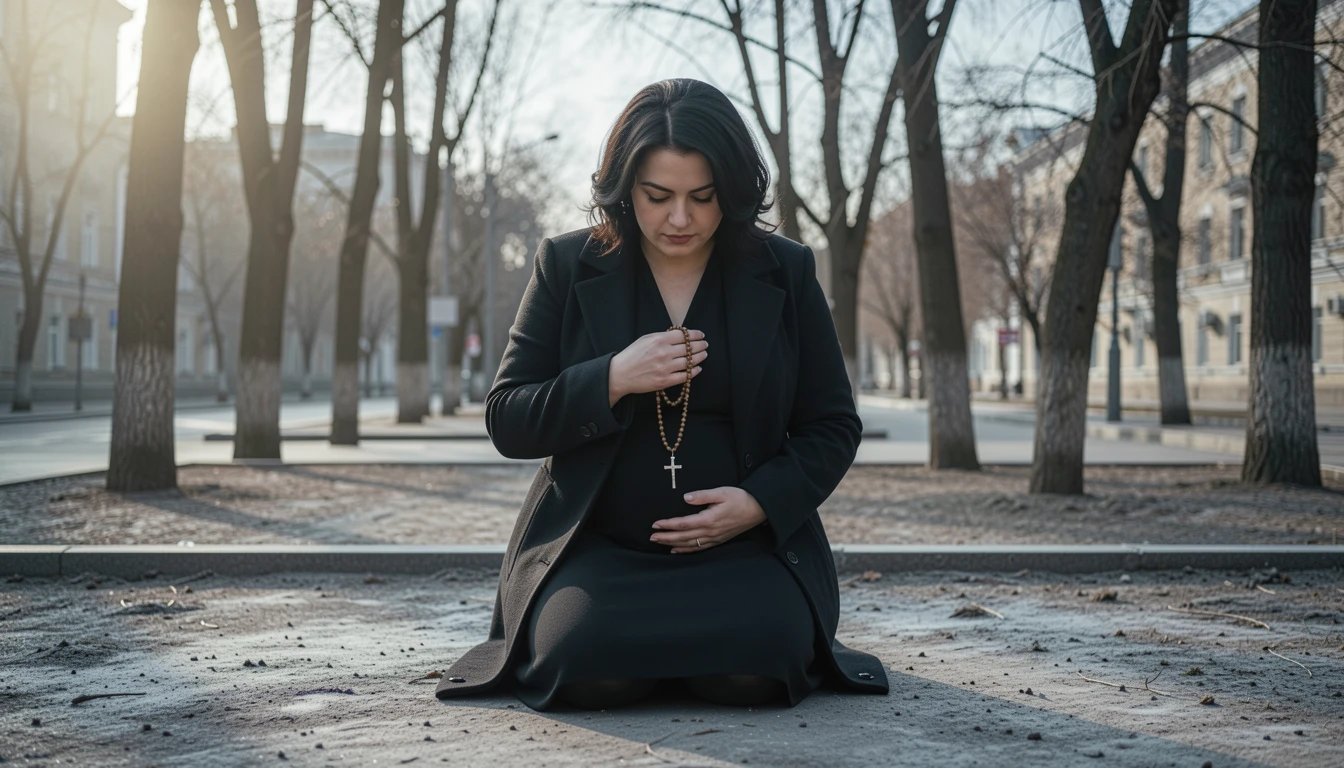
The cold hit me first—that Moscow bite that never quite leaves the air even in early spring. I stepped onto the corner and stopped dead.
The crowd was a sea of faces. Sixty. Maybe more.
They spilled off the sidewalk onto the frozen grass of the park, mothers holding children by the hand, old men with canes, young couples with their arms wrapped around each other. Many already held rosaries—my rosaries, the blue glass and silver wire I'd threaded with my own fingers on cold nights. Others reached toward me, hands open, empty, hungry for what I carried in my coat pocket.
"Nadezhda." A woman's voice, cracked with age. I turned and saw the grandmother who had confessed to me, her eyes wet before I'd even spoken. She pressed forward through the crowd, her daughter beside her holding a toddler on her hip. "We came. We all came."
I felt the weight of them all pressing in—not threatening, not demanding, but expectant. They had come because I had promised something. Because I had stood on this corner and handed out hope like bread, and now they were hungry for more.
Father Alexei appeared at my elbow, his cassock dark against the gray morning. He surveyed the crowd with the calm of a man who had seen congregations gather before, but I caught the slight widening of his eyes as he counted.
"You've been busy, my child."
"I didn't—" I shook my head, searching the faces. "I only gave away fifty. There were nine who came back. Nine."
"And they told others." He smiled, warm and steady. "That is how the Word spreads. One heart at a time, each one telling the next."
I felt a hand on my lower back and didn't need to turn to know it was Dmitri. He stood close, a wall of warmth against the cold, his presence a quiet anchor. He leaned down, his breath warm against my ear.
"The park across the street. Benches. Grass. Room for all of them." He gestured with his chin. "I'll have Elena bring more chairs from the house."
I looked where he pointed. The park was skeletal, trees still bare, the ground patchy with old snow and new mud. But it was open. It could hold us.
"Yes," I said. "There."
He squeezed my shoulder and stepped away, already pulling out his phone to call Elena. I watched him go for half a second—the broad set of his shoulders in his dark coat, the silver at his temples catching the pale light—and then I turned back to the crowd.
"Come," I called out, raising my voice so it carried over the murmur. "Follow me. We'll pray in the park, where there's room for everyone."
They moved as one, a slow tide of bodies crossing the street. I led them, Father Alexei at my side, and I felt the twins shift inside me as I walked—a flutter, a turn, as if they too were settling in for what was to come.
The park opened before us, a wide clearing ringed by benches. The grass was wet, cold seeping through the knees of anyone who knelt, but no one hesitated. They spread out, finding their places, some on benches, some standing, some lowering themselves carefully to the ground.
I stopped in the center of the clearing and turned to face them.
Sixty faces. Sixty pairs of eyes, watching me, waiting.
I had never led this many. I had never led more than twenty. The weight of it pressed against my ribs, and for a moment I couldn't breathe.
Then I felt the rosary in my pocket, the one I'd made for myself, blue glass worn smooth from my fingers. I pulled it out and wrapped it around my hand, the beads cool against my palm.
"We'll begin with the Glorious Mysteries," I said, and my voice came out steadier than I felt. "The first decade. The Resurrection."
I knelt.
The ground was cold and wet through the fabric of my dress, the chill seeping into my knees, but I didn't care. I held up the crucifix, let the light catch the silver, and began.
"I believe in God, the Father Almighty, Creator of heaven and earth..."
The words came from me, but they weren't mine alone. The crowd joined in, a wave of voices rising around me, sixty people reciting the Creed together. I heard the grandmother's cracked voice, her daughter's softer one, a young man's baritone, a child's high, clear soprano.
We moved through the Our Father, and then the Hail Marys began.
I led the first one alone, my voice carrying over the park. "Hail Mary, full of grace, the Lord is with thee. Blessed art thou among women, and blessed is the fruit of thy womb, Jesus."
Then the second decade's responses rose from the crowd, and I let myself sink into the rhythm of it. Bead after bead. Decade after decade. The words washing over me, through me, binding us all together in a single voice.
I didn't count the faces anymore. I didn't think about the cold or the wet or the weight of expectation. I just prayed, and the crowd prayed with me, and somewhere in the middle of the third decade I felt the twins turn inside me—not a flutter this time, but a deliberate roll, a press of small bodies against my walls.
I gasped, my hand going to my belly.
Father Alexei glanced at me, concern flickering across his face. "Are you all right?"
I nodded, tears pricking at my eyes. "They're moving," I whispered. "They're moving like they're saying yes."
He smiled, a deep, knowing warmth. "They know their mother's voice. They know the words she speaks."
I looked down at my belly, at the swell beneath my coat, and I felt it again—a kick, a turn, a small life pressing back against my palm.
I had spent so long afraid of what my body had become. Afraid of what it was for, what it would be used for, what it would produce. But here, on my knees in the cold Moscow grass, surrounded by strangers who had become something more, carrying children who moved in time with my prayers—here, my body felt like a gift.
I lifted my eyes to the gray sky and continued the prayer.
The fourth decade passed in a blur of Hail Marys. I felt my voice growing stronger, the words finding a rhythm that carried me. And when we reached the fifth decade, the Glorious Mystery of the Coronation, I felt something shift in the crowd—a deepening, a settling, a sense that we were all part of something larger than ourselves.
We finished the last Hail Mary, and for a moment there was silence. Just the wind in the bare trees, the distant sound of traffic, the breath of sixty people who had prayed together.
Then the grandmother began to sing.
It was an old hymn, one I didn't know, in a language I didn't recognize. Russian, but older, more archaic—a song from her childhood, from a church that no longer stood. Her voice was cracked and thin, but it carried, and one by one, others joined in.
I didn't sing. I didn't know the words. But I listened, and I felt the music wrap around me, a blanket of sound that held us all.
When the hymn ended, the grandmother made her way toward me, the crowd parting to let her through. She reached me and took my hands in hers, her grip surprisingly strong for her age.
"You are carrying hope," she said, her eyes on my belly. "I can see it. I can feel it."
I blinked back tears. "I am carrying twins," I said. "Two sons."
She nodded, as if she'd known. "They will be strong. They will be faithful. They will carry your light into the world."
She released my hands and reached into her coat, pulling out a small, worn prayer book. The cover was cracked leather, the pages yellowed with age.
"This was my mother's," she said. "She carried it through the war, through the camps, through everything. She prayed with it every day of her life." She pressed it into my hands. "Now it is yours."
"I can't—" I started, but she cut me off with a shake of her head.
"You can. You will. You are the one who brought us here, who taught us to pray again. Take it. Use it. Let it remind you that hope survives even when everything else is taken."
I looked down at the prayer book in my hands, felt its weight, its history. And I nodded.
"Thank you," I whispered.
She smiled, and then she was gone, disappearing back into the crowd.
I stood there, holding the prayer book, the crowd slowly beginning to disperse around me. People came up to thank me, to shake my hand, to ask when we would meet again. I answered them all, but my mind was elsewhere, on the small book in my hands and the weight of what it meant.
Then I felt a presence beside me, and I turned to find Dmitri standing there, his eyes soft.
"You were magnificent," he said quietly. "I watched you. I saw what you did to them."
I shook my head. "I didn't do anything. I just prayed."
"You showed them how." He reached out and brushed a strand of hair from my face. "That's everything."
I leaned into his touch, letting myself feel the warmth of it. "I felt them move," I said. "The twins. In the middle of the third decade. Like they were saying yes."
His hand moved to my belly, pressing gently against the swell. "They know their mother. They know her voice."
I covered his hand with mine. "I want them to know you too. I want them to know your voice, your prayers, your faith."
He was quiet for a moment, his eyes searching mine. Then he said, "They will. I'll make sure of it."
We stood there in the cold, his hand on my belly, the crowd thinning around us, and I felt something settle in my chest—a certainty, a peace, a knowledge that this was where I was meant to be.
The grandmother's prayer book was warm in my hands, a new weight to carry, a new promise to keep. And somewhere in the distance, I heard the sound of a church bell, calling the faithful to prayer.
I looked up at the gray sky and whispered, "Thank you."
I didn't know who I was thanking—God, or the grandmother, or the strangers who had become something more. But I meant it. For the first time in longer than I could remember, I meant it with my whole heart.
Dmitri's arm came around my shoulders, and I leaned into him, feeling the solid warmth of his body against mine. The twins stirred between us, a gentle flutter that felt like a promise.
"Come," he said. "Let's go home."
I nodded, and we walked together out of the park, the prayer book clutched to my chest, the cold wind at our backs. Behind us, the corner was empty now, the crowd dispersed, but the echo of their prayers lingered in the air, a song that would not be silenced.
We crossed the street and climbed into the waiting car. Dmitri held the door for me, his hand on my lower back as I settled into the seat. The warmth of the car enveloped me, chasing away the chill, and I let out a long breath.
"I didn't expect so many," I admitted, looking down at the prayer book in my hands. "I thought it would be the same nine. Maybe a few more. Not—" I gestured vaguely. "Not all of them."
"Word spreads," Dmitri said, settling into the seat beside me. "You gave them something to believe in. They want more."
I ran my thumb over the cracked leather of the prayer book. "I don't know if I have more to give."
"You don't have to know." He took my hand, his fingers warm around mine. "You just have to show up. God does the rest."
I looked at him, at the quiet certainty in his eyes, and I felt something loosen in my chest. "When did you become so faithful?" I asked, a small smile tugging at my lips.
He returned the smile, a rare, unguarded thing. "When I met you."
The car pulled away from the curb, and I leaned my head against his shoulder, the prayer book cradled in my lap. The city slid past the windows, gray and cold, but I felt warm. I felt held.
And when I closed my eyes, I could still hear the echo of sixty voices praying together, a sound that felt like hope itself.
We drove in silence for a while, the only sound the hum of the engine and the soft rhythm of our breathing. I let my mind drift, replaying the morning—the sea of faces, the weight of the prayers, the flutter of the twins inside me.
"Dmitri?" I said, my voice quiet.
"Yes?"
I hesitated, the words catching in my throat. "I want to tell you something. Something I should have told you before."
He turned to look at me, his eyes searching mine. "What is it?"
I took a breath, feeling the weight of the secret pressing against my chest. This was it. This was the moment I had been dreading, the confession that could change everything between us.
"The twins," I started, and then I stopped, the words dying on my tongue.
His hand tightened around mine. "What about the twins?"
I opened my mouth to say it—to tell him that Luca was their father, that the seed he had injected into me had come from another man, that the sons he was so proud of were not his blood—but the words wouldn't come. They stuck in my throat like stones, heavy and immovable.
Instead, I said, "I want them to know you. To grow up knowing you love them. That you chose them."
His expression softened, and he brought my hand to his lips, pressing a kiss to my knuckles. "They will know. I'll make sure of it. They will never doubt for a moment that they are wanted."
I nodded, swallowing the confession that had almost escaped. The secret sat heavy in my chest, a stone I couldn't seem to drop. But I pushed it down, buried it, and smiled at him instead.
"Thank you," I whispered.
He held my gaze for a long moment, and I felt like he could see right through me, like he knew I was holding something back. But he didn't push. He just kissed my hand again and turned to look out the window.
I looked down at the prayer book in my lap, running my thumb over the worn leather. The grandmother's words echoed in my mind: Let it remind you that hope survives even when everything else is taken.
I held onto that. Held onto the hope that somehow, some way, the truth would come out and we would survive it.
The car turned onto the long driveway leading to the house, and I saw Elena standing on the steps, waiting for us. She had a tray in her hands, steam rising from a teapot, and I realized with a start that she must have prepared for our return.
Dmitri helped me out of the car, his hand warm on my back as we climbed the steps. Elena's eyes flickered to the prayer book in my hands, and something crossed her face—recognition, perhaps, or understanding.
"You've been busy," she said, her voice dry but not unkind.
I smiled, a tired, genuine thing. "I didn't expect so many."
She nodded, as if she'd known all along. "Come inside. You need to rest."
I followed her into the house, the warmth washing over me like a blessing. Dmitri closed the door behind us, shutting out the cold, and I felt myself begin to thaw.
Elena led me to the sitting room, where a fire crackled in the hearth. I sank into the armchair, the prayer book still clutched in my hands, and let the heat seep into my bones.
"Tea," Elena said, pressing a cup into my hands. "And food. You need to eat."
I took a sip of the tea, feeling the warmth spread through me. "Thank you, Elena."
She nodded and left, and I was alone with Dmitri and the fire and the weight of the secret I was still carrying.
He sat in the chair across from me, watching me with those dark, searching eyes. "What happened out there?" he asked quietly. "You changed. I saw it."
I looked down at the prayer book, tracing the cracked leather with my finger. "I felt them move," I said. "The twins. In the middle of the prayers. Like they were responding to the words."
He leaned forward, his elbows on his knees. "They know their mother's voice."
I shook my head. "It's more than that. It's like they know—" I stopped, struggling to find the words. "It's like they know they're part of something bigger. Like they can feel the prayers, the faith, the hope. And they're saying yes to it."
He was quiet for a moment, and then he said, "They're saying yes to you."
I looked up at him, tears pricking at my eyes. "What if I'm not enough? What if I can't give them what they need?"
He rose from his chair and crossed to me, kneeling in front of me and taking my hands in his. "You are enough," he said, his voice fierce. "You are more than enough. You are the woman who stood on a frozen street corner and gave away hope to strangers. You are the woman who brought sixty people together to pray. You are the woman I love, and you will be the mother of my sons."
A tear slipped down my cheek, and he caught it with his thumb. "I love you," I whispered, the words finally finding their way out. "I love you, Dmitri."
His eyes widened, and then he pulled me into his arms, holding me tight against his chest. "I love you too," he murmured into my hair. "I have loved you since the moment I saw you, and I will love you until the day I die."
I clung to him, letting the words wash over me, letting myself believe them. The secret was still there, buried in my chest, but for this moment, it didn't matter. All that mattered was this—his arms around me, his voice in my ear, the warmth of his love surrounding me.
The fire crackled, the tea grew cold, and I held onto him, feeling the twins stir between us, a gentle reminder of the life we were building together.
I held onto him for a long moment, letting the solid weight of his arms anchor me. The fire popped, sending a spark up the chimney, and I felt the twins settle again, their brief stirring done. Dmitri's hand moved in slow circles on my back, and I could feel his heartbeat through his shirt, steady and sure.
We might have stayed like that until the tea went completely cold, but a knock at the sitting room door broke the spell. Dmitri pulled back, his hands lingering on my shoulders before he rose. I smoothed my dress, feeling the heat of the moment still on my cheeks.
Father Alexei stood in the doorway, his cassock dusted with the gray of the morning. He had a folded piece of paper in his hand, and his expression was thoughtful, almost hesitant.
"Forgive the interruption," he said, stepping inside. "I didn't want to leave without speaking to you both."
Dmitri gestured to the chair across from me. "Sit. Please. Can I get you anything?"
Father Alexei shook his head, settling into the chair with the careful grace of a man who had spent decades in prayer. He looked at me, then at Dmitri, and I saw something flicker in his eyes—a weighing, a measuring.
"I had a phone call this morning," he said slowly. "Before I came to the corner." He unfolded the paper in his hand, though he didn't look at it. "Archbishop Kirill has been asking about you, Nadezhda."
The name still caught me off guard. I had been Isabella for so long, and before that, Carter. Nadezhda was new, still sharp at the edges, like a stone not yet worn smooth by the river.
"About me?" I said, my voice coming out smaller than I intended.
"About the woman on the corner," Father Alexei corrected gently. "The one handing out rosaries she made herself. The one teaching strangers to pray. The one who brought sixty people to a frozen park on a Thursday morning." He smiled, a warm, knowing thing. "Word travels, my child. Especially word like this."
I felt heat rise to my cheeks. "I didn't do anything special. I just—"
"You just fed five thousand with five loaves," Dmitri said quietly, and I looked at him, startled by the weight of the comparison. He was watching me with those dark eyes, and I saw something in them I hadn't seen before. Pride. And something else, something I couldn't quite name.
Father Alexei nodded. "The Archbishop has heard of your ministry, Nadezhda. He's heard of the conversions, the prayer gatherings, the way people have started coming back to the Church because of a young woman on a street corner." He paused, and I felt the weight of what was coming next settle over the room. "He asked me to extend an invitation."
My heart was beating too fast. I could feel it in my throat, in my temples. "What kind of invitation?"
Father Alexei looked at me, and I saw the care in his eyes, the gentleness of a man who had watched me stumble and rise and stumble again. "He would like to officiate your wedding," he said. "To Dmitri. He's offering to preside over the ceremony himself."
The words hung in the air, heavy and unexpected. I felt Dmitri shift beside me, felt his hand find mine, warm and grounding. But my eyes were on Father Alexei, on the man who had walked with me through my darkest confessions, who had held my hand when I had admitted I was born a man, who had taught me to pray when I didn't know if God was listening.
"No," I said, and the word came out before I could stop it.
Father Alexei's eyebrows rose. "No?"
I shook my head, my grip tightening on Dmitri's hand. "I mean—I would be honored. Truly. To have the Archbishop's blessing on our marriage, to have him pray over us, to have him present—that would be a gift beyond anything I could have imagined." I took a breath, feeling the words arrange themselves in my chest. "But you will officiate, Father. You will be the one who marries us."
He was quiet for a long moment, his eyes searching mine. "Nadezhda, the Archbishop is a busy man. This is a considerable honor—"
"I know what it is." My voice was steady now, sure in a way I hadn't felt in weeks. "And I am deeply grateful. But you are the one who found me in the chapel when I couldn't even say my own name without shame. You are the one who heard my confession and didn't turn away. You are the one who taught me that God could love someone like me, that I could be forgiven, that I could become someone new." I felt tears prick at my eyes, but I didn't blink them away. "You will marry us, Father Alexei. If the Archbishop wants to give his blessing, I will receive it on my knees with gratitude. But you will be the one who stands with us at the altar."
The silence that followed was thick, full of things unsaid. Father Alexei looked at me, and I saw something move in his face—a softening, a loosening of the careful composure he wore like a cassock.
"You humble me," he said finally, his voice rough. "You humble me, Nadezhda."
I shook my head. "I'm not trying to humble you. I'm trying to honor you. The way you honored me."
He was quiet for another long moment, and then he nodded, a slow, deliberate thing. "Then I will speak to the Archbishop. I will tell him that you have asked me to officiate, and that you would be honored to receive his blessing at the ceremony." He paused, a small smile tugging at his lips. "I suspect he will understand. He has a heart for the Church, but he also knows that some things are not about rank or position."
I felt the tension in my shoulders release, a breath I hadn't known I was holding escaping my lungs. "Thank you, Father."
He rose from the chair, folding the paper and tucking it into his pocket. "I should go. There is much to prepare for the weekend's services, and I want to think about what I will say to the Archbishop."
Dmitri stood, extending his hand. "Thank you for coming, Father. For everything."
Father Alexei took his hand, gripping it firmly. "You have a remarkable woman here, Dmitri. A woman of deep faith and deeper courage. Take care of her."
"I intend to," Dmitri said, and I heard the promise in his voice, solid as stone.
Father Alexei turned to me, and I rose to meet him. He took my hands in his, his grip warm and dry, and I felt the calluses on his palms—the calluses of a man who spent his life on his knees, in prayer, in service.
"You have grown so much since I first met you," he said quietly. "I remember a woman who could barely speak her own name without flinching. And now you stand here, carrying twins, leading congregations, choosing your own path." He squeezed my hands. "You have become who God always intended you to be, Nadezhda. Never doubt that."
I blinked back tears, my throat too tight for words. I nodded, and he released my hands, turning to leave. He paused at the door, looking back over his shoulder.
"I will pray for you both," he said. "For your wedding, for your sons, for the life you are building together. And I will pray that the Archbishop's blessing brings you peace, not pressure."
"Thank you, Father," I managed.
He smiled, and then he was gone, the door closing softly behind him.
I stood there for a moment, the silence of the room settling around me. The fire crackled, the tea had gone cold, and I could still feel the ghost of Father Alexei's grip on my hands.
Dmitri crossed to me, his hands finding my shoulders. "That was brave," he said quietly. "Turning down the Archbishop. Most people would have said yes without thinking."
I shook my head. "It wasn't brave. It was just—true. He's the one who should marry us. He's the one who walked with me through all of it." I looked up at him, at the lines of his face, the silver at his temples. "Does it bother you? That I said no to the Archbishop?"
He was quiet for a moment, and then he shook his head. "No. I wanted Father Alexei to officiate too. I just didn't know how to say it without seeming ungrateful."
I felt something loosen in my chest. "We're a pair, aren't we? Two people who don't know how to say what they want."
He smiled, a rare, unguarded thing. "We're learning."
I leaned into him, letting his warmth surround me. The fire crackled, the cold pressed against the windows, and I felt the twins stir inside me—a gentle flutter, a reminder of the life we were building.
"The Archbishop," I said, the thought surfacing. "Do you think he'll be offended?"
Dmitri's hand moved to my belly, pressing gently against the swell. "I think he'll understand. A man of God knows that the Church is not about the man in the highest chair. It's about the people in the pews. The people on the corners." He paused. "The people who give away hope like bread."
I looked up at him, at the quiet certainty in his eyes. "When did you become so wise?"
He laughed, a low, warm sound. "When I met you."
I kissed him then, soft and slow, and I felt his hand tighten on my belly, felt the twins shift between us like they were part of the embrace. When we broke apart, I was breathless, my heart pounding in a way that had nothing to do with fear.
"I want to show you something," I said, and I took his hand, leading him out of the sitting room and down the hall to the small room that had become mine.
It was a simple room—a bed, a dresser, a window that looked out over the garden. But on the dresser, next to the silver cross Irina had given me, lay the blue rosary I had made for myself, the one I had wrapped around my hand on the corner. And beside it, the prayer book the grandmother had pressed into my hands, its cracked leather warm with age.
I picked up the rosary, running the beads through my fingers. "I made this the night before I gave the first fifty away," I said. "I was so scared. I didn't know if anyone would come. I didn't know if I had anything worth giving."
Dmitri stood in the doorway, watching me. "And now?"
I looked down at the beads, blue glass worn smooth from my fingers. "Now I know that it was never about me. It was about something bigger. Something I couldn't see until I let go of my fear."
He crossed to me, taking the rosary from my hands and wrapping it around his own. "You gave these away like bread," he said softly. "And the people came like they were starving."
"Because they were," I said. "Not for bread. For hope."
He looked at me, and I saw something in his eyes I couldn't name—something deep and fierce and tender all at once. "You are hope, Nadezhda. You are the hope that I found when I thought I had lost everything."
I felt tears prick at my eyes again. "Dmitri—"
"I know about the letters," he said, and the words hit me like cold water.
I froze, my heart stopping in my chest. "What?"
"The letters you wrote. To Mama Rosa. To the Don." He paused, his eyes searching mine. "The courier brought them to me first. He always does. He thought I would want to know what you were sending."
The room seemed to tilt around me. I felt the floor shift under my feet, felt the walls close in. The secret I had been carrying, the one I had buried so deep I thought I could forget it—it was out. It was in his hands.
"Dmitri, I—"
"I read them," he said, his voice quiet, careful. "I read the one to the Don. The one where you said you couldn't fully forgive him, but you were laying down your hate for your sons' sake." He paused. "And I read the one to Mama Rosa. The one where you said you found the ability to choose."
I couldn't breathe. I couldn't speak. I could only stand there, the rosary hanging from his hand, the weight of my secret pressing down on me like a stone.
"I should have told you," I whispered. "I should have told you I wrote them. I just—I didn't know how. I didn't know if you would understand."
He was quiet for a long moment, and then he reached out, his hand finding my cheek. "I understand more than you know," he said. "I understand what it costs to forgive someone who has hurt you. I understand what it costs to let go of hate, even when you're not ready to forgive."
I looked up at him, tears streaming down my face. "You're not angry?"
He shook his head slowly. "No. I'm not angry. I'm proud of you." He paused, his thumb brushing the tears from my cheek. "But there's something else. Something I need to ask you."
My heart seized. This was it. This was the moment I had been dreading, the moment the truth would come out. I could feel it rising in my throat, the confession I had been carrying for weeks, the secret that could change everything.
"What is it?" I managed.
He looked at me, and I saw the weight in his eyes, the careful weighing of words. "The twins," he said slowly. "You told me they were conceived with my seed. That Luca—that he used the applicator, the sample I sent."
I nodded, my throat too tight for words.
"But the courier," he said, and I felt the floor drop out from under me. "The courier told me something else. Something about the letters you sent to Luca. The ones you wrote before you came here."
I felt the world go silent around me. The fire, the cold, the twins stirring in my belly—all of it faded to a single point of focus: his eyes, dark and searching, waiting for the truth.
"Dmitri," I whispered, and my voice cracked. "I—"
He waited. He didn't push. He just stood there, the rosary hanging from his hand, his eyes soft with something I couldn't name.
And I knew, in that moment, that I couldn't carry it anymore. The secret was too heavy. It had been too heavy for too long.
"Luca is their father," I said, and the words fell out of me like stones, heavy and final. "The seed you sent—it was used. But it didn't take. I don't know why. I don't know how. But the twins are Luca's. They were always Luca's."
The silence that followed was deafening. I watched his face, waiting for the anger, the betrayal, the cold withdrawal I had feared for weeks. But it didn't come.
Instead, he closed his eyes. He took a breath. And when he opened them again, they were wet.
"I know," he said, and the words were barely a whisper. "I've known for weeks."
The words didn't land like a blow. They landed like a door opening—quiet, inevitable, letting in light I'd been cowering from in the dark. I stared at him, my breath caught somewhere between my throat and my chest, and the room around us seemed to hold still.
"You've known," I repeated, the syllables thick and foreign on my tongue. "How long?"
"Since before you came to Moscow." He let the rosary slide through his fingers, the blue beads clicking softly against each other, and set it on the dresser beside the prayer book. "Luca told me. Before he handed you over on the jet. He said the applicator had failed, that the seed hadn't taken, that he'd tried again himself." A pause, his jaw tightening. "He wanted me to know the truth before I claimed you. So that I could choose with open eyes."
The floor was solid under my feet, but I felt like I was standing on the deck of a ship in a storm. All those weeks of carrying the secret, of flinching every time Dmitri touched my belly, of lying awake at night rehearsing confessions I never had the courage to speak—and he had known. He had known before I ever set foot on his jet.
"Why didn't you say anything?" My voice cracked on the last word. "Why did you let me carry it alone?"
He crossed to me, his hands finding my arms, warm and steady. "Because I needed to know if you would tell me yourself." His eyes held mine, dark and unflinching. "I needed to know if the woman I was falling in love with was capable of honesty, even when it cost her everything." He paused, his thumb brushing the inside of my elbow. "You just told me. You just gave me the truth, knowing I could crush you with it. Do you understand what that means to me?"
Tears spilled over my cheeks, hot and silent. "I thought you would hate me. I thought you would send me back, or—or worse."
"Never." The word came out hard, final, with the weight of a man who had killed for less than what he felt for me. "You are carrying my sons, Nadezhda. Not by blood, but by choice. I chose them when I chose you. I chose to raise Luca's children as my own, to love them as my own, to give them my name and my inheritance." His hand moved to my belly, pressing flat against the swell. "These boys will never know they were made by another man. They will know only that I am their father, that I held their mother through the night, that I will teach them to pray and to fight and to be men of honor."
His hand stayed flat on my belly, warm through the thin cotton of my dress. The weight of his palm was an anchor, holding me to the earth while the rest of me spun. I could feel the boys moving beneath his touch, those small flutters that had become the rhythm of my days, and I watched his face soften as he felt them too. He had known. All those weeks of carrying the secret like a stone in my chest, and he had known before I ever set foot on his jet. Luca had told him. Luca, who had sold me, trained me, broken me open and remade me—Luca had given Dmitri the truth so he could choose with open eyes. And he had chosen me anyway.
"Why?" The word came out raw, scraped from somewhere I didn't know I was hiding. "Why would you choose this? Choose me? I'm carrying another man's children. I lied to you—not in words, but I let you believe—"
"You didn't lie." His voice was low, steady, the kind of voice that had calmed men in worse moments than this. "You didn't tell me, and I didn't ask. We both carried the same secret, Nadezhda. We were both waiting to see if the other would speak it first."
His hand moved from my belly to my face, cupping my jaw with a tenderness that made my chest ache. His thumb traced the wet trail of a tear I hadn't felt fall. "I knew the moment I read your letter to the Don. The one where you said you were laying down your hate for your sons' sake. You called them yours, Nadezhda. Not mine. Not Luca's. Yours. And I knew—I knew you had been carrying this alone, afraid I would turn you away for something you had no control over."
"I should have told you myself. I should have trusted you."
"You did trust me." He smiled, and it was a broken thing, beautiful and sad. "You just told me the truth that could have destroyed everything we've built. You gave me the one thing I've never been able to give anyone—the truth, without conditions, without protection. Do you know how rare that is? Do you know how many men I've killed who would have died before speaking a truth that cost them something?"
I shook my head, the motion small and helpless. "I'm not brave, Dmitri. I'm terrified. I've been terrified since the moment I found out the applicator hadn't worked."
"Terrified and brave are not opposites." His thumb brushed my cheek again. "They are the same thing, seen from different angles. You were terrified, and you told me anyway. That is the bravest thing a person can do."
I wanted to believe him. I wanted to let the words sink into the cracked places of my heart and seal them shut. But there was still something sitting between us, something I hadn't said, something I had been too afraid to even name in my own prayers.
"Dmitri." I said his name like a question, like a plea. "These boys—they're not yours. Not by blood. And I know you said you chose them, but—" I swallowed hard, forcing the words out. "What if you can't love them? What if you look at them and see him? What if—"
"Nadezhda." His voice cut through my spiral, sharp and gentle at once. "Listen to me. I have spent thirty years of my life taking what I wanted and discarding what I didn't. I have broken men who crossed me. I have broken women who loved me. I have stood in churches and lied to God and called it prayer." He paused, his eyes holding mine with an intensity that made the air thick. "And then you came. You, with your blue beads and your cracked voice and your stubborn, foolish hope. You taught me that a man can be remade. Not by magic, not by force—but by choice."
His hand slid down to my belly again, pressing flat against the swell. "These boys are mine. Not because of blood, but because I choose them. I choose to wake in the night when they cry. I choose to teach them to pray and to fight. I choose to love them until they never question whose son they are." His voice dropped, rough and low. "And I choose you. I choose you every day, Nadezhda. I choose you the way I chose God when I knelt in that chapel with you. Not because it's easy. Because it's true."
The tears were falling freely now, hot and silent down my cheeks. I couldn't speak. I could only stand there, his hand on my belly, his eyes on my face, and let the truth of his words wash over me like water from the font.
"I love you," I said, and this time the words didn't catch in my throat. They came out clear and steady, like a bell struck once. "I love you, Dmitri. I love you for choosing me. I love you for choosing them. I love you for being the man who saw me broken and decided I was worth putting back together."
His breath caught. Something flickered in his eyes—something raw and unguarded, the kind of thing a man like him never showed anyone. "Say it again."
"I love you."
He kissed me then, and it wasn't the careful, reverent kiss of a man afraid of breaking something fragile. It was the kiss of a man who had been starving for years and had finally been invited to the table. His hands came up to frame my face, his fingers threading into my hair, and he kissed me like I was the answer to every prayer he'd ever stopped believing in.
When he finally pulled back, his forehead rested against mine, his breath warm on my lips. "I love you too," he said, and the words sounded like they hurt him to say, like he had been holding them so long they had grown thorns. "I love you more than I ever thought I could love anyone. I love you more than I loved Katya, and I loved her enough to destroy myself when I lost her."
I flinched at the name, at the weight of it. Katya. The woman he had loved and abandoned, the woman who had killed herself. I had heard the story in the chapel, had held his hand while he confessed it. But hearing her name now, in this moment, felt different. It felt like he was giving me something he had never given anyone—the truth of his past, laid bare at my feet.
"You don't have to—"
"I do." He cut me off gently. "I need you to understand. I need you to know that I am not choosing you because you're convenient, or because you're carrying my heirs, or because Irina thinks you're good for me. I am choosing you because you are the first person who has ever made me want to be better. The first person who has ever looked at me and seen something worth saving."
His hand moved to the cross at my throat, the one Irina had given me, the one engraved with Nadezhda. "You wear hope around your neck," he said softly. "And I wear it in my chest. You did that. You, with your blue beads and your cracked voice and your stubborn, foolish hope."
I laughed, and it came out wet and broken. "You already said that."
"It bears repeating." He smiled, and for a moment he looked younger, lighter, like the weight of thirty years of sin had been lifted from his shoulders. "You are the most stubborn, foolish, beautiful woman I have ever known. And I am going to spend the rest of my life proving to you that I am worthy of the hope you carry."
I opened my mouth to speak, to tell him he didn't have to prove anything, that he had already earned it a thousand times over. But before the words could come, a sharp movement in my belly made me gasp. The twins were kicking, hard and insistent, like they were demanding to be part of the conversation.
Dmitri felt it too. His hand was still on my belly, and I saw his eyes widen as one of the boys landed a particularly forceful blow against his palm.
"They're strong," he said, and there was wonder in his voice, a kind of awe I had never heard from him before. "They're going to be fighters."
"They're going to be trouble," I corrected, wincing as another kick landed. "They take after their father."
The words hung in the air between us, and I felt the weight of them settle. Their father. I had meant Dmitri—I had meant it as a joke, a way of saying that he was their father now, that he would be the one they took after. But I saw the flicker in his eyes, the brief shadow that crossed his face, and I knew he had heard the other meaning too.
"I didn't mean—"
"I know." His voice was steady, but I could hear the careful control in it. "I know what you meant."
He was quiet for a long moment, his hand still on my belly, feeling the boys move beneath his palm. And then he spoke, his voice low and deliberate, like he was making a vow.
"Nadezhda. I need you to promise me something."
My heart seized. "What?"
"Promise me that our children—the ones we have together, after these two—promise me they will be mine. Truly mine. Conceived in love, not in a clinic. Born from our union, not from a stranger's seed." His eyes met mine, dark and fierce and vulnerable all at once. "I will raise Aleksandr and Mikhail as my own. I will love them as my own. I will give them my name and my inheritance and my blood, if it comes to that. But I need to know that there will be more. That we will have children who are ours—yours and mine, made in the way God intended."
The request hit me like a wave, cold and overwhelming. I understood what he was asking. He was asking for a promise that I would give him sons of his own blood. He was asking for a future beyond the twins, a future where the shadow of Luca didn't hang over every child I bore.
And I wanted to give it to him. God, I wanted to give it to him. But the words felt heavy in my throat, like they carried the weight of everything we had been through.
"Dmitri—"
"I know it's a lot to ask." His voice was gentle, but I could hear the ache beneath it. "I know you're still carrying these two, still healing from everything that happened in Milan. I'm not asking for tomorrow. I'm not even asking for next year. I'm asking for a promise. A hope. Something to hold onto when the nights get dark and I wonder if I'm worthy of the life you've given me."
I looked at him—this man who had killed and prayed and loved and lost, this man who had chosen me despite knowing the truth about my past, this man who was standing in front of me with his heart in his hands, asking me to promise him a future.
And I realized, in that moment, that I had never wanted anything more.
"I promise," I said, and the words came out clear and steady, like a vow spoken in a church. "I promise you, Dmitri. Our children—the ones we have together—they will be yours. Truly yours. Conceived in love, born from our union, raised in the faith you've taught me to believe in."
His breath caught. Something broke open in his face, something raw and beautiful and terrifying. "Nadezhda—"
"I mean it." I reached up, my hand finding his cheek, feeling the rough stubble beneath my palm. "I love you. I love these boys. And I want to give you more. I want to give you sons who look at you and see their father. I want to give you daughters who wrap their fingers around yours and never let go. I want to build a family with you, Dmitri. A real family. Ours."
He kissed me again, and this time there was no restraint, no careful control. It was the kiss of a man who had been given something he never thought he would have, and he was pouring every ounce of gratitude and love and desperate hope into it. His hands fisted in my hair, pulling me close, and I felt the tears on his cheeks, felt them against my own.
When we finally broke apart, we were both breathing hard, both trembling. His forehead rested against mine, and his voice was rough when he spoke.
"I don't deserve you."
"You do." I cupped his face in my hands, forcing him to look at me. "You deserve every ounce of hope I carry. You deserve every prayer I've ever whispered. You deserve to be loved, Dmitri. And I am going to love you until you believe it."
His laugh was broken, wet, beautiful. "You already do."
"Then let me keep doing it." I smiled, and I felt the tears on my own cheeks, felt the joy and the grief and the hope all tangled together in my chest. "Let me love you for the rest of our lives. Let me give you children who are yours. Let me build a family with you that will outlast every shadow of the past."
He kissed my forehead, my cheek, the corner of my mouth. "I love you, Nadezhda. I love you more than I ever thought I could love anyone."
"I love you too." I pulled back, looking at him through the tears. "And I meant what I said. All of it."
He was quiet for a long moment, his hand still on my belly, feeling the boys move beneath his palm. And then he spoke, his voice low and reverent, like a prayer.
"Aleksandr and Mikhail already are mine," he said. "They have been mine since the moment I chose you. And they will be mine until the day I die. But our children—the ones we make together—they will be the proof of everything we've built. They will be the light that comes after the dark."
I felt the twins kick again, hard and insistent, and I laughed through my tears. "They're listening," I said. "They know you're talking about them."
"Good." His hand pressed flat against my belly, and I felt the warmth of it seep through the cotton. "They should know that their father loves them. That he chose them. That he will never, ever let them go."
The words settled into me like a balm, soothing the raw places I had been carrying for so long. The secret was out. The truth had been spoken. And instead of destroying us, it had brought us closer together.
I leaned into him, resting my head against his chest, feeling the steady thrum of his heartbeat beneath my ear. His arms came around me, holding me close, and for a moment the world was quiet and safe and full of light.
"I love you," I whispered into his chest.
"I love you too," he murmured against my hair. "Now and always."
We stood there in the simple room, the blue rosary on the dresser, the prayer book warm with age, the cross warm against my chest. And I knew, in that moment, that I had finally found what I had been searching for my whole life.
Hope. Love. Home.
They were all here, in this man's arms, in this child growing in my belly, in the promise of a future we would build together.
And I was ready to hold onto them for the rest of my life.