

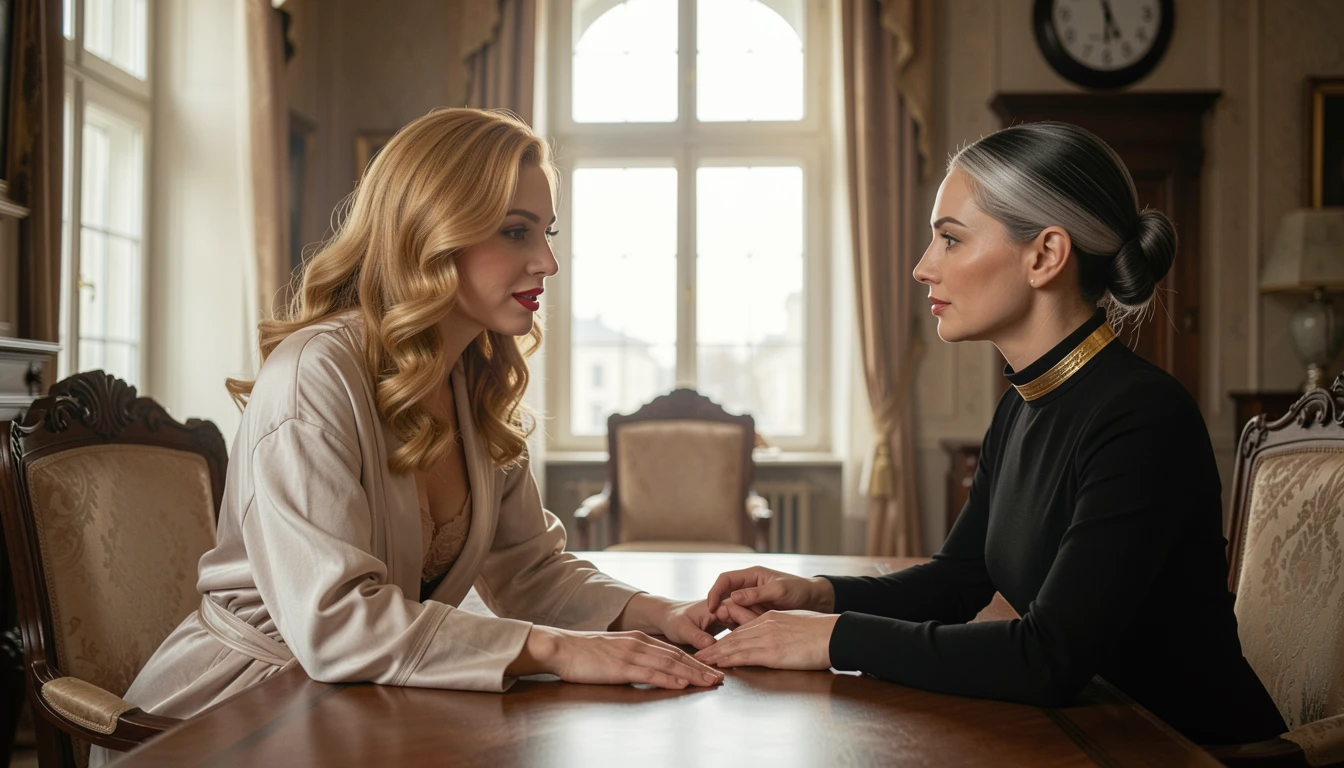
The morning light came through the tall windows in long pale slabs, catching the dust motes that hung in the air above the breakfast table. I sat across from Dmitri and Irina, my hands flat on the polished mahogany, the silver cross cool against my collarbone beneath the collar of my gray dress.
Elena had cleared the plates an hour ago, but none of us had moved. The coffee had gone cold in my cup. I'd been staring at the grain of the wood, tracing the whorls with my eyes, trying to find the words that had been circling in my chest since I woke.
"Tell us," Dmitri said. Not a command. An invitation. His voice was soft in a way it rarely was outside the chapel, the edges worn smooth by patience.
I lifted my gaze. He sat at the head of the table in his usual dark suit, the black rosary I'd made him wrapped around his wrist beneath his cuff. Irina was beside him, her severe bun catching the light, the blue beads of her own rosary visible at her throat where they'd tangled with the gold collar she always wore.
They were both watching me like I was something fragile. Something precious.
"I've been weighing names," I said. My voice came out rougher than I meant it to. "For the baptism. Father Alexei asked me to choose, and I thought I'd decided, but—" I stopped, pressing my palms flat against the table. "Every time I settle on one, it slips away."
Irina tilted her head. The movement was small, almost birdlike, but I caught the way her dark eyes sharpened. "Which ones have you considered?"
"Pelagia." I said it like I was testing the weight of it on my tongue. "She was an actress. A courtesan. She converted and spent her life as a hermit, disguised as a man, and no one knew until she died." I paused. "I thought—I thought if she could be remade, maybe I could too."
Dmitri's fingers moved, a slow roll of the black beads against his wrist. He didn't speak, but the silence was a question.
"And Mary of Egypt," I continued. "Father Alexei told me her story. She was a prostitute for seventeen years, and she walked into a church and couldn't cross the threshold until she prayed. She spent forty-seven years in the desert afterward." I swallowed. "She let herself be seen. That's what he said about her. That she was forgiven because she let herself be seen."
Irina's hand moved to her throat, touching the blue beads there. Her voice was quiet when she spoke. "And Thérèse?"
"The little way." I almost smiled. "Do small things with great love. I thought—I thought maybe I could be that instead. Small. Quiet. Not a dramatic conversion in the desert, just—" I gestured vaguely at the room, at the life I'd somehow stumbled into. "This. Learning to make breakfast and pray the rosary and love the people in front of me."
The clock on the mantel ticked. Ten forty-seven in the morning, and I could feel the weight of the day pressing down on me, the hours until the vigil counting down like grains of sand through a glass I couldn't turn over.
Dmitri leaned forward, his forearms resting on the table. The movement brought him closer, and I caught the scent of him—cigar smoke and something clean, like cedar. "I've prayed," he said slowly, "that you'd choose a name that carries your past without being bound by it."
I blinked. "What does that mean?"
"Pelagia hid who she was. Mary of Egypt ran from who she was—until she couldn't anymore, and then she let God remake her. Thérèse never had to reckon with the things you've survived." He held my gaze, his dark eyes steady. "You need a name that acknowledges the woman you were without letting her define the woman you're becoming."
The words landed somewhere deep in my chest, settling like stones in still water.
"I've always seen hope in you," Irina said softly. "Not shame. From the first moment I met you, when you knelt in that chapel and didn't know the words you were praying—I saw hope." She touched the blue beads at her throat again, a gesture I'd come to recognize as her reaching for strength. "I named my cross Nadezhda because that's what I wanted to become. But you—you were already that. You just couldn't see it."
Something in my throat tightened. I looked down at my hands, at the fingers that had threaded hundreds of beads onto silver wire over the past weeks, that had written nine letters of forgiveness and meant every word.
"I don't feel like hope," I admitted. "I feel like a woman who's still learning to stop flinching."
"Hope isn't the absence of fear," Dmitri said. "It's the decision to keep walking anyway."
The clock ticked. Ten fifty-two.
I opened my mouth to say something—I don't know what, maybe that I still felt like Pelagia, hiding, or Mary, running—but the word that came out wasn't either of those names.
"Nadezhda."
It surfaced like a stone breaking water, like something that had been submerged so long it had forgotten it was ever meant to see the light. The sound of it hung in the air between us, and I felt it settle into my bones with a rightness that made my breath catch.
Irina's eyes went wide. Her hand flew to her mouth, and I saw the glint of tears before she blinked them back.
Dmitri went very still.
"Nadezhda," I said again, slower this time, tasting each syllable. Hope. The name Irina had given her cross. The name I'd written into the family book for a future daughter. The name that had been waiting for me all along, buried under the weight of Pelagia's disguises and Mary's desert and Thérèse's little way.
And then I felt it—a flutter low in my belly, like wings beating against the inside of my skin. Then another, stronger. The twins turning, pressing against the walls of me as if they recognized the word I'd spoken.
I gasped, one hand flying to my stomach. "They moved."
"What?" Irina was out of her chair in an instant, rounding the table, her hand reaching for my belly before she caught herself and looked up at me, asking permission with her eyes.
I nodded, and her palm pressed against the swell of my dress. For a moment, nothing. Then another flutter, right beneath her hand.
Her face transformed. The severe lines softened, and for a moment she looked almost young, almost girlish, her dark eyes shining. "They know," she breathed. "They know their mother's name."
Dmitri had risen too, standing behind Irina, his hand hovering near my shoulder. He didn't touch me, but I could feel the heat of him, the solid presence of him, and I reached up and caught his fingers, pulling him down to me.
His palm joined Irina's on my belly, and I felt the twins move again—a strong, insistent kick against his hand, as if they were reaching for him too.
"Nadezhda," Dmitri said, and the word sounded different in his mouth—reverent, almost prayerful. "Hope."
I laughed, and the sound came out wet. "I didn't plan this. I didn't—I thought I would choose one of the saints. I thought—"
"You thought you had to become someone else," Irina said softly. "You thought the name had to be a transformation. But Nadezhda isn't a name you become, little sister. It's a name you've been living since the day you knelt in that chapel and prayed in a language you didn't know you spoke."
The tears I'd been holding back broke free, sliding hot down my cheeks. I didn't wipe them away. I let them fall, let Irina's hand cup my face, let Dmitri's thumb brush the wetness from my other cheek.
"Nadezhda," I whispered again, and the twins turned inside me like they were settling into the sound of it, like they'd found their way home.
The clock struck noon.
The chimes filled the room, bright and golden, and I felt the weight of the moment settle over me—not heavy, but warm, like a blanket I'd been shivering without.
"I need to tell Father Alexei," I said, my voice still thick with tears. "He asked me to choose before the vigil, and I—" I laughed again, shaky and wondering. "I think I just did."
Irina pulled back, her hands finding mine and squeezing. "He'll be overjoyed. He's been praying for you to find the right name."
"You knew," I said, looking at her. "You knew before I did. You gave me that cross—" I touched the silver at my throat, the one engraved with her mother's name. "You told me it meant hope. You told me that's what you wanted to become." I swallowed. "Did you know I'd choose it?"
Irina's smile was soft, almost sad. "I hoped." She touched the blue beads at her throat. "I hoped you'd see yourself the way I see you."
Dmitri's hand found the back of my neck, warm and grounding. "Nadezhda Volkov," he said quietly, and the sound of my future name—his name—made something in my chest crack open. "It suits you."
I looked up at him, at the man who had claimed me in a jet, who had knelt beside me in a chapel, who had confessed his sins to me in the dark and asked me to be his wife. The man who had given me his mother's prayer book and his mother's medal and his name, without ever asking me to become someone I wasn't.
"Nadezhda Volkov," I repeated, and the twins kicked again, hard enough that I felt it in my ribs. "They like it."
"They know their mother," Dmitri said. "They've always known."
I stood, and the movement made the room shift around me. Irina steadied me with a hand on my elbow, and Dmitri was there, his arm around my waist, and for a moment I just breathed, letting the reality of it wash over me.
In two days, I would stand in the baptismal font and Father Alexei would pour water over my head and speak the words that would wash me clean. And when he asked me my name, I would say it—Nadezhda—and it would be true in a way that Carter's name had never been, in a way that Isabella's name was only beginning to be.
"I want to go to the chapel," I said. "I want to pray."
Dmitri's arm tightened around me. "I'll come with you."
Irina shook her head, a small smile playing at her lips. "No. This is between you and God now. I'll find Elena, tell her the news. She'll want to make something special for lunch."
She kissed my cheek—a quick, fierce press of her lips—and then she was gone, her heels clicking down the hallway toward the kitchen.
Dmitri looked down at me, his dark eyes searching mine. "Are you all right?"
I nodded, and the movement felt truer than it had in days. "I think I am. For the first time in—" I paused, trying to find the words. "I think I might actually be all right."
He didn't smile, but something in his face softened. He took my hand, his fingers interlacing with mine, and led me out of the sitting room and down the long hallway toward the east wing.
The chapel was cold when we entered, the way it always was—the stone walls holding the chill of the Moscow winter even as the spring pressed against the windows. The Saint Michael stained glass caught the noon light, casting blue and gold patterns across the floor, and I felt the familiar hush settle over me as the door closed behind us.
I walked to the front pew and knelt, my hands finding the worn wood of the rail. Dmitri knelt beside me, close enough that I could feel the warmth of his shoulder against mine, but not touching. Giving me space.
I closed my eyes and let the silence wash over me.
Nadezhda. Hope.
The word echoed in my chest, in my bones, in the soft movements of the twins against my belly. I thought of the grandmother on the corner, her whispered confession, her promise to weep at my baptism. I thought of Monica, who had walked out of her past and into the light. I thought of Mary of Egypt, who had crossed the threshold of a church she couldn't enter until she prayed.
And I thought of myself—Carter, who had been remade into Isabella, who had been sold and used and broken and remade again, who had written nine letters of forgiveness and meant every word, who had given away fifty rosaries to strangers on a frozen street corner and watched God multiply them into a garden.
I wasn't Pelagia, hiding in the desert. I wasn't Mary, running from her past until she couldn't anymore.
I was Nadezhda. Hope. The thing that kept walking anyway.
"Thank you," I whispered, and I wasn't sure if I was speaking to God or to the man beside me or to the woman I was becoming. "Thank you for not letting me give up."
Dmitri's hand found mine in the silence, warm and solid. He didn't speak, but he didn't need to.
We knelt there together, the noon light falling over us in blue and gold, and I felt the twins settle inside me, quiet and content, as if they too had found their rest.
The vigil was in two days. The wedding was a week after that.
And I—Nadezhda, hope—was finally ready to step into the light.
The silence in the chapel deepened around us, but it wasn't empty. It was full—full of the weight of the name I'd spoken, full of the presence of the man beside me, full of the small lives turning inside my body. I kept my eyes closed, letting the stillness hold me, and I felt something loosen in my chest that I hadn't known was clenched.
Dmitri's thumb traced a slow circle on the back of my hand. "What are you thinking?"
I opened my eyes, looking at the stained glass—Saint Michael, his sword raised, his wings catching the light. "I'm thinking about how strange it is," I said, "to feel like I'm finally becoming the person I was supposed to be all along. After everything. After all the wrong turns."
"Not wrong turns," Dmitri said quietly. "The road."
I turned to look at him. His face was in profile, the strong line of his jaw softened by the colored light falling over us. He looked younger in the glow of the stained glass, less like the man who commanded rooms and more like the boy who'd knelt in this chapel thirty years ago, praying for his mother.
"You really believe that," I said. "You really believe none of it was wasted."
"I believe God doesn't waste anything." He turned to meet my eyes. "Not the years I spent running from Him. Not the sins I confessed to you in the dark. Not the nights you spent in that brothel, or the hands that hurt you, or the fear you carried like a second skin." His voice dropped. "I believe He was there in all of it, waiting for you to find your way to this moment."
My throat tightened. "That's a hard thing to believe."
"I know." He lifted our joined hands, pressing them briefly to his chest, over his heart. "I've spent thirty years learning to believe it. You have two days."
A laugh escaped me, wet and surprised. "Two days to learn what took you thirty years."
"You've always been a fast learner." There was warmth in his voice, a tenderness that made my chest ache. "You learned Russian in weeks. You learned to pray in a language you didn't know you spoke. You learned to forgive the unforgivable." He paused. "I have no doubt you'll learn to believe you're worthy of the light."
The words settled over me like a blessing. I looked down at our joined hands—his large and weathered, mine smaller, softer, the fingers that had threaded so many beads onto wire. In two days, those hands would hold a candle at my baptism. In a week, they would hold mine at the altar.
"Dmitri," I said, and something in my voice made him go still. "I never said it back."
He frowned slightly. "Said what back?"
"When you told me you loved me. In the sitting room, after I came back from the corner." I swallowed. "I felt it. I felt it so strongly I thought I might break open with it. But I didn't say it." I looked up at him, letting him see the tears gathering in my eyes. "I was afraid that if I said it out loud, it would make it real, and if it was real, I could lose it."
His hand tightened around mine. "Isabella—"
"Nadezhda," I corrected softly. "I'm Nadezhda now."
He was silent for a long moment. Then he said, very quietly, "Nadezhda."
"I love you." The words came out steady, sure, like they'd been waiting in me all along. "I love you, Dmitri Volkov. I love the way you pray with your whole body. I love the way you confessed your sins to me like they were gifts you were trusting me to hold. I love the way you look at me like I'm already whole." I reached up with my free hand, touching his face. "I love you, and I'm not afraid to say it anymore."
Something broke open in his face. Not the controlled mask he wore for the world, not even the softness he showed me in the chapel—something rawer, younger, more vulnerable. His breath came out shaky, and he pressed his forehead to mine, his eyes closed.
"I have waited," he said, his voice rough, "so long to hear you say that."
"I'm sorry it took me so long."
"Don't be." He pulled back, his dark eyes shining. "You said it when you were ready. That's all I ever wanted."
He kissed me then—soft, reverent, a press of lips that was more prayer than passion. I felt it down to my toes, felt the twins stir in response, and I kissed him back with everything I had, pouring into it all the words I hadn't been able to say.
When we broke apart, we were both breathing hard. The colored light fell over us, blue and gold, and I felt like I was standing at the edge of something vast and beautiful, about to step into it.
"Two days," Dmitri said, his voice still rough. "Two days until you're washed clean. And then a week after that, I get to marry you."
"Nadezhda Volkov," I said, testing the name again. It felt different now, warmer, like it had been waiting for this moment to become fully mine.
"Nadezhda Volkov," he repeated, and the sound of it in his mouth was a promise.
I looked past him, at the altar, at the candles that would be lit for the Easter Vigil. In two days, I would stand in that font and be reborn. In nine days, I would stand at this altar and become his wife. And somewhere in between, I would learn to believe—truly believe—that I was worthy of all of it.
I didn't have to be Pelagia, hiding in the desert. I didn't have to be Mary, running until she couldn't anymore. I just had to be Nadezhda—hope—the woman who kept walking anyway.
And for the first time since I'd been remade, I wasn't walking toward something I feared. I was walking toward something I loved.
The chapel door opened behind us, letting in a shaft of brighter light. I turned, expecting Irina, but it was Elena, her face flushed from the kitchen, a smile tugging at her lips.
"Forgive the interruption," she said, her accent thickening the words. "But Irina told me the news, and I couldn't wait. Nadezhda." She said the name like she was tasting something sweet. "It suits you."
I felt heat rise to my cheeks. "Thank you, Elena."
"I've made a cake," she said, her smile widening. "For lunch. To celebrate." She paused, her eyes flicking to Dmitri. "Irina said you'd be in the chapel. She said to tell you—" Elena's voice caught, and she pressed a hand to her chest. "She said to tell you that your mother would be proud."
The words hit me somewhere I hadn't expected—somewhere below the ribs, in the hollow where Carter used to live. My throat closed, and I had to look away from Elena's face, down at my hands where they rested on the pew. Dmitri's mother. A woman I'd never met, whose prayer book I now held in my hands at night, whose medal hung warm against my chest, whose name Irina had given me in silver. And she would have been proud of me. Of a former man, a former whore, a woman carrying twins out of wedlock who had somehow stumbled into her son's chapel and found God waiting.
"Thank you," I managed, and my voice cracked on the second word. Elena's smile softened, and she nodded once—a small, knowing gesture—before she turned and slipped back out through the chapel door, leaving the shaft of brighter light to narrow and die behind her.
I sat in the silence of the chapel for a long time after Elena left, Dmitri's hand still wrapped around mine. The noon light had shifted, the blue and gold of Saint Michael's window sliding across the floor in slow degrees, and I watched it move like I was watching time itself pass. Two days. Forty-eight hours until I stood in that font and let the water wash over me. The thought should have terrified me. Instead, it felt like the most real thing I'd ever known.
Dmitri rose first, his knees cracking softly as he stood. He didn't pull me up, just waited, his hand extended. I took it and let him draw me to my feet, the swell of my belly pressing against the wool of my dress. The twins had gone quiet again, worn out by their celebration.
"I should find Father Alexei," I said. "Tell him before the vigil."
Dmitri nodded. "He'll be in the parish house. I'll have the car brought around."
"No." The word came out faster than I meant it to. "I want to walk. It's not far."
He studied me for a moment, his dark eyes unreadable. Then he reached up and brushed a strand of hair from my face, the gesture so tender it made my chest ache. "I'll walk with you."
The streets were thawing. Spring had finally come to Moscow, and the slush that had lined the curbs for months was giving way to bare wet asphalt. The air smelled like wet stone and diesel, and somewhere a dog was barking. I walked with Dmitri's hand at the small of my back, the silver cross warm against my collarbone, and I felt the name settling into me with every step.
Nadezhda. Hope. The word was a rhythm in my chest, a heartbeat I hadn't known was missing until I found it.
The parish house was a squat brick building behind the church, its paint peeling in strips. Father Alexei answered the door in his shirtsleeves, his collar loose, a pair of reading glasses perched on his nose. He took one look at my face and stepped aside, waving us in without a word.
"I've chosen," I said, before I'd even crossed the threshold. The words felt like they'd been waiting to be spoken all day.
He led us into his small study, cluttered with books and candle stubs and the faint smell of incense. He gestured to a worn armchair, and I sank into it, Dmitri standing behind me with his hand on my shoulder. Father Alexei settled across from me, his eyes bright behind the glasses.
"Tell me."
"Nadezhda." I said it plainly, without ceremony. "I want to be baptized Nadezhda."
Father Alexei went still. For a long moment, he just looked at me, and I saw something move behind his eyes—surprise, maybe, or recognition. Then he smiled, slow and warm, like the sun breaking through winter clouds.
"You know the story of Saint Nadezhda," he said. "The martyr. She was one of three sisters—Vera, Nadezhda, and Lyubov. Faith, Hope, and Love. They were children when they were killed for their faith, and their mother died with them." He paused. "She was thirteen years old."
I blinked. "I didn't know."
"She was young. She was afraid. And she stood anyway." Father Alexei leaned forward, his elbows on his knees. "The name means hope, but it also means the courage to hope when hope seems foolish. That's what you've been doing since the day you knelt in my church and prayed in a language you didn't know you spoke."
The words landed in me like stones in still water, sending ripples outward. I thought of the grandmother on the corner, her whispered confession. I thought of Monica, who had walked out of her past into the light. I thought of the nine strangers who had come back to learn to pray, and the twenty who had come after them.
"I didn't choose her because of the martyrdom," I said. "I chose her because of the hope."
"They're the same thing," Father Alexei said. "Hope isn't optimism. It's the decision to keep walking when the road is dark. It's the choice to believe that the light is real even when you can't see it." He smiled again. "You've been living that name for weeks. Now you'll carry it into the font."
I felt the tears prick my eyes again, and I didn't fight them. "Thank you, Father."
"I'll be there," he said. "I'll be the one who pours the water."
Dmitri's hand tightened on my shoulder, and I reached up and covered it with my own.
We stayed in the parish house until the light outside began to fade, Father Alexei walking me through the vigil liturgy, the prayers I would hear, the responses I would make. He gave me a candle to hold during the ceremony, its wax still cool and clean, and I wrapped my fingers around it like it was something precious.
"The light of Christ," he said, "entering the world. You'll carry it into the church, and you'll pass it to the person next to you, and they'll pass it on, until the whole building is burning with the same flame." He paused. "That's what you've been doing on that street corner, Nadezhda. Passing the light."
I looked down at the candle in my hands, at the small flame I could almost see waiting to be lit, and I felt something settle in me that I hadn't known was restless.
The walk back to the house was longer. Dmitri and I took the slow way, along the river, where the ice had cracked and the water ran dark and quick beneath it. He didn't speak, and neither did I. We just walked, our shoulders brushing, the silence comfortable between us.
The house was warm when we entered, the smell of Elena's cooking wrapping around me like a blanket. Irina met us in the hallway, her face bright, and she pulled me into a quick embrace before I could even take off my coat.
"Elena's made a feast," she said. "And I've opened a bottle of wine that Dmitri's been saving for a special occasion."
"I thought we were celebrating at lunch," I said.
"Lunch was a cake. This is a feast." Irina's eyes sparkled. "Nadezhda deserves a feast."
I laughed, and the sound surprised me. It was light, free, like something I hadn't heard from myself in a long time.
Dinner was loud and warm and full of laughter. Elena had made some kind of roasted meat I couldn't name, and potatoes, and a rich dark bread that I ate too much of. Irina kept refilling my glass with the wine—a red, velvety thing that Dmitri said came from a vineyard in Georgia—and even though I only had one glass, the warmth of it spread through me like a second sun.
Dmitri watched me across the table with an expression I couldn't quite read. Not hunger, exactly. Something softer. Something that made my stomach flip in a way that had nothing to do with the twins.
After dinner, Elena cleared the plates and Irina retreated to her room, claiming exhaustion. I found myself alone with Dmitri in the sitting room, the fire crackling in the hearth, the velvet drapes drawn against the night.
"You're staring," I said.
"I'm admiring." He was sitting in the armchair across from me, his long legs stretched out, his black rosary wrapped around his wrist. "I've been waiting years to see you like this."
"Like what?"
"At peace."
The word hit me somewhere unexpected. I looked down at my hands, at the fingers that had threaded so many beads, written so many letters. "I don't know if I'd call it peace. It's more like—" I paused, searching for the word. "Like I've stopped fighting the current. Like I'm finally letting it carry me somewhere."
Dmitri rose from his chair and crossed the room. He knelt in front of me, his hands finding mine, his dark eyes level with my own.
"I love you," he said. "I love you, Nadezhda. I love the name you've chosen, and I love the woman who chose it." He lifted my hands to his lips, pressing a kiss to each palm. "In two days, you'll be washed clean. In nine days, you'll be my wife. And I will spend the rest of my life making sure you never regret either of those choices."
My throat tightened. "I don't think I could."
"Regret?"
"Love you." The words came out steady, sure. "I don't think I could regret loving you."
He kissed me then, slow and deep, and I felt the twins stir in response, a flutter of movement against my belly. I pulled back, laughing, my hand pressed to the swell.
"They're active tonight," I said.
Dmitri's hand joined mine, warm and broad, and we sat there in the firelight, feeling the small lives moving beneath our palms.
"They know their mother's happy," he said.
I leaned into him, letting my head rest against his shoulder. "I think they do."
The next day passed in a blur of small moments. I helped Elena in the kitchen, learning to make a soup she said would be good for the babies. I sat with Irina in the sitting room, her hands working a piece of embroidery while I threaded beads onto wire, making a new rosary for the grandmother from the corner who had promised to weep at my baptism. I knelt in the chapel with Dmitri, praying the Glorious Mysteries, the twins moving inside me like they were praying too.
And all through it, the name settled into me. Nadezhda. Hope. It felt less like a costume with each passing hour, less like something I was trying on and more like something that had always been waiting for me to claim it.
That night, I couldn't sleep. I lay in my bed, the candle Father Alexei had given me on the nightstand, the silver cross warm against my chest, and I watched the moonlight shift across the ceiling. Tomorrow was the vigil. Tomorrow, I would stand in the font and be reborn.
The thought should have terrified me. Instead, it felt like the most real thing I'd ever known.
I rose before dawn, dressing in the gray dress I'd worn for weeks now, the one that was starting to strain across my belly. I pinned my hair back, clipped the silver cross at my throat, and went down to the chapel to pray.
The church was dark when I entered, lit only by the flicker of the sanctuary lamp. I knelt in the front pew, my hands finding the worn wood of the rail, and I let the silence wash over me.
"I'm scared," I whispered into the dark. "I'm scared I'm not ready. I'm scared I'll step into that water and come out the same person I was before." I paused, the words catching in my throat. "I'm scared I'll fail them. The babies. Dmitri. Irina. You."
The silence stretched, vast and patient.
"But I'm here," I said finally. "I'm still here. And I'm trying. I'm trying so hard."
The sanctuary lamp flickered, and I felt something settle in my chest—not an answer, not a sign, but a presence. A warmth that had nothing to do with the cold stone walls.
I stayed there until the light began to change, the first gray fingers of dawn reaching through the stained glass.
The day of the vigil passed in a haze of preparation. Irina helped me dress, her fingers nimble on the buttons of my white dress—a simple thing, high-necked and long-sleeved, that she said had been her mother's. It was too big in the shoulders and too tight across the belly, but when I looked in the mirror, I saw a woman I almost didn't recognize.
"You look beautiful," Irina said softly.
I touched the fabric, the worn softness of it. "It was your mother's."
"She wore it when she was baptized." Irina's voice was quiet. "It's been waiting for another woman to wear it."
The words hit me somewhere deep. I turned to her, and she was crying, silent tears sliding down her cheeks.
"Irina—"
"I'm just so proud of you," she said, her voice cracking. "I never thought—when I met you, I never thought I'd see you like this. And now you're going to stand in that water and become hope itself." She wiped her eyes with the back of her hand. "I'm just so proud."
I pulled her into a hug, feeling the fragile strength of her body against mine. "Thank you," I whispered. "Thank you for seeing me."
The church was full when we arrived. I saw the grandmother from the corner, seated in the back, her daughter beside her. I saw Yuri, the widower, holding his wife's rosary. I saw Monica, her face bright with tears. And I saw Luca, standing in the shadows near the door, his hazel eyes fixed on me.
I hadn't expected him to come. I'd invited him, yes, but I hadn't let myself believe he would. And yet there he was, his salt-and-pepper hair catching the candlelight, his soft hands folded in front of him.
Dmitri stood beside me, his hand finding mine. "Are you ready?"
I looked at the baptismal font, the water gleaming in the candlelight. I looked at Father Alexei, waiting with the holy oils and the white robe. I looked at the congregation—the people I'd brought to this church, the people who had brought me.
"I'm ready," I said.
Father Alexei took my hand and led me to the font. He asked me the questions—do you renounce Satan, do you renounce his works, do you believe in God the Father, the Son, the Holy Spirit—and I answered each one, my voice steady, my heart pounding.
And then he poured the water over my head, cool and clean, running down my face and my neck and my shoulders, and he said the words that would remake me.
"Nadezhda, I baptize you in the name of the Father, and of the Son, and of the Holy Spirit."
The water ran over me, and I felt it—a lightness, a lifting, like something heavy that had been weighing me down for years was finally washing away. I gasped, and the twins turned inside me, and I felt them move in a way that felt like joy.
When I opened my eyes, the congregation was on its feet, clapping and crying and singing. The grandmother was weeping, her hands pressed to her chest. Monica was beaming. Irina was crying openly, her blue beads clutched in her hand.
And Dmitri was there, his dark eyes shining, his hand reaching for mine.
"Nadezhda," he said, and the name sounded like a prayer.
I stepped out of the font, dripping and reborn, and I walked into his arms.
His arms closed around me, and for a moment the world narrowed to the heat of his body against my wet dress, the thrum of his heartbeat through his chest, the smell of him—cologne and candle smoke and something clean like rain. The water dripped from my hair down my neck, and I didn't care. I pressed my face into his shoulder and let myself be held.
"You're cold," he murmured against my hair.
"I'm not." And I wasn't. I was burning, a fire lit somewhere in my chest that had nothing to do with the temperature of the room. I pulled back just enough to look at him, and I saw the tears standing in his dark eyes, unshed but bright.
"Nadezhda," he said again, softer this time, like he was tasting the name on his tongue and finding it sweet.
I reached up and touched his face, my fingers wet against his cheek. "I love you." The words came out without thought, without fear. "I love you, Dmitri."
Something broke open in his expression. He kissed me then, in front of everyone—in front of the grandmother and Monica and Yuri and Luca and all the people who had come to watch me die to my old self and rise into the new. He kissed me like I was the only person in the room, and I kissed him back, my hands fisting in the lapels of his jacket, the taste of holy water on both our lips.
The congregation cheered. I heard Irina's laugh, bright and broken, and the grandmother's weeping, and the sound of hands clapping together like rain on a roof. But all of it was distant, a roar at the edge of my awareness. What mattered was Dmitri's mouth on mine, and the twins turning inside me, and the name that had become mine.
When we finally broke apart, Father Alexei was waiting with a towel, his face creased with a smile that reached all the way to his eyes. "Welcome home, Nadezhda," he said, and wrapped the towel around my shoulders.
"Thank you, Father." My voice was hoarse. "For everything."
"The thanks belong to God." He pressed the towel tighter around me, a father's gesture, warm and sure. "But I'll take a cup of tea from you before the week is out."
I laughed, and the sound was wet and unsteady. "You'll have it."
Irina reached me then, her blue beads clutched in one hand, her face streaked with tears. She didn't speak—she just pulled me into a fierce embrace, her arms locking around me like she was afraid I'd disappear. I hugged her back, feeling the fragile strength of her, the way she shook with the force of her joy.
"Little sister," she whispered into my hair. "My little sister."
"Irina." I held her tighter. "Thank you. For the dress. For everything."
She pulled back, wiping her eyes with the back of her hand. "You wear it better than I ever could have."
The grandmother from the corner was next, her daughter steadying her as she shuffled forward. She reached out and took my hands, her skin papery and warm, and she looked at me with eyes that had seen fifty years of shame and fifty years of grace.
"I told you," she said, her voice thick with tears. "I told you I would weep."
And she did, tears sliding down the deep lines of her face, and I wept with her, the two of us standing in the aisle of the church like two women who had been given back something they'd thought was lost forever.
Monica hugged me wordlessly, her face bright, and Yuri pressed his wife's rosary to his lips and then to my hand. The strangers from the corner came too, one by one, and I realized with a start that they were not strangers anymore. They were my people. My flock. The garden I had planted and watched bloom.
And then, at the edge of the crowd, I saw Luca.
He hadn't moved from the shadows near the door. His hazel eyes were fixed on me, and there was something in his face I couldn't name—not quite sorrow, not quite pride. Something in between, something that looked like the ghost of a man who had once thought he owned me.
I excused myself from the grandmother and walked toward him. The crowd parted around me, still buzzing with celebration, and I stopped a few feet away, the wet hem of my dress pooling on the stone floor.
"You came," I said.
"I said I would." His voice was quiet, measured. "I wanted to see you."
"See me?"
"Reborn." He said the word carefully, like it was a foreign language. "I wanted to see what you would become."
I studied him—the salt-and-pepper hair, the soft hands, the lines around his eyes that hadn't been there when I'd first met him. He looked older. Tired. Like a man who had spent a long time carrying something heavy.
"I'm not the woman you made," I said. "I'm not the woman you sold."
"I know." His voice was barely audible. "I know, Isabella."
"Nadezhda," I corrected him, gently. "My name is Nadezhda."
The word hung between us. He opened his mouth, closed it, and then nodded slowly. "Nadezhda," he repeated, and the name sounded strange on his tongue, like a bird trying to learn a new song.
I reached out and took his hand. It was warm, familiar, the hand that had painted me and fed me and taught me to want things I'd never known I could want. I squeezed it once, then let go.
"Thank you," I said. "For coming. For letting me go."
His eyes glistened. "I never really let you go, Nadezhda. I just—" He stopped, swallowed. "I learned to hold you differently."
I didn't know what to say to that. So I just nodded, and stepped back, and let Dmitri's hand find mine again, warm and solid and mine.
The rest of the vigil passed in a blur of light and song. The candles were lit, one from another, until the whole church was burning with the same flame. I held my candle high, the wax warm against my fingers, and I passed the light to Dmitri, and he passed it to Irina, and she passed it to the grandmother, and on and on until the darkness was pushed back to the corners.
I received the Eucharist for the first time, the host dissolving on my tongue like something sweeter than bread. I heard the Exsultet sung, the ancient words rolling over me like water, and I felt the twins move inside me in response, a flutter of life that felt like a yes.
When it was over, when the last hymn had faded and the candles had been snuffed one by one, I stood in the doorway of the church and looked out at the Moscow night. The air was cold and clean, the stars sharp overhead, and I felt the name settle into me like a stone settling into a riverbed.
Nadezhda. Hope.
I was not the woman who had entered that church. I was not the man who had been remade in a brothel, or the concubine who had been sold, or the girl who had prayed in a language she didn't know she spoke. I was something new. Something the water had washed clean.
Dmitri came up behind me and wrapped his arms around my waist, his chin resting on my shoulder. "How do you feel?"
I thought about it. The word came to me, simple and true.
"Free."
He pressed a kiss to my temple. "Good. That's how it should feel."
I leaned back into him, letting him hold my weight, the twins stirring between us. In nine days, I would marry this man. In a few months, I would hold our sons. And all of it, every step of it, had led me here, to this doorway, to this night, to this name.
"Nadezhda," I whispered to the stars, and the name echoed back to me, a promise and a prayer.
I stepped out into the night, and the world was waiting.