
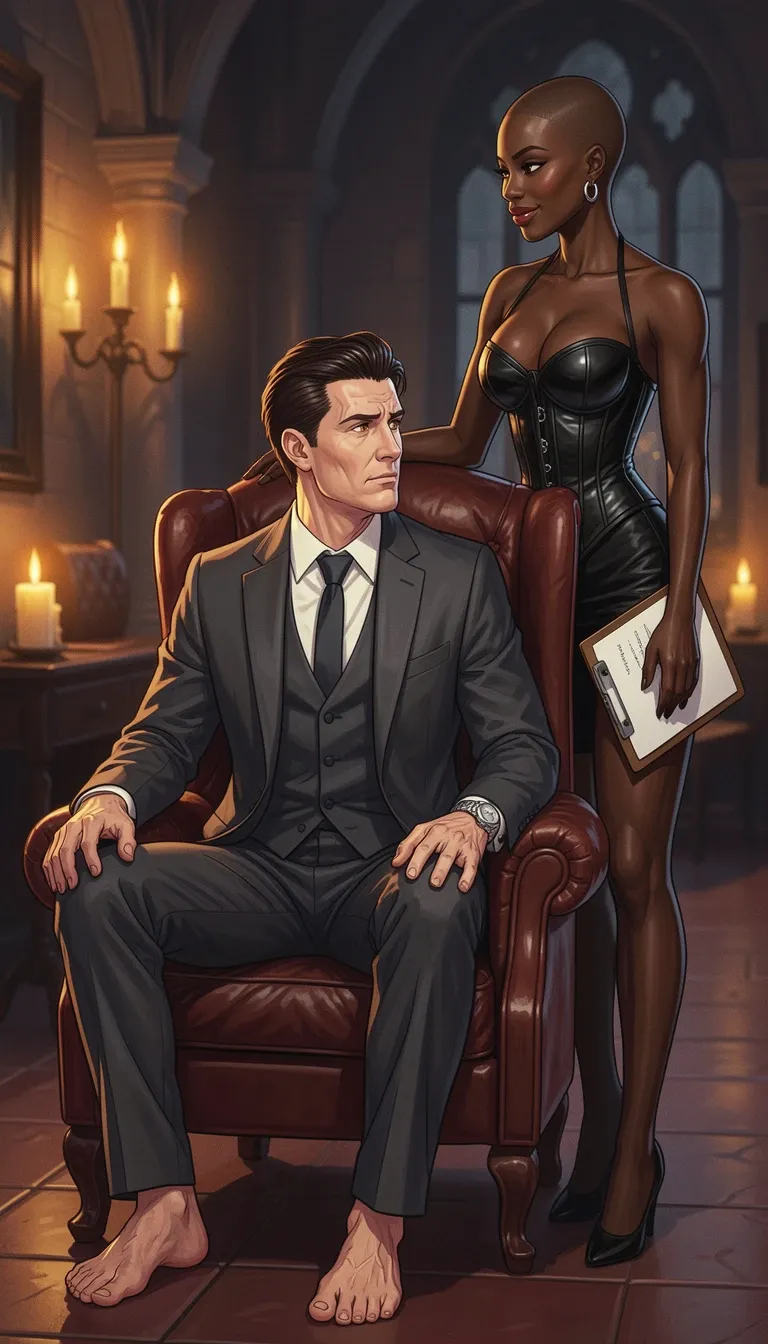
Tuesday night in Southwark smelled of rain on the pavement and the ghost of someone's cigarettes. Saffron Okoye had the window cracked anyway — the dungeon needed airing, and the air needed the reminder that the world outside was still turning.
She was thirty-nine years old and she had built this room herself. Not the building — the building was a Victorian warehouse with good bones and bad plumbing — but the room. The low light that fell in strips across the oak bench. The iron ring set into the wall at exactly the height of a standing man's wrist. The shelf of implements arranged by weight rather than by name, because weight was what a body understood first. She moved along it now, fingers passing over leather, over steel, over the long stiff feather she kept in a glass tube like a specimen.
She set the feather down on the table beside her clipboard. Then she set the clipboard down too, because the bell had rung at the street door and she did not want to be holding anything when she opened it.
Hugo Ferreira stood on her step with his collar turned up against the rain and his umbrella closed and dripping, and he looked exactly like the photograph he had sent: a man in a charcoal suit who had spent a great deal of money to look unremarkable. Forty-two years old, dark hair slicked back, a silver watch on his wrist that cost more than the deposit on the flat above her head. Hazel eyes that went straight past her face and into the room behind her, cataloguing it, the way a man catalogues a witness stand.
"Mr Ferreira."
"Mistress Okoye." He said it the way he might say *Your Honour* — correctly, and with a small private amusement. "Thank you for seeing me at short notice."
"I see everyone at short notice. It's the nature of the work." She stepped back. "Wipe your feet."
He looked at her.
"You heard me."
He wiped his feet on the mat. She watched him do it, and watched him know she was watching, and watched the small heat of it cross his neck before he got it back under control. Then he came in, and she shut the door, and the rain went quiet.
She sat him in the chair across from the table — a plain wooden chair, no arms, nothing to grip — and she took her own seat opposite him and laid the clipboard flat. The pen clicked. She liked the pen. It was a cheap plastic biro and it clicked like a knuckle and it made men nervous.
"Before we do anything," she said, "we talk. You've read the forms."
"I've read the forms."
"You've signed the forms."
"I have."
"Then this is just the two of us agreeing what they mean." She turned the top sheet. "Name, age, occupation."
"Hugo Ferreira. Forty-two. Barrister."
"Which chambers?"
He hesitated — not the hesitation of a man who didn't want to say, but of a man who wasn't used to being asked questions he hadn't prepared for. "I'd rather not."
"That's fine. I don't need it." She wrote *barrister* and nothing else. "Medical. Anything I should know. Heart, back, joints, skin conditions, medication."
"Nothing. I'm in good health."
"You're sure. Because I'm going to put your ankles in steel and leave you there for a while, and I don't want to find out about your trick knee the hard way."
"My knees are fine." A beat. "I run. Four times a week. Along the river."
"Good for you." She clicked the pen. "Alcohol before you came?"
"One glass of wine. Two hours ago."
"Fine." Click. "Now. The interesting column." She turned the page and let him see it — the printed rows, the little boxes, the words in her neat block capitals. "I'm going to read these out and you're going to tell me yes, no, or maybe. Maybe means we discuss it. No means no, and I don't ask again, and I don't sulk about it. Yes means yes tonight, and we can revisit it another night if you change your mind. Nothing here is a contract. It's a map. Understand?"
"I understand."
"Bondage."
"Yes."
"Restraint to furniture."
"Yes."
"Gags."
"No."
She wrote *no* without looking up. "Good. I like a man who knows his own mind. Blindfolds."
"Maybe."
"We'll discuss it." Click. "Impact play. Hands, cane, crop, paddle."
"No."
"Any of it?"
"None of it."
She looked up at him then, properly, and he met her eyes and did not flinch, and she thought: *interesting.* A man who wanted to be tied up and wouldn't take a single stroke. That narrowed things. That pointed somewhere.
"Wax. Clamps. Electricity."
"No. No. No."
"Degradation. Verbal."
"Maybe."
"Humiliation."
"Maybe."
"You're saying maybe a lot, Mr Ferreira. That's not an answer, that's a place to hide." She set the pen down. "Let me help you. When you imagine it — whatever it is you've been imagining, alone, in that flat of yours, for however many years — what's the part that makes your stomach drop? Not the part you'd admit to a colleague. The part you'd die before you said out loud."
The rain ticked at the window. Somewhere in the building a pipe knocked twice and went quiet.
"Tickling," he said.
The word came out small. It came out of a man who had spent his whole life making words do what he wanted, and it came out wrong — too quiet, too fast, the consonants gone soft at the edges.
Saffron did not smile. She had learned years ago that the moment you smiled at a man's secret he put it back in his pocket and buttoned it up. She picked up the pen and clicked it and wrote the word down.
"Tickling," she said, flat, ordinary, the way you'd say *knee.* "Where?"
"My—" He stopped. He looked at the ceiling. He looked at the iron ring in the wall. "My feet."
"Your feet."
"My soles. Mostly. The arches are—" He made a gesture with one hand, a barrister's gesture, *you take my point.* "The arches are the worst. Or the best. I don't know which word I mean."
"You mean the word is *worst,* and you want to find out if it can be *best.*"
He looked at her then, and something in his face came apart and went back together differently. "Yes," he said. "That's exactly what I mean."
"How ticklish are we talking. On a scale of one to ten, where one is *a bit of a giggle* and ten is *I cannot physically bear it.*"
"Twelve."
"I'm not being—" He stopped himself. Started again, more carefully, the barrister reasserting control of the room. "I'm not exaggerating for effect. I have been ticklish my entire life. It is, genuinely, the most unbearable physical sensation I know. I once had a medical examination and the doctor touched the arch of my foot and I kicked him in the chest. Reflex. I apologised for a week."
"And you want to be tied down and have that done to you."
"I want to be—" His jaw worked. "I want to be helpless about it. I want to not be able to stop it. I want—" He looked away. "I want to find out what's on the other side of not being able to stop it."
Saffron wrote for a moment. Then she set the pen down and folded her hands on the clipboard and said, "Safe word."
"Objection."
She raised one eyebrow. "You've thought about this."
"I've thought about this for eleven years."
"Then say it properly. I need to hear it in your voice, and I need to know you'll use it, and I need to know you know that using it is not a failure. It's the mechanism. It's the handbrake. Without it the car's just going to go off the road."
"Objection." His voice was steady. "If I say *objection,* everything stops. Immediately. No argument, no negotiation, no *just one more minute.* You stop, you let me loose, and we talk about what happened."
"And if you can't speak? If you're laughing too hard to get the word out?"
He blinked. He hadn't thought of that. She watched him not have thought of that, and watched him work it through, and watched him arrive somewhere.
"Then—" He wet his lips. "Then I tap. Three taps with my hand on whatever's nearest. Three taps means objection."
"Good. That's good." She wrote it down. "And if you're laughing too hard to tap?"
"Then you'll have to use your judgment."
"I always use my judgment. But I want you to hear yourself say it. If you're laughing too hard to tap, and I think you've had enough, I'll stop. And you don't get to argue with me about it afterward. That's the deal. I'm the one who decides when it's enough, and I decide it before you do, because that's the whole point of you being here. Yes?"
"Yes."
"Say it once more. The word."
"Objection."
"Objection," she said back, and the word sat between them on the table, and then she clicked the pen and it was agreed.
She stood. "Right. Clothes off. Down to your shorts. Shoes and socks first, and I want them off properly, not kicked into a corner."
He undressed the way he did everything — methodically, folding. The jacket over the back of the chair. The tie rolled. The silver watch set down last, face up, and she noticed he set it face up so he could see the time, and she noticed him notice her noticing, and neither of them said anything. His body under the suit was the body of a man who ran along the river four times a week: broad through the shoulders, a flat stomach going a little soft at the sides, dark hair on his chest and forearms. His shorts were plain navy cotton. He stood in them with his hands at his sides and his chin up, and he looked like a man awaiting sentence.
"On the bench," she said. "On your back."
The bench was oak, worn smooth, long enough for him. He lay back and the wood took his weight and he looked at the ceiling and his hands lay flat at his sides, and she saw his fingers find the edge of the bench and grip it, once, before he made them let go.
The spreader bar was steel, a metre of it, with a padded cuff at each end and a ratchet buckle. It was cold. She laid it across his shins first, just to let him feel the weight of it, and then she took his right ankle and fitted the cuff around it and pulled the strap through the buckle and ratcheted it down.
*Click. Click. Click.*
"Too tight?"
"No."
She did the left. *Click. Click. Click.* The bar held his ankles a shoulder's width apart and his legs straight, and she lifted the bar and set it into the two uprights at the end of the bench, and the effect was that his legs went up and his feet went up with them, soles turned toward her, and he was suddenly, entirely, at her mercy.
He made a sound. Not a word. Something small in the back of his throat.
Saffron stood at the end of the bench and looked at his feet.
They were, she thought, the best thing about him. She'd seen a lot of feet in this room and most of them were just feet — things a man stood on, callused and indifferent. Hugo's were not indifferent. They were long and narrow and well-made, the skin pale and clean, the nails trimmed short and square, and the arches were high, almost absurdly high, the kind of arch you saw in a drawing and assumed the artist had flattered. The tendons stood out along the top. The soles were smooth — too smooth, she thought; he'd been hiding them, probably, all his life, keeping them in socks and shoes and never letting anyone near. The low light fell across them and made a long shadow of the bar and the cuffs and the upturned soles.
"Oh," she said, softly, to herself. "You're going to be a problem."
"What?"
"Nothing. Just appreciating the view." She picked up the feather from the table. It was stiff, a good long quill, the barbs dense and springy. She turned it in her fingers and let him watch. "I'm going to start light. I want to hear what you sound like before I give you anything worth hearing. You understand?"
"Yes."
"And what do you say if it's too much?"
"Objection."
"Good." She laid the tip of the feather against the arch of his right foot.
He came off the bench. Not far — the bar held him — but his whole body arched and his hands slapped down on the oak and he made a noise like a man who had been expecting it and was still not prepared. The feather travelled, slow, from the ball of his foot to the heel, tracing the high curve of the arch, and Hugo Ferreira, who had won every argument of his adult life, made a sound that was not an argument.
"That's—" he gasped. "That's not— that's not fair, that's—"
"It's not meant to be fair." She drew the feather back down. "It's meant to be unbearable. You said twelve."
"I said—" He laughed. It came out of him in a helpless bark, entirely undignified, and she watched his face go red with it. "I said twelve, I didn't say— oh, God—"
She worked the feather in small circles at the base of his toes, where the skin was thinnest, and he pulled against the cuffs and the steel held him and his laugh went high and cracked. "Talk to me, Mr Ferreira. Tell me what it's like."
"It's—" He couldn't. He tried. "It's like— it's like being— I can't, I can't, please—"
"Please what?"
"Please—" He was laughing so hard he could barely get the words out. "Please don't stop. Don't stop, don't stop, don't—"
She didn't stop. She laid the feather down and used her nails instead, dragging them lightly, lightly, up the length of his left sole, and the sound he made was not a laugh anymore, it was something closer to a howl, and his hips bucked and the bench creaked and his hands scrabbled at the oak and found nothing to hold. She did it again. And again. His feet jerked and twisted in the cuffs and there was nowhere for them to go.
"Look at you," she said. "Forty-two years old and you can't keep your feet still."
"I can't—" He was weeping with it, a little, the corners of his eyes wet. "I can't, I can't, I can't—"
"You can. You are. You're doing beautifully." She dragged her nails down both soles at once. "You wanted to find out what was on the other side of not being able to stop it. This is it. This is the other side. Nothing happens. You just lie there and take it and laugh until you can't breathe, and I keep going, because I decide when it's enough."
"Objection—" he gasped, and she stopped instantly, hands off, and he lay there heaving and laughing and shaking and she watched him and waited.
"Was that real?" she asked.
"No." He was still laughing, helplessly. "No. God. No. I just wanted to hear you stop."
"That's a dangerous game, using the word when you don't mean it."
"I know. I'm sorry. I—" He got his breath. "I wanted to know it worked."
"It works." She picked up the feather again. "Now I'm going to make you sorry you asked."
She was gentler after that, which was somehow worse. The feather, drawn so slowly along the arch of his foot that he had time to anticipate every inch of it, to feel it coming, to know it was coming and be unable to do one single thing about it. He laughed until his ribs hurt. He laughed until the laugh turned into a kind of sob and then turned back into a laugh. His feet were pink now, warm under her hands, and she found she couldn't stop touching them — not for the tickling, just for the touching, the long clean line of them, the way the arch fit the cup of her palm.
"These are beautiful," she said. "Did you know that? You've got beautiful feet. You've been hiding them in those shoes for years."
He couldn't answer. She bent her head and kissed the arch of his left foot, slow, open-mouthed, and he made a sound that had nothing to do with laughter at all.
"Oh," he said. "Oh, that's—"
"That's what?"
"That's— nobody's ever—"
"Nobody's ever kissed your feet?" She kissed the right arch, the same way, and felt him shiver all the way up his body. "Then nobody's been paying attention." She kissed the ball of his foot, the base of his toes, the soft pad beneath them. "Open your mouth."
"What?"
"You heard me. Open your mouth." She took his right foot in both hands and brought it up. He understood, and his mouth opened, and she slid her toes — her own toes, bare, warm — past his lips. "Suck."
He sucked. He was clumsy at first, unsure, and then something in him gave way and he did it properly, his tongue curling around her toes, his mouth working. She watched his eyes go half-closed and his whole body go still and quiet for the first time since she'd touched him.
"Good," she said. "That's a good boy. You like that."
"Mmph—"
"I know you do. You've got a mouth on you, Mr Ferreira. All those clever words. And here you are." She let him suck a moment longer, then drew her foot back and stood over him. "Now. I'm going to sit on your face. And you're going to keep doing that with your mouth, and you're going to do it well, because I've been on my feet all day and I intend to enjoy my Tuesday night. And while you're doing it—" She climbed up onto the bench, straddling his chest, and settled herself over him, her thighs bracketing his head. "—I'm going to have my hand on your cock. And you're not going to come until I say so. Understand?"
"Yes—" His voice was muffled against her thigh. "Yes. Please."
She lowered herself onto his mouth.
The first touch of his tongue was tentative, and she rolled her hips, and he got the message. He was thorough. She'd give him that. He worked his tongue along her cunt in long strokes, found her clit and circled it. She braced one hand on the bench above his head and let her head fall back and let herself feel it. With her other hand she reached down and found his cock through his shorts, hard and straining. She wrapped her fingers around it and squeezed.
He groaned into her, and the vibration of it went right through her. She laughed — a real laugh, low and pleased. "That's it. Keep going. Don't you dare stop."
She stroked him slow. She could feel him through the cotton, the shape of him, the wet spot where he was leaking. She pushed the shorts down over his hips and took him in her bare hand, skin on skin. He bucked up into her fist and she tightened her grip and held him still.
"None of that. You come when I say. Not before."
He moaned against her cunt and got back to work. She let him, riding his mouth, her hand moving on his cock in a rhythm that had nothing to do with his and everything to do with hers. She was close. She'd been close since she'd first put her nails to his soles and heard him howl. She ground down against his face and his tongue found the right spot and stayed there. She felt it building, hot and tight and sweet. She took her hand off his cock and put it flat on his chest to brace herself and let it come.
She came with her thighs clamped around his head and her fingers digging into his chest and a sound that was almost a growl. It rolled through her in long waves and she rode them out, grinding against his mouth. He kept licking, kept working, until she was too sensitive and pushed his head away with her hand.
"Good," she breathed. "Good. That's— good."
She climbed off him and stood beside the bench. She looked down at him — spread out, cuffed, his cock hard and wet and standing up from his belly, his mouth slick with her, his chest heaving. His feet were still up in the bar, pink and warm. She reached down and took his cock in her hand again and stroked it, fast now, no teasing.
"You can come," she said. "Come for me. Now."
He came with a shout that cracked in the middle, his whole body pulling against the cuffs, his hips lifting off the oak, and she watched it happen — the first pulse of it, thick and white, hitting his stomach, then another, and another, running down over his belly and pooling in the hollow of his hip. She kept stroking until he was done, until he was twitching and oversensitive and making small broken sounds, and then she let go and wiped her hand on his thigh.
He lay there. The rain ticked at the window. The pipe knocked twice and went quiet, and the low light lay in strips across his heaving stomach and his upturned, beautiful, pink feet.
"Well," Saffron said, and picked up the clipboard. "I think we can safely say that's a yes."