
The kitchen was quiet except for the drip of the coffee maker and the scrape of the ceramic cup in my hands. I'd been rinsing the same cup for three minutes, watching the water run clear over the porcelain, my mind still stuck on the café booth and the way Anna'd said my weakness like it was a fact about the weather.
The scrape under the door was soft. Like something pushed through by a shoe.
I turned off the water. Set the cup down on the drainboard. The sound came again — paper against hardwood, a slow slide.
"Mom?"
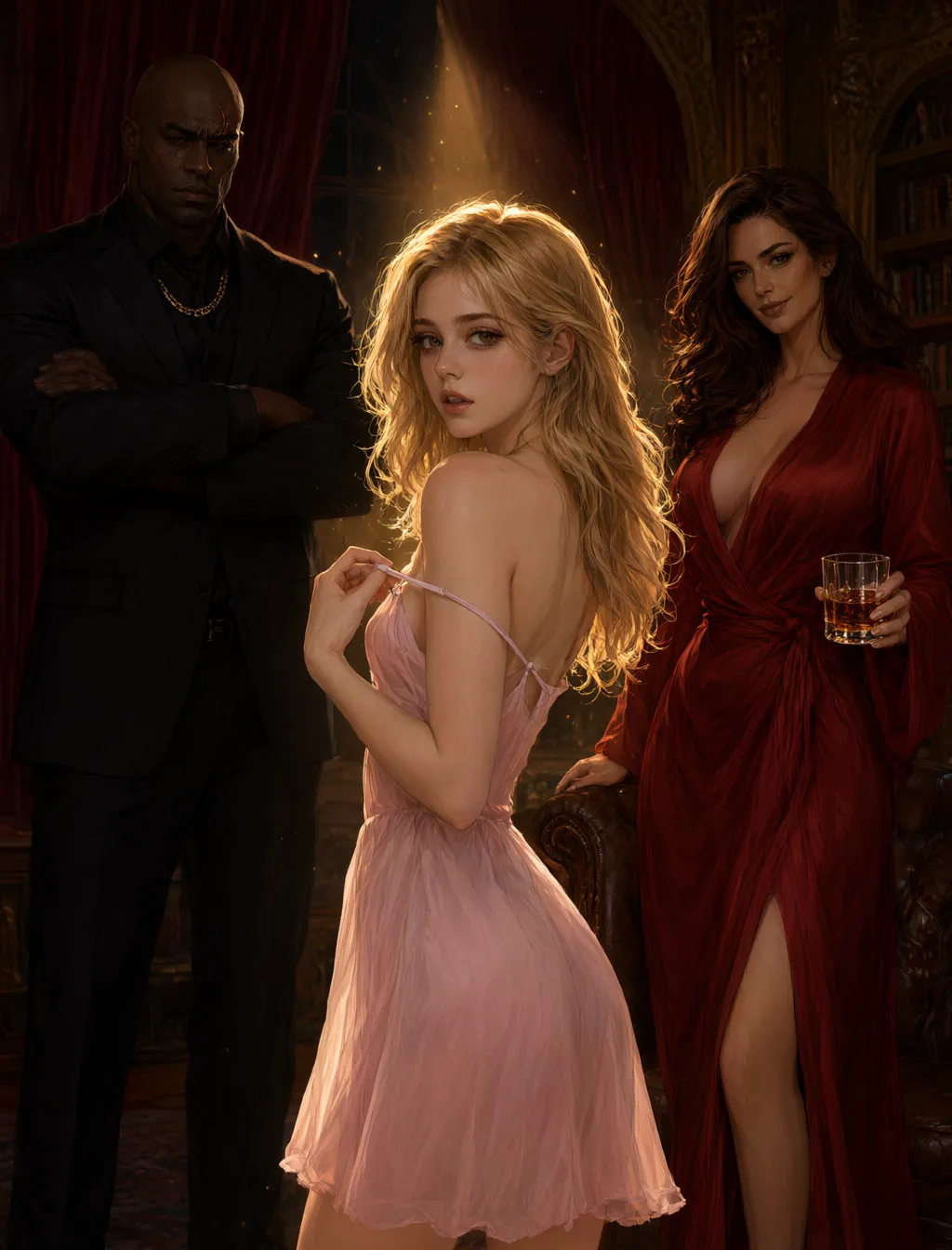
She was at the table in her red silk robe, dark chestnut hair loose around her shoulders, a mug of coffee cooling between her hands. She hadn't touched it. The skin around her eyes looked tight, like she hadn't slept any better than I had.
"Did you hear that?" I asked.
She tilted her head. Listened. The apartment went still around us — the hum of the fridge, the distant hiss of traffic on the avenue, nothing else.
I walked to the front door. A black envelope lay on the mat, the paper thick and expensive-looking, the kind that comes with a weight to it. No stamp. No return address. Just my mother's name written across the front in precise, angular handwriting I didn't recognize.
I picked it up. The paper was cool and smooth, and something about the weight of it made my stomach tighten.
"Who sends mail without a stamp?"
Anna was behind me. I hadn't heard her move, but she was there, her hand reaching past mine to take the envelope. Her fingers trembled as she turned it over. She knew the handwriting. I saw it in the way her jaw went tight, the way her breath stopped for a second before she made herself breathe again.
"Mom?"
She tore it open. No ceremony, no hesitation — just her thumb under the flap and a sharp rip. A single sheet of heavy cream paper inside. She unfolded it with hands that shook, and I watched her face drain.
Not pale like she'd had a shock. Pale like all the blood had been siphoned out of her at once.
"What is it?"
She didn't answer. Her eyes moved across the page — once, twice — as if reading the same line over and over would change what it said. Then she lowered the paper and looked at me, and I saw something I'd never seen in her face before.
Fear. Real fear. The kind that doesn't perform for anyone.
"They want me tonight," she said.
The words landed wrong. They wanted her tonight — that was every night. That was the whole arrangement. Anna went out most evenings, kissed my forehead, told me not to wait up, and came home at four in the morning smelling of perfume and other men. But the way she said it now, with the paper trembling in her fingers, it wasn't the usual summons.
"They want you where?"
She looked at the envelope in her hands, then back at me. "The estate. All three of them." A pause. "It's not a request."
I read the line myself. She let me take the paper from her fingers. The typed words were cold, businesslike, the kind of language you use for a delivery schedule or an invoice.
Anna. Tonight. Eight o'clock. The house. Come alone. Don't make us come to you.
No signature. No name. Just the threat sitting underneath every word like a second layer of ink.
"What does that mean — don't make us come to you?"
Anna took the paper back. Folded it along its creases with careful, deliberate movements. "It means they know I've been talking to you. It means they're reminding me who owns me."
The word landed hard in the quiet kitchen. Owns. Not employs, not works with — owns. She'd used it before, at the café, but it had been abstract then. A word in a story about someone else's life. Now it sat on the counter between us, solid as the marble, and I couldn't pretend it was anything but what it was.
"What are you going to do?"
Anna laughed. It was a dry, hollow sound, nothing like the warm laugh she used with me. "What do you think I'm going to do? I'm going to put on a dress and I'm going to go."
"You can't just—"
"I can't what, Martha?" She turned to face me, and the fear was still there, but it had calcified into something harder. "I can't refuse? I can't tell them no? I've been telling them no for fourteen years — the only answer they've ever accepted is the one where I show up."
"But this is different." I gestured at the envelope, now sitting on the counter like a black stone. "This is a threat. They've never sent a letter before."
Anna's jaw worked. She looked at the envelope, then at me, and something shifted in her eyes. The fear was still there, but something else was rising underneath it — something I couldn't name.
"They've never had a reason to," she said quietly.
The words hung in the air. I understood what she wasn't saying. They'd never had a reason to threaten her because she'd never given them one. She'd been compliant, reliable, a whore who showed up when called and did what she was told. But now — now her daughter knew. Now she'd been seen in the club, seen on her knees, seen with Marcus's hand fisted in her hair. And she'd been talking. Telling me things. Things no one was supposed to know.
"This is because of me," I said.
Anna's head snapped up. "No."
"They know I saw you. They know I know." The words came out flat, matter-of-fact, like I was reading from a script. "Marcus told you he'd exploit it. You said so yourself. He's been waiting, and now he's making his move."
"Martha—"
"He's not summoning you because he wants you." The realization came cold and clear. "He's summoning you because he wants to see if you've told me enough to make me curious. Or enough to make me scared."
Anna stared at me. For a long moment, neither of us spoke. The coffee machine beeped — the timer, the pot done brewing — and the sound was so ordinary it felt obscene.
"You're too smart for your own good," she said finally.
"Someone in this family has to be."
It came out sharper than I meant it to. Anna flinched, and I saw the guilt move through her face — the familiar calcified guilt that lived under her skin, the thing she carried every day and never let me see until three weeks ago.
"I'm sorry," I said. "I didn't mean—"
"Yes, you did." She turned away, walked to the counter, picked up her cold coffee. She didn't drink it. Just held the mug in both hands, staring at the dark liquid like it held an answer. "And you're right. You're not wrong. Marcus has been patient. He's been watching. And now he's decided the time has come to tighten the leash."
"What does that mean for you?"
"It means I go tonight. I let them do whatever they want to do. I take it, the way I've always taken it." She set the mug down. "And I pray that's enough."
The words hit me in the chest. I'd heard her talk about the work before — clinical descriptions of what the men wanted, how she endured it, sometimes even enjoyed it. But she'd never sounded like this. Small. Cornered. Like an animal that knows the trap has closed and is just waiting for the wire to tighten.
"What if it's not enough?"
Anna didn't answer. That was the worst part. She didn't tell me it would be fine, didn't promise she'd come home safe, didn't offer any of the lies a mother is supposed to tell. She just stood there in her red silk robe, the black envelope on the counter between us, and said nothing.
"Mom." I took a step toward her. "What if it's not enough?"
"Then I'll deal with it."
"How?"
She turned to face me. Her eyes were dry, but I could see the effort it took to keep them that way. "The way I've dealt with everything else. I'll spread my legs and I'll take it, and I'll smile while I do it. And if that doesn't work, I'll spread them wider."
The crudeness of it hit me like a slap. Anna never talked that way at home — she kept the work separate, in the nights, in the other rooms, in the person she became when she walked out the door. Hearing those words come out of her mouth in our kitchen, in the morning light, with her hair soft around her shoulders and her robe tied at the waist — it was wrong. Everything about it was wrong.
"I don't want you to go."
"I don't have a choice."
"There's always a choice."
Anna laughed again — that same hollow sound. "Is there? Tell me what my choices are, Martha. I can go to the estate tonight and do what I've always done. Or I can refuse, and Marcus sends those photos to the college board, to your professors, to everyone who's ever known you as Anna Cole's daughter. And then what? You lose your scholarship. You lose your future. I lose the only thing I've ever been good at."
"That's not true."
"What's not true? That I'm good at it? I've been doing it for fourteen years, baby. I'm very good at it." She picked up the envelope, turned it over in her hands. "The question is whether I'm good enough to keep you safe."
The words landed heavy in the quiet kitchen. I wanted to argue, wanted to tell her there had to be another way, wanted to be the daughter who rescued her mother from the monsters. But I'd seen the monsters. I'd seen Marcus's scarred eyebrow and Luther's pale, unblinking eyes and John's too-handsome grin, and I knew — with a certainty that sat in my gut like a stone — that they weren't the kind of men you reasoned with.
They were the kind of men you survived.
"I'm coming with you."
The words came out before I'd decided to say them. Anna's head snapped up.
"No."
"Mom—"
"I said no." Her voice was steel. "You're not coming anywhere near that house. You're not coming anywhere near them."
"They already know I exist. Marcus already knows I saw you. What difference does it make if I'm there or not?"
"It makes every difference." She crossed the kitchen, took my face in her hands. Her palms were warm against my cheeks, and I could feel the tremor in her fingers. "Because if you're not there, they have nothing to hold over me. If you're not there, I can take whatever they give me and know that you're safe. That you're here, in this apartment, living the life I've been paying for with my body for fourteen years."
"But what if they hurt you?"
"They've hurt me before." A ghost of a smile crossed her lips. "I'm still here. I'm still your mother. And I'm still going to do whatever it takes to keep you out of this."
She kissed my forehead. Soft, warm, the kind of kiss she'd given me my whole life — the kind that was supposed to make everything okay.
It didn't.
"I need to get ready," she said, stepping back. "They want me at eight."
"There is still three hours left."
"I know." She picked up the envelope, carried it to the drawer where she kept her things. She didn't throw it away. She tucked it in the drawer, next to a stack of folded receipts and a bottle of aspirin, like it was just another piece of paper in a life full of them. "I have to prepare."
She left the kitchen. I heard her bedroom door close, heard the click of the lock — a sound I'd never heard in this apartment, not once, not in nineteen years.
I stood alone in the kitchen, the coffee machine still beeping, the morning light still cutting through the dusty air. I looked at the drawer where Anna had put the envelope. I thought about the typed words, the cold precision of them. Don't make us come to you.
I thought about my mother, alone in her bedroom, preparing her body for men who owned her.