
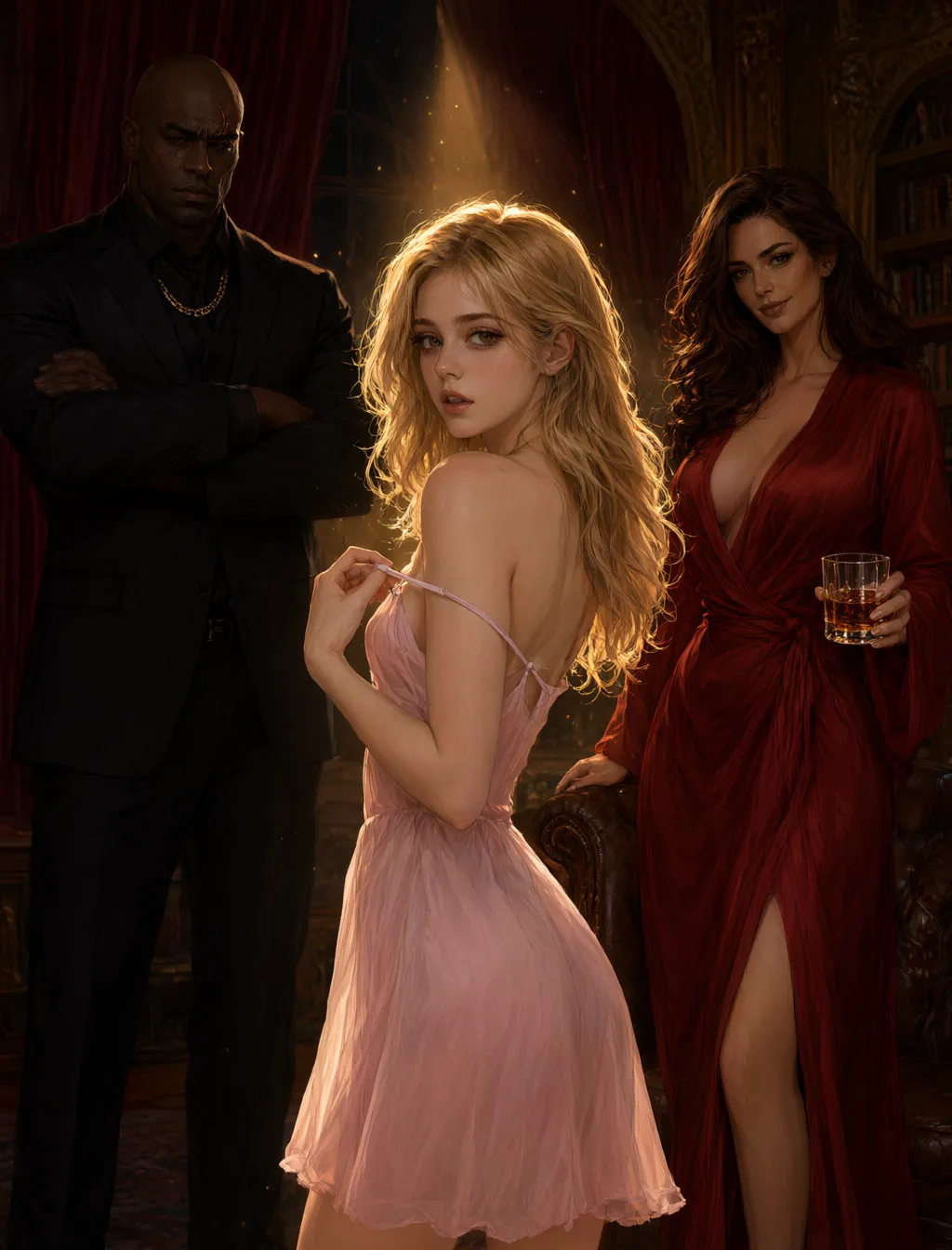
The scrambled eggs had gone cold on my plate. I'd been pushing them around for so long they'd turned into a yellow smear, a landscape of nothing I couldn't bring myself to eat. The kitchen smelled like burnt coffee and the ghost of last night's wine, that glass still sitting on the counter with its dried purple crescent staining the rim.
Anna moved around the kitchen like nothing had happened. Like she hadn't come home at four in the morning wearing nothing but a red lace bodysuit under her trench coat. Like I hadn't seen her on her knees.
The coffee pot gurgled. She refilled my mug without asking, the ceramic warm through my fingers when I wrapped both hands around it.
"You should eat," she said.
I looked at the eggs. Looked at her. She was wearing a silk robe the color of old blood, tied loose at her waist, her dark chestnut hair falling in waves past her shoulders. She looked younger than thirty-eight in the morning light. She always had.
"I'm not hungry."
She didn't push. That was the thing about Anna—she knew when to push and when to let the silence do the work. She'd spent fourteen years learning exactly which pressure to apply and when to pull back.
She sat down across from me with her own mug, black coffee, no sugar. The lipstick mark on the rim was smudged at the edges, a faded pink crescent from a mouth that had been otherwise occupied just hours ago.
The refrigerator hummed. The pendant lamp over the table cast a weak yellow circle in the morning brightness. Neither of us moved to clean the wine glass.
"What are they like?"
The words came out before I could stop them. I'd been holding them in my throat since I watched her walk through the front door at dawn, since I saw that thumbprint bruise on her collarbone, since she told me she sometimes asks them to hurt her.
Anna's hands paused on the pot.
For a second, the only sound was the drip of coffee falling back into the carafe. Her fingers stayed curled around the handle, and I watched the muscles in her jaw work, like she was deciding which version of the truth to give me.
She set the pot down. Slowly. Deliberately. Then she sat back down across from me, and her eyes—those deep brown eyes that had learned to lie with a straight face—held mine.
"Marcus is... commanding," she said.
The word hung in the air between us. Not a warning. Not an apology. Just a fact, offered up like a piece of bread she was testing whether I'd take.
"He takes what he wants," she continued, and her voice had changed. Softer. Almost reverent. "And you learn to want it too."
I watched her lips curve. A small smile, private and knowing, like she was remembering something I wasn't supposed to see. Something she'd let me see anyway.
My fingers tightened on my cup. The coffee was too hot. I didn't let go.
"What does that mean?"
"It means he doesn't ask." She took a sip of her coffee, leaving another pink print on the rim. "He tells. And there's something... clean about it. You don't have to decide anything. You just have to yield."
"Yield." The word tasted strange in my mouth. Foreign. Like a language I was only beginning to learn.
"Yes." She set the mug down. "You'd think it would feel like losing. It doesn't. It feels like finally putting down something you've been carrying your whole life."
The morning light was too bright on the table between us. I could see every grain in the wood, every scratch from years of dinners and homework and arguments and quiet mornings like this one. Except nothing about this morning was quiet.
"And Luther?" The name came out easier than I expected. Like I was testing how it felt to say it out loud in our kitchen, in our house, in the life we'd built on top of a lie.
Anna's smile shifted. Something darker flickered through her eyes.
"Luther is... intense." She wrapped both hands around her mug, letting the warmth seep into her palms. "He doesn't speak much. He watches. And when he moves, it's like a snake. You don't see it coming until it's already on you."
"Is he—" I stopped. Swallowed. "Does he hurt you?"
The question landed between us like a stone in still water. Anna looked at me for a long moment, and I saw something move behind her eyes. Not shame. Not quite pride. Something in between.
"Sometimes," she said. "When I ask him to."
The words sat in my chest, heavy and warm. I should have been horrified. I'd read enough articles, watched enough documentaries about women like my mother—victims, survivors, cautionary tales. But Anna didn't look like a victim sitting across from me. She looked like a woman who knew exactly what she was and had made peace with it.
"Why would you ask him to hurt you?"
She tilted her head, studying me like I was a puzzle she was trying to solve. "You really want to know?"
"I'm asking."
"Because sometimes the pain is the only thing that feels real." She said it simply, like she was explaining how to fold a fitted sheet. "When you've been doing this as long as I have, you learn to find the places where you still feel something. For me, that's the edge. The place where pleasure and pain blur together until you can't tell where one ends and the other begins."
My mouth was dry. I took a sip of coffee anyway, let the bitter heat burn my tongue.
"And John?"
Anna laughed. A real laugh, low and warm, and it transformed her face. For a second she looked like the mother I remembered from childhood—the one who used to dance with me in the living room to old Motown records, who let me put makeup on her face with clumsy six-year-old fingers.
"John's the talker," she said. "He'll quote scripture at you while he's got you bent over a desk. Calls himself the Preacher. Says he's just administering the sacrament."
"That's—"
"Profane?" She raised an eyebrow. "Yeah. That's the point."
I pushed my eggs around the plate again. The yellow smear had started to dry at the edges, crusting against the ceramic. Neither of us moved to scrape it off.
"Do you love them?"
The question surprised me as much as it surprised her. Anna's cup paused halfway to her lips.
"Love is a complicated word," she said finally.
"That's not an answer."
"It's the only one I have." She set the cup down. "I love what they give me. The security. The way they look at me like I'm the only woman in the room. The way Marcus holds my jaw when he kisses me, like I'm something precious that might break."
Her voice dropped on the last words, and I felt something shift in my stomach. A flutter. A heat that had no business being there.
"And the way Luther takes me from behind without saying a word, like I'm just a body he needs to use." She was looking at me now, really looking, and there was something in her eyes I'd never seen before. An invitation. A test. "And the way John whispers my name like a prayer when he comes inside me."
The kitchen felt too small. The walls too close. I could hear my own heartbeat in my ears, a dull drum that seemed to match the rhythm of the refrigerator's hum.
"Why are you telling me this?"
"Because you asked." Anna shrugged, but there was nothing casual about it. "And because I think you're old enough to understand that sometimes the things that look like cages are actually the only places you can be free."
I stared at her. The woman who raised me. The woman who'd lied to me for nineteen years. The woman who'd sold her body so I could have dance lessons and college textbooks and a bedroom with a door that locked.
The woman who was looking at me now like she was seeing me for the first time. Like I wasn't her daughter anymore. Like I was something else entirely.
"Do you want to know what it feels like?" she asked.
The question hung in the air between us, heavy and charged. The burnt coffee smell had faded, replaced by something else. Something warmer. Something that made my skin prickle.
"What what feels like?" My voice came out thinner than I wanted. Smaller.
"Being wanted like that." She leaned forward, and the silk robe gaped slightly at her neckline, revealing the edge of that bruise on her collarbone. A thumbprint, still faintly purple. "Being so completely consumed by someone that you forget where you end and they begin. Having a man look at you like you're the answer to a question he didn't know he was asking."
I couldn't look away from her. The morning light caught the gold flecks in her brown eyes, and for a moment she didn't look like my mother at all. She looked like a stranger. A beautiful, dangerous stranger who knew things I'd never dreamed of.
"I don't—" I started.
"You don't have to decide anything right now." She reached across the table and took my hand. Her skin was warm, soft, the nails perfectly manicured. The same hands that had held me when I was sick, that had braided my hair before school, that had signed my permission slips and paid my tuition.
The same hands that had gripped the sheets of a stranger's bed while three men used her body.
"But Martha," she said, and her voice was low now, intimate, like we were sharing a secret. "When you're ready to know—really know—I'll tell you everything."
Her thumb traced a slow circle on the back of my hand. The gesture was tender, maternal, and something else entirely. Something that made my breath catch in my throat.
"Everything?" I echoed.
"Everything." She squeezed my hand. "What it feels like when Marcus puts his hands on your throat. What it sounds like when Luther groans your name. What it tastes like when John—"
She stopped. A small smile played at the corner of her lips.
"You're blushing."
I pulled my hand back, pressed it to my cheek. It was hot. Burning. I could feel the heat spreading down my neck, into my chest.
"I'm not—"
"It's okay." Anna's voice was gentle now, the same voice she'd used when I was six and had scraped my knee, when I was twelve and crying over a boy who didn't like me back. "It's okay to be curious. It's okay to want to know."
I looked down at my plate. The eggs had formed a crust, the yellow smear dried and cracked. I'd been pushing them around for so long they'd become something unrecognizable.
"I don't know what I want," I said. The words felt like a confession.
"You don't have to know yet." Anna stood up, carried her mug to the sink. Her robe swayed as she moved, and I caught a glimpse of her bare leg, smooth and tanned. "You just have to be willing to find out."
She rinsed her mug, set it in the drying rack. The lipstick mark faded under the water, swirling pink down the drain.
"I'm going to take a shower," she said. "There's fresh coffee if you want more."
She paused at the doorway, looked back at me. The morning light caught her profile, and I saw it again—that flicker in her eyes. Pride, maybe. Or calculation. Or something I didn't have a name for yet.
"Martha?"
"Yeah?"
"I'm glad you asked."
She disappeared down the hall, and I heard the bathroom door click shut. A moment later, the pipes groaned and the shower started running.
I sat at the table, alone with my cold eggs and my burning cheeks. The kitchen was too quiet now. The refrigerator hummed. The pendant lamp swayed slightly in a draft I couldn't feel.
I thought about what she'd said. About being wanted like that. About yielding. About the edge where pleasure and pain blurred together until you couldn't tell where one ended and the other began.
I thought about Marcus's hands. I'd only seen them for a second, fisted in my mother's hair, but I remembered them. Huge. Capable. The hands of a man who took what he wanted.
I thought about the way Anna's voice had dropped when she talked about them. The way her eyes had gone soft and distant, like she was seeing something I couldn't.
I thought about the word she'd used. Yield.
I pushed my chair back, carried my plate to the sink. The eggs scraped off in one dry clump, and I watched them circle the drain before they disappeared.
The wine glass was still on the counter. I picked it up, held it to the light. The dried purple crescent at the bottom looked like a bruise. Like the one on my mother's collarbone.
I set it down. Didn't wash it.
Somewhere in the apartment, the shower stopped running. I heard Anna moving around in her bedroom, opening drawers, closing them. Getting dressed for a day that would end the same way every day ended now—with me wondering what she was doing, who she was with, whether she was thinking about me.
The front door had a small window at the top, and the morning light slanted through it, casting a long rectangle across the linoleum. I stood in it for a moment, letting the warmth soak into my bare feet.
Then I heard it.
A knock.
Three sharp raps against the wood, loud in the quiet apartment. No car engine idling outside. No warning.
I looked toward the hallway, where Anna's bedroom door was still closed.
The knock came again. Harder this time.
And I saw, in the brief silence that followed, the smile that had curved my mother's lips when she talked about Marcus. The one I hadn't understood until now.
It wasn't a mother's smile.
It was the smile of a woman who belonged to someone.
The knock came a third time, harder, the wood vibrating under the impact. I stood frozen in the rectangle of morning light, my bare feet cold against the linoleum, my heart slamming against my ribs like it wanted out.
I thought about the smile on my mother's lips. The way she'd said *belonged* without ever saying the word.
I walked to the door on legs that didn't feel like mine. The peephole was brass, cold against my eye when I pressed my face to it.
A man in a brown uniform held a flat package. Delivery van parked at the curb, engine still running.
I opened the door a crack.
"Martha Cole?"
"Yeah." My voice came out scratchy.
"Sign here." He held out a tablet, stylus attached by a thin cord.
I signed. He handed me the package and was gone, the van pulling away before I'd even closed the door.
The package was from the university bookstore. The textbooks I'd ordered for my online classes two weeks ago, before everything changed. Before I'd stopped checking my email. Before I'd stopped caring whether I passed or failed a semester that suddenly felt like it belonged to another girl entirely.
I carried it to the kitchen table, set it down next to my cold plate. The cardboard was crisp, untouched. I didn't open it.
The bathroom door opened down the hall. Anna emerged in a cloud of steam, wrapped in a towel, her dark chestnut hair wet and slicked back from her face. She looked younger without makeup, almost vulnerable, the bruise on her collarbone standing out darker against her damp skin.
"Delivery?" she asked, nodding at the package.
"Textbooks."
She didn't say anything else. Just walked into her bedroom and closed the door.
I stood in the kitchen, listening to the sounds of her getting dressed. The slide of drawers. The rustle of fabric. The quiet hum of a woman who had spent nineteen years perfecting the art of putting herself together.
The shower had left steam clinging to the hallway mirror. I could smell her perfume from here—something floral and expensive, the same scent that had clung to her trench coat that night. The same scent that had been on her skin when she'd come home at four in the morning with a thumbprint bruise blooming on her collarbone.
She came out ten minutes later wearing jeans and a soft gray sweater, her hair twisted into a loose knot at the nape of her neck. She looked like any other mother on any other morning. Like she might pack me a lunch and remind me to call when I got to campus.
She walked past me to the coffee pot, refilled her mug.
"Anna."
She turned. The coffee steamed between us.
"I'm ready."
"Ready for what?" But something flickered in her eyes. She knew.
"What you said. About telling me everything." I swallowed. My throat felt tight, like the words were having trouble fitting through. "You said when I was ready to know—really know—you'd tell me."
Anna set the coffee pot down. Slow. Deliberate. The same way she'd set it down earlier, when I'd asked her what the men were like.
"Martha—"
She didn't finish. The word hung there, soft and unfinished, like she'd started a sentence and lost the thread of it somewhere in her throat.
I waited. The refrigerator hummed. Somewhere outside, a car door slammed.
"I need to know," I said. "Not the version you tell yourself. Not the version you tell me to make it easier. The real one."
Anna looked at me for a long moment. Then she did something I hadn't seen her do in days—she pulled out the chair across from me and sat down. Not across the room. Not standing by the counter with her mug between us like a shield. She sat down, folded her hands on the table, and looked at me with those brown eyes that had learned to lie with a straight face.
"You want to know what it feels like," she said. Not a question.
"Yes."
"Why?"
I thought about lying. I thought about telling her it was curiosity, or closure, or some clean word that would make us both comfortable. But she'd spent nineteen years protecting me from the truth, and I was done being protected.
"Because I saw your face that night," I said. "In the club. You weren't—" I stopped, searched for the word. "You weren't enduring it."
Anna's jaw tightened. Just a fraction. The kind of tell most people would miss.
"You saw that."
"I saw it."
She looked down at her hands. The manicured nails. The skin that cost more per month than most people spent on rent. Every inch of her maintained and polished and paid for.
"The first time," she said slowly, "I was twenty-four. You were five. We were three months behind on rent, and I'd just been fired from my waitressing job because I couldn't afford a babysitter and I showed up with you in the break room." She paused. "A woman I knew—a client of hers, really—introduced me to Marcus."
I didn't move. Didn't breathe.
"He was different then. Less... polished. More hungry. He had a crew of three guys working for him, and he needed someone who could keep her mouth shut and her legs open." She said it flat, clinical, like she was reading a grocery list. "I was desperate. He could tell. He paid me more in one night than I'd made in a month of waitressing."
"And you went back."
"I went back." She met my eyes. "I told myself it was temporary. That I'd save up enough to get us out, and then I'd never do it again. But the money was too good. The apartment got nicer. You got new shoes for school. And every time I told myself I'd stop, there was another bill, another month, another reason to go back just one more time."
"Fourteen years," I said. "You couldn't have been that desperate for fourteen years."
Anna's smile was thin, bitter. "No. I couldn't."
The silence stretched between us. I could hear the clock in the hallway, ticking off seconds that felt like they belonged to someone else's life.
"Then why?" I asked.
She didn't answer right away. She picked up her coffee mug, held it in both hands, stared into the dark liquid like it might give her the words.
"Because somewhere along the way," she said quietly, "I stopped doing it for the money. I started doing it because—" She stopped. Swallowed. "Because when Marcus puts his hands on you, when he takes control like that, you don't have to think. You don't have to make decisions. You don't have to be the one holding everything together. You just... let go."
I thought about the smile I'd seen on her face. The way she'd said *belonged*. The thumbprint bruise on her collarbone that she'd admitted asking for.
"You like it," I said. It came out flat, not quite a question.
Anna set the mug down. "I like the way it makes me feel afterward. The release. The quiet in my head. For those few hours, I'm not a mother. I'm not a failure. I'm not the woman who couldn't keep her husband from leaving or her daughter from growing up too fast. I'm just—" She gestured vaguely. "A body. And that's all I have to be."
I didn't know what to say to that. I'd spent the last week trying to understand why she'd done it, and I'd built a version of her that was a victim, a survivor, someone who endured because she had no choice. But sitting across from me was a woman who had choices. Who kept making the same one.
"What about Luther?" I asked. My voice sounded strange to my own ears. "You said he's brutal. That he hurts you."
Anna's eyes flickered. Something passed through them—not shame, exactly. Something older and more complicated.
"Luther doesn't hurt me," she said. "Not the way you're thinking. He's rough. He takes what he wants. But he never crosses the line into actually damaging me. He knows where the line is."
"And you ask him to cross it."
"Sometimes." She held my gaze. "Not often. But sometimes I need to feel it. The sting. The ache afterward. It reminds me I'm still here. Still real."
I thought about the bruise on her collarbone. Marcus's thumbprint. The mark of a hand that had gripped her hard enough to leave a stain.
"Show me," I said.
Anna blinked. "What?"
"Show me where he touched you." I didn't know where the words were coming from. They felt like they were being pulled out of me by something I couldn't name. "The bruise. Show me."
For a long moment, she didn't move. Then, slowly, she reached up and pulled the collar of her gray sweater aside.
The bruise had faded since the night I'd first seen it. It was no longer that angry purple-black, but a sickly yellow-green at the edges, the center still a dull brown. A thumbprint, perfectly shaped, pressed into the hollow of her collarbone.
I reached out. I didn't ask permission. I just reached across the table and touched it, my fingertips brushing the discolored skin.
It was warm. That was the thing that surprised me. Warm, like the rest of her. Like it was just another part of her body, not a mark of something done to her.
"Does it hurt?" I asked.
"Not anymore."
"Did it hurt when he did it?"
Anna's eyes met mine. "Yes."
"And you liked that."
She didn't look away. "I liked that he wanted to mark me. That he wanted me to remember, the next day, that I was his."
I let my fingers trail away from the bruise. The skin was soft. Warm. I could feel her pulse beneath my fingertips, steady and alive.
"What does it sound like?" I asked. "When Luther groans your name."
Anna's breath caught. Just a small hitch, barely visible. But I saw it.
"Why do you want to know this?"
"Because I need to understand." I leaned forward. "Because I saw your face that night, and I've been trying to figure out if what I saw was real or if I imagined it. And I think—" I stopped. Swallowed. "I think it was real. I think you were enjoying yourself. And I need to know if that's something I could ever—"
I stopped myself. The words were too big. Too close to something I wasn't ready to name.
Anna studied me for a long moment. Her brown eyes moved over my face like she was reading something written there that I couldn't see myself.
"Martha," she said softly. "Why do you really want to know?"
The question hung between us. The refrigerator hummed. The clock ticked. Somewhere in the building, a pipe gurgled.
And I realized I didn't have an answer. Or rather, I had one, but it was too dangerous to say out loud.
So I said the only thing I could.
"Because I think I might be like you."
The words landed between us like a stone dropped into still water. Anna didn't move. Didn't blink. Her brown eyes held mine, and for a moment I thought I saw something crack open behind them—not shock, not horror. Recognition.
"Martha." Her voice was soft. Careful, like she was handling something fragile. "That's a heavy thing to say."
"I know." My hands were trembling under the table. I pressed them flat against my thighs to still them. "But I've been thinking about it all week. About what I saw. About the way you looked. And I keep coming back to the same place."
"Which is?"
"I wasn't disgusted." The words came out before I could stop them. "That's the thing that scares me. I should have been. I should have walked out of that club and never looked back. But when I saw you there, on your knees, with Marcus's hand in your hair—" I stopped, swallowed. "I couldn't stop looking."
Anna was quiet for a long moment. The refrigerator hummed its low, steady note. Somewhere in the building, a door opened and closed.
"You think that means something," she said slowly. "That you couldn't look away."
"Doesn't it?"
"It means you're human." She leaned back in her chair. "Everyone stares at a car wreck, Martha. That doesn't mean they want to be in one."
"This wasn't a car wreck." I shook my head. "This was—" I searched for the word, came up empty. "I don't know what it was. But it wasn't horror."
Anna studied me. Her fingers traced the rim of her coffee mug, a slow, circular motion that I'd seen her do a thousand times. Usually when she was thinking. Usually when she was about to say something she wasn't sure I was ready to hear.
"What do you think it was?" she asked.
"Curiosity." The word felt too small. Too clean. "And something else. Something I can't name."
"Something you're afraid to name."
I met her eyes. "Yes."
The silence stretched. I could feel the weight of it pressing down on my chest, making it hard to breathe. But I didn't look away. I'd spent nineteen years looking away from the truth of my mother's life. I wasn't going to start now.
"Tell me," I said. "Everything. The things you said you'd tell me when I was ready."
Anna's jaw tightened. She set the mug down, folded her hands on the table. When she spoke, her voice was lower. Rougher.
"Marcus likes my throat." She said it flat, clinical, like she was reading from a script. "He likes to hold it while he fucks me. Not hard enough to cut off air, but enough to feel it. To know he could if he wanted to."
I felt my pulse jump. My fingers curled against my palms.
"The first time he did it," she continued, "I panicked. I'd never let a man do that before. But he didn't stop. He just held me there, looking into my eyes, and said, 'Trust me.' And I did. I don't know why. But I did."
"What did it feel like?"
"Like being held." She paused. "Like being completely, utterly held. There's something about having someone's hand on your throat that strips away everything else. You can't think about bills or grocery lists or the homework you need to help your daughter with. All you can do is be there, in that moment, with that hand on you."
I thought about the bruise on her collarbone. The way she'd said *belonged*. The look on her face in that club—not pain, not endurance. Something else entirely.
"And Luther?" I asked. My voice was barely above a whisper.
Anna's eyes flickered. "Luther is different. Luther doesn't need to dominate. He just—takes. He's rough in a way that Marcus isn't. Marcus controls. Luther consumes."
"And you like that too."
"I like the way it makes me feel afterward." She met my gaze. "The ache. The soreness. The reminder that I'm real, that I'm here, that I survived it." She paused. "It's like—have you ever gotten a tattoo?"
I shook my head.
"It hurts. But there's something about the pain that's almost cleansing. Like it's burning away everything that isn't essential. When Luther is done with me, I feel raw. Exposed. But also—clean. Empty in a way that feels like peace."
I didn't know what to say. The words felt too big, too strange, like they belonged to a language I didn't speak yet but somehow understood.
"And John?" The name came out before I'd fully decided to ask it.
Anna's expression shifted. Something softer. Something almost like warmth.
"John is the one who makes me laugh." A ghost of a smile crossed her lips. "He's the one who holds me afterward. When the others are done, when they've taken what they need, John stays. He runs his hands through my hair. He tells me I did good. He makes me feel like—" She stopped, searching for the word. "Like I matter. Not just as a body. As a person."
"You said he tastes like whiskey."
"He does." Her smile widened, just a fraction. "And cigarettes. And something else I've never been able to place. Something warm."
I leaned forward. The kitchen felt smaller suddenly, the air thicker. My heart was beating hard against my ribs, a steady drum that seemed to fill the silence between us.
"What does it taste like," I asked, "when John kisses you?"
Anna's breath caught. Her eyes met mine, and for a moment I saw something raw pass through them—something I couldn't name.
"Why do you want to know that?"
"Because I need to understand." My voice was steady, even though my hands were shaking under the table. "I need to know what it's like to want something that much. To need it the way you do."
Anna was quiet for a long moment. Then she pushed her chair back from the table. She stood, walked to the counter, and picked up her coffee mug. She didn't drink from it. Just held it, staring at the dark liquid.
"Martha," she said, without turning around. "If I tell you these things, I can't take them back."
"I know."
"And you can't unhear them."
"I know."
She turned. Her face was unreadable, but her eyes were bright. Wet. Not tears, not quite. Something else.
"Then I'll tell you," she said. "But not here. Not at this table, with cold coffee and textbooks and the morning light." She set the mug down. "Get dressed. We're going out."
"Where are we going?" I asked, pushing my chair back from the table.
Anna was already at the hallway, her red silk robe cinched tight around her waist. She didn't turn around when she answered.
"Somewhere we can talk without the ghosts of textbooks and cold coffee watching us."
I stood there for a beat too long, watching the sway of her hips as she disappeared into her bedroom. The kitchen felt emptier without her in it. The burnt coffee smell clung to the air, mixing with something floral from the vase of wilting tulips on the windowsill.
I walked to my room and pulled open the closet. My hand hovered over the sundresses, the cardigans, the safe and soft colors I'd worn my whole life. Then I pushed them aside and grabbed a pair of dark jeans and a fitted black top instead. I didn't know why. It just felt right. Like armor.
Anna was waiting by the front door when I came out. She'd changed into a deep green wrap dress that hugged every curve, her chestnut hair falling in loose waves past her shoulders. She looked like she was going to a business meeting. Or a funeral.
"Ready?" she asked.
I nodded.
The morning air hit me hard when we stepped outside. It was one of those deceptive spring days that looked warm from inside but bit cold the second you got into it. I crossed my arms over my chest, regretting the thin top.
Anna led me down the block, past the corner bodega with its flickering neon sign, past the laundromat where Mrs. Delgado was already fighting with a washing machine. She didn't tell me where we were going, and I didn't ask again. I just followed.
We walked for fifteen minutes before she stopped at a small café tucked between a pawn shop and a closed-down barbershop. The sign above the door read "Elvira's" in faded gold letters. I'd walked past this place a hundred times and never once thought to go inside.
Anna pushed the door open. A bell chimed overhead. The air inside was thick with the smell of fresh bread and strong coffee, and a woman with gray-streaked hair looked up from behind the counter and smiled like she knew my mother.
"Anna," she said warmly. "The usual?"
"Please, Elvira." Anna slid into a booth in the corner, her back to the wall, her eyes on the door. I sat across from her.
"You come here a lot?" I asked.
"When I need to think." She unwrapped a paper napkin and laid it flat on the table. "No one bothers you here. Elvira doesn't ask questions."
"That sounds like exactly the kind of place you'd like."
Anna's eyes flicked to me, something sharp passing through them. But she didn't take the bait.
Elvira brought over two cups of coffee and a plate of pastelitos still warm from the oven. The sugar dusted my fingers when I reached for one, and the first bite melted on my tongue, sweet and flaky and impossibly good.
"Eat," Anna said. "You'll need your strength."
"For what?"
She took a sip of her coffee, black, no sugar. "For the conversation you asked for."
I set the pastelito down. My appetite was suddenly gone.
"I didn't mean to make you—"
"You didn't make me anything." Anna's voice was firm but not unkind. "You asked a question. A fair one. And I told you I'd answer it. I meant that."
"Then why here?" I looked around the café, at the cracked vinyl booths and the faded photographs of Cuba on the walls. "Why not at home?"
"Because at home, you can run away." She met my eyes. "You can go to your room and close the door. You can pretend the conversation never happened. Here, you have to sit with it."
The words landed harder than I expected. She was right. I'd spent the last few days running from this, from the truth of what I'd seen, from the weight of what she'd told me. I'd let myself believe that hearing her confession over dinner was enough, that I'd processed it, that I understood.
But I didn't understand. Not really.
"What does it feel like?" I asked. "When you're with them. When it's happening."
Anna's fingers wrapped around her coffee mug. She stared into the dark liquid for a long moment before she spoke.
"It depends on which one."
"Start with Marcus."
She took a breath. "Marcus is... methodical. He doesn't rush. He wants you to know he's in control, that he's been in control since the moment he decided he wanted you. When he touches you, it's not a question. It's a statement."
"A statement of what?"
"That you belong to him." She said it simply, without shame. "For that hour, or that night, or however long he decides, you are his. And there's something about that—being so completely owned that you don't have to think anymore. You don't have to make decisions. You just... surrender."
I felt a shiver run down my spine that had nothing to do with the cold. "And you like that?"
"I need it." She said it like she was admitting to a weakness. "I know that sounds wrong. I know a woman my age should have her own life, her own identity. But when Marcus holds me down and takes what he wants, I don't have to be Anna Cole, the single mother who's been lying to her daughter for fourteen years. I don't have to be anything. I just have to feel."
"And Luther?"
"Luther is the storm." A ghost of a smile crossed her lips. "He doesn't ask. He doesn't warn. He just takes, and you either keep up or you break. There's no negotiation with Luther. There's no safe word. He pushes you right to the edge of what you can handle, and then he pushes a little further."
"That sounds terrifying."
"It is." Her eyes met mine. "And it's the only time I feel truly alive."
I didn't know what to say to that. I sat there, the pastelito growing cold on the plate in front of me, and tried to wrap my head around the woman sitting across from me. This wasn't the mother who'd packed my lunches and kissed my scraped knees and helped me with my math homework. This was someone else entirely. Someone who'd been living in the shadows of my mother's body for longer than I'd been alive.
"What about John?" I asked, my voice barely above a whisper.
Anna's expression softened. "John is the one who makes it bearable."
"Because he's gentle?"
"Because he sees me." She paused, her fingers tracing the rim of her mug. "The others see a body. A tool. A toy. John sees a person. He asks me how my day was. He remembers things I tell him. He holds me after, when the others are done, and he doesn't rush to leave."
"You love him."
The words came out before I could stop them. Anna's head snapped up, her eyes wide.
"No," she said quickly. "No, I don't love him. I can't love any of them. That's not what this is."
"But you feel something for him."
She was quiet for a long moment. Then she said, "I feel grateful. He treats me like a human being, and in this life, that's more than most women get."
"This life," I repeated. "The life you chose."
"I didn't choose it." Her voice sharpened. "I fell into it. There's a difference."
"Is there?" I leaned forward. "You said you've been doing this for fourteen years. You could have stopped at any time. Found another way."
"Another way?" Anna laughed, but there was no humor in it. "I was twenty-four years old with a five-year-old daughter and no college degree. My husband had walked out and left us with nothing but debt and a stack of bills I couldn't pay. I couldn't get a job that would cover rent and food and childcare. I couldn't ask my family for help—they'd already given everything they had. I was drowning, Martha. And Marcus was the hand that pulled me out."
"But at what cost?"
"Everything." Her voice cracked. "It cost me everything. It cost me my dignity. My self-respect. The right to look my daughter in the eye and tell her that I was a good person."
"You are a good person."
"Am I?" She met my gaze, and for the first time, I saw tears glistening in her eyes. "I've let men use my body for money. I've lied to you every single day of your life. I've participated in things that would make you sick if you knew the details. And I've enjoyed it, Martha. That's the part I can't forgive myself for."
"Enjoyed it?"
"The pain. The degradation. The feeling of being completely and utterly owned." She shook her head. "There's something wrong with me. Something broken. I know that. I've always known it."
"You're not broken."
"You don't know that."
"I know you." I reached across the table and took her hand. Her fingers were cold, trembling slightly. "I know the woman who stayed up with me when I was sick. Who worked double shifts to buy me a prom dress. Who never let me see how hard she was struggling, because she wanted me to have a normal life."
"That's exactly what I mean." Anna pulled her hand away. "I did all those things to protect you from the truth. And now the truth is out, and I don't know how to protect you from it anymore."
"I don't need protecting."
"Yes, you do." Her voice was fierce. "You're nineteen years old. You should be worried about exams and boys and what to wear to parties. Not about your mother's—" She stopped, unable to finish the sentence.
"Not about my mother's what?" I pressed. "Profession? Lifestyle? Whatever you want to call it?"
"I don't know what to call it." Anna's voice dropped to a whisper. "I've never had to say it out loud before."
"Say it now."
She closed her eyes. When she opened them, they were hard. Resigned.
"I'm a whore, Martha. I've been a whore for fourteen years. And the worst part is, I'm good at it. I'm so good at it that the men who own me don't ever want to let me go."
The word hung in the air between us, sharp and ugly and honest. I felt it land in my chest like a stone, heavy and cold.
"They own you," I said slowly. "You said they own you."
"That's what it feels like." She picked up her coffee, took a sip, set it down. "I don't know if there's a legal document somewhere. I don't know if I could walk away if I wanted to. All I know is that I've been theirs for so long that I don't know who I am without them."
"You're my mother."
"I'm more than that." She looked at me, and there was something almost like pity in her eyes. "And less. So much less."
I didn't know what to say to that. I sat there, watching her, and I realized that I'd been holding onto an image of my mother that didn't exist. The woman I'd grown up with—the one who'd taught me to ride a bike and braided my hair and told me I could be anything I wanted to be—she was a fiction. A carefully constructed lie that Anna had built to protect me from the truth of what she was.
And now the truth was out, and I didn't know who she was anymore.
"What happens now?" I asked.
"I don't know." Anna's voice was quiet. "I've been thinking about it since you came home that night. About what happens next. About what Marcus will do when he realizes you know."
"He already knows I know. You said so yourself."
"He knows you saw us. He doesn't know what you'll do with that knowledge." She paused. "That's what scares me."
"He's not going to hurt me."
"You don't know that."
"I know that you've been with him for fourteen years. If he was going to hurt me, he would have done it already."
"That's not how Marcus works." Anna shook her head. "He's patient. He waits. He watches. He finds your weakness, and then he exploits it."
"And what's my weakness?"
Anna looked at me, and for a moment, I saw something raw and vulnerable pass through her eyes.
"You love me," she said. "That's your weakness. You love me, and you'd do anything to protect me. And Marcus knows that."