
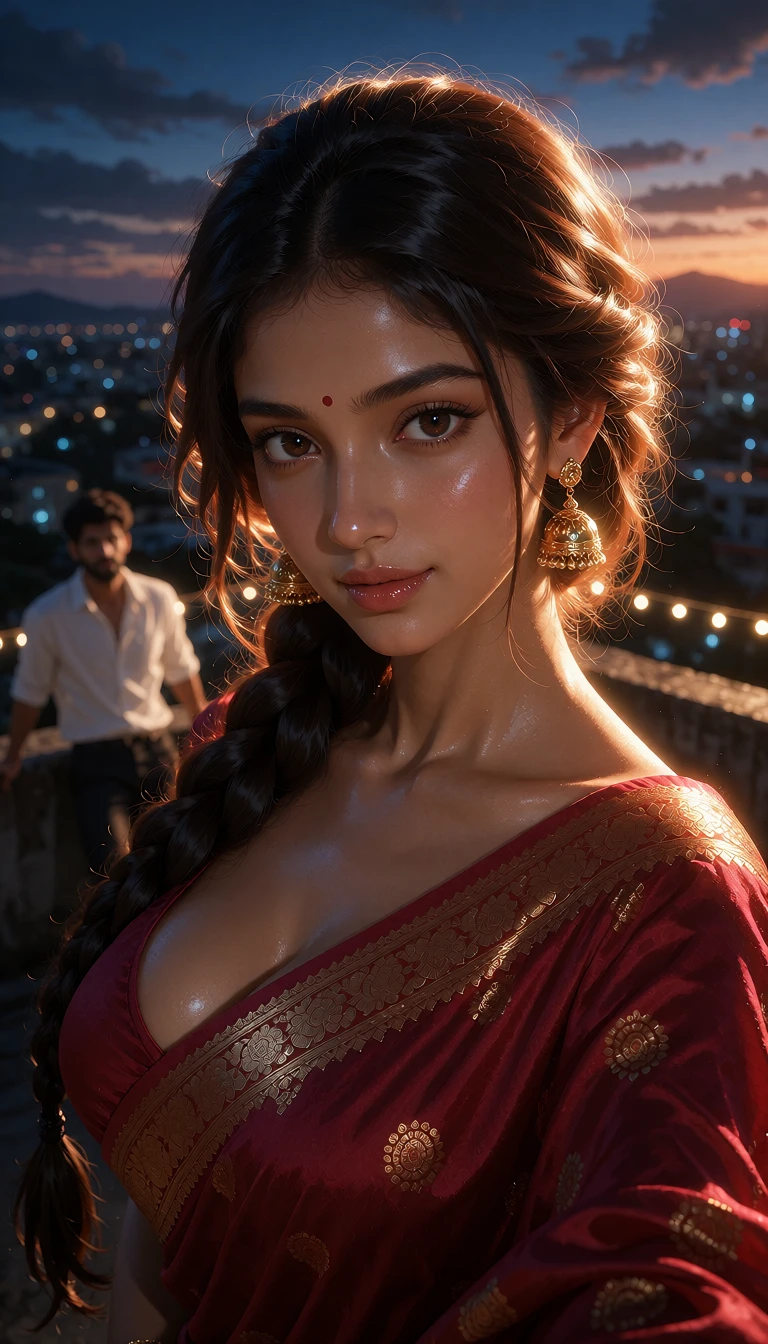
The Sunday sun came through the window like a hand pressing down on the room, and I was sitting cross-legged on Lakshmi's cot because mine had a spring that dug into my back if I sat on it too long. The air smelled of coffee gone cold and the sweat of six people who had nowhere else to be on a Sunday afternoon. Someone's radio was playing a Tamil film song from somewhere down the lane, the tune thin and far away, and above us the floorboards groaned as another tenant walked across the ceiling.
"You're thinking too loud," Lakshmi said. She was leaning against the wall, her legs stretched out in front of her, her toes playing with the edge of her chappal. "I can hear it from here."
"I'm not thinking anything," I said.
"That's the problem." She grinned. "A girl who isn't thinking is a girl who's about to do something stupid."
The thin boy—the one with the sharp elbows and the hungry look—snorted from his cot. "She's a village girl. Everything she does is stupid."
"Don't be mean," Lakshmi said, but she was still smiling, and the thin boy knew she wasn't really telling him to stop.
I kept my face still. I had learned already, in the weeks since I came to this city, that if I showed them I was hurt, they would only do it again. It was like the stray dogs on my street back home—if you ran, they chased. If you stood still, they lost interest.
There were six of us in the room. Me and Lakshmi, the two girls on the far wall who I still didn't know the names of, the thin boy, and the quiet one with the gold chain. The quiet one was lying on his cot with his arm over his eyes, blocking out the sun, and I had never heard him say more than three words at a time. He was not handsome exactly, but there was something about him that made you look twice—a stillness, like a pond that had never been disturbed. The gold chain sat against his throat, catching the light when he shifted.
"We should play something," Lakshmi said. "It's too hot to sit around like dead fish."
"Like what?" the thin boy said.
"Truth or dare."
The two girls on the far wall looked at each other. One of them—the one with the long hair that she never tied back—shrugged. "We don't have anything else to do."
"That's the spirit," Lakshmi said. She clapped her hands once, sharp, and the sound cut through the thick air. "Come on. All of you. Pull your cots closer. We're doing this properly."
There was a moment of groaning and shifting, the scrape of metal legs on cement, and then we were all in a rough circle, our knees almost touching. The quiet boy pulled his arm off his eyes and sat up slowly, and the gold chain swung against his collarbone. He did not look at anyone. He just sat there, waiting.
"I'll go first," the mustache boy said. He was the one who always talked the loudest, the one who made the other boys laugh. He had a thin mustache that he was clearly proud of, and he was always touching it, stroking it like it was a pet. "Dare."
Lakshmi looked at him, her eyes narrowing. "I dare you to kiss the wall."
"That's it?"
"And say 'I love you' to it."
The thin boy burst out laughing, and the mustache boy's face went red, but he got up anyway, walked to the wall, and pressed his mouth to the peeling paint. "I love you," he said, muffled, and the two girls on the far wall giggled, and the thin boy was laughing so hard he had to hold his stomach.
I laughed too. It was stupid, but it was stupid in a way that made the room feel less like a cage. For a moment, we were just six young people passing a Sunday afternoon, and the city outside could wait.
Then it was the thin boy's turn, and he chose truth, and Lakshmi asked him how many girls he had kissed, and he said seven, and everyone knew he was lying, and the laughter started again. The two girls went next—truth for both of them, shy answers, more laughter. The quiet boy with the gold chain said "dare" in a voice so low I almost didn't hear it, and the mustache boy dared him to do twenty push-ups, and he did them without breaking a sweat, his back straight, his arms moving like they were made of rope, and when he finished he sat back down on his cot and folded his hands and looked at no one.
Then it was my turn.
The room went quiet. I felt it happen—the way the air changed, the way the laughter drained out. The two girls on the far wall were watching me with those wide, curious eyes. The thin boy was grinning. The mustache boy was stroking his mustache. And Lakshmi was leaning forward, her elbows on her knees, her face tilted, that knowing smile spreading across her mouth.
"Truth or dare, village girl?" she said.
I could feel my pulse in my throat. Truth was the safe one. Truth was what a scared girl would choose. And I was tired—so tired—of being the scared girl. The one who flinched when a man looked at her too long. The one who said "sir" to everyone. The one who didn't know what to do when a hand touched her knee under a table.
I had come to this city to learn. That was what I kept telling myself, lying on my cot at night, listening to the sea grind against the shore. I had come here to become someone else. Someone who was not afraid.
"Dare," I said.
The room went quiet again, but it was a different kind of quiet. It was the kind of quiet that happens right before something breaks.
Lakshmi's smile widened. She did not look away from me. She did not even blink. She just sat there, letting the silence stretch, letting me feel the weight of what I had just agreed to.
Then she turned her head, slow, deliberate, and looked at the quiet boy with the gold chain.
He was sitting on his cot with his hands folded in his lap, and the sunlight was coming through the window behind him, catching the gold at his throat, making it glow. He was looking at me. Not at Lakshmi. At me. And there was something in his eyes that I could not read—something dark and still, like the water at the bottom of a well.
"Touch his thigh," Lakshmi said. "Under the blanket. For ten seconds."
The words landed like stones in the middle of the room.
No one moved. No one spoke. The radio was still playing somewhere down the lane, a woman's voice rising and falling in a song I did not know, and above us the floorboards groaned as someone crossed the ceiling, and I could hear my own heartbeat in my ears, loud and stupid.
The quiet boy did not move. He did not look away from me. His jaw tightened—just a flicker, just a muscle jumping under the skin—and then it was still again, and his eyes were still on mine, and I could not tell if he was waiting for me to refuse or waiting for me to do it.
Lakshmi was watching me. They were all watching me. The thin boy with his hungry grin, the mustache boy with his hand frozen on his mustache, the two girls on the far wall with their wide eyes. And Lakshmi, leaning forward, her chin on her knuckles, her smile patient and knowing, like she had already seen how this would end.
"Ten seconds," she repeated. "That's all. Touch his thigh. Under the blanket. Count to ten. Then you're done."
I could feel my fingers curling into my palm. I could feel my nails pressing into my skin, hard enough to leave marks. I could feel the heat of the room, the weight of the sun, the eyes of five people all fixed on me, waiting to see what the village girl would do.
And I could feel the quiet boy's gaze, steady and dark, holding mine like a hand.
I did not decide to do it. My body decided for me. I was off the cot before I knew I had moved, and then I was sitting beside him, the rough cotton of his blanket under my knees, and I could smell him—soap and sweat and something else, something warm and male—and he was so close that I could see the pulse beating in his throat, just above the gold chain.
He did not move away. He did not move toward me. He just sat there, still as a pond, watching me, and I slid my hand under the edge of the blanket and found his thigh.
The heat of his leg through the cotton was like a burn. I felt it travel up my arm, into my chest, into my stomach, a wave of it that made me want to pull my hand back and made me want to press harder at the same time. His thigh was solid under my palm, the muscle firm, the bone close beneath, and he went still—so still that I could feel him holding his breath.
One.
I could feel the room around us, the weight of their watching. I could feel the thin boy's grin, the mustache boy's silence, the two girls' wide eyes. I could feel Lakshmi's smile, patient and knowing, like she had already seen how this would end.
Two.
His thigh was warm through the cotton. Warm and solid and real, and I could feel the shape of it under my palm, the way the muscle ran long and straight, the way the bone pressed close. I could feel the heat of his body bleeding through the fabric, and I could feel my own pulse in my fingertips, stupid and loud.
Three.
He was still watching me. I could feel his eyes on my face, dark and unreadable, and I could not look at him, so I looked at his throat instead, at the gold chain resting against his skin, at the pulse beating just above it, fast and steady.
Four.
I heard the thin boy shift on his cot. I heard the mustache boy clear his throat. I heard the two girls whisper something to each other, their voices low and excited. And I heard Lakshmi, her voice soft and pleased, saying: "She's doing it. Look at her. The village girl is doing it."
Five.
My hand was trembling. I could feel it, a fine tremor running through my fingers, and I could feel the sweat on my palm, the way my skin was slick against the cotton. I wanted to pull away. I wanted to press harder. I wanted to disappear into the floor and I wanted to stay here forever, my hand on this boy's thigh, the room watching, the sun hot on my back.
Six.
He moved. Just a little. Just a shift of his leg under my hand, and I felt the muscle flex, felt the heat of him move against my palm, and I made a sound—a small sound, a sound I did not mean to make—and I felt my face go hot, felt the blush climb up my neck, up my cheeks, felt it burn.
Seven.
No one said anything. No one laughed. The room was so quiet that I could hear the sea, the distant grinding of it against the shore, and I could hear my own heartbeat, and I could hear his breathing, slow and even, like he was trying to keep it steady.
Eight.
I moved my hand. Not much. Just a fraction of an inch, just a shift of my palm against the cotton, and I felt him go still again, felt the breath catch in his chest, and I looked up—I could not help it—and I saw his eyes, dark and deep and unreadable, and I saw the way his jaw was tight, the way a muscle jumped in his cheek, the way his hands were gripping his own knees, white-knuckled, like he was holding himself still.
Nine.
Ten.
I pulled my hand away.
The blanket fell back into place, and the heat of his thigh was gone, and I was left with my palm burning, my fingers trembling, the ghost of his warmth still pressed into my skin. I did not look at him. I could not. I looked at my own hand instead, at the way it was shaking, at the sweat on my palm, at the crease in my fingers where the cotton had pressed.
And I could feel the room around me, the weight of their watching, the silence that had not broken.
Lakshmi was the first to speak. "Well," she said, and her voice was light, almost lazy, like she had not just watched me put my hand on a boy's thigh in front of everyone. "That's one way to pass a Sunday."
The thin boy laughed—a sharp, barking sound—and the mustache boy joined in, and the two girls were giggling, their hands over their mouths, and the sound of it filled the room, loud and bright, and I sat there on the edge of the quiet boy's cot with my hands folded in my lap and my face burning and my heart pounding in my chest like a trapped bird.
And the quiet boy with the gold chain did not say anything. He did not laugh. He did not move. He just sat there, still as a pond, and I could feel his eyes on the side of my face, dark and unreadable, and I could not look at him, could not turn my head, could not meet his gaze.
I just sat there, my fingers trembling in my lap, the heat of his thigh still burning on my palm, and I waited for the laughter to stop.
I stayed on the edge of his cot for one more breath, then two, then I stood up and crossed back to my own, and the room came apart into its usual pieces again—the thin boy wiping his eyes, the mustache boy still stroking that sad little line of hair above his lip, the two girls on the far wall whispering behind their hands. The radio down the lane had moved on to a different song. Nobody was looking at me anymore. That was worse, somehow. When they were watching, at least I knew where I stood.
I sat down on my cot and pulled my knees up and rested my chin on them, and I felt the spring dig into my backside exactly the way it always did, and I was almost grateful for it. Something to be annoyed at. Something that was not the heat still sitting in my palm.
"Okay," Lakshmi said. She stretched her arms over her head until her shoulders cracked, one, then the other, and then she let them fall. "My turn. Truth."
The thin boy leaned forward, hungry. "Who's the ugliest boy in this room?"
"You," Lakshmi said, without even pausing.
Everyone laughed. The thin boy's ears went red but he laughed too, because laughing was the only way to survive it, and I knew that already—I had known it since my first week in this city.
"That's not a real truth," he said.
"It is if it's true." Lakshmi shrugged. "Ask me something better."
"Fine." He thought about it, chewing the inside of his cheek. "Why do you charge us two hundred and them four hundred?"
The room went still, but not the bad kind of still. The curious kind.
Lakshmi looked at him for a long moment. Then she looked at the wall behind his head, at the damp patch that had been spreading there since the monsoon, and she said, "Because the wall is safer. You want the wall, you pay for the wall. Simple."
"That's not fair," the mustache boy said.
"Nothing is." She said it lightly, like she was commenting on the weather. "You want me to lie to you instead?"
He didn't answer. She turned her head and looked at me, and something passed between us—not a smile exactly, but close. An understanding. The wall is safer. I had paid for the wall. I had not known what I was buying, but I had bought it.
"Village girl's turn," Lakshmi said.
I sat up straighter. My heart was still going too fast, but it was slowing, and I found that I could think again, that the room had come back into focus around me. The thin boy was picking at a thread on his blanket. The mustache boy was watching me with his eyebrows up. The quiet boy with the gold chain had lain back down on his cot with his arm over his eyes, exactly the way he had been before the game started, as if nothing had happened, as if my hand had never been anywhere near him.
"Truth," I said.
Lakshmi's eyebrows went up. "Truth? After that?"
"Truth," I said again.
She studied me. I could see her deciding whether to push, whether to say something clever, whether to make me pay for choosing the safe one after I had just done the dangerous one. But whatever she saw in my face, she let it go.
"Fine," she said. "Ask."
I had not thought that far. I had only known that I wanted to sit still for a minute, that I wanted the room to stop moving around me, that I wanted to be the one asking for once instead of the one being asked. And now they were all waiting, the thin boy and the mustache boy and the two girls on the far wall, and even the quiet boy had lifted his arm a little, just enough to see me from underneath it.
I looked around the room. Six cots. Six people. I had been sleeping in this room for weeks and I did not know the names of the two girls on the far wall. I did not know where the thin boy was from, or why the mustache boy was so proud of that sad little line of hair, or what the quiet boy with the gold chain did all day when he was not lying on his cot with his arm over his eyes. I did not know any of them. I only knew how they looked when they were asleep.
So I said, "Introduce yourselves to me."
Nobody spoke.
"What?" the thin boy said.
"Introduce yourselves," I said again. My voice came out steadier than I expected. "I don't know your names. I've been here three weeks and I don't know your names. So. Tell me who you are."
The mustache boy laughed, but it was a confused laugh, the kind you make when you don't know what else to do. "Why?"
"Because I asked," I said.
Lakshmi was watching me with her head tilted, and I could not tell if she was amused or impressed or both. Then she said, "Alright. That's a fair truth. I'll go first."
She sat up and folded her legs under her and put her hands on her knees like a schoolteacher. "Lakshmi. Twenty-three. From Kanchipuram. My father drives a lorry and my mother sells flowers outside the temple, and I have two younger brothers who are both useless, and I send two thousand rupees home every month because if I don't, my mother will call me every single day and cry, and I cannot take the crying. I do tuitions for rich children in Kilpauk. They are horrible. I love them. That's me."
She said it all in one breath, flat and quick, like she was reading a list she had read a hundred times. Then she looked at the thin boy and said, "Your turn."
He scowled. "I don't want to."
"You don't get to not want to. That's the game."
He sighed, big and dramatic, and flopped back against the wall. "Ravi. Twenty-one. From Trichy. I came here for an IT course. It's shit. The course is shit, the teachers are shit, the food is shit. My father thinks I'm going to get a job in a big company and buy him a car. I'm going to fail the course. I haven't told him." He picked at the thread on his blanket again. "That's it. That's my whole life."
The mustache boy snorted. "That's depressing, da."
"You asked."
"I didn't ask. She asked." He jerked his chin at me, and then he sat up a little straighter and touched his mustache, once, twice, the way he always did before he said something he thought was important. "Fine. Suresh. Twenty-two. From Salem. I'm doing my B.Com. My father has a provision store. I'm going to take it over when I finish. I have a mustache because my girlfriend likes it." He paused, waiting for someone to react.
"You don't have a girlfriend," Ravi said.
"I have a girlfriend."
"You don't."
"I have a girlfriend in Salem. You don't know her. She goes to a different college."
"Sure, da."
The two girls on the far wall were giggling again, their hands over their mouths, and I found that I was smiling too, a real smile, the kind that came out before you could stop it. Suresh's ears were going red and he was stroking his mustache faster and faster, and Ravi was grinning at him like a cat, and for a moment the room felt like the canteen at college felt, like a place where people were just people and nothing was at stake.
Then the girl with the long hair that she never tied back said, "I'm Bhavani. Twenty. From Vellore. My father is a tailor. I came here because my cousin said the city was better. She was lying. It's not better. It's just louder." She said it without any bitterness, like she was reporting the weather. "I'm doing my B.A. English. I want to be a teacher."
The other girl, the one who was always chewing her thumbnail, said, "Meena. Nineteen. From Cuddalore. My father is dead. My mother runs a tea shop. I have three sisters and I'm the second one, so I have to get a job fast and send money home, so I'm doing nursing. I don't like blood. But." She shrugged, and went back to chewing her thumbnail, and nobody said anything, because there was nothing to say to that.
Then there was only the quiet boy left.
He had not moved. His arm was still over his eyes, and the gold chain was still sitting against his throat, and I could see the slow rise and fall of his chest under his shirt. The room had gone quiet in a different way now, waiting, the way you wait for a bus that is late—you know it is coming, you just don't know when.
"Arjun," he said. Just the one word. He did not lift his arm.
"That's not introducing yourself," Lakshmi said. "That's just saying your name."
"It's what she asked for."
"She asked you to introduce yourself."
He was quiet for a moment. Then he pulled his arm off his eyes and sat up, and he looked at me—straight at me, not at Lakshmi, not at anyone else—and I felt it land somewhere under my ribs, that look, the same dark still water I had seen before, and I did not know what to do with my face, so I did nothing with it.
"Arjun," he said again. "Twenty-two. From Coimbatore. My father has a textile shop. I'm doing my MBA. I have one sister. I don't like talking about myself." He paused. "That's all you're getting."
"That's not fair," Suresh said. "We all said more than that."
"You all wanted to." Arjun lay back down and put his arm over his eyes again, and the conversation was over, the way a door closes.
The room did not laugh at Arjun the way it had laughed at Suresh. It just sat there with his refusal in the middle of it, and I watched the others decide, one by one, not to push him. Lakshmi looked at me and lifted one shoulder, a small shrug that said that is as much as you are going to get from him, and I nodded, because I understood that some people paid their rent in silence and that was a kind of currency too.
"Fine," Lakshmi said, and turned to the two girls on the far wall. "You two. You heard her. Names, places, why you're here. Go."
Bhavani sat up first, tucking her loose hair behind one ear, and I noticed for the first time that she had a small silver stud in the side of her nose, so small I had to squint to see it. "I already said mine," she said.
"Say it again. Properly. She wasn't listening the first time."
"I was listening," I said, and my voice came out sharper than I meant it to, and Bhavani looked at me, and something in her face softened.
"It's all right," she said. "I'll say it again." She folded her hands in her lap the way she did when she was reciting something she had memorized. "Bhavani. Twenty. From Vellore. My father stitches school uniforms for a living and my mother does the buttons. I have one older brother who is married and one younger sister who is smarter than me. I came to Chennai because my cousin said there were jobs here, and there are, but they are all the kind where you stand on your feet for twelve hours and nobody says thank you." She paused. "I am doing B.A. English. I want to teach. Not because I love children. Because the holidays are long."
Meena snorted, and Bhavani grinned, and the grin changed her whole face, made her look younger than twenty, made her look like someone I might have known in my village.
"Meena," the other girl said, before anyone could ask. She had stopped chewing her thumbnail and was sitting cross-legged now, her hands wrapped around her knees. "Nineteen. From Cuddalore. My father died two years ago. My mother has a tea stall outside the bus stand and she wakes up at four every morning and she has not slept past five in her life." She said it flatly, the way you say the price of something. "I have three sisters. I am the second. The first one is married and gone, so it is my turn to earn, and the fastest way to earn is nursing, so I am doing nursing. I faint at the sight of blood. I have fainted twice already. I am hoping I will stop." She shrugged. "That is all."
Nobody laughed. Suresh was looking at his own hands, and Ravi had stopped picking at his blanket thread, and even Lakshmi had gone quiet, and I understood that we had all just been handed something and did not know where to put it down.
"Okay," Lakshmi said finally. "That's the girls. Boys, you've all gone. Village girl, you've heard everyone. Are you satisfied?"
I was not satisfied. I was sitting on my cot with my knees pulled up and I was turning something over in my head, and it took me a moment to find the words for it, because the words were not in Tamil and they were not in English either, they were just a feeling, a shape, the shape of six people lying in the dark every night not knowing each other's names.
"No," I said.
Lakshmi raised her eyebrows. "No?"
"You told me where you are from and what you are doing. That is not the same as who you are." I looked around the room, at all of them, one at a time, the way I had been looked at on the bus, the way I had been looked at by the tea-stall man, the way I had been looked at by Arun under the canteen table. "I want to know one true thing about each of you. Not a fact. A truth."
The room went quiet again, but it was a different quiet, a listening quiet, and I felt the hair on my arms lift a little because I had not expected them to actually do it.
"What's the difference?" Suresh said.
"A fact is your father has a provision store. A truth is something you have never told anyone."
Suresh's mouth opened and then closed. He touched his mustache, once, twice, and then he looked away, and I knew I had hit something, though I did not know what.
Lakshmi was watching me with that tilted head again. "That's a hard game," she said.
"You said the wall is safer. That was a truth. You didn't have to say it. You said it anyway."
She was quiet for a moment. Then she laughed, short and surprised, like a coin dropped on a table. "Fine," she said. "Fine. I'll go first. Again." She uncrossed her legs and let them hang off the edge of the cot and looked at the floor between her feet. "I have a fiancé in Kanchipuram. My parents arranged it two years ago. He is a good man. He sends me money sometimes, more than I send home, and I take it, and I put it in a tin, and I have never spent a single rupee of it." She looked up. "I am saving it to run away. I don't know where. But that is the truth."
Nobody said anything. The radio down the lane had gone quiet, and the only sound was the sea, grinding away at itself the way it always did, and I could hear my own breathing in my ears.
"Your turn," Lakshmi said, and she pointed at Ravi.
He picked at the thread one more time, and then he stopped, and he folded his hands in his lap, and he looked at the crack in the wall above my head, the same crack I looked at every night, and he said, "I have not called my father since I came here. Four months. He calls me and I do not pick up. I tell myself it is because I have nothing to tell him. But the truth is I am afraid he will hear it in my voice. That I am failing. That his money is going into a drain." He swallowed. "That is my truth."
Suresh was next, and he did not joke, which surprised me. He sat up straight and put his hands on his knees and said, "I have never kissed a girl. The girlfriend in Salem is real, but we have never—we only talk on the phone. She is waiting for me to finish my degree. I am twenty-two years old and I have never kissed anyone and I am afraid that when I see her next I will not know how." His ears were red but his voice was steady, and he did not look away from me. "That is my truth."
Bhavani went next, and she said, "I told my parents I am in a hostel. I am not. I am sharing a room with three other girls in a building with no lift and one bathroom on the whole floor. If they knew, they would make me come home. I do not want to go home. That is my truth."
Meena said, "I have a boyfriend. He is a nursing student too. He is from Kerala. My mother does not know because he is not the caste she would choose. I am going to marry him anyway. That is my truth."
And then it was only Arjun left, and he had not moved, and his arm was still over his eyes, and I thought he would refuse again, and I was ready for it, I had already decided that it was all right, that he did not owe me anything, that I had asked and he had answered as much as he wanted to.
But he pulled his arm down.
He did not sit up. He just lay there on his back with his hands folded on his chest and his eyes on the ceiling, and he said, "I have not spoken to my father in three years. Not since my mother died. He thinks I am angry at him. I am not angry. I am just—" He stopped. The room waited. He did not finish the sentence. He just lay there looking at the ceiling, and after a while he said, "That is my truth," and put his arm back over his eyes.
Nobody asked him to finish. Nobody laughed. The room held still around him, the way it had held still around Meena, the way it had held still around me, and I understood that we had all just given each other something and that none of us knew yet what to do with it.
Then Lakshmi stood up and clapped her hands once, briskly, the way she did when she wanted the room to move. "Okay," she said. "That's enough truth for one night. If we keep going we will all start crying and then nobody will sleep."
She went to the switch and turned off the big light, and the room fell into the blue half-dark of the streetlamp coming through the window, and one by one the others lay down on their cots, and I heard the rustle of blankets and the creak of springs and the small sounds of six people settling into the dark.
I lay down too, on my back, and I looked at the crack in the wall, and I thought about what I had just heard. Lakshmi's tin of money. Ravi's father calling a phone that rang and rang. Suresh's mouth that had never touched a girl's. Bhavani's lie. Meena's Kerala boy. Arjun's unfinished sentence, the way it had stopped in the middle like a road that ends at water.
I had come to this city to learn things. That was what I had told myself on the bus, with my forehead against the glass. I had come to learn. And I had thought the learning would be about the city—about the roads and the buses and the college and the way people spoke. But lying there in the dark with six strangers around me, I understood that the learning was about this. About the fact that everyone was carrying something and nobody was putting it down. About the fact that the rooming house was full of people who had run away from somewhere and were pretending they had come.
I turned onto my side and pulled the sheet up to my chin, and I felt the spring dig into my hip the way it always did, and for once I did not mind it. It was the same spring it had always been. It was the same crack in the wall. But the room felt different. Smaller, maybe. Or fuller. I could not tell which.
Somewhere across the room, I heard Arjun turn over on his cot, the springs groaning under him, and then go still. And then there was nothing but the sea, grinding away at itself, and the small breathing of six people, and the dark, and me in the middle of it, awake, with my hand curled under my cheek and my eyes open, thinking about a tin of money and a sentence that had stopped in the middle.