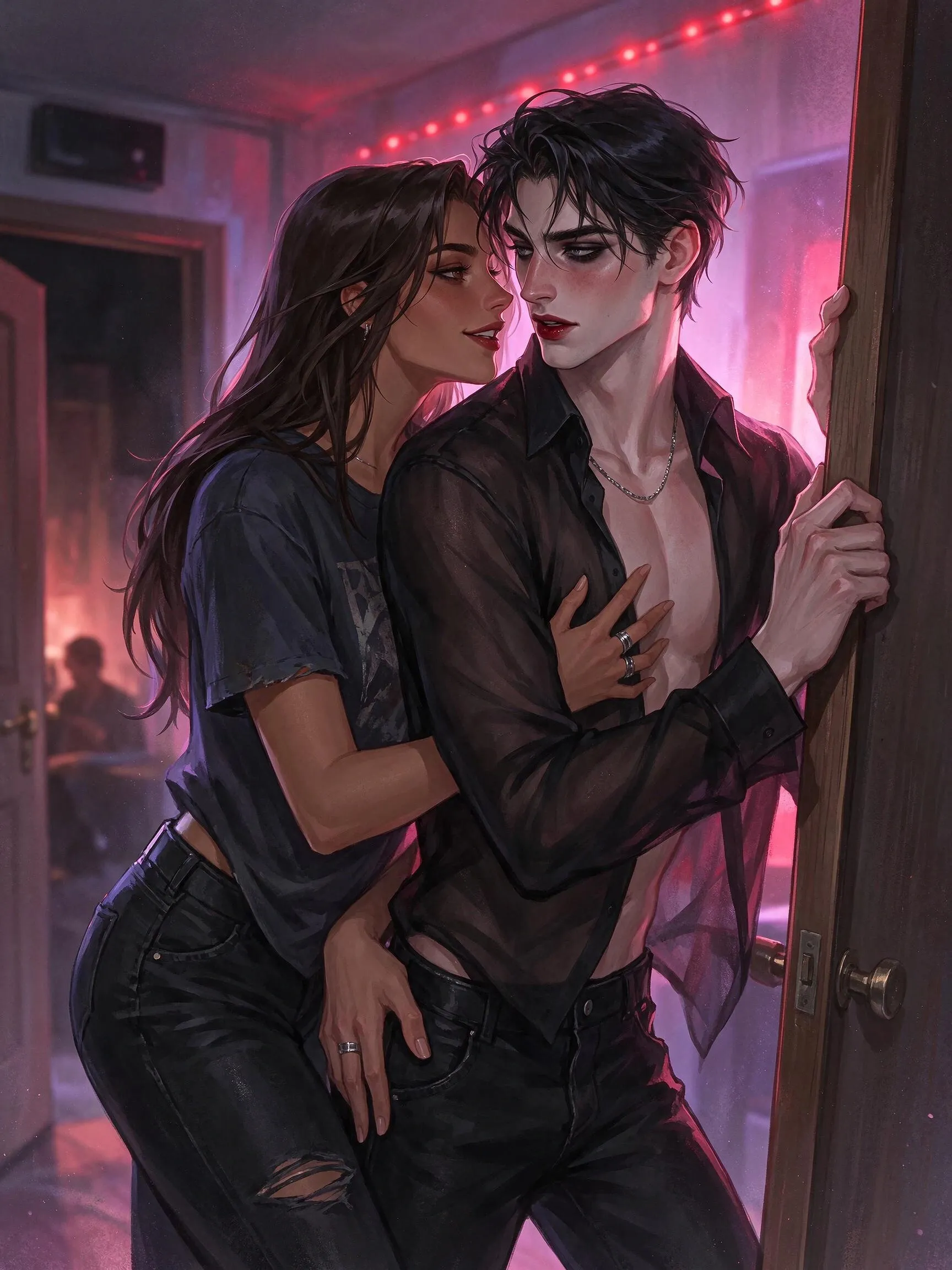

Topher's heels knocked against the cabinet door, a dull rhythm that matched the thud in his chest. The bathroom mirror was fogged at the edges from Lidia's shower, and the whole room smelled like her floral soap, thick enough to taste. He kept his eyes on the ceiling because every time he looked down, he caught his own reflection and had to look away.
"Hold still."
"I am holding still."
"You're vibrating." Lidia's thumb pressed into the hinge of his jaw, tilting his face up an inch. "Stop vibrating."
The kohl pencil touched his waterline and he flinched, a full-body twitch that nearly took his eye out. Lidia made a sound like a cat being stepped on and pulled back, the pencil hovering.
"This won't work," Topher said. "I look stupid. I already know I look stupid, you don't have to—"
"Shh." She didn't even look at him. She was studying his left eye the way she studied a canvas before she started, head tilted, tongue between her teeth. "You don't get to have opinions for the next ten minutes."
"That's not how opinions—"
"Shh."
He shut up. The pencil came back, softer this time, and he felt the drag of it along the rim of his eye, a cool wet line that made his lashes heavy. Lidia's hand on his jaw was warm. Steady. She'd done this a hundred times, on herself, on him in high school when they'd snuck into her mom's makeup bag before a party he'd ended up leaving early. She was better at it now.
"Other eye."
He turned his head. The counter was cold through his jeans, and the denim was tighter than anything he owned, tight enough that when he'd pulled them on an hour ago he'd had to lie down on the bed to zip them. Lidia had watched from the doorway and said nothing, which was its own kind of comment.
"Why do you even have this," he said.
"Because I contain multitudes."
"You contain one thing. It's chaos."
"Chaos is a multitude." She finished the second eye and leaned back, and something in her face changed, the way it did when she was about to say something he didn't want to hear. "There. Look."
"I don't want to look."
"Topher."
He looked.
The person in the mirror was not him. Or — it was him, but a version of him he'd never seen, the version that lived in the back of his skull when he couldn't sleep, the one that did things he never did. The eyeliner made his grey eyes look almost silver, ringed and sharp, and his cheekbones stood out like they'd been carved, and his mouth — she hadn't done his mouth yet — his mouth was just his mouth, but the eyes changed everything. The eyes made the rest of him look deliberate.
"Okay," he said, and his voice came out weird.
"Okay?" Lidia's grin crept up the side of her face. "That's it? That's all you've got?"
"It's — I don't know." He touched his own cheek, and the mirror-Topher touched his too. "It's a lot."
"It's about to be more." She uncapped something and pressed her thumb into a pot of dark red, working it warm. "Close your mouth."
He closed his mouth. Her thumb came down on his lower lip and dragged, left to right, staining it. She did the upper lip with a smaller stroke, careful at the cupid's bow, and when she was done she wiped her thumb on her own hip and stepped back to look at him.
For a second she didn't say anything, and that was worse than anything she could have said.
"What," Topher said. "What. Say something."
"You want my cousin," she said.
The bathroom went very quiet. The shower dripped into the tub. Somewhere down the hall, a door opened and closed, and Topher heard the low rumble of Beck's voice, arguing about something, the way he always argued, like every conversation was a hill he'd die on.
Topher's throat closed. He nodded.
It was a small nod. It was the smallest nod he'd ever given, and it felt like signing something.
"Yeah," he said, quieter than he meant to. "Yeah."
Lidia's face did something soft, just for a second, before the wicked came back. She stepped in close, close enough that her breath hit the shell of his ear, warm and conspiratorial, and she said it low enough that the mirror couldn't hear.
"Then go out there like this," she said, "and I promise you, Topher Jacobes, he will lose his fucking mind."
He stared at the mirror. The eyeliner. The mouth. The tight denim clinging to his thighs, the sheer shirt she'd thrown at him an hour ago that he'd put on because she'd told him to and he never said no to her, not really, not when it mattered.
"You promise," he said.
"I promise." She pulled back, and her dark eyes were bright, and she was smiling like she'd already won something. "Go out there like this and he'll do whatever you want. I'm willing to bet you."
"Whatever I want."
"Whatever." She said it like a dare.
Topher's mouth moved before his brain caught up. "Beck Marlow on his knees."
It came out almost like a purr, which surprised him, the low drag of his own voice, and he watched Lidia's eyebrows go up.
"On his knees," she repeated, delighted. "Crawling for you?"
"Crawling." His face was burning. He didn't stop. "For me."
"He will." Lidia reached past him and pushed the bathroom door all the way open, and the living room spilled in — lamplight, the worn rug, the low thrum of the TV nobody was watching, and Beck's voice, mid-sentence, sharp and annoyed. "If you ask him, he will."
Topher slid off the counter. His boots hit the tile and the denim pulled tight across his thighs and he felt every inch of it, the way the fabric hugged and held, the way it made him stand differently, straighter, like he was being watched already. His heart was slamming so hard he could feel it in his ears.
"Lidia."
"Mm."
"What if he—"
"Topher." She put both hands on his shoulders and turned him toward the door. "Go."
She gave him a shove.
He went.
The hallway was three steps long and he took them slow, because his legs felt like they belonged to somebody else, because the denim was so tight he could feel the seam of it against the inside of his thigh, because the eyeliner made the lamplight sharper and the whole house looked like it was lit for a photograph. The bathroom fog followed him a few feet and then thinned. His palms were damp. He wiped them on the denim, which did nothing, which just made the denim damp, which was somehow worse.
Beck's voice was right there, on the other side of the wall.
"—which is exactly my point, which is that the whole framework collapses the second you introduce—"
"That's not the framework," Kaladin said, dry. "That's you not reading past the abstract."
"I read the whole thing."
"You read the abstract and the conclusion and you filled in the middle with vibes."
"Vibes are a methodology."
"Vibes are not—"
Topher stepped into the doorway.
The living room was the same living room it always was. The same sagging couch, the same two lamps, the same stack of Kaladin's psych books on the coffee table with a mug resting on top of them like a threat. Kaladin was folded into the armchair with his glasses sliding down his nose. Beck was on the couch, one leg pulled up, his phone face-down on the cushion beside him, mid-gesture, mid-argument, his blue eyes narrowed at Kaladin in that way he got when he was losing and knew it.
Lidia slipped past Topher and threw herself onto the settee by the window, and she was smirking, and she didn't say a word.
Beck looked up.
He looked up the way you look up when someone walks into a room — casual, half-distracted, mouth still open on the argument he was winning — and then he saw Topher, and whatever he was going to say died in his throat.
Topher watched it happen. He watched Beck's face go through something, a quick series of somethings, none of them finished, and then Beck's grip on the couch cushion loosened and he listed sideways, just a few inches, like the couch had tilted. His phone slid off the cushion and hit the floor with a flat slap and nobody picked it up.
Kaladin looked over. His eyebrows went up. He looked at Beck, then at Topher, then back at Beck, and a slow, knowing smile spread across his face, and he said nothing at all.
Beck's mouth was still open.
"Wow," he said.
The word landed in the middle of the room and just sat there. Beck blinked. He sat up straighter, then seemed to think better of it and leaned forward instead, elbows on his knees, and his eyes went down Topher's body and back up to his face and then stayed on his face, and Topher felt every inch of that look like a hand.
"Um," Beck said. "Wow. Just — wow."
Topher's face was on fire. His ears were on fire. The eyeliner was probably melting. He should have said something cool, something Lidia had coached him on, something with that purr in it, but what came out was:
"I look stupid, right?"
The room went still.
"Fuck no," Beck said.
It came out fast. Faster than anything Beck had said all night, faster than his arguments, and Topher saw Beck's jaw work, saw him swallow, saw him look at Topher's mouth and then look away and then look back, because he couldn't seem to help it.
"You look—" Beck stopped. Started again. "You look—"
He didn't finish. He just looked, and the looking was doing something to Topher, something hot and tight in his chest, because Beck Marlow did not get flustered. Beck Marlow argued for sport. Beck Marlow had once told a professor she was wrong about her own research and won. And now he was sitting on the couch with his phone on the floor and his mouth half-open and his ears going red, and he couldn't finish a sentence.
Topher felt something click over in his chest. The fear was still there, but it had somewhere to go now. He took a step into the room, and the denim pulled, and he watched Beck's eyes drop to follow it.
"I look?" Topher said.
His voice came out lower than he meant it to. Almost a purr. Almost the thing Lidia had been trying to get out of him all night, and he watched it land on Beck like a hand on the chest.
Beck's throat moved.
"You look like fucking sin, Toph," he said.
Kaladin stood up. He did it slowly, deliberately, picking his mug off the stack of books and tucking his glasses up his nose, and he looked at Topher and then at Beck and then at Lidia on the settee, and his dry face cracked into something that was almost a grin.
"I'm going to make tea," he said.
"Kal—" Beck started.
"Tea," Kaladin said. "In the kitchen. With the door closed. For a while."
He walked past Topher on his way out, and as he passed he leaned in, close enough that only Topher could hear him, and said, quiet and dry:
"Took you long enough."
And then he was gone, and the kitchen door clicked shut behind him, and the living room was just Topher and Beck and Lidia, and Lidia was already standing up, stretching, cat-like, and Topher watched her cross the room and pause at the hallway that led to the bedrooms. She looked back over her shoulder at Beck and raised one eyebrow, and she didn't say anything, and she didn't have to.
Beck stared at her.
Lidia's smirk widened. She looked at Topher, and her eyes said I told you so, and then she was gone too, and the hallway swallowed her, and a door closed somewhere at the end of the house.
The living room was very quiet.
Topher stood in the middle of the rug with his heart slamming and his eyeliner perfect and his mouth stained dark, and Beck sat on the couch and looked up at him, and neither of them said anything for a long, long moment.
Then Beck said, low, like it cost him something:
"Come here."
Topher didn't move.
He wanted to. His whole body was leaning toward the couch, toward Beck's hands, toward the way Beck was looking at him like Topher was the only thing in the room that mattered. But Lidia's voice was still in his ear. Whatever you want. If you ask him, he will.
So Topher didn't move. He stood there, and he let Beck look, and he felt the tight denim and the sheer shirt and the kohl on his eyes like armor he hadn't known he was wearing.
"No," he said.
Beck's eyes went dark.
"No?"
"No." Topher's voice was shaking, just a little, and he hated it and he didn't stop. "You come here."
Beck was on his feet before Topher finished the sentence.
He crossed the rug in four steps and stopped close enough that Topher could smell him — soap, the ghost of whatever he'd been drinking, and underneath it the warm skin smell of him, the one Topher had been standing too close to for a year without ever once being allowed to name. Beck was taller up close. Topher always forgot that until he was this near, and then he never forgot it again.
Beck's hand came up. Stopped halfway. Hovered in the air between them like he'd forgotten what hands were for, fingers half-curled, and Topher watched it hang there — the broad palm, the knuckles, the fine tremor he'd have missed if he hadn't been staring. Then Beck dropped it. Fisted it at his side.
"You—" Beck said, and stopped.
His jaw worked. His eyes were doing that thing again, dragging down Topher's body and hauling themselves back up, and Topher felt it land on his mouth and stay there, dark and fixed, and it took everything he had not to touch his own lip just to have something to do with his hands.
"What," Topher said.
"Nothing." Beck's voice was rough. "I just — I didn't know you had this."
"Had what."
"This." Beck gestured at all of him, a short, frustrated flick of the wrist, like the word he wanted was somewhere in the room and he couldn't find it. "You wear hoodies. You wear the same hoodie. I've seen you in that hoodie for a year and I thought — I had it filed, Toph. I had you filed."
"Filed."
"Under things I don't get to have." He said it flat. Like a fact. Like a reading he'd done once and never revisited, and Topher's stomach dropped through the floor of him and kept going.
He kept his face still. It cost him.
"You don't get to have," he repeated, slow, tasting it. "Who decided that."
Beck's mouth opened. Closed. The muscle in his jaw jumped once, twice.
"Me," he said. "Obviously me. I decided that. Because you're — you're Lidia's, you're the guy who falls asleep on my couch during the third period and wakes up confused about the score, you're —"
"I'm what."
"You're not supposed to look at me like that."
The room got very small. Topher could hear the kitchen tap running, a thin thread of water through the closed door, and under it the low sound of Kaladin's kettle starting to tick. He could hear his own pulse. He could hear Beck breathing, too fast for a man standing still.
"Like what," Topher said.
Beck didn't answer. He reached out again instead — and this time the hand made it all the way, fingertips brushing the sheer fabric at Topher's hip, a touch so light it was barely a touch, just the drag of skin across a seam. Topher's whole body lit up under it like a struck match. His breath caught in his throat and he hated that Beck heard it.
Because Beck did hear it. His eyes flicked up, fast, and something in them changed — sharpened, went greedy — and his fingers curled into the fabric, gathering it, tugging Topher half a step forward onto the balls of his feet.
Topher caught himself on Beck's chest.
His palm flat against the hockey shirt, and under it Beck's heartbeat going like a fist on a door, and Beck's hand still fisted in the sheer fabric at his hip, and they stood there, breathing at each other, close enough that Topher could count the individual lashes over Beck's blue eyes.
Beck's other hand came up. Found Topher's waist. The whole span of it, thumb at the jut of his hipbone, fingers spread wide across his back, and this one wasn't hovering at all — it was sure, and it was hot through the thin shirt, and it pulled.
"Come here," Beck said again, low, but it wasn't a command this time. It was closer to a plea dressed up in a command's clothes, and Topher heard the difference.
He let himself be pulled. Half a step. Beck's mouth was right there. Beck's mouth was right there and open and coming down, and Topher could feel the heat of his breath on his own stained lip, and every nerve in his body was screaming yes, and he raised one hand and pressed two fingers flat against Beck's sternum and pushed him back.
Not hard. Just enough.
Beck stopped like he'd hit a wall. His eyes flew open. His hands stayed where they were — no, his hands tightened, one at the hip, one at the small of Topher's back, and Topher felt the war in them, felt Beck's whole body leaning into him and holding itself back at the same time, a bowstring drawn past its safe draw.
"What," Beck said. Hoarse.
"No."
"No?"
"You don't get to just take." Topher's voice came out steadier than he felt, which was a gift, which was maybe the eyeliner doing it, maybe the denim, maybe just the fact that he'd spent an hour in a fogged bathroom deciding he was allowed to want this out loud. "You said 'come here' and I came. You said 'come here' again and I let you put your hands on me. You don't get to just —"
He stopped. He was going to say something else and it was going to be too much, and he felt it sitting behind his teeth, and he swallowed it.
Beck's thumb moved. One slow stroke up the side of Topher's ribs, over the sheer shirt, and Topher's whole spine arched into it before he could stop it, a betrayal his body committed without asking him. Beck felt that too. Beck's eyes went darker, and his mouth curved, just at one corner, and it was the most dangerous thing Topher had ever seen on a face he'd spent a year memorizing.
"Ask you properly," Beck said.
Topher's heart tripped. He hadn't said that. He hadn't said that out loud. He'd thought it — he'd thought it so hard it must have leaked out of his face, because Beck was reading him, Beck had always been able to read him, that was the whole problem, Beck read everyone, Beck read him like a set text he'd annotated in the margins.
"Ask you properly," Beck said again, slower, like he was testing the weight of it. "That what you want?"
"I want—"
"Say it."
"No." Topher shook his head, and the kohl on his lashes made the room sharpen and blur. "You say it. You're the one who's been sitting on a couch for a year with it filed."
Beck went still.
Absolutely still. The hand on Topher's waist stopped moving. The breath in his chest stopped going anywhere. For a second Topher thought he'd broken something — thought he'd pushed too far, said the true thing, the thing that made it real, and Beck was going to step back and laugh and call him a hazard and go pick his phone up off the floor.
Then Beck's forehead came down and rested against his.
Skin on skin. Warm. Topher's eyes closed without his permission and he felt Beck's breath on his mouth, felt the rasp of stubble, felt the small, helpless tremor run through the hand at his back like a current. Nobody had told him Beck Marlow trembled. Nobody had told him Beck Marlow could stand this close to a person and not be able to speak.
"Topher," Beck said. Just his name. Just the whole of it, low and cracked in the middle, and Topher's throat closed around a sound he refused to make.
"Ask me," Topher whispered.
Beck pulled back an inch. Just enough to look at him. His blue eyes were bright and awful and wide open, all the argument gone out of them, and he looked at Topher's mouth and then at the eyeliner and then straight into him, and Topher stood there and let himself be looked at, which was the hardest thing he'd done all night. Harder than the hallway. Harder than the doorway.
Beck's hand slid off his hip.
Topher felt the loss of it like cold air. He watched Beck step back — one step, deliberate, into the middle of the rug — and then Beck's weight shifted, and his knee bent, and the whole room tilted sideways around the sound of it: the soft thud of a man going down onto the rug in front of him.
Beck knelt. One knee, then both, and he didn't stop looking up. The lamplight caught the side of his face and the line of his throat and the way his hands hung loose at his sides, open, empty, offering nothing but the fact of them. Topher stared down at him and could not make his lungs work.
Beck Marlow on the rug. Beck Marlow, who argued for sport. Beck Marlow, whose shoulders were broad enough that kneeling made him look like something out of a painting, jaw tipped up, waiting.
"Please," Beck said.
One word. It came out of him quiet and wrecked and entirely his own, and it sat in the middle of the living room between them, and Topher didn't say anything at all.
He waited.
One second. Two. Five, maybe, and the number didn't matter because Topher had stopped counting the moment Beck's weight settled onto the rug — the shift of fabric, the creak of the floorboard under one knee, the way Beck's hands stayed open at his sides like a man who'd been told not to move them and was obeying before he'd been asked. Topher had never seen Beck Marlow wait for anything. Beck argued for the right to speak; he interrupted Kaladin mid-sentence on principle; he had once talked over a referee through a pane of glass. And now he was down there, on the floor of his own living room, jaw tipped up, and he wasn't saying a word, and Topher understood with a slow, dizzy clarity that this was the thing Lidia had promised him in the bathroom mirror. Not the kneeling. The waiting.
The lamp on the side table hummed. One of the bulbs had always hummed — Topher knew that, he'd slept under it a hundred times, curled on the far end of that same couch with a hoodie hood pulled up over his ears — and he'd never once heard it this loud.
His own hand was still up. Two fingers, extended, the ghost of the push he'd given Beck's sternum, and he hadn't lowered them yet, so they hung in the air between them like a bridge with only one end built. He dropped them. Let the arm come down to his side, and the movement felt enormous, like moving furniture.
Beck tracked it. His eyes followed Topher's hand all the way down and then came back up to his face, patient, and there was something in that patience that made Topher's palms go damp.
"You're going to make me wait," Beck said. Not a question.
"I'm thinking about it."
"You're already doing it."
"Then why are you still down there."
Beck's mouth twitched. Almost a smile. It didn't make it all the way, but it started, and Topher saw the thing he'd spent a year watching Beck do in arguments — the moment where Beck found the angle and committed to it — except this time it was pointed at him, at the space between Topher's shoes on the rug, and it wasn't an argument at all.
"Because you haven't told me to get up," Beck said.
Topher's throat went tight. He looked down at the broad shoulders, the hockey shirt pulled across them, the collar that had gone crooked on the way down. One sleeve was rucked up and Beck's forearm rested against his own thigh, and there was a thin scar on that forearm, old and pale, that Topher had somehow never noticed in a year of sitting across from him. It was strange what you could see from above. Strange how much of a person was invisible from the same eye level.
"Ask me properly," Topher said.
It came out quieter than he meant. It came out like a sentence he'd rehearsed in the fogged bathroom and never once believed he'd get to say.
Beck's breath went out of him. Topher watched it happen — the rise of the chest, the held second, the slow release — and watched Beck's hands, still open, still empty, curl just slightly against the tops of his own thighs, fingers pressing down into denim like he needed something to hold that wasn't Topher.
"Properly," Beck repeated.
"You heard me."
"I heard you." Beck's voice had gone low and careful. He shifted his weight on the rug, one knee taking more of it, and the movement put him a fraction closer, and Topher had to lock his own knees to keep from stepping back. "I want to make sure I do it right, is all. You've got a very specific idea of what this is. I can see it on your face."
"You can't see anything on my face."
"Toph." Beck said it like a fact he'd verified. "I've been reading your face for a year. You do this thing with your jaw when you want something and you're pretending you don't. You're doing it right now."
Topher's jaw, immediately, wanted to do the thing. He held it still by force and felt the heat climb up the back of his neck, into his ears, and the kohl on his waterline suddenly felt like a costume he'd been caught in. He hated that. He hated that Beck could still do this from the floor. He hated that he liked it.
"Then you should already know what to say," Topher said.
Beck looked at him. Long. Longer than the room could comfortably hold, and Topher stood inside it anyway, let himself be looked at the way he'd let himself be looked at before — harder than the hallway, harder than the doorway, and this time without the eyeliner to hide behind, because the eyeliner wasn't a shield, he understood that now, it was a dare.
Beck's hands came off his thighs.
Topher's whole body braced — for the touch, for the reach, for the hand that would find his hip again and pull, and his stomach dropped with wanting it — and then Beck put both palms flat on the rug instead. Either side of his knees. Fingers spread. He didn't reach. He just knelt there with his hands pressed into the floor and his shoulders squared and his eyes up, and he said it like he was signing something.
"Topher Jacobes."
His own name, all three syllables, laid down on the rug in front of him. Nobody called him Topher Jacobes. Lidia called him Toph when she wanted something and Topher when she was annoyed, his mother called him Christopher in a voice that meant trouble, the guys on the rec league called him Jacobes and nothing else, and Beck — Beck had called him Toph for a year, Toph in the hallway, Toph over the back of the couch, Toph thrown at him across the library with a pencil. Three syllables was a different animal. Three syllables was Beck putting the whole thing on the table.
The lamp ticked. The tap in the kitchen had stopped running and nobody had turned it off; the silence had a wet drip in it somewhere, one every few seconds, and Topher heard every single one of them because his own ears had gone sharp and stupid with the waiting.
"That's it?" he said.
"No." Beck's voice was low and even, and his palms stayed flat on the rug. "That's the beginning of it. You want the rest, you're going to have to stand there a minute longer."
"You're telling me what I have to do."
"I'm telling you what I'm going to do." Beck's chin came up half an inch. "I'm going to ask you properly. And you're going to let me, because that's what you want, and you've been standing there with your jaw doing that thing since I got on the floor."
Topher's jaw did the thing.
He felt it go and there was nothing he could do about it now, no hood to pull up, no sleeve to drag over his knuckles, nowhere to put his hands except the air. He put them in his pockets. The denim was tight enough that it took effort, and the effort gave him something to do with his face, and Beck watched the whole maneuver with his head tilted like a man reading a page he'd already annotated.
"You're stalling," Beck said.
"You're the one on the floor."
"I know where I am."
There it was again — the patience. Topher had spent a year watching Beck Marlow win arguments by refusing to sit still inside them. Beck talked over people. Beck got up mid-sentence and paced and came back with the counterpoint already loaded. Beck had never in his life let a silence sit long enough to get cold. And now he was kneeling on the rug with his shoulders squared and his hands open and his eyes up, and the silence had been sitting there for a full minute and Beck hadn't touched it once.
Topher looked at the hands.
They were big hands. He'd known that. He'd watched them wrap a hockey stick and pry a beer cap off a counter edge and gesture through an entire argument about Kaladin's psych reading, and he'd never once let himself think about what they'd feel like on him, which was a lie, which he'd told himself so many times it had worn a groove. The palms were flat on the rug now, fingers spread, and there was a callus on the right one near the base of the thumb, and the knuckles had gone a little white from pressing down.
He wanted them on him. That was the whole of it. That was the entire thought, stripped of everything he'd dressed it up in for a year.
"Say it," Topher said.
"I'm getting there."
"You're not getting anywhere. You're kneeling on my — on your own rug being quiet."
"Your rug too." Beck's mouth did the thing at one corner again. "You've slept on that couch more nights than I have. It's your rug. That's half the problem."
"What's the problem."
"That you're not a guest." Beck said it plainly, no heat in it, like he was laying out a reading. "You're not somebody I can want and then forget about by Tuesday. You're the guy who knows where I keep the good pan. You're the guy who put a blanket over me when I passed out on the floor after the semifinal and didn't tell anyone I cried about it."
Topher's stomach turned over.
"You were asleep."
"I was not asleep."
"You were snoring."
"I was doing both." Beck's eyes didn't leave his face. "That's the point. That's the whole point, Toph. I could have had this — could have walked up to you in a bar somewhere in September and said something and it would have been a night. One night. Clean. I could have filed it under things that happened and gotten on with it."
"But you didn't."
"But I didn't." Beck's hands flexed on the rug, once, and went flat again. "Because it wouldn't have been one night. It would have been you, and it would have been every day after, and I'd have had to look at you across the couch and know what I'd had and lost, and I'd rather have filed you under things I don't get to have and kept the couch."
The tap dripped. Somewhere down the hall a door clicked — Kaladin's door, probably, the soft latch of a man making a point about being elsewhere — and neither of them looked at it.
"That's the stupidest thing I've ever heard," Topher said.
"Probably."
"That's — you sat on that couch for a year. A year, Beck. You argued with me about the offside rule for a year and you were —" He stopped, because his voice had climbed and he didn't want it climbing, and he took it back down with an effort that showed in his throat. "You were filing me. Like a form."
"Like a form I wasn't allowed to submit."
"Nobody said you weren't allowed."
"You did." Beck's chin lifted another fraction. "Every day. Not on purpose. But you'd come in and drop on the end of the couch and pull the hood up and put your feet on my coffee table, and you'd look at me like — " He stopped, and started again, quieter. "You looked at me like I was furniture you were comfortable with. And that was good. That was a good thing to be. I wasn't going to trade it in for a shot at something better and end up with nothing."
Topher stood there with his hands in his pockets and his heart going like a drum line and understood, with a slow, unwelcome clarity, exactly how much of the last year had been built on top of this. Every couch. Every argument. Every time Beck had thrown a pillow at his head and every time Beck had handed him the last of the coffee without being asked. A year of a man standing at the edge of something and choosing the couch every single time.
"So you filed me," Topher said.
"I filed you."
"And tonight."
"And tonight you walked through that door in those jeans with that on your eyes and Lidia standing behind you looking like the cat that ate the whole neighborhood." Beck's voice had gone rough at the edges. "And I couldn't find the file. I looked for it. I sat there on the couch with Kaladin talking about attachment theory and I could not find the file, Toph, because there isn't one. There never was. There was just a year of me deciding not to look at you directly."
Topher's mouth was dry. He could feel his own pulse in his lip, in the place where he'd bitten it in the hallway, and he could feel the kohl sitting on his waterline like a line drawn to be crossed, and he did not move, and he did not say anything, and he watched Beck Marlow kneel on the rug and wait for him.
It was the waiting that did it. That was the thing Lidia had promised and Topher hadn't understood until now. Not the kneeling. Anybody could kneel. The kneeling was a shape a body made. The waiting was the man — Beck Marlow, who had never once in a year let a silence stand, choosing to stand inside this one with his palms flat on the floor and his mouth shut, because Topher hadn't told him to speak.
"Ask me properly," Topher said.
Third time. His own voice came out low and steady and it did not sound like his voice, and Beck's whole body went still under it — the shoulders, the hands, the line of his throat — and then Beck's eyes came up and found his, and they were blue and bright and absolutely unarmed, and Topher watched a man decide something.
"Topher Jacobes," Beck said. "I've wanted you since October."
Topher's breath went out of him.
"October," he said.
"October. You came in from the rain with your hair flat to your head and you stood in the doorway of this room dripping on the floor and you said something about the bus and I thought — " Beck's jaw moved. "I thought, that's it, that's the rest of my life, that's the guy. And then you took your shoes off and walked in and asked what was for dinner and I said pasta and you said good and that was that. That was the whole conversation. I've been standing inside that conversation for a year."
"You never said anything."
"No."
"You could have."
"I could have." Beck's hands stayed flat on the rug. He hadn't moved an inch. "I'm saying it now. You asked me to ask you properly and I'm doing it, and I'm doing it from down here because you put me down here and I'm going to stay down here until you tell me what happens next, and I want you to understand that I mean that. I'm not going to get up. I'm not going to reach for you. I'm going to kneel on my own rug with my hands on the floor and I'm going to wait for you to say something, and if you say nothing I'll wait for that too."
The lamp hummed. The tap dripped. Topher stood in the middle of the room with his heart in his throat and looked down at the man on the floor, and the whole year rearranged itself behind his eyes — every couch, every argument, every hand that had hovered and dropped, every time Beck had looked at him a beat too long and then looked away like a man closing a book he wasn't allowed to read.
He could end it here. That was the thought. He could say something light and step back and laugh and let the whole thing fold up, and they'd still have the couch, they'd still have the year, and Beck would get up off the rug and go make the tea and nothing would have happened.
He looked at Beck's hands on the floor. Flat. Open. Waiting.
"Ask me," Topher said.
"I just did."
"No." Topher shook his head, slow, and the kohl made the room go soft at the edges. "That was telling. You told me. I want you to ask."
Beck's breath caught. Topher heard it — the small hitch of it, the way it stopped halfway and had to be picked up again — and watched Beck's fingers press harder into the rug, watched the knuckles go pale, watched the man on the floor take a second to find the bottom of his own voice.
"Please," Beck said. "Topher. Please."
"Please," Beck said. "Topher. Please."
Topher stood there a second longer than he meant to. Long enough that the lamp hummed through two whole drips of the tap. Long enough that he felt the kohl sitting heavy on his waterline like something he'd have to answer for eventually, and the tight denim pulling at the backs of his knees, and the sheer shirt doing absolutely nothing to keep the heat of the room off his skin.
He'd been standing in the doorway of this living room a hundred times. In wet sneakers. In the hoodie with the hole in the cuff. In nothing but a towel once, when the shower backed up and Kaladin had yelled at him to come hold the plunger. He'd never once stood here like this — with a man on the floor in front of him who had just said please twice, and meant it both times.
His hands came out of his pockets.
He didn't think about it. That was the thing he'd remember later — that he did not think about it. He stepped forward off the threshold of the hallway and onto the rug, felt the pile give under the flat of his boot, and reached down.
Beck's wrist was warm. That was what hit him first. Not the size of it, though it was a big wrist, hockey-broad, the kind of wrist that threw pillows across rooms and pinned readings to a corkboard with one hand. Warm, and steady, and there was a pulse under the skin, and Topher's fingers closed around it and felt that pulse go quick — one beat, two, a whole run of them tripping over each other.
Beck didn't move. He stayed exactly where he was, kneeling on the rug with his other hand still flat on the floor, and let himself be taken by the wrist like a thing that had been waiting to be taken.
Topher drew his hand up.
Slow. He drew it up slow, because he wanted to feel the weight of it, the drag of Beck's arm coming off the rug, the way the man had to shift to keep his balance and chose, deliberately, to give up the balance instead. Beck's palm turned over on the way up. Fingers loose. Not grabbing. Not closing on anything. Just open, and coming up through the lamplight, and Topher brought it in flat against his own chest and pressed.
Through the thin fabric of the sheer shirt, Beck's hand landed over his heart.
The heat of it went through him like a hand had gone through him. Palm to sternum. Fingers spread over the left side, over the place where the whole drum line had been going since the door opened, and Topher felt the contact land all the way down in his gut — that fast, heavy knock of his own pulse coming back at him through somebody else's skin.
Beck made a sound. Small. Not a word. Something that came out of him before he could stop it, and his fingers flexed once against the shirt, and then went still, spread wide, holding the beat.
Topher could feel him feeling it. That was the part he hadn't expected. He'd expected to be the one doing the feeling — his own heart, his own ribs, his own nerve. But Beck's hand was on his chest and Beck's face was turned up to him and Beck's whole attention had narrowed to the point of contact like a man who'd been handed the one thing he'd been told he couldn't have, and Topher could feel the shape of that attention coming back through the palm.
His heart was going fast. He knew it was going fast. He could feel it against Beck's hand — a hard, quick, stupid beat, the beat of a man who was about to do something he couldn't take back, and there was no hiding it, no way to slow it down, no way to make it casual. Beck had his hand on the evidence.
Topher looked down at him.
From here, from standing, Beck looked different. The jaw was still the jaw. The stubble was still there, dark along the line of it. But the eyes — the eyes were all the way up, blue and unblinking, and there was a shine in them that Topher had never seen on this man's face in a year of couch and argument and coffee. Beck looked like a man who had just walked into weather he'd been watching from a window for twelve months.
"You feel that?" Topher asked.
Low. Barely above the hum of the lamp. It came out of him in a voice he didn't recognize but was starting to, and he didn't move his hand off Beck's wrist, and he didn't let up the pressure of Beck's palm against his chest, and he watched the question land.
Beck's throat moved. He swallowed, and his fingers spread a fraction wider on the shirt, and for a second Topher thought he wasn't going to answer — thought the man was going to stay down there with his mouth shut because he'd been told to wait for something and didn't know if this counted.
Then Beck said, "Yes."
Just that. Rough at the bottom. And then, quieter, like he was answering a second question Topher hadn't asked: "It's going like a rabbit."
Topher's mouth twitched. He couldn't help it. "That's — that's a terrible way to put it."
"It's accurate." Beck's hand stayed where it was, flat and warm and holding the beat. "You put my hand on your heart and told me to feel it. I'm telling you what I feel. It's going like a rabbit."
"You're supposed to say something romantic."
"You didn't ask for romantic." Beck's eyes didn't leave his. "You asked me to feel it. I felt it."
Topher stood there with a man's hand on his heart and a man's eyes on his face and the whole room gone narrow and hot around the edges, and something in his chest — some small, sensible, Lidia-shaped part of him — was saying this is the part where you say something. The part where you break it. The part where you laugh and step back and let it fold up neat, because that's what you do, that's what you've always done, that's the file you keep yourself in.
He didn't do it.
Instead he looked at Beck's hand — his own fingers still curled around the wrist, the pulse still skipping under his thumb — and he said, "You're shaking."
"I know."
"You weren't shaking a minute ago."
"A minute ago you weren't touching me."
That landed somewhere under Topher's ribs and sat there. He looked down at the man on the floor and thought about the year — the couch and the pillows and the last of the coffee and the offside rule and every single time Beck had looked at him a beat too long and then looked away like he was closing a book — and he thought, he was shaking the whole time. I just couldn't feel it. I didn't have my hand on the evidence.
The tap dripped. Somewhere down the hall, faint, the kettle clicked off — Kaladin, in his room, making tea and making a point — and neither of them turned toward the sound.
"How long," Topher said.
"How long what."
"How long have you been shaking."
Beck's hand flexed against his chest. Once. Then flat again. "Since October."
"That's — " Topher's voice did something at the end of the word and he took it back down. "That's a year, Beck."
"I know how long it is."
"You sat on that couch for a year with your whole — " He stopped. Started again. "You could have said something. Any day. Any single day. I was right there."
"You were right there." Beck's jaw moved. "And you were comfortable. And I wasn't going to be the guy who made you uncomfortable on your own couch."
"It's not my couch."
"It's the couch you sleep on more than your own bed." Beck's eyes held his. "Don't tell me it's not your couch."
Topher had no answer for that. It was true. It had been true for a year. He'd fallen asleep on that couch with his head on the arm more times than he could count, and woken up with a blanket over him that he'd never put there, and never once asked who had put it there, because the answer had been obvious and also not something he'd been ready to look at directly.
He was looking at it now. It was kneeling on the rug with its hand on his heart.
"You put the blanket on me," Topher said.
"Every time."
"Every single time." Beck's thumb moved. Just an inch, just a small drag across the sheer fabric, and Topher felt it like a finger drawn down the inside of his wrist. "You'd fall asleep with your shoes on and your mouth open and I'd sit there and watch the game on mute so I wouldn't wake you up, and then I'd get up and put the blanket over you and go to bed and lie there and think about the fact that I'd just tucked in a man I wasn't allowed to have."
Topher's throat was tight. "That's — "
"Stupid. I know. You said."
"That's the saddest thing I've ever heard."
Beck's mouth did something at one corner. Not quite a smile. Close. "It was worse in October."
Topher laughed. It came out of him short and surprised and a little wrecked, and he felt Beck's hand on his chest take the shape of the laugh — felt the vibration of it come back through the palm — and something in the room shifted with it. Some of the heat went out of the air and left something else in its place. Something slower. Something with room in it.
He was still holding Beck's wrist. He hadn't let go. His thumb was still resting on the pulse, and the pulse had slowed a little, or his own had, and he couldn't tell which, and it didn't matter, because they were both still going and both still there and Beck was still on his knees with his hand spread flat over Topher's heart like a man taking an oath.
"Get up," Topher said.
Beck's eyes flicked up. Something crossed them — quick, dark, there and gone — and Topher watched him not move.
"I said get up."
"You told me to stay down here."
"I did." Topher's thumb pressed into the pulse. "And now I'm telling you to get up. Are you going to argue with me about it?"
"No." Beck's hand slid off his chest — slow, reluctant, fingers dragging on the sheer fabric like he was leaving something behind — and he came up off the rug in one long unfolding of knees and shoulders and spine, and then he was standing, and he was close, closer than Topher had let him get all night, close enough that Topher had to tip his chin up a fraction to keep the eyes.
They stood there. Beck's hand was at his side now, still open, still empty. Topher was still holding the other wrist. Neither of them let go.
"You feel it now?" Topher asked.
Beck looked down at him. The lamplight caught the side of his face and left the other half in shadow, and his eyes were blue and steady and there was no shake in the jaw now, no rabbit in the throat, just a man standing very still and very close and very aware of every inch between them.
"I feel it," Beck said.
"Good."
Topher let go of his wrist.
He didn't step back. He just let the hand drop, and stood there in his tight jeans and his sheer shirt and his eyeliner, with his heart still going hard under the place where Beck's palm had been, and looked up at the man who had knelt on his own rug and asked him properly, and waited to see what Beck would do with the room he'd just been given.